
This is the official Directing Class 12 Business Studies chapter — Chapter 7 of the NCERT Business Studies Part I textbook, spanning 32 printed pages (170–201). The official PDF is offered right below, and the rest of this page walks through every section the chapter contains, from the Ford Motor Company opening case to the closing exercises.
Download the Directing Class 12 Business Studies Chapter 7 PDF
| What the chapter holds | Count | Where it is used |
|---|---|---|
| Printed pages | 32 | |
| Figures with NCERT captions | 3 | |
| Tables | 1 | |
| Official NCERT PDF | Download the chapter PDF | the chapter exactly as NCERT publishes it |
Get the NCERT Class 12 Business Studies Chapter 7 Directing PDF straight from the official NCERT website to read the chapter exactly as printed, including the Ford case, the four elements of directing and all the exercise questions at the end.
This is the current official edition published by NCERT. Page numbers cited throughout this page (171, 174, 180, 194 and so on) refer to that same printing.
Chapter at a Glance: What Is Inside This NCERT Chapter
The chapter opens with a case on Ford Motor Company’s drive to build grassroots leadership, then defines directing and shows why it matters. The heart of the chapter is organised around the four elements of directing — supervision, motivation, communication and leadership — each with its own section.
It closes with a key-terms list, a chapter summary, and three exercise sets: very short, short and long answer questions. The table on this page lists the chapter’s exact counts of sections, figures and exercise questions.
What the Directing Chapter Covers, from the Ford Case to the Exercises
Directing is the management function that actually starts work: planning, organising and staffing prepare the setting, but directing is what makes people act (NCERT, p. 171). This chapter builds that function from its four elements. The map below shows where each idea sits in the book.
| Part of the chapter | What it teaches | NCERT printed page |
|---|---|---|
| Meaning and importance | What directing is, its four characteristics, five reasons it matters | 171–172 |
| Principles of directing | Eight principles that guide effective directing | 172–173 |
| Elements of direction | Supervision, motivation, leadership, communication | 174 |
| Supervision | Two senses of supervision, seven roles of the supervisor | 174–175 |
| Motivation | Motive vs motivation vs motivators, the motivation process, Maslow’s need hierarchy | 176–181 |
| Incentives | Financial and non-financial incentives | 181–184 |
| Leadership | Definition, features, importance, three leadership styles | 185–188 |
| Communication | Process elements, formal and informal networks, barriers, improving effectiveness | 188–198 |
| Key terms and summary | Recap of the chapter’s vocabulary and main points | 199 |
| Exercises | Very short, short and long answer questions | 200–201 |
Three Cases That Anchor the Chapter
The chapter anchors its theory in three real organisations:
- Ford Motor Company — grassroots leadership (p. 170). Ford’s attempt to mass-manufacture leaders shows why leadership qualities must exist at every level, not just the top. This case opens the chapter and frames everything that follows.
- Rashmi Joshi, the dissatisfied manager (p. 175). A district sales manager passed over for a promotion lets her work deteriorate. The case introduces motivation: formal authority alone cannot get the best work from people.
- Tata Steel’s motivation and communication programme (p. 178). Personal development plans, performance-linked compensation, rewards, recognition and multi-path communication helped Tata Steel build a motivated, focused team. The case shows leadership, motivation and communication working together.
Key Concepts in Directing: Meaning, Principles and the Four Elements
Directing is how managers turn plans into action by guiding people (NCERT, p. 171). Everything in this chapter — supervision, motivation, leadership, communication — is one piece of that job.
What Directing Means and Its Four Characteristics
In management, directing means the process of instructing, guiding, counselling, motivating and leading people in the organisation to achieve its objectives (NCERT, p. 171). It is not merely giving orders or communicating; it includes supervision, motivation and leadership, and it is performed by every manager.
Directing has four characteristics:
- It initiates action. Planning, organising and staffing only prepare the setting; directing starts the actual work.
- It takes place at every level. Every manager, from top executive to supervisor, directs — wherever superior–subordinate relations exist.
- It is continuous. Directing runs through the whole life of an organisation. Managers may change, as in companies like Infosys, Tata and BHEL, but directing continues.
- It flows from top to bottom. Direction starts at the top and moves down the hierarchy; each manager directs an immediate subordinate and takes instructions from an immediate boss.
Why Directing Matters: Five Ways It Helps an Organisation
Every action in an organisation is initiated through directing, which is why the chapter calls its importance fundamental (NCERT, p. 172). Five points carry this idea:
- It initiates action towards the desired objectives — a supervisor who guides workers and clarifies doubts helps them meet their targets.
- It integrates individual efforts, so every person’s work contributes to organisational performance.
- It guides employees to realise their potential by motivating them and providing effective leadership.
- It facilitates change. People resist change; explaining the purpose, providing training and rewarding cooperation reduces that resistance. For example, a shop installing new billing software may face reluctance from staff until the manager shows why it helps and offers incentives.
- It brings stability and balance, fostering cooperation and commitment across groups, activities and departments.
The Principles That Guide Effective Directing
Directing deals with people of diverse backgrounds and expectations, so the chapter offers eight principles to keep it effective (NCERT, pp. 172–173):
- Maximum individual contribution — direct in a way that draws out each person’s fullest effort; a good motivation plan with suitable rewards does this.
- Harmony of objectives — individual and organisational goals often conflict (an employee wants a high salary; the organisation wants higher productivity). Good directing shows employees that rewards and efficiency go together.
- Unity of command — one person, one boss. Instructions from more than one superior create confusion and conflict.
- Appropriateness of direction technique — choose the motivational or leadership technique to suit each subordinate’s needs and abilities. Money motivates some; promotion motivates others.
- Managerial communication — instructions must be clear and create total understanding; proper feedback confirms the message was understood.
- Use of informal organisation — informal groups exist inside every formal organisation; a manager should spot them and use them for effective directing.
- Leadership — good leadership influences subordinates positively without causing dissatisfaction.
- Follow through — giving an order is not the end. Review whether it is being implemented and modify directions if needed.
Supervision: What a Supervisor Actually Does
Supervision is the element of directing closest to the worker — the supervisor is the only manager with direct daily contact with the people doing the job (NCERT, p. 174).
The term is used in two senses. As an element of directing, every manager supervises, guiding the efforts of employees and other resources to achieve targets. As a position, the supervisor sits in the hierarchy immediately above the workers, at the operative level.
A supervisor’s roles make the position vital:
- Maintains day-to-day contact and friendly relations — acts as a guide, friend and philosopher to workers (p. 175).
- Acts as a link between workers and management, passing management’s ideas down and workers’ problems up, which prevents misunderstandings.
- Maintains group unity by sorting out internal differences among workers.
- Ensures work is done according to targets and takes responsibility for task achievement.
- Provides good on-the-job training to build an efficient team.
- Exercises leadership that builds high morale among workers.
- Analyses work done, gives feedback and suggests ways to develop work skills.
The Rashmi Joshi case on page 175 forms the bridge from supervision into motivation: the chapter shows that formal authority could keep the department running, but could not restore Rashmi’s performance.
Motivation: Motives, the Motivation Process and Maslow’s Need Hierarchy
The Rashmi case shows that formal authority alone cannot get the best work from people. Psychologists argue it is motivation that stimulates people to take up work voluntarily (NCERT, p. 176). The chapter separates three related terms:
- Motive — the inner state that energises, activates and directs behaviour towards goals. Motives arise from needs: hunger is a motive, so is the need for security or recognition (p. 176). Example: thirst sends a person looking for water.
- Motivation — the process of stimulating people to action to accomplish desired goals; it works by satisfying people’s needs (p. 176).
- Motivators — the techniques used to motivate people, such as pay, bonus, promotion, recognition, praise and responsibility (p. 177).
Motivation has four features: it is an internal feeling; it produces goal-directed behaviour; it can be positive (rewards such as pay hikes and recognition) or negative (punishment, stopping increments, threats); and it is complex, because individuals differ in expectations and reactions (NCERT, p. 177).
The motivation process runs: an unsatisfied need creates tension; tension stimulates drives; drives generate search behaviour; satisfying the need relieves the tension (NCERT, p. 177).
Original example: a trainee badly wants a permanent post. The desire — an unsatisfied need — makes her restless. That tension drives her to take extra training, put in longer hours and prepare for interviews. When she is confirmed, the need is satisfied and the restlessness disappears, until the next need, such as promotion, surfaces.
Motivation matters because it improves individual and organisational performance, changes negative attitudes into positive ones, reduces employee turnover (saving recruitment and training costs and retaining talent), reduces absenteeism, and helps managers introduce change without resistance (NCERT, p. 179).
Maslow’s Need Hierarchy Theory is treated by the chapter as fundamental to understanding motivation (NCERT, p. 180). The five levels, each matched to a workplace example, are:
| Level of need | What it is | Workplace example |
|---|---|---|
| Physiological | Hunger, thirst, shelter, sleep, sex — the most basic needs | Basic salary satisfies these |
| Safety / security | Protection from physical and emotional harm | Job security, stable income, pension plans |
| Affiliation / belonging | Affection, belongingness, acceptance, friendship | Teamwork, friendly co-workers, being part of a group |
| Esteem | Self-respect, autonomy, status, recognition, attention | Recognition, status, awards |
| Self-actualisation | The drive to become what one is capable of becoming; growth, self-fulfilment, achievement | Challenging assignments, growth opportunities |
The theory rests on four assumptions: people’s behaviour is based on their needs; needs are in hierarchical order; a satisfied need no longer motivates — only the next higher need does; and a person moves up only when the lower need is satisfied (NCERT, p. 181).
Financial and Non-Financial Incentives: What Managers Offer
An incentive is any measure used to motivate people to improve performance, and money is only half the story (NCERT, p. 181). Financial incentives are direct monetary payments or amounts measurable in money:
- Pay and allowances — basic pay, dearness allowance and other allowances, with regular increments.
- Productivity-linked wage incentives — wages tied to a rise in productivity, at individual or group level.
- Bonus — an amount over and above wages or salary.
- Profit sharing — giving employees a share in the organisation’s profits (p. 182).
- Co-partnership / stock options — employees are offered company shares at a price below the market price, creating a feeling of ownership. Infosys has used stock options as part of managerial compensation (p. 183).
- Retirement benefits — provident fund, pension and gratuity give financial security after retirement.
- Perquisites — car allowance, housing, medical aid and children’s education over and above salary.
Non-financial incentives answer psychological, social and emotional needs. Promotion, for example, adds money, but its real pull is the feeling of elevation, status and challenge (NCERT, p. 183). The chapter’s list:
- Status — the ranking of a position; satisfies psychological, social and esteem needs.
- Organisational climate — characteristics like individual autonomy, reward orientation, consideration and risk-taking that shape behaviour.
- Career advancement opportunity — skill development programmes and a sound promotion policy; promotion acts like a tonic.
- Job enrichment — designing jobs with greater variety, higher skill demands, more autonomy and room for personal growth, so the job itself motivates.
- Employee recognition programmes — congratulations, notice-board displays, awards, certificates and mementos (p. 184).
- Job security — stability of future income and work; its negative side is complacency when employees feel they cannot lose their jobs.
- Employee participation — involving employees in decisions through joint management committees, work committees and canteen committees.
- Employee empowerment — giving subordinates more autonomy and power, making them feel their jobs are important.
Leadership: Features, Importance and the Three Styles
Think of organisations inseparable from a leader’s name — Microsoft and Bill Gates, Infosys and Narayana Murthy, Tata and J.R.D. Tata (NCERT, p. 185). That is because leadership is influence, not command: the process of influencing people to strive voluntarily towards organisational goals.
Its features: leadership is an ability to influence others; it brings change in people’s behaviour; it rests on interpersonal relations between leaders and followers; it aims at common organisational goals; and it is continuous.
Followers matter as much as the leader — their skill, commitment and willingness to cooperate are what make a person effective, and followers make someone a leader by accepting that leadership (NCERT, p. 185).
Good leadership influences behaviour positively, helps fulfil followers’ needs and creates a congenial work environment, introduces change with minimum discontent, handles conflict, and builds successors through training.
The chapter classifies leadership styles by use of authority (NCERT, pp. 187–188). Consider a class project with a deadline — the three styles behave very differently:
| Style | Who decides | How communication flows | When it suits |
|---|---|---|---|
| Autocratic | The leader alone decides and orders; subordinates obey | One-way, from leader to subordinates | Urgent or production-oriented work needing quick decisions, such as a factory supervisor meeting a deadline |
| Democratic | The leader decides in consultation with the group | Two-way; members participate and are encouraged to speak | Most organisations today, where people perform best when they have set their own objectives |
| Laissez faire | The group sets its own objectives and methods; the manager supports | Free; the manager supplies information when asked | A mature, self-directed team that can assume responsibility |
Leaders are not locked into one style: they combine styles according to the situation. Even a laissez faire leader maintains certain rules, and a democratic leader may take a lone decision in an emergency (NCERT, p. 188).
Communication: Process, Formal and Informal Networks, Barriers
A manager’s professional knowledge becomes immaterial if it cannot be communicated and create understanding in subordinates — directing ability rests on communication skill (NCERT, p. 188). Communication is the exchange of ideas, views, facts and feelings between or among people to create common understanding; the word comes from the Latin communis, meaning common (p. 189).
The communication process has eight elements, and each one can fail:
| Element | What it is (p. 189) | Where it fails |
|---|---|---|
| Sender | The person who conveys thoughts or ideas — the source | A manager who is not clear about what she wants to ask |
| Message | The content — ideas, feelings, suggestions, orders — intended to be communicated | A vague instruction: “fix this soon”, with no task and no deadline |
| Encoding | Converting the message into symbols: words, pictures, gestures | Ambiguous words that can be read two ways |
| Media | The channel of transmission: written, face-to-face, phone, internet | A poor telephone connection that drops half the message |
| Decoding | The receiver converting the sender’s encoded symbols back into meaning | Attaching the wrong meaning — hearing criticism in a casual comment |
| Receiver | The person who receives the communication | An inattentive receiver whose mind is elsewhere |
| Feedback | The receiver’s actions showing the message was received and understood (p. 190) | No reply, no question, no confirmation |
| Noise | Any obstruction to communication — to the sender, message or receiver | Prejudices, distracting gestures, a noisy workplace |
Communication is important because it coordinates departments and people, keeps the enterprise working smoothly, supplies the information decisions need, increases managerial efficiency, promotes cooperation and industrial peace, establishes effective leadership, and boosts morale (NCERT, pp. 190–191).
Formal communication flows through the official channels shown in the organisation chart; it is usually recorded and filed (p. 192). It is vertical — upward (subordinate to superior: a leave application, a progress report) or downward (superior to subordinate: notices, orders, guidelines) — or horizontal/lateral, between divisions, such as a production manager and a marketing manager coordinating delivery schedules.
Formal networks come in five patterns (p. 193): single chain (each superior to immediate subordinate), wheel (all subordinates communicate through one superior as hub), circular (each person communicates with the two adjoining persons; slow), free flow (everyone communicates freely; fast), and inverted V (a subordinate may communicate with the immediate superior and, in prescribed matters, the superior’s superior).
Informal communication — the grapevine — ignores formal lines and spreads through the organisation in every direction (NCERT, p. 193). It arises from employees’ need to exchange views that formal channels cannot carry.
It spreads rapidly and can get distorted, its source is hard to detect, and it breeds rumours. But it is not only harmful: it carries information fast, and managers can use it to test reactions. The wise manager uses its positive aspects and limits the negative ones.
Grapevine networks take four forms: single strand (person to person in sequence), gossip (one person to all, non-selectively), probability (random communication), and cluster (communicating only with people one trusts) — and cluster is the most popular in organisations (p. 194).
The chapter groups barriers to communication into four families (NCERT, pp. 194–196):
| Barrier group | What causes it | One workplace example |
|---|---|---|
| Semantic | Problems of meaning in encoding and decoding — badly expressed messages, words with several meanings, faulty translations, jargon, unclarified assumptions | A manager says “deal with the client” without mentioning that the client’s budget limit has changed |
| Psychological | Emotional states of sender or receiver — premature evaluation, lack of attention, poor retention, distrust | A subordinate explains a delay to a manager who is checking her phone and misses the point |
| Organisational | Structure and rules — unsupportive policy, rigid rules, status distance, too many levels, missing facilities like suggestion boxes | A three-level approval chain distorts instructions before they reach the worker |
| Personal | Attitudes of individuals — fear of challenge to authority, lack of confidence in subordinates, unwillingness to communicate | A supervisor sits on a report that might question his decisions |
Nine measures help overcome these barriers and improve communication effectiveness (NCERT, pp. 197–198):
- Clarify ideas before communicating.
- Communicate according to the receiver’s level of understanding.
- Consult others before communicating.
- Be aware of the language, tone and content of the message.
- Convey things of help and value to the listeners.
- Ensure proper feedback.
- Communicate for the present as well as the future.
- Follow up on communications.
- Be a good listener — patient and attentive listening solves half the problems.
Three Figures in the Directing Chapter, Explained
Three statements are highlighted as figures in this chapter. Each carries one of the chapter’s main arguments, and none is decoration.

This statement sits in the leadership section (NCERT, p. 185) and defines how the chapter judges leadership: by results. Work completed, deadlines met, cost contained — not personality or charm. The Ford case at the start of the chapter makes the same point: Ford wanted leaders who could get things done, so it set out to build them at every level.

This figure opens the Communication section (NCERT, p. 188), and the chapter places it there for a reason: directing depends on the manager’s ability to create understanding in subordinates. Efficiency rises when instructions are clear, feedback is genuine and the manager’s knowledge actually reaches the people doing the work.
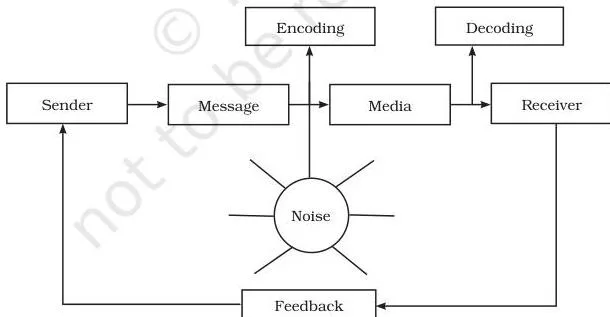
This statement heads the discussion of why communication matters (NCERT, p. 190). The chapter estimates that a manager spends 90 percent of working time communicating — reading, writing, listening, guiding, instructing, approving, reprimanding.
Beside it stands the communication process diagram: the sender encodes a message, sends it through a channel, the receiver decodes it and responds with feedback, and noise can obstruct any stage. That is the whole loop the eight elements describe, and it is why communication is central to managerial activity.
Key Terms in Directing, Defined Simply
The chapter’s own Key Terms list appears on page 199. The table below restates those terms in plainer words so a revision check takes seconds.
| Term | Plain definition | NCERT page |
|---|---|---|
| Directing | Process of instructing, guiding, counselling, motivating and leading people to achieve organisational objectives | 171 |
| Supervision | Guiding the efforts of employees and other resources to accomplish objectives; also the position immediately above the workers | 174 |
| Motive | Inner state that energises and directs behaviour towards goals; arises out of needs | 176 |
| Motivation | Process of stimulating people to action to accomplish desired goals | 176 |
| Motivators | Techniques such as pay, bonus, promotion, recognition and praise used to motivate people | 177 |
| Incentive | Any measure used to motivate people to improve performance | 181 |
| Self-actualisation | The drive to become what one is capable of becoming — the highest need in Maslow’s hierarchy | 180 |
| Leadership | Process of influencing people to strive voluntarily towards organisational goals | 185 |
| Communication | Exchange of ideas, views, facts and feelings between or among people to create common understanding | 189 |
| Encoding | Converting the message into communication symbols such as words, pictures and gestures | 189 |
| Decoding | Converting the sender’s encoded symbols back into meaning | 189 |
| Feedback | The receiver’s actions showing the message was received and understood | 190 |
| Grapevine | Informal communication that spreads through the organisation ignoring levels of authority | 193 |
| Formal communication | Communication that flows through official channels shown in the organisation chart | 192 |
| Informal communication | Communication that takes place without following formal lines of communication | 193 |
| Profit sharing | Giving employees a share in the organisation’s profits | 182 |
| Co-partnership / stock options | Offering employees company shares at a set price below the market price | 183 |
Common Mistakes Students Make in This Chapter
Most marks in this chapter are lost on blurred distinctions between similar terms, not on facts — and the book’s own Summary (p. 199) stresses these separations.
| Mistake | Correct rule | How to check your answer |
|---|---|---|
| Treating motive, motivation and motivators as the same thing | A motive is the inner need state; motivation is the process of stimulating action; motivators are the techniques used (pp. 176–177) | Ask which is inner (motive), which is the process (motivation), which is a technique like bonus (motivator) |
| Thinking motivation is only about money | Non-financial incentives exist because psychological, social and esteem needs matter; money alone does not satisfy them | Name the need behind each non-financial incentive — status, recognition, participation |
| Assuming autocratic leadership is always bad | It secures productivity and quick decisions in situations like factory supervision; styles are used situationally (p. 187) | Ask when a one-way command style would be the fastest way to get urgent work done |
| Treating grapevine as purely harmful | It carries information rapidly and helps managers test reactions; the manager manages rumours instead of banning the channel (p. 193) | List one use and one danger of informal communication |
| Mixing up upward and downward communication | Upward runs subordinate to superior (leave application, progress report); downward runs superior to subordinate (notices, orders, guidelines); horizontal runs between divisions (p. 192) | Ask who is sending to whom in the example |
| Getting Maslow’s order wrong, or thinking a satisfied need keeps motivating | A satisfied need no longer motivates; only the next higher need does, and the person moves up only when the lower need is satisfied (p. 181) | Put the five needs in order from physiological to self-actualisation, then test each on a workplace example |
| Missing the negative side of job security | Job security can make employees complacent when they feel they cannot lose their jobs (p. 184) | State both the benefit and the drawback of security |
How the Directing Chapter’s Exercise Questions Test Each Idea
The chapter closes with three exercise sets on pages 200–201. This table shows what each question is actually testing, so revision can be targeted: try the question, then check the section listed.
| Question (paraphrased) | Concept tested | Where the answer lives |
|---|---|---|
| What is informal communication? | Informal (grapevine) communication | p. 193 |
| Which leadership style avoids using power unless absolutely essential? | Laissez faire leadership | p. 188 |
| Which element converts a message into words, symbols and gestures? | Encoding | p. 189 |
| Workers refuse new work and a supervisor faces sudden excess demand — which element of directing helps? | Motivation — stimulating people to take up work voluntarily | pp. 174–176 |
| What are semantic barriers? | Semantic barriers | pp. 194–195 |
| Explain the motivation process with the help of a diagram. | Motivation process | p. 177 |
| State the different networks of grapevine communication. | Grapevine networks | p. 194 |
| Explain any three principles of directing. | Principles of directing | pp. 172–173 |
| An inflexible manager who dislikes being contradicted — how is authority being used? | Autocratic leadership | p. 187 |
| GyanPradan hostel gives medical aid and free education to employees’ children — which incentive is this, and name two more of its category? | Perquisites, a financial incentive; e.g. pay and allowances, bonus, profit sharing | p. 183 |
| Discuss Maslow’s Need Hierarchy theory. | Maslow’s theory | pp. 180–181 |
| What are the common barriers to communication? Suggest measures to overcome them. | Barriers and remedies | pp. 194–198 |
| Explain the different financial and non-financial incentives. | Incentives | pp. 181–184 |
| Everyone approaches anyone freely, secrecy is leaking — what system should the manager adopt? | Formal communication channels | p. 192 |
Note that textbook contents and the examinable syllabus are not always identical — check the current official syllabus for what is assessable this session.
Fast Revision: The Directing Chapter in Five Minutes
This is the chapter’s own Summary (p. 199) compressed into a recall check. If you can say each line aloud, you have the chapter.
- Directing is a complex managerial function that encourages subordinates to work effectively. It has four elements: supervision, motivation, communication and leadership.
- Eight principles guide the directing process, from maximum individual contribution to follow through.
- Supervision is both a process (overseeing work) and a position — the supervisor, immediately above workers, who ensures targets are met.
- Motivation is stimulating people to action based on their needs. Managers use financial incentives (pay, bonus, profit sharing, perquisites) and non-financial incentives (status, recognition, job enrichment, participation, empowerment).
- Maslow’s need hierarchy is the fundamental theory: needs run from physiological, safety, affiliation and esteem to self-actualisation, and a satisfied need stops motivating.
- Leadership is influencing people to strive willingly for group objectives; the three styles are autocratic, democratic and laissez faire.
- Communication is the exchange that creates common understanding. Formal and informal (grapevine) channels run side by side in every organisation.
- Barriers — semantic, psychological, organisational and personal — exist in all organisations; the manager’s job is to identify and overcome them.
Related Resources for Class 12 Business Studies
Continue revising the book in order, or return to the wider CBSE notes library.
- NCERT Class 12 Business Studies notes — the full book, chapter by chapter
- NCERT Class 12 Business Studies Chapter 6 Staffing — the previous chapter
- NCERT Class 12 Business Studies Chapter 8 Controlling — the next chapter
- Class 12 NCERT books — all subjects for this class
Sources and Data Verification
All page references on this page describe the same edition: the NCERT Class 12 Business Studies Part I textbook, Chapter 7 (Directing), printed pages 170–201, as published on the official NCERT portal. NCERT settles the textbook, its editions and official PDFs; CBSE settles the curriculum, syllabus and examinations.
This page is maintained for the 2026-27 academic session. If you are reading it later, confirm the current edition from the NCERT textbook portal and the current syllabus from cbse.gov.in.
Reference: NCERT Class 12 Business Studies textbook, chapter 7, official edition on ncert.nic.in.
Directing Class 12: Frequently Asked Questions
What are the four elements of directing in Class 12 Business Studies?
Supervision, motivation, communication and leadership (NCERT, p. 174). These four together cover everything a manager does to guide, coach, instruct and lead people towards organisational objectives.
What are Maslow’s five levels of needs, in order?
Physiological needs, safety/security needs, affiliation/belonging needs, esteem needs and self-actualisation. They run from the most basic to the highest, and a person moves up only when the lower need is satisfied (NCERT, pp. 180–181).
What is the difference between formal communication and grapevine or informal communication?
Formal communication flows through official channels shown in the organisation chart and is usually recorded and filed; it is vertical (upward or downward) or horizontal.
Grapevine or informal communication follows no formal lines, spreads rapidly and is often distorted, and its source is hard to detect — but it carries information fast and can help a manager test reactions (NCERT, pp. 192–193).
Which leadership style does not believe in using power unless it is absolutely essential?
Laissez faire, also called the free-rein style. The leader gives followers a high degree of independence to formulate their own objectives and methods, and supports them with information (NCERT, p. 188).
What are financial and non-financial incentives? Give two examples of each.
Financial incentives are direct payments or amounts measurable in money — for example, pay and allowances, bonus, profit sharing and perquisites. Non-financial incentives provide psychological, social and emotional satisfaction — for example, status, job enrichment, employee recognition and employee participation (NCERT, pp. 181–184).
Which grapevine network is the most popular in organisations?
The cluster network, in which an individual communicates only with people he or she trusts. The other networks are single strand, gossip and probability (NCERT, p. 194).
Explore Class 12 Business Studies Books
- Previous: Staffing
- Next: Controlling
Related chapters:
- Nature and Significance of Management
- Principles of Management
- Business Environment