
Organising Class 12 Business Studies Chapter 5 comes from the NCERT Class 12 Business Studies Part I textbook. It is a 30-page chapter that begins at NCERT page 108, and the official NCERT PDF is available on this page. Use the download link below for the full chapter, or keep reading for a section-by-section explanation of what this chapter teaches.
Download the Official Organising Class 12 Business Studies Chapter 5 PDF
Open the Organising Class 12 Business Studies Chapter 5 PDF from ncert.nic.in to read the chapter in its original layout. It is the official NCERT edition.
This chapter belongs to Business Studies Part I, not Part II. Keep the file open while you study — the walkthrough below gives page references you can follow with a finger on your book.
| What the chapter holds | Count | Where it is used |
|---|---|---|
| Printed pages | 30 | |
| Figures with NCERT captions | 2 | |
| Tables | 4 | |
| Official NCERT PDF | Download the chapter PDF | the chapter exactly as NCERT publishes it |
On This Page
Organising Class 12: Chapter at a Glance
The table below lists how much this chapter holds — its sections, figures and exercise questions. The points around it describe what those contents actually teach.
- The Wipro opening case (p. 108) introduces organising as the way plans become action.
- Four steps make up the process of organising (pp. 111-112).
- Seven benefits of importance of organising are explained (pp. 113-114).
- Functional and divisional structures are compared in NCERT Table 1 (p. 120).
- Formal and informal organisation are compared in NCERT Table 2 (p. 125).
- Delegation and its three elements — authority, responsibility, accountability — appear in NCERT Table 3 (p. 129).
- Delegation vs decentralisation are compared in NCERT Table 4 (pp. 134-135).
- An ONGC organisation chart and the story of its restructuring (pp. 120-122).
- Key terms (p. 135) and a chapter summary (p. 136).
- Three rounds of exercises — very short, short and long answer (pp. 137-138).
How the Organising Chapter Is Built: A Section-by-Section Walkthrough
Organising sits between planning and action. The previous chapter decides what the goals are; this chapter builds the structure that carries them out. That logic shapes the order of the book.
- Wipro case (p. 108): a real company shows what restructuring looks like before any theory is given.
- Learning objectives (p. 109): the chapter states what you should be able to explain by the end.
- Meaning of organising (pp. 110-111): built on the school-fete example — committees for food, decoration and ticketing under one coordinator.
- Process steps (pp. 111-112): the four steps, shown through the twelve-student library shipment example.
- Importance (pp. 113-114): the seven benefits, with a Think About It box on the pitfalls of specialisation.
- Organisation structure and span of management (pp. 114-115): the framework that organising produces, with Sunita’s travel agency example.
- Functional structure (pp. 115-117): grouping by function, with advantages, disadvantages and suitability.
- Divisional structure (pp. 117-120): grouping by product line, followed by Table 1’s comparison.
- ONGC chart and McKinsey transformation (pp. 120-122): a real organisation chart, then the story of its restructuring in the 1990s.
- Formal organisation (pp. 122-123): the officially designed structure, its advantages and limitations.
- Informal organisation (pp. 123-125): the social network that emerges around the formal one, with Table 2’s comparison.
- Delegation and its elements (pp. 126-129): authority, responsibility and accountability, with Table 3.
- Importance of delegation (pp. 129-131): the reasons delegation makes organising effective.
- Decentralisation (pp. 131-134): where decision-making power sits, its importance, and Table 4’s comparison with delegation.
- Key terms and summary (pp. 135-136): the chapter’s vocabulary and its own condensed recap.
- Exercises (pp. 137-138): three rounds, from definition recall to full company scenarios.
Notice the narrowing pattern once you read it through: the chapter moves from the whole organisation (structure), to its two types, to the smallest unit of authority transfer (delegation), and finally to delegation applied organisation-wide (decentralisation). Remember this order and the ideas lock into place.
The Three Company Cases in This Chapter: Wipro, ONGC and McNeil
Three real companies carry the chapter’s theory. Each one is a worked example of a concept you need in answers, so learn them as pairs: company → concept.
Wipro: from centralised to decentralised (p. 108)
Wipro separated itself into several subsidiaries by product line — telecommunications, engineering, financial services and others — each bringing in about $300 million in annual earnings and running its own accounting, personnel and administrative functions.
It shifted from a centralised to a decentralised management system, and Premji described the change as de-layering the organisation and empowering business leaders with far more growth responsibility; an entire layer of executives was removed.
The case introduces the whole chapter: organising is how a company’s plans become real action, and restructuring the management hierarchy is part of that process.
ONGC: the organisation chart and the McKinsey transformation (pp. 120-122)
ONGC’s organisation chart appears in the chapter as a real example of how a structure is drawn. The text then explains why the structure had to change.
In the 1990s, the corporation suffered from what the chapter calls organisational atrophy: decisions on fields could be delayed by over a year because they passed through functional heads, responsibilities at production platforms were shared between business groups and degenerated into wrangling, and group loyalties often took precedence over tasks.
McKinsey’s ‘Organisation Transformation Project’ recommended an asset-based approach with clearly defined responsibilities. The final structure rolled out as 14 assets and 11 centralised services, with asset managers given control over all service personnel working with them and procurement powers devolved to them.
McNeil Consumer Healthcare: decentralisation as a strength (p. 134)
McNeil Consumer Healthcare, a Johnson & Johnson company in Canada, operates as part of a group that runs as roughly 190 smaller companies, each focused on a specific medical or product franchise or geographic area.
The chapter uses this business to argue that decentralisation combines the advantages of being big with the agility and focus of smaller firms: each company stays close to its customers, keeps short lines of communication and accelerates the development of talent.
Key Ideas in Organising Class 12, Explained
Organising is the bridge between planning and action. It decides who does what, who gets what authority and who reports to whom — and once you see every later idea in this chapter as an answer to one of those three questions, the chapter stops being a list of definitions.
What Organising Means, and Why It Follows Planning
Organising can be defined as a process that initiates implementation of plans by clarifying jobs and working relationships and effectively deploying resources for the attainment of identified goals (NCERT, p. 111). In plain terms: planning says what to do; organising says who will do it, with what authority, and who answers to whom.
The book’s hook is the school fete. The whole activity is divided into task groups — the food committee, the decoration committee, the ticketing committee — all under the official in charge of the event, with coordinating relationships established among the groups. That division of work and building of relationships is organising.
The Four Steps in the Process of Organising
Think of twelve students told to unload a library shipment and clear the waste. If all twelve do it their own way, you get mass confusion; if one student supervises by grouping the students, dividing the work, assigning each group its quota and setting reporting relationships, the job gets done faster and better. Those actions are the four steps (pp. 111-112).
- Identification and division of work: split the total work into manageable activities so that duplication is avoided and the burden is shared among employees.
- Departmentalisation: group similar activities together — commonly by territory (north, south, west) or by product (appliances, clothes, cosmetics) — so that specialisation becomes possible.
- Assignment of duties: place each department under an individual in charge, then match every job to a person’s skills and competencies. The job must fit the person.
- Establishing authority and reporting relationships: make sure each individual knows from whom to take orders and to whom he is accountable. This creates the hierarchical structure.
The chapter’s own short-answer exercise asks for these steps, so learn them in this sequence.
Why Organising Matters: Seven Benefits
Organising matters because it helps an enterprise survive, grow and meet changing challenges. The chapter lists seven benefits (pp. 113-114):
- Benefits of specialisation: systematic allocation of jobs lets a worker repeat one task, gain experience and become expert in it.
- Clarity in working relationships: clear lines of communication specify who reports to whom, fixing responsibility and the extent of authority.
- Optimum utilisation of resources: proper assignment of jobs avoids overlapping work and makes the best use of material, financial and human resources.
- Adaptation to change: the structure can be modified as the business environment changes, giving the enterprise stability.
- Effective administration: clear job descriptions and duties remove confusion and duplication, making management easy.
- Development of personnel: delegation reduces a manager’s routine workload, freeing time to innovate, while subordinates grow by handling challenges.
- Expansion and growth: the enterprise can add job positions, departments, product lines and new geographical territories.
Organisation Structure and Span of Management
Organisation structure is the framework within which managerial and operating tasks are performed; it specifies the relationships between people, work and resources, and is shown visually in an organisation chart (p. 114). Peter Drucker’s warning is the chapter’s strongest line on why structure matters: the wrong structure will seriously impair business performance and even destroy it (p. 115).
Span of management is the number of subordinates that can be effectively managed by a superior (p. 115). A wide span means fewer levels in the structure; a narrow span means more levels.
Sunita’s travel agency shows the idea in miniature: she divides the work into operations, sales and administration, each breaking into roles such as travel counsellor, reservation and ticketing, accounts executive, book keeper and cashier — producing a structure with clear lines of authority and responsibility.
Functional Structure: How It Works
Functional structure groups jobs of a similar nature into departments. In a manufacturing concern these key functions are production, purchase, marketing, accounts and personnel, all reporting to a coordinating head (pp. 115-116). The diagram on p. 115, explained below, shows this arrangement.
Advantages: occupational specialisation; control and coordination within a department; managerial and operational efficiency; minimal duplication with economies of scale; easier training of employees; and due attention to every function.
Disadvantages: functional empires in which one function’s goals overshadow the enterprise’s objectives; coordination problems as information crosses functionally differentiated departments; inter-departmental conflict, such as sales demanding a customer-friendly design that production finds difficult; inflexibility and a narrow perspective; and functional heads gaining no experience in diverse areas, so they are not trained for top positions.
Suitability: most suitable when the organisation is large, has diversified activities and needs a high degree of specialisation (p. 117).
Divisional Structure: How It Works
Divisional structure creates separate business units, generally by product line, each with its own production, marketing, finance and purchase functions working toward a common goal (pp. 117-118). Each division is self-contained, adopts a functional structure within itself, and works as a profit centre where the divisional head answers for profit or loss.
Advantages: product specialisation develops varied skills in the divisional head and prepares him for higher positions; accountability for profit or loss is easy to fix; flexibility and faster decisions because each division is autonomous; and easy expansion — new divisions can be added without disturbing existing operations (pp. 118-119).
Disadvantages: conflict among divisions over the allocation of funds; duplication of activities across products raises costs; and divisional managers may grow powerful and ignore organisational interests (p. 119).
Suitability: suitable for enterprises manufacturing a large variety of products using different productive resources (p. 120).
Functional vs Divisional: The Comparison Table (NCERT Table 1)
The chapter’s first comparison table (p. 120) is the one students are most often asked to reproduce. It compares the two structures on six bases:
| Basis | Functional structure | Divisional structure |
|---|---|---|
| Formation | Based on functions | Based on product lines, supported by functions |
| Specialisation | Functional specialisation | Product specialisation |
| Responsibility | Difficult to fix on a department | Easy to fix for performance |
| Managerial development | Difficult — each functional manager reports to the top | Easier — autonomy and multiple functions develop managers |
| Cost | Economical — functions are not duplicated | Costly — resources are duplicated across divisions |
| Coordination | Difficult for a multi-product company | Easy — all functions for one product are integrated |
The quick memory hook: functional structure groups by function, divisional groups by product — and every comparison row follows from that one difference. Be able to write any three bases from memory.
Formal and Informal Organisation
Every enterprise runs two systems of relationships at once. Formal organisation is the structure designed by management to accomplish a particular task; it specifies the boundaries of authority and responsibility and coordinates activities systematically (p. 122).
Informal organisation is the network of social relationships that arises when people interact beyond their officially defined roles — the group that plays cricket on Sundays or meets for coffee (pp. 123-124).
Advantages of formal organisation: easier to fix responsibility; no ambiguity of roles; unity of command through the chain of command; effective accomplishment of goals; and stability because employee behaviour can be fairly predicted (p. 123).
Limitations of formal organisation: procedural delays as decisions climb the chain; creative talent may go unrecognised because rigidly laid-down policies allow no deviation; and it never gives a complete picture of how the organisation actually works (p. 123).
Advantages of informal organisation: faster spread of information and quick feedback; fulfilment of social needs and a sense of belonging; and it compensates for inadequacies of the formal structure — for example, reactions to plans can be tested through informal channels (p. 124).
Disadvantages of informal organisation: rumours become a destructive force; groups may resist change and delay growth; and members are pressurised to conform to group norms that may go against organisational interests (p. 124).
The chapter’s key conclusion (p. 125): informal organisation cannot be altogether eliminated. Management should recognise its existence, identify the roles its members play, and use these groups as communication channels rather than confronting them.
Delegation and Its Three Elements
Delegation refers to the downward transfer of authority from a superior to a subordinate (p. 126). No manager, however capable, can do every task himself; delegation lets him extend his area of operations while keeping his own position.
Fix this first: delegation does not mean abdication — the manager remains accountable for the assigned tasks, and the authority given can be taken back and redelegated to another person (p. 126).
| Element | Meaning | Can it be delegated? | Flow |
|---|---|---|---|
| Authority | The right to command and take decisions within the scope of one’s position | Yes | Downward, from superior to subordinate |
| Responsibility | The obligation to perform the assigned duty | Cannot be entirely delegated | Upward, from subordinate to superior |
| Accountability | Answerability for the final outcome | Cannot be delegated at all | Upward |
Authority must be commensurate with responsibility: if authority exceeds responsibility it gets misused; if responsibility exceeds authority the person becomes ineffective (p. 129). The chapter’s own closing phrase is the one to remember: authority is delegated, responsibility is assumed, accountability is imposed (p. 129).
Delegation matters for six reasons: effective management, employee development, motivation of employees, facilitation of growth, the basis of management hierarchy, and better coordination (pp. 129-131).
Centralisation and Decentralisation
Both terms answer one question: where does decision-making authority sit? Centralisation means decision-making authority is retained by higher management levels. Decentralisation is the systematic delegation of authority throughout all levels of the organisation, placing decisions nearest to the points of action (p. 131).
Both are relative terms. Complete centralisation would remove the need for a management hierarchy; complete decentralisation would remove the need for higher managerial positions — both scenarios are unrealistic (p. 131).
Every organisation combines the two, and as firms grow in size and complexity they tend to push decisions downward, because employees directly involved with operations often know more about them than top management does.
The chapter treats decentralisation as a philosophy as well as a technique: it rests on the belief that people are competent, capable and resourceful and can take responsibility for implementing their own decisions (p. 132).
Its six points of importance (pp. 132-133): develops initiative among subordinates; develops managerial talent for the future; quick decision making because fewer approvals are needed; relief to top management for policy decisions; facilitates growth; and better control through performance evaluation at each level.
The caution (p. 133): decentralisation should be applied with care and balanced with centralisation in major policy decisions — if departments start operating on their own guidelines against organisational interests, the organisation can disintegrate.
The Two Diagrams in This Chapter, Explained
Two diagrams carry the chapter’s central ideas visually. The first shows the shape of a functional structure; the second shows what happens when a manager refuses to delegate. Read each one with the explanation below it.
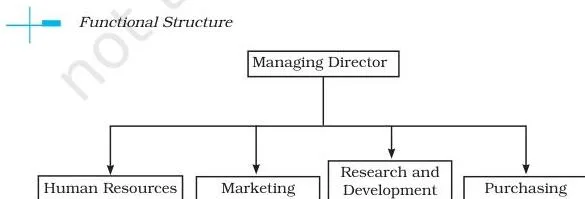
This is the functional structure, drawn on NCERT page 115. Read it top-down: a coordinating head sits at the top, and below him the organisation divides into departments that each hold jobs of a similar nature — in a manufacturing firm these would be production, purchase, marketing, accounts and personnel. Each department can split further into sections.
The diagram makes the chapter’s advantages visible: because similar jobs sit together, specialisation happens, control within a department is easy, and training only has to cover a limited range of skills (pp. 115-116).

The second diagram (NCERT p. 126) shows the opposite situation: a manager who keeps every decision at the top. Each subordinate’s query travels up to the manager, gets an answer and travels back down — and with many subordinates the manager becomes the bottleneck.
It is the visual argument for why delegation exists, and it connects directly to the decentralisation benefit of quick decision making because decisions are taken nearest to the points of action (p. 132).
Definitions by Management Thinkers in This Chapter
The chapter prints definition boxes from well-known management writers, and the very-short-answer round of its exercises tests exactly this kind of concept recall. Learn who said what, not just the ideas.
| Theorist | Concept | One-line meaning | NCERT page |
|---|---|---|---|
| Louis Allen | Organising | Identifying and grouping work, defining and delegating responsibility and authority, and establishing relationships so people work together effectively | p. 112 |
| Theo Haiman | Organising | Defining and grouping the activities of the enterprise and establishing authority relationships among them | p. 112 |
| Peter Drucker | Organisation structure | Structure is an indispensable means; the wrong structure will seriously impair business performance and even destroy it | p. 115 |
| Chester Barnard | Formal organisation | A system of consciously coordinated activities of two or more persons toward a common objective | p. 123 |
| Chester Barnard | Informal organisation | An aggregate of interpersonal relationships without conscious purpose | p. 124 |
| Keith Davis | Informal organisation | A network of personal and social relations that arises spontaneously as people associate with one another | p. 124 |
| Louis Allen | Delegation | The process of dividing work so the manager performs only what his unique organisational placement lets him do, and others handle the rest | p. 126 |
| Theo Haiman | Delegation | Granting authority to subordinates to operate within prescribed limits | p. 126 |
| Louis Allen | Decentralisation | A systematic effort to delegate to the lowest level all authority except what must be exercised at central points | p. 131 |
| Henri Fayol | Centralisation / decentralisation | Everything that increases the importance of a subordinate’s role is decentralisation; everything that reduces it is centralisation | p. 131 |
Think About It and Do It Yourself Boxes
Scattered through the chapter are five short activities that ask you to connect the theory to the world around you. They are thinking tasks and revision aids, not exam items — but working through them fixes the concepts.
- p. 112 (Think About It): your school’s societies — the dramatics society, quiz club, economics society, debating society — observe their division of labour, chain of communication and reporting levels, and compare them with the process of organising.
- p. 114 (Think About It): specialisation has a pitfall — repetitive work can cause monotony, stress, boredom and absenteeism. What can managers do about it?
- p. 117 (Think About It): read newspapers regularly and identify which organisation structures the businesses in the news have adopted.
- p. 121 (Do It Yourself): browse the websites of business organisations, study their organisation charts and identify the structure each uses.
- p. 131 (Think About It): if you were a manager, would you decentralise, knowing it means dispersal of decision-making authority?
Common Mistakes Students Make in This Chapter
This chapter’s confusions all come from one source: words that look alike — delegation, decentralisation, authority, accountability — carrying different meanings. Name the error before it happens:
| Mistake | Correct rule | How to check your answer |
|---|---|---|
| Writing that accountability can be delegated | Accountability cannot be delegated at all; the superior remains answerable for the final outcome even after authority is passed down (p. 129) | Ask ‘who answers for the result?’ — the answer is always the delegating manager |
| Mixing up the directions of flow | Authority flows downward; responsibility flows upward; accountability flows upward (p. 129) | Authority comes down from the superior; everything else goes up from the subordinate |
| Treating delegation and decentralisation as the same thing | Delegation is a compulsory process between a superior and his immediate subordinate; decentralisation is an optional policy decision extending delegation to the lowest levels (pp. 134-135) | If it is a top-management policy choice, it is decentralisation; a routine handover of tasks is delegation |
| Believing informal organisation can be removed | It arises spontaneously out of social interaction and cannot be eliminated; management should recognise it and use it (p. 125) | Any grouping based on friendship or common interest is informal, and such groups exist in every organisation |
| Recommending a structure without checking the company’s products | Functional structure suits a large enterprise needing specialisation; divisional structure suits a multi-product enterprise (pp. 117, 121) | Count the product lines — one main line with many functions means functional; several distinct products mean divisional |
| Confusing delegation with abdication | Delegation does not mean abdication; the manager stays accountable, and the authority given can be taken back (p. 126) | If a line says the manager ‘hands over full responsibility’, that is abdication — wrong for delegation |
How This Chapter Is Asked: Question Pattern and Case Scenarios
The chapter’s own exercises (pp. 137-138) show the shape questions take. There are three rounds, and the whole chapter is concept-based — there are no numerical problems to solve.
- Very short answer — definition and concept recall: identify the network of social relationships that arises spontaneously; explain ‘span of management’; state circumstances where functional structure fits; draw a functional structure diagram.
- Short answer — process and elements: the steps in the process of organising; the elements of delegation; how informal organisation supports formal organisation; whether a large organisation can be totally centralised or decentralised; plus situational questions like Neha’s shoe factory diversifying into leather bags and western formal wear.
- Long answer — full company scenarios: why delegation is essential; divisional structure with its advantages and limitations; why an organisation would choose decentralisation; the toys company diversifying into electronic toys; the sewing-machines company paralysed by formal culture and red tape; cosmetics company X Limited facing MNC competition after 1991.
The long-answer pattern is consistent: the situation is described, you recommend an organisation structure, and then you justify it with the benefits that structure offers.
The foreman question shows the reasoning expected on authority: a production manager who demands a target of 200 units a day without giving the foreman authority to requisition tools cannot blame him for failing, because authority must be commensurate with responsibility (p. 129).
The four comparison tables — functional vs divisional (p. 120), formal vs informal (p. 125), the three elements of delegation (p. 129), and delegation vs decentralisation (pp. 134-135) — are the skeleton of the chapter; if you can reproduce each one, you can answer the compare-and-contrast questions and most of the case scenarios.
Note that textbook contents and the examinable syllabus are not always identical — check the current official syllabus.
Organising Class 12: What to Remember From This Chapter
This is the chapter’s own summary (p. 136), rebuilt for fast recall. It is the minimum you should be able to write before any test.
- Organising is the process of defining and grouping activities and establishing authority relationships among them.
- The process has four steps: identification and division of work, departmentalisation, assignment of duties, and establishing reporting relationships.
- Organising matters because it brings division of work, clarity in reporting relationships, optimum utilisation of resources, growth, better administration and greater creativity.
- Organisation structure is the framework within which managerial and operating tasks are performed; it can be functional or divisional.
- Span of management is the number of subordinates a superior can effectively manage.
- Functional structure groups activities by function. Advantages: specialisation, better control, managerial efficiency, ease in training. Disadvantages: functional empires, conflict of interest, inflexibility, restricted managerial development.
- Divisional structure groups activities by product. Advantages: integration, product specialisation, greater accountability, flexibility, better coordination, more initiative. Disadvantages: departmental conflicts, costly duplication, organisational interests ignored, more general managers required.
- Formal organisation is designed by management to achieve organisational goals. Advantages: fixation of responsibility, clarity of roles, unity of command, effective accomplishment of goals. Limitations: procedural delays, inadequate recognition of creativity, limited scope.
- Informal organisation arises from interaction among people at work. Advantages: speed, fulfilment of social needs, it fills gaps in the formal structure. Disadvantages: it can be a disruptive force, resists change, and puts group interests first.
- Delegation is the transfer of authority from a superior to a subordinate, with three elements: authority, responsibility and accountability.
- Delegation helps in effective management, employee development, motivation, growth and coordination.
- Decentralisation is delegation of authority throughout the organisation. Its importance: develops managerial talent, quick decision making, relief to top management, development of initiative, growth and better control.
The chapter’s key terms (p. 135), in the order they appear: organising, organisational structure, departmentalisation, delegation, authority, responsibility, accountability, functional structure, divisional structure, formal organisation, informal organisation, span of management, centralisation, decentralisation.
Related Chapters and Resources
This listing is maintained for the 2026-27 academic session using the NCERT textbook information available to us. NCERT remains the authority for confirming the latest edition.
Organising is the second function of management, so it reads naturally with the chapters around it. The Class 12 Business Studies Planning chapter sets the goals that organising then structures; the Class 12 Business Studies Staffing chapter follows and fills those structures with people.
For the full set, open the Class 12 Business Studies notes, browse the Class 12 hub, or start at the CBSE notes home. The official chapter file is the Organising Class 12 Business Studies Chapter 5 PDF on ncert.nic.in — open it alongside this page to check any page reference.
Reference: NCERT Class 12 Business Studies Part I textbook, chapter 5, official edition on ncert.nic.in.
Sources and Data Verification
- The explanations, page references and figure captions on this page describe the NCERT Class 12 Business Studies Part I textbook, Chapter 5 Organising, as published on ncert.nic.in.
- This page covers that single chapter and book. It does not cover Business Studies Part II or other subjects.
- The listing is maintained for the current academic session using the NCERT information available to us.
- NCERT settles textbooks, editions and official PDFs; CBSE settles curriculum, syllabus and examinations.
Frequently Asked Questions About Organising Class 12
What is the definition of organising in Class 12 Business Studies?
Organising is the process that initiates implementation of plans by clarifying jobs and working relationships and effectively deploying resources to achieve goals (NCERT, p. 111). It coordinates human efforts and resources into a unified whole, so organising is the bridge between planning and action.
What are the steps in the process of organising?
The four steps are: identification and division of work; departmentalisation, which groups similar activities commonly by territory or product; assignment of duties to people whose skills fit the jobs; and establishing authority and reporting relationships so everyone knows from whom they take orders and to whom they are accountable (NCERT, pp. 111-112).
What are the three elements of delegation?
The three elements are authority, the right to command; responsibility, the obligation to perform the assigned duty; and accountability, answerability for the final outcome. Only authority can be delegated; responsibility cannot be entirely delegated and accountability cannot be delegated at all (NCERT, p. 129).
What is the difference between delegation and decentralisation?
Delegation is a compulsory process between a superior and his immediate subordinate to share the manager’s workload. Decentralisation is an optional policy decision of the top management that extends delegation to the lowest levels of the organisation (NCERT, pp. 134-135). Delegation has narrow scope; decentralisation has wide scope.
What is the difference between functional and divisional structure?
A functional structure groups jobs of a similar nature into departments such as production, marketing and accounts. A divisional structure groups them by product line, with each division holding all its functions and working as a profit centre. Functional structure is economical but coordination is difficult for a multi-product company; divisional structure fixes responsibility easily but duplicates resources (NCERT, p. 120).
Which book contains the Organising chapter in Class 12 Business Studies?
The Organising chapter is Chapter 5 of the NCERT Class 12 Business Studies Part I textbook, beginning at page 108. It is not in Business Studies Part II — check the book’s cover before quoting from it.
Explore Class 12 Business Studies Books
Related chapters:
- Nature and Significance of Management
- Principles of Management
- Business Environment