
The official NCERT Class 12 Business Studies Part I Chapter 1 textbook file — Nature and Significance of Management — is on this page, straight from ncert.nic.in. The chapter runs 29 printed pages (textbook pages 1–29).
Whether you came for the nature and significance of management class 12 PDF or to understand what the chapter teaches, the download sits immediately below and the explanation follows it.
Download: Nature and Significance of Management Class 12 PDF
This is the official NCERT edition of the chapter, published on the NCERT website itself — the same text as the printed Class 12 Business Studies Part I textbook.
Open the NCERT Class 12 Business Studies Chapter 1 Nature and Significance of Management PDF to read or download the chapter directly from the official NCERT server, without registration or third-party hosts.
| What the chapter holds | Count | Where it is used |
|---|---|---|
| Printed pages | 29 | |
| Figures with NCERT captions | 2 | |
| Official NCERT PDF | Download the chapter PDF | the chapter exactly as NCERT publishes it |
Chapter at a Glance: What the Chapter Contains
Before you open the file, here is what is inside it and where each part sits. For the exact counts of sections, illustrations and exercise questions, the chapter table on this page has the numbers.
What the numbers cannot show is the chapter’s shape: this is a concept chapter, not a numerical one. It opens with the Tata Steel case study (NCERT, p. 1), which shows management at work in a century-old global group, and then develops nearly every idea through the running example of Smita Rai and Namchi Designer Candles (NCERT, p. 2).
The book states its own learning objectives on page 1, closes with a Key Terms list, a printed summary and a three-tier exercise set — Very Short Answer, Short Answer and Long Answer — on pages 26–29. The teaching is carried by prose and case-study boxes, with captioned illustrations anchoring the planning and coordination sections.
What This Chapter Covers, Section by Section
If you are stuck on one part of the chapter, this reading map shows the order the book presents its material, so you can jump straight to the page you need.
- Management at Tata Steel (p. 1): how the Tata group, founded in 1868, is sustained by values, social responsibility and effective management at every level.
- Learning objectives (p. 1): the chapter’s own list of what you should be able to do after reading it.
- Introduction with Smita Rai (p. 2): a Sikkim entrepreneur who turned a candle-making hobby into Namchi Designer Candles, showing management as a series of interrelated, continuous functions.
- Definitions of management (p. 3): three named-author definitions — Koontz and Weihrich, Trewelly and Newport, and Kreitner — all describing management as a process that achieves results through people.
- Concept (pp. 4–5): management as the process of getting things done effectively and efficiently.
- Seven characteristics (pp. 5–9): goal orientation, all-pervasive nature, multidimensionality, continuity, group activity, dynamic adjustment and intangibility.
- Objectives (pp. 9–11): organisational, social and personal objectives, with the survival–profit–growth chain.
- Importance (pp. 11–12): five reasons management matters to any organisation.
- Nature of management (pp. 12–17): whether management is an art, a science or a profession — the chapter’s central question, with a cross-disciplinary box on page 14.
- Levels of management (pp. 17–19): top, middle and supervisory levels.
- Functions of management (pp. 19–21): planning, organising, staffing, directing and controlling.
- Coordination (pp. 21–24): why coordination is the essence of management, its characteristics and its importance.
- Management in the twenty-first century (pp. 25–26): how globalisation makes the manager’s role multi-faceted — hard technical skills plus soft people skills.
- Key terms, summary and exercises (pp. 26–29): the chapter’s own revision material.
Five boxes carry the chapter’s teaching. This table links each box to the management idea it illustrates.
| Case study box | Page | Management idea it illustrates |
|---|---|---|
| Management at Tata Steel | p. 1 | Effective and efficient management, values and social responsibility sustain a large organisation. |
| Namchi Designer Candles (Smita Rai) | p. 2 | Management as a series of interrelated, continuous functions — the chapter’s running example. |
| The Management Mantra from GE (Jack Welch) | p. 6 | Goal-oriented management: vision, leadership, and getting the best ideas from everyone. Welch’s four E’s are Energy, Energise, Edge and Execution. |
| ITC – Empowering Rural India (E-Choupal) | p. 10 | Social objectives — corporate social responsibility in action. |
| ‘Dabba wallas’ – Excellence through Coordination | pp. 24–25 | Coordination at work: unity of action among many independent groups using negligible technology. |
The Nature and Significance of Management Class 12, Explained
This is the core of the chapter. It answers four questions: what management is, why it matters, whether it is an art or a science or a profession, and how it is actually carried out. The blocks below follow the order the book uses, with page references so you can follow along in your copy.
Management Defined: Process, Effectiveness and Efficiency
Everything in the chapter hangs on one definition. Management is the process of getting things done through planning, organising, staffing, directing and controlling, so that goals are achieved effectively and efficiently (NCERT, p. 4). Two words in that definition carry the most weight, and students routinely swap them.
Effectiveness means finishing the task: completing activities and achieving the goal. It is concerned with the end result (NCERT, p. 5). Efficiency means doing the task correctly and with minimum cost — the relationship between inputs and outputs, a kind of cost-benefit analysis (NCERT, p. 5).
The difference matters because a manager can succeed at one without the other. Try this example with new numbers. A factory sets a production target of 2,000 units for the month, budgeting Rs 40 per unit — a total budget of Rs 80,000.
| Manager | Units produced | Total cost | Effective? | Efficient? |
|---|---|---|---|---|
| A | 2,000 — target met | Rs 95,000 (Rs 47.5 per unit) | Yes — task completed | No — cost per unit exceeds the Rs 40 budget |
| B | 1,700 — target missed | Rs 66,000 (about Rs 38.8 per unit) | No — task not completed | Yes — fewer inputs per unit than budgeted |
Manager A is effective but not efficient; Manager B is efficient but not effective. Management must balance the two — achieve goals (effectiveness) with minimum resources (efficiency) — because poor management comes from both inefficiency and ineffectiveness (NCERT, p. 5).
The Seven Characteristics of Management
Every answer about the nature of management — in short answers and in later chapters — starts from these seven traits. Each one gets a single grounded line (NCERT, pp. 5–9).
- Goal oriented: management unites the efforts of different individuals towards clearly stated organisational goals (p. 5).
- All pervasive: the same managing activities are needed in every organisation — a petrol pump, a hospital or a school (p. 6).
- Multidimensional: three dimensions — management of work, management of people, and management of operations (pp. 6–8).
- Continuous process: the series of functions is ongoing; managers perform them all the time (p. 8).
- Group activity: management works through a team towards a common goal, not through isolated individuals (pp. 8–9).
- Dynamic function: management adapts to a changing environment — the book’s example is McDonald’s changing its menu for the Indian market (p. 9).
- Intangible force: you cannot see management; you feel its presence in orderliness, satisfied employees and met targets (p. 9).
Objectives of Management: Organisational, Social and Personal
Management exists to achieve objectives, which the book groups into three types (NCERT, pp. 9–11). An answer about objectives should name all three.
Organisational objectives are economic: survival, profit and growth (pp. 9–10). Survival means earning enough revenue to cover costs; profit is the incentive for continued operation; growth appears in rising sales volume, more employees, a wider product range or greater capital investment (p. 10).
Social objectives create benefit for society: environment-friendly production, employment for underprivileged sections, and basic amenities such as schools and healthcare for the community (pp. 10–11). The ITC E-Choupal box (p. 10) is the book’s own example of corporate social responsibility.
Personal (individual) objectives satisfy employees’ diverse needs — financial (competitive salaries and perks), social (peer recognition) and higher-level (personal growth) — while management reconciles personal goals with organisational goals for harmony (p. 11). The solar-train exercise at the end of the chapter (p. 27) directly tests this section.
Why Management Matters: Importance of Management
Five reasons, one line each (NCERT, pp. 11–12). Learn them as a set, because the exercise questions reuse them.
- Achieving group goals — giving individual effort a common direction (p. 11).
- Increasing efficiency — reducing costs and raising productivity through better planning, organising, directing, staffing and controlling (p. 11).
- Creating a dynamic organisation — helping people adapt to constant change, as McDonald’s did for the Indian market (pp. 9, 11–12).
- Achieving personal objectives — motivation and leadership build team spirit, cooperation and commitment (pp. 11–12).
- Developing society — quality products, employment opportunities and new technology for the greater good (p. 12).
Nature of Management: Art, Science and Profession
The chapter’s signature question is whether management is an art, a science or a profession. The book’s answer: all three, in part. This table shows which feature of each management satisfies, with the page for every row.
| Feature | Art | Science | Profession | Where management stands | NCERT page |
|---|---|---|---|---|---|
| Body of knowledge | Theoretical knowledge, with recognised literature | Systematised body of knowledge; principles follow cause and effect | Well-defined body of knowledge, learnt through instruction | Has its own theory and principles, and draws on economics, sociology, psychology and mathematics | pp. 12–13, 15–16 |
| How it is learned | Study, observation and experience | Repeated experimentation under controlled conditions | Formal instruction, often with entry through examination | Taught at institutes such as the IIMs; entry is usually through an examination | pp. 12–13, 15, 17 |
| Application | Personalised; varies from person to person; needs creativity | Principles have universal validity | Practice is guided by a code of conduct | Principles are modified to fit each situation; different styles of management exist | pp. 13, 15–16 |
| Restriction on entry | None | None | Restricted — e.g. the CA examination for chartered accountants | None — anyone can be called a manager, with or without a degree | pp. 16–17 |
| Association and code of conduct | — | — | Association regulates entry and enforces a code, e.g. the Bar Council for lawyers | AIMA exists and has a code of conduct, but membership is not compulsory and there is no statutory backing | p. 17 |
| Motive | Creative expression | Discovering general truths | Service to the client’s interests | Helping the organisation achieve its goals — profit for business, service for a hospital | pp. 16–17 |
Two nuances the book insists on. First, management is an inexact science: because it deals with human beings and human behaviour, the outcomes of its experiments cannot be accurately predicted or replicated, unlike the law of gravity (NCERT, p. 16).
Second, art and science are not opposites here — the practice of management is an art, but practice works better when it is based on the principles that constitute the science; the two complement each other (NCERT, p. 16).
On profession: management is professional in character — it has a systematic body of knowledge and associations with codes of conduct — but it is not a full-fledged profession because entry is unrestricted and the association lacks statutory backing (NCERT, p. 17). F.W. Taylor’s scientific management and Henri Fayol’s functional management, named on pages 15–16, form the whole of the next chapter.
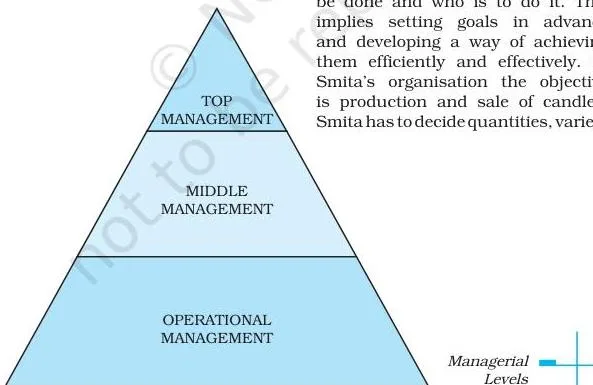
The Three Levels of Management
Management is a three-tier activity. The table distinguishes the levels by who sits there and what each actually does (NCERT, pp. 17–19).
| Level | Who sits there | Main duties | NCERT page |
|---|---|---|---|
| Top management | Chairman, CEO, COO, president, vice-president | Formulate overall goals and strategies; integrate diverse elements; coordinate departments; analyse the business environment; answer for the organisation’s welfare and survival | pp. 17–18 |
| Middle management | Division heads, e.g. production manager | Link top and lower levels; interpret policies; ensure personnel; assign duties and responsibilities; motivate; cooperate with other departments | pp. 18–19 |
| Supervisory or operational management | Foremen and supervisors | Directly oversee the workforce; maintain quality of output; minimise wastage; enforce safety standards | p. 19 |
One warning the book prints: the top manager’s job is complex and stressful, demanding long hours and commitment to the organisation (NCERT, p. 18).
The Five Functions of Management
The definition of management names five functions, and the book explains each through Smita’s candle business at Namchi Designer Candles (NCERT, pp. 19–21). Learn each function with its Namchi example and the definition sticks.
- Planning — determining in advance what is to be done and who is to do it. Smita decides the quantities, variety and colour of candles and allocates resources for purchasing from suppliers (pp. 19–20).
- Organising — assigning duties, grouping tasks, establishing authority and allocating resources required to carry out the plan (p. 20).
- Staffing — finding the right people for the right job: recruitment, selection, placement and training. Smita recruits more workers for the Diwali rush (pp. 2, 20).
- Directing — leading, influencing and motivating employees; communicating and supervising. Smita regularly communicates with her suppliers to meet delivery deadlines (pp. 2, 20).
- Controlling — setting standards of performance, measuring current performance, comparing with standards and correcting deviations (pp. 20–21).
Do not picture the five as a strict sequence. Managers are rarely able to carry them out in isolation — the activities are interrelated, and it is often difficult to pinpoint where one ended and the next began (NCERT, p. 21). This interdependence is exactly why the next section, coordination, matters.
The planning illustration on page 19 belongs to this section — see the Figure Walkthrough below.
Coordination: The Essence of Management
Coordination synchronises the activities of different departments towards a common goal — and it is the single most-quoted idea in this chapter (NCERT, p. 21). The key teaching point: coordination is not a separate sixth function. It is the essence of management, implicit and inherent in all five functions, and the thread that runs through purchase, production, sales and finance (NCERT, p. 21).
Coordination has six characteristics (NCERT, pp. 22–23):
- It integrates group efforts — unifies diverse interests into purposeful work (p. 22).
- It ensures unity of action — all action aims at the organisational goal; at Namchi, production and sales must coordinate so production matches market demand (p. 22).
- It is a continuous process — begins at the planning stage and continues till controlling (p. 22).
- It is all pervasive — required at all levels because departments are interdependent (p. 22).
- It is the responsibility of all managers — every manager coordinates, at every level (p. 23).
- It is a deliberate function — a conscious act by the manager, not an accident of goodwill (p. 23).
Why coordination matters: because departments and individuals are interdependent. It becomes important as organisations grow in size, as functions divide into departments with conflicting objectives, and as specialisation increases (NCERT, pp. 23–24). The Dabbawallas box (pp. 24–25) is the book’s proof: many groups working independently, negligible technology, yet a system that never gets delayed even by a few minutes — that is coordination.
And the illustration on page 22 makes the opposing point — without coordination, what results is chaos. See the Figure Walkthrough below.
Figure Walkthrough: The Two Illustrations in This Chapter
The chapter carries two captioned illustrations, and each anchors one of the big ideas — planning and coordination. Here is each one, where it sits, and what it is teaching.
The first illustration sits on page 19, inside the functions section. It visualises the planning definition exactly as the caption states it: deciding in advance what is to be done and who is to do it.
That caption is worth memorising as the precise meaning of planning — along with the book’s qualification that planning cannot prevent problems, but it can predict them and prepare contingency plans to deal with them (NCERT, p. 20).

The second illustration appears on page 22, in the coordination section. The caption carries the whole argument: in the absence of coordination what results is chaos. The surrounding text spells out what that means — overlapping and chaos instead of harmony and integration of activities (NCERT, pp. 22–23).
It pairs with the sixth characteristic, that coordination is a deliberate function, because order appears only when a manager consciously coordinates.
Key Definitions From This Chapter
Short answers in the exercise set ask you to define terms. This quick-reference table gives each definition in plain words, with the page where the book states it.
| Term | Meaning in plain words | NCERT page |
|---|---|---|
| Management (concept) | Getting things done through planning, organising, staffing, directing and controlling, achieving goals effectively and efficiently | p. 4 |
| Management (Koontz and Weihrich) | Designing and maintaining an environment in which individuals working together in groups efficiently accomplish selected aims | p. 3 |
| Management (Trewelly and Newport) | Planning, organising, actuating and controlling operations so that human and material resources are coordinated for effective, efficient attainment of objectives | p. 3 |
| Management (Kreitner) | Working with and through others to achieve organisational objectives by efficiently using limited resources in a changing environment | p. 3 |
| Effectiveness | Completing the task; concerned with the end result | p. 5 |
| Efficiency | Doing the task correctly and with minimum cost; the input–output relationship | p. 5 |
| Planning | Determining in advance what is to be done and who is to do it | p. 19 |
| Organising | Assigning duties, grouping tasks, establishing authority and allocating resources to carry out a plan | p. 20 |
| Staffing | Finding the right people for the right job — recruitment, selection, placement and training | p. 20 |
| Directing | Leading, influencing and motivating employees to perform the tasks assigned to them | p. 20 |
| Controlling | Monitoring performance — establishing standards, measuring performance, comparing with standards, correcting deviations | pp. 20–21 |
| Coordination | The process by which a manager synchronises the activities of different departments towards a common goal | p. 21 |
For coordination the book also prints three named-author definitions on page 23 — Brech, McFarland and Haimann. All three describe the same act: arranging individual efforts in an orderly pattern so the group achieves unity of action.
Common Mistakes Students Make in This Chapter
These are the confusions this chapter actually produces, and the book’s own text carries the correction for each one. Learn the correction before you make the mistake.
| The mistake | The correct rule | How to check your answer |
|---|---|---|
| Treating effectiveness and efficiency as the same thing | Effectiveness is completing the task (the end result); efficiency is the cost of completing it. A manager can be one without the other. | Ask two questions: was the target met? was the cost within budget? Both must answer yes — the Ashita–Lakshita bracelets question (p. 28) tests exactly this. |
| Calling coordination a sixth separate function | Coordination is the essence of management, implicit and inherent in all five functions. | An item that calls coordination “the force that binds all the other functions” is testing this exact point (pp. 21, 27). |
| Treating management as an exact science | Management is an inexact science — it deals with human behaviour, so outcomes cannot be accurately predicted or replicated. | Contrast it with the law of gravity: human responses do not repeat the way physical laws do (p. 16). |
| Calling management a full-fledged profession | Entry to management is not restricted, and the AIMA has no statutory backing — both are required features of a profession. | The phrase “full-fledged profession” should make you name the two criteria management fails (p. 17). |
| Confusing coordination with cooperation | Cooperation without coordination leads to wasted effort; coordination without cooperation leads to dissatisfaction among employees. | Check that your answer includes both elements — willing effort and deliberate direction (p. 23). |
| Mixing up management levels with departments | Levels are positions in the hierarchy — top, middle, supervisory. A production manager is a middle-level role, not a level of its own. | Ask what the role does — set strategy, link levels, or oversee the workforce — then place it (p. 18). |
What the End-of-Chapter Questions Test
The chapter ends with three tiers — Very Short Answer, Short Answer and Long Answer — on pages 27–29. This mapping shows what each item actually tests, so you can revise by concept instead of by question number.
| Question (paraphrased) | Tier | Concept it tests |
|---|---|---|
| What is meant by management? | Very Short | Concept — process plus effectiveness and efficiency (p. 27) |
| Name any two characteristics of management | Very Short | The seven characteristics (p. 27) |
| The force that binds all the other functions | Very Short | Coordination as the essence of management (p. 21) |
| Two indicators of an organisation’s growth | Very Short | Organisational objectives — measures of growth (p. 10) |
| Indian Railways’ solar-power train | Very Short | Objectives of management, applied to a case (p. 27) |
| Ritu, manager of the northern division | Short | Levels of management — middle level and its basic functions (p. 18) |
| Basic features of management as a profession | Short | Features of a profession (p. 16) |
| Why management is a multi-dimensional concept | Short | Characteristics — the three dimensions of work, people and operations (pp. 6–8) |
| Company X: production and marketing blame each other | Short | Coordination and its importance between interdependent departments (pp. 23–24) |
| “Coordination is the essence of management. Do you agree?” | Short | Coordination — characteristics and reasons (pp. 21–23) |
| Ashita and Lakshita producing bracelets | Short | Effectiveness versus efficiency — the chapter’s one numerical-reasoning item, with units and costs (p. 28) |
| Management is considered to be both an art and a science | Long | Nature of management — art and science features (pp. 12–16) |
| Does management have the characteristics of a full-fledged profession? | Long | Nature of management — profession criteria (pp. 16–17) |
| “A successful enterprise has to achieve its goals effectively and efficiently.” | Long | Effectiveness and efficiency, and the balance between them (pp. 4–5) |
| “Management is a series of continuous interrelated functions.” | Long | The five functions and their interdependence (p. 21) |
| A company wants to modify an existing product | Long | Levels of management — the part each level plays in one decision (pp. 17–19) |
| A firm’s plans are not being adhered to | Long | Coordination — the chapter describes overlapping and duplication as the result of its absence (pp. 22–23) |
The pattern is worth noticing: Very Short items test direct recall, Short items apply one concept to a small case and demand reasons, Long items ask you to explain a statement or solve a case using several concepts. A full answer needs the definition, the features, the application to the case, and a concluding reason — not just the list.
Two final notes. Textbook contents and the examinable syllabus are not always identical — check the current official syllabus for what is assessable this year. And the chapter points forward: F.W. Taylor’s scientific management and Henri Fayol’s functional management, named on pages 15–16, are the subject of the next chapter.
What to Remember From This Chapter
A two-minute revision pass. The book prints its own summary on pages 26–27; this is that summary compressed into working memory.
- Concept: management is the process of getting things done effectively (task completed) and efficiently (minimum cost) (p. 26).
- Characteristics: goal oriented, all pervasive, multidimensional, continuous, a group activity, dynamic, intangible (p. 26).
- Objectives: organisational (survival, profit, growth), social and personal (p. 26).
- Importance: achieving group goals, increasing efficiency, creating a dynamic organisation, helping achieve personal objectives, developing society (p. 27).
- Nature: an organised body of knowledge (science) plus its skillful application (art); professional in character but not a full profession (p. 27).
- Levels: top (objectives and policies), middle (achieves objectives through other managers), supervisory (directly oversees the workforce) (p. 27).
- Functions: planning, organising, staffing, directing and controlling — interrelated, not isolated (p. 27).
- Coordination: the essence of management — unity of action among interdependent activities and departments (p. 27).
Before you move to Chapter 2, tick off five checks:
- Can you define management as a process that is both effective and efficient?
- Can you list all seven characteristics without looking?
- Can you name the three objectives and the survival–profit–growth chain?
- Can you explain why management is an art and an inexact science, but not a full profession?
- Can you list the five functions and say why coordination is their essence?
Related NCERT Class 12 Business Studies Resources
This listing is maintained for the 2026-27 academic session using the NCERT textbook information available to us. NCERT remains the authority for confirming the latest edition.
Move on without a fresh search. These pages on this site fit around this chapter.
- NCERT Class 12 Business Studies book page — the directory for the Part I textbook, where each chapter of the book has its own entry.
- NCERT Class 12 books hub — gathers the class’s book pages in one place.
- CBSE notes for Class 12 Business Studies — revision material built for this subject.
- Class 12 study notes and the main notes index cover the rest of your subjects.
- The next chapter, Principles of Management — F.W. Taylor and Henri Fayol — continues directly from the nature of management discussed here.
Sources and Data Verification
Four things, plainly, so a parent or teacher can verify this page without being an expert.
- This page describes the NCERT Class 12 Business Studies Part I textbook, Chapter 1, official edition published on ncert.nic.in. Page counts, section structure and exercise tiers are taken from that edition.
- This page covers Chapter 1 of Part I only. Business Studies Part II is a separate book and is not covered here.
- This listing is maintained for the current academic session, following the NCERT edition published on ncert.nic.in. If your school lists a different edition, the NCERT textbook portal carries the latest files.
- NCERT settles textbooks, editions and PDFs; CBSE settles curriculum, syllabus and examinations. For the examinable portion of this chapter in your year, check the current official CBSE syllabus.
Frequently Asked Questions About This Chapter
Is management a science or an art?
Both. Management has a systematised body of knowledge whose principles developed through observation and experimentation — the science part (NCERT, p. 15). But applying those principles to a real situation takes skill, practice and personal judgement — the art part (NCERT, pp. 12–13). Because it deals with human behaviour, management is an inexact science: its outcomes cannot be accurately predicted or replicated (NCERT, p. 16).
What is the difference between effectiveness and efficiency?
Effectiveness is completing the task — achieving the goal, the end result. Efficiency is doing the task correctly with minimum cost — the relationship between inputs and outputs (NCERT, pp. 4–5). A manager can be effective without being efficient (target met, but at too high a cost) or efficient without being effective (costs controlled, but the target missed).
Good management needs both (NCERT, p. 5).
Why is coordination called the essence of management?
Because coordination is not one more function alongside planning, organising, staffing, directing and controlling — it is implicit and inherent in all of them (NCERT, p. 21). Every managerial function is an exercise contributing to coordination, and coordination binds the activities of different departments into unity of action towards a common goal (NCERT, pp. 21–22).
That is why the book calls it the essence rather than a sixth function.
Is management a full profession?
No, not fully. Management has a well-defined body of knowledge, and associations such as the AIMA have laid down a code of conduct (NCERT, p. 17). But entry is not restricted — anyone can be appointed a manager, with or without a management degree — and the association has no statutory backing (NCERT, p. 17).
The book’s conclusion: management is professional in character, but not a full-fledged profession (NCERT, p. 27).
What are the three levels of management?
Top management — chairman, CEO, president, vice-president — formulates overall goals and strategies (NCERT, pp. 17–18). Middle management — division heads such as the production manager — links top and lower levels and turns policies into action (NCERT, pp. 18–19). Supervisory or operational management — foremen and supervisors — directly oversees the workforce and maintains quality and safety (NCERT, p. 19).
What are the objectives of management?
Three types (NCERT, pp. 9–11). Organisational objectives are economic: survival (earning enough to cover costs), profit (the incentive for continued operation) and growth (measured by sales, employees, products or capital investment). Social objectives mean creating benefit for society — the ITC E-Choupal box is the book’s example of corporate social responsibility (NCERT, p. 10).
Personal objectives satisfy employees’ financial, social and higher-level needs and reconcile them with organisational goals (NCERT, p. 11).
Reference: NCERT Class 12 Business Studies textbook, chapter 1, official edition on ncert.nic.in.