
Consumer Protection Class 12 Business Studies Chapter 3 covers the Consumer Protection Act 2019. It is printed on pages 290–305 of the official NCERT Business Studies Part II textbook.
The official chapter PDF is linked just below, free to read or download. The rest of this page explains what the file contains — the six consumer rights, the three-tier redressal agencies, and the terms the Act defines — so you can revise before you open it.
Get the official file here: NCERT Class 12 Business Studies Consumer Protection Chapter 3 PDF. It is the official NCERT edition of Business Studies Part II used in CBSE schools, and it is free to read, save or print from the NCERT portal.
| What the chapter holds | Count | Where it is used |
|---|---|---|
| Printed pages | 16 | |
| Figures with NCERT captions | 3 | |
| Tables | 1 | |
| Official NCERT PDF | Download the chapter PDF | the chapter exactly as NCERT publishes it |
Consumer Protection Class 12 Chapter 3 PDF
This is the file you were looking for: the complete NCERT chapter on Consumer Protection, 16 printed pages in the book (NCERT pages 290–305). Inside it you get the chapter text, its figures, a key-terms table, the chapter summary, and closing exercises in three types — very short, short and long answer — plus a project work suggestion.
Everything below this line is a plain-language guide to that file, with the NCERT page number beside each idea.
Consumer Protection Chapter at a Glance
A table on this page lists how much the chapter holds — its sections, figures, worked examples and exercise questions. The list below shows where each part of the chapter sits in the file.
- Learning objectives — p. 290
- Opening case: banks responsible for failed ATM transactions with no cash — p. 290
- Introduction: from caveat emptor to caveat venditor — p. 290–291
- Importance of consumer protection — p. 291–292
- Need for consumer protection — p. 292
- From consumers’ point of view — p. 292–293
- From the point of view of business — p. 293–294
- The Consumer Protection Act 2019 — p. 294
- Who is a consumer — p. 294–295
- Consumer rights and terms and definitions — p. 295–297
- Consumer responsibilities — p. 297–298
- Ways and means of consumer protection — p. 298–299
- Redressal agencies under the Act — p. 300–302
- Role of consumer organisations and NGOs — p. 302–303
- Key terms, summary and exercises — p. 303–305
- Project work — p. 305
All page references on this page follow the printed NCERT page numbers of Business Studies Part II.
What the Consumer Protection Chapter Covers
This chapter explains the legal protection Indian consumers have under the Consumer Protection Act 2019, and why that protection matters to both consumers and businesses. NCERT builds the argument in clear steps, and knowing that order makes the chapter easy to revise.
The opening case (p. 290). The chapter opens with a real judgement. In May 2017, a consumer forum in Raipur fined a bank for three failed ATM withdrawals caused by empty machines. The forum treated “no cash in the ATM” as a deficiency of service — rejecting the bank’s argument that the customer was not directly its client during an internet-based transaction.
The order: ₹2,500, made up of ₹1,500 compensation for mental harassment and ₹1,000 for legal expenses. The case shows that a failed service, not just a faulty product, can be challenged.
The shift from caveat emptor to caveat venditor (p. 291). Markets have moved from a seller’s market — caveat emptor, “let the buyer beware” — to a consumer market — caveat venditor, “let the seller beware”. In a free market the consumer is treated as king, so the seller carries the responsibility for fair dealing.
Why consumers need protection (p. 292–293). Three facts from the consumer’s side:
- Consumer ignorance — most buyers do not know their rights or the reliefs available to them.
- Unorganised consumers — individual buyers are weak on their own; consumer organisations are still growing in India.
- Widespread exploitation — defective and unsafe products, adulteration, false and misleading advertising, hoarding and black-marketing.
Why business needs consumer protection (p. 293–294). Five reasons, each a mark of an enlightened firm:
- Long-term interest of business — satisfied customers give repeat sales and bring new customers.
- Business uses society’s resources — using public resources carries a duty to supply products in the public interest.
- Social responsibility — consumers are an important stakeholder group.
- Moral justification — exploiting consumers is simply wrong.
- Avoiding government intervention — exploitation invites regulation that tarnishes the company’s image.
The legal framework (p. 294). The Consumer Protection Act 2019 replaced the 1986 Act. It extends to the whole of India, applies to manufacturers, traders and service providers, and covers e-commerce firms too. The rest of the chapter works through who counts as a consumer, what rights the Act grants, and where a consumer goes for justice.
The chapter then turns to the five ways and means of consumer protection (NCERT, p. 298–299) and the three-tier redressal machinery under the Act (NCERT, p. 300–302). Both are expanded in the key concepts section below.
Key Concepts in the Consumer Protection Chapter
The core of the chapter is legal protection for consumers in India. NCERT builds it in five blocks: the definition of a consumer, six rights, ten responsibilities, five ways and means of protection, and the three-tier redressal machinery. Each block is expanded below.
Who Is a Consumer Under the Act
Under the Consumer Protection Act 2019, a consumer is a person who buys any goods or avails services for a consideration — the payment for them — which has been paid, is promised, is partly paid and partly promised, or falls under a deferred-payment scheme (NCERT, p. 294).
The definition also covers any user of such goods or beneficiary of the service when that use happens with the buyer’s approval. And it extends to purchases through electronic means, teleshopping, direct selling and multilevel marketing — not just shop purchases.
The exclusion matters as much as the definition: a person who buys goods or avails services for resale or for a commercial purpose is not a consumer and is outside the Act (NCERT, p. 294). A trader restocking a shop is not a consumer; the final user of the goods is.
The Six Consumer Rights
The Act gives consumers six rights (NCERT, p. 296–297). Each one protects a different interest, from physical safety to the freedom to complain.
| Right | What it protects | Example |
|---|---|---|
| Right to safety | Protection against goods and services hazardous to life, health and property. | Using ISI-marked electrical appliances so sub-standard wiring cannot cause injury. |
| Right to be informed | Complete information about the product: ingredients, date of manufacture, price, quantity, directions for use. | The legal requirement that manufacturers print this information on the package and label. |
| Right to be assured | The freedom to choose from a variety of products at competitive prices. | A market offering different brands, qualities, sizes and price points to choose from. |
| Right to be heard | The right to file a complaint and be heard when dissatisfied with a good or service. | Business firms setting up their own consumer service and grievance cells. |
| Right to seek redressal | Relief against unfair or restrictive trade practices when a product or service falls short of expectations. | Replacement of the product, removal of the defect, or compensation for loss or injury. |
| Right to consumer education | The right to acquire knowledge and stay a well-informed consumer throughout life. | Consumer organisations running campaigns that teach buyers their rights and reliefs. |
One naming slip to know: the chapter body calls the third right the “right to be assured”, while the chapter summary calls it the “right to choose” (NCERT, p. 303). They are the same right — the freedom to choose from a variety of products.
Consumer Responsibilities
Rights alone cannot achieve consumer protection — the consumer must act too. This is why the chapter lists ten responsibilities a consumer should keep in mind while purchasing, using and consuming goods and services (NCERT, p. 297–298):
- Be aware of the goods and services available in the market before choosing.
- Buy only standardised goods — look for the ISI mark on electrical goods, the FPO mark on food products and Hallmark on jewellery.
- Learn about the risks of products, follow the manufacturer’s instructions, and use products safely.
- Read labels carefully for price, net weight, manufacturing and expiry dates.
- Assert yourself to make sure you get a fair deal.
- Be honest in your dealings; choose only legal goods and discourage black-marketing and hoarding.
- Ask for a cash memo on purchase — it serves as proof of purchase.
- File a complaint in the appropriate consumer forum even when the amount involved is small.
- Form consumer societies that educate consumers and safeguard their interests.
- Respect the environment — avoid waste, littering and pollution.
Ways and Means of Consumer Protection
Awareness of rights and responsibilities is only one route to protection. The chapter names five ways and means by which the objective of consumer protection can be achieved (NCERT, p. 298–299):
- Self-regulation by business — socially responsible firms follow ethical standards and set up customer service and grievance cells, because serving customers fairly is in their long-term interest.
- Business associations — bodies like FICCI and CII lay down codes of conduct that guide their members’ dealings with customers.
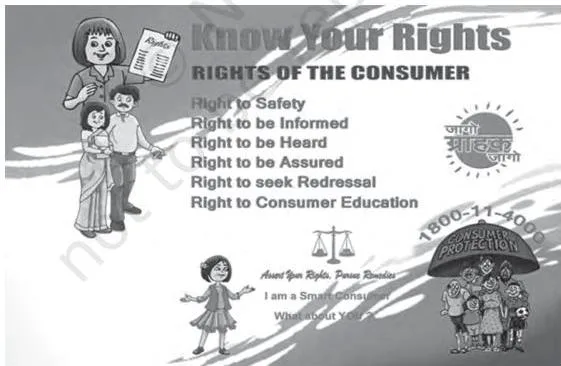
- Consumer awareness — an informed consumer can raise a voice against unfair trade practices. The Department of Consumer Affairs runs the Jago Grahak Jago campaign and a toll-free national consumer helpline, 1800114000.
- Consumer organisations — they educate consumers and can force business firms to avoid malpractices and exploitation.
- Government — it protects consumers through legislation and through the Central Consumer Protection Authority (CCPA), which regulates violations of consumer rights, unfair trade practices, and false or misleading advertisements.
The chapter summary (NCERT, p. 303) reminds you that this legal framework is wider than the 2019 Act alone. The older statutes that add protection include the Indian Contract Act 1872, the Sale of Goods Act 1930, the Essential Commodities Act 1955, the Agricultural Produce (Grading and Marking) Act 1937 and the Prevention of Food Adulteration Act 1954.
The list also includes the Standards of Weights and Measures Act 1976, the Trade Marks Act 1999, the Competition Act 2002 and the Bureau of Indian Standards Act 1986.
Redressal Agencies: District, State and National Commissions
For actual justice, the 2019 Act sets up a three-tier enforcement machinery at the district, state and national levels (NCERT, p. 300). A commission may first try to settle the dispute through mediation; if the complaint alleges a defect in goods that cannot be judged without testing, the commission seals a sample and sends it for analysis (NCERT, p. 300–301).
The table below shows which commission hears which case — the core structure of the redressal section.
| Commission | Money limit (value of goods or services paid) | Appeal lies to | Appeal window |
|---|---|---|---|
| District Commission | Up to ₹50 lakh | State Commission | 45 days |
| State Commission | Above ₹50 lakh up to ₹2 crore | National Commission | 30 days |
| National Commission | Above ₹2 crore | Supreme Court of India | 30 days |
Reliefs a commission can order (NCERT, p. 301–302):
- Remove the defect in goods or deficiency in service.
- Replace the defective product with a new one, free from any defect.
- Refund the price paid for the product or the charges paid for the service.
- Pay compensation for any loss or injury suffered due to the opposite party’s negligence.
- Pay punitive damages in appropriate circumstances.
- Discontinue the unfair or restrictive trade practice and not repeat it.
- Not offer hazardous goods for sale; withdraw hazardous goods from sale; cease manufacture of hazardous goods.
- Compensate for loss or injury under product liability.
A commission’s order is deemed final if no appeal is filed within the window.
Consumer Organisations and NGOs
Consumer organisations and NGOs exist to promote consumer welfare and are free from government interference (NCERT, p. 302). Their functions include:
- Educating the public about consumer rights through training programmes, seminars and workshops.
- Publishing periodicals on consumer problems, legal reporting, reliefs and related matters.
- Comparative testing of competing brands in accredited laboratories and publishing the results.
- Encouraging consumers to protest and take action against unscrupulous, exploitative and unfair trade practices.
- Providing legal aid and legal advice to consumers seeking a remedy.
- Filing complaints in appropriate consumer courts on behalf of consumers.
- Taking up cases in the interest of the general public, not for any individual.
The chapter names the Consumer Unity and Trust Society (CUTS), Jaipur as an example of such an organisation (NCERT, p. 302–303).
Figures in the Consumer Protection Chapter, Explained
The chapter carries three figures, and each one reinforces a block of the chapter’s argument.
Socially responsible firms and grievance cells (NCERT, p. 297)
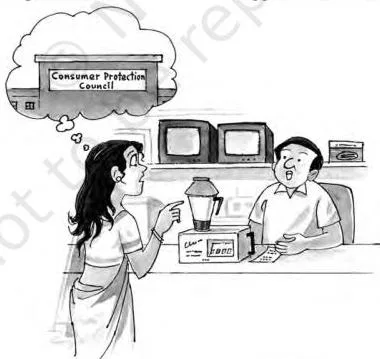
This figure sits inside the self-regulation idea. It shows why good firms do not wait for a law to force them: serving customers fairly is in their long-term interest. In practice this is why many businesses run their own customer service and grievance cells — the practical expression of the consumer’s right to be heard.
Marks indicating quality in different products (NCERT, p. 298)
This plate shows the quality marks a consumer should look for before buying. The chapter ties each mark to the products it belongs on: ISI on electrical goods, FPO on food products and Hallmark on jewellery (NCERT, p. 297), and Agmark on agricultural products (NCERT, p. 304). The plate also shows Eco-mark among the marks indicating quality in different products.
| Quality mark | Products it covers in this chapter |
|---|---|
| ISI | Electrical goods (NCERT, p. 297) |
| FPO | Food products (NCERT, p. 297) |
| BIS Hallmark | Jewellery (NCERT, p. 297) |
| Agmark | Agricultural products (NCERT, p. 304) |
| Eco-mark | Shown among the marks indicating quality in different products (NCERT, p. 298) |
The three-tier redressal structure (NCERT, p. 299)
This figure introduces the redressal section with its lowest tier. The District Commission hears complaints up to ₹50 lakh, with appeals to the State Commission within 45 days. Use it to fix the money-limit ladder in your memory before you move up to the State and National Commissions.
Terms and Definitions From the Consumer Protection Act 2019
The Act defines eleven terms that every complaint and every answer in this chapter depends on. Use them exactly and your answers stay accurate.
| Term | Plain meaning |
|---|---|
| Complaint | An allegation in writing made to obtain relief regarding a restrictive trade practice, defect in goods, deficiency in service, overcharging, or goods or services injurious to life and safety. |
| Complainant | A consumer, a voluntary consumer association, the central or state government, or a legal heir or representative, including for a minor. |
| Spurious goods | Goods falsely claimed to be genuine. |
| Unfair trade practice | Falsely representing the quality, standard, quantity, composition, style or model of goods or services to promote their sale. |
| Restrictive trade practice | Manipulating price or the flow of supplies so that an unjustified cost falls on the consumer. |
| Defect | A fault, imperfection or shortcoming in the quality, nature or manner of performance of goods. |
| Deficiency | A fault, imperfection or shortcoming in any service, including negligence or withholding information that causes loss or injury. |
| Injury | Harm illegally caused to a person in body, mind or property. |
| Product | Any article, goods, substance or raw material with intrinsic value, in solid, liquid or gaseous state. It excludes human tissues, blood, blood products and organs. |
| Product seller | Anyone in the course of business who imports, sells, distributes, labels, markets, repairs or maintains a product, or provides a service. |
| Product liability | The manufacturer’s or seller’s responsibility to compensate for harm caused by a defective product or deficient service. |
Memorise the pair students blur: defect applies to goods, deficiency applies to services (NCERT, p. 295). The chapter’s opening ATM case is a deficiency of service, not a defective product.
Common Mistakes Students Make in Consumer Protection
Most mistakes in this chapter come from confusing pairs of similar-sounding terms or mixing up the numbers in the redressal machinery. Correct each one before it costs you a mark.
| Mistake | Correct rule | How to check your answer |
|---|---|---|
| Writing “defect” for a service problem | Defect is a fault in goods; deficiency is a fault in a service (NCERT, p. 295). | Ask what failed — the product or the service. The ATM case is a deficiency of service. |
| Quoting the 1986 Act | The Consumer Protection Act 2019 replaced the 1986 Act and widened the scope to e-commerce, the CCPA and mediation (NCERT, p. 290, 299–300). | Answer with 2019 whenever the question asks for the current Act. |
| Treating “right to be assured” and “right to choose” as different rights | They are the same right, named differently in the body text (p. 296) and the summary (NCERT, p. 303). | Either name is acceptable — the idea is freedom to choose from a variety of products. |
| Assuming every buyer is a consumer | Buying goods or availing services for resale or commercial purpose removes consumer status (NCERT, p. 294). | Ask what the buyer does with the goods. A dealer restocking a shop is not a consumer. |
| Thinking a verbal complaint is enough | A complaint is an allegation in writing (NCERT, p. 295). | Your answer should mention the written allegation made to obtain relief. |
| Mixing up money limits and appeal windows | District: up to ₹50 lakh, appeal in 45 days. State: ₹50 lakh–₹2 crore, appeal in 30 days. National: above ₹2 crore, appeal to the Supreme Court in 30 days (NCERT, p. 300–301). | Reproduce the three-tier table from memory and compare every number. |
| Thinking the Act covers goods only | The Act applies to goods and services, covering manufacturers, traders and e-commerce firms (NCERT, p. 294). | Recheck the Act’s scope line — it covers businesses supplying goods or providing services. |
How the Chapter’s Questions Test Each Concept
This is a map of what the chapter’s closing questions actually test — not a prediction of the exam. Revise the concept behind each question type and you can answer any version of it.
Very short answer questions (p. 304)
- The business grievance cell question tests the right to be heard.
- The agricultural products question tests the Agmark quality mark.
- The State Commission question tests the money-limit jurisdiction: cases above ₹50 lakh up to ₹2 crore.
- The reliefs question tests two of a commission’s powers, such as removing a defect or paying compensation.
- The product-mix question tests labelling — the component of the product mix that lets a consumer exercise the right to information, a link back to the marketing chapter.
Short answer questions (p. 304)
- Enumerate the Acts — remember the framework of statutes from the chapter summary.
- Responsibilities of a consumer — the ten-point list.
- Who can file a complaint — a consumer, a voluntary consumer association, the government, or a legal heir or representative.
- The FSSAI proposal for hotels to declare cooking oil on menus reinforces the right to be informed.
- Who is a consumer as per the Act — the definition plus the resale/commercial exclusion.
Long answer questions (p. 304–305)
- Importance of consumer protection from the point of view of a business — the five reasons.
- Rights and responsibilities of a consumer — use both lists together.
- Ways and means of consumer protection — the five routes.
- Redressal mechanism under the Consumer Protection Act 2019 — three tiers, limits, appeals and reliefs.
- Role of consumer organisations and NGOs — their functions.
- The Mrs Mathur jacket case (p. 305): (a) the right exercised at the first instance was the right to be heard — she complained to the dry cleaner; (b) the right that helped her avail compensation was the right to seek redressal — the court secured her ₹2,500; (c) the responsibility she fulfilled was keeping proof of the transaction (the dry cleaner’s confirmation letter) and taking the complaint forward despite the small amount; (d) two more responsibilities can come from the ten-point list, such as being honest in dealings and reading labels.
One honest caveat: textbook contents and the examinable syllabus are not always identical. Check the current official syllabus before deciding what to leave out.
Consumer Protection: The Chapter in Brief
Everything the chapter’s own summary carries (NCERT, p. 303–304), condensed for a last-scan revision:
- Why consumer protection matters — consumers: ignorance, unorganised consumers and widespread exploitation.
- Why it matters — business: long-term interest, use of society’s resources, social responsibility, moral justification, and avoiding government intervention.
- Legal protection: the Consumer Protection Act 2019 together with the older statutes in the legal framework.
- Six consumer rights: safety, to be informed, to be assured (to choose), to be heard, to seek redressal, and to consumer education.
- Consumer responsibilities: awareness, standardised goods, safe use, reading labels, self-assertion, honesty, cash memo, complaining, forming consumer societies, and respect for the environment.
- Ways and means: self-regulation by business, business associations, consumer awareness, consumer organisations, and government.
- Redressal machinery: District, State and National Commissions with appeals up the ladder, and reliefs from removing defects to product liability compensation.
- Consumer organisations and NGOs: education, publications, comparative testing, legal aid and public-interest cases.
To fix the six rights in order, use the first letters: Smart Indian Consumers Have Real Education — Safety, Informed, Choice (or to be assured), Heard, Redressal, Education.
Related Chapters and Resources
This listing is maintained for the 2026-27 academic session using the NCERT textbook information available to us. NCERT remains the authority for confirming the latest edition.
Consumer Protection connects to the marketing chapter’s product decisions — labelling, for example, is the product-mix component behind the right to information. If you are revising the whole subject, work through the NCERT Class 12 Business Studies Part II book page and the Class 12 notes hub for the full chapter set.
Two chapters that pair well with this one are the Understanding Market chapter on marketing decisions and the Planning chapter notes.
For the official book itself — including every chapter of Business Studies Part II — browse the NCERT textbook portal on ncert.nic.in. This page covers only the Consumer Protection chapter, not the full CBSE syllabus.
Sources and Data Verification
So you can check this page against the book without hunting:
- Which textbook this page describes: NCERT Class 12 Business Studies Part II, Chapter 3 “Consumer Protection”, printed pages 290–305 of the NCERT edition listed on ncert.nic.in.
- What this page covers: this single chapter only — it is not a statement of the full CBSE syllabus.
- Academic session: this page is maintained for the current academic session, using the NCERT edition named above.
- Which authority settles what: NCERT settles textbooks, editions and official PDFs; CBSE settles the curriculum, syllabus and examinations.
Consumer Protection Class 12 FAQs
Who is not treated as a consumer under the Consumer Protection Act 2019?
Any person who buys goods or avails services for resale or for a commercial purpose is not a consumer and falls outside the Act (NCERT, p. 294). A shopkeeper restocking inventory is not a consumer, but the person who finally buys and uses the goods is — including a user who buys with the buyer’s approval.
What is the difference between a defect and a deficiency under the Act?
A defect is a fault in goods — in their quality, nature or manner of performance. A deficiency is a fault in any service, including negligence or withholding information that causes loss or injury (NCERT, p. 295). The chapter’s opening ATM case is a deficiency of service, not a defective product.
What are the six consumer rights under the Consumer Protection Act 2019?
The six rights are safety, to be informed, to be assured (the right to choose), to be heard, to seek redressal, and to consumer education (NCERT, p. 296–297). Each right is explained with an example in the six-rights table above.
What are the money limits for filing a case in the District, State and National Commissions?
The District Commission hears complaints up to ₹50 lakh; the State Commission hears those above ₹50 lakh up to ₹2 crore; the National Commission hears complaints above ₹2 crore. Appeals move up the ladder — 45 days to the State Commission, 30 days to the National Commission, and 30 days to the Supreme Court (NCERT, p. 300–301).
What do caveat emptor and caveat venditor mean in this chapter?
Caveat emptor means “let the buyer beware” — the old seller’s-market approach in which risk sat with the buyer. Caveat venditor means “let the seller beware” — the modern consumer-market approach in which the seller carries the responsibility for fair dealing, and the consumer is treated as king (NCERT, p. 291).
Where can I download the official NCERT Class 12 Business Studies Consumer Protection chapter PDF?
The official file is on the NCERT portal. Open the NCERT Class 12 Business Studies Consumer Protection Chapter 3 PDF from ncert.nic.in, choose Class XII and Business Studies, and open Part II, Chapter 3 — it is free to read online or download.
Reference: NCERT Class 12 Business Studies textbook, Part II, Chapter 3, official edition on ncert.nic.in.
Explore Class 12 Business Studies Books
Related chapters: