
The business environment class 12 chapter — Chapter 3 of the NCERT Class 12 Business Studies Part 1 textbook — answers one question: what surrounds a business and can still change its fortunes? It is a concept-based, example-driven chapter, and this page tells you exactly what is inside it.
The chapter runs 22 printed pages (book pages 68–89), covering the meaning and seven features of the business environment, why managers must study it, the five dimensions, and India’s economic environment from the 1991 crisis and LPG reforms to demonetisation.
The official NCERT PDF is linked directly below, and the rest of this page works through each part of the chapter in plain language.
Open the official NCERT Class 12 Business Studies Chapter 3 Business Environment PDF straight from ncert.nic.in — the same current-edition file your school’s printed textbook is made from, with every page in order and no login needed.
| What the chapter holds | Count | Where it is used |
|---|---|---|
| Printed pages | 22 | |
| Figures with NCERT captions | 2 | |
| Tables | 2 | |
| Activities | 1 | |
| Official NCERT PDF | Download the chapter PDF | the chapter exactly as NCERT publishes it |
Chapter 3 at a Glance
This table summarises what the chapter physically holds — pages, sections, figures and tables — so you know the size of what you are reading before you start.
| What the chapter holds | Count |
|---|---|
| Printed pages | 22 |
| Sections and sub-sections | 22 |
| Figures | 2 |
| Tables | 2 |
| Question bands at the end | Very Short, Short and Long Answer |
The chapter builds in a practical order: the opening case of Dharamveer Kamboj (pp. 68–69) leads into the meaning of business environment and its seven features (pp. 70–72), why understanding it matters (pp. 72–74), and the five dimensions (pp. 74–80).
The second half is the Indian story — the economic environment, the 1991 crisis and the LPG reforms (pp. 81–86), then demonetisation (pp. 86–87). The chapter closes with Key Terms and a Summary (pp. 87–89) and three bands of exercise questions (pp. 89–90).
What This Chapter Covers
This tour tells you exactly where each idea sits inside the file, so you can jump straight to the section you are revising.
- The opening case study (pp. 68–69): Dharamveer Kamboj, a Delhi rickshaw puller, lost his livelihood in an accident and returned to his village in Haryana. Watching rural women grate gooseberries by hand, he designed a low-cost multi-purpose machine that cuts, grates, juices and pulverises fruit without damaging seeds; his third prototype solved an overheating problem and was sent to Kenya for a pilot run. The chapter credits the National Innovation Foundation (NIF) as its source.
- Why the case matters: the invention made a painful manual task easier (social), created a machine-based way of processing food (technological), and gave small-scale producers an affordable option (economic) — three environmental forces working together.
- Learning objectives (p. 69): the chapter promises four outcomes — explain the meaning of business environment, discuss its importance, describe its elements, and examine the economic environment in India and the impact of government policies on business and industry. These four map onto the end-of-chapter questions.
- Meaning of business environment (pp. 70–72): the definition, the “universe minus the organisation” idea, and the seven features.
- Importance of business environment (pp. 72–74): six reasons, from spotting opportunities to improving performance.
- Dimensions of business environment (pp. 74–80): the economic, social, technological, political and legal dimensions, each with its component lists and examples.
- Economic environment in India (pp. 81–82): what the economy looked like at Independence and how state control and central planning reshaped it.
- The 1991 crisis and reforms (pp. 83–86): the June 1991 crisis, the New Industrial Policy of July 1991, liberalisation–privatisation–globalisation, and the early reform measures.
- Demonetisation (pp. 86–87): the announcement of 8 November 2016, its aims and features, and the impact table taken from the Economic Survey 2026-27.
- Key Terms and Summary (pp. 87–89): the chapter’s own revision material — one line per term, then the whole chapter condensed to a page.
- Exercises (pp. 89–90): three bands of questions, from one-line definitions to long essay-style answers.
Key Concepts of Business Environment Class 12
The business environment is not a vague backdrop. It is every individual, institution and force outside a firm that can still change how that firm performs.
NCERT defines the term on page 70 as the working total of everything outside a firm — the individuals, institutions and forces beyond its control that can still affect its performance. The book uses a memorable shorthand: take the universe, subtract the organisation, and the remainder is the environment.
What belongs in that remainder? Economic, social, political and technological forces, plus institutions such as consumers, competitors, governments, courts, consumer groups and the media. Each can move a firm: a tax rise makes goods costlier, a new technology can make old products obsolete, political uncertainty frightens investors, shifting fashion moves demand, and sharper competition squeezes profit margins.
The seven features of the business environment
The chapter draws seven features from this definition (NCERT, pp. 70–72). These are also the standard material for a “characterise the business environment” answer.
| Feature | What it means | Example from the chapter |
|---|---|---|
| Totality of external forces | The environment is the sum of everything external to the firm — aggregative in nature. | Outside forces act as a whole, not as isolated events. |
| Specific and general forces | Specific forces (investors, customers, competitors, suppliers) affect one enterprise directly and immediately; general forces (social, political, legal, technological conditions) affect all enterprises and reach a single firm indirectly. | A customer’s complaint hits one firm today; a new law eventually touches every firm. |
| Inter-relatedness | The parts of the environment connect and influence one another. | Rising life expectancy and health awareness increased demand for health-oriented products such as soft drinks, fat-free cooking oil and health resorts — and those new products changed lifestyles in turn. |
| Dynamic nature | The environment keeps changing. | Technology improves, consumer preferences shift, new competition enters. |
| Uncertainty | The future is hard to predict. | Industries like information technology and fashion change so fast that forecasting is difficult. |
| Complexity | Many interlocking forces make the whole hard to grasp at once, though parts are easier. | It is hard to say how much of a demand change came from social versus economic or legal factors. |
| Relativity | The environment differs by country and even by region. | Sarees sell widely in India but almost not at all in France; political conditions in the USA differ from those in China or Pakistan. |
Why understanding the environment matters
A firm cannot control these outside forces; it can only respond and adapt (NCERT, p. 72). That is why managers study the environment, and the book gives six reasons (NCERT, pp. 72–74).
| Reason | What it means | Example from the chapter |
|---|---|---|
| Identifying opportunities and first-mover advantage | Opportunities are positive external trends; spotting them early lets a firm exploit them before rivals. | Maruti Udyog led the small-car market by seeing, ahead of others, the demand created by rising petrol prices and a large middle class. |
| Identifying threats and early warning signals | Threats are negative external trends; early detection gives a firm time to prepare. | An Indian firm seeing a foreign multinational enter with new substitutes treats it as a warning and responds with better quality, lower costs and aggressive advertising. |
| Tapping useful resources | The environment supplies inputs (finance, machines, raw materials, power, water, labour) and absorbs outputs (goods, taxes, returns). | Policies designed around what the environment offers let a firm secure the resources it needs. |
| Coping with rapid changes | The pace of change matters as much as change itself. | Turbulent markets, less brand loyalty, market fragmentation, more demanding customers, fast technology and intense global competition. |
| Assisting planning and policy formulation | Analysis of opportunities and threats becomes the basis of future plans and decision guidelines. | The entry of new players forces an enterprise to rethink how it will compete. |
| Improving performance | Enterprises that monitor the environment and adapt tend to perform better and last longer. | The chapter reports studies showing a firm’s future is bound up with its environment. |
The Five Dimensions of Business Environment
The five dimensions together form the general environment — conditions that influence most enterprises at once — unlike specific forces such as one customer or supplier, which act on a single firm directly.
The section opens with a research example: when an energy-efficient bulb appeared that could last about twenty times longer than a standard one, lighting managers at companies such as General Electric tracked the research closely because it could reshape their markets.
| Dimension | What it includes | Example from the chapter |
|---|---|---|
| Economic (pp. 74–75) | Interest rates, inflation, disposable income, stock market indices, the value of the rupee. | Low long-term interest rates help construction companies and automobile makers because more consumers borrow to buy homes and cars; high inflation raises the costs of raw materials, machinery and wages. |
| Social (pp. 75–78) | Customs and traditions, values, social trends, society’s expectations of business. | Festivals like Diwali, Eid, Christmas and Guru Parv create demand for greetings cards and sweets; the health-and-fitness trend drives demand for organic food, gyms, bottled water and supplements. |
| Technological (pp. 76–77) | Scientific improvements and innovations that give new ways of producing goods and services and new methods of operating a business. | Railway tickets booked online from home; computerised advertising kiosks; shifts from typewriters to word processors, from vacuum tubes to transistors. |
| Political (pp. 77–78) | General stability and peace in the country, and the attitudes of elected government representatives towards business. | Political stability builds investor confidence to fund long-term projects; unrest and threats to law and order create uncertainty. |
| Legal (pp. 78–80) | Legislations, administrative orders, court judgments, and decisions of commissions and agencies at every level of government. | Advertising of alcoholic beverages is prohibited; cigarette packets carry a statutory health warning; baby-food advertisements must state that mother’s milk is best. |
Questions often ask you to list the components of a dimension, so the chapter’s own checklists are worth learning as sets.
Components of the economic environment (p. 75)
- The existing structure of the economy — the relative role of private and public sectors.
- Growth rates of GNP and per capita income, at current and constant prices.
- Rates of saving and investment.
- Volume of imports and exports of different items.
- Balance of payments and changes in foreign exchange reserves.
- Agricultural and industrial production trends.
- Expansion of transportation and communication facilities.
- Money supply in the economy.
- Public debt, internal and external.
- Planned outlay in the private and public sectors.
Major elements of the social environment (p. 77)
- Attitudes towards product innovations, lifestyles, occupational distribution and consumer preferences.
- Concern with quality of life.
- Life expectancy.
- Expectations from the workforce.
- Shifts in the presence of women in the workforce.
- Birth and death rates.
- Population shifts.
- Educational system and literacy rates.
- Consumption habits.
- Composition of the family.
Major elements of the political environment (p. 81)
- The prevailing political system.
- The degree of politicisation of business and economic issues.
- Dominant ideologies and values of major political parties.
- The nature and profile of political leadership.
- The level of political morality.
- Political institutions like the government and allied agencies.
- The ideology and practices of the ruling party.
- The extent and nature of government intervention in business.
- The nature of the country’s relationship with foreign countries.
Economic Environment in India: From 1991 Crisis to Demonetisation
This half of the chapter turns the concept into history — the story of how India’s economic environment moved from a controlled, closed economy to a globalising one.
The economy at Independence (pp. 81–82)
At Independence the Indian economy was mainly agricultural and rural: about 70% of the working population worked in agriculture and about 85% of people lived in villages. Production used outdated, low-productivity technology, communicable diseases were widespread, mortality was high and there was no proper public health system.
The government answered with state control of key industries, central planning and a reduced role for the private sector. The aims were rapid growth, self-reliance through heavy and basic industries, less inequality, and a socialist pattern to prevent exploitation.
The results were mixed; by 1991 the economy faced a serious foreign-exchange crisis, a high government deficit and rising prices despite bumper crops.
The crisis of June 1991 (pp. 83–84)
The numbers that forced reform were stark:
- The fiscal deficit reached 6.6% of GDP in 1990-91.
- Internal debt rose to about 50% of GDP, with interest payments draining roughly 39% of the central government’s revenue collections.
- GNP growth fell to 1.4% — down from a peak of 10.5% in 1988-89 — and agricultural output, foodgrain production and industrial production all shrank (-2.8%, -5.3% and -0.1%).
- Inflation ran at 13–14%.
- Trade collapsed: imports fell 19.4% and exports 1.5%, while the rupee depreciated 26.7% against the US dollar.
- Foreign exchange reserves covered barely a few weeks of imports, and non-resident Indians were withdrawing deposits rapidly.
- Confidence vanished: the country’s credit rating fell from AAA to BB+ within about a year.
- In May 1991 the government leased 20 tonnes of gold to the State Bank of India, and the RBI pledged 47 tonnes to the Bank of England to raise a loan of $600 million.
The New Industrial Policy of July 1991 (pp. 82–83)
The government answered within a month. The New Industrial Policy of July 1991:
- cut compulsory licensing to just six industries;
- dereserved industries earlier kept for the public sector, limiting it to four strategic industries;
- began disinvestment in many public sector enterprises;
- raised the permitted share of foreign equity, allowing 100% Foreign Direct Investment (FDI) in many activities;
- granted automatic permission for technology agreements with foreign companies; and
- set up the Foreign Investment Promotion Board (FIPB) to promote and channel foreign investment.
Liberalisation, privatisation and globalisation
In essence the policy did three things at once — it freed industry from licensing (liberalisation), shrank the public sector (privatisation) and opened the door to foreign participation (globalisation).
| Reform | Plain definition | What it changed in practice |
|---|---|---|
| Liberalisation (p. 83) | Freeing business and industry from unnecessary government controls — the end of the licence-permit-quota raj. | Licensing was abolished in most industries; firms gained freedom over the scale of business, movement of goods, pricing, lower tax rates, simpler import-export procedures and easier access to foreign capital and technology. |
| Privatisation (p. 84) | Giving the private sector a greater role in development and reducing the public sector’s role. | Planned disinvestment of public enterprises; loss-making and sick units referred to the Board for Industrial and Financial Reconstruction. Ownership actually passes to private hands only when the government’s stake falls below 51%. |
| Globalisation (p. 84) | Integrating the Indian economy with the world economy, so that physical distance and political boundaries no longer stop a firm from serving distant markets. | Import liberalisation, rationalisation of tariffs and foreign-exchange reform; made possible by rapid technological advance and liberal trade policies. |
The chapter adds a checklist of what a truly globalised economy looks like (p. 85): free flow of goods and services; free flow of capital; free flow of information and technology; free movement of people; a common mechanism for settling disputes; and a global governance perspective.
Early measures that met the crisis (pp. 85–86)
Alongside the policy, the government took immediate crisis measures:
- fiscal correction aimed at cutting the fiscal deficit by about ₹7,700 crore in 1991-92;
- abolition of industrial licensing for all projects except 18 of high strategic and environmental importance — roughly 80% of industries were delicensed;
- amendment of the MRTP Act so large companies no longer needed prior government approval for expansion, diversification or mergers;
- the foreign-equity limit raised from 40% to 51% in a wide range of priority industries, with the FIPB negotiating and clearing investment proposals;
- devaluation of the rupee by 18% in early July 1991, supported by a $2.3 billion standby credit from the IMF;
- a $500 million Structural Adjustment Loan from the World Bank (April 1992);
- import licensing replaced by tradeable import entitlements (Eximscrips) and a dual exchange rate under the Liberalised Exchange Rate Management System (LERMS); and
- the pledged gold brought back from the Bank of England and the Bank of Japan.
A short activity in this section asks you to list five Indian companies with global operations, the major products they sell and the countries they operate in — a useful way to connect the concept to real firms.
Demonetisation (pp. 86–87)
On 8 November 2016, the government announced that ₹500 and ₹1,000 notes would stop being legal tender immediately, except for a few purposes such as paying utility bills. About 86% of the currency in circulation became invalid overnight.
People had to deposit the old notes in banks, under restrictions on cash withdrawals — in effect, a restriction on the convertibility of domestic money and bank deposits. New ₹500 and ₹2,000 notes were issued in their place.
The stated aim was to curb corruption, counterfeiting and the use of high-denomination notes for illegal activity — especially the accumulation of “black money”, meaning income never declared to the tax authorities.
The chapter lists four features of demonetisation (p. 87):
- It is a tax-administration measure — holders of declared income exchanged cash readily, while black-money holders had to declare unaccounted wealth and pay tax at a penalty rate.
- It signals that tax evasion will no longer be tolerated or accepted.
- It channels savings into the formal financial system — new deposit schemes give banks a base for lending at lower interest rates.
- It pushes toward a less-cash economy — more savings through the formal system and better tax compliance, even though digital payments need phones, PoS machines and internet connectivity.
Digitisation affected three groups differently: the poor, largely outside the digital economy; the less affluent, joining through Jan Dhan accounts and RuPay cards; and the affluent, fully at ease with digital transactions.
The impact table in plain words. NCERT prints the effects as a table adapted from the Economic Survey 2026-27 (p. 87):
| Area | What actually happened |
|---|---|
| Money and interest rates | Cash transactions declined, bank deposits increased and financial savings rose. |
| Private wealth | Declined — some high-denomination notes were never returned and real estate prices fell. |
| Public sector wealth | No effect. |
| Digitisation | Digital transactions among new users (RuPay, AEPS) increased. |
| Real estate | Prices declined. |
| Tax collection | Income tax collection rose because of increased disclosure. |
Figure Walkthrough: What the Two Images in Chapter 3 Show
This is a concept-based chapter, so it uses images sparingly. The two image spots are an activity and a real-world feature — not diagrams you need to memorise.
The social-environment activity (p. 78)
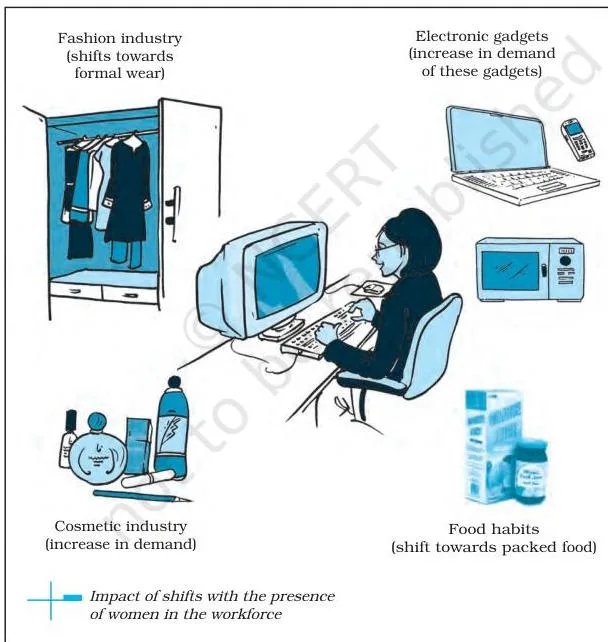
This activity sits inside the Social Environment discussion. Your task: contact ten families, find how their consumption habits changed over the last five years, and analyse what those changes mean for business enterprises.
It teaches the social dimension because consumption habits are a social force — when habits shift, demand shifts with them, and firms that notice the shift early gain the advantage.
E-ticket booking — technology at work (p. 79)
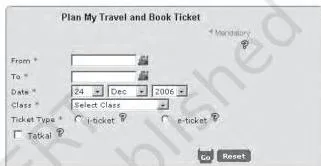
The second image is an e-ticket booking guide, and the text beside it makes the point: because of technological advancement, railway tickets can now be booked through the internet from home or office. That is the technological environment in action — a scientific improvement giving a business a new way to operate.
Keep this example in mind when the chapter later discusses demonetisation’s push toward digital transactions (RuPay cards, PoS machines): online booking was the earlier wave of the same digitisation.
Definitions From This Chapter: Key Terms You Must Know
These are the terms the chapter itself collects as Key Terms (p. 87). Each is written in plain language, with the page where it appears.
| Term | Plain meaning | Page |
|---|---|---|
| Business environment | The sum total of all individuals, institutions and forces outside a firm’s control that may affect its performance. | p. 70 |
| Opportunities | Positive external trends or changes that can help a firm improve performance. | p. 72 |
| Threats | External trends or changes that can hinder a firm’s performance. | p. 72 |
| Specific forces | Forces such as customers, competitors, investors and suppliers that affect an individual enterprise directly and immediately. | p. 71 |
| General forces | Conditions such as social, political, legal and technological circumstances that affect all enterprises, and reach a single firm indirectly. | p. 71 |
| Economic environment | Economic factors — interest rates, inflation, disposable income, stock market indices and the value of the rupee. | p. 74 |
| Social environment | Social forces — customs, traditions, values, social trends and society’s expectations of business. | p. 75 |
| Technological environment | Scientific improvements and innovations that give new ways of producing goods and services and operating a business. | p. 76 |
| Political environment | Stability and peace in the country plus the attitudes of elected representatives towards business. | p. 77 |
| Legal environment | Legislations, administrative orders, court judgments and decisions of agencies at every level of government. | p. 78 |
| Liberalisation | Freeing business and industry from unnecessary controls — the end of the licence-permit-quota raj. | p. 83 |
| Privatisation | Giving the private sector a greater role in development and reducing the public sector’s role. | p. 84 |
| Globalisation | Integrating the world’s economies into a cohesive global economy, with rising interaction between nations. | p. 84 |
| Disinvestment | Transfer of public sector enterprises to the private sector; ownership passes only when the government’s stake falls below 51%. | p. 84 |
| Demonetisation | Withdrawal of currency units as legal tender, as with the ₹500 and ₹1,000 notes in November 2016. | p. 86 |
Common Mistakes Students Make in Business Environment
The biggest slip is confusing specific and general forces — the second feature of the environment. Beyond that, students most often make these six mistakes:
| Mistake | Correct rule | How to check your answer |
|---|---|---|
| Naming customers, investors and suppliers as general forces. | They are specific forces: they act on an individual enterprise directly and immediately (pp. 71–72). | Ask who the force touches — one firm’s daily working means specific; the whole economy or society means general. |
| Thinking a firm can control its environment. | The environment is outside the firm’s control; a firm can only respond and adapt (p. 72). | If your sentence says “control”, rewrite it as “respond” or “adapt”. |
| Swapping dimension labels. | Inflation and interest rates are economic; stability and peace are political; laws and court judgments are legal (pp. 74–80). | Name the source: money matters → economic; a government order → legal; order and safety → political. |
| Confusing liberalisation, privatisation and globalisation. | Each maps to one reform goal: removing licensing controls → liberalisation; shrinking the public sector → privatisation; inviting foreign participation → globalisation (p. 83). | Match the reform to what it changes: controls on private industry, the public sector’s size, or India’s links with the world. |
| Assuming any disinvestment equals privatisation. | Ownership actually transfers only if the government’s stake falls below 51% (p. 84). | Check the stake: above 51%, the government still controls; below it, control passes to private hands. |
| Reversing demonetisation’s effects. | Private wealth declined, public sector wealth was unaffected, and tax collection rose (p. 87). | Test each row of the impact table: deposits up, private wealth down, public wealth unchanged, tax revenue up. |
Exam Notes: Matching Questions to Concepts
The chapter’s own end questions are the best practice you can get — each one tests a single concept from a specific part of the chapter.
| Question | Concept it tests | Where to revise it |
|---|---|---|
| Very Short Q1 — “What is meant by business environment?” | The definition itself. | p. 70 |
| Very Short Q3 — example of inter-relatedness | Whether the parts of the environment affect one another. | pp. 71–72 |
| Very Short Q4 — Krishna Furnishers Mart | Impacts of a changing environment: increase in competition and market orientation. | pp. 72–73 |
| Short Q3 — National Digital Library of India (NDL India) | Recognising the dimensions of business environment from a described case — chiefly the technological dimension. | pp. 74–80 |
| Short Q4 — demonetisation’s impact | Effects on interest rates, private wealth and real estate. | p. 87 |
| Long Q1 — characterising the business environment | The features, and the difference between general and specific environment. | pp. 70–71 |
| Long Q4 — demonetisation dimensions and features | The dimensions highlighted by the announcement, plus the features of demonetisation. | pp. 86–87 |
| Long Q5 — Industrial Policy 1991 | The policy’s changes and their impact on business and industry. | pp. 82–86 |
A strong long answer names the concept, explains it, and supports it with the chapter’s own examples — a bare definition rarely carries the question.
How to structure a strong short answer
A strong answer follows three steps: name the concept, define it in one line, then support it with an example. Here is the pattern worked on a case the book does not use — a food-delivery app.
Case: A food-delivery company lets customers order meals through a phone app, pay digitally, and expect products to meet government safety rules. Which dimension of the business environment is most directly at work?
Model answer: The technological environment is most directly at work. It covers scientific improvements and innovations that give businesses new ways of producing goods, delivering services and operating (NCERT, p. 76).
Ordering food through an app is possible only because of advances in phones, the internet and payment systems — the same technology the chapter shows making railway tickets bookable from home (NCERT, p. 79).
A complete answer then adds the economic dimension (what customers can spend depends on income and prices) and the legal dimension (consumer-protection and safety rules the business must obey).
One caution: textbook contents and the examinable syllabus are not always identical. Check the current official syllabus on cbse.gov.in to confirm what is examinable this session.
Chapter 3 Recap: The Entire Chapter in Brief
This recap follows the NCERT summary that closes the chapter, in plainer words, so you can revise the whole chapter in about a minute.
- Meaning. The business environment is the sum total of individuals, institutions and forces outside a firm that may affect its performance. Its seven features: totality of external forces; specific and general forces; inter-relatedness; dynamic nature; uncertainty; complexity; and relativity.
- Importance. Six reasons — identifying opportunities and first-mover advantage, identifying threats and early warning signals, tapping resources, coping with rapid change, helping planning and policy formulation, and improving performance.
- Dimensions. Five — economic, social, technological, political and legal.
- India’s economic environment. Mainly agricultural at Independence, then state-controlled and centrally planned, with mixed results until the 1991 crisis.
- The 1991 reforms and after. The New Industrial Policy of July 1991 brought liberalisation, privatisation and globalisation; November 2016 brought demonetisation.
- Impact on business and industry. The policy changes produced seven shifts: increasing competition; more demanding customers; rapidly changing technology; the necessity for change; the need to develop human resources; market orientation; and the loss of budgetary support to the public sector.
Related Resources
If you are working through the whole book, start at the Class 12 Business Studies Part 1 book page for the chapter list. This chapter follows Principles of Management (Chapter 2) and comes just before Planning (Chapter 4). The Class 12 hub gathers the class-level pages on this site.
For revision material, the Class 12 Business Studies notes page collects chapter-wise notes, inside the Class 12 notes hub and the wider CBSE notes library. If your teacher has moved into marketing-related units, the Understanding the Market notes cover how firms read consumer demand, and the Planning revision notes continue this book’s sequence.
Sources and Data Verification
What this page describes: the NCERT Class 12 Business Studies Part 1 textbook, Chapter 3 “Business Environment”, in its official edition on ncert.nic.in, maintained for the current academic session.
What it covers: only this one chapter. For the rest of the book, use the Business Studies Part 1 chapter list; this page is not a guide to Business Studies Part 2 or to other subjects.
Where editions come from: NCERT publishes and maintains the textbook, its editions and its official PDFs, all verifiable on the NCERT textbook portal. CBSE settles the syllabus and examinations, and textbook contents and the examinable syllabus are not always identical.
Reference: NCERT Class 12 Business Studies textbook, chapter 3, official edition on ncert.nic.in.
FAQs on Business Environment Class 12
Quick answers to the questions students search for most, each tied to the page of the chapter where the answer appears.
What is the definition of business environment in class 12?
The business environment is the sum total of all individuals, institutions and other forces outside the control of a business enterprise that may affect its performance (NCERT, p. 70). In simpler terms, it is everything outside the firm — customers, competitors, suppliers, government, courts, media, economic conditions, technology and social trends — that can still help or hurt the firm.
What are the five dimensions of business environment class 12?
The five dimensions are economic, social, technological, political and legal (NCERT, pp. 74–80). Economic covers interest rates, inflation, disposable income, stock market indices and the value of the rupee; social covers customs, values and trends; technological covers new ways of producing and operating; political covers stability, peace and government attitudes; legal covers laws, administrative orders and court judgments.
What is the difference between liberalisation, privatisation and globalisation?
Liberalisation frees business and industry from unnecessary controls — most licensing was abolished and firms gained freedom over the scale of business and pricing (NCERT, p. 83). Privatisation gives the private sector a greater role and shrinks the public sector through disinvestment; ownership actually transfers only when the government’s stake falls below 51% (NCERT, p. 84).
Globalisation integrates the Indian economy with the world economy so that goods, capital, information, technology and people can move across borders (NCERT, p. 84).
Why were economic reforms introduced in India in 1991?
Because by June 1991 the economy was in serious crisis: the fiscal deficit reached 6.6% of GDP, GNP growth fell to 1.4%, inflation ran at 13–14%, foreign exchange reserves covered barely a few weeks of imports, and the country stood close to defaulting on international obligations — the government even pledged gold to the Bank of England for a loan (NCERT, pp. 83–84).
The New Industrial Policy of July 1991 answered with liberalisation, privatisation and globalisation.
What are the effects of demonetisation on business and the economy?
According to the table NCERT adapts from the Economic Survey 2026-27 (p. 87): cash transactions declined while bank deposits and financial savings rose; private wealth declined because some high-denomination notes were never returned and real estate prices fell; public sector wealth was unaffected; digital transactions (RuPay, AEPS) increased; real estate prices declined; and income tax collection rose because of increased disclosure.
Explore Class 12 Business Studies Books
Related chapters: