
These Describing Motion Around Us Class 9 Notes condense NCERT Chapter 4 into what you need to revise: definitions, formulas, graph rules and solved problems. The chapter studies motion in its idealised simple forms — motion in a straight line and uniform circular motion.
Read the sections in order, then test yourself on the worked examples and the one-page cheat sheet at the end.
Every definition below matches the NCERT Class 9 Science (Exploration) textbook, with page references so you can verify any line. Two ideas decide most of the marks in this chapter: the ± direction sign and the constant-acceleration condition. Keep both in mind as you study.
What This Chapter Covers (Revision Map)
The chapter opens with a method: complex motion is best studied in idealised simple forms — linear, circular and oscillatory motion (NCERT, p. 1). This chapter builds six connected ideas out of that approach.
What’s inside these Describing Motion Around Us Class 9 notes
- Describing position — a fixed reference point and a +/− direction sign tell you where an object is.
- Distance vs displacement — path length vs net change in position; equal only when the object never turns back.
- Speed, velocity, acceleration — how fast, how fast in which direction, and how fast that velocity is changing.
- Motion graphs — position-time and velocity-time graphs, where slope and area carry the answers.
- Kinematic equations — three equations linking \(u\), \(v\), \(a\), \(s\) and \(t\) for constant acceleration.
- Uniform circular motion — constant speed but changing velocity, so still accelerated motion.
When you finish this chapter, the Class 9 Science notes hub links every chapter of the book. For other subjects, browse all Class 9 notes or the complete CBSE notes index.
Every formula and figure here can be checked against the source — the official NCERT Class 9 Science Chapter 4 PDF on ncert.nic.in. Keep it open while revising if you want to confirm any line against the textbook.
Position, Reference Point and the ± Sign Rule
To study motion in a straight line (linear motion), you must first fix a reference point. The position of an object at any instant is its distance and direction from that reference point (NCERT, p. 2).
An object is in motion if its position relative to the reference point changes with time, and at rest if that position does not change (NCERT, p. 2). So motion and rest are always judged relative to a chosen reference point.

Two times you must never confuse (NCERT, p. 3):
- Instant of time — a single clock reading at one moment, such as the athlete at \(t = 4\) s.
- Time interval — the duration between two clock readings, such as the 6 s from \(t = 4\) s to \(t = 10\) s.
On a straight line an object can move in only two directions — forward or backward. By convention, positions to the right of the origin O are positive (+) and positions to the left are negative (−) (NCERT, p. 3). Once you pick the positive direction, do not change it in the middle of a problem.
Distance vs Displacement: The Core Difference
This is the most-tested idea in the chapter. Distance records the whole path; displacement records only the net change in position. The table fixes the terms.
| Term | What it means | Example from Fig. 4.4 |
|---|---|---|
| Distance | Total length of the path actually travelled; a scalar (value with units, no direction) | O → B → A → B: 160 m |
| Displacement | Net change in position from start to finish; a vector (value, units and direction) | O → B: 40 m in the positive direction |
| Magnitude | The numerical value (with units) of a quantity | Magnitude of the 40 m displacement is 40 m |
Scalars need only a value, like distance (160 m). Vectors need a value and a direction, like displacement (40 m to the right). You will explore scalars and vectors fully in higher grades (NCERT, p. 3).
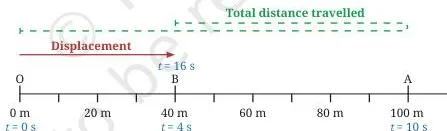
The athlete starts at O, runs to B, continues to A, then returns to B (NCERT, p. 3). Total distance = OA + AB = 100 m + 60 m = 160 m. Displacement from the starting position = OB = 40 m in the positive direction. Same journey, two very different answers.
A ball thrown straight up and caught back at O shows the general rule: the magnitude of displacement is never more than the total distance travelled (NCERT, p. 4, Activity 4.1).
When are distance and displacement equal?
For motion in a straight line, total distance and the magnitude of displacement are equal only when the object moves without turning back, in one direction (NCERT, p. 4).
| Motion | Total distance | Magnitude of displacement | Equal? |
|---|---|---|---|
| Walk 40 m straight ahead, stop | 40 m | 40 m | Yes — one direction, no turn |
| Walk 40 m ahead, then 40 m back | 80 m | 0 m | No — turned back |
| Athlete O → B → A → B | 160 m | 40 m | No — turned back |
Average Speed and Average Velocity
Average speed tells you how fast or slow an object moves. It is the total distance travelled divided by the time interval (NCERT, p. 5):
\[ \text{average speed} = \frac{\text{total distance travelled}}{\text{time interval}} \qquad (4.1) \]
Average velocity tells you how fast the position is changing and in which direction. It is the displacement divided by the time interval (NCERT, p. 5):
\[ v_{av} = \frac{\text{displacement}}{\text{time interval}} = \frac{s}{t} \qquad (4.2a, 4.2b) \]
Both share the same SI unit — metre per second, written m s⁻¹ or m/s — and km h⁻¹ is also common (NCERT, p. 6).
Two kinds of straight-line motion (NCERT, p. 5):
- Uniform motion — equal distances in equal intervals of time; the object moves at constant speed.
- Non-uniform motion — unequal distances in equal intervals; speed increases, decreases, or both.
Speed vs velocity: the swimming pool case
NCERT’s Example 4.2 makes the difference concrete. Sarang swims one length and back — 50 m total — in 50 s. Because he returns to the starting wall, his displacement is 0 m (NCERT, p. 6).
| Quantity | What it needs | Sarang’s 50 m round trip in 50 s |
|---|---|---|
| Average speed | A number and a unit (scalar) | 50 m ÷ 50 s = 1 m s⁻¹ |
| Average velocity | A number, a unit and a direction (vector) | 0 m ÷ 50 s = 0 m s⁻¹ (no net change in position) |
This is the case to remember: average speed can be non-zero while average velocity is zero, whenever the object returns to its start. In one-direction straight-line motion, average speed and the magnitude of average velocity are equal (NCERT, p. 6).
Self-test from the textbook (NCERT, p. 6, Pause and Ponder): you drive 200 km north in 3 h, then 200 km south in 2 h.
- Total distance = 200 + 200 = 400 km; total time = 5 h → average speed = 80 km h⁻¹.
- Displacement = 0 km (you end where you began) → average velocity = 0 km h⁻¹.
Average Acceleration: How Fast Velocity Changes
You feel a jolt when a vehicle suddenly starts or stops — that jolt is your body detecting a change in velocity (NCERT, p. 7). Average acceleration is the change in velocity divided by the time interval:
\[ a = \frac{v – u}{t_2 – t_1} \qquad (4.3c) \]
Here \(u\) is the initial velocity at time \(t_1\) and \(v\) is the final velocity at time \(t_2\). The SI unit is m s⁻² (metre per second squared), and, like displacement and velocity, acceleration needs a direction (NCERT, p. 7).
For straight-line motion, acceleration points along the velocity when the speed is increasing and opposite to the velocity when the speed is decreasing (NCERT, p. 7). The figure shows both cases.
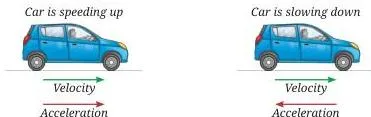
Acceleration can come from a change in speed, a change in direction, or both. The circular-motion section later shows a case where only the direction changes.
NCERT’s Example 4.4 drops an object and records its velocity each second: 9.8, 19.6, 29.4 and 39.2 m s⁻¹ at 1 s, 2 s, 3 s and 4 s. Every interval gives the same average acceleration, 9.8 m s⁻² — the acceleration due to gravity, written \(g\) (NCERT, p. 8).
The worked bus example shows the standard conversion (NCERT, p. 8): 36 km h⁻¹ = 10 m s⁻¹ and 54 km h⁻¹ = 15 m s⁻¹.
- Accelerating: \(a = (15 – 10)/10 = 0.5\) m s⁻², acting along the velocity.
- Braking from 15 m s⁻¹ to 0 in 5 s: \(a = (0 – 15)/5 = -3\) m s⁻²; the minus means opposite to the velocity.
Key note: an object can move very fast and still have zero acceleration. Acceleration depends on how quickly velocity changes, not on how fast the object moves — a bus at constant velocity on a highway has zero acceleration (NCERT, p. 8).
Reading Motion Graphs: Slope and Area
Graphs show how position, velocity or acceleration depends on time, and they help compare two motions (NCERT, p. 9). Two golden rules run through the whole section.
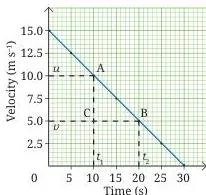
- The slope of a line (its steepness) gives the rate of change of the Y-axis quantity with respect to the X-axis quantity (NCERT, p. 13).
- The area between a velocity-time graph and the time axis gives displacement over that time interval (NCERT, p. 15).
Position-time graphs
Position goes on the Y-axis, time on the X-axis. What the shape tells you (NCERT, p. 12):
- Straight line — constant velocity; equal time intervals give equal displacements (Fig. 4.13a).
- Curved line — changing velocity, so accelerated motion (Fig. 4.13b).
- Horizontal line — position does not change, so the object is at rest (Example 4.6, NCERT, p. 13).
- Comparing two lines — the steeper line belongs to the higher velocity (Example 4.7, NCERT, p. 13).
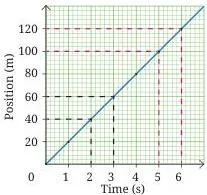
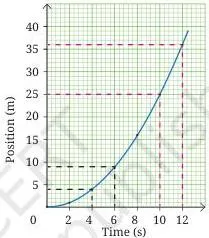
The slope of a position-time graph gives velocity (NCERT, p. 13). In the textbook’s worked case, the rise is 80 m − 40 m = 40 m over 4 s − 2 s = 2 s, so the velocity is 20 m s⁻¹.
Remember, a graph is not a route map — it shows how position changes with time from the origin, not the path taken (NCERT, p. 11).
Velocity-time graphs
Velocity goes on the Y-axis, time on the X-axis. Shape meanings (NCERT, p. 14):
- Horizontal line — constant velocity, so acceleration is zero.
- Straight line rising — velocity increases with constant acceleration.
- Straight line falling — velocity decreases with constant acceleration.
The slope of a velocity-time graph gives acceleration (NCERT, p. 15). The figure below shows the slope triangle: between \(t_1\) and \(t_2\), acceleration \(a = (v – u)/(t_2 – t_1) = BC/CA\).
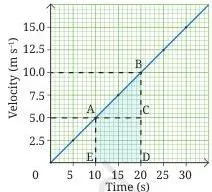
The area under the graph with the time axis gives displacement (NCERT, p. 15). For constant velocity of 20 m s⁻¹ over 6 s, the rectangle OABC has area 20 × 6 = 120 m. For changing velocity between 10 s and 20 s, the shape is a rectangle plus a triangle, giving 50 m + 25 m = 75 m in Fig. 4.18b.
Slope vs area: which is which?
| Graph | Slope gives | Area with time axis gives | Shape → meaning |
|---|---|---|---|
| Position–time | Velocity \(v = \frac{s_2 – s_1}{t_2 – t_1}\) | Not used in this chapter | Straight = constant velocity; curve = accelerated; horizontal = rest |
| Velocity–time | Acceleration \(a = \frac{v – u}{t_2 – t_1}\) | Displacement (rectangle + triangle areas) | Horizontal = zero acceleration; rising/falling straight = constant acceleration |
Kinematic Equations for Constant Acceleration
For motion in a straight line with constant acceleration, exactly three equations relate the five quantities — displacement \(s\), time interval \(t\), initial velocity \(u\), final velocity \(v\) and acceleration \(a\) (NCERT, p. 16).
\[ v = u + at \qquad (4.4a) \]
\[ s = ut + \tfrac{1}{2}at^2 \qquad (4.4b) \]
\[ v^2 = u^2 + 2as \qquad (4.4c) \]
| Symbol | Quantity | SI unit |
|---|---|---|
| \(u\) | Initial velocity (at \(t = 0\) s) | m s⁻¹ |
| \(v\) | Final velocity (at time \(t\)) | m s⁻¹ |
| \(a\) | Acceleration (constant) | m s⁻² |
| \(s\) | Displacement in time \(t\) | m |
| \(t\) | Time interval | s |
Where they come from, in words (NCERT, pp. 16–17):
- Eq. 4.4a is the definition of average acceleration rearranged: \(a = (v – u)/t\) becomes \(v = u + at\).
- Eq. 4.4b comes from the area under the velocity-time graph OABD — a rectangle \(u \times t\) plus a triangle \(\tfrac{1}{2} \times t \times (v – u)\), with \((v – u)\) replaced by \(at\).
- Eq. 4.4c eliminates \(t\): from 4.4a, \(t = (v – u)/a\); substituting this into 4.4b and simplifying gives \(v^2 = u^2 + 2as\).
Validity condition: these equations work only when acceleration is constant (NCERT, p. 18). For one-direction straight-line motion, distance = magnitude of displacement and speed = magnitude of velocity, so the same equations double as distance formulas there. In two-direction motion, the signs of \(u\), \(v\), \(a\) and \(s\) carry the directions.
Memory device for the three equations
Keep the symbol row u v s a t in mind with the line “Use Very Small Accelerations Today”. Then tell the equations apart by which quantity each one leaves out:
- \(v = u + at\) → no \(s\)
- \(s = ut + \tfrac{1}{2}at^2\) → no \(v\)
- \(v^2 = u^2 + 2as\) → no \(t\)
If a question gives three knowns and you need a fourth, pick the equation that contains your missing quantity and omits the variable you were never given.
Uniform Circular Motion: Constant Speed, Changing Velocity
So far the motion was in one dimension — a straight line. Motion in a plane, such as a kicked ball, a satellite orbit or a vehicle overtaking, is two-dimensional (NCERT, p. 19). A special case is circular motion.
In the textbook’s merry-go-round example, a child moves from A to B to C. Distance travelled is the arc length ABC, while displacement is the straight line AC — the two are not equal (NCERT, p. 19).
For one full revolution, distance = circumference \(2\pi R\) and displacement = 0, because the child returns to the start (NCERT, p. 19). If one revolution takes time \(T\), the average speed is:
\[ v_{av} = \frac{2\pi R}{T} \qquad (4.5) \]
Uniform circular motion is motion along a circle at constant speed (NCERT, p. 19). The speed is the same at every point of the circle; only the direction of velocity changes.
Why is it still accelerated? Imagine an athlete on a track. A rectangle forces 4 direction changes per lap; a hexagon, 6. As the number of sides grows without limit, the track becomes a circle and the direction of velocity changes continuously (NCERT, p. 19).
Since velocity is a vector, a continuous change in direction means continuous acceleration even at constant speed (NCERT, p. 20).
The direction of velocity at any instant is along the tangent to the circle at that point, pointing along the motion (NCERT, p. 20). The figure defines a tangent: a straight line that meets the circle at exactly one point.
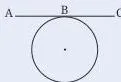
The ring-and-marble activity gives the intuition (NCERT, p. 20): when a marble rolling inside a ring is released, it flies off in a straight line — along the direction it was heading at the instant of release, which is the tangent.
Uniform circular motion is an idealised model — constant speed and a perfect circle rarely hold in the real world. Still, it is the foundation for planets orbiting the Sun and for a vehicle making a circular turn (NCERT, p. 20).
Worked Examples: Solved Step by Step
All four problems below use fresh numbers. The pattern that earns marks: name the method, substitute with units at every step, and state the conclusion clearly.
Worked Example 1: A jogger’s round trip
Method: separate the scalar reading (distance, speed) from the vector reading (displacement, velocity) on one straight north–south road.
Step 1: A jogger runs 120 m north, turns, and runs 45 m south.
Total time = 60 s.
- Step 1: Total distance = 120 m + 45 m = 165 m.
- Step 2: Displacement = 120 m − 45 m = 75 m north (net change in position).
- Step 3: Average speed = 165 m ÷ 60 s = 2.75 m s⁻¹.
- Step 4: Average velocity = 75 m ÷ 60 s = 1.25 m s⁻¹ north.
Final answer: speed 2.75 m s⁻¹; velocity 1.25 m s⁻¹ directed north.
Worked Example 2: A bike speeding up
Method: convert km h⁻¹ to m s⁻¹ first, then apply the definition of acceleration, then the displacement equation.
Step 1: The bike goes from 7.2 km h⁻¹ to 28.8 km h⁻¹ in 6 s.
Convert each: 7.2 × 5/18 = 2 m s⁻¹; 28.8 × 5/18 = 8 m s⁻¹.
- Step 1: Acceleration \(a = \frac{v – u}{t} = \frac{8 – 2}{6} = 1\) m s⁻².
- Step 2: Displacement \(s = ut + \tfrac{1}{2}at^2 = (2 \times 6) + \tfrac{1}{2} \times 1 \times 6^2 = 12 + 18 = 30\) m.
Final answer: acceleration 1 m s⁻²; displacement 30 m in the direction of motion.
Worked Example 3: Stopping distance of a car
Method: use the no-time equation \(v^2 = u^2 + 2as\) for distance, then the first equation for time.
- Step 1: A car at 72 km h⁻¹ = 20 m s⁻¹ brakes with \(a = -4\) m s⁻² until \(v = 0\) m s⁻¹.
- Step 2: \(0 = (20)^2 + 2(-4)s \Rightarrow 0 = 400 – 8s \Rightarrow s = 50\) m.
- Step 3: Time to stop: \(v = u + at \Rightarrow 0 = 20 + (-4)t \Rightarrow t = 5\) s.
Final answer: stopping distance 50 m; stopping time 5 s.
Worked Example 4: Displacement from a velocity-time triangle
Method: for uniform acceleration from rest, displacement equals the triangular area under the velocity-time graph: \(\tfrac{1}{2} \times\) base × height.
- Step 1: From rest with \(a = 2\) m s⁻² for 5 s, final velocity \(v = u + at = 0 + 2 \times 5 = 10\) m s⁻¹.
- Step 2: The graph is a triangle with base 5 s and height 10 m s⁻¹.
- Step 3: Displacement = \(\tfrac{1}{2} \times 5\ \text{s} \times 10\ \text{m s}^{-1} = 25\) m.
Final answer: displacement 25 m.
Common Mistakes to Avoid
These are the chapter-specific traps, each with the fix and a way to check yourself.
| Mistake | Correct rule | How to check your answer |
|---|---|---|
| Writing distance = displacement | They are equal only when the object moves in one straight direction and never turns back (NCERT, p. 4) | Did the object reverse anywhere? If yes, distance > magnitude of displacement |
| Taking \((u+v)/2\) as average velocity in every case | This shortcut is valid only for constant acceleration | If acceleration is not constant, use displacement ÷ time instead |
| Applying kinematic equations when acceleration changes | The equations are valid only for constant acceleration (NCERT, p. 18) | Does velocity change by equal amounts in equal times? |
| Substituting 54 km h⁻¹ as 54 into a formula | Convert first: ×5/18 (write it as ×1000/3600); 54 km h⁻¹ = 15 m s⁻¹ (NCERT, p. 8) | Convert before substituting; a speed in m s⁻¹ should be a small number |
| Saying uniform circular motion has zero acceleration | Speed is constant but the direction of velocity changes continuously, so acceleration is non-zero (NCERT, p. 20) | Velocity is a vector — a direction change alone is a velocity change |
| Confusing slope with area on a graph | Slope of v–t graph = acceleration; area under v–t graph = displacement (NCERT, p. 15) | Slope is a ratio (divide units); area is a product (multiply units) |
The same study approach backs the other rationalised chapters — see our notes on Tissues in Action and Exploring Mixtures and Their Separation.
Exam Notes: What Earns the Mark
These are observed scoring patterns in motion problems — follow the steps and the method marks are yours.
- Write the formula line first. In numeric problems, writing \(v^2 = u^2 + 2as\) before substituting earns method credit even if the arithmetic slips (NCERT, p. 18).
- Draw construction lines on graph questions. For slope, mark the horizontal and vertical sides of the triangle (like BC and CA in Fig. 4.14) — showing the working earns the mark (NCERT, p. 13).
- State the direction for vectors. When asked for displacement or velocity, the answer must include a direction or a ± sign (NCERT, p. 3).
- Show the unit conversion explicitly. Writing 36 km h⁻¹ = 36 × 1000/3600 = 10 m s⁻¹ is expected working, not extra steps (NCERT, p. 8).
- Label every unit. An answer of “50” with no unit is incomplete — write 50 m, 1 m s⁻², 5 s.
Revision Cheat Sheet: The Chapter in One Page
Scan this the night before — every formula, rule and unit in one block.
\[ \text{Average speed} = \frac{\text{total distance}}{\text{time interval}} \quad (4.1) \qquad v_{av} = \frac{\text{displacement}}{t} = \frac{s}{t} \quad (4.2) \]
\[ a = \frac{v – u}{t_2 – t_1} \quad (4.3c) \qquad v = u + at, \quad s = ut + \tfrac{1}{2}at^2, \quad v^2 = u^2 + 2as \quad (4.4) \]
\[ v_{av} = \frac{2\pi R}{T} \quad \text{(uniform circular motion)} \quad (4.5) \]
Graph rules
- Position–time: straight line → constant velocity; curve → accelerated; horizontal → at rest.
- Velocity–time: horizontal → zero acceleration; rising/falling straight → constant acceleration.
- Slope of position–time graph = velocity; slope of velocity–time graph = acceleration.
- Area under velocity–time graph with the time axis = displacement.
- A graph is not a route map (NCERT, p. 11).
Equality rules
- Distance = |displacement| and speed = |velocity| only when the object moves in one direction without turning back.
- Average velocity can be 0 while average speed is not (round trip returns to start).
SI units
- Displacement \(s\): metre (m); time \(t\): second (s).
- Speed and velocity: m s⁻¹ (also km h⁻¹); acceleration: m s⁻².
- Conversion: km h⁻¹ × 5/18 = m s⁻¹.
When is acceleration zero or constant?
- Velocity constant → acceleration = 0, even at high speed (NCERT, p. 8).
- Speed changes by equal amounts in equal times → constant acceleration.
- Free fall: \(g \approx 9.8\) m s⁻², directed downwards (NCERT, p. 8).
Frequently Asked Questions
When are total distance travelled and magnitude of displacement equal?
Only when the object moves without turning back — in one straight direction (NCERT, p. 4). The moment it reverses, distance exceeds the magnitude of displacement.
Can average velocity be zero while average speed is not? Give an example.
Yes. In NCERT’s Example 4.2, Sarang swims a 50 m round trip in 50 s: average speed 1 m s⁻¹ but average velocity 0 m s⁻¹, because his net displacement is zero (NCERT, p. 6).
Why is uniform circular motion called accelerated motion even though the speed is constant?
Because velocity is a vector. In uniform circular motion the speed is constant but the direction of velocity changes continuously, so the velocity — and therefore the acceleration — is never zero (NCERT, p. 20).
What is the fastest way to convert km h⁻¹ to m s⁻¹?
Multiply by 5/18. This is the same as ×1000/3600: for example, 54 × 5/18 = 15 m s⁻¹ and 72 × 5/18 = 20 m s⁻¹ (NCERT, p. 8).
What do the slope and the area under a velocity-time graph give?
The slope gives acceleration, and the area between the graph and the time axis gives displacement (NCERT, p. 15). Slope is a ratio (division of units); area is a product (multiplication of units).
When are the kinematic equations \(v = u + at\), \(s = ut + \tfrac{1}{2}at^2\) and \(v^2 = u^2 + 2as\) valid?
Only when acceleration is constant (NCERT, p. 18). For two-direction straight-line motion, the signs of \(u\), \(v\), \(a\) and \(s\) handle the directions.
Reference: NCERT Class 9 Science (Exploration) textbook, chapter Describing Motion Around Us.
Explore Class 9 Science Notes
Class 9 Science on LearnCBSE:
Related chapters: