
These electromagnetic waves class 12 notes compress NCERT Class 12 Physics Chapter 8 into one revision page: the displacement-current paradox, Maxwell’s four equations, wave production, the E–B field structure, the spectrum table, every formula with units, and three worked examples with fresh numbers.
Revise in two passes. First read the concepts in order — displacement current, Maxwell’s equations, production, nature of the wave, spectrum. Then, the night before the exam, scan only the formula sheet and the revision summary table at the end.
Every equation below matches the NCERT text (pages 202–213), and you can verify any number against the official PDF on the NCERT textbook portal. Use it with the other pages in our Class 12 physics notes hub.
Why Maxwell added the displacement current
Chapter 4 told you that a current produces a magnetic field around it, and Chapter 6 showed that a changing magnetic field produces an electric field. Maxwell (1831–1879) asked the converse question: does a changing electric field produce a magnetic field? He argued that it does (NCERT, p. 202).
Applying Ampere’s circuital law \( \oint \mathbf{B}\cdot d\mathbf{l} = \mu_0 i(t) \) to a charging capacitor exposed an inconsistency. The left side around a fixed loop stayed the same, but the right side — the current through the surface stretched across the loop — came out different for different surfaces (NCERT, p. 202).
- Flat surface over the wire (Fig 8.1a): the conduction current passes through, so \( \oint \mathbf{B}\cdot d\mathbf{l} = \mu_0 i \) and B at point P is non-zero.
- Pot-shaped surface (Fig 8.1b): it dips between the plates, no current crosses it, so the right side becomes zero.
- Tiffin-shaped surface (Fig 8.1c): same rim, flat bottom between the plates — again no current, again zero.
Same rim, same left side \( B(2\pi r) \), yet the right side reads \( \mu_0 i \) for one surface and zero for another. One law cannot give two different values of B at the same point, and Maxwell realised Ampere’s law was missing a term (NCERT, p. 203).
What actually crosses the tiffin surface’s flat bottom? The electric field. With plate area A and charge Q, \( E = Q/(A\varepsilon_0) \), so the electric flux is \( \Phi_E = |\mathbf{E}|A = Q/\varepsilon_0 \) (Eq 8.3).
Differentiating gives \( \frac{d\Phi_E}{dt} = \frac{1}{\varepsilon_0}\frac{dQ}{dt} \), and since \( dQ/dt = i \), we get \( \varepsilon_0\frac{d\Phi_E}{dt} = i \). That is the missing term (NCERT, p. 203).
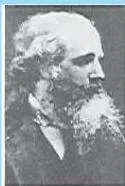
Maxwell’s deeper achievement was unification. He gathered the laws of Coulomb, Oersted, Ampere and Faraday into one consistent set — Maxwell’s equations — and derived that electromagnetic disturbances travel at a speed matching measured light speed. That is how light came to be understood as an electromagnetic wave, joining electricity, magnetism and light in one theory (NCERT, pp. 202, 205).
Hertz produced and detected these waves in the laboratory in 1887, and Marconi’s later work turned the discovery into wireless communication (NCERT, p. 202).
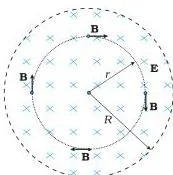
Fig 8.2(a) shows the fields between the plates at point M. The measured magnetic field at M equals the field just outside the plates at P, exactly as the displacement-current correction predicts — direct evidence that a changing electric field generates a magnetic field (NCERT, p. 203).
What exactly is displacement current
Displacement current is Maxwell’s missing term: \( i_d = \varepsilon_0\frac{d\Phi_E}{dt} \) (Eq 8.4, NCERT, p. 203). It is not a flow of charge — it is the rate of change of electric flux acting as a source of magnetic field.
The definition follows in three steps:
- Between the plates of area A carrying charge Q: \( E = \frac{Q}{A\varepsilon_0} \), so \( \Phi_E = EA = \frac{Q}{\varepsilon_0} \).
- Differentiate with time: \( \frac{d\Phi_E}{dt} = \frac{1}{\varepsilon_0}\frac{dQ}{dt} \).
- The charging current is \( i = \frac{dQ}{dt} \), hence \( \varepsilon_0\frac{d\Phi_E}{dt} = i \).
Maxwell generalised Ampere’s law to use the total current \( i = i_c + i_d \), the sum of the conduction current and the displacement current (Eq 8.5). Outside the plates only conduction current flows: \( i_c = i, i_d = 0 \). Between the plates only displacement current exists: \( i_c = 0, i_d = i \) (NCERT, p. 204).
The corrected law is the Ampere-Maxwell law (Eq 8.6, NCERT, p. 204):
\[ \oint \mathbf{B}\cdot d\mathbf{l} = \mu_0 i_c + \mu_0\varepsilon_0\frac{d\Phi_E}{dt} \]
| Basis | Conduction current | Displacement current |
|---|---|---|
| Definition | Actual flow of charge through a conductor | Rate of change of electric flux, \( \varepsilon_0\frac{d\Phi_E}{dt} \) |
| Formula | \( i_c = \frac{dQ}{dt} \) | \( i_d = \varepsilon_0\frac{d\Phi_E}{dt} \) |
| Where it exists | In the wires, outside the capacitor plates | Between the plates, where E changes with time |
| Value during charging | i | i (the same) |
| When it is zero | When the circuit is open | When the field is steady, \( d\Phi_E/dt = 0 \) |
| Physical origin | Moving charges | Time-varying electric field (electric displacement) |
So the source of a magnetic field is not just moving charge but also any time-varying electric field. Even in a region with no conductor nearby, a changing electric field predicts a magnetic field — and measurement at M confirms it (NCERT, p. 204).
Why this symmetry creates waves. Faraday’s law says a changing B makes an E; the Ampere-Maxwell law says a changing E makes a B. The two fields regenerate each other, and that mutual regeneration is the electromagnetic wave.
The symmetry is not perfect: no magnetic monopoles are known, so there is no magnetic ‘charge’ to mirror electric charge (NCERT, p. 204).
Maxwell’s equations in vacuum: the four laws
In vacuum, all of classical electromagnetism is contained in these four equations (NCERT, p. 205). Direct-recall questions often ask you to match each law with its equation.
| Law | Equation | What it says |
|---|---|---|
| Gauss’s law for electricity | \( \oint \mathbf{E}\cdot d\mathbf{A} = \frac{Q}{\varepsilon_0} \) | Charges are the sources of E; electric flux out of a closed surface equals the enclosed charge over \( \varepsilon_0 \). |
| Gauss’s law for magnetism | \( \oint \mathbf{B}\cdot d\mathbf{A} = 0 \) | No magnetic monopoles exist; net magnetic flux through any closed surface is zero. |
| Faraday’s law | \( \oint \mathbf{E}\cdot d\mathbf{l} = -\frac{d\Phi_B}{dt} \) | A changing magnetic flux induces an electric field (an emf). |
| Ampere-Maxwell law | \( \oint \mathbf{B}\cdot d\mathbf{l} = \mu_0 i_c + \mu_0\varepsilon_0\frac{d\Phi_E}{dt} \) | Magnetic fields come from conduction current plus changing electric flux (displacement current). |
The fourth equation is simply Ampere’s law with Maxwell’s displacement-current term added. Notice how the second law is the odd one out: its right side is zero because there is no magnetic monopole to play the role that charge plays for the electric field.
How electromagnetic waves are produced
The most tested idea in this chapter: only accelerated charges radiate electromagnetic waves. Stationary charges make only an electrostatic field, and charges in uniform motion (steady currents) make only a constant magnetic field. Neither field changes with time, so neither radiates (NCERT, p. 205).
Why an oscillating charge works, step by step:
- An oscillating charge is an accelerating charge, oscillating at frequency \( \nu \).
- It produces an oscillating electric field in the space around it.
- That changing E acts as a displacement current and produces an oscillating magnetic field.
- The changing B, by Faraday’s law, produces an oscillating electric field again.
- The fields regenerate each other as the wave propagates, carrying energy drawn from the source charge.
The frequency of the wave equals the frequency of oscillation of the charge (NCERT, p. 205).
Why an AC circuit cannot produce visible light. Yellow light oscillates at about \( 6 \times 10^{14}\ \) Hz, but even modern electronic circuits barely reach \( 10^{11}\ \) Hz. That gap forced Hertz to demonstrate electromagnetic waves in the radio region instead (NCERT, p. 205). If the circuit side feels shaky, our Class 12 alternating current notes revise that ground.
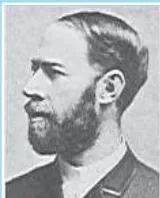
Hertz (1887) first produced and detected radio waves in the laboratory. A few years later, J.C. Bose working in Kolkata generated and observed shorter waves, 25 mm to 5 mm, still confined to the laboratory. Marconi then transmitted waves over many kilometres, marking the practical start of communication using electromagnetic waves (NCERT, p. 206).
Fields in an electromagnetic wave
Maxwell’s equations show that in an EM wave, E and B are perpendicular to each other and both are perpendicular to the direction of propagation. Fig 8.3 shows the standard picture: a plane wave travelling along +z, with E oscillating along +x and B oscillating along +y. Such a wave is linearly polarised (NCERT, p. 206).
The two fields vary sinusoidally in space and time:
\[ E_x = E_0\sin(kz – \omega t) \quad \text{and} \quad B_y = B_0\sin(kz – \omega t) \]
Here \( E_0 \) and \( B_0 \) are the amplitudes, \( k = 2\pi/\lambda \) is the magnitude of the propagation (wave) vector \( \mathbf{k} \), and \( \omega = 2\pi\nu \) is the angular frequency. The direction of \( \mathbf{k} \) gives the direction of travel (NCERT, p. 206).
Maxwell’s equations place two constraints on these waves:
- Speed: \( \omega = ck \), which in frequency form is \( \nu\lambda = c \), with \( c = \frac{1}{\sqrt{\mu_0\varepsilon_0}} \approx 3 \times 10^8\ \text{m/s} \) (Eq 8.9, NCERT, p. 207).
- Amplitudes: \( B_0 = \frac{E_0}{c} \), or \( E_0 = B_0c \) (Eq 8.10, NCERT, p. 207).
Why this particular speed? The regeneration of E and B is governed by the vacuum constants \( \mu_0 \) and \( \varepsilon_0 \), and experiment shows the same value — about \( 3 \times 10^8\ \text{m/s} \) — for every wavelength, to within a few metres per second. This constancy is so reliable that the speed of light defines a standard of length (NCERT, p. 207).
No material medium is needed. EM waves are self-sustaining oscillations of E and B in free space, which is what separates them from sound and water waves. Inside a medium of permittivity \( \varepsilon \) and permeability \( \mu \), the speed falls to \( v = 1/\sqrt{\mu\varepsilon} \) (Eq 8.11, NCERT, p. 207).
The refractive index of the next chapter is the ratio of such speeds — connect it there with the Class 12 ray optics notes.
These waves carry energy from one place to another: radio and TV signals from broadcast stations, and sunlight from the Sun to the Earth, making life on Earth possible (NCERT, p. 207).
The electromagnetic spectrum, region by region
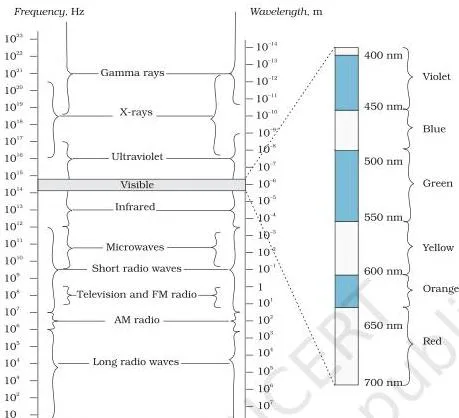
The full range of electromagnetic waves, arranged by frequency or wavelength, is the electromagnetic spectrum (Fig 8.4). All regions travel at the same speed c in vacuum; they differ only in wavelength and frequency. The boundaries between regions are not sharp, and the names reflect how each kind is produced and detected (NCERT, p. 208).
Fig 8.4 draws the whole range as one continuous band with names attached — notice that neighbouring regions blend into each other.
Table 8.1 summarises the regions (NCERT, p. 211):
| Type | Wavelength range | Production | Detection |
|---|---|---|---|
| Radio | \( \gt 0.1\ \text{m} \) | Fast acceleration and deceleration of electrons in transmitting aerials | Receiving aerials |
| Microwave | \( 0.1\ \text{m} \) to \( 1\ \text{mm} \) | Klystron valve or magnetron valve | Point contact diodes |
| Infrared | \( 1\ \text{mm} \) to \( 700\ \text{nm} \) | Atomic and molecular vibrations | Thermopiles, bolometers, infrared film |
| Light | \( 700\ \text{nm} \) to \( 400\ \text{nm} \) | Electrons in atoms dropping to lower energy levels | The eye, photocells, photographic film |
| Ultraviolet | \( 400\ \text{nm} \) to \( 1\ \text{nm} \) | Inner-shell electrons dropping to lower energy levels | Photocells, photographic film |
| X-rays | \( 1\ \text{nm} \) to \( 10^{-3}\ \text{nm} \) | X-ray tubes; inner-shell electron transitions | Photographic film, Geiger tubes, ionisation chamber |
| Gamma rays | \( \lt 10^{-3}\ \text{nm} \) | Radioactive decay of the nucleus | Same as X-ray detection |
Frequency bands worth memorising from the text (NCERT, p. 209):
- AM radio: 530–1710 kHz; short-wave bands up to 54 MHz; TV: 54–890 MHz; FM radio: 88–108 MHz; cellular phones use the UHF band.
- Microwaves: gigahertz range, produced by klystrons, magnetrons and Gunn diodes; used in radar, speed guns and microwave ovens, whose frequency matches the resonance of water molecules.
- Infrared: produced by hot bodies and molecules — called heat waves; responsible for the greenhouse effect; used in remote switches.
- Visible: about \( 4 \times 10^{14} \) to \( 7 \times 10^{14}\ \) Hz, or 700–400 nm — the only region the human eye detects.
- Ultraviolet: 400 nm down to 0.6 nm; most solar UV is absorbed by ozone at 40–50 km altitude; used in LASIK and water purifiers.
- X-rays: \( 10^{-8}\ \) m down to \( 10^{-13}\ \) m; generated by high-energy electrons hitting a metal target; used for medical imaging.
- Gamma rays: \( 10^{-10}\ \) m down to less than \( 10^{-14}\ \) m; produced in nuclear reactions and by radioactive nuclei; used to destroy cancer cells.
An antenna radiates most efficiently when the wavelength of the wave is about the same size as the antenna — that is why aerials are sized for their broadcast band (NCERT, p. 213).
Mnemonic for the spectrum order. Increasing frequency (decreasing wavelength) runs \( \text{radio} \rightarrow \text{microwave} \rightarrow \text{infrared} \rightarrow \text{visible} \rightarrow \text{ultraviolet} \rightarrow \text{X-ray} \rightarrow \text{gamma} \). Keep the first letters with ‘Raging Martians Invaded Venus Using X-ray Guns’. Reading it backwards gives the gamma-to-radio order.
Everyday applications the textbook does not list:
- Wi-Fi and Bluetooth transmit at 2.4 GHz, the same band as microwave ovens.
- Infrared thermometers measure the heat radiation a body emits, without touching it.
- Ultraviolet fluorescent markings on currency are used to check banknotes.
- Gamma irradiation sterilises food by killing microbes.
Key terms and definitions
Quick-scan vocabulary for one-mark and short-answer questions:
| Term | Meaning | Example |
|---|---|---|
| Displacement current | “Current” due to a changing electric flux, \( i_d = \varepsilon_0\frac{d\Phi_E}{dt} \); no charges move | Exists between capacitor plates while charging |
| Conduction current | Actual flow of charge through a conductor, \( i_c = \frac{dQ}{dt} \) | Current in the wire feeding the capacitor |
| Electric flux | Total electric field through a surface, \( \Phi_E = |\mathbf{E}|A \) for a uniform field normal to the area | EA between the charged plates |
| Electromagnetic wave | Coupled, time-varying electric and magnetic fields that propagate through space | Light, radio waves, X-rays |
| Propagation vector \( \mathbf{k} \) | Vector of magnitude \( k = 2\pi/\lambda \); its direction is the direction of travel | \( \mathbf{k} \) along +z for a wave moving along +z |
| Angular frequency | \( \omega = 2\pi\nu \), the rate of change of phase | \( \omega \approx 3.77 \times 10^8\ \text{rad/s} \) for a 60 MHz wave |
| Electromagnetic spectrum | The full range of EM waves ordered by frequency or wavelength | Radio waves to gamma rays |
| Heat waves (infrared) | Infrared radiation, readily absorbed by water molecules, raising their thermal motion | Infrared lamp used in physical therapy |
| Accelerated-charge radiation | Electromagnetic radiation emitted because the source charge accelerates | Oscillating charge in a transmitting aerial |
Electromagnetic waves class 12 notes: complete formula sheet
Every formula you need, with symbol meanings and SI units. Only these formulas are used in the NCERT chapter.
| Quantity | Formula | Symbols and units |
|---|---|---|
| Displacement current | \( i_d = \varepsilon_0\frac{d\Phi_E}{dt} \) | \( \Phi_E \) = electric flux in \( \text{V}\cdot\text{m} \); \( \varepsilon_0 = 8.85 \times 10^{-12}\ \text{C}^2/(\text{N}\cdot\text{m}^2) \); \( i_d \) in A |
| Ampere-Maxwell law | \( \oint \mathbf{B}\cdot d\mathbf{l} = \mu_0 i_c + \mu_0\varepsilon_0\frac{d\Phi_E}{dt} \) | \( \mu_0 = 4\pi \times 10^{-7}\ \text{T}\cdot\text{m/A} \); \( i_c \) in A; B in T |
| Plane wave, electric field | \( E_x = E_0\sin(kz – \omega t) \) | \( E_0 \) in V/m; k in rad/m; \( \omega \) in rad/s |
| Plane wave, magnetic field | \( B_y = B_0\sin(kz – \omega t) \) | \( B_0 \) in T; same k and \( \omega \) |
| Wave number | \( k = \frac{2\pi}{\lambda} \) | \( \lambda \) in m |
| Speed in vacuum | \( c = \frac{1}{\sqrt{\mu_0\varepsilon_0}} = 3 \times 10^8\ \text{m/s} \) | \( c \) is the speed of light and of every EM wave |
| Frequency–wavelength relation | \( \nu\lambda = c \) | \( \nu \) in Hz; \( \lambda \) in m |
| Field amplitudes | \( E_0 = B_0c \) | E in V/m; B in T |
| Speed in a medium | \( v = \frac{1}{\sqrt{\mu\varepsilon}} \) | \( \mu \), \( \varepsilon \) are the medium’s permeability and permittivity; \( v \) in m/s |
Worked examples: stepwise solutions with original numbers
Each example mirrors the method board numericals expect, but with fresh numbers so you can practise the working itself.
Worked example 1: Finding the magnetic field of a plane wave
Method: use \( B = E/c \) for magnitude, then fix the axis with \( \mathbf{E} \times \mathbf{B} \) = direction of propagation.
Given: a plane wave in vacuum travels along +z; at a point, E = 12 V/m along +x.
Step 1: Magnitude.
\( B = \frac{E}{c} = \frac{12\ \text{V/m}}{3 \times 10^8\ \text{m/s}} = 4 \times 10^{-8}\ \text{T} \).
Step 2: Direction.
The wave propagates along +z, so \( \mathbf{E} \times \mathbf{B} \) must point along +z.
With E along +x, \( \hat{x} \times \hat{y} = \hat{z} \), so B is along +y.
Final answer: \( \mathbf{B} = 4 \times 10^{-8}\ \hat{y}\ \text{T} \).
Worked example 2: Extracting wave parameters from a 60 MHz wave
Method: walk from wavelength to k and omega, then assemble the field equations.
Given: \( B_0 = 4.2 \times 10^{-8}\ \text{T} \), \( \nu = 60\ \text{MHz} = 60 \times 10^6\ \text{Hz} \); the wave travels along +z, B along +y.
Step 1: Wavelength.
\( \lambda = \frac{c}{\nu} = \frac{3 \times 10^8\ \text{m/s}}{60 \times 10^6\ \text{Hz}} = 5\ \text{m} \).
Step 2: Electric amplitude.
\( E_0 = B_0c = (4.2 \times 10^{-8}\ \text{T})(3 \times 10^8\ \text{m/s}) = 12.6\ \text{V/m} \).
Step 3: Wave number.
\( k = \frac{2\pi}{\lambda} = \frac{2\pi}{5} \approx 1.26\ \text{rad/m} \).
Step 4: Angular frequency.
\( \omega = 2\pi\nu = 2\pi \times 60 \times 10^6 \approx 3.77 \times 10^8\ \text{rad/s} \).
Step 5: Axes.
Wave along +z with B along +y gives E along +x, so that \( \hat{x} \times \hat{y} = \hat{z} \).
\[ E_x = 12.6\sin(1.26z – 3.77 \times 10^8 t)\ \text{V/m} \]
\[ B_y = 4.2 \times 10^{-8}\sin(1.26z – 3.77 \times 10^8 t)\ \text{T} \]
Final answer: \( \lambda = 5\ \text{m} \), \( E_0 = 12.6\ \text{V/m} \), \( k \approx 1.26\ \text{rad/m} \), \( \omega \approx 3.77 \times 10^8\ \text{rad/s} \), with the two field equations above.
Worked example 3: Displacement current in a charging capacitor
Method: write flux in terms of V, then differentiate; continuity links \( i_d \) to \( i_c \).
Given: plate area \( A = 100\ \text{cm}^2 = 10^{-2}\ \text{m}^2 \), separation \( d = 1\ \text{mm} = 10^{-3}\ \text{m} \), \( \frac{dV}{dt} = 2 \times 10^5\ \text{V/s} \).
- Step 1: Field between the plates: \( E = V/d \), uniform, so \( \Phi_E = EA = \frac{VA}{d} \).
- Step 2: Displacement current: \( i_d = \varepsilon_0\frac{d\Phi_E}{dt} = \varepsilon_0\frac{A}{d}\frac{dV}{dt} \).
\[ i_d = (8.85 \times 10^{-12})\frac{10^{-2}}{10^{-3}}(2 \times 10^5) = 1.77 \times 10^{-5}\ \text{A} \approx 17.7\ \mu\text{A} \]
Step 3: Why this equals the conduction current: charge arriving at the plate at rate \( dQ/dt = i_c \) is exactly what changes the flux, so continuity forces \( i_d = i_c \) during charging (NCERT, p. 203).
Final answer: \( i_d \approx 17.7\ \mu\text{A} \), equal to the conduction current while the capacitor charges.
Common mistakes students make
These are the traps that cost marks in this chapter:
| Students write | Correct is | How to check your answer |
|---|---|---|
| \( B = E \times c \) when finding the magnetic field | \( B = \frac{E}{c} \), because \( E_0 = B_0c \) (Eq 8.10) | Unit check: \( \frac{\text{V/m}}{\text{m/s}} = \frac{\text{V}\cdot\text{s}}{\text{m}^2} = \text{T} \), so B must come out in tesla |
| Displacement current is charge actually crossing the gap | \( i_d = \varepsilon_0\frac{d\Phi_E}{dt} \); no charge moves between the plates | Ask: is the gap a conductor? There \( i_c = 0 \) and only \( i_d \) exists |
| Stationary charges or steady currents radiate EM waves | Only accelerated charges radiate | Does the charge’s velocity change with time? If not, no wave |
| EM waves need a medium to travel | They are self-sustaining E–B oscillations and travel in vacuum | Sunlight reaches Earth across empty space |
| Guessing the B axis instead of deriving it | \( \mathbf{E} \times \mathbf{B} \) must equal the propagation direction | For +z propagation with E along +x: \( \hat{x} \times \hat{y} = \hat{z} \), so B along +y |
| Leaving MHz as MHz and nm as nm in \( \nu\lambda = c \) | Convert first: \( 1\ \text{MHz} = 10^6\ \text{Hz} \), \( 1\ \text{nm} = 10^{-9}\ \text{m} \) | A 60 MHz wave should give \( \lambda \) of the order of metres; a wild number means a conversion slip |
Exam notes: what earns the mark
Observed patterns, written with an examiner’s mindset:
- Name the quantity first. In a displacement-current question, writing \( i_d = \varepsilon_0\frac{d\Phi_E}{dt} \) and then separating conduction current (outside plates) from displacement current (inside plates) earns the early marks (NCERT, p. 204).
- Show the formula before substituting. For field-amplitude numericals, write \( E_0 = B_0c \) and \( c = 1/\sqrt{\mu_0\varepsilon_0} \) explicitly; the formula step itself carries the mark (NCERT, p. 207).
- Direction questions are checked on the vector rule. Show \( \mathbf{E} \times \mathbf{B} \) pointing along propagation, then state the axis of B (NCERT, p. 206).
- Spectrum questions reward one production plus one application per region — the Table 8.1 pairings. Quote the wavelength range only when asked (NCERT, p. 211).
- The recurring numerical trap is the unit conversion in \( \nu\lambda = c \): \( 1\ \text{MHz} = 10^6\ \text{Hz} \), \( 1\ \text{nm} = 10^{-9}\ \text{m} \). Checking the order of magnitude of your answer catches it.
Revision summary: the chapter in one page
Scan this table in the last five minutes before the exam:
| Idea | Formula / fact | Key value |
|---|---|---|
| Displacement current | \( i_d = \varepsilon_0\frac{d\Phi_E}{dt} \) | Equals the charging current in the gap |
| Ampere-Maxwell law | \( \oint \mathbf{B}\cdot d\mathbf{l} = \mu_0 i_c + \mu_0\varepsilon_0\frac{d\Phi_E}{dt} \) | Removes the capacitor contradiction |
| Wave speed in vacuum | \( c = \frac{1}{\sqrt{\mu_0\varepsilon_0}} \) | \( 3 \times 10^8\ \text{m/s} \) |
| Field amplitudes | \( E_0 = B_0c \) | B is tiny: \( 4 \times 10^{-8}\ \text{T} \) for \( E = 12\ \text{V/m} \) |
| Plane wave | \( E_x = E_0\sin(kz – \omega t) \), \( B_y = B_0\sin(kz – \omega t) \) | E, B and propagation are mutually perpendicular |
| Speed in a medium | \( v = \frac{1}{\sqrt{\mu\varepsilon}} \) | \( v \lt c \); basis of refractive index |
| Spectrum order | Increasing frequency: radio to microwave to infrared to visible to ultraviolet to X-ray to gamma | All regions travel at c in vacuum |
Points to ponder (NCERT, p. 213):
- EM waves differ from each other in wavelength and frequency, not in vacuum speed.
- An antenna radiates best when its size is about one wavelength of the wave.
- Infrared vibrates whole atoms and molecules, raising temperature — hence heat waves.
- Human eyes are most sensitive to the wavelengths the Sun emits most strongly.
If you are revising several subjects together, the Class 12 notes hub collects every chapter in one place. Need other classes or subjects? Browse the full CBSE notes library.
FAQs on electromagnetic waves
Is displacement current a real current — do charges actually flow inside a capacitor?
No charge crosses the gap, so it is not a flow-of-charge current. It is real in effect: the changing electric flux \( \varepsilon_0\frac{d\Phi_E}{dt} \) produces a magnetic field exactly as a conduction current does. The measured field between the plates (Fig 8.2) equals the field just outside, confirming this (NCERT, p. 203).
What is the direction of the magnetic field in an electromagnetic wave and how do we find it?
B is perpendicular to both E and the direction of travel. Use \( \mathbf{E} \times \mathbf{B} \) = direction of propagation. For a wave along +z with E along +x, \( \hat{x} \times \hat{y} = \hat{z} \), so B points along +y (NCERT, p. 206).
Why can we not produce electromagnetic waves at the frequency of visible light with an AC circuit?
Frequency gap: yellow light is about \( 6 \times 10^{14}\ \) Hz, while even modern electronic circuits reach only about \( 10^{11}\ \) Hz. Hertz therefore demonstrated EM waves in the radio region (NCERT, p. 205).
Are conduction current and displacement current equal in magnitude inside a charging capacitor?
Yes, while charging. The current arriving at a plate is \( dQ/dt \), and \( \varepsilon_0\frac{d\Phi_E}{dt} = dQ/dt \), so \( i_d = i_c \). In the gap \( i_c = 0 \) and \( i_d = i \); in the wire \( i_d = 0 \) and \( i_c = i \) (NCERT, p. 204).
Why are infrared waves called heat waves?
Water molecules (and \( CO_2 \), \( NH_3 \)) absorb infrared waves readily. The absorbed energy increases their thermal motion, so the material heats up and warms its surroundings (NCERT, p. 210).
Why do electromagnetic waves travel through vacuum while sound waves cannot?
EM waves are self-sustaining: the oscillating E creates B and the oscillating B creates E, so no medium is required. Sound is a mechanical vibration and needs particles to carry it (NCERT, p. 207).
Reference: NCERT Class 12 Physics Part I textbook, Chapter 8 — Electromagnetic Waves.
Explore Class 12 Physics Notes
More for this chapter:
Class 12 Physics on LearnCBSE:
Related chapters: