
Class 12 Geography Chapter 5, Secondary Activities, explains the part of the economy that turns raw materials into useful goods. These revision notes cover the same ground as NCERT pages 36–44 of Fundamentals of Human Geography: the meaning of secondary activities and manufacturing, the six characteristics of modern large-scale industry, the seven location factors, the classification of industries, and high-technology industry.
The notes follow the 2026-27 session and are built for a quick but complete revision: definitions with page references, comparison tables, a worked example, common mistakes, and a final checklist you can read the night before. The chapter’s exercises are not worked through on this page — you get the concepts and the answering method instead.
If you want the full set, browse the Class 12 Geography notes hub.
What Are Secondary Activities?
Every economic activity — primary, secondary, tertiary and quaternary — revolves around obtaining and using the resources we need for survival. Within that set, secondary activities add value to natural resources by transforming raw materials into valuable products (NCERT, p. 36).
Cotton in the boll has limited use, but once spun into yarn it becomes more valuable and can be made into clothes. Iron ore cannot be used directly from the mine, but once converted into steel it gains value and can be shaped into machines and tools.
The same holds for most materials that come from the farm, the forest, the mine and the sea.
Secondary activities, therefore, cover manufacturing, processing and construction (infrastructure) industries. Everything else in this chapter — location, classification, high-tech industry — hangs off this one idea: raw material in, higher-value product out.
The Chapter in Five Revision Points
Fix this map of the chapter in your head before you revise the details.
| Revision cluster | What it covers | NCERT pages |
|---|---|---|
| Value addition and manufacturing | Raw materials transformed into valuable products; the meaning of manufacturing | pp. 36–37 |
| Modern large-scale manufacturing | Six characteristics of modern industry, from specialisation to automation | pp. 36–37 |
| Industrial location factors | The seven factors that decide where industry is set up | pp. 37–38 |
| Classification of industries | Grouping industries by size, inputs, output and ownership | pp. 38–42 |
| High-technology industry | The latest generation of manufacturing; technopolies | pp. 42–43 |
Manufacturing: Meaning, Craft Method and Mass Production
Manufacturing literally means ‘to make by hand’. Today the term includes goods made by machines, and the chapter defines it as the process of transforming raw materials into finished goods of higher value for sale in local or distant markets (NCERT, p. 37).
Manufacturing spans an enormous range — from handicrafts to moulding iron and steel, stamping out plastic toys, and assembling delicate computer components or space vehicles. Whatever the product, the common features are the application of power, the mass production of identical products, and specialised labour in factory settings producing standardised commodities (NCERT, p. 36).
Why ‘manufacturing industry’ and not just ‘industry’? Because industry is the broader word: it covers factory activities like the steel and chemical industries, but also secondary activities that do not happen in factories, such as the entertainment industry and the tourism industry. To stay clear, the textbook uses the longer expression ‘manufacturing industry’ for factory-based manufacturing.
| Craft method | Mass production |
|---|---|
| A few pieces, made to order | Large quantities of standardised parts |
| The product is often finished as a whole | Each worker performs only one task, repeatedly |
| Costs are high | Repetition and scale suit a factory line |
Definitions at a Glance
These are the nine key terms the chapter keeps returning to, with the textbook pages where each is defined.
| Term | Student-friendly meaning | NCERT page |
|---|---|---|
| Secondary activities | Activities that add value to natural resources by transforming raw materials into valuable products — manufacturing, processing and construction industries | p. 36 |
| Manufacturing | Literally ‘to make by hand’; today, making goods with machines and transforming raw materials into finished goods of higher value for sale in local or distant markets. The phrase ‘manufacturing industry’ is used because plain ‘industry’ also covers entertainment and tourism. | p. 37 |
| Mechanisation | Using gadgets (machines) that accomplish tasks | p. 37 |
| Automation | The advanced stage of mechanisation, where manufacturing proceeds without human thinking during the process | p. 37 |
| Footloose industries | Industries tied to no specific raw material; small output and small labour force; generally non-polluting; located mainly by road-network accessibility | p. 38 |
| Agglomeration economies | Savings an industry gains from locating near a leader-industry and other linked industries | p. 38 |
| Basic industries | Industries whose products are used by other industries as raw materials (iron/steel → machines for the textile industry) | p. 42 |
| Consumer goods industries | Industries whose goods are consumed directly by users (bread, tea, soaps, televisions); also called non-basic industries | p. 42 |
| Technopoly | High-tech industries that are regionally concentrated, self-sustained and highly specialised | p. 42 |
Six Characteristics of Modern Large-Scale Manufacturing
Modern large-scale manufacturing is defined by six characteristics (NCERT, pp. 36–37). Learn them as a set — an answer on the trends of modern industry is largely these six points restated.
- Specialisation of skills / methods of production — production is either craft-based (a few made-to-order pieces, high cost) or mass production (large quantities of standardised parts, one repeated task per worker).
- Mechanisation — using gadgets that accomplish tasks.
- Automation — the advanced stage of mechanisation, in which the process runs without human thinking; automatic factories with feedback and closed-loop computer control systems, where machines are developed to ‘think’, have sprung up worldwide.
- Technological innovation — research and development aimed at quality control, eliminating waste and inefficiency, and combating pollution.
- Organisational structure and stratification — complex machine technology plus extreme specialisation and division of labour to produce more goods with less effort and lower cost; this demands vast capital, large organisations and executive bureaucracy.
- Uneven geographic distribution — the major concentrations of modern manufacturing cover less than 10 per cent of the world’s land area, yet these few places have become centres of economic and political power. Manufacturing is far more concentrated than agriculture: 2.5 km² of the American corn belt typically holds about four large farms employing 10–20 workers and supporting 50–100 persons, while the same area could contain several large integrated factories employing thousands of workers.
| Mechanisation | Automation |
|---|---|
| Uses gadgets that accomplish tasks | Advanced stage of mechanisation |
| Human thinking still guides the process | No human thinking during the manufacturing process |
| Machines replace manual effort | Closed-loop computer controls let machines ‘think’ and run feedback systems |
Location Factors: The Chapter’s Real ‘Formulas’
Industries maximise profit by reducing costs, so the ideal location is where production costs are minimum. The chapter gives seven location factors, best revised as decision rules (NCERT, pp. 37–38).
| Factor | Decision rule | Example from the chapter |
|---|---|---|
| Access to market | Locate where people have demand and the purchasing power to buy | Aircraft manufacturing and the arms industry serve global markets; densely populated South and South-east Asia form large markets |
| Access to raw material | Cheap, bulky and weight-losing material pulls the industry to the source; perishability also forces proximity | Steel, sugar and cement (bulky/weight-losing); agro-processing and dairy products close to farms or milk supply (perishable) |
| Access to labour supply | Skilled labour attracts industry, but mechanisation and automation reduce that dependence | Industries that still require skilled labour; mechanised plants need fewer workers |
| Access to sources of energy | Power-hungry industries locate close to the energy supply | The aluminium industry; coal earlier, today hydroelectricity and petroleum |
| Transportation and communication | Speedy, efficient transport of raw materials in and finished goods out attracts industry | Western Europe and eastern North America, whose dense transport systems induced industrial concentration |
| Government policy | Regional policies deliberately set up industries in particular areas for balanced development | Industries established in chosen regions under government policy |
| Agglomeration economies | Locate near a leader-industry to save through linkages between industries | Industries that benefit from the nearness of a leader-industry and other industries |
A working analogy for agglomeration economies: a shopping street. When one new shop opens on a busy street it brings more footfall, and every existing shop gains customers without spending anything. In the same way, an industry that settles near a leader-industry picks up savings through linkages it did not pay for.
The footloose industry is the exception that tests all these rules (NCERT, p. 38). It can be located in a wide variety of places because it depends on no specific raw material, weight-losing or otherwise — its component parts can be obtained anywhere.
It produces in small quantity, employs a small labour force, is generally not polluting, and its one critical locational need is accessibility by road network.
Classification of Industries: Reading Fig 5.1
Manufacturing industries are classified on four bases: size, inputs or raw materials, output or products, and ownership (NCERT, p. 38). Fig 5.1 is the chapter’s master diagram — keep it in mind and the rest of the chapter is just four branches, each covered by the next sections.
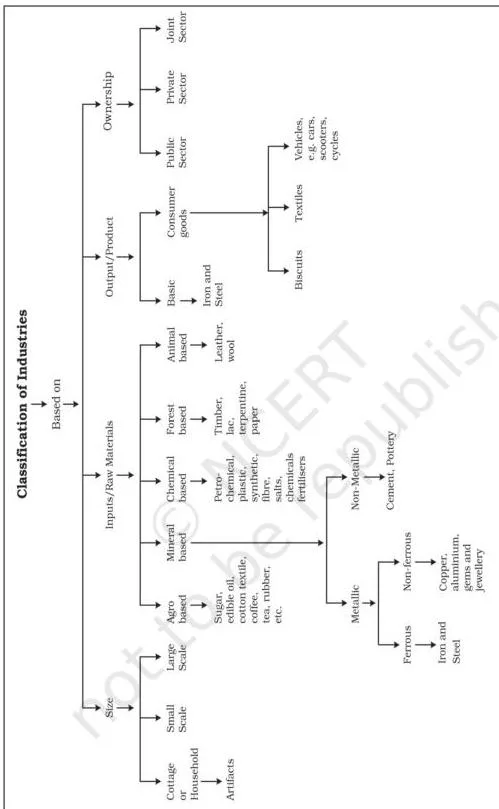
Memory device: the four bases are S-I-O-O (say it like ‘see-oo’) — Size, Inputs, Output, Ownership. Whatever industry you are asked to classify, run it through these four questions and you will place it correctly.
Note that size itself is decided by three things: the amount of capital invested, the number of workers employed, and the volume of production (NCERT, p. 38).
Size-Based Industries: Household, Small-Scale and Large-Scale
Household (cottage) industries are the smallest manufacturing units. Artisans use local raw materials and simple tools to produce everyday goods in their homes, with the help of family members or part-time labour. Output may be consumed in the same household, sold in local village markets, or bartered.
Because their commercial significance is low, capital and transport matter little, and most tools are devised locally (NCERT, p. 40).
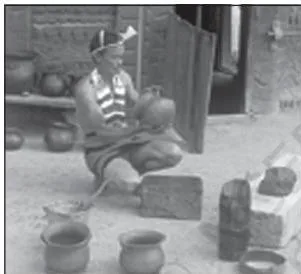
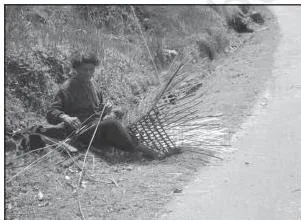
The two photographs in Fig 5.2 are the chapter’s own examples of household production: a man making pots in his courtyard in Nagaland, and a man weaving a bamboo basket by the roadside in Arunachal Pradesh. Both use local material and simple tools.
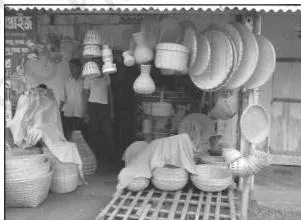
Fig 5.3 shows the other end of the household chain — cottage industry products on sale in Assam, which is how such goods reach the local market.
Small-scale manufacturing differs from household industry in two ways: production technique and place of manufacture. It works in a workshop outside the home, uses local raw material, simple power-driven machines and semi-skilled labour. Because it provides employment and raises local purchasing power, countries like India, China, Indonesia and Brazil have promoted labour-intensive small-scale manufacturing as an employment strategy (NCERT, p. 40).
Large-scale manufacturing needs a large market, varied raw materials, enormous energy, specialised workers, advanced technology, assembly-line mass production and large capital. It developed over the last 200 years in the United Kingdom, north-eastern USA and Europe, and has since diffused almost worldwide (NCERT, pp. 40–41).
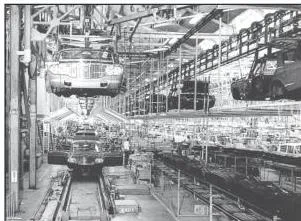
Fig 5.4 shows the factory face of large-scale industry — workers on a passenger-car assembly line at a Motor Company plant in Japan, the chapter’s example of assembly-line mass production.
The world’s large-scale industrial regions fall into two broad types:
- Traditional large-scale industrial regions, thickly clustered in a few more developed countries.
- High-technology large-scale industrial regions, which have diffused to less developed countries.
| Feature | Household or cottage | Small-scale | Large-scale |
|---|---|---|---|
| Capital | Low; most tools devised locally | Limited; a few simple powered machines | Vast capital for plant, technology and assembly line |
| Workers | Family members or part-time labour | Semi-skilled labour | Specialised workers in large numbers |
| Tools and place of work | Simple tools, worked in the home | Simple power-driven machines in a workshop outside the home | Advanced technology on a factory assembly line |
| Market | Home use, barter or local village sale | Provides employment and raises local purchasing power; serves local buyers | A large market, often national or global |
Input-Based Industries: Agro, Mineral, Chemical, Forest, Animal
On the basis of raw materials, industries are divided into five categories (NCERT, pp. 41–42).
| Category | Raw materials used | Examples from the chapter |
|---|---|---|
| Agro-based | Raw materials from the field and the farm | Food processing, sugar, pickles, fruit juices, beverages (tea, coffee, cocoa), spices, oils and fats, textiles (cotton, jute, silk), rubber |
| Mineral-based | Ferrous metallic, non-ferrous metallic and non-metallic minerals | Iron and steel; aluminium, copper and jewellery; cement and pottery |
| Chemical-based | Natural chemical minerals, plus raw materials from wood and coal | Petrochemicals from mineral oil, salts, sulphur, potash, synthetic fibre, plastic |
| Forest-based | Major and minor forest products | Timber for furniture, wood, bamboo and grass for paper, lac for lac industries |
| Animal-based | Products obtained from animals | Leather, wool for woollen textiles, ivory from elephant tusks |
Agro-processing turns raw materials from the field and farm into finished products for rural and urban markets; food processing (canning, cream, fruit processing, confectionery) is a major part of it. Agri-business is commercial farming on an industrial scale, often financed by businesses whose main interests lie outside agriculture — the chapter’s example is large corporations in the tea plantation business.
Agri-business farms are mechanised, large, highly structured, reliant on chemicals, and may be described as ‘agro-factories‘ (NCERT, p. 41).
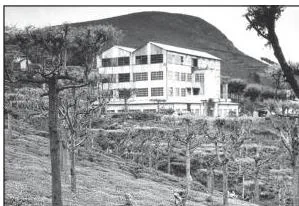
Fig 5.5 pairs a tea garden with a tea factory in the Nilgiri Hills of Tamil Nadu — the garden supplies the factory, so processing sits right next to its raw material. That is the classic pattern of agro-processing.
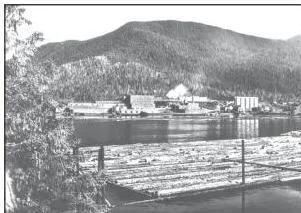
Fig 5.6 makes the same point for a forest-based industry: the pulp mill stands in the heart of Ketchikan’s timber area in Alaska, placed inside the source of its raw material.
Output and Ownership: Basic, Consumer, Public, Private, Joint
Look at the link chain the chapter builds: iron/steel → machines for the textile industry → clothes for consumers. The industry whose products are used to make other goods — here iron and steel — is a basic industry.
Industries producing goods consumers use directly — bread and biscuits, tea, soaps and toiletries, writing paper, televisions — are consumer goods industries, also called non-basic industries (NCERT, p. 42).
| Ownership sector | Who owns and manages it | Notes from the chapter |
|---|---|---|
| Public sector | Owned and managed by governments | India had a number of Public Sector Undertakings (PSUs); socialist countries have many state-owned industries; mixed economies have both public and private enterprises |
| Private sector | Owned by individual investors, managed by private organisations | In capitalist countries, industries are generally owned privately |
| Joint sector | Managed by joint stock companies, or established and managed by the private and public sectors together | Mixed economies contain both public and private enterprises |
High-Technology Industry and Technopolies
High-technology (high-tech) industry is the latest generation of manufacturing activities. It is best understood as the application of intensive research and development (R&D) leading to products of an advanced scientific and engineering character (NCERT, p. 42).
- Workforce: professional (white-collar) workers make up a large share of the total; highly skilled specialists greatly outnumber the blue-collar production workers.
- Typical high-tech processes: robotics on the assembly line, computer-aided design (CAD) and manufacturing, electronic controls of smelting and refining processes, and the constant development of new chemical and pharmaceutical products.
- Landscape: neatly spaced, low, modern, dispersed office-plant-lab buildings rather than massive assembly structures; planned business parks for high-tech start-ups have become part of regional and local development schemes.
High-tech industries that are regionally concentrated, self-sustained and highly specialised are called technopolies. The chapter names Silicon Valley near San Francisco and Silicon Forest near Seattle as examples, then asks whether technopolies are developing in India (NCERT, p. 43).
The textbook leaves that question open — a good answer defines a technopoly first and then argues for its own chosen example using the ideas of regional concentration, self-sustainability and specialisation.
Worked Example: Classifying Four Industries and Choosing a Location
The method: ask three questions about any industry
- What raw material does it use?
- What happens to that material — is it bulky, weight-losing or perishable, or is the real cost in another input such as power?
- Who owns the production unit?
The first two questions fix the classification basis and the location factor; the third places the industry in the public, private or joint sector. Apply them to four original cases below — none of these exact scenarios is worked out in the textbook, so they test your transfer of the rules (NCERT, pp. 37–42).
| Original case | Classification basis | Strongest location factor | Why the rule applies |
|---|---|---|---|
| A sugar mill beside sugarcane fields | Agro-based (inputs) | Raw material | Sugarcane is bulky and weight-losing — it shrinks in processing, so it is cheaper to move the finished sugar than the cane |
| An aluminium smelter near a hydroelectric plant | Mineral-based, non-ferrous metallic (inputs) | Energy | Aluminium smelting uses huge amounts of power; the chapter gives the aluminium industry as the classic energy-located industry |
| A software design unit in a planned business park | High-technology, footloose | Transport and communication (road access) | Its inputs — component parts and skills — can be obtained anywhere; footloose industries locate mainly by road-network accessibility |
| A bakery selling bread in the same town | Consumer goods (output) | Market | Bread is perishable and bought directly by consumers, so the bakery must sit near its customers |
Common Mistakes to Avoid in This Chapter
| Students write | Correct rule | How to check your answer |
|---|---|---|
| Footloose industries have no locational constraints at all. | They have no raw-material tie, but road accessibility is still a locational requirement. | Ask: can the industry go literally anywhere? No — it still needs to be reachable by road. |
| Basic industries and consumer industries are the same. | Basic industries make raw materials for other industries (iron/steel → textile machinery); consumer goods industries sell directly to users (bread, soaps, TVs). | Trace the chain: is the product consumed directly, or fed into another industry? |
| Mechanisation and automation are the same. | Mechanisation uses gadgets that accomplish tasks; automation is the advanced stage, with no human thinking during production. | Does a human steer the process? If machines ‘think’ via closed-loop controls, it is automation. |
| Household and small-scale industries are the same. | Household units work in the home with family labour and simple tools; small-scale units work in a workshop with power-driven machines and semi-skilled labour. | Check the place of work and the tool: home + simple tools → household; workshop + powered machines → small-scale. |
| Every industry must be near its raw material. | Market, energy, transport, government policy and agglomeration also decide location — footloose industries ignore raw materials entirely. | List all seven location factors before you decide; raw material is only one of them. |
| ‘Industry’ means only factories. | The term also covers entertainment and tourism, which is why the textbook prefers ‘manufacturing industry’. | Would the activity count as manufacturing? If not, it is ‘industry’ only in the broad sense. |
How to Answer the End-of-Chapter Exercises
The chapter’s exercises ask for short notes, a differentiation, and discussion-style answers. The same methods work across all of them.
For a short note of about 30 words (on high-tech industry, manufacturing, or footloose industries), a complete answer has three parts: a one-line definition, one supporting point, and one example. For manufacturing: define it as transforming raw materials into finished goods of higher value, add that it now includes machine-made goods, and close with cotton-into-yarn or iron-ore-into-steel.
For the 150-word differentiation between primary and secondary activities, build a two-column comparison. This table is a ready structure you can expand into paragraphs:
| Point of comparison | Primary activities | Secondary activities |
|---|---|---|
| What they do | Obtain and use resources directly from nature | Add value by transforming raw materials into valuable products |
| Examples | Farming, fishing, forestry, mining | Textiles, steel, food processing, construction |
| Relationship to nature | Production tied directly to natural resources | Process the products the primary sector supplies |
| Value | Raw resources in their natural state | Finished goods of higher value |
For the trend and location questions, gather points from the chapter’s own material. The six characteristics of modern large-scale manufacturing supply the trends; the seven location factors supply the ‘why there’; the two types of large-scale industrial regions explain the geography.
For the question on high-tech industry in peripheral areas of metropolitan centres, combine the high-tech landscape (low, modern, dispersed office-plant-lab buildings, planned business parks) with the footloose industry’s need for road accessibility. Some discussion questions — such as the one on Africa’s industrial backwardness — expect you to apply the location factors and reason with them rather than copy a book answer.
One-Page Recap: Secondary Activities in Thirty Seconds
- Core definition: secondary activities add value by transforming raw materials — manufacturing, processing and construction industries.
- Manufacturing: ‘to make by hand’, now machine-made; ‘manufacturing industry’ because plain ‘industry’ also covers entertainment and tourism.
- Six characteristics: specialisation of skills, mechanisation, automation, technological innovation, organisational structure and stratification, uneven geographic distribution.
- Seven location factors: market, raw material, labour, energy, transport and communication, government policy, agglomeration economies.
- Footloose exception: no raw-material tie; located by road-network accessibility.
- Classification: S-I-O-O — Size, Inputs, Output, Ownership.
- High-tech industry: R&D-driven, white-collar-heavy, dispersed office-plant-lab landscape; technopolies like Silicon Valley and Silicon Forest.
Revise the economic-activities story as one family: the Primary Activities notes cover the extractive side that supplies industry’s raw materials, and the Tertiary and Quaternary Activities notes continue the story into services. For the whole picture, browse the Class 12 notes and the CBSE notes library.
The official NCERT textbook PDF for this chapter (Fundamentals of Human Geography, chapter 5) is hosted on ncert.nic.in and is worth opening for the original figures and exercises.
Quick Answers: Doubts Students Ask About This Chapter
What is the difference between a basic industry and a consumer goods industry?
A basic industry makes products that other industries use as raw materials — iron/steel becomes machines for the textile industry. A consumer goods industry makes goods used directly by consumers, such as bread, tea, soaps and televisions; the chapter also calls these non-basic industries.
Why are footloose industries not tied to raw materials?
They depend on component parts that can be obtained anywhere rather than on one specific raw material, and they produce in small quantity with a small labour force and are generally non-polluting. Their one real locational need is accessibility by road network.
What is the difference between mechanisation and automation?
Mechanisation means using gadgets that accomplish tasks, with human thinking still guiding the process. Automation is the advanced stage of mechanisation, where the manufacturing process runs without human thinking — as in automatic factories with feedback and closed-loop computer control systems.
What are technopolies, and what examples does the NCERT give?
Technopolies are high-tech industries that are regionally concentrated, self-sustained and highly specialised. NCERT names Silicon Valley near San Francisco and Silicon Forest near Seattle as its examples (NCERT, p. 43).
Why are sugar and cement industries located near raw materials?
Both use cheap, bulky, weight-losing materials — the raw material loses weight during processing, so transporting it far is costlier than transporting the finished product. The textbook groups steel, sugar and cement under this rule (NCERT, p. 38).
How should I differentiate primary and secondary activities in an answer?
Structure the answer as two columns: what each activity does (obtaining resources directly vs adding value by transformation), examples (farming, fishing, forestry, mining vs textiles, steel, food processing), and the relation to natural resources (raw produce from the farm, forest, mine and sea vs the finished goods made from those materials).
Reference: NCERT Class 12 Fundamentals of Human Geography textbook, chapter Secondary Activities.
Explore Class 12 Geography Notes
- Class 12 Geography Notes
- Class 12 CBSE Notes
- CBSE Notes for Classes 1 to 12
- Previous: Primary Activities
- Next: Tertiary and Quaternary Activities
Class 12 Geography on LearnCBSE:
Related chapters:
- The World Population notes
- Human Development notes
- Transport and Communication notes