
These mineral and energy resources class 12 notes condense the entire NCERT Chapter 5 (India: People and Economy) into one revision page, following the 2026-27 session.
You get the definition and classification of minerals, India’s three mineral belts, the state-wise spread of iron ore, manganese, bauxite, copper and mica, conventional and non-conventional energy, and the conservation argument — all in tables you can memorise in one sitting.
The page is built around the chapter’s own structure and its five NCERT figures. Most key facts carry their NCERT page number, so you can cross-check a doubt in seconds. Read it top to bottom the first time; later, use the contents list below to jump straight to the section you are revising.
If you need the full chapter text beside these notes, the official PDF (legy205.pdf) is free on the NCERT website. For other units from the same book, head to the Class 12 Geography notes hub; for every subject, use the Class 12 notes collection.
The Chapter at a Glance: Minerals First, Energy Second
The whole chapter moves in one direction: understand minerals, then see how they power the country. Six steps carry that logic.
- What a mineral is — a natural substance of organic or inorganic origin with definite chemical and physical properties, with three defining characteristics (NCERT, p. 54).
- Types of minerals — metallic (ferrous and non-ferrous) and non-metallic (organic and inorganic), mapped in Fig 5.1.
- Where minerals sit — three broad belts in peninsular India plus the Himalayan belt and the Assam valley.
- The mineral-wise picture — ferrous (iron ore, manganese), non-ferrous (bauxite, copper) and non-metallic (mica) minerals.
- Energy sources — conventional (coal, petroleum, natural gas, nuclear) and non-conventional (solar, wind, tidal and wave, geothermal, bio-energy).
- Conservation — minerals cannot be replenished; they “do not have the second crop”.
Five NCERT figures carry most of the distribution data. Each one is explained in the section where it belongs, so the maps become revision tools, not decorations.
What Is a Mineral? Definition, Characteristics and the Classification Tree
A mineral is a natural substance of organic or inorganic origin with definite chemical and physical properties (NCERT, p. 53). India is mineral-rich because of its varied geological structure: most valuable minerals are products of the pre-Palaeozoic age, locked in the metamorphic and igneous rocks of peninsular India.
The vast alluvial plains of north India, by contrast, are devoid of minerals of economic use.
| Term | Meaning | Example |
|---|---|---|
| Mineral | Natural substance of organic or inorganic origin with definite chemical and physical properties | iron ore, coal, mica |
| Metallic minerals | Minerals that are sources of metals | iron ore, copper, gold |
| Ferrous metallic | Metallic minerals that contain iron | iron ore |
| Non-ferrous metallic | Metallic minerals without iron content | copper, bauxite |
| Non-metallic (organic) | Fossil fuels, also called mineral fuels, derived from buried animal and plant life | coal, petroleum |
| Non-metallic (inorganic) | Non-metallic minerals of inorganic origin | mica, limestone, graphite |
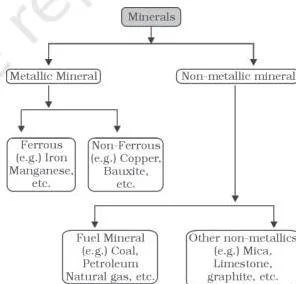
Fig 5.1 is the chapter’s route map. Walk it from the top: minerals split first into metallic and non-metallic. Metallic divides into ferrous (with iron, such as iron ore) and non-ferrous (without iron, such as copper and bauxite). Non-metallic divides into organic — fossil fuels like coal and petroleum — and inorganic, like mica, limestone and graphite.
Redraw this tree from memory and you have already solved most classification questions in the chapter.
Minerals share three characteristics (NCERT, p. 54):
- Unevenly distributed over space — some regions are rich, others empty.
- Inverse relation between quality and quantity — good-quality minerals exist in smaller quantity than low-quality ones.
- All minerals are exhaustible — they take long to form geologically and cannot be replenished at the time of need.
That third point is why the book warns that minerals “do not have the second crop”: squander them and there is no harvest next season. This single phrase ties the whole chapter’s conservation argument together.
Where India’s Minerals Are: The Three Belts and the Himalayan Belt
Two spatial rules set the scene before the belts (NCERT, p. 54):
- Over 97 per cent of coal reserves lie in the valleys of the Damodar, Sone, Mahanadi and Godavari rivers.
- Most major minerals occur east of a line joining Mangaluru and Kanpur — so this eastern part of peninsular India is the mineral heartland.
| Belt | States covered | Minerals found |
|---|---|---|
| North-Eastern Plateau | Chhotanagpur (Jharkhand), Odisha plateau, West Bengal, parts of Chhattisgarh | Iron ore, coal, manganese, bauxite, mica — the most diversified list of the three belts |
| South-Western Plateau | Karnataka, Goa, contiguous Tamil Nadu uplands, Kerala | Ferrous metals, bauxite, high-grade iron ore, manganese, limestone. Lacks coal except Neyveli lignite. Kerala has monazite, thorium and bauxite clay; Goa has iron ore |
| North-Western Region | Along the Aravali in Rajasthan and parts of Gujarat; minerals associated with Dharwar system rocks | Copper, zinc; building stones (sandstone, granite, marble); gypsum, Fuller’s earth, dolomite, limestone; Gujarat’s petroleum; salt in both Gujarat and Rajasthan |
Two further zones complete the picture (NCERT, p. 54–55). The Himalayan belt carries copper, lead, zinc, cobalt and tungsten on both its eastern and western parts. The Assam valley holds mineral oil deposits, and oil is also found offshore near the Mumbai coast at Mumbai High.
One curiosity from the textbook: it pairs the north-western belt’s salt wealth with a margin question on why and where Mahatma Gandhi organised the Dandi March — salt, not just coal, connects the belts to national history.
Memory trick — “NE has the most, SW has the best, NW has the rest.” The North-Eastern belt has the most diversified minerals; the South-Western belt has the best (high-grade) iron ore; the North-Western belt holds the rest — building stones, gypsum and salt. The rhyme fixes both the order of the belts and their one-line identities.
Ferrous Minerals: Iron Ore and Manganese
Ferrous minerals — iron ore, manganese, chromite and the like — provide the base for metallurgical industries, and India is well placed in both reserves and production (NCERT, p. 55).
Iron ore
India holds the largest iron ore reserve in Asia. The two ore types are haematite and magnetite, and Indian ore has great demand internationally for its superior quality. A key locational advantage: the mines lie close to the coal fields of the north-eastern plateau.
About 95 per cent of reserves sit in Odisha, Jharkhand, Chhattisgarh, Karnataka, Goa, Telangana, Andhra Pradesh and Tamil Nadu (NCERT, p. 55).
| State | Main districts and mines |
|---|---|
| Odisha | Hill ranges of Sundergarh, Mayurbhanj and Kendujhar — Gurumahisani, Sulaipet, Badampahar, Kiruburu, Bonai |
| Jharkhand | Oldest mines in Poorbi and Pashchimi Singhbhum — Noamundi and Gua; most iron and steel plants sit around them |
| Chhattisgarh | Durg, Dantewara, Bailadila — Dalli and Rajhara in Durg |
| Karnataka | Sandur-Hospet (Ballari), Baba Budan hills, Kudremukh (Chikkamagaluru), parts of Shivamogga, Chitradurg and Tumakuru |
| Maharashtra | Chandrapur, Bhandara, Ratnagiri |
| Telangana and Andhra Pradesh | Karimnagar and Warangal (Telangana); Kurnool, Cuddapah and Anantapur (AP) |
| Tamil Nadu | Salem, Nilgiris |
| Goa | Emerging as an important producer |
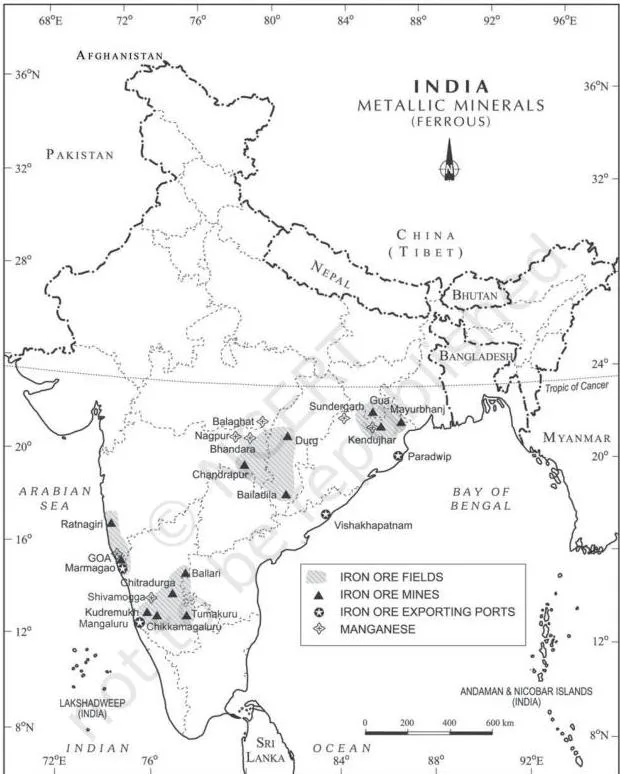
Read Fig 5.2 as the visual of the 95-per-cent fact. The ferrous mineral clusters sit in the eastern half of peninsular India: the Odisha–Jharkhand–Chhattisgarh block (Gurumahisani, Noamundi, Gua, Bailadila) and a second cluster on Karnataka’s western side (Sandur-Hospet, Kudremukh). The map matches the chapter’s rule that most major minerals lie east of the Mangaluru–Kanpur line.
Manganese
Manganese is the raw material for smelting iron ore and for manufacturing ferro alloys. It is found in almost all geological formations but is mainly associated with the Dharwar system. Madhya Pradesh and Odisha are the leading producers; Karnataka and Maharashtra follow, with Telangana, Goa and Jharkhand as minor producers.
The major disadvantage: these mines sit far from steel plants, which raises transport cost (NCERT, p. 55–57).
- Odisha: central part of the iron ore belt — Bonai, Kendujhar, Sundergarh, Gangpur, Koraput, Kalahandi, Bolangir.
- Madhya Pradesh: a belt through Balaghat–Chhindwara–Nimar–Mandla and Jhabua.
- Karnataka: Dharwar, Ballari, Belagavi, North Canara, Chikkamagaluru, Shivamogga, Chitradurg, Tumakuru.
- Maharashtra: Nagpur, Bhandara, Ratnagiri.
Non-Ferrous and Non-Metallic Minerals: Bauxite, Copper and Mica
The chapter’s blunt judgement first: India is poorly endowed with non-ferrous metallic minerals except bauxite (NCERT, p. 57).
Bauxite (ore of aluminium)
- Found mainly in tertiary deposits, associated with laterite rocks on the plateaus, hill ranges and coastal tracts of peninsular India.
- Odisha is the largest producer; Kalahandi and Sambalpur lead, with Bolangir and Koraput increasing production.
- Jharkhand’s Lohardaga patlands have rich deposits.
- Gujarat: Bhavnagar and Jamnagar. Chhattisgarh: the Amarkantak plateau. Madhya Pradesh: Katni–Jabalpur and Balaghat.
- Maharashtra: Kolaba, Thane, Ratnagiri, Satara, Pune, Kolhapur. Tamil Nadu, Karnataka and Goa are minor producers.
Copper
Copper is indispensable to the electrical industry — wires, electric motors, transformers and generators all need it. It is malleable and ductile, and it is mixed with gold to strengthen jewellery. Main deposits occur in Singhbhum (Jharkhand), Balaghat (Madhya Pradesh) and Jhunjhunu and Alwar (Rajasthan).
Minor producers are Agnigundala in Guntur (Andhra Pradesh), Chitradurg and Hasan (Karnataka) and South Arcot (Tamil Nadu).
Mica
Mica serves the electrical and electronic industries because it can be split into very thin sheets that are tough and flexible (NCERT, p. 57). It is produced mainly in Jharkhand, Andhra Pradesh, Telangana and Rajasthan, followed by Tamil Nadu, West Bengal and Madhya Pradesh.
- Jharkhand: a belt of about 150 km by 22 km in the lower Hazaribagh plateau.
- Andhra Pradesh: Nellore district produces the best quality mica.
- Rajasthan: a belt of about 320 km from Jaipur to Bhilwara and around Udaipur.
- Minor areas: Mysuru and Hasan (Karnataka), Coimbatore, Tiruchirapalli, Madurai and Kanniyakumari (Tamil Nadu), Alleppey (Kerala), Ratnagiri (Maharashtra), Purulia and Bankura (West Bengal).
Besides mica, the non-metallic minerals extracted mainly for local consumption are limestone, dolomite and phosphate.
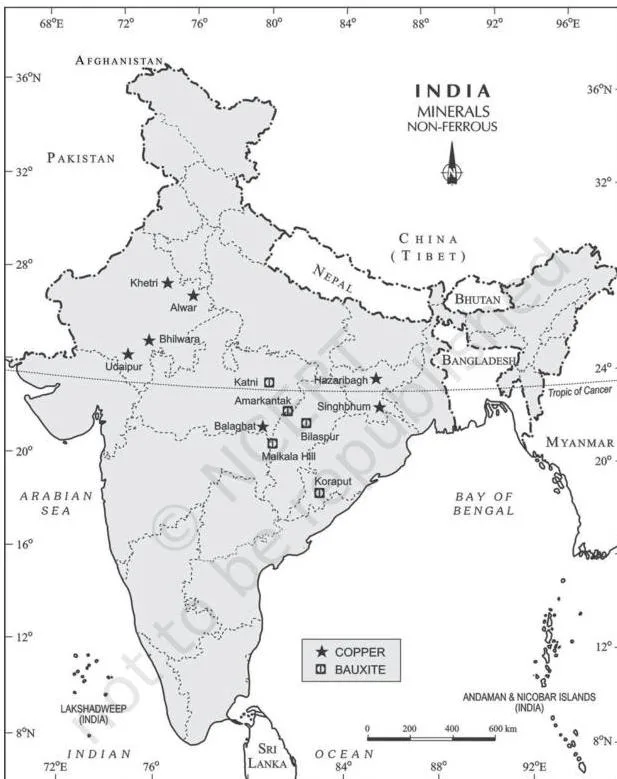
Fig 5.3 carries the non-ferrous picture. Read one cluster to practise: the bauxite symbols thicken over Odisha — the state’s Kalahandi–Sambalpur belt is the largest producer the text names. Then locate copper at Singhbhum in Jharkhand and Balaghat in Madhya Pradesh, two of the three main copper districts given in the chapter.
Conventional Energy: Coal, Petroleum and Natural Gas
Mineral fuels generate the power that agriculture, industry and transport need. The conventional sources are coal, petroleum and natural gas (the fossil fuels) plus nuclear energy minerals — all of them exhaustible (NCERT, p. 57).
Coal
Coal generates thermal power and smelts iron ore. It occurs in rock sequences of two geological ages: Gondwana and Tertiary (NCERT, p. 59).
- About 80 per cent of deposits are bituminous and non-coking.
- Gondwana fields concentrate in the Damodar Valley (Jharkhand–Bengal belt): Raniganj, Jharia, Bokaro, Giridih, Karanpura. Jharia is the largest field; Raniganj is the second largest. Other Gondwana valleys: Godavari, Mahanadi and Sone.
- Mining centres: Singrauli (Madhya Pradesh; part lies in Uttar Pradesh), Korba (Chhattisgarh), Talcher and Rampur (Odisha), Chanda-Wardha, Kamptee and Bander (Maharashtra), Singareni (Telangana), Pandur (Andhra Pradesh).
- Tertiary coals occur in Assam, Arunachal Pradesh, Meghalaya and Nagaland — Darangiri, Cherrapunji, Mewlong and Langrin (Meghalaya); Makum, Jaipur and Nazira (upper Assam); Namchik–Namphuk (Arunachal Pradesh); Kalakot (Jammu and Kashmir).
- Lignite (brown coal) lies in the coastal tracts of Tamil Nadu, Puducherry, Gujarat and Jammu and Kashmir — Neyveli is the classic example.
Memory trick for the Damodar Valley fields — “Rani Jhansi Boli, Gir Karo!” The first letters, R-J-B-G-K, give the five fields in order: Raniganj, Jharia, Bokaro, Giridih, Karanpura. Keep Jharia at the top of the list — it is the largest, with Raniganj behind it.
Petroleum
Petroleum is called “liquid gold” because of its scarcity and diversified uses. Crude petroleum is a mixture of hydrocarbons in liquid and gaseous states, and it powers all internal-combustion engines. Its by-products feed petrochemical industries — fertilisers, synthetic rubber and fibre, medicines, vaseline, lubricants, wax, soap and cosmetics (NCERT, p. 59).
- Crude occurs in sedimentary rocks of the Tertiary period.
- The Oil and Natural Gas Commission (ONGC) was set up in 1956; before that, Digboi in Assam was the only producing region.
- Assam: Digboi, Naharkatiya, Moran. Gujarat: Ankaleshwar, Kalol, Mehsana, Nawagam, Kosamba, Lunej.
- Mumbai High, about 160 km off Mumbai, was discovered in 1973; production began in 1976.
- New finds: exploratory wells in the Krishna-Godavari and Kaveri basins on the east coast.
- Crude contains impurities, so it must be refined — at field-based refineries (Digboi) or market-based ones (Barauni).
Natural gas
Natural gas is found with petroleum and is released when crude oil is brought to the surface. It fuels power generation, heats industries and serves as a raw material in the chemical, petrochemical and fertiliser industries. With expanding pipeline and city-level distribution networks, it is also becoming a preferred transport fuel (CNG) and cooking fuel (PNG).
Major reserves are at Mumbai High and allied west-coast fields, supplemented by the Cambay basin; new east-coast reserves have been found in the Krishna-Godavari basin (NCERT, p. 59–61).
A chapter activity asks you to collect information on the cross-country natural-gas pipelines laid by GAIL under the “One Nation One Grid” plan — a useful single fact to carry into any discussion of gas infrastructure.
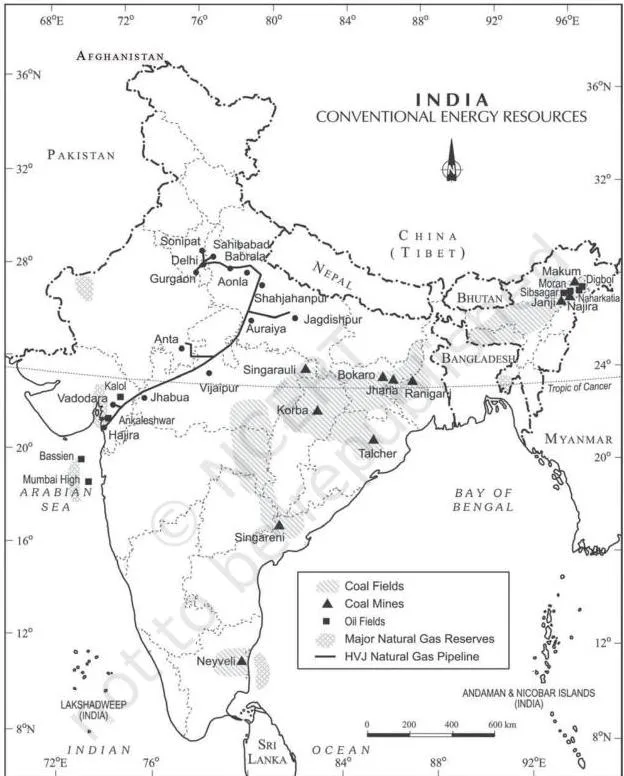
Fig 5.4 pulls the conventional sources together on one map. Coal symbols stretch from the Damodar Valley (Jharia, Bokaro, Raniganj) south-westward through the Mahanadi and Godavari valleys, with a separate Tertiary cluster in the north-east and lignite on the Tamil Nadu and Gujarat coasts. Petroleum appears in Assam, Gujarat and offshore from Mumbai — exactly the three regions the text names.
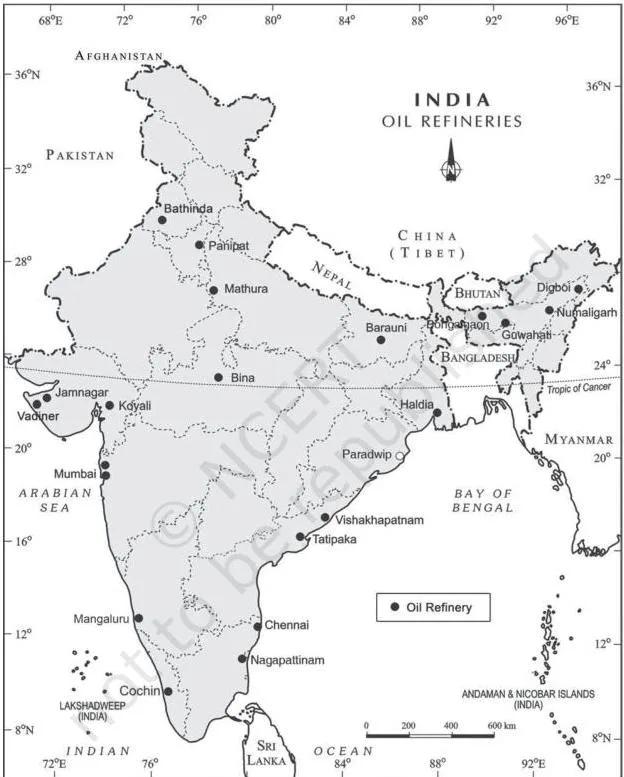
Fig 5.5 shows how refineries spread across India. Match it to the text’s two anchor examples: Digboi, the field-based refinery inside Assam’s oil region, and Barauni, the market-based refinery located near the consuming market in Bihar.
Non-Conventional Energy Sources: Nuclear to Bio-energy
One naming trap first: the chapter puts nuclear energy under conventional sources because nuclear runs on exhaustible raw materials (uranium and thorium). The non-conventional discussion opens by calling only solar, wind, hydro-geothermal and biomass sustainable — these are the renewable sources, more equitably distributed and environment-friendly, and cheaper after the initial cost is covered (NCERT, p. 61).
| Conventional (exhaustible) | Non-conventional (renewable) | |
|---|---|---|
| Sources | Coal, petroleum, natural gas, nuclear | Solar, wind, tidal and wave, geothermal, bio-energy |
| Indian examples | Jharia and Raniganj (coal); Mumbai High, Digboi, Ankaleshwar (petroleum); Mumbai High and Cambay basin (gas); Tarapur, Kalpakkam, Rawatbhata (nuclear) | Gujarat and Rajasthan (solar); Rajasthan, Gujarat, Maharashtra, Karnataka (wind); west coast (tidal potential); Manikaran (geothermal); Okhla in Delhi (bio-energy) |
| Character | Exhaustible raw materials; concentrated in a few regions | Renewable; more equitably distributed, environment-friendly, cheaper after initial cost |
Each source, with how it works and where India uses it
| Source | How it works | Indian locations | One key fact |
|---|---|---|---|
| Nuclear (classified conventional) | Energy generated from uranium and thorium minerals | Uranium in Dharwar rocks — Singhbhum copper belt; Udaipur, Alwar and Jhunjhunu (Rajasthan); Durg (Chhattisgarh); Bhandara (Maharashtra); Kullu (Himachal Pradesh). Thorium from monazite and ilmenite in Kerala–Tamil Nadu beach sands; richest monazite at Palakkad and Kollam, near Vishakhapatnam and in the Mahanadi delta | AEC 1948; Trombay institute 1954, renamed BARC 1967. Plants: Tarapur, Rawatbhata (near Kota), Kalpakkam, Narora, Kaiga, Kakarapara |
| Solar | Sun rays tapped in photovoltaic cells; photovoltaics and solar thermal technology | Western India — Gujarat and Rajasthan have greater potential | 7 per cent more effective than coal- or oil-based plants; 10 per cent more effective than nuclear plants |
| Wind | Kinetic energy of wind turned into electricity through turbines | Favourable conditions in Rajasthan, Gujarat, Maharashtra and Karnataka | Absolutely pollution-free and inexhaustible; uses trade winds, westerlies, monsoons, local winds and breezes |
| Tidal and wave | Ocean currents as a store-house of infinite energy | Large tidal waves along the west coast of India | Great potential but not yet utilised |
| Geothermal | Heat from magma released at the surface, plus hot water gushing from geyser wells | Plant commissioned at Manikaran, Himachal Pradesh | First successful tapping of underground heat at Boise, Idaho (USA), 1890 — still working |
| Bio-energy | Energy from agricultural residues, municipal, industrial and other wastes | Okhla, Delhi converts municipal waste to energy | Cuts pollution, improves rural economies, enhances self-reliance, reduces pressure on fuel wood |
Two textbook news insets add current colour: in September 2023 India crossed 70,000 MW of installed solar capacity, and ONGC was considering the first oil production from the Karmada coast (NCERT, p. 63). Use them as a single illustrative line in a discussion of India’s energy future, not as core facts.
Conservation of Mineral Resources: Why There Is No Second Crop
Sustainable development asks for the integration of economic development with environmental concerns (NCERT, p. 64). Traditional methods of resource use generate enormous waste and create environmental problems, so the chapter presses for protection of resources for future generations. The concrete measures:
- Develop inexhaustible alternatives — solar, wind, wave and geothermal energy — to replace exhaustible resources.
- Recycle scrap metals; this matters most for copper, lead and zinc, where India’s reserves are meagre.
- Use substitutes for scarce metals to cut consumption.
- Reduce exports of strategic and scarce minerals so existing reserves last longer.
The whole argument rests on the chapter’s reminder that minerals “do not have the second crop” — once used, they cannot be regrown. The same concern — development without wrecking the resource base — carries into the notes on planning and sustainable development in the Indian context.
Worked Examples: Classification and Map Reading Drills
Example 1 — Push three minerals through the Fig 5.1 tree
Apply the classification tree step by step. For each mineral ask: Is it metallic? If yes, does it contain iron? If no, is its origin organic or inorganic?
- Magnetite: metallic (it is a source of metal) → contains iron → ferrous metallic mineral.
- Limestone: metallic? no → organic? no → inorganic non-metallic mineral.
- Coal: metallic? no → organic origin? yes — it comes from buried plant life → fossil fuel (mineral fuel), an organic non-metallic mineral.
This is the same route Fig 5.1 draws: metallic splits into ferrous and non-ferrous; non-metallic splits into organic and inorganic.
Example 2 — Match six energy places to state, type and fact
Work each place through three questions: Which state? Which energy type (conventional or non-conventional)? Which one grounded fact? The answers, all directly from the chapter text:
| Place | State / location | Energy type | Grounded fact |
|---|---|---|---|
| Manikaran | Himachal Pradesh | Geothermal (non-conventional) | A geothermal plant has been commissioned here |
| Okhla | Delhi | Bio-energy (non-conventional) | Municipal waste is converted into energy here |
| Neyveli | Tamil Nadu | Lignite / brown coal (conventional) | It is the south-western belt’s coal exception |
| Mumbai High | About 160 km offshore from Mumbai | Petroleum (conventional) | Discovered 1973; production from 1976 |
| Digboi | Assam | Petroleum (conventional) | Field-based refinery; the only oil region before ONGC (1956) |
| Tarapur | Maharashtra | Nuclear (classified conventional) | The first atomic power station |
How to read the NCERT distribution maps
All three distribution maps (Figs 5.2, 5.3 and 5.4) work the same way. This five-step routine pulls the information out of any of them:
- Read the figure title first. It tells you the category you are looking at — ferrous, non-ferrous or conventional energy — and therefore which minerals or fuels to expect.
- Look for symbol clusters, not single dots. A cluster of symbols is what the text calls a belt or a district-level concentration.
- Overlay the states mentally. Ask which state the cluster sits in; the text below the map names the districts, so map and prose are meant to be read together.
- Test the chapter’s big rule. Check whether the cluster lies east of the Mangaluru–Kanpur line; most major minerals do.
- Turn the pattern into an answer. For a spatial-distribution answer, name the belt, then the state, then one specific mine or deposit.
Example 3 — Read Fig 5.2 to explain Chhotanagpur’s iron and steel location
Work this location question in four steps, reasoning from the map and the text:
- Locate the oldest iron ore mines. Fig 5.2 shows the Singhbhum district of Jharkhand with Noamundi and Gua — the chapter calls these some of the oldest mines, around which most iron and steel plants sit.
- Add the coal fields. Immediately north lies the Damodar Valley with Jharia, Bokaro and Raniganj — the coal needed for steel making and thermal power.
- Add manganese. Odisha’s manganese belt (Bonai, Kendujhar, Sundergarh) runs through the central part of the same iron ore belt, supplying the alloy material for steel.
- Conclude with the transport logic. Iron ore, coal and manganese within a short radius cut the cost of moving heavy raw materials — the reason Chhotanagpur (Jharkhand) became the heart of the iron and steel industry.
Common Mistakes: Ferrous or Non-Ferrous, Jharia or Raniganj
Here is the list of six confusions students commonly carry into the exam, each paired with the correct fact — plus a seventh that appears just as often. All corrections come straight from the chapter.
| Mistake | Correct rule | How to check your answer |
|---|---|---|
| “Nuclear energy is non-conventional.” | The chapter lists nuclear under conventional sources because uranium and thorium are exhaustible raw materials. | Ask: does the source run on a finite mineral? If yes, it sits with conventional. |
| “Neyveli produces coal.” | Neyveli produces lignite (brown coal) — the south-western belt’s coal exception. | Re-read the belt table: the south-western belt lacks coal “except Neyveli lignite”. |
| “Kudremukh is in Goa.” | Kudremukh is in Chikkamagaluru district, Karnataka. | Check the iron-ore table: Karnataka’s row names Sandur-Hospet, Baba Budan hills and Kudremukh. |
| “Raniganj is India’s largest coal field.” | Jharia is the largest; Raniganj is second. | Recite the Damodar list R-J-B-G-K (“Rani Jhansi Boli, Gir Karo!”) and keep Jharia first. |
| “Mumbai High began producing in 1973.” | Discovered: 1973. Production: 1976. Distance: about 160 km off Mumbai. | Pair the dates in order — discovery first, production later. |
| “Thorium, like uranium, comes from Dharwar rocks.” | Uranium occurs in Dharwar rocks; thorium comes from monazite and ilmenite in Kerala and Tamil Nadu beach sands. | Link each element to its host: uranium → Dharwar rocks; thorium → beach-sand minerals. |
| “Kalpakkam was India’s first atomic power station.” | Tarapur in Maharashtra was the first. | List the six stations in the chapter’s order: Tarapur leads, then Rawatbhata, Kalpakkam, Narora, Kaiga, Kakarapara. |
Exam Notes: Frameworks for the Textbook’s Questions
The textbook’s exercises ask three kinds of things: fact-recall multiple-choice questions, short answers of about 30 words, and two essays of about 150 words. Here is the shape a complete answer of each kind takes. These are frameworks — build each answer from the facts in your own words.
30-word answers: definition → distribution → named example
- Distribution of mica: one line on what mica is (electrical and electronic uses; splits into thin, tough sheets), then the three main areas — the Jharkhand belt (about 150 km by 22 km in the lower Hazaribagh plateau), Nellore in Andhra Pradesh (best quality), and the Rajasthan belt (about 320 km from Jaipur to Bhilwara and around Udaipur).
- Nuclear power and its stations: define it as energy generated from uranium and thorium minerals, then list the six stations: Tarapur, Rawatbhata near Kota, Kalpakkam, Narora, Kaiga, Kakarapara.
- Non-ferrous metals and their distribution: define non-ferrous (metallic minerals without iron), open with the book’s judgement that India is poorly endowed except for bauxite, then distribute: bauxite — Odisha largest, Kalahandi and Sambalpur leading; copper — Singhbhum, Balaghat, Jhunjhunu and Alwar.
- Non-conventional sources: define them as renewable, more equitably distributed and environment-friendly sources, then name the four: solar, wind, hydro-geothermal and biomass.
150-word essays: a four-part skeleton
Petroleum resources of India — build four paragraphs:
- Significance and uses: “liquid gold” for its scarcity and diversified uses; powers internal-combustion engines; by-products feed petrochemical industries.
- Occurrence: hydrocarbons in liquid and gaseous states in sedimentary rocks of the Tertiary period.
- Regions and institutions: ONGC set up in 1956; Digboi the only pre-1956 field; Assam fields (Digboi, Naharkatiya, Moran), Gujarat fields (Ankaleshwar, Kalol, Mehsana, Nawagam, Kosamba, Lunej), Mumbai High (about 160 km offshore, discovered 1973, production from 1976), and new east-coast finds in the Krishna-Godavari and Kaveri basins.
- Refining and conservation: crude needs refining because of impurities; field-based (Digboi) versus market-based (Barauni) refineries; close with the need to conserve an exhaustible fuel.
Hydel power essay — read this note first. The chapter text itself only touches hydro inside the sustainable list as “hydro-geothermal” and gives no specific hydel statistics, dam names or capacity figures.
Write the essay from the chapter’s classification of energy sources and its non-conventional discussion: hydropower is a renewable, sustainable source that fits the book’s argument that renewable sources are more equitably distributed and environment-friendly. Do not invent hydel numbers the book never provides — the chapter does not carry them.
The multiple-choice pattern
The three multiple-choice questions in the exercises are pure fact recall. One tests the petroleum-producing state, one tests the first atomic power station, and one tests whether you can sort a list of energy sources into renewable and non-renewable.
Practise by reciting single-fact lines from the chapter — the ONGC year, the Tarapur project, the renewable list — and the pattern answers itself.
One framing tip for distribution answers: name the belt first (north-eastern plateau, south-western plateau, north-western region), then the states, then one specific mine, district or deposit. A numbered answer with that belt → state → site order shows a complete chain of recall.
Key Numbers: The Chapter’s Data Sheet
This chapter has no formulas, so this table takes the formula sheet’s place. These are the quantitative facts a complete short answer should carry with it.
| Fact | Number or detail |
|---|---|
| Coal reserves in river valleys | Over 97 per cent in the Damodar, Sone, Mahanadi and Godavari valleys |
| Coal by type | About 80 per cent bituminous and non-coking |
| Iron ore reserves | About 95 per cent in eight states: Odisha, Jharkhand, Chhattisgarh, Karnataka, Goa, Telangana, Andhra Pradesh, Tamil Nadu |
| Mica belt, Jharkhand | About 150 km by 22 km in the lower Hazaribagh plateau |
| Mica belt, Rajasthan | About 320 km from Jaipur to Bhilwara and around Udaipur |
| Mumbai High | About 160 km offshore; discovered 1973; production from 1976 |
| ONGC established | 1956 |
| Atomic Energy Commission | 1948; Trombay institute 1954, renamed BARC 1967 |
| Solar efficiency | 7 per cent more effective than coal- or oil-based plants; 10 per cent more effective than nuclear plants |
| Geothermal plant | Manikaran, Himachal Pradesh |
| First underground heat tapping | Boise, Idaho (USA), 1890; the plant still works |
| Solar capacity (textbook inset) | India crossed 70,000 MW in September 2023 |
One-Page Revision Summary
Everything above, compressed to three tables. Revise these and you have the chapter’s spine.
Table 1 — Major minerals
| Mineral | Top producing states | One key fact |
|---|---|---|
| Iron ore | Odisha, Jharkhand, Chhattisgarh, Karnataka, Goa | Largest reserve in Asia; haematite and magnetite are the ore types |
| Manganese | Madhya Pradesh and Odisha lead | Smelts iron ore and makes ferro alloys; linked to the Dharwar system |
| Bauxite | Odisha (Kalahandi, Sambalpur) | Ore of aluminium; tertiary deposits with laterite rocks |
| Copper | Jharkhand, Madhya Pradesh, Rajasthan | Core electrical metal; malleable and ductile |
| Mica | Jharkhand, Andhra Pradesh, Rajasthan | Splits into thin, tough, flexible sheets for electrical use |
Table 2 — Energy sources
| Source | Conventional or non-conventional | Indian example |
|---|---|---|
| Coal | Conventional | Jharia, Raniganj; Neyveli lignite |
| Petroleum | Conventional | Mumbai High, Digboi, Ankaleshwar |
| Natural gas | Conventional | Mumbai High, Cambay basin |
| Nuclear | Conventional (per the chapter) | Tarapur, Kalpakkam, Rawatbhata |
| Solar | Non-conventional | Gujarat, Rajasthan |
| Wind | Non-conventional | Rajasthan, Gujarat, Maharashtra, Karnataka |
| Tidal and wave | Non-conventional | West coast (potential) |
| Geothermal | Non-conventional | Manikaran, Himachal Pradesh |
| Bio-energy | Non-conventional | Okhla, Delhi |
Table 3 — Characteristics and conservation
| Three characteristics of minerals | Three conservation measures |
|---|---|
| Unevenly distributed over space | Develop inexhaustible alternatives (solar, wind, wave, geothermal) |
| Inverse relation between quality and quantity | Recycle scrap metals — significant for copper, lead and zinc |
| All minerals are exhaustible — “no second crop” | Use substitutes and reduce exports of strategic and scarce minerals |
The three belts in one line: North-Eastern Plateau (Chhotanagpur, Odisha plateau, West Bengal, parts of Chhattisgarh), South-Western Plateau (Karnataka, Goa, Tamil Nadu uplands, Kerala), North-Western Region (Aravali in Rajasthan, parts of Gujarat) — plus the Himalayan belt and the Assam valley. For the rest of the site’s subjects, browse the complete CBSE notes library.
Frequently Asked Questions
Why does the NCERT chapter count nuclear energy among conventional sources?
The chapter defines conventional sources as those that use exhaustible raw materials — coal, petroleum, natural gas and nuclear minerals all run on finite resources. Only the renewable group — solar, wind, hydro-geothermal and biomass — is called sustainable. So nuclear sits under conventional in this book, even though other discussions often call it non-conventional.
Which are the three mineral belts of India and which is richest in minerals?
The three belts are the North-Eastern Plateau (Chhotanagpur in Jharkhand, Odisha plateau, West Bengal, parts of Chhattisgarh), the South-Western Plateau (Karnataka, Goa, Tamil Nadu uplands and Kerala) and the North-Western Region (along the Aravali in Rajasthan with parts of Gujarat).
The north-eastern belt is the richest in variety — iron ore, coal, manganese, bauxite and mica — which is why the iron and steel industry concentrates there. The memory line is: “NE has the most, SW has the best, NW has the rest.”
How do the sources of uranium and thorium differ in India?
Uranium occurs in Dharwar rocks — along the Singhbhum copper belt and in Udaipur, Alwar and Jhunjhunu (Rajasthan), Durg (Chhattisgarh), Bhandara (Maharashtra) and Kullu (Himachal Pradesh). Thorium comes from monazite and ilmenite in the beach sands of Kerala and Tamil Nadu, with the world’s richest monazite deposits at Palakkad and Kollam, near Vishakhapatnam and in the Mahanadi delta.
What is the difference between a field-based and a market-based refinery?
A field-based refinery is located at the oil field, refining crude where it is produced — Digboi in Assam is the example. A market-based refinery stands near the consuming market — Barauni is the example. Since crude oil contains impurities and cannot be used directly, it must be refined before use, and that is the logic behind both location patterns.
What does the textbook say about solar energy’s effectiveness compared with coal and nuclear power?
The textbook states that solar energy is 7 per cent more effective than coal- or oil-based plants and 10 per cent more effective than nuclear plants. It adds that solar thermal technology is cost-competitive, environment-friendly and easy to construct, and that western India — Gujarat and Rajasthan — has the greater potential for solar development.
Where is India’s geothermal plant, and where was underground heat first tapped?
India’s geothermal energy plant has been commissioned at Manikaran in Himachal Pradesh. The first successful attempt to tap underground heat was in 1890 at Boise, Idaho in the USA, where a hot-water pipe network was built to heat surrounding buildings — and that plant is still working.
Reference: NCERT Class 12 Geography textbook, chapter Mineral and Energy Resources.
Explore Class 12 Geography Notes
- Class 12 Geography Notes
- Class 12 CBSE Notes
- CBSE Notes for Classes 1 to 12
- Next: Planning and Sustainable Development in Indian Context
Class 12 Geography on LearnCBSE:
Related chapters:
- Transport and Communication notes
- International Trade notes
- Geographical Perspective on Selected Issues and Problems notes
Official source: download the NCERT textbook free from ncert.nic.in.