
Revising the International Trade chapter of Class 12 Geography? These notes condense the whole chapter — definitions, causes, classifications, dates and examples — in the order a teacher would build the topic, not the textbook’s page order. Everything here follows the rationalised NCERT edition in use for the 2026-27 session.
The chapter’s logic runs from barter to global ports: how money replaced barter, how trade grew from the Silk Route to the WTO, why trade exists, how balance of trade is measured, what free trade and dumping mean, and why ports matter as gateways. Use the jump links below, revise section by section, and finish with the recap tables.
Chapter at a Glance: From Barter to Global Ports
Hold the whole chapter in one frame before the details. International trade is the voluntary exchange of goods and services across national boundaries, and every section below answers one question about it.
- What trade is — voluntary exchange, the barter system, and how money solved barter’s problems.
- How it grew — from local markets to the Silk Route, colonial and slave trade, the Industrial Revolution, and the WTO.
- Why it exists — specialisation, comparative advantage, complementarity, transferability, and five concrete bases.
- How it is measured — balance of trade, favourable and unfavourable.
- How it is organised — bilateral and multilateral trade, free trade, dumping, the WTO and regional trade blocs.
- How it moves — ports as gateways, classified by cargo, location and specialised function.
These notes are part of the Class 12 Geography chapter notes and the wider CBSE notes library. The worked example, misconception autopsy and common-mistakes table are the parts most students skip and later regret.
Trade, Barter and Money: How Exchange Began
Trade is the voluntary exchange of goods and services between two parties — one sells, the other purchases, and both benefit. When that exchange crosses national boundaries it becomes international trade: a country buys what it cannot produce itself, or what it can buy cheaper elsewhere (NCERT, p. 70).
The first form of trade in primitive societies was the barter system — direct exchange of goods without money (NCERT, p. 70). The textbook’s example: if you were a potter who needed plumbing, you had to find a plumber who needed pots, and only then could you exchange your pots for the plumbing work.
That matching problem made barter slow and difficult, and money eventually removed it.
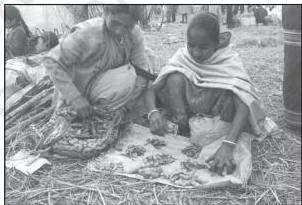
The system still survives in one famous spot. Fig. 8.1 shows two women practising barter at the Jon Beel Mela, a fair held every January in Jagiroad, 35 km from Guwahati, after the harvest season. It is possibly the only fair in India where barter is still alive — people from various tribes and communities exchange their products there (NCERT, p. 70).
Before coins and paper currency, rare objects with high intrinsic value served as money (NCERT, p. 71):
- Stone and shell objects — flintstones, obsidian, cowrie shells
- Animal products — tiger’s paws, whale’s teeth, dogs’ teeth, skins, furs, cattle
- Food and harvest items — rice, peppercorns, salt
- Metals and tools — small tools, copper, silver, gold
Do you know? The word salary comes from the Latin Salarium, which means payment by salt. Producing salt from sea water was unknown at the time, so salt could only be made from rare and expensive rock salt — that is why it became a mode of payment (NCERT, p. 71).
History of International Trade: From the Silk Route to the WTO
International trade did not start global. It passed through clear stages, each pushed by transport, war or industrial change (NCERT, pp. 71–74).
| Stage | What happened |
|---|---|
| Ancient times | Long-distance transport was risky, so trade stayed in local markets. Most resources went to basics like food and clothing; only the rich bought jewellery and costly dresses, so luxury items were traded. |
| Silk Route | An early example of long-distance trade: 6,000 km from Rome to China. Traders carried Chinese silk, Roman wool, precious metals and other high-value commodities from intermediate points in India, Persia and Central Asia. |
| 12th–13th century | After the Roman Empire disintegrated, European commerce grew with the development of ocean-going warships. Europe–Asia trade expanded and the Americas were discovered. |
| Colonialism and slave trade | From the 15th century, the Portuguese, Dutch, Spaniards and British captured Africans and transported them to the Americas as plantation labour. Slave trade stayed lucrative for more than 200 years. |
| Industrial Revolution | Demand for raw materials like grain, meat and wool expanded, but their monetary value declined relative to manufactured goods. Industrialised nations imported primary products as raw materials and exported finished products; they later became each other’s principal customers. |
| World Wars I and II | Countries imposed trade taxes and quantitative restrictions for the first time. |
| Post-war era | GATT (General Agreement on Tariffs and Trade, later the WTO) helped reduce tariffs. |
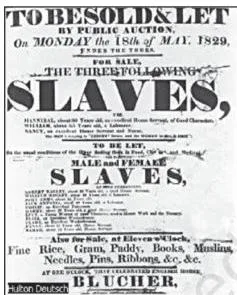
Fig. 8.2 shows the brutal side of the colonial stage — an American slave auction advertisement from 1829. It advertised slaves for sale or temporary hire by their owners; buyers often paid as much as $2,000 for a skilled, healthy slave, and such auctions frequently separated family members, many of whom never saw their loved ones again (NCERT, p. 71).
| Country | Year slave trade was abolished |
|---|---|
| Denmark | 1792 |
| Great Britain | 1807 |
| United States | 1808 |
Why International Trade Exists: Specialisation and Its Five Bases
International trade is the result of specialisation in production. When different countries practise specialisation and division of labour in producing commodities or providing services, each kind of specialisation can give rise to trade, and the world economy benefits as a whole (NCERT, p. 72). Three principles sit beneath the whole idea:
- Comparative advantage — a country gains by specialising in goods it can produce more efficiently than its partners, then trading for the rest.
- Complementarity — countries complement each other: what one lacks, another can supply, so the two fit together as trading partners.
- Transferability — goods and services must be movable between places, and the gains from moving them must be worth the cost.
In principle, trade built on these principles should be mutually beneficial to both partners (NCERT, p. 72). The five bases below are the concrete reasons real trade happens.
| Basis of trade | What it covers | Example |
|---|---|---|
| 1. Difference in national resources | Resources are uneven because of geology, relief, soil and climate. Geological structure decides minerals and crop diversity; lowlands have greater agricultural potential; mountains attract tourism. Climate decides which flora and fauna survive in a region. | Wool from cold regions; bananas, rubber and cocoa from tropical regions |
| 2. Population factors | Population size, distribution and diversity affect the type and volume of goods traded. Cultural factors produce distinctive art and craft; dense populations mean large internal trade but little external trade; standard of living decides demand for quality imports. | Chinese porcelain and brocades, Iranian carpets, North African leather work, Indonesian batik cloth |
| 3. Stage of economic development | The nature of traded items changes as a country develops. Agricultural countries exchange agro products for manufactured goods; industrialised nations export machinery and finished products and import food grains and raw materials. | Agro exports exchanged for manufactured goods; machinery and finished products traded by industrial nations |
| 4. Extent of foreign investment | Foreign capital develops capital-intensive activities in developing countries — mining, oil drilling, heavy engineering, lumbering and plantation agriculture — which steps up the volume of trade and creates markets for finished products. | Industrial nations investing to secure foodstuffs and minerals and to sell finished products |
| 5. Transport | Poor transport once restricted trade to local areas; only high-value goods such as gems, silk and spices travelled far. Rail, ocean and air transport, plus refrigeration and preservation, gave trade spatial expansion. | Refrigerated transport moving perishables over long distances |
Memory device: the first letters of the five bases — National resources, Population, Stage of economic development, Foreign investment, Transport — spell “New Products Sell Fast Today”. Recall the sentence, then expand each word into its base.
Why does no country simply opt out? Because transport and communication systems are now so well developed that no country is willing to forgo the benefits of participating in international trade (NCERT, p. 72). How movement networks enable this is developed further in the Class 12 Geography notes on transport and communication.
Balance of Trade: The Formula and Its Two Faces
Balance of trade records the volume of goods and services a country imports and exports (NCERT, p. 73). It is a simple subtraction:
\[ \text{Balance of Trade} = \text{Value of exports} – \text{Value of imports} \]
- Exports exceed imports — positive or favourable balance of trade.
- Imports exceed exports — negative or unfavourable balance of trade.
The implication is serious: a negative balance means the country spends more on buying goods than it earns by selling goods, which ultimately exhausts its financial reserves (NCERT, p. 73). Note that the balance is a money value — the difference between export earnings and import payments, never a count of goods.
Types of Trade: Bilateral and Multilateral
International trade takes two organisational forms (NCERT, p. 73):
| Feature | Bilateral trade | Multilateral trade |
|---|---|---|
| Partners | Two countries trading with each other | One country trading with many countries |
| Agreement | The two countries enter into an agreement to trade specified commodities | Trade flows with numerous partners; the country may grant Most Favoured Nation (MFN) status to some partners |
| Example | Country A agrees to supply raw material; country B supplies a specified manufactured item | A country selling to and buying from several countries at once |
Most Favoured Nation (MFN) status is a trading privilege a country can grant to selected partners within multilateral trade (NCERT, p. 73).
Free Trade, Dumping and the WTO
Free trade, also called trade liberalisation, is the act of opening up economies for trading by bringing down barriers like tariffs. It allows goods and services from everywhere to compete with domestic products (NCERT, p. 73).
The chapter adds a warning: globalisation along with free trade can hurt developing economies by imposing unfavourable conditions and denying an equal playing field. Free trade should not only let rich countries enter other markets, but allow the developed countries to keep their own markets protected from foreign products (NCERT, p. 73).
Misconception Autopsy: Free Trade Is Not Automatically Fair Trade
Students often read “free trade” as “fair trade”. The chapter shows why that is a mistake. Free trade removes barriers; fair trade would ask whether both sides benefit equally. The WTO’s critics argue free trade is doing the opposite (NCERT, p. 74):
| Criticism of the WTO | What it means |
|---|---|
| Widening rich–poor gap | Free trade makes rich countries richer instead of making ordinary people’s lives more prosperous. |
| Self-interested powerful nations | Influential member nations focus on their own commercial interests. |
| Closed markets in the developed world | Many developed countries have not fully opened their markets to products from developing countries. |
| Ignored issues | Health, workers’ rights, child labour and the environment are left out of trade decision-making. |
The other danger inside “free” trade is dumping — selling a commodity in two countries at prices that differ for reasons not related to costs (NCERT, p. 73). The textbook’s case: the US imposed anti-dumping duties on shrimp from India and other countries; India and Thailand took the matter to the WTO, which constituted a panel to examine the duty.
At the time, the US was the second largest importer of marine products from India. Cheap imports sound like a bargain, but they can destroy domestic producers who cannot match artificially low prices.
The WTO at a Glance
- Origin: GATT was formed in 1948 to reduce high customs tariffs and other restrictions. In 1994 member countries decided to set up a permanent institution, and GATT was transformed into the WTO on 1 January 1995.
- Function: the WTO is the only international organisation dealing with the global rules of trade between nations. It sets the rules, resolves disputes between member nations, and also covers trade in services such as telecommunication and banking, and issues like intellectual property rights (NCERT, p. 74).
- Facts: headquarters in Geneva, Switzerland; 166 member countries as of December 2024; India is a founder member (NCERT, p. 74).
Regional Trade Blocs and Concerns of International Trade
Regional trade blocs are groupings of countries with geographical proximity, similarity and complementarity in trading items. They remove trade tariffs within the member nations and encourage free trade among them. Blocs developed as a response to the failure of global organisations to speed up intra-regional trade. Today, 120 regional trade blocs generate 52 per cent of world trade (NCERT, p. 74).
Whether trade helps or harms a nation depends on how it is managed — the same exchange can be mutually beneficial or detrimental (NCERT, p. 74):
| Benefits if trade is managed well | Risks if trade goes wrong |
|---|---|
|
|
The chapter also flags an environmental cost: as countries compete to trade more, production and the use of natural resources spiral up, and resources are used faster than they can be replenished. Marine life is depleting, forests are being cut down, and river basins are sold off to private drinking water companies.
Multinational corporations in oil, gas, mining, pharmaceuticals and agri-business keep expanding at all costs, creating more pollution — their mode of work does not follow the norms of sustainable development (NCERT, p. 74).
Ports: Gateways of International Trade and Their Classification
Harbours and ports are the chief gateways of international trade — cargoes and travellers pass through them from one part of the world to another (NCERT, p. 75). Ports provide facilities for docking, loading, unloading and storage. To keep these working, port authorities maintain navigable channels, arrange tugs and barges, and provide labour and managerial services (NCERT, p. 75).
A port’s importance is judged by the size of cargo and the number of ships it handles. The quantity of cargo handled by a port is an indicator of the level of development of its hinterland — the region the port serves (NCERT, p. 75).
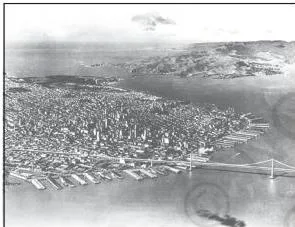
Fig. 8.3 shows San Francisco, which the textbook identifies as the largest land-locked harbour in the world — proof that a naturally sheltered harbour can still grow into a world-scale trade gateway.
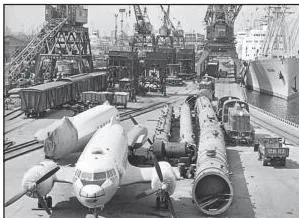
Fig. 8.4 shows Leningrad Commercial Port, the textbook’s example of a commercial port — the type that handles general cargo such as packaged products and manufactured goods, along with passenger traffic (NCERT, p. 75). Ports are classified in three ways: by cargo handled, by location, and by specialised function (NCERT, p. 75).
Classification by cargo handled
| Type | What it handles | Key point |
|---|---|---|
| Industrial port | Bulk cargo — grain, sugar, ore, oil, chemicals and similar materials | Specialises in bulk traffic |
| Commercial port | General cargo — packaged products and manufactured goods; also passenger traffic | Leningrad is the textbook’s example |
| Comprehensive port | Bulk and general cargo, both in large volumes | Most of the world’s great ports are comprehensive |
Classification by location
| Type | Definition | Examples |
|---|---|---|
| Inland port | Located away from the sea coast and linked to the sea through a river or a canal; accessible to flat-bottom ships or barges | Manchester (linked with a canal); Memphis (on the river Mississippi); Mannheim and Duisburg (on the Rhine); Kolkata (on the river Hoogli, a branch of the Ganga) |
| Out port | Deep-water port built away from the parent port; receives ships that cannot approach the parent port because of their large size | Athens and its out port Piraeus in Greece |
Classification by specialised function
| Type | Function | Examples |
|---|---|---|
| Oil port | Deals in the processing and shipping of oil; some are tanker ports, some are refinery ports | Tanker ports: Maracaibo (Venezuela), Esskhira (Tunisia), Tripoli (Lebanon); refinery port: Abadan on the Gulf of Persia |
| Port of call | Originally calling points on main sea routes where ships anchored for refuelling, watering and taking food; later developed into commercial ports | Aden, Honolulu and Singapore |
| Packet station | Also called ferry ports; move passengers and mail across short stretches of water; occur in pairs facing each other across the water body | Dover (England) and Calais (France) across the English Channel |
| Entrepot port | Collection centres where goods are brought from different countries for export | Singapore for Asia, Rotterdam for Europe, Copenhagen for the Baltic region |
| Naval port | Has strategic importance only; serves warships and has repair workshops for them | Kochi and Karwar in India |
Key Terms at a Glance: Definitions with Examples
Use this table for last-minute recall — it compresses the chapter’s full vocabulary into one screen. Cover the meaning column and try to reconstruct each term from its hook.
| Term | Meaning | Example / hook |
|---|---|---|
| Trade | Voluntary exchange of goods and services between two parties | One party sells, the other purchases — both benefit |
| Barter system | Direct exchange of goods without money | Potter exchanging pots for plumbing services |
| Silk Route | Early long-distance trade route connecting Rome to China | About 6,000 km; silk, wool and precious metals moved along it |
| Slave trade | Forced transport of captured Africans to the Americas for plantation labour | Run by the Portuguese, Dutch, Spaniards and British |
| Comparative advantage | A country specialises in goods it can produce more efficiently and trades for the rest | The basis of all specialisation |
| Complementarity | Countries produce what other countries lack, so they fit together as partners | One country’s surplus meets another country’s need |
| Transferability | Goods and services must be movable between places for trade to happen | Depends on transport development |
| Balance of trade | Value of exports minus value of imports | Records a country’s trade in money terms |
| Favourable balance | Exports exceed imports — a positive balance | The country earns more than it spends on trade |
| Unfavourable balance | Imports exceed exports — a negative balance | Drains the country’s financial reserves |
| Bilateral trade | Two countries trading specified commodities under an agreement | Country A supplies raw material, country B supplies a manufactured item |
| Multilateral trade | One country trading with many countries | The country may grant MFN status to some partners |
| Most Favoured Nation (MFN) | Trading privilege granted to selected partners in multilateral trade | Status a country can grant to some trading partners |
| Free trade / trade liberalisation | Opening up economies by reducing tariffs and other barriers | Lets foreign goods and services compete with domestic ones |
| Dumping | Selling a commodity in two countries at prices that differ for reasons not related to costs | US anti-dumping duty on shrimp from India |
| WTO | World Trade Organisation — sets global trade rules and resolves disputes | GATT’s successor from 1 January 1995 |
| Regional trade bloc | Grouping of geographically close countries that removes tariffs among members | 120 blocs generate 52 per cent of world trade |
| Industrial port | Specialises in bulk cargo such as grain, sugar, ore, oil and chemicals | Handles one class of traffic in bulk |
| Commercial port | Handles general cargo and passenger traffic | Leningrad Commercial Port |
| Comprehensive port | Handles bulk and general cargo in large volumes | Most of the world’s great ports |
| Inland port | Away from the sea coast, linked to the sea by river or canal | Manchester, Memphis, Mannheim, Duisburg, Kolkata |
| Out port | Deep-water port built away from the parent port for large ships | Athens–Piraeus in Greece |
| Oil port | Processes and ships oil; tanker port or refinery port | Abadan refinery port on the Gulf of Persia |
| Port of call | Refuelling, watering and food stops that later grew into commercial ports | Aden, Honolulu, Singapore |
| Packet station | Ferry port moving passengers and mail across short distances | Dover–Calais across the English Channel |
| Entrepot port | Collection centre for goods brought from different countries for export | Singapore, Rotterdam, Copenhagen |
| Naval port | Port of strategic importance serving warships | Kochi and Karwar in India |
Worked Example: Calculating a Country’s Balance of Trade
Method: use the balance of trade formula — value of exports minus value of imports — then label the result by which side is larger. The result is a money value, never a quantity of goods.
Step 1: Write the formula.
\[ \text{Balance of Trade} = \text{Value of exports} – \text{Value of imports} \]
Step 2: Substitute Country X’s values, working in ₹ crore.
\[ \text{Balance of Trade} = 4{,}800 – 6{,}500 = -1{,}700 \]
Step 3: Read the sign.
The balance is −₹1,700 crore.
Step 4: Interpret.
Imports (₹6,500 crore) exceed exports (₹4,800 crore), so Country X has a negative, or unfavourable, balance of trade — it spends more on buying goods than it earns by selling goods, which ultimately drains its financial reserves.
Final answer: −₹1,700 crore — unfavourable balance of trade.
Quick variant: if the same country’s exports rose to ₹7,200 crore while imports stayed at ₹6,500 crore, \[ 7{,}200 – 6{,}500 = +700 \]
so the balance of trade is +₹700 crore — positive and favourable, because exports now exceed imports.
Common Mistakes to Avoid in This Chapter
Six confusions trip students up most often, and all of them come from this chapter’s trickier distinctions (NCERT, pp. 72–76).
| Mistake | Correct rule | How to check your answer |
|---|---|---|
| “Exports more than imports means unfavourable balance.” | Exports exceeding imports means a positive, favourable balance of trade. | Compare the two values first — the larger side names the balance. |
| “Inland port and out port are the same.” | Inland ports are away from the sea and linked by river or canal (Manchester, Kolkata). Out ports are deep-water ports built away from the parent port for large ships (Athens–Piraeus). | Ask where the port sits: inland on a waterway, or at deep water serving a parent port? |
| “Most of the world’s great ports are industrial ports.” | They are comprehensive ports, which handle bulk and general cargo in large volumes. | Does the port accept both bulk and general cargo? If yes, it is comprehensive. |
| “Ports of call are ferry ports.” | Ports of call were refuelling, watering and food stops on main sea routes (Aden, Honolulu, Singapore). Ferry ports are packet stations moving passengers and mail (Dover–Calais). | What does the port serve — long-route ships needing supplies, or ferries shuttling passengers and mail? |
| “Dumping just means selling cheap goods.” | Dumping is selling a commodity in two countries at prices that differ for reasons unrelated to cost, and it harms domestic producers. | Is the price difference explained by costs? If not, it is dumping. |
| “A negative balance of trade is about the quantity of goods.” | Balance of trade compares the money value of exports and imports, not quantities of goods. | Confirm that both sides of the subtraction are money values, not counts. |
Exam Notes: How to Structure Answers to the Textbook Exercises
The chapter’s exercises (NCERT, p. 76) ask for two lengths of answers, and each length has a shape that works.
- About 30 words: open with a definition, then add one consequence or function. This suits the questions on the basic function of the WTO, why a negative balance of payments is detrimental, and the benefits nations get from forming trading blocs.
- Not more than 150 words: open with a defining statement, then classify or list reasons, support each point with a textbook example, and end with a one-line conclusion that returns to the question. This suits the questions on how ports help trade (with a classification of ports by location) and how nations gain from international trade.
What a complete answer needs to include:
- WTO’s basic function — it sets rules for the global trading system, resolves disputes between member nations, and also covers trade in services such as telecommunication and banking and issues such as intellectual property rights (NCERT, p. 74).
- Negative balance of payments — the country spends more on buying goods than it earns by selling goods, which leads to exhaustion of its financial reserves (NCERT, p. 73).
- Benefits of trading blocs — blocs remove trade tariffs within member nations and encourage free trade among them; they speed up intra-regional trade that global organisations were too slow to promote (NCERT, p. 74).
- Ports and classification by location — ports provide docking, loading, unloading and storage; port authorities maintain navigable channels, arrange tugs and barges, and provide labour and management. The location classification needs inland ports (Manchester, Memphis, Mannheim, Duisburg, Kolkata) and out ports (Athens–Piraeus), with a line on how each works (NCERT, p. 75).
- Gains from international trade — regional specialisation, higher production, better standard of living, worldwide availability of goods and services, equalisation of prices and wages, and diffusion of knowledge and culture (NCERT, p. 74).
The choose-the-right-answer items draw directly on the port tables above — for example, “most of the world’s great ports” are classified as comprehensive ports (NCERT, p. 75). In the 150-word answers, connect each point to an example; a bare list of reasons is not a complete answer.
Revision Summary: Last-Minute Recap Tables
If you have ten minutes, revise entirely from this section.
Milestone table
| Milestone | Key fact |
|---|---|
| Ancient trade | Local markets only; long-distance transport risky; luxury items for the rich |
| Silk Route | Rome to China, 6,000 km; silk, wool, precious metals |
| 12th–13th century | European commerce grew after the Roman Empire fell; the Americas were discovered |
| Colonialism and slave trade | From the 15th century; abolished in Denmark 1792, Britain 1807 and the US 1808 |
| Industrial Revolution | Industrial nations exported manufactured goods and imported raw materials |
| World Wars I and II | First trade taxes and quantitative restrictions |
| GATT | Formed in 1948 to reduce tariffs |
| WTO | GATT transformed into the WTO on 1 January 1995 |
Five bases of international trade with examples
| Base | Example |
|---|---|
| Difference in national resources | Wool from cold regions; bananas, rubber and cocoa from the tropics |
| Population factors | Chinese porcelain, Iranian carpets, Indonesian batik cloth |
| Stage of economic development | Agro exports exchanged for machinery and finished products |
| Extent of foreign investment | Foreign capital develops mining, oil and heavy engineering in poorer countries |
| Transport | Refrigeration and rail, ocean and air links expanded trade spatially |
Port classification with examples
| Axis | Types and examples |
|---|---|
| By cargo handled | Industrial (bulk cargo) · Commercial (general cargo and passengers; Leningrad) · Comprehensive (bulk + general; most great ports) |
| By location | Inland (Manchester, Memphis, Mannheim, Duisburg, Kolkata) · Out port (Athens–Piraeus) |
| By specialised function | Oil (Maracaibo, Abadan) · Port of call (Aden, Honolulu, Singapore) · Packet station (Dover–Calais) · Entrepot (Singapore, Rotterdam, Copenhagen) · Naval (Kochi, Karwar) |
Key numbers to recall:
- Silk Route — 6,000 km
- Regional trade blocs — 120 blocs generating 52 per cent of world trade
- WTO members — 166 as of December 2024
- WTO headquarters — Geneva, Switzerland
To verify any definition or figure against the original, the official NCERT textbook portal hosts the Class 12 Fundamentals of Human Geography textbook. When you move on to other subjects, the Class 12 notes hub organises everything by subject.
Frequently Asked Questions
What is the easiest way to remember the five bases of international trade?
Use the memory device “New Products Sell Fast Today”. Each first letter stands for a base: National resources, Population factors, Stage of economic development, Foreign investment, and Transport. Recall the sentence, then expand each word into its full base.
What is the difference between an inland port and an out port?
The difference is location. Inland ports sit away from the sea coast and are linked to the sea by a river or canal, so flat-bottom ships and barges can reach them — Manchester, Memphis, Mannheim, Duisburg and Kolkata.
Out ports are deep-water ports built away from the parent port to receive ships too large to approach the parent port, as with Athens and its out port Piraeus.
Why is dumping considered harmful even when the goods are cheaper?
Because the low price is artificial. Dumping means selling a commodity in two countries at prices that differ for reasons not related to costs — so the cheaper price does not reflect the true cost of production. Domestic producers cannot match that price and are harmed, which is why dumping is a serious concern among trading nations.
Why are comprehensive ports the most common among the world’s great ports?
Comprehensive ports handle both bulk cargo and general cargo in large volumes. That versatility lets them serve the widest mix of ships, cargoes and trade flows, which is why most of the world’s great ports are classified as comprehensive ports.
How does the balance of trade formula tell you whether a country’s trade is favourable?
Subtract the value of imports from the value of exports. If the result is positive, exports exceed imports and the balance is favourable. If the result is negative, imports exceed exports and the balance is unfavourable.
The sign of the result gives the label — and a negative balance means the country spends more on buying goods than it earns by selling goods.
What makes a regional trade bloc different from the WTO?
Scale and membership. Regional trade blocs are groupings of geographically close countries that remove tariffs among members — 120 blocs generate 52 per cent of world trade. The WTO is a single global organisation whose 166 member nations set global trade rules and resolve disputes. A bloc liberalises trade regionally; the WTO does so globally, and one country can belong to both.
Reference: NCERT Class 12 Fundamentals of Human Geography textbook, chapter International Trade.
Explore Class 12 Geography Notes
- Class 12 Geography Notes
- Class 12 CBSE Notes
- CBSE Notes for Classes 1 to 12
- Previous: Transport and Communication
Class 12 Geography on LearnCBSE:
Related chapters:
- The World Population notes
- Human Development notes
- Primary Activities notes