
Sexual Reproduction in Flowering Plants is the first chapter of the NCERT Class 12 Biology textbook, and it follows a flower from bud to seed. These notes follow the 2026-27 session and compress the chapter into revision length: flower structure, male and female gametophytes, pollination, double fertilisation, post-fertilisation events and apomixis.
Everything is arranged the way a teacher would build it — flower first, then the male side, then the female side, then how pollen meets stigma, the two fusions inside the embryo sac, and finally the seed, fruit, and seeds without fertilisation.
The page is built for speed: tables carry the comparisons you need to revise fast, the ploidy table answers ploidy questions in one place, and the common-mistakes table shows where students slip.
NCERT page references (for example, NCERT, p. 7) let you jump back to the textbook for a single fact, and the figures here are the same ones you should be able to draw. If you want to check any figure or quoted fact against the official text, the chapter PDF is freely available from NCERT.
This chapter opens the Reproduction unit of this book. It is part of our Class 12 Biology notes collection, and you can browse the CBSE notes index for other subjects and classes.
The flower-to-seed journey at a glance
Fix the chapter’s logic before the details: a flower makes two gametophytes — the pollen grain (male) in the anther and the embryo sac (female) in the ovule.
Pollination carries pollen to the stigma, the pollen tube delivers male gametes to the embryo sac, double fertilisation produces a zygote and an endosperm, and the ovule becomes a seed while the ovary becomes a fruit (NCERT, p. 4).
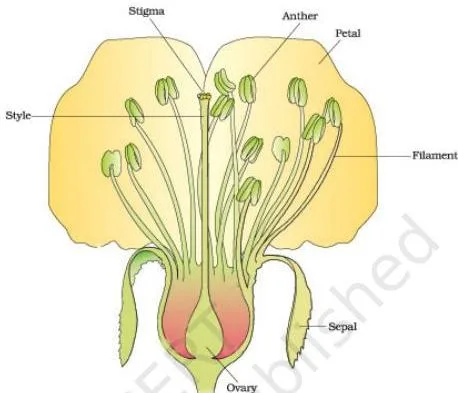
Figure 1.1 is the L.S. (longitudinal section) of a typical flower, and the chapter uses it to recall the parts of the flower before naming where the key structures develop (NCERT, p. 4).
The two most important units of sexual reproduction develop in the anther of the stamen (male gametophyte = pollen grain) and in the ovule inside the ovary (female gametophyte = embryo sac). If a question asks you to name these two sites, this is the answer.
| Stage | Main events | Where they happen |
|---|---|---|
| Pre-fertilisation: structures | Microsporogenesis and megasporogenesis build the gametophytes | Anther; ovule in the ovary |
| Pre-fertilisation: pollination | Pollen travels from anther to stigma; pollen tube grows to the embryo sac | Stigma, style, ovary |
| Double fertilisation | Syngamy + triple fusion in the same embryo sac | Inside the embryo sac |
| Post-fertilisation | Endosperm, embryo, seed and fruit develop | Ovule and ovary |
| Apomixis and polyembryony | Seeds form without fertilisation | Some grasses and Asteraceae; Citrus and Mango |
Learn the chain first because nearly every “arrange in sequence” or “where does this happen” question in the chapter tests it. The same logic, applied to humans, is the subject of the next chapter of this book, Human Reproduction; the chapter after that, Reproductive Health, completes the unit.
Male side: stamen, microsporangium and pollen grain
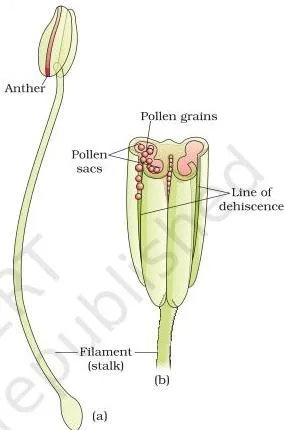
The stamen is the male reproductive organ. Figure 1.2 shows a typical stamen with its long, slender filament and the terminal bilobed anther; the cut section in part (b) reveals two thecae in each lobe, so the anther is bilobed and dithecous (NCERT, p. 5).
In transverse section (Figure 1.3a) the anther is four-sided, with four microsporangia at the corners, two in each lobe — hence tetrasporangiate. These microsporangia become pollen sacs packed with pollen grains. The enlarged view (Figure 1.3b) shows the four wall layers around each microsporangium, and part (c) shows a mature anther after dehiscence has released the pollen (NCERT, p. 6).
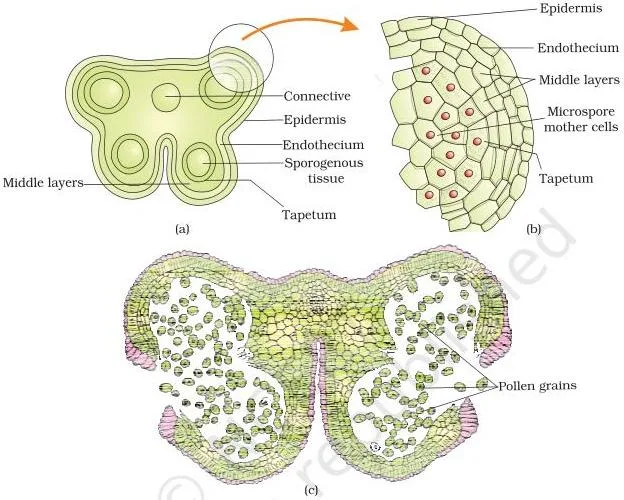
| Wall layer (outer → inner) | What it is | Function |
|---|---|---|
| Epidermis | Outermost layer | Protection |
| Endothecium | Below the epidermis | With the outer layers, helps the anther dehisce to release pollen |
| Middle layers | Thin layers between endothecium and tapetum | Protection and dehiscence |
| Tapetum | Innermost layer; cells with dense cytoplasm, often more than one nucleus | Nourishes the developing pollen grains |
Only the tapetum feeds the developing pollen; the outer three layers protect and help the anther open. Remember it as “outer three protect, tapetum nourishes.”
Microsporogenesis in five steps
Microsporogenesis is the formation of microspores from a pollen mother cell (PMC) through meiosis (NCERT, p. 6).
- The young anther has a central group of cells called sporogenous tissue (2n) in each microsporangium.
- Every cell of this tissue is a potential pollen mother cell (PMC), and each one can form a tetrad.
- PMCs undergo meiosis — this is microsporogenesis — producing microspore tetrads, clusters of four haploid microspores (n).
- As the anther matures and dehydrates, the microspores separate from the tetrad.
- Each microspore matures into a pollen grain; thousands are produced per microsporangium and released when the anther dehisces.
The pollen grain: wall, cells and shed stage
A pollen grain is the male gametophyte (NCERT, p. 7). It is generally spherical, about 25–50 µm across, with a two-layered wall:
- Exine — the hard outer layer of sporopollenin, among the most resistant organic materials known. It withstands high temperatures and strong acids and alkalis, no enzyme that degrades it is known, and it is why pollen survives as fossils. Sporopollenin is absent at the germ pores, the apertures through which the pollen tube emerges.
- Intine — the thin inner layer made of cellulose and pectin.
A mature pollen grain contains two cells: a large vegetative cell (abundant food reserve, large irregularly shaped nucleus) and a small spindle-shaped generative cell floating in its cytoplasm. More than 60% of angiosperms shed pollen at this two-celled stage; in the remaining species the generative cell divides mitotically before shedding, giving two male gametes — the three-celled stage.
Viability varies with species and depends on temperature and humidity: in cereals such as rice and wheat, pollen may lose viability within about 30 minutes of release, while many members of Rosaceae, Leguminosae and Solanaceae stay viable for months. Pollen of many species can be stored for years in liquid nitrogen (−196°C) as pollen banks, used in breeding programmes (NCERT, p. 8).
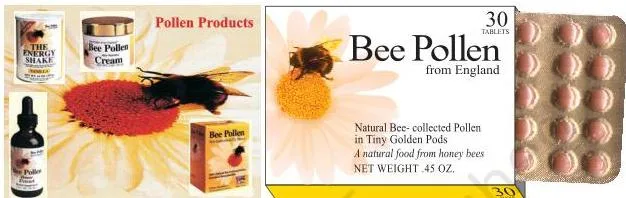
Pollen is also nutrient-rich enough to be sold as food supplements, and Parthenium (carrot grass) is a common cause of pollen allergy in India.
Female side: pistil, ovule and the 7-celled embryo sac
The pistil is the female reproductive organ. Each pistil has three parts: the stigma, a landing platform for pollen; the style, the slender part beneath the stigma; and the ovary, the basal bulged part that holds the ovules (NCERT, p. 8).
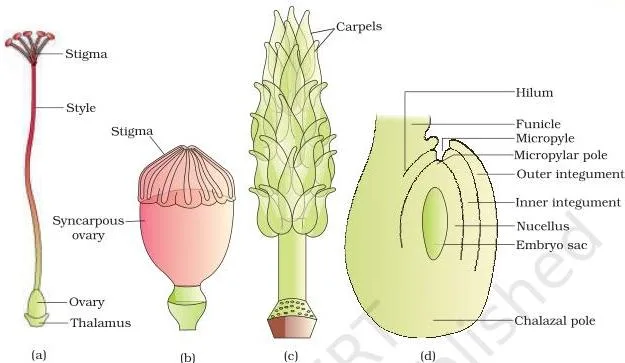
Figure 1.7(a) shows a dissected Hibiscus flower with its pistil exposed after other floral parts were removed. Compare (b) and (c): the pistils of Papaver are fused (syncarpous), while those of Michelia are free (apocarpous). Part (d) is the diagrammatic ovule used for the parts named below (NCERT, p. 9).
| Part of the ovule | Meaning |
|---|---|
| Funicle | Stalk attaching the ovule to the placenta |
| Hilum | Junction where the ovule body meets the funicle |
| Integuments | One or two protective envelopes around the nucellus |
| Micropyle | Small opening at the tip where the integuments do not cover the nucellus |
| Chalaza | Basal part of the ovule, opposite the micropyle |
| Nucellus | Mass of reserve-food-rich cells inside the integuments |
| Embryo sac | The female gametophyte, located in the nucellus |
Megasporogenesis is the formation of megaspores from the megaspore mother cell (MMC). One MMC (2n) differentiates in the micropylar region of the nucellus and undergoes meiosis to produce four haploid megaspores.
In the majority of plants, three megaspores degenerate and only one functional megaspore survives; this pattern is called monosporic development, and the surviving megaspore builds the female gametophyte, the embryo sac (NCERT, p. 10).
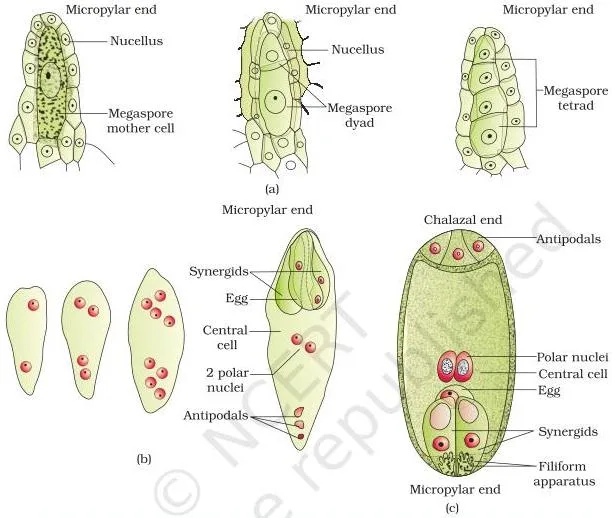
Figure 1.8(a) shows the MMC, a dyad and a tetrad of megaspores inside the ovule; (b) shows the 2-, 4- and 8-nucleate stages and the mature embryo sac; (c) is the diagrammatic mature sac you should be able to reproduce (NCERT, p. 10).
The functional megaspore’s nucleus divides mitotically, and the divisions are free nuclear — no cell wall forms after each division — so the sac passes through 2-nucleate and 4-nucleate stages before reaching eight nuclei. Only then do cell walls form, organising the cells in a fixed arrangement:
- Micropylar end — the egg apparatus: two synergids and one egg cell. The synergids carry the filiform apparatus at their micropylar tips, which guides the pollen tube into the synergid.
- Chalazal end — three antipodals.
- Centre — one large central cell with two polar nuclei.
So the mature embryo sac is 8-nucleate but 7-celled — the detail this chapter is famous for (NCERT, p. 11).
Pollination: types, agents and floral adaptations
Both gametes of a flowering plant are non-motile, so they must be brought together. Pollination is the transfer of pollen grains from the anther to the stigma of a pistil (NCERT, p. 11).
| Type | Source of pollen | Genetic consequence |
|---|---|---|
| Autogamy | Same flower | Self-pollination; the genetics of one plant |
| Geitonogamy | Another flower of the same plant | Functionally cross-pollination (needs an agent), but genetically like autogamy — same plant |
| Xenogamy | A different plant | The only type that brings genetically different pollen to the stigma |
Autogamy is rare in open flowers because it demands synchrony of pollen release and stigma receptivity, with the anthers and stigma lying close. Some plants — Viola, Oxalis, Commelina — produce two kinds of flowers: chasmogamous flowers that open normally, and cleistogamous flowers that never open.
In cleistogamous flowers the anthers dehisce inside the bud, pollen touches the stigma directly, and no cross-pollen can land; they are invariably autogamous and give assured seed-set even without pollinators (NCERT, p. 12).
Two abiotic agents (wind and water) and one biotic agent (animals) move pollen. Pollination by wind or water is a chance event, so such plants release enormous amounts of pollen compared with the number of ovules.
| Agent | Floral adaptations | Example plants |
|---|---|---|
| Wind (abiotic) | Light, non-sticky pollen; well-exposed stamens; large, often feathery stigma; often one ovule per ovary; flowers packed into compact inflorescences; no colour or nectar | Grasses; corn — the ears are the stigmas and styles waving in the wind |
| Water (abiotic) | Rare — about 30 genera, mostly monocots; pollen protected from wetting by a mucilaginous covering; male flowers or pollen carried passively to the female flower | Vallisneria, Hydrilla (fresh water); Zostera (marine) |
| Animals (biotic) | Large, colourful, fragrant flowers rich in nectar; small flowers clustered into conspicuous inflorescences; sticky pollen that coats the visitor; nectar and pollen as rewards; foul odours for flies and beetles | Bees are the dominant insect pollinators; also butterflies, moths, birds, bats |
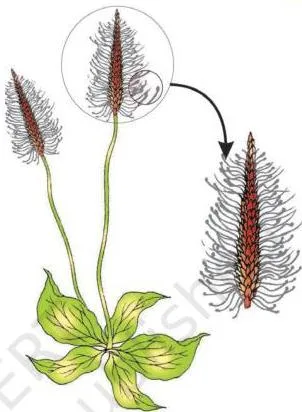
Figure 1.10 shows the two signatures of a wind-pollinated plant: a compact inflorescence and well-exposed stamens that release pollen directly into air currents (NCERT, p. 13). Water pollination is rare — about 30 genera — and it does not apply to all aquatic plants: water hyacinth and water lily raise their flowers above the water and are pollinated by insects or wind like land plants.
That is the usual counter-intuitive exam fact.
How flowers discourage self-pollination
Continued self-pollination leads to inbreeding depression, so most flowering plants carry devices that discourage selfing and encourage cross-pollination (NCERT, p. 15).
- Non-synchrony — pollen is released before the stigma becomes receptive, or the stigma matures before pollen is released.
- Position — anther and stigma are placed so pollen cannot reach the stigma of the same flower.
- Self-incompatibility — a genetic mechanism that blocks self-pollen (from the same flower or the same plant) from fertilising ovules by inhibiting pollen germination or pollen tube growth in the pistil.
- Unisexual flowers — monoecious plants such as castor and maize prevent autogamy but not geitonogamy; dioecious plants such as papaya prevent both autogamy and geitonogamy.
Landing on a stigma is not enough: pollen must be compatible — of the same species. The pistil recognises pollen through a continual dialogue of chemical components between pollen grain and pistil, then either accepts it and promotes post-pollination events, or rejects it by stopping germination on the stigma or tube growth in the style (NCERT, p. 16).
Think of it as a security check: the pistil reads the pollen’s chemical ID, lets a compatible visitor through and turns the wrong one away.
The path of a compatible pollen tube runs: stigma → tissues of the style → ovary → ovule through the micropyle → one synergid through the filiform apparatus, where the two male gametes are discharged (NCERT, pp. 16–17).
In plants shed at the two-celled stage, the generative cell divides during tube growth to form the two male gametes; in three-celled pollen the tube carries them from the beginning.
Emasculation and bagging: the breeder’s controlled cross
Plant breeders combine desirable characters from different species, sometimes genera, through artificial hybridisation, and they must be sure only the chosen pollen reaches the stigma. The controlled-cross procedure has three steps (NCERT, p. 17):
- Emasculation — if the female parent has bisexual flowers, remove its anthers from the flower bud with forceps before they dehisce.
- Bagging — cover the emasculated flower with a bag (usually of butter paper) so the stigma is protected from unwanted pollen.
- Pollination and rebagging — when the stigma becomes receptive, dust mature pollen collected from the male parent, rebag the flower, and let the fruit develop.
If the female parent produces unisexual flowers, emasculation is unnecessary: bag the female flower buds before they open, then pollinate with the desired pollen and rebag.
Double fertilisation: syngamy plus triple fusion
After the pollen tube enters a synergid, it releases two male gametes into the synergid’s cytoplasm. Two fusions then take place inside the same embryo sac (NCERT, p. 18):
- Syngamy — one male gamete moves to the egg cell and fuses with its nucleus, forming the diploid zygote (2n).
- Triple fusion — the other male gamete moves to the central cell and fuses with the two polar nuclei, forming the triploid primary endosperm nucleus (PEN, 3n). Because three haploid nuclei fuse, this event is called triple fusion.
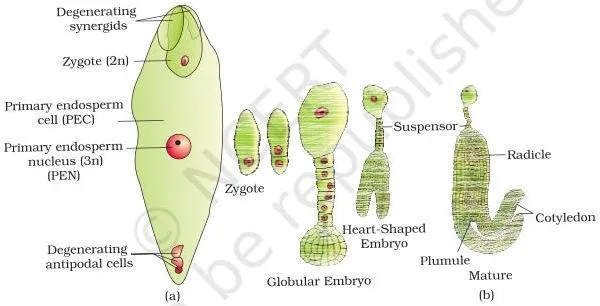
Figure 1.13(a) shows the fertilised embryo sac with its two products side by side — the zygote and the PEN. Since syngamy and triple fusion both occur in an embryo sac, the phenomenon is called double fertilisation, and it is unique to flowering plants.
The central cell, after triple fusion, becomes the primary endosperm cell (PEC) and develops into endosperm, while the zygote develops into the embryo. Keep the ploidy straight: zygote 2n, PEN 3n.
Post-fertilisation: endosperm, embryo, seed and fruit
Everything after double fertilisation — endosperm and embryo development, the maturing of ovules into seeds and the ovary into a fruit — counts as post-fertilisation events (NCERT, p. 18).
Endosperm: built before the embryo
Endosperm development precedes embryo development because the endosperm is the embryo’s food store. The PEN divides repeatedly into triploid endosperm tissue packed with reserve food. In the commonest pattern the PEN first undergoes successive nuclear divisions without cell wall formation — the free-nuclear stage — and then cell walls form, making the endosperm cellular.
Tender coconut water is nothing but free-nuclear endosperm, made of thousands of nuclei, and the white kernel around it is the cellular endosperm (NCERT, p. 19). Endosperm may be completely consumed by the embryo (pea, groundnut, beans) or may persist in the mature seed for use during germination (castor, coconut).
Embryo: proembryo to mature
The embryo develops at the micropylar end of the embryo sac, where the zygote sits, and most zygotes divide only after a certain amount of endosperm has formed — an adaptation giving assured nutrition to the embryo (NCERT, p. 19). The stages are proembryo → globular → heart-shaped → mature embryo; the lower panel of Figure 1.13 traces them for a dicot.
| Feature | Dicot embryo | Grass (monocot) embryo |
|---|---|---|
| Cotyledons | Two | One — the scutellum, placed laterally |
| Upper end of the axis | Epicotyl ending in the plumule (stem tip) | Epicotyl with shoot apex and leaf primordia enclosed in the coleoptile |
| Lower end of the axis | Hypocotyl ending in the radicle (root tip) covered by a root cap | Radicle and root cap enclosed in the coleorrhiza |
A memory hook for the grass terms: “coleo” means sheath — coleoptile is the sheath around the shoot tip, coleorrhiza the sheath around the root tip.
Seed and fruit
A seed is often described as a fertilised ovule. A typical seed has seed coat(s), cotyledon(s) and an embryo axis. The integuments harden into the seed coat, and the micropyle remains as a small pore in the coat, letting oxygen and water enter during germination (NCERT, p. 20).
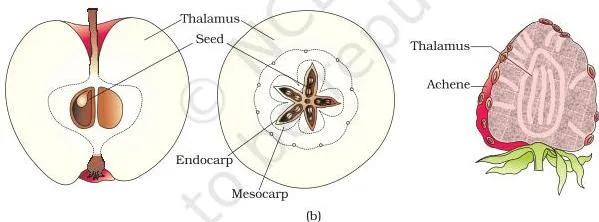
Figure 1.15(a) shows the structure of some seeds — seed coat, stored food and, in albuminous seeds, persistent endosperm; (b) shows the false fruits of apple and strawberry, in which the thalamus is part of the fruit (NCERT, p. 21).
| Seed type | Meaning | Examples |
|---|---|---|
| Non-albuminous (ex-albuminous) | Endosperm fully consumed by the embryo; none left in the seed | Pea, groundnut |
| Albuminous | Part of the endosperm remains in the mature seed | Wheat, maize, barley, castor |
| Perisperm | Persistent nucellus remaining in the seed | Black pepper, beet |
As ovules mature into seeds, the ovary develops into a fruit; the ovary wall becomes the pericarp. Fruits may be fleshy (guava, orange, mango) or dry (groundnut, mustard). In most plants the other floral parts degenerate, but in apple, strawberry and cashew the thalamus also contributes — these are false fruits.
Most fruits form only from the ovary and are true fruits; a few form without fertilisation and are called parthenocarpic fruits — banana is the example — and such fruits are seedless (NCERT, p. 21).
As seeds mature they become dry (about 10–15% moisture by mass), metabolism slows, and the embryo may enter dormancy until moisture, oxygen and suitable temperature allow germination — the property that makes seed storage and agriculture possible (NCERT, p. 20).
Apomixis and polyembryony: seeds without fertilisation
Some flowering plants — certain species of Asteraceae and grasses — have evolved a mechanism to produce seeds without fertilisation. This is apomixis, a form of asexual reproduction that mimics sexual reproduction (NCERT, p. 22). Two routes are described in the chapter:
- In some species, a diploid egg cell is formed without reduction division and develops into an embryo without fertilisation.
- More often, as in many Citrus and Mango varieties, nucellar cells around the embryo sac start dividing, protrude into the embryo sac and develop into embryos.
When several embryos develop this way, one ovule contains many embryos; the occurrence of more than one embryo in a seed is polyembryony (NCERT, p. 23).
The importance of apomixis lies in the hybrid seed industry. Hybrid seeds are costly because farmers must buy fresh hybrid seed every year — seeds saved from hybrids segregate in the progeny and lose the hybrid characters.
If hybrids are made apomictic, there is no segregation of characters in the progeny, and farmers can keep using hybrid seeds year after year instead of rebuying them (NCERT, p. 23). Keep the two “without fertilisation” terms apart: parthenocarpy is fruit without fertilisation; apomixis is seed without fertilisation.
Key terms: a definitions table
The chapter’s exercises ask several definitions outright, and most answers need the term plus one purpose or example. The table below gives both.
| Term | Student-friendly meaning | Example or note |
|---|---|---|
| Autogamy | Pollination within the same flower | Cleistogamous flowers are always autogamous |
| Geitonogamy | Pollen moves to another flower of the same plant | Needs an agent, but genetically like autogamy |
| Xenogamy | Pollen moves to a flower of a different plant | Only type bringing genetically different pollen |
| Chasmogamous | Flowers that open, exposing anthers and stigma | Most ordinary flowers |
| Cleistogamous | Flowers that never open; self-pollinate inside the bud | Viola, Oxalis, Commelina |
| Self-incompatibility | Genetic block that stops self-pollen fertilising ovules | Inhibits germination or tube growth in the pistil |
| Emasculation | Removing a bisexual flower’s anthers before dehiscence | Breeder’s tool; done with forceps |
| Bagging | Covering flowers with a bag to block unwanted pollen | Usually a butter-paper bag |
| Syngamy | Fusion of a male gamete with the egg | Gives the 2n zygote |
| Triple fusion | Fusion of a male gamete with the two polar nuclei | Gives the 3n PEN |
| Double fertilisation | Syngamy + triple fusion in one embryo sac | Unique to flowering plants |
| Endosperm | Triploid nutritive tissue from the PEN | Coconut water is its free-nuclear stage |
| Perisperm | Persistent nucellus left in a seed | Black pepper, beet |
| False fruit | Fruit formed with tissue beyond the ovary | Apple, strawberry (thalamus) |
| Parthenocarpy | Fruit formed without fertilisation | Banana; inducible by growth hormones |
| Apomixis | Seed formed without fertilisation | Some Asteraceae and grasses |
| Polyembryony | More than one embryo in one seed | Nucellar embryos in Citrus and Mango |
Memory device for the embryo sac: think 3 + 3 + 1. Three cells of the egg apparatus (2 synergids + 1 egg), three antipodals, one central cell — that is 7 cells. The central cell alone holds two polar nuclei, so the sac contains 8 nuclei. Seven cells, eight nuclei: the central cell is where the count changes.
Ploidy quick reference: from nucellus to endosperm
Read this table as a ladder: meiosis drops ploidy from 2n to n, and fusions push it back up.
| Structure or event | Ploidy |
|---|---|
| Nucellus | 2n |
| Megaspore mother cell (MMC) | 2n |
| Pollen mother cell (PMC) | 2n |
| Microspore / megaspore | n |
| Pollen grain (vegetative + generative cells) | n |
| Generative cell and male gametes | n |
| All embryo sac nuclei (egg, synergids, antipodals, polar nuclei) | n |
| Zygote (product of syngamy) | 2n |
| Primary endosperm nucleus (product of triple fusion) | 3n |
| Endosperm | 3n |
The pattern explains itself: everything produced by meiosis is n; the zygote is 2n because it is one n egg plus one n male gamete; the endosperm is 3n because it is one n male gamete plus two n polar nuclei. The triploid endosperm is the direct result of triple fusion and is unique to angiosperms (NCERT, pp. 10, 18).
Worked sequence problems: three developmental paths with ploidy
Three sequences cover most “arrange in order” questions in this chapter. Ploidy is labelled at every step.
Sequence A: the male path (microsporogenesis)
- Sporogenous tissue (2n) occupies the centre of each young microsporangium.
- Each cell acts as a pollen mother cell, PMC (2n).
- Meiosis (microsporogenesis) → microspore tetrad of four haploid microspores (n).
- The tetrad separates as the anther dehydrates → free microspores (n).
- Each microspore matures into a pollen grain (n) with a vegetative cell and a generative cell.
- In many species the generative cell later divides mitotically into two male gametes (n).
Sequence B: the female path (embryo sac formation)
- Megaspore mother cell, MMC (2n), differentiates in the micropylar region of the nucellus.
- Meiosis (megasporogenesis) → four megaspores (n).
- Three degenerate; one functional megaspore (n) survives — monosporic development.
- Free-nuclear mitotic divisions → 2-nucleate (n) → 4-nucleate (n) → 8-nucleate (n).
- Cell walls form → 7-celled embryo sac: egg apparatus (2 synergids + 1 egg), 3 antipodals, central cell with 2 polar nuclei (every nucleus n).
Sequence C: the pollen tube path
- Compatible pollen lands on the stigma.
- The pollen grain germinates through a germ pore.
- The pollen tube grows through the tissues of the stigma and style.
- The tube reaches the ovary and enters the ovule through the micropyle.
- It enters a synergid through the filiform apparatus.
- It discharges two male gametes into the synergid’s cytoplasm (NCERT, pp. 16–17).
Try it: arrange these terms in the correct developmental sequence — pollen grain, sporogenous tissue, microspore tetrad, pollen mother cell, male gametes. Answer: sporogenous tissue → pollen mother cell → microspore tetrad → pollen grain → male gametes. This is Exercise Q3 of the chapter, and the same logic applies to the female side.
Common mistakes students make in this chapter
| Students write | Correct is | Why |
|---|---|---|
| “The embryo sac is 8-celled” | 7-celled, 8-nucleate | The two polar nuclei live inside one central cell, so 3 (egg apparatus) + 3 (antipodals) + 1 (central cell) = 7 cells holding 8 nuclei |
| “The pollen grain is the male gamete” | The pollen grain is the male gametophyte; the male gametes are its generative-cell products | The two male gametes form only when the generative cell divides — inside the pollen tube in two-celled-shed plants |
| “Endosperm is diploid” | Triploid (3n) | It comes from triple fusion: one male gamete + two polar nuclei |
| “All aquatic plants pollinate by water” | Only about 30 genera do | Water hyacinth and water lily raise their flowers above water and are insect- or wind-pollinated |
| “Perisperm = pericarp” | Perisperm is persistent nucellus; pericarp is the ovary wall | One is inside the seed, the other is the fruit wall |
| “Tapetum protects the anther” | Tapetum nourishes the pollen; the outer three layers protect and aid dehiscence | Tapetum is the innermost layer, with dense cytoplasm and often more than one nucleus |
| “Endosperm develops after the embryo” | Endosperm precedes the embryo | Most zygotes divide only after some endosperm has formed, to assure embryo nutrition |
Exam notes: writing complete answers to the textbook exercises
The chapter’s exercises (NCERT, pp. 24–25) fall into a few types. Match your answer to the type, and you will not leave out the fact the question is looking for.
- Name-the-parts questions (Q1) — state the exact structure and add its function. For the male gametophyte the site is the anther; for the female gametophyte it is the ovule (embryo sac inside the ovary). Naming both sites completely answers the question.
- Differentiate questions (Q2, Q13) — write contrasting points, one per line, in two columns. Microsporogenesis vs megasporogenesis: both use meiosis; products are microspore tetrads vs megaspores. For the Q13 pairs (hypocotyl/epicotyl, coleoptile/coleorrhiza, integument/testa, perisperm/pericarp), give what each structure is and where it lies.
- Sequence questions (Q3) — write the chain and label where division is meiotic or mitotic: sporogenous tissue → pollen mother cell → microspore tetrad → pollen grain → male gametes. Meiosis happens at the PMC; mitosis happens in the generative cell.
- Diagram questions (Q4, Q6) — draw the grounded figures: the ovule (Figure 1.8a: funicle, hilum, integuments, micropyle, chalaza, nucellus, embryo sac) and the mature embryo sac (Figure 1.8c: egg apparatus with two synergids and the egg, three antipodals, central cell with two polar nuclei). Label every named part. Keep the related grounded diagrams — Figures 1.3 and 1.13 — ready for anther and embryo-sac/embryo drawings.
- Definition questions (Q5, Q7, Q9, Q10, Q15, Q18) — give the definition first, then one purpose or example. For example, self-incompatibility’s definition names the genetic block on pollen germination or tube growth; its purpose is to prevent inbreeding. Monosporic development means one functional megaspore builds the embryo sac while the other three degenerate.
- Reasoning questions (Q8, Q12, Q14, Q16, Q17) — state the mechanism, then the reason. The tapetum’s role (Q17) is nourishment of developing pollen. The zygote’s brief dormancy (Q12) is an adaptation for assured nutrition after endosperm forms. Apple is a false fruit (Q14) because the thalamus contributes to it. For Q16, choose fruits in which seedlessness is an advantage, with banana as the textbook example of a naturally parthenocarpic fruit; induced parthenocarpy also gives seedless fruits.
Keep the exact NCERT terminology; for example, write “primary endosperm nucleus” rather than “endosperm nucleus” when naming the triple-fusion product.
Revision summary in one look
Skim this list the night before the test; each line is one revision point.
- Flower → gametophytes: pollen grain (male) forms in the anther; embryo sac (female) forms in the ovule.
- Anther wall layers: epidermis, endothecium and middle layers protect and help dehiscence; the inner tapetum nourishes developing pollen.
- Pollen wall: exine = sporopollenin (resistant; absent at germ pores); intine = cellulose and pectin.
- Shed stage: more than 60% of angiosperms shed two-celled pollen; the rest shed three-celled after the generative cell divides.
- Ovule parts: funicle, hilum, integuments, micropyle, chalaza, nucellus, embryo sac.
- Embryo sac: 7-celled, 8-nucleate — egg apparatus (2 synergids + 1 egg) + 3 antipodals + central cell with 2 polar nuclei.
- Pollination types: autogamy (same flower), geitonogamy (same plant), xenogamy (different plant) — only xenogamy is truly cross.
- Pollinating agents: wind, water, animals; bees dominate; only about 30 genera use water — water hyacinth and water lily do not.
- Outbreeding devices: non-synchrony, different anther/stigma positions, self-incompatibility, unisexual flowers (monoecy blocks autogamy; dioecy blocks both).
- Double fertilisation: syngamy → zygote (2n); triple fusion → PEN (3n); unique to angiosperms.
- Endosperm before embryo: free-nuclear → cellular; coconut water is the free-nuclear stage.
- Embryo: proembryo → globular → heart-shaped → mature; dicot (epicotyl, hypocotyl, two cotyledons) vs grass (scutellum, coleoptile, coleorrhiza).
- Seed and fruit: seed from ovule, fruit from ovary; perisperm = persistent nucellus; false fruits (apple, strawberry) include the thalamus; parthenocarpic fruits (banana) are seedless.
- Apomixis and polyembryony: seed without fertilisation (Asteraceae, grasses; nucellar route in Citrus and Mango); apomixis keeps hybrid characters from segregating, so farmers can reuse hybrid seed.
For quick cross-chapter review, this page lives inside our full set of Class 12 notes; the chapters that follow it in the same book are covered in the Human Reproduction and Reproductive Health notes.
Frequently asked questions
What is the ploidy of the different cells of the embryo sac?
Every nucleus of the embryo sac is haploid (n): the two synergids, the egg, the three antipodals and the two polar nuclei. The central cell is the only cell without its own single nucleus — it holds two haploid polar nuclei, which is why the sac is 7-celled but 8-nucleate (NCERT, p. 11).
Why is double fertilisation called double, and where does each fusion happen?
Because two fusions take place in the same embryo sac: syngamy (one male gamete fuses with the egg) and triple fusion (the second male gamete fuses with the two polar nuclei). Both happen inside the mature embryo sac after the pollen tube discharges its gametes (NCERT, p. 18).
Are all aquatic plants pollinated by water?
No. Water pollination is limited to about 30 genera of flowering plants, mostly monocots. In a majority of aquatic plants such as water hyacinth and water lily, the flowers emerge above water and are pollinated by insects or wind like land plants (NCERT, p. 13).
What is the difference between apomixis and parthenocarpy?
Apomixis is seed formation without fertilisation — asexual reproduction that mimics sexual reproduction, as in some Asteraceae and grasses. Parthenocarpy is fruit formation without fertilisation, as in banana. One gives viable seeds; the other gives seedless fruits (NCERT, pp. 21–22).
Why does a tender coconut contain free-nuclear endosperm?
Because the coconut water is the free-nuclear stage of endosperm growth. The primary endosperm nucleus divides repeatedly without cell wall formation, producing thousands of free nuclei; the white kernel around the water is the cellular endosperm that forms after walls appear (NCERT, p. 19).
Why can cleistogamous flowers not cross-pollinate?
Because they never open. Their anthers dehisce inside the bud, pollen comes in contact with the stigma of the same flower, and no cross-pollen can reach it, so cleistogamous flowers are invariably autogamous (NCERT, p. 12).
Reference: NCERT Class 12 Biology textbook, chapter Sexual Reproduction in Flowering Plants.
Explore Class 12 Biology Notes
- Class 12 Biology Notes
- Class 12 CBSE Notes
- CBSE Notes for Classes 1 to 12
- Next: Human Reproduction
Class 12 Biology on LearnCBSE:
Related chapters:
- Reproductive Health notes
- Principles of Inheritance and Variation notes
- Evolution notes
Official source: download the NCERT textbook free from ncert.nic.in.