
These Reproductive Health Class 12 notes compress Chapter 3 of your Biology textbook into one revision-ready page: what reproductive health means, how India checks population growth, all seven categories of contraceptives with their mechanisms, the legal rules for medical termination of pregnancy, the sexually transmitted infections you must know, and the assisted reproductive technologies that help infertile couples.
The notes follow the 2026-27 session and the rationalised NCERT textbook.
Use the page to revise definitions, compare contraceptive methods side by side, learn the two mnemonics that make the chapter easy to recall, and practise the step-by-step scenarios in which a couple chooses a contraceptive or an ART technique.
You can also branch out to the Class 12 Biology notes, or step up to the class 12 notes and the CBSE notes index.
Reference: NCERT Class 12 Biology textbook, chapter Reproductive Health.
The Chapter in One View: From Awareness to Assisted Reproduction
The chapter runs on one line of logic: a society stays reproductively healthy through awareness, contraception, safe termination when needed, infection control and fertility assistance. The five NCERT topics build on each other in that order.
| NCERT section | Topic | Core question it answers |
|---|---|---|
| 3.1 | Reproductive health – problems and strategies | What does reproductive health mean, and how is a reproductively healthy society built? |
| 3.2 | Population explosion and birth control | Why did population growth become alarming, and how do contraceptives control it? |
| 3.3 | Medical termination of pregnancy | When and how can an unwanted or risky pregnancy be legally terminated? |
| 3.4 | Sexually transmitted infections | Which infections spread through sex, which are curable, and how are they prevented? |
| 3.5 | Infertility | How do assisted reproductive technologies help couples who cannot conceive? |
If you want to verify the exact wording, tables or figures while revising, the complete chapter is in the official NCERT PDF.
Reproductive Health: What the Term Actually Means
Reproductive health is broader than a healthy reproductive system. According to the WHO, it means total well-being in all aspects of reproduction — physical, emotional, behavioural and social (NCERT, p. 41). A reproductively healthy society is one where people have normally functioning reproductive organs and healthy emotional and behavioural interactions in all sex-related matters.
India was among the first countries to run national-level programmes for this goal. The family planning programme began in 1951; today it operates as the Reproductive and Child Health Care (RCH) programmes, whose two main tasks are creating awareness and providing facilities and support for a reproductively healthy society (NCERT, p. 42).
This chapter builds directly on what you studied in the Human Reproduction notes (Chapter 2) — the organs and functions you learnt there are the starting point for everything here.
Awareness about reproduction is spread through:
- Media: audio-visual and print campaigns run by governmental and non-governmental agencies.
- People: parents, close relatives, teachers and friends who pass on correct information.
- Schools: sex education, which gives young people right information and counters myths and misconceptions.
- Content: reproductive organs, adolescence and its changes, safe and hygienic sexual practices, STDs and AIDS, birth control options, care of pregnant mothers, post-natal care of mother and child, breast feeding, and equal opportunities for the male and female child.
Two programmes deserve special mention:
- Statutory ban on amniocentesis for sex determination: amniocentesis draws some amniotic fluid to analyse foetal cells and dissolved substances. It is a legitimate test for genetic disorders such as Down syndrome, haemophilia and sickle-cell anaemia — conditions you meet again in the Principles of Inheritance and Variation notes — and for the foetus’s survivability. Using the same test to learn the sex and then aborting a female foetus (female foeticide) is what the ban checks (NCERT, p. 42).
- Saheli: an oral contraceptive for females developed by scientists at the Central Drug Research Institute (CDRI), Lucknow — an Indian research achievement (NCERT, p. 42). Its details appear under hormonal methods below.
Population Explosion and How India Responded
Better living conditions and expanded health facilities produced an explosion in population growth. The probable reasons are a rapid decline in the death rate, maternal mortality rate (MMR) and infant mortality rate (IMR), plus an increase in the number of people in the reproductive age group (NCERT, p. 43).
| Year / event | World population | India’s population |
|---|---|---|
| 1900 | 2 billion | — |
| Independence (1947) | — | about 350 million |
| 2000 | about 6 billion | close to 1 billion |
| 2011 | 7.2 billion | crossed 1.2 billion (May 2011) |
The 2011 census put India’s growth rate below 2 per cent — about 20 per 1000 per year — a rate at which the population could still increase rapidly and create absolute scarcity of food, shelter and clothing (NCERT, p. 43). The government’s non-contraceptive measures were:
- Higher legal marriage age: 18 years for females and 21 years for males.
- Incentives for couples with small families.
- Small family norms: the slogan “Hum Do Hamare Do” (we two, our two), and the “one child norm” adopted by many young, urban, working couples.
Contraceptive Methods: All Six Categories, Mechanism by Mechanism
Birth control is the heart of the chapter, and exam answers revolve around it. An ideal contraceptive should be user-friendly, easily available, effective and reversible, with no or least side effects, and must not interfere with the sexual drive, desire or the sexual act (NCERT, p. 43).
The available methods fall into seven categories: natural/traditional, barrier, IUDs, oral pills, injectables, implants, and surgical methods. The memory phrase below joins injectables and implants under one letter. To recall them in order, memorise “No Baby Please, I’ll Inject Something” → Natural, Barrier, Pills, IUD, Injectables/Implants, Surgical.
For the three actions of IUDs, use “Sperms get Chewed, Chilled, and the uterus turns Hostile”:
- Chewed: IUDs increase the phagocytosis of sperms inside the uterus.
- Chilled: copper ions released by copper IUDs suppress sperm motility and fertilising capacity.
- Hostile: hormone-releasing IUDs make the uterus unsuitable for implantation and the cervix hostile to sperms (NCERT, p. 44-45).
Natural and Traditional Methods
All three natural methods work on one principle: avoid the meeting of ovum and sperms. Because no medicines or devices are used, side effects are almost nil — but the chances of failure are high (NCERT, p. 43-44).
| Method | How it works | Limitation |
|---|---|---|
| Periodic abstinence | Couples avoid coitus during days 10-17 of the menstrual cycle — the fertile period when ovulation is expected | Needs cycle awareness and discipline |
| Withdrawal (coitus interruptus) | The male withdraws the penis from the vagina just before ejaculation to avoid insemination | Depends on timing and self-control |
| Lactational amenorrhea | Intense lactation after parturition suppresses ovulation, so the menstrual cycle stops while the mother fully breastfeeds | Effective only up to about six months after parturition |
Barrier Methods: Condoms and Cervical Barriers
Barrier methods keep the ovum and sperms from physically meeting. Condoms are thin rubber/latex sheaths: the male condom covers the penis; the female condom (below) lines the vagina and covers the cervix. Either way, ejaculated semen cannot enter the female reproductive tract. “Nirodh” is a popular male condom brand.
Condoms are disposable, can be self-inserted, and give the user privacy — but their extra advantage is that they protect the user from STIs and AIDS (NCERT, p. 44).
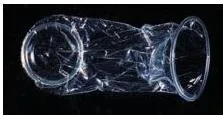
Diaphragms, cervical caps and vaults are rubber barriers inserted into the female reproductive tract to cover the cervix during coitus, blocking sperms from entering through it. They are reusable, and spermicidal creams, jellies and foams are usually used alongside them to increase their contraceptive efficiency.
Intrauterine Devices: How IUDs Work
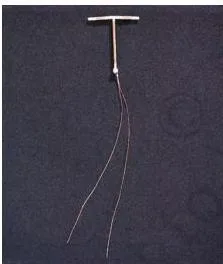
Intrauterine devices (IUDs) are inserted into the uterus through the vagina by doctors or expert nurses (NCERT, p. 44). Three types exist:
- Non-medicated IUDs: e.g. Lippes loop.
- Copper-releasing IUDs: CuT, Cu7, Multiload 375.
- Hormone-releasing IUDs: Progestasert, LNG-20.
The figure below shows the Copper T (CuT), a T-shaped device whose copper does the contraceptive work. The action of IUDs is threefold: they increase phagocytosis of sperms in the uterus; copper ions suppress sperm motility and fertilising capacity; and hormone-releasing IUDs additionally make the uterus unsuitable for implantation and the cervix hostile to sperms (NCERT, p. 44-45).
IUDs are ideal for women who want to delay pregnancy and/or space children, and they are among the most widely accepted contraceptive methods in India.
Hormonal Methods: Pills, Injectables and Implants
Oral contraceptive pills contain small doses of progestogens alone or progestogen-estrogen combinations. The schedule: take one tablet daily for 21 days, ideally beginning within the first five days of the menstrual cycle; then a 7-day gap follows, during which menstruation occurs; repeat this pattern until the female wishes to prevent conception.
Pills work by inhibiting ovulation and implantation and by altering the quality of cervical mucus to slow or prevent the entry of sperms (NCERT, p. 45).
Saheli is a different pill: a non-steroidal, once-a-week tablet with very few side effects and high contraceptive value, developed at CDRI Lucknow (NCERT, p. 45).
Injections and implants use progestogens alone or with estrogen; their mode of action is similar to the pills, but their effective period is much longer. The figure below shows implants — small rods placed under the skin.
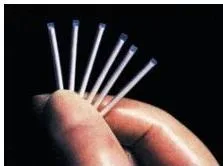
Emergency contraception: progestogens, progestogen-estrogen combinations or IUDs taken within 72 hours of coitus are very effective at avoiding a possible pregnancy after rape or casual unprotected intercourse.
Surgical Methods: Vasectomy and Tubectomy
Sterilisation is the surgical method, advised as a terminal method when a couple wants no more pregnancies. The operation blocks gamete transport — it does not stop gametes from being formed (NCERT, p. 45-46).
Vasectomy (male): a small part of the vas deferens is removed or tied up through a small incision on the scrotum. Tubectomy (female): a small part of the fallopian tube is removed or tied up through a small incision in the abdomen or through the vagina.
Compare the two figures below: the surgery site is a sperm duct in the male and an oviduct in the female — in both cases a transport tube, which is why the method is so effective.
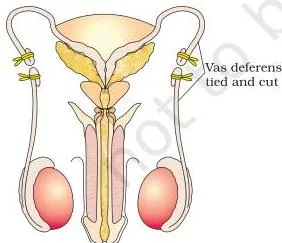
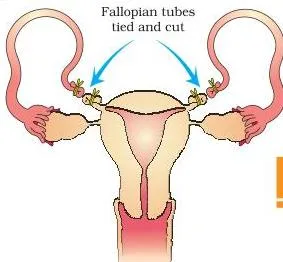
Both methods are highly effective, but their reversibility is very poor — which is exactly why they are treated as permanent decisions.
Choosing a Contraceptive: A Quick Comparison
When a question gives you a couple and asks which method suits them, run through this table first.
| Category | Examples | How it works | Best for (user) | Reversibility | Side effects / note |
|---|---|---|---|---|---|
| Natural / traditional | Periodic abstinence, withdrawal, lactational amenorrhea | Prevents ovum and sperms from meeting; no medicine or device | Couples avoiding drugs and devices | Fully reversible | Almost no side effects; chances of failure high |
| Barrier | Male/female condoms (Nirodh); diaphragms, cervical caps, vaults | Physical block stopping sperms entering through the cervix; spermicides raise efficiency | Both male and female users | Reversible; condoms disposable, caps and vaults reusable | Bonus: protects the user from STIs and AIDS |
| IUDs | Lippes loop; CuT, Cu7, Multiload 375; Progestasert, LNG-20 | Phagocytosis of sperms; copper ions suppress motility; hormones make uterus unsuitable and cervix hostile | Women who want to delay pregnancy or space children | Fertility returns after removal | Widely accepted in India; chapter-listed possible effects: breakthrough or irregular bleeding (NCERT, p. 46) |
| Oral pills | Progestogen or progestogen-estrogen tablets; Saheli | Inhibit ovulation and implantation; alter cervical mucus | Females able to follow a daily routine | Fertility returns when stopped | 21-day + 7-day gap routine; chapter-listed possible effects: nausea, breakthrough bleeding (NCERT, p. 46) |
| Injectables / implants | Progestogen (± estrogen) injections; skin implants | Same as pills, but the effective period is much longer | Females wanting long-acting hormonal cover | Reversible, but duration is long | Act like pills; implants sit under the skin (Figure 3.3) |
| Surgical | Vasectomy; tubectomy | Blocks gamete transport along the vas deferens or fallopian tube | Couples whose family is complete | Very poor — terminal method | Highly effective; needs prior counselling |
Two cautions the textbook insists on: choose and use any contraceptive in consultation with qualified medical professionals, and remember that contraceptives are not a regular requirement for maintaining reproductive health — they are practised against the natural event of conception (NCERT, p. 46).
Medical Termination of Pregnancy: Rules, Risks and Misuse
Medical termination of pregnancy (MTP) is a pregnancy deliberately ended before full term — also called induced abortion. The scale is large: about 45 to 50 million MTPs are performed worldwide every year, roughly one-fifth of all conceived pregnancies (NCERT, p. 46).
MTP is needed to end unwanted pregnancies — from casual unprotected intercourse, contraceptive failure or rape — and in cases where continuing the pregnancy could harm or even kill the mother or the foetus. India legalised MTP in 1971 with strict conditions to prevent misuse.
Under the Medical Termination of Pregnancy (Amendment) Act, 2017, the current framework described in the textbook is:
- Up to 12 weeks of pregnancy: termination on the opinion of one registered medical practitioner.
- More than 12 but fewer than 24 weeks: two registered medical practitioners must agree.
The legal grounds for termination are two: the pregnancy involves a risk to the life of the woman or grave injury to her physical or mental health, or there is a substantial risk that the child, if born, would suffer physical or mental abnormalities serious enough to be handicapped (NCERT, p. 46).
Why the chapter treats MTP as risky: MTPs are relatively safe during the first trimester, up to 12 weeks; second-trimester abortions are much riskier. Yet most MTPs in India are performed illegally by unqualified quacks — unsafe and sometimes fatal.
A second dangerous trend is the misuse of amniocentesis to determine the sex of the unborn child; when the foetus turns out to be female, it is often followed by MTP — that is female foeticide and is against what is legal.
The chapter’s remedy: effective counselling about unprotected coitus and the risk factors of illegal abortion, plus more health-care facilities (NCERT, p. 46-47).
Sexually Transmitted Infections: What Spreads, What Cures, What Harms
Sexually transmitted infections (STIs) — also called venereal diseases (VD) or reproductive tract infections (RTI) — are infections or diseases that pass from person to person during sexual intercourse (NCERT, p. 47). The common ones are:
- Gonorrhoea
- Syphilis
- Genital herpes
- Chlamydiasis
- Genital warts
- Trichomoniasis
- Hepatitis-B
- HIV leading to AIDS
Most of these spread sexually, but hepatitis-B and HIV can also be transmitted by sharing injection needles or surgical instruments with infected persons, by blood transfusion, or from an infected mother to her foetus. HIV, the most dangerous of these, is discussed in detail in the Human Health and Disease notes (Chapter 7).
The curability rule: except for hepatitis-B, genital herpes and HIV, the other STIs are completely curable if detected early and treated properly. Early symptoms are mild — itching, fluid discharge, slight pain and swellings in the genital region — and infected females are often asymptomatic, so the infection may stay undetected for long.
Social stigma also deters people from timely detection and treatment. The late complications include pelvic inflammatory disease (PID), abortions, still births, ectopic pregnancies, infertility and even cancer of the reproductive tract.
The incidence of STIs is reported to be very high in the 15-24 years age group. Prevention follows three simple principles from the textbook:
- Avoid sex with unknown or multiple partners.
- Always use condoms during coitus.
- In case of doubt, go to a qualified doctor for early detection and complete treatment if diagnosed.
Infertility and Assisted Reproductive Technologies
A couple is said to be infertile when they cannot have a child despite unprotected sexual cohabitation — the chapter summary fixes this at two years (NCERT, p. 49). The causes can be physical, congenital, due to diseases or drugs, or be immunological or psychological (NCERT, p. 47-48).
The chapter’s sharpest social point: in India the female is often blamed for a childless couple, but more often than not the problem lies in the male partner. So the correct first step is diagnosis in specialised infertility clinics, not blame.
Where correction is not possible, couples are helped by assisted reproductive technologies (ART):
- IVF-ET (in vitro fertilisation – embryo transfer): the “test tube baby” programme. Ova from the wife/donor and sperms from the husband/donor are collected and induced to form a zygote in the laboratory under simulated body conditions.
- ZIFT (zygote intra fallopian transfer): the zygote or an early embryo with up to 8 blastomeres is transferred into the fallopian tube.
- IUT (intra uterine transfer): an embryo with more than 8 blastomeres is placed into the uterus to complete development.
- GIFT (gamete intra fallopian transfer): an ovum from a donor is transferred into the fallopian tube of a female who cannot produce one but can provide a suitable environment for fertilisation and development.
- ICSI (intracytoplasmic sperm injection): a sperm is injected directly into the ovum to form an embryo in the laboratory.
- AI / IUI (artificial insemination / intra-uterine insemination): semen from the husband or a healthy donor is artificially introduced into the vagina or uterus — used when the male cannot inseminate or has very low sperm counts in the ejaculate.
| Technique | Where fertilisation happens | Where the embryo or gamete is placed |
|---|---|---|
| IVF-ET | Laboratory (in vitro) | Embryo transferred later, by ZIFT or IUT |
| ZIFT | Laboratory | Zygote or early embryo (up to 8 blastomeres) → fallopian tube |
| IUT | Laboratory | Embryo (more than 8 blastomeres) → uterus |
| GIFT | Recipient’s fallopian tube (in vivo) | Donor ovum → fallopian tube |
| ICSI | Laboratory | Sperm injected into the ovum itself |
| AI / IUI | Naturally, inside the female tract | Semen introduced into the vagina or uterus |
Be realistic about the limits of ART: these techniques demand extremely high precision handling by specialised professionals and expensive instrumentation, so facilities exist in only a few centres and are affordable to few. Emotional, religious and social factors also deter adoption.
Since the aim of all these procedures is to have children, the chapter closes with a reminder that legal adoption — permitted by Indian law — remains one of the best methods for couples looking for parenthood (NCERT, p. 48).
Key Terms and Definitions at a Glance
| Term | Meaning | Example or context |
|---|---|---|
| Reproductive health | Total well-being in all aspects of reproduction — physical, emotional, behavioural and social | WHO definition; the goal of India’s programmes |
| RCH programmes | Reproductive and Child Health Care programmes, India’s current family-planning umbrella | Started as family planning in 1951 (NCERT, p. 42) |
| Periodic abstinence | Avoiding coitus during the fertile period | Days 10-17 of the menstrual cycle |
| Lactational amenorrhea | Absence of menstruation due to intense lactation after childbirth | Natural contraception, effective up to about six months |
| IUD | Intrauterine device inserted into the uterus through the vagina | CuT, Lippes loop, LNG-20 |
| MTP | Medical termination of pregnancy — a pregnancy deliberately ended before full term | Legal in India since 1971 |
| STI | Infection or disease transmitted through sexual intercourse; also VD or RTI | Gonorrhoea, syphilis, HIV |
| Infertility | Inability to produce children even after two years of unprotected sexual cohabitation | Solved by ART or legal adoption |
| ART | Assisted reproductive technologies — lab-based methods that help infertile couples conceive | IVF, ZIFT, GIFT, ICSI |
| IVF-ET | In vitro fertilisation followed by embryo transfer; the “test tube baby” programme | Zygote formed in the lab, embryo transferred later |
| ZIFT | Zygote intra fallopian transfer | Embryo up to 8 blastomeres → fallopian tube |
| IUT | Intra uterine transfer | Embryo with more than 8 blastomeres → uterus |
| GIFT | Gamete intra fallopian transfer | Donor ovum → recipient’s fallopian tube |
| ICSI | Intracytoplasmic sperm injection | Sperm injected directly into the ovum |
| AI / IUI | Artificial insemination / intra-uterine insemination | Semen introduced into the vagina or uterus |
Key Numbers and Legal Cut-offs to Remember
This chapter has no formulas, but it has numbers that complete answers. Revise them as a set.
| Item | Value | Why it matters |
|---|---|---|
| Fertile window | Days 10-17 of the menstrual cycle | The period for periodic abstinence |
| Lactational amenorrhea | Effective up to about 6 months after parturition | Beyond this it fails even with breastfeeding |
| Pill schedule | 21 days daily + 7-day gap, then repeat; start within first 5 days of the cycle | Menstruation occurs during the gap |
| Emergency contraception window | Within 72 hours of coitus | Used after rape or casual unprotected intercourse |
| MTP — first trimester | Up to 12 weeks: one registered medical practitioner | First-trimester MTP is relatively safe |
| MTP — second trimester | 12-24 weeks: two registered medical practitioners | Second-trimester abortions are much riskier |
| MTP legalisation | 1971 in India | Framework updated by the 2017 Amendment Act |
| Marriage age | 18 years (female), 21 years (male) | Statutory measure to slow population growth |
| World population | 7.2 billion in 2011 (2 billion in 1900, about 6 billion in 2000) | Shows the speed of the explosion |
| India’s population | 1.2 billion by May 2011 (about 350 million at independence) | Same explosive trend |
| India’s growth rate (2011 census) | Below 2 per cent — about 20 per 1000 per year | A rate at which population still increases rapidly |
| MTP volume | 45-50 million per year worldwide, about one-fifth of conceived pregnancies | Shows why safe, legal MTP matters |
Worked Examples: Three Couples, Three Decisions
Method first: Decision flow for choosing contraception or ART. For any scenario, answer in three steps — identify the couple’s need, match a mechanism to that need, and state the reversibility or the biological route you are using.
Worked Example 1: A young couple delaying their first child
Step 1 — Identify the need: delaying a first pregnancy.
The couple wants children later, so the method must be reversible, not permanent.
Step 2 — Match the mechanism: a copper-releasing IUD (CuT or Cu7) fits — copper ions suppress sperm motility and fertilising capacity, and the IUD increases phagocytosis of sperms in the uterus.
Step 3 — State reversibility: once the IUD is removed, fertility returns, so a delay of about two years is fully manageable.
Final answer: advise a copper-releasing IUD for this couple.
Worked Example 2: A couple whose family is complete
Step 1 — Identify the need: permanent.
With two children and a decision that the family is complete, the aim is no more pregnancies.
Step 2 — Choose the terminal method: vasectomy (a part of the vas deferens removed or tied through the scrotum) or tubectomy (a part of the fallopian tube removed or tied through the abdomen or vagina).
Both block gamete transport, not gamete formation.
Step 3 — Rule out daily pills: oral pills are reversible and demand daily compliance; a missed pill weakens protection.
They cannot serve a permanent decision.
Because surgical reversibility is very poor, the choice needs counselling.
Final answer: recommend vasectomy or tubectomy as the terminal method.
Worked Example 3: Blocked fallopian tubes
Step 1 — Identify the blocked site: the fallopian tube is where fertilisation normally happens; a block stops the sperms from meeting the egg.
Step 2 — Bypass the block with IVF: collect ova from the wife and sperms from the husband and allow a zygote to form in the laboratory under simulated body conditions.
Step 3 — Choose the transfer route: if the early embryo has up to 8 blastomeres, transfer it into the fallopian tube (ZIFT); if it has more than 8 blastomeres, transfer it into the uterus (IUT).
Final answer: IVF-ET, with the embryo delivered by ZIFT or IUT depending on its cell stage.
Worked Example 4: Male factor with very low sperm count
Step 1 — Identify the problem: the egg is normal, but too few sperms in the ejaculate make natural fertilisation unlikely.
Step 2 — Choose between two routes: ICSI (a single sperm injected directly into the ovum in the lab) when fertilisation itself is at risk; or artificial insemination (AI/IUI) — the husband’s semen introduced into the vagina or uterus — when the sperms can still fertilise once placed close to the egg.
Final answer: ICSI for severe sperm defects; AI/IUI for low count or inability to inseminate.
In every answer, give the full name of the technique, its abbreviation, and the biological reason it matches the couple’s condition.
Common Mistakes Students Make and Their Corrections
| Mistake | Why it is wrong | Correct idea | How to check your answer |
|---|---|---|---|
| “Surgical contraceptives prevent gamete formation” | Sterilisation acts on the tubes that carry gametes, not on the organs that make them | Vasectomy blocks the vas deferens; tubectomy blocks the fallopian tube — gamete transport is blocked, not formation (NCERT, p. 45-46) | Ask: is the surgery on a duct (vas deferens) or an oviduct? If yes, the answer is about transport |
| “Lactational amenorrhea works as long as breastfeeding continues” | The method is tied to intense lactation; ovulation can return even while nursing continues | It is effective only up to about six months after parturition, with full breastfeeding | Ask: how long after childbirth? Answer “about six months”, not “as long as nursing” |
| “All STIs are completely curable” | The chapter names three exceptions that cannot be cured | Except hepatitis-B, genital herpes and HIV, the other STIs are curable if detected early and treated properly (NCERT, p. 47) | Run the infection through the exception list before writing “curable” |
| “Infertility is always the female’s fault” | Blame ignores the biology | More often than not the problem lies in the male partner; both partners need diagnosis | Ask: who should be investigated? Both, with the male routinely screened |
| “MTP is a contraceptive method” | The two act at different points of reproduction | Contraceptives prevent conception; MTP terminates a pregnancy that has already begun | Ask: has conception already happened? Yes → MTP territory; No → contraception |
| “IUDs are barrier devices” | An IUD sits inside the uterus, not at the cervix, and does not physically block sperm entry | Its action is phagocytosis of sperms, copper ions suppressing motility, and hormonal changes making the uterus hostile (NCERT, p. 44-45) | Mechanism questions: “physical block” describes condoms and diaphragms; IUDs use the three actions |
Exam Notes: How to Structure a Complete Answer
The exercises at the end of the chapter (NCERT, p. 50) fall into four types. Each type has a standard answer skeleton you can reuse.
- “Why” or “justify” questions (for example, sex education in schools, the justification of contraceptive use, or the amniocentesis ban): answer in three moves — state your position in one line; give two or three reasons drawn from the chapter; close with the consequence of ignoring the issue. For amniocentesis, first define the test and what it detects, then explain its misuse for sex determination and the female foeticide it feeds, and only then justify the ban.
- “Suggest methods” questions (assisting infertile couples): name the ART technique with its full form and abbreviation, and give one line on how it works — for instance, that ZIFT transfers a zygote or early embryo into the fallopian tube.
- True/False questions: write True or False as the first word, then justify in one line. A bare word with no reason does not complete the question.
- Statement-correction questions: identify the exact phrase that is wrong, then rewrite the whole statement as a correct one. Crossing out a word is not enough; the rebuilt statement must be complete and accurate.
Finally, write the full forms of abbreviations — ZIFT, IUT, GIFT, ICSI and IUI — at least once in every answer that uses them.
Quick Revision Summary: One-Minute Recap
| Aspect | One line to remember |
|---|---|
| Definition | Reproductive health = total well-being in reproduction: physical, emotional, behavioural, social (WHO) |
| Programmes | Family planning (1951) → RCH programmes; awareness via media, schools, family, friends |
| Population data | World 7.2 billion (2011); India 1.2 billion (May 2011); growth below 2% (20/1000/year) |
| Contraceptive categories | Natural, Barrier, Pills, IUD, Injectables/Implants, Surgical — “No Baby Please, I’ll Inject Something” |
| IUD actions | Chewed (phagocytosis), Chilled (copper ions), Hostile (hormonal uterus) — “Sperms get Chewed, Chilled, hostile uterus” |
| MTP | Legal since 1971; up to 12 weeks = one doctor, 12-24 weeks = two doctors; first trimester relatively safe |
| STIs | Hepatitis-B, genital herpes, HIV not curable; prevent with fewer partners, condoms, early qualified treatment |
| Infertility | No child after 2 years of unprotected cohabitation; often male factor, not female blame |
| ART | IVF-ET (test tube baby), ZIFT (up to 8 blastomeres → fallopian tube), IUT (>8 → uterus), GIFT (donor ovum), ICSI (inject sperm), AI/IUI (insemination) |
| Alternative | Legal adoption remains one of the best paths to parenthood |
Frequently Asked Questions
Why is lactational amenorrhea effective for only six months as a contraceptive?
Because it depends on the hormonal state of intense lactation, and that suppression of ovulation does not last. While a mother fully breastfeeds after childbirth, ovulation and the menstrual cycle do not occur, so conception is very unlikely. This protection holds only up to about six months after parturition (NCERT, p. 44).
Beyond that, ovulation can return even if breastfeeding continues, so relying on this method risks failure.
What is the difference between ZIFT, IUT and GIFT in assisted reproduction?
The difference is what gets transferred, and where. ZIFT places the zygote or an early embryo of up to 8 blastomeres into the fallopian tube. IUT places an embryo that has grown beyond 8 blastomeres into the uterus.
GIFT transfers a donor’s ovum — not an embryo — into the fallopian tube of a woman who cannot produce eggs of her own, and fertilisation happens naturally inside her body.
Why is amniocentesis banned in India for sex determination?
Because the test can reveal the sex of the foetus, and that information was being misused: female foetuses were frequently aborted, in a practice called female foeticide. The statutory ban exists to check this menace (NCERT, p. 42).
The test itself remains legitimate for detecting genetic disorders; what is banned is using it to determine sex and then terminating the pregnancy on that basis.
Which sexually transmitted infections are not completely curable?
Hepatitis-B, genital herpes and HIV. Every other STI on the chapter’s list — gonorrhoea, syphilis, chlamydiasis, genital warts and trichomoniasis — is completely curable if detected early and treated properly (NCERT, p. 47).
How is MTP different from contraception, and up to how many weeks is it legal in India?
Contraception stops conception from occurring in the first place; MTP ends a pregnancy that has already begun. Under the Medical Termination of Pregnancy (Amendment) Act, 2017, a pregnancy up to 12 weeks can be terminated on the opinion of one registered medical practitioner; between 12 and 24 weeks, two registered medical practitioners must agree (NCERT, p. 46). MTP was legalised in India in 1971.
Reference: NCERT Class 12 Biology textbook, chapter Reproductive Health.
Explore Class 12 Biology Notes
- Class 12 Biology Notes
- Class 12 CBSE Notes
- CBSE Notes for Classes 1 to 12
- Previous: Human Reproduction
- Next: Principles of Inheritance and Variation
Class 12 Biology on LearnCBSE:
Related chapters:
- Sexual Reproduction in Flowering Plants notes
- Evolution notes
- Human Health and Disease notes