
You have about fifteen pages of dense NCERT prose to turn into revision material: the origin of the universe, the chemistry of the first life, Darwin’s theory, eight strands of evidence, adaptive radiation, an algebraic principle, two billion years of geological history and the whole human story.
The facts exam answers depend on — dates, brain sizes, the difference between homology and analogy — sit scattered across the chapter.
These Evolution Class 12 notes reorder Chapter 6 into the sequence a teacher would build: origin of life → theory → evidence → adaptive radiation → mechanism → Hardy-Weinberg maths → geological timeline → human evolution. Definitions sit in tables, Miller’s experiment is read figure by figure, and the Hardy-Weinberg calculation is worked on original numbers.
Bracketed references such as (NCERT, p. 111) point to the textbook page if you need to verify a detail. This page follows the 2026-27 session.
The official NCERT chapter PDF is available from ncert.nic.in for checking any detail against the source text. This page is part of the Class 12 Biology notes hub, where the rest of the subject’s chapters live. Use the table of contents below to jump to any section.
Where the Chapter Goes: A Quick Map
The chapter’s summary (NCERT, p. 126) states the whole argument in one breath: diversity of life has been changing over millions of years, variations in a population produce variable fitness, and homology is explained by branching descent. The nine sections of the chapter build that argument step by step:
- Universe and earth first. The Big Bang, a 13.8-billion-year-old universe, a ~4.5-billion-year-old earth, then a reducing atmosphere with no free oxygen.
- Chemical evolution. Oparin and Haldane propose life from non-living organic molecules; Miller’s experiment produces amino acids in the lab.
- Darwin’s theory. Built-in variation + reproductive fitness + natural selection = gradual evolution.
- The evidence. Fossils, embryos, comparative anatomy, biochemistry, artificial selection and industrial melanism all point the same way.
- Adaptive radiation. One ancestral stock radiates into many species — Darwin’s finches, Australian marsupials.
- Mechanisms. Mutation, genetic drift and gene flow supply and shuffle the variation evolution needs.
- Hardy-Weinberg. The quantitative check — stable allele frequencies mean no evolution; disturbance means evolution is happening.
- Geological timeline. From the first cells (~2000 mya) to the dinosaurs’ disappearance (~65 mya) and the mammals’ rise.
- Origin of man. Dryopithecus to Homo sapiens — the most interesting story of all.
Notice that each section answers the question the previous one leaves open. The ancestor of all sections is the origin of life, so that is where these notes start too.
Origin of Life: From the Big Bang to the First Cells
The chapter opens by pushing the clock back as far as it goes: looking at stars is looking into the past, because starlight takes millions of years to reach us (NCERT, p. 110).
The numbers that follow recur constantly, so fix them first: the universe is ~13.8 billion years old; earth formed ~4.5 billion years ago; life appeared ~4 billion years ago — 500 million years after earth formed (NCERT, p. 110-111).
How earth became habitable (NCERT, p. 111):
- The Big Bang theory explains the universe’s origin: a huge explosion, expansion and cooling; hydrogen and helium formed, then gases condensed under gravitation into galaxies.
- Early earth had no atmosphere. Water vapour, methane \( (CH_4) \), carbon dioxide \( (CO_2) \) and ammonia \( (NH_3) \) came from the molten mass covering the surface.
- UV rays split water into hydrogen and oxygen; the lighter hydrogen escaped. Oxygen combined with ammonia and methane to form water and \( CO_2 \), and the ozone layer formed.
- As the earth cooled, water vapour fell as rain, filled the depressions, and formed the oceans.
- Life appeared almost four billion years ago — entirely in water.
Once oceans existed, where did life come from? The chapter gives three historical answers (NCERT, p. 111):
- Panspermia — spores or units of life carried between planets; still a favourite idea for some astronomers.
- Spontaneous generation — life arising from decaying matter such as straw and mud. Louis Pasteur’s pre-sterilised flask experiments ended it: life comes only from pre-existing life.
- Chemical evolution — Oparin of Russia and Haldane of England proposed that the first life came from pre-existing non-living organic molecules (RNA, protein), and that its formation was preceded by chemical evolution — diverse organic molecules built from inorganic constituents.
The version most scientists accept — biogenesis — is that the first life arose slowly, through evolutionary forces, from non-living molecules (NCERT, p. 112).
How to read Figure 6.1 — Miller’s experiment, step by step
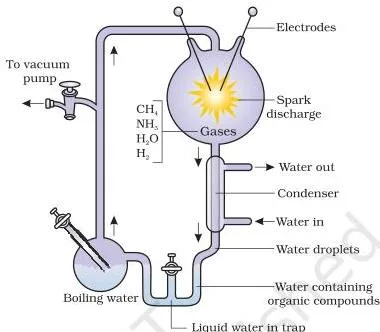
In 1953, S.L. Miller recreated early-earth conditions in a closed flask containing \( CH_4 \), \( H_2 \), \( NH_3 \) and water vapour at \( 800^\circ\text{C} \). He passed an electric discharge through the mixture to simulate lightning and observed that amino acids formed (NCERT, p. 111).
Later experiments by others produced sugars, nitrogen bases, pigments and fats; analysis of meteorites found similar compounds, suggesting the same chemistry is happening in space. This one closed flask — gases, spark and products — is the most quoted evidence for chemical evolution.
From molecules to cells, the chapter gives three checkpoints (NCERT, p. 111-112): non-cellular giant molecules (RNA, protein, polysaccharides) could have originated ~3 billion years ago; the first cellular forms appeared ~2000 mya as single cells; and all early life was in the water environment only.
Theories of Evolution: Darwin, Lamarck and deVries
Before Darwin, religious literature offered special creation in three claims: species were created exactly as they are; diversity has stayed unchanged since creation; and earth is about 4000 years old (NCERT, p. 112). Darwin’s voyage on H.M.S. Beagle dismantled all three.
He saw that existing forms share similarities with each other and with extinct forms; extinctions happen as new forms arise; so there has been gradual evolution (NCERT, p. 112-113).
The core of Darwin’s argument is short: populations carry built-in variation; those better able to survive natural conditions leave more progeny; “fitness” in Darwin’s sense means reproductive fitness; because better-fit individuals are effectively selected by nature, the mechanism is called natural selection. The two key concepts of the whole theory are branching descent and natural selection (NCERT, p. 118).
Alfred Wallace, working in the Malay Archipelago, reached similar conclusions independently at about the same time (NCERT, p. 113).
Three other accounts matter for exams:
- Lamarck (before Darwin) said evolution is driven by use and disuse of organs — giraffes stretched their necks to reach leaves and passed the stretched neck to offspring. This is rejected because acquired characters are not inherited; nobody believes it today (NCERT, p. 118-119).
- Hugo deVries (from evening primrose work) said mutations — large, sudden, random differences — cause evolution. He called a single-step large mutation saltation and believed it causes speciation directly. Darwin’s variations were small and directional; mutations are random and directionless (NCERT, p. 119).
- Malthus (an influence, not a theory of evolution) pointed out that resources are limited while populations would grow exponentially if all reproduced maximally — competition for resources follows. Darwin’s achievement was to connect this with heritable variations that improve resource use (NCERT, p. 119).
One conceptual puzzle the NCERT flags: is evolution a process or a result? The world we see is the success story of evolution, so describing it treats evolution as a process; the story of life on earth treats evolution as the consequence of a process called natural selection. The chapter leaves the question open (NCERT, p. 119).
The three theories differ sharply on where variation comes from, how fast change happens, and whether the idea survives today:
| Feature | Darwin — natural selection | Lamarck — use and disuse | deVries — mutation |
|---|---|---|---|
| Source of variation | Small, heritable variations already in the population | Acquired characters from use or disuse of organs | Large, sudden mutations |
| Direction of variation | Small and directional | Towards the organ that is used | Random and directionless |
| Timescale of change | Gradual, over many generations | Gradual, within a lineage | Single step — saltation — to a new species |
| Mechanism of change | Natural selection of the reproductively fit | Inheritance of acquired characters | Mutation causes evolution and speciation |
| Status today | Core of evolutionary theory | Rejected | Mutations accepted as real and random; population genetics later brought clarity |
Evidence That Evolution Really Happened
The chapter assembles eight strands of evidence; a strong answer cites a strand by name with its example (NCERT, p. 113-116):
- Paleontological. Fossils are the remains of hard parts of life forms in rock sediments. Different-aged sediments hold different life forms — some resemble modern organisms, others (like dinosaurs) are extinct. Ages are calculated by radioactive dating.
- Embryological. Haeckel proposed that all vertebrate embryos develop a row of vestigial gill slits just behind the head — functional only in fish. Von Baer’s careful study corrected him: embryos never pass through the adult stages of other animals (NCERT, p. 113).
- Comparative anatomy. The forelimbs of whales, bats, cheetahs and humans share the same bones — humerus, radius, ulna, carpals, metacarpals, phalanges — though they do different jobs. Same structure, different functions = homologous organs, produced by divergent evolution from a common ancestor. In plants, the Bougainvillea thorn and Cucurbita tendril are the textbook pair. The shared plan is easy to explain by common ancestry and hard to explain any other way.
- Analogous structures (the opposite case). Bird and butterfly wings look alike but are not anatomically similar — same function, different structure — the result of convergent evolution. Other examples: the eyes of octopus and mammals, the flippers of penguins and dolphins, and sweet potato root versus potato stem (NCERT, p. 115).
- Biochemical. Similarities in proteins and genes performing a given function across diverse organisms point to a shared ancestry (NCERT, p. 115).
- Artificial selection. Man produced distinct dog breeds within hundreds of years of breeding; if man can do it in centuries, nature could do the same in millions of years (NCERT, p. 115).
- Industrial melanism. Moth collections from 1850s England had more white-winged moths; the post-industrialisation collection of 1920 had more dark-winged (melanised) moths. Predators spot moths against a contrasting background: white lichen made white moths safe before industrialisation; soot-dark trunks favoured the melanised form afterwards. Lichens are pollution indicators, and in unpolluted rural areas the melanic count stayed low. Crucially, no variant was completely wiped out (NCERT, p. 115-116).
- Anthropogenic evolution. Excess use of herbicides, pesticides and antibiotics selects resistant varieties in months or years, not centuries. This shows evolution is stochastic — based on chance events and chance mutations — not directed or deterministic (NCERT, p. 116). It is also the practical reason to complete a full antibiotic course: stopping early kills the susceptible bacteria and leaves resistant survivors to multiply. Exactly this mechanism is treated in detail in the Human Health and Disease notes.
The dinosaur family tree gives the paleontological strand its clearest picture:
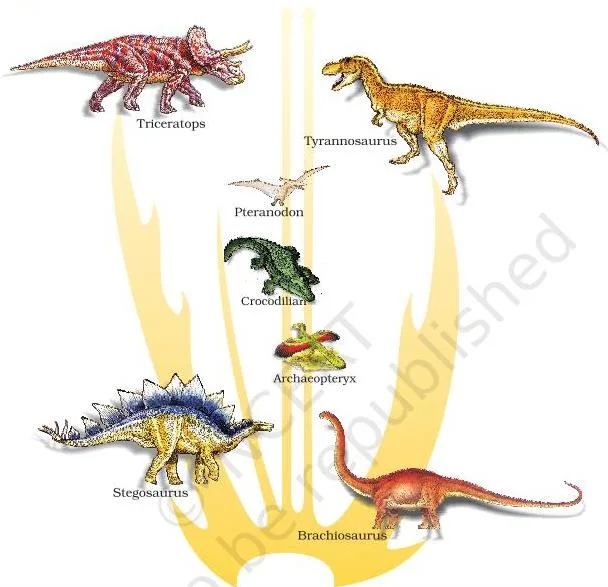
The tree places extinct dinosaurs in the past branches and connects them to living counterparts — crocodiles and birds — exactly what branching descent predicts: today’s forms grow from yesterday’s branches (NCERT, p. 114). The textbook’s Figures 6.3 and 6.4 (homologous organs; moths on tree trunks) make the same points visually; the examples above carry the full argument.
Adaptive Radiation: Finches, Marsupials and Convergent Evolution
Adaptive radiation is the evolution of different species in a given geographical area, starting from a single point and radiating into different habitats (NCERT, p. 117).
Darwin found the classic case in the Galapagos Islands:
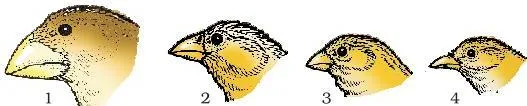
The figure shows the variety of finch beaks. From one seed-eating ancestor, many forms with altered beaks arose — including insectivorous and vegetarian finches, each exploiting a different food niche. All of them, Darwin conjectured, evolved on the island itself (NCERT, p. 117).
The second chapter example is Australia’s marsupials:
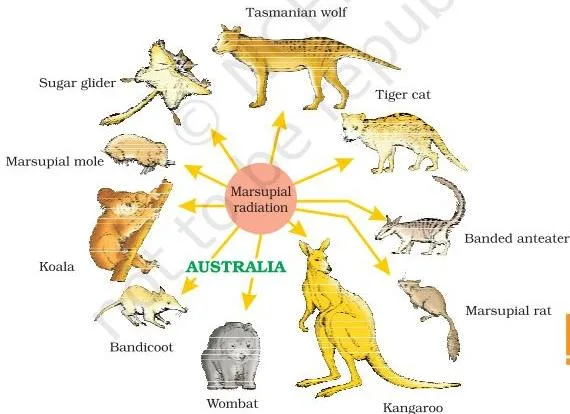
As the figure shows, many marsupial types — each different from the other — evolved from one ancestral stock, all within the island continent of Australia (NCERT, p. 117).
Convergent evolution looks similar but has a different cause: when more than one adaptive radiation appears to have occurred in an isolated area, different groups evolve similar adaptive features toward the same function because they live in similar habitats (NCERT, p. 117-118). The placental wolf and the marsupial Tasmanian wolf are the chapter’s headline pair. The NCERT’s full comparison (p. 118):
| Placental mammals | Australian marsupials |
|---|---|
| Mole | Marsupial mole |
| Anteater | Numbat (anteater) |
| Mouse | Marsupial mouse |
| Lemur | Spotted cuscus |
| Flying squirrel | Flying phalanger |
| Bobcat | Tasmanian tiger cat |
| Wolf | Tasmanian wolf |
One discriminator settles most confusions: adaptive radiation means one ancestral stock radiating into many habitats (finches, marsupials); convergent evolution means different ancestral stocks converging on the same habitat or function (placental and marsupial wolves).
Hardy-Weinberg Principle: The Maths of Evolution
The Hardy-Weinberg principle gives evolution a quantitative test: allele frequencies in a population remain stable and constant from generation to generation; the gene pool (total genes and their alleles in a population) stays constant. This is genetic equilibrium (NCERT, p. 120).
If a measured frequency differs from the expected value, the direction of the difference indicates the extent of evolutionary change — a disturbed equilibrium means evolution is happening (NCERT, p. 120-121).
The equation is a binomial expansion of \( (p + q)^2 \):
\[ p + q = 1 \]
\[ p^2 + 2pq + q^2 = 1 \]
Symbol meanings: \( p \) = frequency of allele A; \( q \) = frequency of allele a; \( p^2 \) = frequency of genotype AA; \( 2pq \) = frequency of genotype Aa; \( q^2 \) = frequency of genotype aa. Frequencies are dimensionless and their total is 1.
Why \( p^2 \) is the AA frequency: in a diploid, \( p^2 \) is the probability that allele A (frequency \( p \)) appears on both chromosomes — the product of probabilities, \( p \times p \) (NCERT, p. 121).
A useful picture to hold it together: the gene pool is a well-shuffled card deck. As long as you only deal hands (random mating), the proportion of red and black cards in the deck never changes. Allele frequencies behave the same way — generation after generation they stay put.
The five disturbing factors act on the deck directly: migration adds cards from outside, drift drops cards by chance, and mutation, recombination and selection change the deck’s composition. Equilibrium means the deck’s proportions are stable; any net change is evidence that something acted on it.
The five factors that disturb equilibrium
These five are exam-critical and often listed together (NCERT, p. 121):
- Gene migration or gene flow — migration of a section of population into another place and population changes gene frequencies in both the original and the new population. If the migration happens repeatedly, it is gene flow.
- Genetic drift — the same kind of change occurring by chance.
- Mutation
- Genetic recombination
- Natural selection
Memory device: “Migrants Drive My Reindeer North” — Migration (gene flow), Drift, Mutation, Recombination, Natural selection.
When drift changes allele frequency so much in a new sample of the population that a different species may arise, the original drifted population becomes founders — the founder effect (NCERT, p. 121).
Three modes of natural selection
Natural selection can act on a trait in three ways (NCERT, p. 121):
- Stabilising — more individuals acquire the mean character value.
- Directional — more individuals acquire a value other than the mean.
- Disruptive — more individuals acquire peripheral values at both ends of the distribution curve.
The textbook’s Figure 6.8 draws the three curves; the definitions above are what to reproduce. All of this assumes you know how alleles, genotypes and the gene pool work from Mendel’s laws — that groundwork is revised in the Principles of Inheritance and Variation notes.
Worked Example: Solving a Hardy-Weinberg Problem
Method: use the Hardy-Weinberg equation when you know the frequency of a recessive phenotype, because that phenotype reveals the homozygous recessive genotype, \( q^2 \).
Problem (original numbers): In a population of 500 flowering plants, 20 have white flowers, a recessive trait, and the rest have purple flowers. Find the allele frequencies, the genotype frequencies, and the expected number of plants of each genotype.
Step 1: Recognise white-flowered plants as the homozygous recessive genotype.
Its frequency is \( q^2 = \frac{20}{500} = 0.04 \).
- Step 1: Take the square root to find the recessive allele frequency: \( q = \sqrt{0.04} = 0.2 \).
- Step 2: The two allele frequencies sum to 1, so the dominant allele frequency is \( p = 1 – q = 1 – 0.2 = 0.8 \).
- Step 3: Find the genotype frequencies: \( p^2 = (0.8)^2 = 0.64 \) for homozygous dominant AA, and \( 2pq = 2 \times 0.8 \times 0.2 = 0.32 \) for heterozygotes Aa.
- Step 4: Convert frequencies to counts in this population of 500 individuals: \( 0.64 \times 500 = 320 \) purple homozygous dominant plants; \( 0.32 \times 500 = 160 \) purple carrier (heterozygous) plants; and the given 20 white plants.
- Step 5: Check the arithmetic.
Genotype counts: \( 320 + 160 + 20 = 500 \).
Genotype frequencies: \( 0.64 + 0.32 + 0.04 = 1 \).
Both sums must close — if either does not, a step above is wrong.
Final answer: \( q = 0.2 \), \( p = 0.8 \); expected genotypes — 320 AA, 160 Aa, 20 aa. Since the observed recessive frequency (0.04) matches the expected \( q^2 \), this population is in Hardy-Weinberg equilibrium for this gene unless a disturbing factor acts on it.
A Brief Account of Evolution: The Geological Timeline
The chapter compresses about two billion years into a few pages. The table below is the exam-facing core — time on the left, event on the right (NCERT, p. 121-124):
| Time | Event |
|---|---|
| ~2000 mya | First cellular forms of life; some cells could release \( O_2 \) (a reaction like the light reaction of photosynthesis); single-celled forms slowly became multicellular. |
| ~500 mya | Invertebrates formed and active. |
| ~350 mya | Jawless fish evolve; fish with stout, strong fins can move on land and return to water. |
| ~320 mya | Sea weeds and a few plants exist. Plants invaded land before animals; giant pteridophyte ferns later fell to form coal deposits. |
| Amphibian age | Lobefins — including the Coelacanth, caught alive off South Africa in 1938 though thought extinct — evolve into the first amphibians, ancestors of modern frogs and salamanders. |
| Reptile age | Amphibians evolve into reptiles with thick-shelled eggs that do not dry in the sun; modern descendants are turtles, tortoises and crocodiles. |
| ~200 mya | Reptiles of many shapes dominate; some land reptiles return to water (Ichthyosaurus); the dinosaurs rule — Tyrannosaurus rex about 20 feet tall. |
| ~65 mya | Dinosaurs suddenly disappear — cause uncertain (climate change? evolution into birds? the truth may lie in between). Small reptiles of that era survive. Mammals — small, shrew-like, viviparous, more intelligent — take over. |
| Continental drift | When South America joined North America, its mammals (resembling horse, hippopotamus, bear, rabbit) were overridden by North American fauna. Australia’s pouched mammals survived because there was no competition. |
| Water mammals | Whales, dolphins, seals and sea cows live wholly in water. |
| Most successful story | The evolution of man with language skills and self-consciousness. Horse, elephant and dog evolution are special stories for higher classes. |
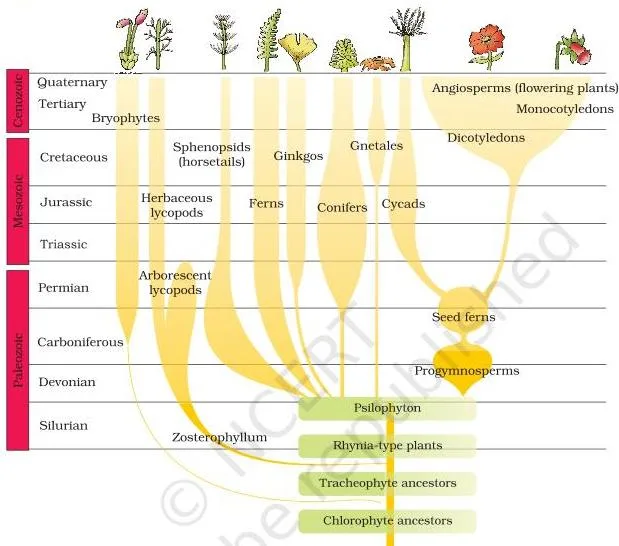
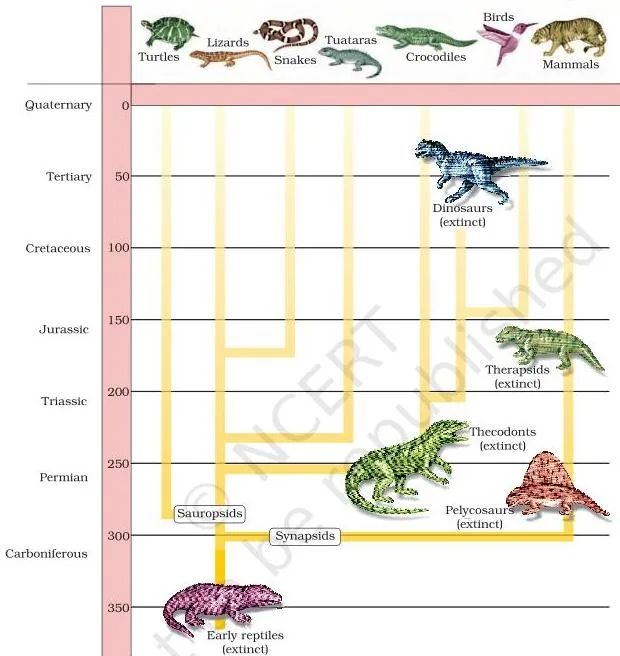
The chapter closes the timeline with two geological-scale sketches. Figure 6.9 sketches the evolution of plant forms through geological periods — from early sea weeds to land plants and the giant ferns that became coal. Figure 6.10 sketches the representative evolutionary history of vertebrates — jawless fish, amphibians, reptiles, then mammals.
Both are rough, designed to fix relative order rather than exact dates (NCERT, p. 122-123).
A quick self-test: can you say, without looking, what happened at ~2000 mya, ~500 mya, ~350 mya, ~65 mya and ~1.5 mya? If yes, the timeline is yours.
Origin and Evolution of Man: From Dryopithecus to Homo sapiens
The hominid story opens ~15 mya with the primates Dryopithecus and Ramapithecus — hairy, walking like gorillas and chimpanzees. Ramapithecus was more man-like; Dryopithecus was more ape-like (NCERT, p. 124). Fossils from Ethiopia and Tanzania suggest that by ~3-4 mya, man-like primates in eastern Africa stood not taller than 4 feet but walked upright (NCERT, p. 124).
The rest of the sequence revises fastest as a species table:
| Species | When | Key features |
|---|---|---|
| Dryopithecus and Ramapithecus | ~15 mya | Hairy; walked like gorillas and chimpanzees; Ramapithecus more man-like, Dryopithecus more ape-like. |
| Australopithecines | ~2 mya | East African grasslands; not taller than 4 feet; walked upright; hunted with stone weapons but essentially ate fruit. |
| Homo habilis | Stage after the Australopithecines | First human-like being (hominid); brain 650-800 cc; probably did not eat meat. |
| Homo erectus | ~1.5 mya (Java fossils, 1891) | Brain ~900 cc; probably ate meat. |
| Neanderthal man | 1,00,000-40,000 years ago | Brain ~1400 cc; lived in near east and central Asia; used hides to protect the body; buried their dead. |
| Homo sapiens | Arose in Africa; modern form during the ice age 75,000-10,000 years ago | Moved across continents and developed into distinct races; cave art ~18,000 years ago (Bhimbetka rock shelter, Raisen district, Madhya Pradesh); agriculture ~10,000 years back. |
Figure 6.11 gives a striking piece of evidence for shared ancestry:
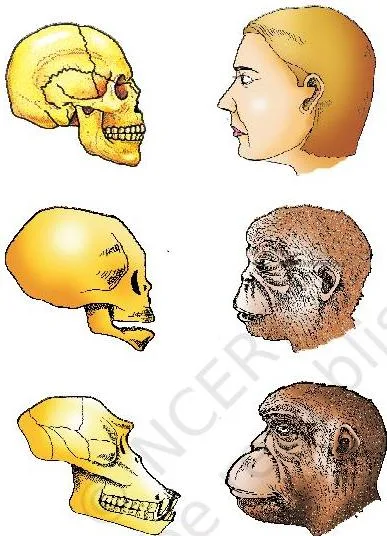
The figure compares the skulls of an adult modern human, a baby chimpanzee and an adult chimpanzee — and the baby chimpanzee skull resembles the adult human skull more than the adult chimpanzee skull does. Juveniles of related species look more alike than adults do, which is exactly what shared ancestry predicts (NCERT, p. 125).
Memory device: “Dashing Ram Always Has Huge Nails!” — Dryopithecus, Ramapithecus, Australopithecus, Homo habilis, Homo erectus, Neanderthal, and then Homo sapiens, which the line leaves out — with brain sizes rising from 650-800 cc (habilis) to ~900 cc (erectus) to ~1400 cc (Neanderthal).
The chapter’s summary ties it together: the story of modern man parallels the evolution of the human brain and language (NCERT, p. 126).
Key Terms in Evolution: Definitions With Examples
One line each, with the chapter’s own example — the fastest way to sound precise in an answer:
| Term | What it means | Example from the chapter |
|---|---|---|
| Evolution | Changes in flora and fauna that have occurred over millions of years on earth | The whole chapter’s subject. |
| Panspermia | Units of life (spores) transferred between planets | Still a favourite idea for some astronomers. |
| Spontaneous generation | Life arising from decaying matter | Dismissed by Pasteur’s pre-sterilised flask experiments. |
| Chemical evolution | Formation of diverse organic molecules from inorganic constituents | Miller’s experiment produced amino acids. |
| Biogenesis | First life arose slowly from non-living molecules through evolutionary forces | Majority-accepted version of life’s origin. |
| Natural selection | Better-fit individuals leave more progeny and are selected by nature | Peppered moth story. |
| Reproductive fitness | Darwin’s “fitness” — leaving more progeny | Selection works through the number of surviving offspring. |
| Branching descent | All existing forms share common ancestors | Explains homology. |
| Homologous organs | Same basic structure, different functions (divergent evolution) | Whale, bat, cheetah, human forelimbs; Bougainvillea thorn and Cucurbita tendril. |
| Analogous organs | Different structure, same function (convergent evolution) | Bird and butterfly wings; sweet potato root and potato stem. |
| Divergent evolution | The same structure develops along different directions | Forelimb bones across mammals. |
| Convergent evolution | Different structures evolve for the same function | Eye of the octopus and of mammals. |
| Adaptive radiation | Different species evolve in a geographical area from one point into different habitats | Darwin’s finches. |
| Genetic drift | Change in allele frequency by chance | Can lead to the founder effect. |
| Gene flow | Migration of alleles between populations, repeated | Gene frequencies change in both original and new populations. |
| Founder effect | The drifted population becomes founders with very different allele frequencies | May become a new species. |
| Saltation | Single-step large mutation causing speciation | deVries’ idea from evening primrose work. |
| Speciation | Formation of a new species | Bacterial variant B outgrowing others on a changed medium. |
| Industrial melanism | Dark (melanised) forms become common after industrialisation | Peppered moth in England. |
| Fossils | Remains of hard parts of life forms found in rocks | Dinosaurs. |
| Paleontological evidence | Fossil study showing life forms varied over time, some restricted to certain time-spans | Different-aged sediments hold different life forms. |
Common Mistakes Students Make in Evolution
Every confusion below is the kind that makes an answer sound vague instead of precise. The rule is strict: see each pair and fix it.
| Students write | Correct is | Because (check it this way) |
|---|---|---|
| “Homologous organs have the same function.” | They share the same basic structure but can have different functions. | Same function with different structure is analogy. Check using whale, bat, cheetah and human forelimbs — same bones, different jobs. |
| “The fittest means the strongest or fastest.” | Fitness in Darwin’s sense is reproductive fitness — leaving more progeny. | Selection works through offspring numbers, not strength. Ask: which individual leaves more surviving young? |
| “Lamarck’s giraffe proves evolution by use and disuse.” | Lamarck’s mechanism is rejected: acquired characters are not inherited. | A stretched neck is acquired during the animal’s life, so it cannot be passed on. Nobody accepts this today. |
| “p² is the frequency of allele A.” | p is the allele frequency; p² is the frequency of genotype AA, and 2pq is the frequency of heterozygotes Aa. | p² is the probability that allele A sits on both chromosomes of a diploid — the product p × p. |
| “Genetic drift and gene flow are the same thing.” | Drift is a change in allele frequency by chance; gene flow is migration carrying alleles between populations. | Gene flow involves movement between populations; drift is just chance. |
| “Adaptive radiation and convergent evolution are the same.” | Radiation: one ancestral stock into many habitats. Convergence: different stocks into the same habitat or function. | Finches versus placental and marsupial wolves — one diversifies a stock, the other parallels different stocks. |
| “The peppered moth evolved a new species.” | No variant was completely wiped out; the population’s allele frequencies shifted. | Camouflaged moths survived better and increased in number; both forms still existed. |
| “Miller’s flask contained oxygen.” | The mixture was \( CH_4 \), \( H_2 \), \( NH_3 \) and water vapour — a reducing atmosphere with no free oxygen. | The whole point was to recreate the reducing early earth, where free oxygen was precisely absent. |
| “Evolution is directed towards perfection.” | Evolution is stochastic — based on chance events and chance mutations, not determinism. | The chapter says it explicitly: evolution is not a directed process in the sense of determinism (NCERT, p. 116). |
How to Structure Answers to the NCERT Exercises
The chapter closes with ten exercises. Four ask you to reason — below is the skeleton of a strong answer for each. The others are research and practice tasks, with one line of approach each. (Full worked answers are handled separately; use these skeletons as your frame.)
Q1 — Antibiotic resistance in light of Darwinian selection. Open with Darwin’s two premises: populations carry built-in variation, and better-fit individuals leave more progeny. Antibiotics act as the selecting agent — resistant mutants survive, reproduce, and resistance spreads in the population. Close with the scale: resistance appears in months or years, an example of evolution by anthropogenic action (NCERT, p. 116).
Q3 — Define the term species. Be honest that the chapter uses the word without formally defining it. Build a working definition from the chapter’s own vocabulary — populations that share a gene pool and can interbreed — and note the practical difficulty of applying this to fossils.
Q4 — Components of human evolution. Organise the answer under the three hints: brain size, skeletal structure and dietary preference. Anchor each with the species table: Homo habilis 650-800 cc and probably vegetarian; Homo erectus ~900 cc and probably a meat-eater; Neanderthal ~1400 cc. Upright walking appears with the man-like primates of eastern Africa and the Australopithecines.
Q8 — One example of adaptive radiation. Describe Darwin’s finches: one seed-eating ancestor on the Galapagos Islands, many beak forms arising on the island itself, including insectivorous and vegetarian finches (NCERT, p. 117).
Q9 — Can we call human evolution adaptive radiation? Answer no, and let the definition be your argument. Adaptive radiation means one ancestral stock radiating into many species in different habitats within an area; humans spread across continents as a single species lineage, diversifying culturally rather than splitting into many new species.
- Q2: Scan newspapers and popular science articles for a new fossil discovery or an evolution controversy; report the fossil’s name, its age and the claim it supports or challenges.
- Q5: Use the internet and popular articles to collect arguments about whether animals other than man have self-consciousness.
- Q6: List 10 modern animals, link each to an ancient fossil using internet resources, and name both.
- Q7: Practice drawing animals and plants — this builds the visual memory the evidence figures rely on.
- Q10: Trace the evolutionary stages of one animal (the horse is the classic choice) using the library, the internet and teacher discussion.
Across all reasoning answers, precision comes from citing the chapter’s named examples — Bougainvillea, the peppered moth, the Coelacanth, Dryopithecus. A named example is worth a paragraph of generalisation.
One-Page Revision Recap
Five blocks. If you can reproduce these from memory, you have the chapter.
1. Key numbers. Universe ~13.8 billion years old · earth ~4.5 billion years · life appeared ~4 billion years ago · non-cellular forms possibly ~3 billion years ago · first cellular forms ~2000 mya · jawless fish ~350 mya · dinosaurs gone ~65 mya.
2. The one equation. \( p^2 + 2pq + q^2 = 1 \), with \( p + q = 1 \). Five factors disturb equilibrium: migration (gene flow), genetic drift, mutation, genetic recombination, natural selection.
3. Evidence checklist. Fossils (paleontological), embryology, comparative anatomy (homology/analogy), biochemistry, artificial selection, industrial melanism.
4. Two definition pairs. Homologous vs analogous organs (structure vs function; divergence vs convergence). Adaptive radiation (one stock → many habitats) vs convergent evolution (different stocks → same function).
5. The hominid line. Dryopithecus and Ramapithecus (~15 mya) → Australopithecines (~2 mya) → Homo habilis (650-800 cc) → Homo erectus (~900 cc) → Neanderthal (~1400 cc) → Homo sapiens.
One framing sentence worth keeping for long answers: the entire account is a conjectured story built on Darwinian ideas of organic evolution by natural selection (NCERT, p. 126) — a strong opening or closing line for an essay-type answer. For other chapters, the all Class 12 notes list and the CBSE notes index are the fastest ways around the site.
Frequently Asked Questions on Evolution
How do you calculate allele frequency using the Hardy-Weinberg equation?
Start from the frequency of the recessive phenotype, because it equals \( q^2 \). Take the square root to get \( q \), the recessive allele frequency, then \( p = 1 – q \). The worked example above shows the full route: \( q^2 = 0.04 \) → \( q = 0.2 \) → \( p = 0.8 \).
What is the difference between homologous and analogous organs?
Homologous organs share the same basic structure but can perform different functions — the forelimbs of whales, bats, cheetahs and humans. Analogous organs have different structures but similar functions — the wings of a bird and a butterfly. Homology comes from divergent evolution (common ancestry); analogy comes from convergent evolution (similar habitats).
Is human evolution an example of adaptive radiation?
Not in the chapter’s sense. Adaptive radiation means one ancestral stock radiating into many species in different habitats within a geographical area — like Darwin’s finches. Humans spread widely as a single species lineage, diversifying culturally rather than splitting into many new species.
What is the founder effect and how does it change allele frequencies?
When a small drifted population settles somewhere new, its allele frequencies differ from the source population by chance. If the difference becomes so great that a new species may arise, the original drifted population becomes the founders — that is the founder effect (NCERT, p. 121).
Why is antibiotic resistance called evolution by natural selection?
Within a bacterial population there is built-in variation. Antibiotics kill the susceptible cells; resistant mutants survive, reproduce and pass on resistance, so the population’s allele frequencies change — natural selection operating on an observable timescale of months or years (NCERT, p. 116).
What did Miller’s experiment actually prove about the origin of life?
It proved that organic molecules such as amino acids can form from inorganic gases under simulated early-earth conditions — strong support for chemical evolution. It did not create life, and it did not explain how the first self-replicating metabolic capsule arose (NCERT, p. 111-112).
Reference: NCERT Class 12 Biology textbook, chapter Evolution.
Explore Class 12 Biology Notes
- Class 12 Biology Notes
- Class 12 CBSE Notes
- CBSE Notes for Classes 1 to 12
- Previous: Principles of Inheritance and Variation
- Next: Human Health and Disease
Class 12 Biology on LearnCBSE:
Related chapters:
- Sexual Reproduction in Flowering Plants notes
- Human Reproduction notes
- Reproductive Health notes