
These are the complete revision notes for NCERT Class 12 Biology Chapter 9, Biotechnology: Principles and Processes, for the 2026-27 session. The page is built for last-minute revision: it is shorter than the textbook but holds every definition, tool, process step, diagram and formula you need, plus the mistakes that cost marks.
The final line of this page carries the required attribution to the NCERT textbook — the rest is original teaching material built strictly from it.
Start with the chapter map, then learn the tools before the processes, because every step of the recombinant DNA pipeline uses a tool from Section 9.2. Work through the glossary, the two worked models, and the mistake table, then finish with the seven-cue summary.
The official NCERT chapter PDF is available at NCERT Class 12 Biology, Chapter 9 if you want to cross-check any figure.
Chapter 9 at a Glance: Principles to Pipeline
The chapter is organised in three sections that build on each other like a staircase. A question like “why is ori needed?” only makes sense once you know what a vector is, which is why the teaching order below matters.
| Section | It answers | What you must be able to do |
|---|---|---|
| 9.1 Principles (NCERT, p. 163) | What is biotechnology and why do we need recombinant DNA? | State the two core techniques and the three basic steps of genetic modification. |
| 9.2 Tools (NCERT, pp. 165–168) | Which enzymes, vectors and hosts make recombinant DNA possible? | Name each tool, explain its role, and read the pBR322 and gel figures. |
| 9.3 Processes (NCERT, pp. 171–174) | How is recombinant DNA actually produced at scale? | Write the six process steps in order and describe a bioreactor. |
Teaching path: learn the tools first. Every process step in 9.3 uses a tool from 9.2 — PCR uses Taq polymerase, transformation uses a competent host, and selection uses a selectable marker. If you know the tool list, the pipeline writes itself.
For the full Class 12 Biology revision set, see the Class 12 Biology notes hub, and for the applications that follow this chapter, see Biotechnology and Its Applications.
From Curd to Recombinant DNA: What Biotechnology Means
Biotechnology means using live organisms or their enzymes to produce products and processes useful to humans (NCERT, p. 163). In this broad sense, curd, bread and wine — all microbe-mediated processes — are biotechnology. But the term is now used in a restricted sense: modern biotechnology means using genetically modified organisms to achieve the same results on a much larger scale.
In vitro fertilisation (“test-tube” baby), gene synthesis, DNA vaccines and gene correction are all part of this modern definition.
The broad official wording comes from the European Federation of Biotechnology (EFB): biotechnology is the integration of natural science and organisms, cells or their parts, and molecular analogues, for products and services (NCERT, p. 163). Note that this definition is wide enough to cover both the traditional and the modern view.
Two core techniques gave birth to modern biotechnology:
- Genetic engineering — altering the chemistry of DNA or RNA, introducing it into host organisms, and thereby changing the host’s phenotype (NCERT, p. 163).
- Bioprocess engineering — maintaining a sterile, contamination-free environment in large-scale chemical engineering processes so that only the desired microbe or eukaryotic cell grows, for products such as antibiotics, vaccines and enzymes (NCERT, p. 164).
Why Alien DNA Needs an Origin of Replication
The problem with traditional breeding: sexual reproduction is useful because it creates variations, but traditional hybridisation in plant and animal breeding drags undesirable genes along with the desirable ones. Genetic engineering fixes this: it isolates and transfers only one or a set of desirable genes (NCERT, p. 164).
The problem with alien DNA: if a piece of DNA is transferred into an alien organism, it usually cannot multiply in the progeny cells. It multiplies only when it becomes part of a chromosome that can replicate.
A chromosome carries a specific sequence called the origin of replication, which initiates replication; an alien piece of DNA must be linked to this sequence to replicate and multiply in the host (NCERT, p. 164). Making multiple identical copies of a template DNA this way is called cloning.
Cohen and Boyer, 1972 (NCERT, pp. 164–165): the first artificial recombinant DNA was built by linking a gene encoding antibiotic resistance with a native plasmid of Salmonella typhimurium.
- A plasmid is an autonomously replicating circular extra-chromosomal DNA.
- The resistance gene was cut out with restriction enzymes (“molecular scissors”).
- The cut gene was linked to the plasmid with DNA ligase; a plasmid used this way is a vector, just as a mosquito is a vector that delivers the malarial parasite.
- The new circular DNA, made in vitro, is recombinant DNA. When transferred into E. coli, it replicated using the host’s DNA polymerase, giving multiple copies — cloning of the resistance gene.
So there are three basic steps in genetically modifying an organism (NCERT, p. 165):
- Identification of DNA with the desirable genes.
- Introduction of that DNA into the host.
- Maintenance of the introduced DNA in the host and its transfer to progeny.
If you need a quick refresher on replication or the origin of replication, see the Molecular Basis of Inheritance notes.
Key Tools: Restriction Enzymes, Vectors and Competent Hosts
Recombinant DNA technology needs five key tools: restriction enzymes, polymerase enzymes, ligases, vectors and a host organism (NCERT, p. 165).
Restriction enzymes: the molecular scissors
In 1963, two enzymes that restrict bacteriophage growth in E. coli were isolated — one added methyl groups to DNA, the other cut DNA. The cutter was named restriction endonuclease (NCERT, p. 165). The first characterised one, Hind II, always cut DNA at a particular point by recognising a specific sequence of six base pairs, called its recognition sequence.
Over 900 restriction enzymes from more than 230 bacterial strains are now known.
Naming convention (NCERT, p. 165): the first letter comes from the genus, the next two letters from the species, then the strain, and a Roman numeral gives the order of isolation from that strain. Mnemonic: Go See Strain One — Genus, Species, Strain, Order.
So EcoRI comes from Escherichia coli RY13; the Roman numeral I means it was the first isolated from that strain.
Exonucleases vs endonucleases (NCERT, p. 166): both are nucleases. Exonucleases remove nucleotides from the ends of DNA; endonucleases cut at specific positions within the DNA. Restriction enzymes are endonucleases.
Each restriction endonuclease “inspects” the DNA, binds to its specific recognition sequence, and cuts both strands of the double helix at specific points in the sugar-phosphate backbones.
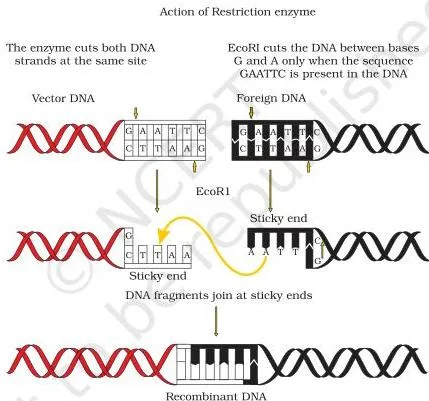
Palindromes (NCERT, p. 166): in words, a palindrome reads the same forward and backward (“MALAYALAM”). A DNA palindrome is a base-pair sequence that reads the same on the two strands when the reading direction is kept the same (5′ → 3′ on both strands):
\[ 5′ \text{—GAATTC—} 3′ \]
\[ 3′ \text{—CTTAAG—} 5′ \]
Restriction enzymes cut a little away from the centre of the palindrome, between the same two bases on opposite strands. This leaves single-stranded sticky ends — overhanging stretches that form hydrogen bonds with complementary cut counterparts. This stickiness lets the enzyme DNA ligase join the ends easily (NCERT, p. 167).
Why this matters: fragments cut by the same restriction enzyme carry the same sticky ends, so they can be joined end-to-end with DNA ligase to form recombinant molecules. Unless the vector and source DNA are cut with the same restriction enzyme, the recombinant vector cannot be created (NCERT, p. 168).
Gel electrophoresis: sorting the cut fragments
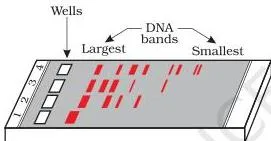
Restriction cutting produces DNA fragments that must be separated. Gel electrophoresis does this (NCERT, p. 168):
- DNA fragments are negatively charged, so under an electric field they move towards the anode (positive electrode).
- They move through a matrix — usually agarose, a natural polymer from seaweeds — which sieves them by size.
- Smaller fragments travel farther through the gel.
- DNA is invisible in visible light; the gel is stained with ethidium bromide and viewed under UV radiation, giving bright orange bands.
- The separated bands are cut out of the gel and the DNA extracted — this step is elution. Purified fragments are then joined with cloning vectors.
Cloning vectors: the delivery vehicles
Plasmids and bacteriophages replicate within bacterial cells independently of chromosomal DNA. If alien DNA is linked to such a vector, its copy number multiplies to match the vector’s. Plasmids may have one or two copies per cell, or 15–100, and their numbers can go higher (NCERT, p. 168). Modern vectors are engineered to make linking easy and to help select recombinants.
Three features are required for cloning into a vector (NCERT, p. 169):
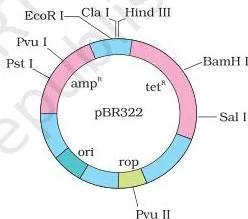
- Origin of replication (ori): the sequence from which replication starts. Any DNA linked to it can replicate in the host, and ori also controls the copy number of the linked DNA.
- Selectable marker: a gene that helps identify and eliminate non-transformants while letting transformants grow. For E. coli, genes encoding resistance to antibiotics such as ampicillin, chloramphenicol, tetracycline or kanamycin are useful, because normal E. coli does not carry resistance to them.
- Cloning sites: the vector needs very few — preferably one — recognition sites for commonly used restriction enzymes. More than one site generates several fragments and complicates cloning.
Insertional inactivation (NCERT, p. 170): selecting recombinants by inactivating an antibiotic resistance gene requires plating on two different antibiotics, which is cumbersome. The alternative is to insert the recombinant DNA within the coding sequence of the enzyme β-galactosidase. With a chromogenic substrate, colonies without an insert are blue; colonies with an insert have an inactivated β-galactosidase gene and stay colourless.
The colourless colonies are the recombinants.
Vectors for plants and animals (NCERT, p. 170): Agrobacterium tumefaciens, a pathogen of several dicot plants, delivers a piece of DNA called T-DNA that transforms normal plant cells into a tumor and makes them produce chemicals the pathogen needs.
The Ti plasmid of A. tumefaciens has been modified into a cloning vector that is no longer pathogenic but still delivers genes of interest into plants. Similarly, retroviruses transform animal cells into cancerous cells; disarmed retroviruses are now used to deliver desirable genes into animal cells.
Competent host: making the cell accept DNA
DNA is a hydrophilic molecule, so it cannot pass through cell membranes. Bacteria must first be made competent to take up DNA (NCERT, p. 170).
- Treat cells with a specific concentration of a divalent cation such as calcium, which increases the efficiency with which DNA enters through pores in the cell wall.
- Then incubate the cells with recombinant DNA on ice, place them briefly at 42 °C (heat shock), and put them back on ice. This makes the bacteria take up the recombinant DNA (NCERT, p. 171).
There are three other routes into host cells (NCERT, p. 171):
| Method | How it works | Used for |
|---|---|---|
| Micro-injection | Recombinant DNA is directly injected into the nucleus. | Animal cells |
| Biolistics / gene gun | Cells are bombarded with high-velocity micro-particles of gold or tungsten coated with DNA. | Plant cells |
| Disarmed pathogen vectors | A pathogen that has been disarmed infects the cell and transfers the recombinant DNA into the host. | Plant or animal cells |
The Recombinant DNA Pipeline: From Cell Lysis to Finished Product
The full process runs in a fixed sequence: isolation of DNA, fragmentation by restriction endonucleases, isolation of the desired fragment, ligation into a vector, transfer into a host, large-scale culturing, and extraction of the product (NCERT, p. 171).
Step 1 — Isolation of the genetic material (DNA)
DNA must be pure — free of RNA, proteins, polysaccharides and lipids — before restriction enzymes can cut it. Cells are broken open with enzymes: lysozyme for bacteria, cellulase for plant cells, and chitinase for fungi (NCERT, p. 171). Then RNA is removed with ribonuclease, proteins with protease, and other molecules by appropriate treatments.
Finally, purified DNA precipitates out after adding chilled ethanol, appearing as fine threads that can be spooled out.
Step 2 — Cutting DNA at specific locations
Purified DNA is incubated with the restriction enzyme under optimal conditions. Agarose gel electrophoresis checks the progress of the digestion (NCERT, p. 172). The source DNA and the vector DNA are both cut with the same restriction enzyme; the gene of interest and the cut vector are mixed, ligase is added, and the ends join to make recombinant DNA.
Step 3 — Amplification of the gene of interest using PCR
PCR stands for Polymerase Chain Reaction. It synthesises multiple copies of a gene (or DNA) in vitro using two sets of primers — small chemically synthesised oligonucleotides complementary to the regions of DNA — and the enzyme DNA polymerase (NCERT, p. 172). The polymerase extends the primers using nucleotides from the reaction and the genomic DNA as template.
Repeating the replication cycle many times can amplify the segment to roughly a billion copies.
The repeated heating to denature double-stranded DNA would destroy ordinary enzymes, so PCR uses a thermostable DNA polymerase isolated from the bacterium Thermus aquaticus — the famous Taq polymerase — which stays active at high temperature (NCERT, p. 173). The amplified fragment can then be ligated with a vector for further cloning.
Step 4 — Insertion of recombinant DNA into the host cell
Recipient cells are made competent to take up DNA from their surroundings. If the recombinant DNA carries a gene for resistance to an antibiotic such as ampicillin, transformed E. coli cells become ampicillin-resistant. Spreading them on agar plates containing ampicillin lets only transformants grow; untransformed cells die. The ampicillin resistance gene here is the selectable marker (NCERT, p. 173).
Step 5 — Obtaining the foreign gene product
The ultimate aim is a desirable protein, so the foreign gene must be expressed under appropriate conditions. A protein-encoding gene expressed in a heterologous host is called a recombinant protein (NCERT, p. 173).
Cells may be grown on a small scale in the lab, or in a continuous culture system where used medium is drained from one side and fresh medium added from the other, keeping the cells in their most active log/exponential phase and producing a larger biomass.
Small cultures cannot yield appreciable quantities. Bioreactors process large volumes (100–1000 litres) and biologically convert raw materials into specific products using microbial, plant, animal or human cells (NCERT, p. 174). The most common type is the stirred-tank bioreactor.
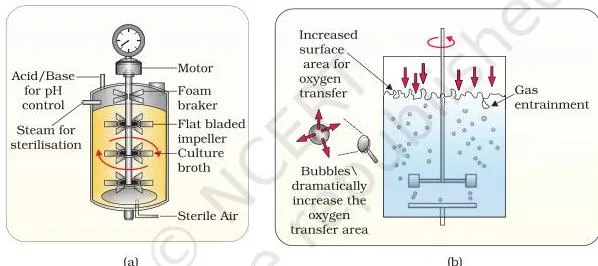
A stirred-tank reactor is cylindrical or curved at the base to help mixing. The stirrer (agitator) ensures even mixing and oxygen availability; air can alternatively be bubbled through. It also carries an oxygen delivery system, a foam control system, a temperature control system, a pH control system, and sampling ports so small culture volumes can be withdrawn periodically (NCERT, p. 174).
Step 6 — Downstream processing
After the biosynthetic stage, the product must pass through a series of processes before marketing (NCERT, p. 174):
- Separation and purification — collectively called downstream processing.
- Formulation with suitable preservatives.
- Clinical trials when the product is a drug.
- Quality control testing for each product.
Downstream processing and quality control vary from product to product.
Master Glossary: The Terms That Carry the Chapter
This table gathers the definitions the chapter repeatedly asks you to reproduce (NCERT, pp. 163–174).
| Term | Meaning | Example / where it appears |
|---|---|---|
| Biotechnology | Using live organisms, cells or enzymes to produce products and processes useful to humans. | Curd, bread, wine; modern GMO-based production |
| Genetic engineering | Altering the chemistry of DNA/RNA, introducing it into a host, changing the host phenotype. | Making recombinant DNA |
| Bioprocess engineering | Maintaining sterile conditions for large-scale growth of only the desired microbe/eukaryotic cell. | Antibiotic and vaccine manufacture |
| Recombinant DNA | A new combination of circular autonomously replicating DNA created in vitro. | Antibiotic resistance gene + plasmid (1972) |
| Plasmid | Autonomously replicating circular extra-chromosomal DNA. | Plasmid of Salmonella typhimurium |
| Vector | A DNA molecule that carries and delivers an alien DNA piece into a host. | Plasmid, bacteriophage, Ti plasmid |
| Restriction endonuclease | An enzyme that cuts DNA at specific positions within the molecule. | EcoRI, Hind II |
| Recognition sequence | The specific base sequence a restriction enzyme recognises and cuts at. | 6 bp sequence for Hind II; GAATTC for EcoRI |
| Palindrome (DNA) | A base-pair sequence that reads the same on both strands in the same direction. | 5′-GAATTC-3′ / 3′-CTTAAG-5′ |
| Sticky ends | Single-stranded overhanging ends produced by staggered cutting. | EcoRI cut ends (Figure 9.1) |
| Gel electrophoresis | Technique separating DNA fragments by size in an agarose matrix under an electric field. | Checking restriction digestion (Figure 9.3) |
| Selectable marker | A gene that helps identify and eliminate non-transformants. | Ampicillin resistance gene in E. coli |
| Transformation | The procedure by which a piece of DNA is introduced into a host bacterium. | E. coli becoming ampicillin-resistant |
| Insertional inactivation | Inactivation of a gene (β-galactosidase) because foreign DNA is inserted into it. | Colourless vs blue colonies |
| Competent host | A host cell made able to take up foreign DNA. | Calcium-treated, heat-shocked E. coli |
| PCR | Polymerase Chain Reaction; in vitro amplification of a DNA segment using primers and a thermostable polymerase. | Amplifying the gene of interest |
| Bioreactor | A vessel where raw materials are biologically converted into products under optimal conditions. | Stirred-tank bioreactor (Figure 9.7) |
| Downstream processing | Separation and purification of the product after the biosynthetic stage. | Formulation and quality control of drugs |
The Only Formulas in This Chapter: PCR Copy Counts and Enzyme Naming
This chapter has no chemical equations. But it carries two rule-like tools you must be able to apply.
Rule 1: PCR copy counts
Starting from one template molecule, every PCR cycle doubles the number of copies (NCERT, pp. 172–173):
\[ \text{copies after } n \text{ cycles} = 2^n \]
That is why repeated cycles can amplify a DNA segment to roughly a billion copies. See the worked model below for the step-by-step calculation.
Rule 2: Restriction enzyme naming
The name of a restriction enzyme is decoded in four parts (NCERT, p. 165):
| Part | Meaning | EcoRI example |
|---|---|---|
| First letter | Genus of the prokaryotic cell | E → Escherichia |
| Next two letters | Species | co → coli |
| Following letter(s) | Strain | R → strain RY13 |
| Roman numeral | Order of isolation from that strain | I → first isolated (the numeral I is shown in EcoRI) |
Memory cue: “Go See Strain One” — Genus, Species, Strain, Order.
Worked Models: Reading a Palindrome and Counting PCR Copies
Model 1: Verifying a palindromic DNA sequence
Method: write the complementary strand (A pairs with T, G pairs with C), then read both strands in the 5′ → 3′ direction and check that the sequences match.
Given sequence: 5′-ATCGAT-3′ (a new, original example).
Step 1: write the complementary strand, anti-parallel to the given one.
\[ 3′ \text{-TAGCTA-} 5′ \]
Step 2: read the complementary strand in the 5′ → 3′ direction. Reversing 3′-TAGCTA-5′ gives 5′-ATCGAT-3′.
Step 3: compare. The 5′ → 3′ reading of the first strand (ATCGAT) equals the 5′ → 3′ reading of the complementary strand (ATCGAT).
Conclusion: 5′-ATCGAT-3′ is palindromic. Restriction enzymes recognise such sequences, cut a little away from the centre between the same two bases on opposite strands, and leave sticky ends (NCERT, pp. 166–167).
Model 2: Counting PCR copies after n cycles
Method: each PCR cycle doubles the DNA copies. With one starting template, copies after \( n \) cycles = \( 2^n \). Each cycle has three steps — denaturation, primer annealing and extension (NCERT, p. 172).
Step 1: after 5 cycles:
\[ 2^5 = 2 \times 2 \times 2 \times 2 \times 2 = 32 \text{ copies} \]
Step 2: after 20 cycles:
\[ 2^{20} = 1{,}048{,}576 \text{ copies} \]
which is roughly a million copies.
Step 3: after 30 cycles:
\[ 2^{30} = 1{,}073{,}741{,}824 \approx 1.07 \times 10^{9} \text{ copies} \]
which matches the textbook statement that PCR can amplify a segment to about a billion copies (NCERT, p. 173).
Conclusion: 5 cycles → 32 copies; 20 cycles → ~1 million copies; 30 cycles → ~1.07 billion copies.
How to Read the Diagrams in This Chapter
Four figures carry most of the exam credit in this chapter. Learn what each one shows and what conclusion it supports.
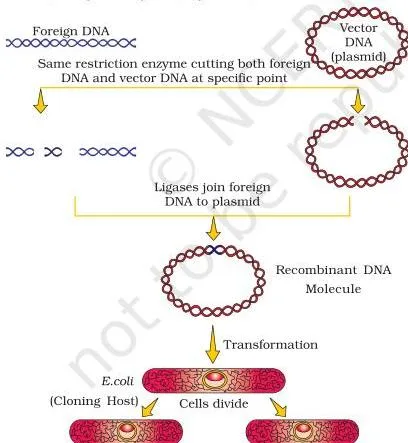
Figure 9.2 — The whole recombinant DNA flow at a glance
This diagram (NCERT, p. 167) maps the entire technology in one picture (a revised original description of its flow, since its caption is brief):
- Start with source DNA and vector DNA; cut both with the same restriction enzyme to create sticky ends.
- Join the cut pieces with DNA ligase to form the recombinant vector.
- Introduce it into a host; the recombinant multiplies and expresses the foreign gene (NCERT, p. 167).
Use this figure as your revision skeleton — every process step in the pipeline is a zoomed-in version of some part of it.
Figures 9.1 and 9.3 — Cutting and sorting DNA
Figure 9.1 (NCERT, p. 166, discussed above) shows EcoRI binding to its recognition site and cutting both strands, leaving overhanging sticky ends — the step that makes DNA ligase joining possible.
Figure 9.3 (NCERT, p. 168, discussed above) shows one undigested sample (lane 1) and digested fragments (lanes 2–4). To read it: DNA is negatively charged, so it moves toward the anode; therefore the sample was loaded near the cathode (negative pole), and the well at the top of the gel is the loading point.
A single bright band in lane 1 vs multiple bands in lanes 2–4 tells you the digestions worked.
Figure 9.4 — pBR322, the exam favourite
This map (NCERT, p. 169, discussed above) is the most quoted diagram in short-answer questions. Locate on it: ori (replication origin), amp^R (ampicillin resistance), tet^R (tetracycline resistance), and the restriction sites Hind III, EcoR I, BamH I, Sal I, Pvu II, Pst I, Cla I. Also note rop, which codes for proteins involved in plasmid replication.
If a question asks where foreign DNA is inserted, the answer is a restriction site lying inside one of the two antibiotic resistance genes — for example the BamH I site of the tetracycline resistance gene.
Figure 9.7 — Stirred-tank bioreactor
This figure (NCERT, p. 174, discussed above) shows two versions: a simple stirred-tank bioreactor and a sparged stirred-tank bioreactor through which sterile air bubbles are sparged. When asked to label a bioreactor, name the agitator system, oxygen delivery system, foam control system, temperature control system, pH control system and sampling ports.
The curved base and the stirrer exist to keep the contents evenly mixed and oxygen availability uniform.
Mistake and Correction Pairs in Biotechnology
The confusions below are the ones that routinely lose short-answer credit. Each row gives the wrong idea, the correct rule, and a check you can do in your head.
| Students write X | Correct is Y because Z | How to check your answer |
|---|---|---|
| Exonucleases cut DNA inside the molecule. | Exonucleases remove nucleotides from the ends of DNA; endonucleases cut at specific positions within the DNA (NCERT, p. 166). | Remember “exo = exits at the end”. |
| DNA moves towards the cathode (negative electrode). | DNA is negatively charged, so it moves towards the anode (positive electrode) in gel electrophoresis (NCERT, p. 168). | Ask: like charges repel, so negative DNA flees the negative pole. |
| Restriction enzymes are found in eukaryotic cells. | They are bacterial in origin; they are the bacterial defence that restricts the growth of bacteriophages (NCERT, p. 165). Eukaryotic cells do not have them. | Recall the 1963 discovery in E. coli. |
| ori is the site where foreign DNA is inserted. | ori is the sequence where replication starts and it controls copy number (NCERT, p. 169). The insertion site is a cloning site — a restriction recognition site. | “O for origin, not opening for insert.” |
| After transformation, all colonies on the plate are recombinants. | Selectable markers separate transformants from non-transformants; insertional inactivation (colourless vs blue) then separates recombinants from non-recombinants (NCERT, p. 170). | Ask: which gene was inactivated by the insert? |
| PCR can use ordinary DNA polymerase. | PCR needs a thermostable polymerase (Taq, from Thermus aquaticus) that survives high-temperature denaturation (NCERT, p. 173). | Reason: each cycle heats the DNA to separate the strands. |
| Bioreactors are where the product is purified. | Bioreactors are the production vessels; separation and purification happen later in downstream processing (NCERT, p. 174). | Bioreactor = make; downstream processing = clean. |
Writing Complete Answers for the Chapter’s Exercise Types
The textbook exercises (NCERT, p. 175) come in four shapes. Match your answer structure to the question verb, and you will cover everything the question expects.
“Describe briefly” (ori, bioreactors, downstream processing)
Use the definition + function + one example structure. For example, for origin of replication: it is the sequence from which replication starts (definition); any DNA linked to it can replicate in the host, and it controls the copy number of the linked DNA (function); a high-copy-number ori is chosen when many copies of target DNA are wanted (example) (NCERT, p. 169).
For bioreactors: vessel where raw materials are biologically converted into products using microbial, plant, animal or human cells; stirred-tank type provides optimum temperature, pH, substrate, salts, vitamins and oxygen (NCERT, p. 174). For downstream processing: the separation and purification stages after biosynthesis, followed by formulation, clinical trials and quality control (NCERT, p. 174).
“Explain briefly” (PCR, restriction enzymes, chitinase)
Use the what it is + why it matters + where it fits structure. PCR is the in vitro synthesis of multiple copies of a gene using primers and thermostable DNA polymerase; it matters because it amplifies a segment to about a billion copies; it fits after cutting the DNA and before ligating into a vector (NCERT, pp. 172–173).
Restriction enzymes cut DNA at specific recognition sequences and make sticky ends; they matter because they allow precise cutting of source DNA and vector; they fit at the start of the pipeline. Chitinase is an enzyme that breaks open fungal cells; it matters because it releases DNA from fungus; it fits in the isolation-of-genetic-material step (NCERT, p. 171).
“Distinguish between” (plasmid vs chromosomal DNA, RNA vs DNA, exonuclease vs endonuclease)
Answer as a point-by-point comparison table: plasmid DNA is circular, extra-chromosomal and autonomously replicating, while chromosomal DNA is linear in most organisms and carries most genes; RNA has ribose and uracil while DNA has deoxyribose and thymine; exonuclease removes nucleotides from ends while endonuclease cuts within the molecule (NCERT, p. 166).
Two or three rows of differences, each with a concrete fact, are enough.
Chart or diagram items
For the chart exercise asking for a restriction enzyme, the substrate DNA, the cut site and the product (NCERT, p. 175): label every component named in the question — enzyme name (e.g., EcoRI), the recognition sequence on the substrate, the staggered cut position, and the sticky-ended product fragments. Use the same rule for any diagram question: the marks follow the labels.
Seven-Cue Revision Summary of the Whole Chapter
This is a memory chain — seven cues that compress the entire recombinant DNA workflow. Each cue is one verb; saying the chain aloud releases the full process description.
| Cue | What it connects to in the chapter |
|---|---|
| 1. Isolate | Break cells with lysozyme (bacteria), cellulase (plants) or chitinase (fungi); remove RNA and protein; precipitate DNA with chilled ethanol (NCERT, p. 171). |
| 2. Cut | Restriction endonucleases cut source DNA and vector at specific palindromic recognition sequences, leaving sticky ends (NCERT, p. 167). |
| 3. Join | DNA ligase joins the gene of interest to the vector, creating recombinant DNA (NCERT, p. 167). |
| 4. Amplify | PCR copies the gene of interest in vitro — denaturation, primer annealing, extension; Taq polymerase survives the heat; 2^n copies after n cycles (NCERT, p. 172). |
| 5. Transform | Competent host cells take up recombinant DNA (calcium treatment + heat shock); selectable markers pick transformants (NCERT, pp. 170, 173). |
| 6. Express | The foreign gene is expressed in the host to give a recombinant protein; grow cells in continuous culture or bioreactors for large yields (NCERT, p. 173). |
| 7. Purify | Downstream processing — separation, purification, formulation, clinical trials, quality control (NCERT, p. 174). |
This sequence — isolate → cut → join → amplify → transform → express → purify — is the backbone of the chapter’s processes section. If you can write the seven verbs and one sentence under each, you have the full pipeline for the exam.
FAQ: Quick Answers to Confusing Points
Why does a restriction enzyme recognise only palindromic sequences?
Because the enzyme must cut both strands of the double helix at equivalent positions. A palindromic recognition sequence reads the same on both strands in the 5′ → 3′ direction, so the same recognition structure is present on both strands, and the enzyme can cut each strand at the same relative point — leaving sticky ends that DNA ligase can later join (NCERT, pp. 166–167).
How does insertional inactivation help identify recombinant colonies?
The foreign DNA is inserted into the coding sequence of the β-galactosidase gene, inactivating it. On a medium with a chromogenic substrate, non-recombinant colonies produce the enzyme and turn blue, while recombinant colonies have an inactivated gene and remain colourless — so the colourless colonies are the recombinants (NCERT, p. 170).
Why is Taq polymerase used in PCR instead of ordinary DNA polymerase?
Each PCR cycle includes a high-temperature step to denature (separate) the double-stranded DNA. Ordinary DNA polymerase would be destroyed by that heat, but Taq polymerase, isolated from the thermophilic bacterium Thermus aquaticus, is thermostable and stays active during denaturation, so repeated cycles of amplification are possible (NCERT, p. 173).
What is the difference between the ori and the cloning site of a vector?
The ori is the sequence where replication starts and it controls the copy number of the linked DNA (NCERT, p. 169). The cloning site is the restriction recognition site where foreign DNA is inserted. One controls replication; the other is the insertion point.
Why must bacteria be made competent before transformation with recombinant DNA?
DNA is a hydrophilic molecule and cannot pass through cell membranes on its own. Treating bacteria with a divalent cation such as calcium, followed by heat shock, creates pores and conditions that let the recombinant DNA enter, so the cells can take it up and be transformed (NCERT, pp. 170–171).
Reference: NCERT Class 12 Biology textbook, chapter Biotechnology: Principles and Processes.
Explore Class 12 Biology Notes
- Class 12 Biology Notes
- Class 12 CBSE Notes
- CBSE Notes for Classes 1 to 12
- Previous: Microbes in Human Welfare
- Next: Organisms and Populations
Class 12 Biology on LearnCBSE:
Related chapters:
- Sexual Reproduction in Flowering Plants notes
- Human Reproduction notes
- Reproductive Health notes