
The rise of nationalism in Europe class 10 notes on this page cover the full chapter for both school tests and the board exam. In the 2026-27 academic session, CBSE students need a clear grasp of how the multi-national dynastic empires of Europe were replaced by nation-states where citizens, not just rulers, shared a common identity.
These notes trace that journey from the French Revolution of 1789 to the Balkan crisis that triggered the First World War in 1914, following the NCERT textbook India and the Contemporary World – II.
Introduction: Sorrieu’s Vision of a World of Nations
In 1848, the French artist Frédéric Sorrieu prepared a series of four prints visualising his dream of a world made up of what he called ‘democratic and social Republics’ (NCERT, p. 3). The first print shows the peoples of Europe and America marching in a long train to offer homage to the statue of Liberty.
The artist personified Liberty as a female figure bearing the torch of Enlightenment in one hand and the Charter of the Rights of Man in the other.
On the earth in the foreground lie the shattered remains of symbols of absolutist institutions. In Sorrieu’s utopian vision, the peoples of the world are grouped as distinct nations, identified through their flags and national costumes. Leading the procession past the statue of Liberty are the United States and Switzerland, which by this time were already nation-states.
France follows, identifiable by the revolutionary tricolour.
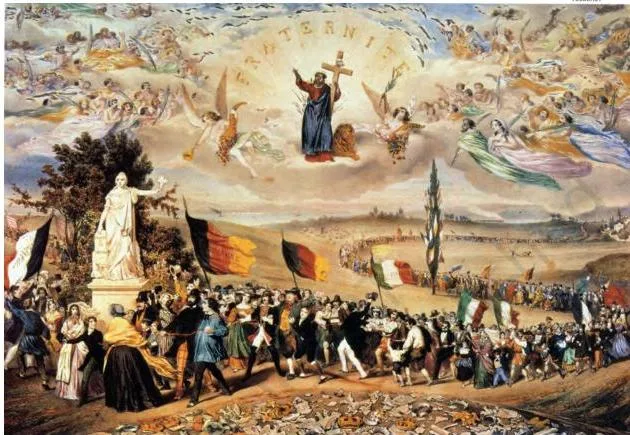
Interestingly, when Sorrieu created this image, the German peoples did not yet exist as a united nation. The black, red and gold flag they carry expressed the liberal hope of 1848 to unify the numerous German-speaking principalities into a nation-state under a democratic constitution (NCERT, p. 3). The chapter you are revising is the story of how such nation-states came into being.
A Modern State vs a Nation-State
A modern state has a centralised power exercising sovereign control over a clearly defined territory. A nation-state goes further: the majority of its citizens, not only its rulers, share a sense of common identity, history, or descent. This commonness did not exist from time immemorial.
It was forged through struggles, through the actions of leaders and the common people (NCERT, p. 3).
What Is a Nation? Ernst Renan’s Idea
In 1882, the French philosopher Ernst Renan delivered a lecture at the University of Sorbonne titled ‘What is a Nation?’ He argued against the notion that a nation is formed by a common language, race, religion, or territory (NCERT, p. 4).
Renan’s core argument was: ‘A nation is the culmination of a long past of endeavours, sacrifice and devotion.’ He described a nation as a large-scale solidarity, built on shared glories in the past and a common will in the present.
He said its existence is a daily plebiscite — meaning a nation survives only as long as its people continue to will it.
Plebiscite means a direct vote by which all the people of a region are asked to accept or reject a proposal (NCERT, p. 4). Renan used it metaphorically: a nation exists because its people daily choose to belong to it.
Renan added that a nation never has any real interest in annexing or holding a country against its will. The existence of nations is a guarantee of liberty, which would be lost if the world had only one law and one master (NCERT, p. 4).
The French Revolution and the Idea of the Nation
The first clear expression of nationalism came with the French Revolution in 1789. The revolution transferred sovereignty from the monarchy to a body of French citizens. It proclaimed that the people, not the king, would henceforth constitute the nation and shape its destiny (NCERT, p. 5).
Steps the Revolutionaries Took to Create Collective Identity
The French revolutionaries introduced a series of measures to create a sense of collective identity among the French people. These are a standard 5-mark exam question:
- la patrie (the fatherland) and le citoyen (the citizen) — emphasised a united community enjoying equal rights under a constitution
- A new tricolour flag replaced the former royal standard
- The Estates General was renamed the National Assembly
- A centralised administration with uniform laws for all citizens
- Internal customs duties abolished; uniform weights and measures adopted
- Regional dialects discouraged; Parisian French became the national language
- New hymns composed, oaths taken, martyrs commemorated — all in the name of the nation
The revolutionaries also declared it the mission of the French nation to liberate other peoples of Europe from despotism. When news of these events reached other European cities, students and educated middle classes set up Jacobin clubs, which prepared the way for French armies to carry the idea of nationalism abroad (NCERT, p. 5).
The Napoleonic Code and Its Impact
Within the territories under French control, Napoleon introduced many reforms already implemented in France. The Civil Code of 1804, usually known as the Napoleonic Code, did away with all privileges based on birth, established equality before law, and secured the right to property (NCERT, p. 6).
Key Features of the Napoleonic Code
- Did away with privileges based on birth
- Established equality before law
- Secured the right to property
Reforms in Conquered Territories
- Simplified administrative divisions
- Abolished the feudal system and freed peasants from serfdom and manorial dues
- Removed guild restrictions in towns
- Improved transport and communication systems
Businessmen and small-scale producers realised that uniform laws, standardised weights, and a common national currency would facilitate movement of goods and capital across regions (NCERT, p. 7). However, the reactions of local people to French rule were mixed. Initially, in Holland, Switzerland, Brussels, Mainz, Milan, and Warsaw, French armies were welcomed as harbingers of liberty.
But enthusiasm turned to hostility due to increased taxation, censorship, and forced conscription into the French armies (NCERT, p. 7).
The Making of Nationalism in Europe: The Social Landscape
In the mid-18th century, Europe had no nation-states. What we know today as Germany, Italy, and Switzerland were divided into kingdoms, duchies, and cantons whose rulers had autonomous territories (NCERT, p. 8). The Habsburg Empire was a patchwork of different regions and peoples with no shared identity — only a common allegiance to the emperor.
The Social Hierarchy
- Landed aristocracy: numerically small but the dominant class; owned estates in the countryside and town-houses; united by the French language, diplomatic ties, and intermarriages
- Peasantry: formed the majority of the population; in the west, land was farmed by tenants and small owners, while in Eastern and Central Europe, vast estates were cultivated by serfs
- New middle class: created by industrialisation (beginning in England in the late 18th century, France and German states in the 19th century) — industrialists, businessmen, and professionals who pushed ideas of national unity
It was among the educated, liberal middle classes that ideas of national unity following the abolition of aristocratic privileges gained popularity (NCERT, p. 9).
Liberal Nationalism: What Did It Stand For?
The term liberalism derives from the Latin root liber, meaning free. In the 19th-century European context, it stood for:
- Political freedom for the individual and equality before law
- Government by consent — constitution and representative government through parliament
- End of autocracy and clerical privileges
- Inviolability of private property
Crucially — and this is an exam point — equality before law did NOT mean universal suffrage (NCERT, p. 9). In revolutionary France, only property-owning men could vote. Men without property and all women were excluded. Only briefly under the Jacobins did all adult males enjoy suffrage.
The Napoleonic Code went back to limited suffrage and reduced women to the status of a minor, subject to fathers and husbands. Suffrage means the right to vote.
The Economic Side: The Zollverein
In the economic sphere, liberalism stood for freedom of markets and the abolition of state-imposed restrictions on movement of goods and capital. The German-speaking regions after Napoleon’s measures were 39 states, each with its own currency and weights (NCERT, p. 9).
A merchant travelling from Hamburg to Nuremberg in 1833 passed through 11 customs barriers and paid customs duty at each one. The elle (a measure of cloth) was 54.7 cm in Frankfurt, 55.1 cm in Mainz, 65.6 cm in Nuremberg, and 53.5 cm in Freiburg. This created obstacles to economic exchange and growth.
In 1834, the Zollverein — a customs union at Prussia’s initiative — was formed. Most German states joined. It abolished tariff barriers and reduced the number of currencies from over thirty to two (NCERT, p. 10). The creation of a railway network further stimulated mobility. As Friedrich List wrote in 1834: ‘The aim of the zollverein is to bind the Germans economically into a nation.’
A New Conservatism After 1815: Congress of Vienna
After Napoleon’s defeat in 1815, European governments were driven by a spirit of conservatism. Conservatives believed that established, traditional institutions of state and society — the monarchy, the Church, social hierarchies, property, and family — should be preserved (NCERT, p. 10). However, most conservatives did not propose a return to pre-revolutionary society.
They realised that modernisation could strengthen monarchies: a modern army, an efficient bureaucracy, the abolition of feudalism and serfdom could all reinforce autocratic rule.
The Treaty of Vienna (1815)
The Congress of Vienna was hosted by Austrian Chancellor Duke Metternich. Representatives of Britain, Russia, Prussia, and Austria drew up the Treaty of Vienna with these objectives (NCERT, p. 10):
- Undo most of the changes that had come about during the Napoleonic wars
- Restore the Bourbon dynasty in France
- Set up boundary states to prevent French expansion: the Kingdom of the Netherlands (including Belgium) in the north, and Genoa added to Piedmont in the south
- Prussia given new western territories
- Austria given control of northern Italy
- The German confederation of 39 states left untouched
- Russia given part of Poland; Prussia given a portion of Saxony
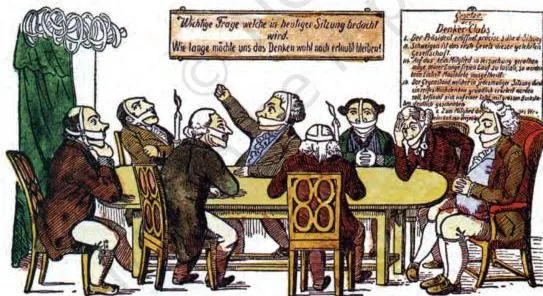
The main intention was to restore monarchies overthrown by Napoleon and create a new conservative order in Europe. Conservative regimes were autocratic, did not tolerate criticism, and imposed censorship laws on newspapers, books, plays, and songs (NCERT, p. 11).
The Revolutionaries: Giuseppe Mazzini and Secret Societies
After 1815, liberal-nationalists went underground. Being revolutionary meant opposing monarchies established after the Vienna Congress and fighting for liberty and freedom. Secret societies sprang up in many European states to train revolutionaries and spread their ideas (NCERT, p. 12).
Giuseppe Mazzini (born Genoa, 1805) was the key figure. He became a member of the secret society Carbonari. At 26, he was sent into exile in 1831 for attempting a revolution in Liguria. He then founded Young Italy in Marseilles and Young Europe in Berne, with members from Poland, France, Italy, and the German states.
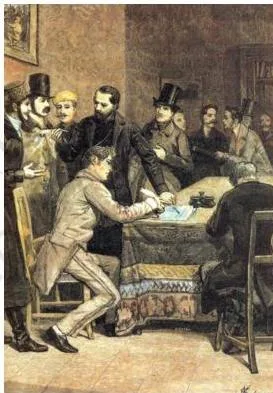
Mazzini believed God intended nations to be the natural units of mankind. Italy had to be forged into a single unified republic within a wider alliance of nations. Metternich described him as ‘the most dangerous enemy of our social order’ (NCERT, p. 12). Mazzini’s uprisings of 1831 and 1848 both failed, but his vision inspired the movement for Italian unification.
The Age of Revolutions (1830–1848): Paris, Greece, and Romanticism
July Revolution 1830 in France
The first upheaval took place in France in July 1830. The Bourbon kings were overthrown by liberal revolutionaries who installed a constitutional monarchy under Louis Philippe. Metternich remarked: ‘When France sneezes, the rest of Europe catches cold.’ The July Revolution sparked an uprising in Brussels that led to Belgium breaking away from the United Kingdom of the Netherlands (NCERT, p. 13).
Greek War of Independence (1821–1832)
Greece had been part of the Ottoman Empire since the 15th century. The struggle for independence began in 1821. Nationalists in Greece received support from West Europeans who were sympathetic to ancient Greek culture. Poets and artists lauded Greece as the cradle of European civilisation.
The English poet Lord Byron organised funds and went to fight in the war, where he died of fever in 1824. The Treaty of Constantinople (1832) recognised Greece as an independent nation (NCERT, p. 13).
Romanticism and National Feeling
Nationalism was not built only through wars. Romanticism — a cultural movement — sought to develop nationalist sentiment through emotions, intuition, and mystical feelings rather than reason and science (NCERT, p. 14).
The German philosopher Johann Gottfried Herder claimed that true German culture was among das volk (the common people) and that the volkgeist (true spirit of the nation) was popularised through folk songs, folk poetry, and folk dances.
Language and folklore carried the nationalist message to largely illiterate audiences. Karol Kurpinski celebrated the Polish national struggle through his operas, turning folk dances like the polonaise and mazurka into nationalist symbols. The Grimm Brothers collected folktales as part of German nation-building against French domination, believing the tales expressed a pure and authentic German spirit (NCERT, p. 15).
In Poland, which was partitioned by Russia, Prussia, and Austria, the Polish language was forced out of schools and Russian imposed everywhere. After the failed 1831 rebellion, clergy in Poland used Polish for Church gatherings and religious instruction as a weapon of resistance. Large numbers of priests were sent to Siberia by Russian authorities (NCERT, p. 14).
Hunger, Hardship, and the Revolts of 1848
The 1830s and 1840s were years of severe economic hardship in Europe. The causes of the 1848 revolutions included:
- Population explosion: enormous increase across Europe, more job seekers than employment
- Rural-to-urban migration leading to overcrowded slums
- Cheap English machine-made goods undercutting small producers, especially in textiles
- Feudal dues and obligations still burdening peasants in aristocratic regions
- Food price rises and bad harvests causing widespread pauperism
In Paris 1848, food shortages and unemployment brought people to the streets. Barricades were erected. Louis Philippe was forced to flee. A Republic was proclaimed, suffrage was granted to all adult males above 21, the right to work was guaranteed, and national workshops were set up (NCERT, p. 15).
The Silesian Weavers’ Revolt (1845)
In 1845, weavers in Silesia led a revolt against contractors who had drastically reduced their payments. A large crowd of weavers marched to the contractor’s mansion demanding higher wages, were treated with scorn, then forced their way into the house, smashed its windows and furniture, and plundered the storehouse. The contractor fled and requisitioned the army.
In the exchange that followed, eleven weavers were shot (NCERT, p. 16). This shows that the nationalist movement had deep economic roots among the poor, not only the middle classes.
1848: The Revolution of the Liberals and the Frankfurt Parliament
Parallel to the revolts of the poor, the educated middle classes led their own revolution in 1848 (NCERT, p. 17). In France, February 1848 brought the abdication of the monarch and a republic with universal male suffrage. In Germany, Italy, Poland, and the Austro-Hungarian Empire, liberal middle classes combined demands for constitutionalism with national unification.
The Frankfurt Parliament
In the German regions, middle-class professionals, businessmen, and prosperous artisans came together in Frankfurt. On 18 May 1848, 831 elected representatives marched in a festive procession to the Church of St Paul to convene the Frankfurt Parliament. They drafted a constitution for a German nation to be headed by a monarchy subject to a parliament.
When they offered the crown to Friedrich Wilhelm IV, King of Prussia, he rejected it and joined other monarchs to oppose the elected assembly (NCERT, p. 17).
The Parliament lost support because the middle classes resisted the demands of workers and artisans. Troops were called in and the assembly was forced to disband.
Women and the Frankfurt Parliament
Women formed political associations, founded newspapers, and participated in meetings. Despite their active role, they were denied suffrage. At Frankfurt, women were admitted only as observers in the visitors’ gallery (NCERT, p. 17).
Louise Otto-Peters (1819–95) founded a women’s journal and a feminist political association. Her editorial declared: ‘Liberty is indivisible! Free men therefore must not tolerate to be surrounded by the unfree.’ In contrast, the liberal politician Carl Welcker argued that equality between sexes would endanger family harmony.
Feminist means awareness of women’s rights and interests based on belief in the social, economic, and political equality of genders (NCERT, p. 17).
Despite suppression, 1848 forced monarchs to grant concessions: serfdom was abolished in the Habsburg dominions and Russia, and more autonomy was granted to Hungarians in 1867 (NCERT, p. 18).
Unification of Germany (1866–1871): Bismarck and the Prussian Army
After 1848, nationalism moved away from democracy and revolution. Conservatives mobilised nationalist sentiments for state power (NCERT, p. 19). The 1848 liberal attempt to unite Germany through an elected parliament was repressed by the monarchy, the military, and the large landowners (called Junkers) of Prussia.
Otto von Bismarck, chief minister of Prussia, was the architect of German unification. He carried it out with the help of the Prussian army and bureaucracy, not through democratic means. Three wars over seven years — with Austria, Denmark, and France — ended in Prussian victory.
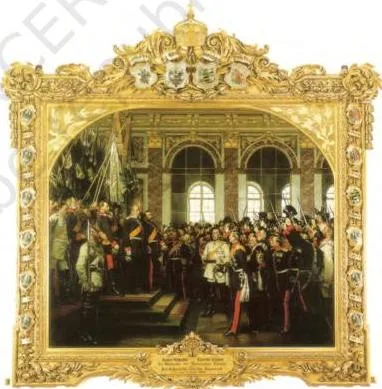
On 18 January 1871, an assembly of princes, army representatives, and Prussian ministers gathered in the Hall of Mirrors at the Palace of Versailles. Prussian King William I was proclaimed German Emperor (Kaiser). The new state emphasised modernising currency, banking, legal, and judicial systems. Prussian measures became a model for the rest of Germany (NCERT, p. 19).
This was a top-down unification — military and bureaucratic, not democratic.
Unification of Italy (1859–1870): Cavour, Garibaldi, and Victor Emmanuel II
Italy had a long history of political fragmentation. In the mid-19th century, it was divided into seven states (NCERT, p. 20):
- Only Sardinia-Piedmont was ruled by an Italian princely house
- The north was under Austrian Habsburgs
- The centre was ruled by the Pope
- The south was under Bourbon kings of Spain
Even the Italian language had many regional and local variations.
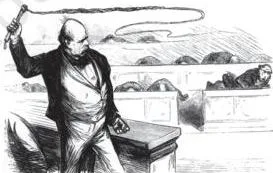
Mazzini’s Failed Vision
During the 1830s, Mazzini sought a coherent programme for a unitary Italian Republic through Young Italy. His uprisings of 1831 and 1848 both failed (NCERT, p. 20).
Cavour’s Diplomacy and Garibaldi’s Volunteers
Chief Minister Cavour of Sardinia-Piedmont led the unification. He was neither revolutionary nor democrat — he spoke French better than Italian. Through a diplomatic alliance with France, Sardinia-Piedmont defeated the Austrian forces in 1859 (NCERT, p. 21). After the victory, a large number of armed volunteers under Giuseppe Garibaldi (1807–82) joined the campaign.
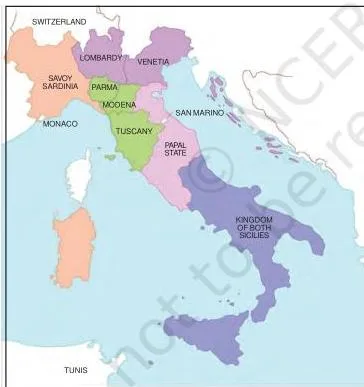
In 1860, Garibaldi’s volunteers — popularly known as the Red Shirts — marched into South Italy and the Kingdom of the Two Sicilies, winning the support of local peasants and driving out the Spanish rulers. In 1861, Victor Emmanuel II was proclaimed king of united Italy (NCERT, p. 21).
Most Italian peasants were illiterate and had never heard of Italia. They believed ‘La Talia’ was Victor Emmanuel’s wife! Rome was the last to join in 1870, when France withdrew its troops during the war with Prussia and the Papal States were finally joined to Italy (NCERT, p. 22).
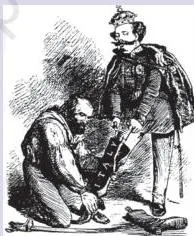
Germany vs Italy Unification: Side-by-Side Comparison
| Feature | Germany | Italy |
|---|---|---|
| Architect | Otto von Bismarck (Prussian chief minister) | Count Cavour (chief minister of Sardinia-Piedmont) |
| Method | Prussian army and bureaucracy; three wars | Diplomatic alliance with France + Garibaldi’s armed volunteers |
| Key figures | Bismarck, King William I, Junkers | Cavour, Garibaldi (Red Shirts), Victor Emmanuel II |
| Wars fought | Denmark, Austria, France (3 wars in 7 years) | War against Austria (1859); Garibaldi’s Expedition of the Thousand (1860) |
| Final date | 18 January 1871 — William I proclaimed Kaiser at Versailles | 1861 — Victor Emmanuel II proclaimed king; Rome joined 1870 |
| Top-down or democratic? | Top-down, military-bureaucratic | Top-down diplomacy + popular volunteer movement |
| Failed earlier attempt | Frankfurt Parliament (1848), crown rejected by Friedrich Wilhelm IV | Mazzini’s uprisings (1831, 1848) for a republic both failed |
The Strange Case of Britain: Forging a Nation Through Force
Britain’s nation-state was not formed by a sudden revolution but through a gradual process of English dominance (NCERT, p. 21). There was no British nation before the 18th century. The primary identities were ethnic: English, Welsh, Scot, or Irish.
The English parliament, which had seized power from the monarchy in 1688, was the instrument of forging a nation-state with England at its centre. The Act of Union (1707) between England and Scotland formed the ‘United Kingdom of Great Britain’.
England imposed its influence on Scotland — Scottish Highlanders were forbidden to speak Gaelic or wear their national dress, and large numbers were driven out (NCERT, p. 21).
Ireland was deeply divided between Catholics and Protestants. The English helped Protestants dominate. After Wolfe Tone’s failed revolt in 1798, Ireland was forcibly incorporated into the United Kingdom in 1801. A new ‘British nation’ was forged through the propagation of dominant English culture — the Union Jack flag, the national anthem (God Save Our Noble King), and the English language.
Ethnic relates to a common racial, tribal, or cultural origin or background (NCERT, p. 22).
The key contrast with the rest of Europe: Britain formed its nation-state by internal conquest and absorption of other peoples, not by liberation from foreign rule.
Visualising the Nation: Allegories of Marianne and Germania
Artists in the 18th and 19th centuries personified nations as female figures. The female form did not stand for any real woman; it gave the abstract idea of the nation a concrete form. This is called allegory — when an abstract idea is expressed through a person or thing (NCERT, p. 23).
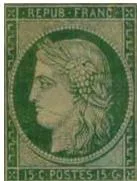
Marianne: The Allegory of France
Marianne represented France. Her characteristics were drawn from Liberty and the Republic — the red cap, the tricolour, the cockade. Statues of Marianne were erected in public squares to remind the public of the national symbol of unity. Marianne images appeared on coins and stamps.
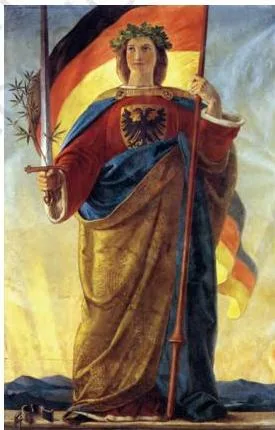
Germania: The Allegory of Germany
Germania represented the German nation. She wears a crown of oak leaves, as the German oak stands for heroism (NCERT, p. 23). Philip Veit painted her in 1848 on a cotton banner meant to hang from the ceiling of the Church of St Paul where the Frankfurt Parliament convened.
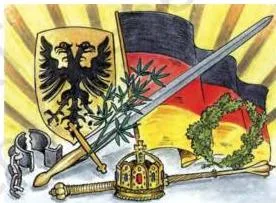
Germania’s Symbols and Their Meanings (Box 3)
| Attribute | Significance |
|---|---|
| Broken chains | Being freed |
| Breastplate with eagle | Symbol of the German empire — strength |
| Crown of oak leaves | Heroism |
| Sword | Readiness to fight |
| Olive branch around the sword | Willingness to make peace |
| Black, red and gold tricolour | Flag of the liberal-nationalists in 1848, banned by the Dukes of the German states |
| Rays of the rising sun | Beginning of a new era |
Nationalism and Imperialism: The Balkans Crisis
By the last quarter of the 19th century, nationalism lost its idealistic liberal-democratic character and became a narrow, intolerant creed aligned with imperialism (NCERT, p. 26). Nationalist groups became increasingly intolerant of each other and ready to go to war. Major European powers manipulated nationalist aspirations for their own imperialist aims.
The Balkans: A Region of Conflict
The Balkans was a region of geographical and ethnic variation, including modern-day Romania, Bulgaria, Albania, Greece, Macedonia, Croatia, Bosnia-Herzegovina, Slovenia, Serbia, and Montenegro. The inhabitants were broadly known as Slavs (NCERT, p. 26).
The region became explosive due to four factors:
- Disintegration of the Ottoman Empire, which had controlled much of the Balkans
- Romantic nationalism inspiring Slavic nationalities to claim independence based on history
- Fierce jealousy among Balkan states, each wanting more territory at the expense of others
- Big power rivalry — Russia, Germany, England, and Austro-Hungary all wanted control of the Balkans
This led to a series of wars in the region and finally the First World War (1914) (NCERT, p. 26). Meanwhile, anti-imperial movements in colonised countries developed their own specific varieties of nationalism, but the idea that societies should be organised into nation-states became accepted as natural and universal.
Key Terms and Definitions Table
Here is a consolidated table of all the key NCERT terms you need for this chapter, with student-friendly meanings and the context in which each appears:
| Term | Meaning | Context / Example |
|---|---|---|
| Absolutist | A government or system of rule with no restraints on the power exercised; centralised, militarised, repressive monarchy | Sorrieu’s 1848 print shows shattered remains of absolutist institutions |
| Utopian | A vision of a society so ideal that it is unlikely to actually exist | Sorrieu’s dream of worldwide democratic republics |
| Plebiscite | A direct vote by which all the people of a region are asked to accept or reject a proposal | Renan called a nation’s existence ‘a daily plebiscite’ |
| Suffrage | The right to vote | Liberal nationalism did not stand for universal suffrage — women and non-propertied men were excluded |
| Conservatism | A political philosophy stressing tradition, established institutions and customs, preferring gradual development to quick change | The Congress of Vienna (1815) under Metternich created a new conservative order |
| Allegory | When an abstract idea (freedom, liberty, justice) is expressed through a person or thing; an allegorical story has a literal and a symbolic meaning | Marianne (France) and Germania (Germany) were female allegories of the nation |
| Ethnic | Relates to a common racial, tribal, or cultural origin or background | British identities before the 18th century were ethnic — English, Welsh, Scot, Irish |
| Feminist | Awareness of women’s rights and interests based on belief in the social, economic, and political equality of genders | Louise Otto-Peters founded a feminist political association in 1849 |
| Ideology | System of ideas reflecting a particular social and political vision | Liberalism and conservatism were competing ideologies in 19th-century Europe |
| Nation-state | A state where the majority of citizens share a common identity and shared history or descent | France after 1789 was the first nation-state; Germany and Italy unified later |
| Zollverein | A customs union formed in 1834 at Prussia’s initiative | Abolished tariff barriers and reduced currencies from over thirty to two in German states |
| Junkers | Large landowners of Prussia | Supported the monarchy and military in suppressing the 1848 liberal movement |
Important Dates Timeline: 1797–1914
Use this table for quick revision of all the key dates from the chapter (NCERT, p. 8 plus throughout):
| Year | Event |
|---|---|
| 1797 | Napoleon invades Italy; Napoleonic wars begin |
| 1804 | Napoleonic Code introduced |
| 1814–1815 | Fall of Napoleon; the Vienna Peace Settlement |
| 1821 | Greek struggle for independence begins |
| 1830 | July Revolution in France; Belgian independence |
| 1831 | Mazzini sent into exile; founds Young Italy |
| 1832 | Treaty of Constantinople recognises Greece as independent |
| 1834 | Zollverein (customs union) formed at Prussia’s initiative |
| 1845 | Silesian weavers’ revolt |
| 1848 | Revolutions in Europe; Frankfurt Parliament convened in Church of St Paul (18 May 1848); Sorrieu’s prints prepared |
| 1859–1870 | Unification of Italy |
| 1860 | Garibaldi’s Expedition of the Thousand to South Italy |
| 1861 | Victor Emmanuel II proclaimed king of united Italy |
| 1866–1871 | Unification of Germany |
| 18 January 1871 | Prussian King William I proclaimed German Emperor at Versailles |
| 1867 | Habsburg rulers granted more autonomy to Hungarians |
| 1870 | Papal States joined Italy after France withdrew troops |
| 1905 | Slav nationalism gathers force in Habsburg and Ottoman Empires |
| 1914 | First World War begins (Balkan tensions) |
Worked Example: Answering ‘Trace the Process of German Unification’ (5 Marks)
Here is a model 5-mark answer written with original framing and an examiner’s commentary. Read this as a teacher’s model response — not how NCERT phrases it, but how a student should write it to earn full marks.
Opening line: The unification of Germany was achieved through a process of Prussian-led state-building, not by a democratic movement.
- Step 1: After the failure of the Frankfurt Parliament (1848), the liberal initiative to unite Germany was repressed by the monarchy, the military, and the Junkers (large landowners) of Prussia.
- Step 2: Prussia took the leadership of the movement for unification under its chief minister Otto von Bismarck.
- Step 3: Bismarck carried out the process with the help of the Prussian army and bureaucracy — NOT through democratic means.
- Step 4: Three wars over seven years — with Denmark, Austria, and France — ended in Prussian victory and completed the process of unification.
- Step 5: On 18 January 1871, in the Hall of Mirrors at the Palace of Versailles, Prussian King William I was proclaimed German Emperor (Kaiser) in the presence of princes, army representatives, and ministers including Bismarck.
- Step 6: The new German Empire placed strong emphasis on modernising currency, banking, legal, and judicial systems. Prussian measures became a model for the rest of Germany.
Examiner’s note: Writing the date (18 January 1871), the three wars, Bismarck’s name, and the venue (Versailles) earns marks. Showing that it was a top-down military unification, not a democratic one, demonstrates understanding of the key concept — this is what separates a 4-mark answer from a 5-mark one.
Common Mistakes Students Make in This Chapter
Here are the strict error → correction pairs for the most frequent mistakes students make while revising this chapter. Each is based on the specific text of the NCERT pages:
| Mistake | Correct rule | How to check your answer |
|---|---|---|
| Writing that Mazzini unified Italy | Mazzini was the ideological visionary who dreamed of a unified Italian republic, but his uprisings of 1831 and 1848 failed. Actual unification was led by Cavour (diplomacy), Garibaldi (armed volunteers), and Victor Emmanuel II | Make sure you distinguish between Mazzini’s role (visionary, secret societies) and Cavour/Garibaldi’s role (actual unification) |
| Writing that Germany was unified by a democratic parliament | The Frankfurt Parliament (1848) was a liberal attempt that failed. Germany was unified by Bismarck’s Prussian army and bureaucracy through three wars | Check: did you write ‘Bismarck’ and ‘Prussian army’ as the agents of unification? |
| Confusing a crown of oak leaves with a laurel wreath | Germania wears a crown of oak leaves, symbolising heroism. Laurel wreaths are a different classical tradition — the German oak specifically represents heroism | In your answer, write ‘crown of oak leaves = heroism’ explicitly, citing the German oak |
| Writing that conservatism meant returning to pre-revolutionary society | Conservatives after 1815 did not propose a return to old society. They believed modernisation (army, bureaucracy, abolition of feudalism) could strengthen monarchies | Check: does your answer acknowledge that conservatives adopted modernisation, not simply restoration? |
| Confusing Britain’s nation-state with revolution | Britain’s nation-state was formed gradually through English dominance (Act of Union 1707, Ireland 1801), not by revolution | Check: did you write ‘gradual English conquest and absorption’ rather than ‘revolution’? |
| Writing that Napoleon’s Code gave women political rights | The Napoleonic Code REDUCED women to the status of a minor, subject to fathers and husbands. It went back to limited suffrage and excluded women and non-propertied men | Check: does your answer say ‘reduced women to the status of a minor’? |
Exam Pointers: What the Examiner Looks For
These are observed patterns from the NCERT exercises and the types of questions that appear in school tests and boards. Write with the examiner’s mindset — each point below tells you what earns marks.
- ‘Briefly trace the process of German unification’ / Italian unification are standard 5-mark questions. Writing the architect (Bismarck / Cavour), the method (army and three wars / diplomatic alliance with France + Garibaldi’s volunteers), and the final date (18 January 1871 / 1861 kingdom, 1870 Rome) earns full marks.
- ‘What steps did the French revolutionaries take to create a sense of collective identity?’ is a 5-mark question. Listing la patrie, le citoyen, the tricolour, the National Assembly, uniform laws, common language, hymns and martyrs is the expected structure.
- ‘Who were Marianne and Germania?’ — the answer must state they were female allegories of the nation, not real women. Mention their symbols (red cap and tricolour for Marianne; oak crown and sword for Germania) and how they conveyed ideas of unity, liberty, and heroism.
- ‘Why did nationalist tensions emerge in the Balkans?’ — name the Slavic nationalities, the disintegration of the Ottoman Empire, big power rivalry (Russia, Germany, England, Austro-Hungary), and the connection to the First World War.
- Source-based questions may use the Ernst Renan extract (page 4), Friedrich List on the Zollverein (page 10), or Carl Welcker and Louise Otto-Peters on women’s rights (page 17). Read these source boxes carefully.
- The Sorrieu print (Fig. 1) is commonly used in picture-based or source-based questions. Identifying the statue of Liberty, the torch of Enlightenment, the Charter of the Rights of Man, and the shattered absolutist symbols earns marks.
- ‘How was the history of nationalism in Britain unlike the rest of Europe?’ — stress gradual internal conquest (Act of Union 1707, Ireland 1801), suppression of Celtic cultures, and dominant English culture — NOT revolution or war of independence.
Revision Summary: The Whole Chapter in One Page
Use this tight recap the night before the exam. It compresses the entire chapter into the essentials.
Core idea: Nationalism in Europe was the process by which multi-national dynastic empires were replaced by nation-states where citizens shared a common identity forged through struggle.
Causes of Nationalism
- French Revolution (1789): transferred sovereignty to citizens; introduced la patrie, le citoyen, tricolour
- Napoleon’s Code (1804): spread equality before law and administrative efficiency
- Industrialisation: created a liberal middle class that pushed for national unity
- Romanticism: created cultural unity through language, folklore, and art
- Economic hardship (1848): drove popular revolts
Key Actors
- Napoleon: Civil Code 1804; spread reforms through conquest
- Metternich: Congress of Vienna 1815; conservatism
- Mazzini: Young Italy, Young Europe — the visionary whose uprisings failed
- Bismarck: German unification via Prussian army, three wars, Versailles 1871
- Cavour: diplomatic alliance with France, defeated Austria 1859
- Garibaldi: Red Shirts, Expedition of the Thousand, 1860
- Victor Emmanuel II: king of united Italy 1861
Key Concepts
- Liberalism: freedom, equality, consent — NOT universal suffrage
- Conservatism: tradition, gradual change, modernisation to strengthen monarchy
- Allegory: Marianne = France, Germania = Germany
- Nation-state: citizens share identity, not just rulers
Two Unifications Contrasted
- Germany: top-down, military, Bismarck, Versailles 1871
- Italy: top-down + popular volunteers, Cavour + Garibaldi, kingdom 1861, Rome 1870
- Britain: gradual, English dominance, Act of Union 1707, Ireland 1801
Endgame
- Nationalism turned imperialist in the Balkans, led to World War I (1914)
For more chapter notes across all subjects, visit our Class 10 Social Science notes collection, the full set of Class 10 notes, or browse all CBSE notes on the site. You can also refer to the official NCERT textbook page for this chapter on the NCERT website for the source material.
Frequently Asked Questions on Nationalism in Europe
What did Ernst Renan mean when he said the existence of a nation is a daily plebiscite?
Renan meant that a nation exists only as long as its people continue to will it. A plebiscite is a direct vote, and he used it as a metaphor: a nation survives through the daily collective will of its people to belong together. If people stop willing it, the nation ceases to exist.
Why is the Napoleonic Code called a modern law code when it gave no rights to women?
Because it established equality before law and abolished birth-based privileges for men, which was revolutionary for its time. The exclusion of women was a limitation of the age, not an accident. Women and non-propertied men had to fight for decades for equal political rights.
The Code went back to limited suffrage and reduced women to the status of a minor, subject to fathers and husbands (NCERT, p. 9).
What is the difference between Mazzini and Cavour’s approach to Italian unification?
Mazzini was a visionary revolutionary who wanted a democratic republic and relied on secret societies. His uprisings of 1831 and 1848 both failed. Cavour was a pragmatic diplomat who used an alliance with France and war against Austria to achieve unification under a monarchy. He was neither a revolutionary nor a democrat, and spoke French better than Italian (NCERT, p. 21).
How did the Zollverein help in German unification?
The Zollverein created a unified economic territory by abolishing tariff barriers and reducing the number of currencies from over thirty to two. As Friedrich List wrote in 1834, it bound the Germans economically into a nation before political unification took place. A railway network further stimulated mobility and national sentiment (NCERT, p. 10).
Why is Britain’s nationalism called strange compared to other European countries?
Because Britain became a nation-state not through a revolution or war of independence, but through gradual English conquest and absorption of Scotland (Act of Union, 1707) and Ireland (1801). English culture — the Union Jack flag, the English language, the national anthem — was imposed on the older nations, which survived only as subordinate partners (NCERT, p. 21).
What was the relationship between nationalism and imperialism in the Balkans?
Nationalism in the Balkans was exploited by big powers — Russia, Germany, England, and Austro-Hungary — for their own imperialist aims. The Slavic nationalities’ struggles for independence became entangled with big power rivalries over territory and control. This turned nationalist tensions into a series of wars that led to the First World War in 1914 (NCERT, p. 26).
Reference: NCERT Class 10 History textbook, chapter The Rise of Nationalism in Europe.
Explore Class 10 History Notes
Class 10 History on LearnCBSE:
Related chapters: