
These The Making of a Global World class 10 notes cover the full chapter for the 2026-27 board session. The chapter maps how global trade, migration, and financial systems evolved across centuries — from pre-modern silk routes through Bretton Woods and modern MNC-driven globalisation.
Silk Routes: Trade and Cultural Exchange
The silk routes were vibrant pre-modern trade links connecting distant regions. Chinese silk travelled west to Europe (NCERT, p. 4), while Indian textiles, spices, and pottery moved along the same paths. In return, precious metals flowed from Europe to Asia.
- Overland and sea paths existed since before the Christian Era and thrived till the fifteenth century.
- Trade and cultural exchange went hand in hand — Buddhism spread from eastern India via silk-route intersections; early Christian missionaries and later Muslim preachers travelled the same paths.
- Sixteenth-century shift: European sailors found sea routes to Asia and crossed to America; the centre of world trade moved westwards from China and India to Europe.
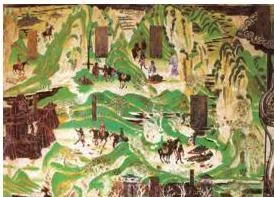
The cave painting above illustrates the overland silk route in action — pack animals, merchants, and goods travelling long distances. This visual confirms that trade and cultural exchange always went hand in hand along these routes.
Food Travels and the Role of the Americas
Food transfers prove that long-distance cultural contact existed long before modern transport. Many common foods were unknown until about five centuries ago — they came from the Americas after Columbus’s accidental discovery (NCERT, p. 4).
Crops That Travelled From the Americas
Memory device for the four key crops that travelled from the Americas to Europe and Asia:
- Potatoes
- Maize
- Tomatoes
- Chillies
Recall these as P-M-T-C — the crop package from the Americas that reshaped diets worldwide.
Silver and the Wealth Shift
Spanish and Portuguese conquest of the Americas was underway by the mid-sixteenth century. Precious metals, especially silver from mines in present-day Peru and Mexico, enhanced Europe’s wealth and financed its trade with Asia (NCERT, p. 5).
The Irish Potato Famine: The Danger of Single-Crop Dependence
The potato transformed diets — Europe’s poor ate better and lived longer. But Ireland’s peasants became dangerously dependent. When disease destroyed the potato crop in the mid-1840s, around 1 million people died of starvation in the Great Irish Potato Famine, and roughly double that number emigrated (NCERT, p. 5).
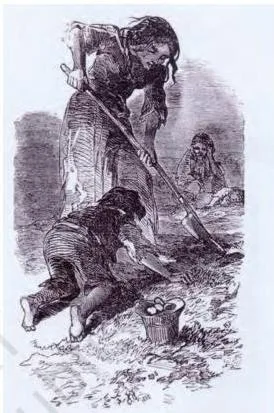
The image above illustrates the scale of European arrival in the Americas — a conquest that combined military force, disease, and economic transformation.
Disease as a Weapon: Smallpox and the Colonisation of the Americas
Misconception Autopsy: “Guns Conquered the Americas”
Misconception: Many students believe European firearms alone conquered the Americas.
Reality: The deadliest weapon was not a gun but smallpox germs that the Spanish carried on their person. America’s original inhabitants had long been isolated, so they had no immunity against European diseases. Smallpox spread deep into the continent, ahead of the Europeans themselves, decimating whole communities and paving the way for conquest.
Why the difference mattered:
- Guns could be captured and turned against the invaders.
- Diseases could not — conquerors were mostly immune. Smallpox killed on a scale firearms could not match.
The first governor of the Massachusetts Bay colony, John Winthrop, wrote in May 1634 that smallpox signalled God’s blessing for the colonists. His phrase “the Lord hathe cleared our title” framed disease-driven depopulation as religious justification for seizing land.
A dissenter is one who refuses to accept established beliefs and practices — and dissenters were among those who fled Europe for America seeking freedom from persecution (NCERT, p. 6).
Three Flows of the Nineteenth-Century World Economy
Economists identify three types of movement within international economic exchanges during 1815–1914 (NCERT, p. 7). All three were closely interwoven, though labour migration was more restricted than goods or capital flows.
| Flow Type | What It Means | Example Involving India |
|---|---|---|
| Trade in goods | Exchange of cloth, wheat, and other primary products across borders | India exported raw cotton and opium; imported British manufactured textiles |
| Labour migration | People moving in search of employment, often across oceans | Indian indentured labourers sent to Caribbean, Mauritius, Fiji, Ceylon |
| Capital movement | Short or long-term investments flowing over long distances | London financial centres financed railways, ports, and plantations in India |
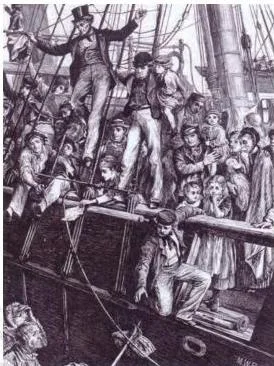
The emigrant ship above represents the second flow — labour migration. Nearly 50 million people left Europe for America and Australia; roughly 150 million people worldwide crossed oceans and vast distances in search of a better future.
Corn Laws, Food Imports, and Agricultural Expansion
The abolition of the Corn Laws in Britain triggered a chain reaction that reshaped global agriculture (NCERT, p. 7–8).
Trigger
- Population growth from the late eighteenth century increased food demand in Britain.
- Food grain prices rose; under pressure from landed groups, the government restricted corn imports via the Corn Laws.
- Industrialists and urban dwellers, unhappy with high prices, forced abolition.
Domestic Consequence
- Food imports became cheaper than domestic production; British agriculture could not compete.
- Vast areas were left uncultivated; thousands were thrown out of work and migrated to cities or overseas.
Global Consequence
- Lands were cleared worldwide — in Eastern Europe, Russia, America, and Australia — to meet British food demand.
- Railways linked agricultural regions to ports; new harbours were built; people settled on cleared land.
- This required capital (from London) and labour (driving more migration).
- By 1890, a global agricultural economy had taken shape.
Closer home, the British Indian government built irrigation canals in west Punjab, transforming semi-desert wastes into fertile land for wheat and cotton. These Canal Colonies were settled by peasants from other parts of Punjab.
Technology and Refrigerated Meat Transport
Technological advances were driven by larger social, political and economic factors — colonisation stimulated investments in transport (NCERT, p. 9).
The Meat Example
- Before the 1870s: Animals were shipped live from America to Europe, then slaughtered on arrival. They took up ship space, many died, lost weight, or became unfit to eat. Meat was an expensive luxury beyond the European poor’s reach.
- After refrigerated ships: Animals were slaughtered at the starting point (America, Australia, New Zealand) and transported as frozen meat. This reduced shipping costs and lowered prices.
Result: the European poor added meat, butter, and eggs to their diet of bread and potatoes. Better living conditions promoted social peace within the country and support for imperialism abroad.
Why this matters: it shows how technology drove consumption and how a better-fed population became more compliant with imperial ambitions.
Late Nineteenth-Century Colonialism and the Scramble for Africa
The expanding trade of the late nineteenth century had a darker side — loss of freedoms and livelihoods across the colonised world (NCERT, p. 10–11).
- 1885 Berlin meeting: European powers drew straight borders across Africa, completing the carving up of the continent between them.
- New colonial powers: Britain, France, Belgium, Germany; the US also took over former Spanish colonies in the late 1890s.
- Geographical exploration was not innocent science: Explorers like Henry Morton Stanley went armed, mobilised local fighters, and mapped regions — activities directly linked to imperial projects.
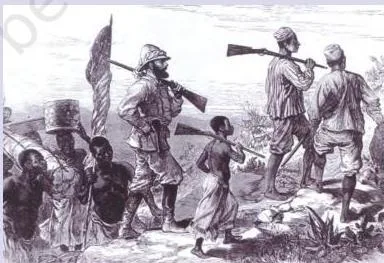
The image above shows Stanley and his retinue in Central Africa. The key point: geographical explorations were not driven by an innocent search for scientific information — they were directly linked to imperial projects.
Rinderpest: How a Cattle Disease Reshaped Africa
Rinderpest, a cattle plague, arrived in Africa in the late 1880s and killed 90% of African cattle — a devastating blow that reshaped the entire continent (NCERT, p. 12–13).
The Problem Europeans Faced
- Europeans wanted plantations and mines in Africa, but faced a labour shortage.
- Africans had abundant land and livestock; they rarely worked for wages because few consumer goods were available to buy.
Methods Used to Force Africans into Wage Labour
- Heavy taxes imposed, payable only by working for wages.
- Changed inheritance laws — only one family member could inherit land, pushing the rest into the labour market.
- Mineworkers confined in compounds and not allowed to move about freely.
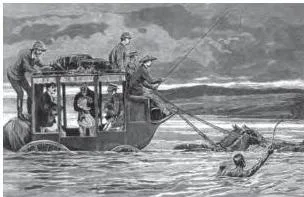
The image above shows how miners were transported to the Transvaal gold fields. The conditions were harsh, and movement was restricted to prevent workers from leaving.
How Rinderpest Reshaped Africa: The Sequence
- The disease was carried by infected cattle imported from British Asia to feed Italian soldiers invading Eritrea.
- It entered Africa in the east and moved west like a forest fire, reaching the Atlantic coast by 1892 and the Cape by 1897.
- It killed 90% of the cattle, destroying African livelihoods that depended on livestock.
- Planters, mine owners, and colonial governments monopolised scarce cattle resources, strengthening their power and forcing Africans into the labour market.
Result: control over scarce cattle resources enabled European colonisers to conquer and subdue Africa.
Indentured Labour Migration from India
Indentured labour migration from India illustrates the two-sided nature of the nineteenth-century world — faster economic growth alongside great misery; higher incomes for some and poverty for others (NCERT, p. 13–14).
What Was Indentured Labour?
A bonded labourer under contract to work for an employer for a specific period, to pay off passage to a new country or home. The contract promised return travel to India after five years on a plantation.
Source Regions and Destinations
| Source Regions in India | Destinations Abroad |
|---|---|
| Eastern Uttar Pradesh | Caribbean islands (Trinidad, Guyana, Surinam) |
| Bihar | Mauritius |
| Central India | Fiji |
| Dry districts of Tamil Nadu | Ceylon and Malaya (closer home) |
| — | Tea plantations in Assam |
Causes of Migration
- Cottage industries declined; land rents rose; lands were cleared for mines and plantations.
- The poor could not pay rents, fell into debt, and were forced to migrate.
The “New System of Slavery”
- Agents used false information about destinations, travel conditions, nature of work, and living conditions.
- Some migrants were forcibly abducted.
- Living and working conditions were harsh; few legal rights existed.
- Workers escaped into the wilds; if caught, punishment was severe.
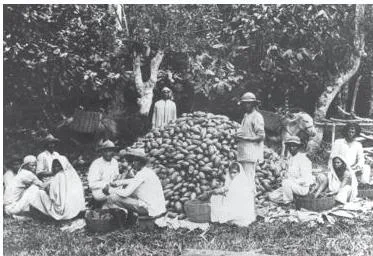
The above image shows indentured labourers at work on a Trinidad cocoa plantation. The contract form alongside reduced workers to numbers — for employers, numbers and not names mattered.
Cultural Fusion: The Lasting Legacy
Workers blended cultural forms to create something new:
- Hosay: In Trinidad, the annual Muharram procession was transformed into a riotous carnival in which workers of all races and religions joined.
- Rastafarianism: The protest religion (made famous by Bob Marley) reflects social and cultural links with Indian migrants.
- Chutney music in Trinidad and Guyana is a creative expression of the post-indenture experience.
Real-Life Application: The Lasting Cultural Footprint
Most indentured workers stayed on after their contracts ended, so large Indian-origin communities remain in these countries. You can see this lasting cultural footprint in recognisable modern figures:
- Shivnarine Chanderpaul and Ramnaresh Sarwan — West Indies cricketers with Indian-descended names.
- V.S. Naipaul — Nobel Prize-winning writer descended from indentured labour migrants.
The system was abolished in 1921 after Indian nationalist leaders opposed it as abusive and cruel. But the descendants of indentured workers, often called ‘coolies’, remained an uneasy minority for decades.
Indian Entrepreneurs and Bankers Abroad
Indian bankers and traders financed export agriculture globally, following colonial networks (NCERT, p. 15).
| Group | Where They Operated | What They Did |
|---|---|---|
| Shikaripuri Shroffs | Central and Southeast Asia | Financed export agriculture using own funds or loans from European banks; developed indigenous corporate organisation |
| Nattukottai Chettiars | Central and Southeast Asia | Sophisticated system to transfer money over large distances for plantation and agricultural finance |
| Hyderabadi Sindhi traders | Busy ports worldwide, beyond European colonies | From the 1860s, established flourishing emporia selling local and imported curios to tourists |
The key insight: Hyderabadi Sindhis ventured beyond European colonies, establishing themselves at ports worldwide. Their growth was linked to the development of safe and comfortable passenger vessels that swelled tourist numbers.
India’s Trade, Colonialism, and the Global System
India’s export profile shifted dramatically over the nineteenth century. With industrialisation, Britain restricted cotton imports through tariffs and then sought overseas markets for its own cloth (NCERT, p. 15–17).
Decline of Indian Cotton Textile Exports
- Around 1800: cotton textiles = about 30% of India’s exports.
- By 1815: declined to 15%.
- By the 1870s: dropped to below 3%.
Rise of Raw Material Exports
- Raw cotton exports rose from 5% to 35% (1812 to 1871).
- Indigo was important for dyeing cloth.
- Opium shipments to China grew rapidly from the 1820s — becoming India’s single largest export for a while.
- Britain sold opium to China to finance tea and other imports from China.
The above export-profile chart illustrates how colonial India was transformed from a manufacturer-exporter into a raw material supplier feeding British industry.
Trade Surplus and Home Charges
- Britain’s exports to India were worth more than its imports from India — so Britain had a trade surplus with India.
- Britain used this surplus to balance its trade deficits with other countries. This is a multilateral settlement system — one country’s deficit with another is settled by its surplus with a third.
- India’s surplus also paid the home charges: private remittances home by British officials and traders, interest payments on India’s external debt, and pensions of British officials in India.
By helping Britain balance its deficits, India played a crucial role in the late-nineteenth-century world economy.
Key Definitions in The Making of a Global World
| Term | Meaning | Example/Context |
|---|---|---|
| Dissenter | One who refuses to accept established beliefs and practices | Religious dissenters persecuted in Europe fled to America |
| Indentured labour | A bonded labourer under contract to work for an employer for a specific time, to pay off passage to a new country | Indian migrants sent to Caribbean, Mauritius, Fiji plantations |
| Tariff | Tax imposed on a country’s imports from the rest of the world, levied at the border or airport | Britain imposed tariffs on cloth imports, restricting Indian textiles |
| Fixed exchange rates | Exchange rates fixed and governments intervene to prevent movements in them | Bretton Woods: national currencies pegged to the dollar; dollar anchored to gold at $35/ounce |
| Floating exchange rates | Rates fluctuate with demand and supply of currencies in foreign exchange markets, without government interference | Replaced the Bretton Woods fixed system from the 1970s |
| MNCs | Large companies operating in several countries at the same time | From the 1950s–60s; high import tariffs forced MNCs to become ‘domestic producers’ in multiple countries |
| Rinderpest | A fast-spreading cattle plague that killed 90% of African cattle in the 1890s | Destroyed African livelihoods, forcing Africans into the wage labour market |
| Corn Laws | Laws restricting the import of corn into Britain to protect local agriculture | Abolition led to cheaper imports, decline of British agriculture, global land clearing |
| Home charges | Private remittances by British officials, interest on India’s external debt, pensions of British officials | Paid from Britain’s trade surplus with India |
The First World War: The First Modern Industrial War
The First World War (1914–18) was fought between the Allies (Britain, France, Russia, later the US) and the Central Powers (Germany, Austria-Hungary, Ottoman Turkey) (NCERT, p. 18). It was the first modern industrial war — leading industrial nations used modern industry to inflict maximum destruction.
- Scale of destruction: 9 million dead and 20 million injured — unthinkable without industrial arms.
- Weapons used: Machine guns, tanks, aircraft, chemical weapons on a massive scale.
- Workforce impact: Most of the killed and maimed were men of working age, reducing able-bodied workforce in Europe.
- Social reorganisation: Women stepped into jobs earlier done only by men.
- Financial shift: Britain borrowed heavily from US banks and the public. The war transformed the US from an international debtor to an international creditor.
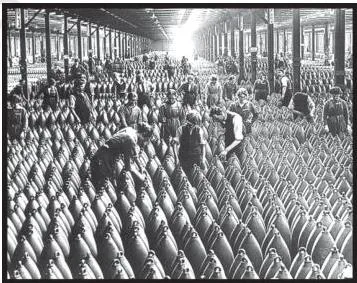
The above image shows a munitions factory during the war. Industries were restructured to produce war-related goods, and entire societies were reorganised for war as men went to the front and women stepped into factories.
Post-War Recovery and Henry Ford’s Mass Production
Britain’s Struggles
- Britain faced huge external debts from war borrowing.
- Competition from India and Japan intensified, including in the Indian market.
- Unemployment: 1 in 5 British workers out of work in 1921.
- Wheat producers in Canada, America, and Australia had expanded during the war; when eastern European supply revived, there was a glut in wheat output and falling grain prices.
US Recovery: Henry Ford’s Assembly Line
Recovery in the US was quicker, driven by mass production (NCERT, p. 19–20).
- Ford adapted the assembly line from a Chicago slaughterhouse to his car plant in Detroit.
- Workers repeated a single task mechanically at a pace dictated by the conveyor belt.
- Ford’s cars came off the line at three-minute intervals — the T-Model was the world’s first mass-produced car.
- Workers quit due to stress; Ford doubled wages to $5 per day in January 1914 and banned trade unions.
- He recovered the high wage by speeding up production, calling the wage hike his ‘best cost-cutting decision’.
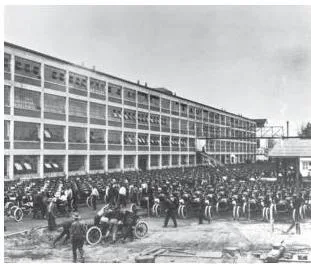
The above photograph shows T-Model Fords lined up outside the factory. Fordist industrial practices spread across the US and were copied in Europe in the 1920s.
Hire Purchase and the Consumer Boom
- Car production rose from 2 million in 1919 to over 5 million in 1929.
- Refrigerators, washing machines, radios, gramophones were bought through hire purchase (credit repaid in instalments).
- By 1923 the US was the largest overseas lender; US capital exports boosted European recovery.
- But in 1929 the prosperity collapsed.
The Great Depression: Causes, Impact, and India
The Great Depression began around 1929 and lasted till the mid-1930s. Most of the world saw catastrophic declines in production, employment, incomes, and trade (NCERT, p. 21–22). Agricultural regions were the worst affected.
Two Main Causes
- Agricultural overproduction: As prices fell, farmers produced more to maintain income; this worsened the glut and pushed prices down further; produce rotted for lack of buyers.
- Withdrawal of US overseas loans: In the first half of 1928, US overseas loans exceeded $1 billion; a year later they fell to one quarter of that. Countries depending on US loans faced acute crisis.
Global Impact
- Europe: failure of major banks; collapse of currencies including the British pound.
- Latin America: intensified slump in agricultural and raw material prices.
- US: doubled import duties to protect its economy, dealing a blow to world trade.
- By 1933, over 4,000 banks had closed; between 1929 and 1932 about 110,000 companies collapsed.
Impact on India: Rural Versus Urban
The depression proved how integrated the global economy had become — tremors in one part of the world were quickly relayed everywhere (NCERT, p. 22).
| Aspect | Rural India | Urban India |
|---|---|---|
| Trade | Exports and imports nearly halved (1928–34); wheat prices fell 50% | Industrial investment grew under tariff protection |
| Prices | Raw jute price crashed over 60%; overproduction worsened distress | Falling prices benefited those with fixed incomes |
| Revenue | Colonial government refused to reduce revenue demands despite price crash | Fixed-income groups (landowners, salaried middle class) were better off; everything cost less |
| Debt and assets | Peasants mortgaged lands, sold jewellery and precious metals; India became an exporter of gold | — |
| Nationalist expression | Rural unrest at its height when Gandhi launched the Civil Disobedience Movement in 1931 | — |
Key observation: India’s gold exports helped speed up Britain’s recovery, and the economist John Maynard Keynes believed they promoted global economic recovery. But they did little for the Indian peasant.
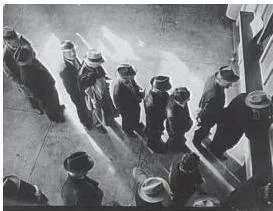
The above image visually references how the Great Depression’s effects reached deep into colonial India — the depression exposed how colonial India had become an exporter of agricultural goods and importer of manufactures.
Rebuilding the World: The Bretton Woods Agreement
The Second World War caused immense economic devastation and social disruption — at least 60 million people were killed (NCERT, p. 24–25). Two crucial influences shaped post-war reconstruction: the US’s emergence as the dominant Western power, and the dominance of the Soviet Union.
Two Key Lessons Learnt
- Mass production needs mass consumption and stable incomes — and this requires steady, full employment. Markets alone could not guarantee full employment; governments must step in to minimise fluctuations of price, output, and employment.
- Full employment requires control over external flows — a country needed power to regulate flows of goods, capital, and labour.
Bretton Woods: The Twin Institutions
In July 1944, the United Nations Monetary and Financial Conference at Bretton Woods, USA established two institutions:
- IMF (International Monetary Fund): deals with external surpluses and deficits of member nations.
- World Bank: official name is International Bank for Reconstruction and Development; finances post-war reconstruction.
- Known together as the Bretton Woods twins; financial operations commenced in 1947.
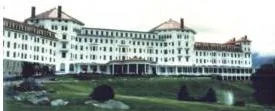
The above image shows the Mount Washington Hotel where the conference met. As discussed, the key lesson was that markets alone could not guarantee full employment, so the agreement empowered government intervention.
The above figure visually represents the Bretton Woods era’s growth statistics: world trade grew annually at over 8% between 1950 and 1970, and incomes grew at nearly 5%.
Fixed Exchange Rates
- National currencies (e.g. the Indian rupee) were pegged to the dollar at a fixed rate.
- The dollar was anchored to gold at a fixed price of $35 per ounce.
- Decision-making in the IMF and World Bank was controlled by Western industrial powers; the US had an effective right of veto over key decisions.
For the full official chapter text used as the source for these notes, see the NCERT textbook page for India and the Contemporary World II, Chapter 3 on ncert.nic.in.
Decolonisation, G-77, and the End of Bretton Woods
Decolonisation and Its Limits
- Over two decades after WWII, most colonies in Asia and Africa became independent nations, but were overburdened by poverty and long colonial rule.
- The IMF and World Bank were designed for industrial countries, not former colonies — they were not equipped to cope with poverty and lack of development in the newly independent nations.
- As Europe and Japan rebuilt, the institutions shifted attention to developing countries from the late 1950s.
- Former colonial powers still controlled vital resources like minerals and land in many former colonies; large corporations of powerful countries like the US often secured cheap rights to exploit natural resources.
The G-77 and NIEO Demand
Developing countries, not benefiting from the fast Western growth of the 1950s–60s, organised as the Group of 77 (G-77) to demand a New International Economic Order (NIEO). Their demands were:
- Real control over their natural resources.
- More development assistance.
- Fairer prices for raw materials.
- Better access for their manufactured goods to developed countries’ markets.
End of Bretton Woods
- From the 1960s, rising costs of overseas involvements weakened US finances and competitiveness.
- The US dollar could no longer maintain its value against gold. This led to the collapse of fixed exchange rates and the introduction of floating exchange rates.
- From the mid-1970s, developing countries had to borrow from Western commercial banks and private lenders, leading to periodic debt crises.
Rise of Modern Globalisation
- From the late 1970s, MNCs began shifting production to low-wage Asian countries.
- China, cut off since its 1949 revolution, was drawn back into the world economy by new economic policies and the collapse of the Soviet Union.
- Low wages in China made it attractive for MNCs; most TVs, mobile phones, and toys now appeared ‘made in China’.
- The relocation of industry to low-wage countries stimulated world trade and capital flows, transforming the economic geography of the world.
Students revising this thread can link this chapter to the earlier chapter on Nationalism in India (Chapter 2) and the later chapter on The Age of Industrialisation (Chapter 4) — both of which interlock with trade, colonialism, and India’s place in the global system.
Common Mistakes Students Make in This Chapter
| Mistake | Correct Rule | How to Check Your Answer |
|---|---|---|
| Students write indentured labour migration was voluntary | It was a ‘new system of slavery’ — agents used false information, migrants were forcibly abducted, living conditions were harsh | Include the phrase ‘new system of slavery’; mention false information and abduction |
| Students think the Great Depression affected only the US | It hit rural India severely (exports halved, wheat prices fell 50%) while urban fixed-income earners actually benefited | State rural and urban India effects separately — contrast clearly |
| Students confuse fixed and floating exchange rates | Fixed = pegged to the dollar/ gold; floating = fluctuates with demand and supply, without government interference | Write one line for each: ‘fixed = government intervenes’, ‘floating = market decides’ |
| Students credit firearms alone for the colonisation of the Americas | Smallpox was the most powerful weapon — native populations had no immunity due to long isolation | Mention lack of immunity and spread ahead of Europeans |
| Students think Bretton Woods institutions were meant for poor colonies | IMF and World Bank were designed for industrial countries, not former colonies — the G-77 demanded a new system | State that these were designed for industrial countries and the G-77 was a reaction to their dominance |
| Students write Britain’s own wealth paid for its global trade deficits | Britain used its trade surplus with India to balance deficits with other countries — this multilateral settlement also paid ‘home charges’ | Use the terms ‘trade surplus’, ‘multilateral settlement’, and ‘home charges’ together |
Exam Notes: What Examiners Look For
These are observed answer patterns, based on the kinds of detail that earn full marks — not predictions. For the latest official syllabus, refer to Class 10 History notes or the Class 10 notes index page.
- Sequence-based answers earn marks stepwise: For example, ‘Corn Laws abolished → cheap imports → British agriculture decline → global land clearing → migration’ — a sequence shows you understand cause and effect, not isolated facts.
- Name specific destinations for indentured labour: Examiners expect ‘Trinidad, Guyana, Surinam, Mauritius, Fiji, Ceylon, Malaya’ — vague ‘Caribbean’ alone may lose a mark.
- Cite exact figures for projectile marks: ‘90% of African cattle killed by Rinderpest’ and ‘$35 per ounce of gold’ are the kind of specific numbers that exam answers at this level reward.
- Mention the ‘darker side’ of colonialism: Answers on expanding trade that skip the loss of freedoms and livelihoods often lose marks — the chapter insists on including this theme.
- Rinderpest answers should name specific mechanisms: Heavy taxes, changed inheritance laws, confinement of mine workers — not just ‘labour shortage’.
- Great Depression answers must split rural versus urban India: One full-mark answer needs the contrast — falling prices devastated peasants with fixed revenue demands, but urban fixed-income earners actually benefited.
- Bretton Woods answer structure: State the two lessons learnt, then the two institutions created, then the fixed exchange rate mechanism (dollar pegged to gold at $35/ounce), then US veto power — in this order.
Revision Summary: Timeline of Globalisation
| Time Period | Key Event | Significance |
|---|---|---|
| Pre-modern (since before Christian Era) | Silk routes | Trade and cultural exchange; spread of Buddhism, Christianity, Islam |
| Sixteenth century | Discovery of the Americas | New crops (potatoes, maize, tomatoes, chillies), smallpox devastated native populations, silver financed European trade with Asia |
| 1840s | Irish Potato Famine | ~1 million died; dependence on a single crop proved dangerous |
| Mid-nineteenth century | Corn Laws abolished in Britain | Global agricultural expansion, mass migration, land clearing in Americas, Australia, Eastern Europe |
| 1890s | Rinderpest in Africa | 90% of cattle killed; African lives and livelihoods reshaped; European colonisation aided |
| 1815–1914 | Indentured labour migration from India | Caribbean, Mauritius, Fiji; cultural fusion (Hosay, Chutney music); abolished 1921 |
| 1914–18 | First World War | First modern industrial war; US became an international creditor nation |
| 1929–mid-1930s | Great Depression | Rural India devastated; urban fixed-income earners benefited; India exported gold |
| 1944 | Bretton Woods Agreement | IMF and World Bank established; fixed exchange rates pegged to US dollar, dollar to gold at $35/ounce |
| 1950s–60s | Decolonisation and G-77 | Former colonies demanded a New International Economic Order (NIEO) |
| 1970s onwards | End of Bretton Woods | Fixed exchange rates collapsed to floating rates; MNCs shifted production to low-wage Asian countries like China |
Frequently Asked Questions
Why was the Bretton Woods system created?
Economists and politicians drew two key lessons from inter-war economic experiences. First, mass production needs mass consumption, which requires high and stable incomes and full employment — and markets alone could not guarantee this, so governments had to step in. Second, a country needed to control flows of goods, capital, and labour to achieve full employment.
Bretton Woods created the IMF and World Bank to preserve economic stability and full employment in the industrial world, with fixed exchange rates pegged to the dollar and the dollar anchored to gold at $35 per ounce.
What was the impact of Rinderpest on Africa?
Rinderpest, a cattle plague, arrived in Africa in the late 1880s and killed 90% of African cattle. This destroyed African livelihoods, which depended on abundant land and livestock. Planters, mine owners, and colonial governments then monopolised the scarce remaining cattle, strengthening their power and forcing Africans into the wage labour market through heavy taxes and changed inheritance laws.
Control over scarce cattle resources enabled European colonisers to conquer and subdue Africa.
How did the Great Depression affect rural India differently from urban India?
Rural India was devastated: exports and imports nearly halved between 1928 and 1934, wheat prices fell 50%, and raw jute prices crashed over 60%. The colonial government refused to reduce revenue demands, so peasants fell deeper into debt, mortgaged lands, and sold jewellery — India became an exporter of gold.
In contrast, urban fixed-income groups (landowners receiving rents, middle-class salaried employees) benefited because everything cost less. Industrial investment also grew as the government extended tariff protection under nationalist pressure.
What did the Bretton Woods Agreement establish?
The Bretton Woods Agreement, signed in July 1944 at Bretton Woods, USA, established the International Monetary Fund (IMF) to deal with external surpluses and deficits of member nations, and the International Bank for Reconstruction and Development (World Bank) to finance post-war reconstruction.
It created a system of fixed exchange rates where national currencies were pegged to the dollar and the dollar was anchored to gold at $35 per ounce. Decision-making was controlled by Western industrial powers, with the US holding an effective right of veto.
What is meant by ‘home charges’ in colonial trade?
‘Home charges’ refers to the payments made from Britain’s trade surplus with India, including private remittances sent home by British officials and traders, interest payments on India’s external debt, and the pensions of British officials who had served in India.
Reference: NCERT Class 10 India and the Contemporary World II textbook, chapter The Making of a Global World. For more revision material, see the complete set of CBSE notes available on this site.
Explore Class 10 History Notes
Class 10 History on LearnCBSE:
Related chapters: