
For the 2026-27 session, these money and credit class 10 notes give you the complete chapter in a revision-friendly format. The chapter splits cleanly into two halves: how money works as a medium of exchange, and how credit can either drive development or trap borrowers in debt.
Why Money and Credit Matter: Chapter Overview
Money and credit sit at the centre of every economic transaction you make. This chapter explains why we moved from barter to modern currency, how banks create loans from deposits, and why the same loan can either lift a person up or drag them into a debt trap (NCERT, p. 1).
Two ideas connect the whole chapter: money is only useful because the banking system backs it, and credit only helps when the terms are fair and the borrower has some support against risk.
Money as a Medium of Exchange
Before money, people traded goods directly. This barter system had one crippling flaw: you could only trade if what you had matched exactly what the other person wanted.
Double coincidence of wants means both parties must want what the other offers — a person with shoes needs to find a farmer who both sells wheat and wants shoes (NCERT, p. 2). Money eliminates this search problem.

Today, imagine trying to buy a specific second-hand textbook by trading your phone for it. Unless the textbook seller wants exactly your phone model, no deal happens. Money solves this: you sell your phone to anyone, take the cash, and buy the textbook from someone else.
Because money sits between the sale and purchase as an accepted middle step, economists call it a medium of exchange (NCERT, p. 2). Everyone accepts money because everyone knows they can spend it next.
Modern Forms of Money: Currency and Bank Deposits
Money has taken many forms over time. Indians once used grains and cattle, then shifted to metallic coins in gold, silver, and copper — metals valued for their own worth.


Modern currency — paper notes and coins — is different. It has no intrinsic value; you cannot eat a note or forge a tool from it. Yet shopkeepers accept it because the government authorises it (NCERT, p. 3). This is fiat money: money accepted because law backs it.
In India, the Reserve Bank of India (RBI) issues currency on behalf of the central government. No other organisation can print rupees. The law also says no one in India can legally refuse a rupee payment — this legal backing is why a worthless-looking piece of paper buys goods.
Fiat Money: A Misconception Autopsy
Students often ask: if a 500-rupee note costs only a few rupees to print, why does it buy goods worth 500? The answer is trust and law. The government declares it legal tender, and the RBI controls supply. Because every citizen accepts this arrangement, the note functions as money.
Remove government authorisation and RBI control, and the same note becomes just paper. This is exactly why forged currency is illegal — it mirrors the government’s authority without having it.
Demand Deposits and Cheque Payments
The second modern form of money is the demand deposit — the balance in your bank account, withdrawable on demand. Because you can write a cheque instructing the bank to pay a specific amount to someone else, demand deposits work like cash for large transactions (NCERT, p. 4).
In the M. Salim example, the shoe manufacturer pays his leather supplier by cheque. The supplier deposits it in his own account, and the bank transfers the amount from Salim’s account to the supplier’s. No cash changes hands, yet the payment is complete. This is why economists count demand deposits as part of the money supply.
Loan Activities of Banks
Banks do not simply store money — they put it to work. They keep only about 5 per cent of deposits as cash to handle daily withdrawals, and lend out the remaining 95 per cent as loans (NCERT, p. 5).
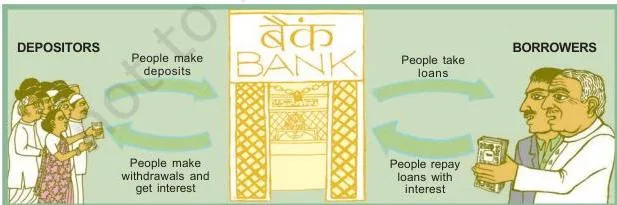
Banks make a profit by paying a lower interest rate on deposits than they charge on loans. For example, if a bank pays 4% on deposits and charges 10% on loans, the 6% difference is its income. This mechanism makes banks the bridge between surplus funds (depositors) and credit needs (borrowers) (NCERT, p. 5).
Why only 5% cash? On any given day, only a few depositors withdraw money. Banks use probability to keep just enough for daily needs. If everyone panicked and withdrew at once — a bank run — the bank would fail. This is why the RBI supervises banks to ensure stability.
Two Faces of Credit: Debt Trap vs Earnings Boost
Credit (a loan) is an agreement: the lender gives money, goods, or services now in exchange for a promise of future payment (NCERT, p. 6). Credit is not inherently good or bad — its impact depends on risk and support.
Salim’s situation (positive): Salim takes a loan to make 3,000 shoes for a festival order. Production finishes on time, he makes a profit, and repays the loan. Here, credit functioned as working capital that boosted his earnings (NCERT, p. 6).
Swapna’s situation (negative): Swapna, a small groundnut farmer, borrows from a moneylender for seeds and fertilisers. Pests destroy her crop, so she cannot repay. She borrows again next year, but the income cannot cover both. She eventually sells part of her land to clear the debt (NCERT, p. 6).
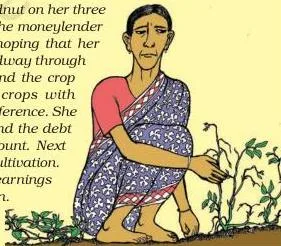
A debt trap is a cycle where a borrower takes new loans to repay old ones. The debt keeps growing until the borrower loses assets. Credit pushes the borrower into a situation from which recovery is very painful (NCERT, p. 6).
| Aspect | Salim (Shoe Manufacturer) | Swapna (Small Farmer) |
|---|---|---|
| Need for credit | Working capital for festival production | Crop cultivation inputs |
| Risk | Low — buyer already placed an order | High — crop depends on weather and pests |
| Outcome | Profit earned, loan repaid | Crop failed, sold land, trapped in debt |
| Role of credit | Positive — increased earnings | Negative — pushed into debt trap |
Key takeaway: Whether credit helps or hurts depends on the risk in the situation and whether support exists to handle loss. Formal credit at fair rates with some insurance or backup is what makes credit a development tool.
Terms of Credit Explained
Every loan comes with specific terms of credit. These usually include the interest rate, collateral requirement, documentation, and the mode of repayment (NCERT, p. 8).
Collateral is an asset the borrower owns — land, a house, a vehicle, livestock, or bank deposits — pledged as a guarantee. If the borrower fails to repay, the lender has the legal right to sell the collateral to recover the loan (NCERT, p. 7).
NCERT’s Megha example illustrates this: she borrows Rs 5 lakhs at 12% annual interest for 10 years. She submits her salary records as documentation, and the bank holds her new house’s papers as collateral until the loan is fully repaid (NCERT, p. 8).
| Term | Meaning | Example |
|---|---|---|
| Interest rate | The extra amount paid on the principal for using the lender’s money | 12% per annum on a home loan |
| Collateral | An asset pledged as security that the lender can sell if the borrower defaults | House papers submitted to the bank |
| Documentation | Proof of identity, income, and employment the borrower submits | Salary slips and employment records |
| Mode of repayment | How and when the loan is repaid | Monthly instalments over 10 years |
Formal vs Informal Sector Credit in India
India’s credit system has two clear halves.
Formal sector lenders include banks and cooperative societies. The RBI supervises them, mandates minimum cash reserves, and requires them to report their lending. They charge moderate interest rates and demand collateral and documentation (NCERT, p. 11).
Informal sector lenders include moneylenders, traders, employers, relatives, and friends. No external body supervises them. They can charge any interest rate and often use unfair means to recover money. Their rates are much higher, but they know borrowers personally and sometimes lend without collateral (NCERT, p. 11).
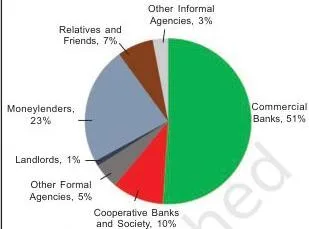
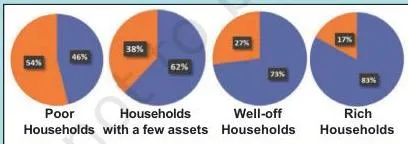
The data is striking: 54% of loans taken by poor urban households come from informal sources, compared to only 17% for rich urban households (NCERT, p. 12). The pattern is similar in rural areas. Formal credit must expand so the poor can access cheaper loans — this is essential for the country’s development.
| Factor | Formal Sector | Informal Sector |
|---|---|---|
| Supervisor | Reserve Bank of India | No external supervisor |
| Interest rate | Lower, regulated | Very high, set by lender |
| Collateral | Usually required | Often not required |
| Borrower profile | Richer households with assets | Poor households with no assets |
| Legal status | Legal and supervised | Legal but unregulated |
Informal credit is not illegal — it operates legally but outside RBI regulation. This distinction matters for exam answers.
For official data on banking and credit supervision, you can visit the Reserve Bank of India website, the central authority that oversees India’s formal credit system. You can also explore more Class 10 Economics notes on related chapters.
Self-Help Groups (SHGs) and Grameen Bank
The poor stay trapped in informal credit because they lack collateral. Self-Help Groups (SHGs) solve this problem through collective action.
A typical SHG has 15-20 members, usually women from one neighbourhood, who save regularly. Each member saves Rs 25 to Rs 100 or more, depending on ability. The group pools these savings and lends small amounts to members at interest rates below what moneylenders charge (NCERT, p. 13).
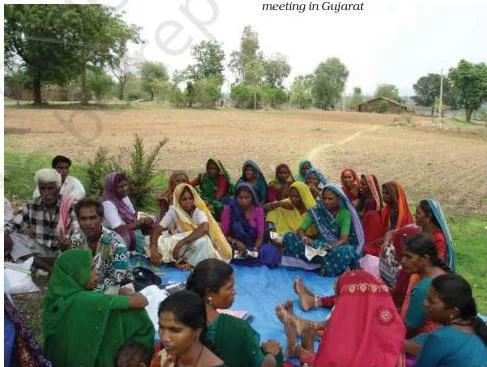
After a year or two of regular savings, the SHG becomes eligible for a bank loan in the group’s name. The collective repayment responsibility is the key: if one member defaults, the others follow up. Because the group as a whole is accountable, banks lend even without individual collateral.
Grameen Bank of Bangladesh is a model of this approach. Started in the 1970s as a small project, it had over 9 million members across 81,600 villages by 2018. Almost all borrowers are women from the poorest sections. Founder Professor Muhammad Yunus received the 2006 Nobel Peace Prize for proving that the poor are reliable borrowers when credit terms are reasonable (NCERT, p. 15).
The Grameen model inspired similar SHG movements across South Asia, including India’s NABARD-supported SHG-Bank Linkage Programme.
Worked Example: Calculating Simple Interest on a Crop Loan
Understanding the cost of credit is easier with numbers. Below is an original problem — the figures are not from NCERT, but they use the standard simple-interest formula.
Question: A farmer borrows Rs 40,000 at 8% per annum for a crop cycle of 6 months. Calculate the simple interest and total repayment.
- Step 1: Identify the given values and units. Principal \( P = \text{Rs}\ 40{,}000 \), Rate \( R = 8\% \) per annum, Time \( T = 6 \) months \( = \frac{6}{12} = 0.5 \) years.
- Step 2: Apply the simple interest formula: \( SI = \frac{P \times R \times T}{100} \).
\[ SI = \frac{40{,}000 \times 8 \times 0.5}{100} \]
\[ SI = \frac{1{,}60{,}000}{100} = \text{Rs}\ 1{,}600 \]
Step 3: Calculate total repayment by adding principal and interest.
\[ \text{Total repayment} = P + SI = 40{,}000 + 1{,}600 = \text{Rs}\ 41{,}600 \]
Final answer: The farmer pays Rs 1,600 as interest and must repay a total of Rs 41,600 after 6 months.
The lower the interest rate and shorter the duration, the cheaper the credit. Formal sector loans at 8% cost far less than moneylender loans at 36% or more — which is why expanding formal credit matters for development.
Common Mistakes Students Make in Money and Credit
These errors appear often in exam answers. Know the correct version before the test.
| Mistake | Correct Rule | How to Check |
|---|---|---|
| Thinking modern currency has intrinsic value because it is money | Paper notes have no intrinsic value; they are accepted because the government authorises them as legal tender | Ask: would this paper buy goods if the government did not back it? |
| Believing informal credit is illegal | Informal credit (moneylenders, friends, traders) is legal — it is simply unregulated by the RBI | Check: the RBI supervises only formal sources — banks and cooperatives |
| Assuming banks keep 100% of deposits as cash | Banks keep only about 5% as cash; they lend out roughly 95% to borrowers | Re-read: banks profit by lending deposits, not by locking them away in the vault |
| Confusing demand deposits with fixed deposits | Demand deposits are withdrawable on demand via cheque; fixed deposits are locked for a period | Check: can I write a cheque against this account? Only demand deposits allow that |
| Thinking all credit leads to debt traps | Credit only becomes a trap when it is high-cost and the borrower’s income fails; fair credit can boost earnings | Compare Salim (credit helped) with Swapna (credit hurt) |
Exam Notes: How CBSE Frames Money and Credit Questions
Knowing how examiners structure questions helps you prepare answers that earn full marks.
- 5-mark questions frequently ask you to analyse the role of credit for development (NCERT, Exercise Q9). A full-marks answer must show both sides: credit can increase earnings (Salim) and credit can push borrowers into a debt trap (Swapna). End with the conclusion that credit is useful only when risk is low and support exists.
- 3-mark questions commonly ask to define terms of credit or explain the SHG model (NCERT, Exercise Q6). State interest rate, collateral, documentation, and mode of repayment — and use the Megha example to illustrate collateral.
- Scenario-based questions reward students who use the Salim and Swapna examples directly. Examiners look for the borrower, the need, the risk, and the outcome in your answer. Name the source, state the situation, and conclude what happened.
- Direct definition questions appear as 1-mark or 2-mark items: define collateral, double coincidence of wants, fiat money, or demand deposits. Keep definitions to one line each.
A useful way to prepare is to attempt the chapter’s own Let’s Work These Out exercises — they cover every concept with practical comparisons. You can also check the broader Class 10 notes hub to see how this chapter fits with other Economics chapters.
Chapter Revision Recap
Here is the night-before-exam summary in bullet points.
- Double coincidence of wants: both parties must want exactly what the other offers; this is the main flaw of barter.
- Medium of exchange: money acts as an accepted middle step between sale and purchase.
- Modern currency: paper notes and coins with no intrinsic value; accepted because the government authorises them via the RBI.
- Demand deposits: bank balances withdrawable on demand; cheques make them function as money.
- Loan mechanism: banks keep ~5% as cash, lend out ~95%; profit from the difference between loan interest and deposit interest.
- Terms of credit: interest rate, collateral, documentation, and mode of repayment.
- Debt trap: a cycle of new loans to repay old ones, ending in loss of assets.
- Formal sector: banks and cooperatives; RBI-supervised; lower rates; collateral needed.
- Informal sector: moneylenders and traders; unregulated; high rates; no collateral needed.
- SHGs: 15-20 members pool savings; collective responsibility enables bank loans without individual collateral.
- Grameen Bank: 9 million members; Muhammad Yunus; 2006 Nobel Peace Prize.
For a broader view of how this connects with other chapters, see our CBSE notes section and the Sectors of the Indian Economy chapter, which explains the production structure that credit supports. You may also find the Globalisation and the Indian Economy notes useful for broader exam context.
Frequently Asked Questions
Why is modern paper money accepted when it has no intrinsic value?
Modern currency is fiat money — accepted because the government authorises it as the official medium of payment. In India, the RBI issues notes on behalf of the central government, and the law states that no one can legally refuse a rupee payment.
The paper has no value itself, but the government’s authority behind it makes everyone accept it in exchange for goods and services (NCERT, p. 3).
How do banks use my deposits to give loans to others?
Banks keep only a small fraction — about 5% — of deposits as cash reserves for daily withdrawals. They lend the remaining 95% to borrowers who need funds for business, farming, housing, or other needs. The bank charges a higher interest rate on loans than it pays on deposits. The difference is the bank’s income.
This system works because on any given day, only a few depositors withdraw money, so the bank can lend the rest without running out of cash (NCERT, p. 5).
What exactly is a debt trap, and how did Swapna fall into one?
A debt trap is a situation where a borrower takes fresh loans to repay old ones, and the debt keeps growing until assets must be sold. Swapna borrowed from a moneylender for her groundnut crop. Pests ruined the crop, so she could not repay. She borrowed again next year, but a normal harvest still did not cover the accumulated debt.
The debt became larger than her income, and she had to sell part of her land to clear it. High interest from informal lenders and crop failure combined to trap her (NCERT, p. 6).
Why can Self-Help Groups get bank loans easily when poor individuals cannot?
SHGs overcome the problem of lack of collateral. A typical SHG has 15-20 members who save and pool their money regularly. After a year or two of regular savings, the group becomes eligible for a bank loan in its own name. The collective responsibility for repayment is what banks trust: if one member defaults, the others follow up.
Because the group as a whole is accountable, banks lend even though individual members own no collateral. This is why SHGs succeed where poor individuals fail to access formal credit (NCERT, p. 13).
Reference: NCERT Class 10 Economics textbook, chapter Money and Credit.
Explore Class 10 Economics Notes
Class 10 Economics on LearnCBSE:
Related chapters:
Official source: download the NCERT textbook free from ncert.nic.in.