
These sectors of the indian economy class 10 notes help you revise every classification — primary, secondary, tertiary, organised, unorganised, public and private — along with GDP calculation, underemployment and MGNREGA for your current session board exams. The chapter teaches you to look at the economy through three lenses so you can analyse production and employment patterns.
Chapter Overview: Three Ways to Classify Economic Activities
NCERT Chapter 2 of Understanding Economic Development gives you three classification systems to make sense of the economy (NCERT, p. 18). Each system answers a different question.
| Classification | Criterion | What it tells you |
|---|---|---|
| Primary / Secondary / Tertiary | Nature of activity | How is the good or service produced? |
| Organised / Unorganised | Employment conditions | How secure and regulated is the work? |
| Public / Private | Ownership of assets | Who owns and controls the enterprise? |
The government tracks Gross Value Added (GVA) and employment figures from each sector to plan schemes, allocate budgets and identify where workers need protection. The GVA data used in the textbook comes from the Economic Survey and the employment data from the National Statistical Office (NCERT, p. 18).
This page compresses the entire chapter into notes you can revise in one sitting; for the full chapter list see our Class 10 Economics notes hub.
Primary, Secondary and Tertiary Sectors — Meaning and Chain
The first classification groups activities by the nature of the activity — how the output is produced (NCERT, p. 20).
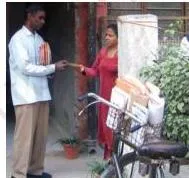
| Sector | What it does | Indian examples |
|---|---|---|
| Primary (Agriculture and related) | Produces goods by using natural resources directly | Cultivation of cotton, dairy, fishing, forestry, mining |
| Secondary (Industrial) | Changes natural products into manufactured goods | Sugar mill turning sugarcane into gur, spinning yarn from cotton, brick-making |
| Tertiary (Service) | Provides services that aid production and trade | Transport, storage, banking, communication, trade, IT |
The three sectors are interdependent. A sugarcane farmer needs the sugar mill to buy the crop; the mill needs farmers to supply cane. If transporters go on strike, urban food supply dries up and farmers cannot sell produce (NCERT, p. 20, Table 2.1).
Cotton-to-garment chain: The farmer grows cotton (primary). A factory spins yarn and weaves fabric (secondary). Trucks transport the cloth to garment shops, banks finance the trade, and shops sell the shirt to you (tertiary). One product passes through all three sectors.
How GDP Is Counted: Final Goods vs Intermediate Goods
We cannot add cars, nails and haircuts in physical units, so economists add their money values (NCERT, p. 22). To avoid double-counting, only the value of final goods and services is included.
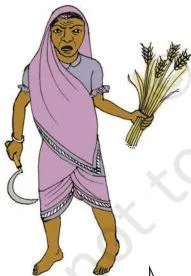
Worked example (original numbers): A farmer sells wheat for \( Rs.\ 200 \) to a miller.
The miller grinds it and sells flour for \( Rs.\ 260 \) to a bakery.
The bakery bakes bread and sells it to consumers for \( Rs.\ 350 \).
Find GDP contribution.
Step 1 — Farmer: Value added = \( 200 – 0 = Rs.\ 200 \).
Step 2 — Miller: Value added = \( 260 – 200 = Rs.\ 60 \).
Step 3 — Bakery: Value added = \( 350 – 260 = Rs.\ 90 \).
\[ \text{Total value added} = 200 + 60 + 90 = Rs.\ 350 \]
This equals the value of bread sold to the consumer.
If we had added \( 200 + 260 + 350 = 810 \) the wheat and flour would have been counted multiple times.
Final answer: GDP contribution is \( Rs.\ 350 \) — counted once, at the final-good stage.
Key definitions
- Intermediate goods: goods used up while making the final good (wheat, flour here).
- Final goods: goods that reach the consumer (bread here).
- GDP: the value of all final goods and services produced within a country during a particular year (NCERT, p. 22).
- GVA: the government’s newer measure that adjusts sector contribution for taxes and subsidies (NCERT, p. 22).
Rising Importance of the Tertiary Sector in India
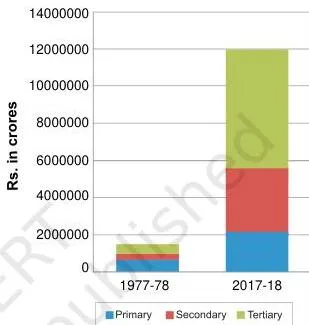
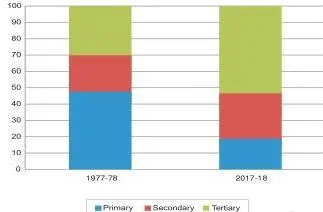
Graph 1 shows GVA for 1977–78 and 2026-27. Over forty years all three sectors grew, but the tertiary sector grew the most and replaced the primary sector as the largest producing sector by 2026-27 (NCERT, p. 24).
Four reasons the service sector grew:
- Basic services — hospitals, schools, courts, police, banks, defence — require government provision in a developing country (NCERT, p. 24).
- Development of primary and secondary sectors raises demand for transport, storage, trade and banking.
- Rising incomes make people demand more services like tourism, eating out and private schools.
- New IT-based services — call centres, software companies, ATM booths — grew rapidly in the last decade.
However, not all of the service sector is growing equally. At one end a few jobs need highly skilled workers; at the other a large mass of small shopkeepers and repair persons barely earn a living because no alternative work exists (NCERT, p. 25).
Where Are Most People Employed? Underemployment Explained
Here is the paradox: the tertiary sector has the largest GVA share, but the primary sector still employs the most people — over half the workforce — producing only about one-sixth of GVA (NCERT, p. 25).
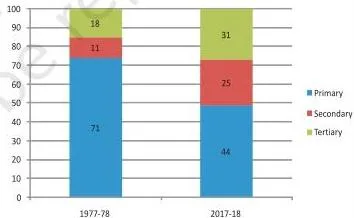
Industrial output rose more than nine times but industry employment rose only around three times; service output rose 14 times but service employment rose only around five times (NCERT, p. 25). Not enough jobs were created outside agriculture.
Underemployment means people are apparently working but less than their potential. Disguised unemployment is the hidden form: remove a few workers and total output does not fall.
Rural example (Laxmi, in original phrasing): Laxmi’s family of five works a two-hectare unirrigated plot all year because they have nowhere else to go. Their labour effort is divided; no one is fully occupied. If two members move to a factory, farm output stays the same and family income rises — proof they were underemployed (NCERT, p. 25).
Urban example: A painter or plumber searching for daily work may find jobs only some days. A street vendor pushing a cart all day earns very little and has no alternative — underemployment hidden in the service sector.

Students revising Development Class 10 notes will recall that income and quality of employment together determine real development.
How to Create More Employment: Irrigation, Agro-mills and MGNREGA
The chapter lists several employment generation strategies a student must reproduce (NCERT, pp. 27–28):
- Irrigation and wells — a well lets a farmer grow a second crop, employing more family labour.
- Cheap rural credit from banks so farmers buy seeds and fertiliser in time instead of borrowing from moneylenders.
- Transport and storage — better roads and godowns let farmers sell surplus at good prices, creating transporting and trading jobs.
- Agro-based mills in semi-rural areas — dal mills, cold storages, honey collection centres, vegetable processing units.
- Tourism, regional crafts and IT services — every region has potential with planning support.
- Schools and health centres — recruiting teachers, nurses and doctors generates employment and raises human development.
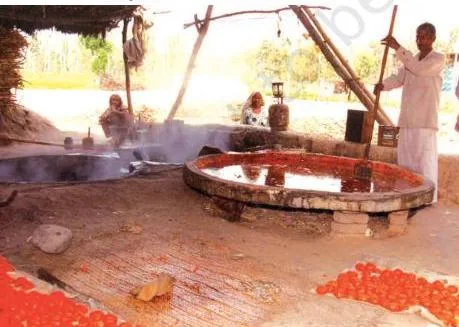
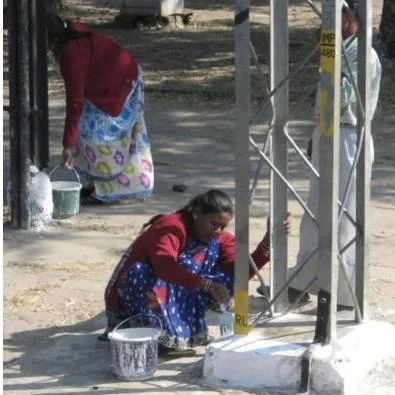
MGNREGA 2005 and Viksit Bharat-G RAM G 2025
The Union Government passed the Mahatma Gandhi National Rural Employment Guarantee Act, 2005 (MGNREGA 2005) to implement the Right to Work in about 625 districts (NCERT, p. 28). Key features:
- Guarantees 100 days of employment per year per rural household for those able to and in need of work.
- If the government fails to provide work it must pay an unemployment allowance.
- Priority is given to work that increases production from land.
- In 2025 this Act was replaced by Viksit Bharat-G RAM G 2025 (NCERT, p. 28).
For the credit angle you will study next, see our Money and Credit Class 10 notes.
Organised vs Unorganised Sector: Kanta and Kamal Compared
This classification looks at conditions of work (NCERT, p. 30). Kanta works in an office with a salary letter and benefits; her neighbour Kamal is a daily wage labourer in a grocery shop with no security. Their situations define the two sectors.
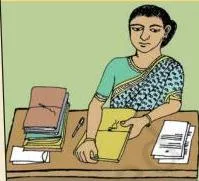
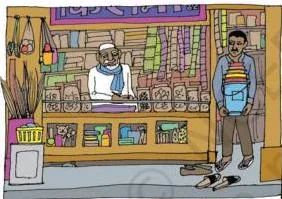
| Feature | Organised (Kanta) | Unorganised (Kamal) |
|---|---|---|
| Job security | Assured work, cannot be removed at will | Can be asked to leave anytime |
| Working hours | Fixed hours; overtime paid extra | Long hours, no overtime pay |
| Paid leave / holidays | Yes, including Sundays | No paid holidays |
| Provident fund / gratuity / pension | Provided as per law | Not provided |
| Appointment letter | Given at joining | No formal letter |
| Government registration | Registered; must follow laws like Factories Act | Largely outside government control |
| Medical and safe working environment | Legally ensured by employer | No guarantee |
Even some organised firms hire workers through the unorganised route to evade taxes and labour laws, so a worker may lose a regular job and be forced back into the unorganised sector (NCERT, p. 31).
Protecting Workers in the Unorganised Sector
Most Indian workers are in the unorganised sector and need protection (NCERT, p. 32).
| Rural vulnerable groups | Urban vulnerable groups |
|---|---|
| Landless agricultural labourers, small and marginal farmers, sharecroppers, artisans (weavers, blacksmiths, carpenters, goldsmiths) | Casual construction workers, small-scale industry workers, street vendors, headload workers, garment makers, rag pickers |
Nearly 80 per cent of rural households are small or marginal farmers who need seeds, credit, storage and marketing support (NCERT, p. 32).
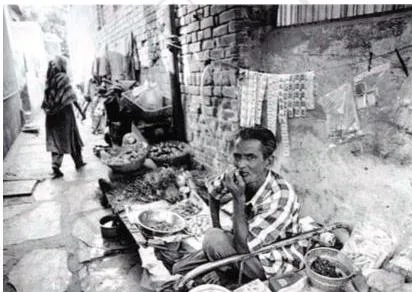
Social justice angle: A majority of workers from scheduled castes, tribes and backward communities are in the unorganised sector. They face both low irregular wages and social discrimination, so protection is necessary for both economic and social development (NCERT, p. 32).
Public vs Private Sector: Who Owns the Assets
This classification is based on ownership of assets (NCERT, p. 33).
| Feature | Public sector | Private sector |
|---|---|---|
| Ownership | Government owns most assets | Private individuals or companies |
| Motive | Public welfare, not mainly profit | Profit motive |
| Funding | Taxes and government revenue | Private investment and sales |
| Examples | Indian Railways, post office | TISCO, Reliance Industries Limited |
Three reasons the government must act:
- Reasonable cost: the private sector will not provide roads, bridges, railways, harbours or electricity at affordable rates; collecting money from thousands of users is not feasible (NCERT, p. 33).
- Support to key activities: the government supplies electricity at rates industries can afford, bearing part of the cost; it buys wheat and rice at fair prices and sells through ration shops to support farmers and consumers.
- Primary responsibility for health and education: running proper schools, providing quality elementary education, health facilities, safe drinking water, housing and nutrition — and caring for the poorest regions — is the government’s duty.
Key Definitions Table
| Term | Meaning | Example |
|---|---|---|
| Primary sector | Activities using natural resources directly | Cotton cultivation, dairy, fishing |
| Secondary sector | Natural products changed through manufacturing | Sugar from sugarcane, cloth from cotton |
| Tertiary sector | Activities producing services that aid production | Transport, banking, communication |
| Intermediate goods | Goods used up in making the final good | Wheat, flour (when making bread) |
| Final goods | Goods and services that reach the consumer | Bread sold to consumer |
| GDP | Value of all final goods and services produced within a country in a year | India’s total GDP for 2026-27 |
| GVA | Contribution of sectors adjusted for taxes and subsidies | Used by government for sector shares |
| Underemployment | People working but less than their potential | Laxmi’s five family members on one plot |
| Disguised unemployment | Hidden underemployment — removing a worker does not reduce output | Surplus labour on a small farm |
| Organised sector | Registered enterprises with regular terms of employment | Kanta’s office job |
| Unorganised sector | Small scattered units outside effective government control | Kamal’s grocery shop job |
| Public sector | Government owns assets and provides services | Indian Railways, post office |
| Private sector | Ownership and delivery by private individuals or companies | TISCO, Reliance Industries Limited |
| MGNREGA 2005 | Law guaranteeing 100 days of work per year to rural households; replaced by Viksit Bharat-G RAM G 2025 | Digging wells, building canals |
Common Mistakes Students Make in This Chapter
| Mistake | Correct rule | How to check |
|---|---|---|
| Students count the value of flour and bread separately in GDP. | Count only the final good (bread) because the value of flour is already included. | Add total value added at each stage and confirm it equals the final sale price. |
| Students assume the tertiary sector is the largest employer in India. | The primary sector still employs the most people even though tertiary has the largest GVA share. | Recall Graph 3 data: primary still over half the workforce. |
| Students write MGNREGA guarantees one year of permanent work. | It guarantees 100 days of employment per rural household per year. | Check: 100 days per household per year — and unemployment allowance if government fails. |
| Students state the criterion after giving examples. | State the criterion of classification first, then give examples. | Board rubric: name the criterion in the first sentence of the distinction. |
Exam Notes: What the Board Expects
- 5-mark questions often ask to distinguish organised vs unorganised (Q16) or explain disguised unemployment with a rural and urban example (Q10, Q11). A full-marks answer states the criterion first, gives a comparison table, and provides one rural and one urban example.
- 3-mark questions frequently ask why the tertiary sector is growing (Q12) or why public sector presence is necessary (Q20). Four numbered reasons for tertiary growth earn all marks.
- 1-mark sections include fill-in-the-blanks (Q1 — terms like interdependent, organised, natural and manufactured) and match-the-following (Q3 — farming problems to measures).
- Numerical: Q24 asks to calculate sector shares from GVA data and draw a bar diagram; the value-added method is the skill tested.
- Always write the criterion of classification before examples — this single step earns the first mark in any distinction question.
The full exercise set runs from pages 35–37 of the textbook; these Class 10 notes cover the concepts needed to solve them.
Revision Recap: One-Page Snapshot
| Classification | Types | Key point |
|---|---|---|
| By nature of activity | Primary, Secondary, Tertiary | Tertiary has largest GVA share; sectors are interdependent |
| By employment conditions | Organised, Unorganised | Most workers in unorganised sector and need protection |
| By ownership | Public, Private | Government provides public goods private sector will not at reasonable cost |
- Primary sector is still the largest employer even though its GVA share has fallen.
- Tertiary sector contributes the most to GVA but does not employ most people.
- Only final goods are counted in GDP to avoid double counting; total value added equals the final sale value.
- Unorganised sector workers need protection — rural and urban, with a social justice angle for SC, ST and backward communities.
- The government provides public goods like roads, electricity, health and education that the private sector will not supply at reasonable cost.
Frequently Asked Questions on Sectors of the Indian Economy
Why does the primary sector still employ the most people in India even though its share in GDP has fallen?
Not enough jobs were created in the secondary and tertiary sectors to absorb surplus farm workers. Industrial output rose more than nine times but industry employment rose only around three times, and service output rose 14 times but service employment rose only around five times (NCERT, p. 25). So over half the workforce remains in agriculture, much of it underemployed.
What is the difference between GDP and GVA in simple terms?
GDP is the total value of all final goods and services produced within a country in a year. GVA measures the contribution of each sector after adjusting for taxes and subsidies, giving a clearer sector-wise picture. The Indian government now reports sector shares using GVA to match global practice (NCERT, p. 22).
How is disguised unemployment different from open unemployment?
In open unemployment a person has no job and is clearly visible as jobless. In disguised unemployment a person appears to be working but contributes so little that removing them does not reduce total output — their labour effort is divided among too many people (NCERT, p. 25).
Why does the government need to run schools and hospitals if the private sector also provides them?
Providing health and education for all is the primary responsibility of the government. The private sector will not provide these at a reasonable cost or reach the poorest regions; India still has a large illiterate population and high malnutrition and infant mortality. Public provision ensures equitable access and human development (NCERT, p. 33).
What kind of work is given priority under MGNREGA 2005?
Work that in future helps increase production from land is given preference — for example, digging wells, constructing canals, building rural roads and water conservation structures (NCERT, p. 28).
You can cross-reference the original chapter at the official NCERT page for Chapter 2 or browse more CBSE notes on our site.
Reference: NCERT Class 10 Understanding Economic Development textbook, chapter Sectors of the Indian Economy.
Explore Class 10 Economics Notes
Class 10 Economics on LearnCBSE:
Related chapters: