
These outcomes of democracy class 10 notes revise Chapter 5 of Democratic Politics II for the current academic session. The chapter moves from theory to evidence: it asks what a democracy actually delivers for citizens in practice, comparing those results with dictatorships across governance, economy, society, and individual dignity.
Most people support democracy in principle but feel let down by how it works in practice. This page turns that gap into a clear, exam-ready revision framework — definitions, data tables, a worked example, common mistakes, and a memory device — so a student revising the night before can recall the full argument quickly.
Introduction: The Expectation vs. Reality Dilemma
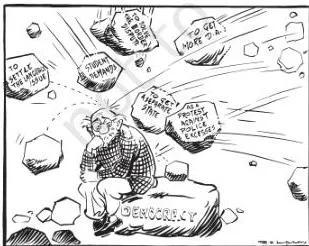
As the textbook’s overview notes, we must move beyond specific themes and ask a general question: what does democracy do, and does it fulfil our expectations in real life? (NCERT, p. 1) Democracy is widely preferred over monarchy, military rule, or religious rule, yet people are often dissatisfied with the democracy they actually live in.
This creates the chapter’s central tension: democracy is good in principle but felt to be not so good in its practice (NCERT, p. 2). Students must be able to explain why we support democracy — for moral reasons (it promotes equality and dignity) and for prudential reasons (it is better suited to resolving conflicts and correcting mistakes).
One fact must anchor the whole chapter: democracy is just a form of government. It can only create conditions for achieving goals; citizens must take advantage of those conditions to achieve them.
Chapter Overview: What to Expect from This Unit
The chapter assesses five major outcomes. A student revising Class 10 Civics should mentally organise the revision around these points:
- Accountable, responsive, and legitimate government — citizens can choose and control their rulers.
- Economic growth and development — does democracy guarantee higher wealth?
- Reduction of inequality and poverty — is wealth distributed fairly?
- Accommodation of social diversity — can diverse groups live peacefully?
- Dignity and freedom of citizens — does democracy advance individual respect?
For a broader view of the syllabus, you can browse our complete Class 10 Civics notes or the wider Class 10 notes collection. This chapter builds directly on the structures discussed in our notes on Federalism and Political Parties, since both institutions determine how accountable a government is in practice.
Key Concepts: Mapping Democracy’s Outcomes
When building the argument conceptually, the teaching order starts with how a government is held to account and ends with how a citizen is treated. This mirrors the logic a teacher would use in a classroom.
Accountability and Responsiveness: The most basic outcome of democracy is producing a government that is accountable to citizens and responsive to their needs (NCERT, p. 3). Because democracy relies on deliberation and negotiation in assemblies, it takes more time to make decisions.
A dictator can bypass public opinion, making a dictatorship faster — but because a democratic government follows procedures, its decisions are more widely accepted and ultimately more effective. The cost of time is worth paying.
Transparency and Legitimacy: A citizen has the right to examine whether a decision followed correct norms and procedures. This is known as transparency, a factor often missing in non-democratic governments (NCERT, p. 3). Democracies have a mixed record on transparency and corruption, but they hold one unbeatable advantage: they are legitimate.
Because people elect their own rulers, there is overwhelming support for democracy globally, even in countries without a democratic regime.
Economic Record: Evidence over 50 years shows dictatorships have a slightly higher rate of economic growth overall (NCERT, p. 5). However, the difference is negligible in poor countries, so growth alone is not a reason to reject democracy. Economic development depends on several factors like a country’s population size, global situation, and economic priorities.
Handling Social Divisions: Democracies reduce the possibility of social tensions becoming violent by developing procedures to conduct competition (NCERT, p. 8). Non-democratic regimes often suppress these differences. Belgium successfully negotiated differences, while Sri Lanka serves as a warning of what happens when conditions for diversity are ignored.
Dignity and Freedom: Democracy stands superior in promoting the dignity of the individual. For societies historically built on subordination, recognising equality is a slow process. Long struggles by women and marginalised castes have created sensitivity today, providing the legal and moral basis to fight against discrimination (NCERT, p. 9).
Definitions in Plain Language
Students often lose marks because they repeat textbook phrases without showing understanding. Memorise these plain-word definitions instead.
| Term | Meaning | Example / Significance |
|---|---|---|
| Accountability | The government must answer to the people for its actions and decisions. | Regular, free elections allow citizens to remove non-performing rulers. |
| Responsiveness | The government must be attentive to the needs and demands of the people. | A democratic government is expected to aid citizens during a natural disaster. |
| Legitimacy | The right to rule based on the consent of the governed, not force. | Massive public support across South Asia proves democracy is the accepted form of rule. |
| Transparency | The citizen’s right and means to examine the process of decision-making. | The Right to Information (RTI) Act allows citizens to check official procedures. |
| Deliberation | Debating and negotiating decisions in assemblies before passing them. | Parliamentary debates on a new bill delay action but improve public acceptance. |
Summary Table: Democracy vs. Dictatorship Outcomes
The debate on the outcomes of democracy class 10 notes can and should be resolved using evidence. The table below summarises a direct comparison between democratic and dictatorial regimes, based on the textbook’s findings (NCERT, p. 5–8).
| Indicator | Democracy | Dictatorship |
|---|---|---|
| Decision Speed | Slower, based on deliberation and negotiation. | Very fast; ignores public opinion and assembly majorities. |
| Economic Growth (1950–2000) | Avg. 3.95% growth rate. | Avg. 4.42% growth rate (slightly better record overall). |
| Growth in Poor Countries | 4.28% growth rate. | 4.34% growth rate (virtually negligible difference). |
| Income Inequality Record | High inequality in many democracies (e.g., South Africa). | No evidence that they distribute wealth more equally than democracies. |
| Legitimacy | High; people’s own government, supported across the world. | Low; rule by force or military power. |
| Handling Social Diversity | Develops procedures to negotiate differences, reducing violence. | Often suppresses or ignores internal social differences. |
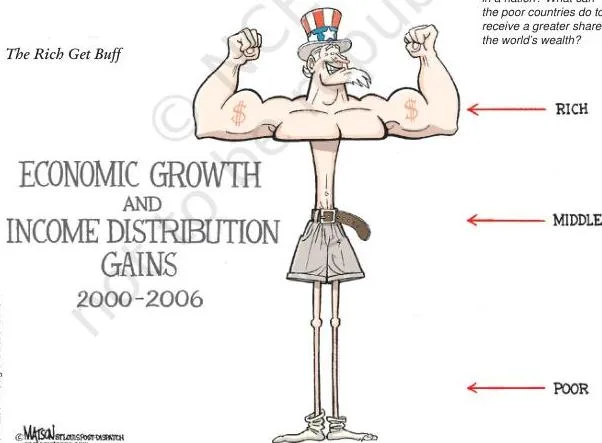
The Rich Get Buff cartoon below captures the chapter’s critique of economic outcomes: while nations grow richer, the gains are often hoarded by the already wealthy, leaving weaker sections behind.
Economic Growth and Inequality: The Data Story
The textbook urges students to look at facts and figures (NCERT, p. 6). Table 1 proves that dictatorships have a slightly better record on economic growth (4.42% vs 3.95%). But in poor countries, the difference is negligible (4.34% vs 4.28%). Therefore, a democracy is not a guarantee of economic development, but it does not lag behind dictatorships either.
Table 2 reveals a darker truth: income inequality within democracies. In democratic countries like South Africa and Brazil, the top 20% of the population takes away more than 60% of the national income, leaving less than 3% for the bottom 20%. Countries like Denmark and Hungary are much better at distributing wealth, proving that democratic politics can achieve equality if the right priorities are adopted.
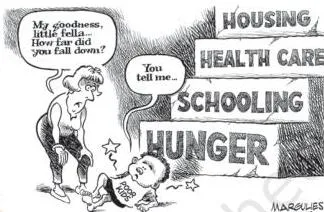
Democracies are based on political equality — every individual has equal weight in electing representatives. Yet, in actual life, a small number of ultra-rich enjoy a disproportionate share of wealth. The cartoon below visualises this reality: growing economic disparities frustrate the needs of the poor.

The poor constitute a large proportion of voters, and no party wishes to lose their votes. Yet, democratically elected governments are not as keen to address the question of poverty as one would expect.
Accommodating Social Diversity: Two Conditions
It is fair to expect a democracy to produce a harmonious social life. Democracies develop procedures to conduct competition, reducing the possibility of tensions becoming explosive (NCERT, p. 8). No society can permanently resolve conflicts, but democracy allows citizens to respect differences and negotiate them.
The example of Belgium shows successful negotiation, while Sri Lanka reminds us of the dangers of ignoring diversity.
A democracy must fulfil two conditions to successfully handle social differences:
- Majority and minority opinions are not permanent: The majority must always work with the minority so that the government represents the general view, not just one faction.
- Rule by majority is not rule by majority community: Rule by majority means that different persons and groups can form a majority at different times. It is not rule by a specific religious, racial, or linguistic group based on birth.
If someone is barred from being in the majority on the basis of birth, democratic rule ceases to be accommodative for that group. The Enemies cartoon below shows the explosive outcome when majorities ignore minorities.


Dignity and Freedom: The Ongoing Examination
Democracy stands superior to any other form of government in promoting dignity and freedom of the individual. The passion for respect and freedom is the basis of democracy (NCERT, p. 9). For societies historically built on subordination and domination, recognising equality is not simple.
Consider the dignity of women. Long struggles have created sensitivity that equal treatment of women is a necessary ingredient of a democratic society. While instances of disrespect still exist, the principle is now recognised. Once the principle has legal and moral force, it becomes easier to wage a struggle against what is unacceptable.
The same is true of caste inequalities in India. Democracy has strengthened claims of disadvantaged castes for equal status. Instances of caste-based atrocities still lack moral and legal foundations.
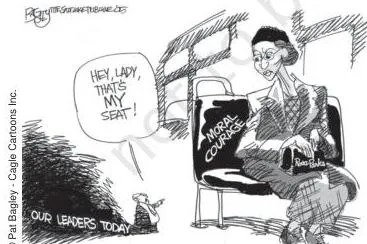
Democracy’s examination never gets over. As people get some benefits, they ask for more. When people complain about the way democracy functions, it is a testimony to the success of democracy. It shows that people have developed awareness and the ability to look critically at power holders.
Public dissatisfaction transforms people from the status of a subject into that of a citizen. The Rosa Parks cartoon below illustrates this ongoing struggle for dignity.

Worked Example: Application-Based Question Practice
Five-mark application questions ask students to connect democratic principles to real-world scenarios. Here is an original example and a stepwise structure for a full-marks answer.
Question: How does the Right to Information (RTI) Act strengthen democratic accountability? Analyse using the case of Sunita, a farmer in Rajasthan.
Step 1: State the core principle.
Accountability means the government must answer to citizens for its actions.
The RTI Act provides a mechanism for citizens to examine the process of decision-making, ensuring transparency.
Step 2: Introduce the scenario.
Sunita applied for a drought-relief subsidy under a government scheme three months ago.
Her file sat untouched with local officials, and no one would give her a status update, mirroring the frustration faced by Nannu in the NCERT textbook.
Step 3: Explain the action taken.
Using transparency laws, Sunita filed an RTI application asking for the daily progress on her file, the names of officials responsible, and the action to be taken against them for inaction.
Step 4: Conclude with the impact.
The fear of public accountability forced the officials to process her file immediately.
The RTI Act transforms a citizen from a passive subject into an active participant, holding rulers accountable and making the government responsive to the needs and expectations of the people.
Final answer: The RTI Act strengthens democratic accountability by making the decision-making process transparent, forcing officials to answer to citizens, and providing the legal means to investigate administrative inaction.
Common Mistakes: Misreading Democracy’s Outcomes
Examiners regularly find students making the following errors. Reviewing these error-to-correction pairs will secure your marks.
| Mistake | Correct Rule / Explanation |
|---|---|
| Students write that democracy guarantees higher economic growth. | Dictatorships have a slightly better record (4.42% vs 3.95%). The advantage of democracy lies elsewhere, not in pure growth numbers. |
| Students say majority rule means rule by the majority community. | Majority means different persons and groups forming a majority at different times, not a permanent religious or linguistic majority group. |
| Students think public complaints show democracy has failed. | Complaints are a testimony to the success of democracy. They show citizens have the awareness to expect and to look critically at power holders. |
| Students claim democracies have successfully eliminated economic inequalities. | Democracies have not eliminated economic inequalities. In South Africa and Brazil, the top 20% take away more than 60% of national income. |
Exam Notes: How CBSE Frames This Chapter
Questions from this chapter often ask you to support or oppose assertions (e.g., the textbook’s Exercise Q3). To score full marks, your answer must take a clear stance and back it with evidence from the chapter.
- Cite specific data: Writing the growth rate figures (3.95% vs 4.42%) or inequality percentages (top 20% taking 60%+) earns the evidence mark. A vague answer without data loses marks.
- Name a specific country: Using Belgium or Sri Lanka for social diversity, or South Africa and Denmark for inequality, provides the concrete example examiners look for.
- The Dignity and Freedom section is a frequent source of 3-mark questions. Be prepared to explain why the principle of legal and moral recognition helps women and marginalised castes.
- Application-based 5-mark questions based on the Right to Information (RTI) Act (like the Nannu case study) test your understanding of transparency. State the mechanism and its impact on officials clearly.
Memory Device: The ARLED Framework
Memory device: ARLED is a mnemonic to recall the five main outcomes of democracy in exam order.
- A — Accountability of government to the citizens.
- R — Responsiveness to the needs and expectations of the people.
- L — Legitimacy as a government elected by the people themselves.
- E — Economic growth and development (a mixed but acceptable record).
- D — Diversity and the accommodation of social differences.
When answering a 5-mark question asking what democracy delivers, tick off each letter of ARLED to ensure your answer is complete and covers all the essential outcomes taught in the chapter.
Revision Summary: One-Glance Recap
For the night-before exam student, here is the tight, scannable recap of the entire chapter based on the five outcomes of democracy class 10 notes framework. For a broader perspective, you can also review our main CBSE notes hub.
- Accountable & Legitimate Government: Slower due to deliberation, but decisions are more accepted. It is the people’s own government, giving it overwhelming legitimacy over dictatorships.
- Economic Growth: Dictatorships have a slightly higher rate (4.42% vs 3.95%). In poor countries, the difference is negligible (4.34% vs 4.28%). Growth alone is not a reason to reject democracy.
- Inequality & Poverty: Democracies have not reduced economic inequalities successfully. The top 20% often controls over 60% of wealth, leaving less than 3% for the bottom 20%.
- Social Diversity: Democracies accommodate differences via procedures. Conditions: majority must work with minority, and majority rule must not mean rule by one majority community based on birth.
- Dignity & Freedom: Promotes the dignity of women and marginalised castes. The ability to complain is a sign of a successful, self-correcting democracy.
Frequently Asked Questions on Outcomes of Democracy
Why is democratic government considered a legitimate government?
A democratic government is legitimate because it is elected by the people themselves. Unlike a dictatorship, it is people’s own government. This gives it an overwhelming support base across the world, as people wish to be ruled by representatives they have elected.
What are the two conditions a democracy must fulfil to accommodate social diversity?
First, the majority must always work with the minority to represent the general view, as opinions are not permanent. Second, rule by majority must not become rule by a majority community in terms of religion, race, or linguistic group; different persons and groups must be able to form a majority at different times.
Do democracies have a better economic growth rate than dictatorships?
No, dictatorships have a slightly better record of economic growth overall. Between 1950 and 2000, the average growth rate for all democratic regimes was 3.95%, while for dictatorial regimes it was 4.42%. However, in poor countries, the difference is negligible (4.28% vs 4.34%).
Why are economic inequalities considered a failure of democracy?
Democracies are based on political equality, but they have not been successful in reducing economic inequalities. A small number of ultra-rich enjoy a disproportionate share of wealth, and in countries like South Africa and Brazil, the top 20% take away more than 60% of national income, leaving very little for the bottom 20%.
What is the significance of public complaints in a democracy?
Public complaints are a testimony to the success of democracy. They show that people have developed awareness and the ability to expect and look critically at power holders. A public expression of dissatisfaction transforms people from the status of a subject into that of a citizen.
How does the Right to Information Act make democracy more accountable?
The Right to Information (RTI) Act provides citizens with the right and the means to examine the process of decision-making. By allowing people to ask for the daily progress of their applications and the names of officials responsible for delays, the RTI Act ensures transparency and forces the government to be responsive to the needs of its citizens.
Reference: NCERT Class 10 Democratic Politics II textbook, chapter Outcomes of Democracy. You can refer to the official NCERT textbook page for the source material.
Explore Class 10 Civics Notes
Class 10 Civics on LearnCBSE:
Related chapters: