
These Political Parties class 10 notes cover Chapter 4 of the Democratic Politics-II textbook for the current academic session. The notes explain why every modern democracy needs political parties, how different party systems work, how the Election Commission of India recognises national and state parties, the four challenges parties face, and the reforms being attempted.
Use them as a one-stop revision guide for your Civics board exam.
Why Democracies Need Political Parties
A political party is a group of people who come together to contest elections and hold power in the government. Members agree on certain policies and programmes aimed at promoting the collective good. Since people differ on what is good for society, parties try to persuade voters that their policies are better than those of their rivals (NCERT, p. 47).
Parties reflect fundamental political divisions within a society. They are identified by which part of society they stand for, which policies they support, and whose interests they uphold. This involvement is called partisanship.
A partisan is a person strongly committed to a party or group, marked by a tendency to take a side and an inability to take a balanced view on an issue (NCERT, p. 48).
Every political party has three core components:
- Leaders: those who control and direct party strategy and occupy key decision-making roles.
- Active members: the cadre who organise campaigns, mobilise supporters, and execute the party’s programme.
- Followers: ordinary citizens who support and vote for the party.

The Seven Functions of Political Parties
Parties fill political offices and exercise power by performing seven key functions (NCERT, pp. 47-48):
- Contesting elections: In most democracies, elections are fought among candidates put up by parties.
- Forming policies and programmes: A party reduces a vast multitude of public opinions into a few basic policy positions, giving direction to governance.
- Making laws: Since most legislators belong to a party, they follow the party leadership’s direction when laws are debated and passed.
- Forming and running governments: Parties recruit and train leaders, and place them in the executive to run the government.
- Playing the opposition role: Losing parties voice different views, criticise government failures, and mobilise opposition.
- Shaping public opinion: Parties raise and highlight issues, launch movements, and help crystallise public opinion.
- Providing access to welfare schemes: For an ordinary citizen, approaching a local party leader is easier than approaching a government officer.
Why Democracies Cannot Exist Without Parties
Modern large societies need representative democracy. As societies grew complex, they needed an agency to gather different views and present them to the government, to bring representatives together to form a responsible government, and to support or restrain the government. Political parties fulfill these needs (NCERT, p. 49).
Imagine an election where every candidate is independent. No candidate could promise major policy changes because a single individual cannot implement a policy agenda. The government may form, but its direction would remain uncertain. Representatives would be accountable to their constituency for local matters, but no one would be collectively responsible for how the country is run.
This is why every representative democracy has parties — they are a necessary condition for democracy.
Types of Party Systems: One, Two, and Multi-Party
How many major or effective parties are good for a democracy? The answer depends on a country’s social and regional divisions, its political history, and its electoral system. Party systems evolve over time; they are not chosen overnight (NCERT, p. 51).
The Three Party Systems Compared
The following comparison table consolidates the definitions, examples, and key advantages and disadvantages of each system into one revision block.
| System | Meaning | Example | Advantage | Disadvantage |
|---|---|---|---|---|
| One-Party System | Only one party is allowed to control and run the government. | China (Communist Party) | Decisions can be made without conflict. | Not a democratic option; no free competition for power. |
| Two-Party System | Power usually changes between two main parties; other parties may win a few seats. | USA, United Kingdom | Stability; clear choice between two alternatives. | Limits the range of opinions that get political representation. |
| Multi-Party System | Several parties compete; more than two have a reasonable chance of coming to power, singly or in alliance. | India | Allows a variety of interests and opinions to enjoy political representation. | Often appears messy; can lead to political instability. |
Alliances and Coalitions
In a multi-party system, several parties often join hands for contesting elections and winning power. This is called an alliance or a front. For example, in the 2004 parliamentary elections in India, three major alliances competed: the National Democratic Alliance (NDA), the United Progressive Alliance (UPA), and the Left Front (NCERT, p. 51).
India has a multi-party system because its social and geographical diversity cannot be absorbed by two or even three parties. No system is ideal for all countries and all situations.
National and State Political Parties in India
India is a federal democracy, so it has two kinds of parties: those present in only one federal unit (state parties) and those present in several or all units (national parties). Every party must register with the Election Commission of India.
The Commission treats all parties equally, but it offers special facilities to large and established parties, such as a unique election symbol. These are called recognised political parties (NCERT, p. 53).
Election Commission Recognition Criteria
Recognition depends on the proportion of votes and seats a party secures. For the exact and updated criteria, students can refer to the official Election Commission of India portal, but the NCERT textbook lays down the following benchmarks (NCERT, p. 53).
| Party Type | Vote Share Criterion | Seat Criterion |
|---|---|---|
| State Party | At least 6% of total votes in a Legislative Assembly election. | Wins at least 2 seats in that state’s Assembly. |
| National Party | At least 6% of total votes in Lok Sabha elections OR Assembly elections in 4 States. | Wins at least 4 seats in the Lok Sabha. |

Six Recognised National Parties (as per ECI 2023 notification)
According to the textbook, there are six recognised national parties in the country (NCERT, pp. 53-55). The table below summarises their year of formation and core ideology for quick revision.
| Party | Year Formed | Core Ideology / Focus |
|---|---|---|
| Aam Aadmi Party (AAP) | 2012 | Accountability, clean administration, transparency, and good governance. Emerged from the anti-corruption movement. |
| Bahujan Samaj Party (BSP) | 1984 | Represents and secures power for the bahujan samaj (dalits, adivasis, OBCs, religious minorities). Founded by Kanshi Ram. |
| Bharatiya Janata Party (BJP) | 1980 | Cultural nationalism (Hindutva), integral humanism, uniform civil code, and a strong modern India. |
| Communist Party of India – Marxist (CPI-M) | 1964 | Marxism-Leninism; supports socialism, secularism, and democracy; opposes imperialism and communalism. |
| Indian National Congress (INC) | 1885 | Centrist party; secularism, welfare of weaker sections and minorities, and new economic reforms with a human face. |
| National People’s Party (NPP) | 2013 | Education and employment for all; empowerment of all sections; first national party from North East India. |
State Parties: Not Always Regional in Ideology
Misconception Autopsy: A common error is to assume that every State party (commonly called a regional party) is narrow in its ideological outlook. The textbook explicitly states that these parties need not be regional in their ideology or outlook (NCERT, p. 55).
For example, the Samajwadi Party and the Rashtriya Janata Dal have national-level political organisations with units in several states. They are classified as State parties by the Election Commission because they have succeeded in winning seats in specific states, not because their ideology is confined to one region.
In contrast, parties like the Biju Janata Dal or the Mizo National Front are more conscious of their specific state identity.
Over the last three decades, the number and strength of State parties has expanded. This made Parliament more diverse. No single national party was able to secure a majority on its own in the Lok Sabha until 2014.
As a result, national parties formed alliances with State parties, and nearly every State party got a chance to be part of a coalition government at the centre since 1996. This has contributed to the strengthening of federalism and democracy in our country (NCERT, p. 55).
Popular Participation and Trust in Parties
People often say that parties are unpopular and citizens are indifferent to them. Survey evidence from India shows this belief is only partly true (NCERT, p. 52):
- Low trust: Political parties do not enjoy much trust among people in South Asia. The proportion of people who say their trust is ‘not much’ or ‘not at all’ is higher than those who have ‘some’ or ‘great’ trust. Parties are among the least trusted institutions worldwide.
- High participation: Despite low trust, the level of participation in party activities is fairly high. The proportion of people who say they are members of a political party is higher in India than in many advanced countries like Canada, Japan, Spain, and South Korea.
- Rising membership: Over the last three decades, the proportion of those reporting party membership in India has gone up steadily. The proportion of those who say they feel ‘close to a political party’ has also risen.
This shows an objective picture: even though people are critical of parties, they continue to engage with them, making them an active and necessary part of democratic life.
Challenges Facing Political Parties
Popular dissatisfaction with parties focuses on four major problem areas. These challenges must be understood using the exact terms examiners look for (NCERT, pp. 57-58).
- Lack of internal democracy: Power concentrates in one or a few leaders at the top. Parties fail to keep membership registers, hold organisational meetings, or conduct internal elections regularly. Ordinary members lack the means to influence decisions, and personal loyalty to the leader becomes more important than loyalty to party principles.
- Dynastic succession: Since parties lack open and transparent procedures, very few ways exist for an ordinary worker to rise to the top. Leaders favour people close to them or their own family members. This is unfair to other members and bad for democracy, as people without adequate experience or popular support occupy positions of power.
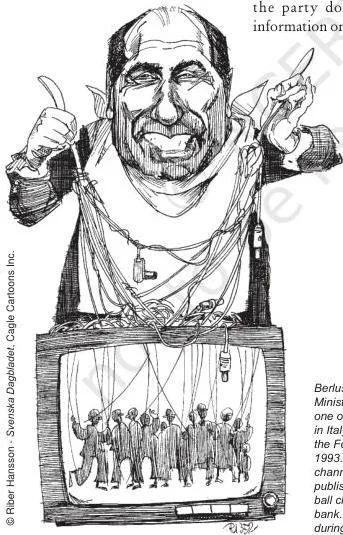
- Money and muscle power: Parties focus on winning elections at any cost. They tend to nominate candidates who can raise large sums of money, which gives rich people and companies influence over party policies. In some cases, parties support criminals who can win elections. This undermines the democratic character of elections.
- Lack of meaningful choice to voters: To offer a meaningful choice, parties must be significantly different. In recent years, ideological differences among parties have declined in many parts of the world. If major parties agree on most fundamental aspects, voters who want genuinely different policies have no real option.
Exam Tip: Do not confuse lack of internal democracy with a lack of democracy in the country. The challenge is about how parties manage themselves internally, not the democratic nature of the nation itself.
How Can Political Parties be Reformed?
Reforming parties is difficult because the final decision-makers are party leaders, and people can only replace them with another set of party leaders. Despite this, some efforts and suggestions have been made (NCERT, pp. 59-60).
Recent Efforts (Already Implemented)
- Anti-Defection Law: The Constitution was amended to prevent elected MLAs and MPs from changing parties. Defection means changing party allegiance from the party on which a person got elected to a different party. If any MLA or MP changes parties, he or she loses the seat. This reduced defections but also made dissent more difficult, as legislators must accept whatever party leaders decide.
- Supreme Court Affidavit Order: The Supreme Court made it mandatory for every candidate contesting elections to file an affidavit — a signed document submitted to an officer making a sworn statement regarding personal information — giving details of their property and any pending criminal cases. This made information available to the public, though there is no system to verify if the information is true.
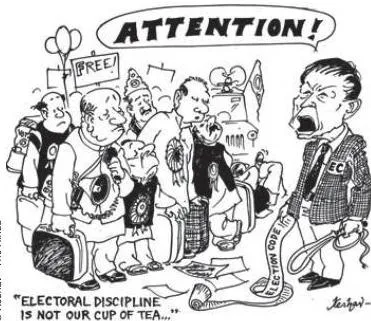
- Election Commission Order on Internal Elections: The Election Commission made it necessary for political parties to hold organisational elections and file income tax returns. Parties now comply, but sometimes it is a mere formality.
Suggestions (Not Yet Accepted)
- Regulate internal affairs: A law should compel parties to maintain a register of members, follow their own constitution, have an independent authority to judge party disputes, and hold open elections to the highest posts.
- Women’s quota: It should be mandatory for parties to give a minimum number of tickets (about one-third) to women candidates, along with a quota for women in decision-making bodies.
- State funding of elections: The government should give parties money or resources (like petrol, paper, telephone) to support election expenses, based on the votes secured in the last election.
The textbook warns that over-regulation of political parties can be counter-productive, as it would force parties to find ways to cheat the law (NCERT, p. 60).
Two Citizen-Driven Methods
Apart from legal reforms, citizens can reform parties in two ways:
- Public pressure: People can put pressure on parties through petitions, publicity, and agitations. Civil society groups, movements, and the media play a role here.
- Joining parties: The quality of democracy depends on public participation. Those who want reform should join political parties instead of criticising from the outside. “The problem of bad politics can be solved by more and better politics.”
Exam Pointers and Common Mistakes
Board examiners frequently ask 5-mark questions from this chapter on “functions of political parties” and “challenges and reforms.” A full-marks answer must state the points using the exact NCERT terminology given above.
Common Mistakes: Error and Correction Table
The table below addresses the most frequent mistakes students make in this chapter, particularly around party systems and the Election Commission’s recognition criteria.
| Mistake | Correct Rule | How to Check Your Answer |
|---|---|---|
| Writing that India has a two-party system because two alliances are dominant. | India has a multi-party system. Alliances are coalitions of multiple parties, not a single party. | Check if you have named “multi-party system” explicitly when asked about India. |
| Confusing the State party vote-share criterion with the National party criterion. | Both need 6% votes, but State needs 2 Assembly seats; National needs 4 Lok Sabha seats across 4 states. | Verify you have mentioned the correct seat count (2 vs. 4) and the correct legislature (Assembly vs. Lok Sabha). |
| Stating that all State parties have only regional or narrow ideologies. | State parties need not be regional in ideology (e.g., Samajwadi Party has a national-level organisation). | Check if you have used the Samajwadi Party or RJD example to prove the point. |
| Confusing “lack of internal democracy” with “absence of democracy in the country.” | Lack of internal democracy refers to power concentration within the party, not the nation’s democratic status. | Ensure your answer focuses on the party’s internal functioning (members, meetings, elections). |
Chapter Revision Recap
- Definition: A group that contests elections to hold power.
- Components: Leaders, active members, followers.
- Functions: Contest elections, form policies, make laws, form governments, play opposition, shape public opinion, provide access to welfare.
- Party Systems: One-party (China), Two-party (USA/UK), Multi-party (India, with alliances/fronts).
- EC Criteria: State party = 6% votes + 2 seats; National party = 6% votes in 4 states + 4 Lok Sabha seats.
- State Parties: Not always regional in ideology (e.g., Samajwadi Party); strengthen federalism.
- Participation: Low trust but high membership in India.
- Challenges: Lack of internal democracy, dynastic succession, money and muscle power, lack of meaningful choice.
- Reforms (Recent): Anti-defection law, Supreme Court affidavit order, EC internal elections order.
- Reforms (Suggested): Regulate internal affairs, one-third tickets to women, state funding of elections.
- Citizen Action: Public pressure and joining parties.
Reference: NCERT Class 10 Democratic Politics-II textbook, chapter Political Parties.
Frequently Asked Questions
What is the difference between a national party and a state party?
A national party is present in several or all federal units and must secure at least 6% of total votes in Lok Sabha elections or Assembly elections in four states and win at least 4 Lok Sabha seats. A state party needs at least 6% of votes in a Legislative Assembly election and must win at least 2 seats.
National parties have units across states, while state parties are typically concentrated in one state, though their ideology may not be regional.
Why is a one-party system not considered a good democratic option?
A one-party system is not a democratic option because it does not allow free competition for power. For a system to be democratic, at least two parties must compete in elections so that voters have a fair chance to choose and change the ruling party.
What are the four major challenges faced by political parties?
The four challenges are: lack of internal democracy, dynastic succession, the growing role of money and muscle power, and the lack of meaningful choice offered to voters.
How does the anti-defection law help political parties?
The anti-defection law prevents elected MLAs and MPs from changing parties after being elected. If they defect, they lose their seat in the legislature. This helps reduce the practice of changing parties for ministerial posts or cash rewards, though it also makes dissent within parties more difficult.
What happens if a party does not maintain a register of its members?
Currently, there is no strict legal penalty within the textbook’s scope, but a key suggested reform is to make it compulsory by law for political parties to maintain a register of members, follow their own constitution, and hold open elections. Maintenance of such registers is part of ensuring internal democracy, which the Election Commission and reform suggestions seek to promote.
Explore Class 10 Civics Notes
Class 10 Civics on LearnCBSE:
Related chapters:
Official source: download the NCERT textbook free from ncert.nic.in.