
For the 2026-27 board session, these gender religion and caste class 10 notes cover Democratic Politics Chapter 3. The chapter examines three social divisions that shape Indian politics. It asks whether expressing these divisions politically is healthy or harmful for democracy.
What This Chapter Is About: Three Divisions in Indian Politics
Social diversity itself does not threaten democracy. The real question is how that diversity is expressed politically (NCERT, p. 1). Expression can be desirable when it helps disadvantaged groups access power, or dangerous when used for dominance. This chapter explores how gender, religion, and caste each follow this logic in India.
For broader context on how power is shared in our democracy, see our Class 10 Federalism notes.
Key Concepts: The Logic Behind Each Division
The three divisions operate on different logic. A student revising this chapter must distinguish what makes each division politically unique.
- Gender is the most universal division, rooted in social expectations rather than biology. Politics can address it positively through equal opportunity demands and representation.
- Religion becomes dangerous when used for political dominance. The core risk is communalism, where one religion is framed as superior to others.
- Caste is unique to India due to hereditary occupation sanctioned by rituals. It can empower disadvantaged groups but also divert attention from broader issues.
Definitions You Must Know
| Term | Meaning | Example / Key Detail |
|---|---|---|
| Sexual division of labour | A system assigning housework to women and outside work to men (NCERT, p. 2). | Cooking and cleaning seen as women’s work even when men are paid as hotel cooks. |
| Feminist | A person who believes in equal rights and opportunities for women and men (NCERT, p. 2). | Activists demanding fair reservation in elected bodies. |
| Patriarchy | A system that values men more and gives them power over women (NCERT, p. 2). | Male-dominated cabinets even when a woman is Chief Minister. |
| Family laws | Laws dealing with marriage, divorce, inheritance, and adoption varying by religion (NCERT, p. 9). | Women’s groups demand these become more equitable. |
| Communalism | The belief that religion is the main basis of social community and a political tool for dominance (NCERT, p. 8). | Appealing to one religious group’s emotions during elections. |
| Secular state | A state with no official religion that protects freedom of religion and prohibits discrimination (NCERT, p. 9). | India bans untouchability to ensure equality within communities. |
| Urbanisation | The shift of population from rural to urban areas (NCERT, p. 12). | Weakens old caste norms, as urban mixing breaks rigid boundaries. |
| Occupational mobility | Shifting to a new occupation different from one’s ancestors (NCERT, p. 12). | A weaver’s child becoming a software engineer. |
| Caste hierarchy | A ladder-like ranking of caste groups from highest to lowest (NCERT, p. 12). | Brahmins historically placed at the top, Dalits at the bottom. |
Gender and Politics: From Household Labour to Legislative Seats
Sexual Division of Labour and the Public/Private Split
Society raises boys and girls to believe women are primarily responsible for housework and childcare. This creates a split between public life (men) and private life (women). Even when women do paid work alongside domestic labour, their contribution remains undervalued and unpaid.
The Time Use Survey (NCERT, p. 4) showed an average woman works over seven and a half hours daily, while an average man works six and a half hours. Much of a woman’s work is unpaid household labour, making it less visible.
Disadvantages Faced by Indian Women
Our society remains male-dominated and patriarchal (NCERT, p. 3). Women face distinct disadvantages:
- Lower literacy: 54% for women versus 76% for men. Parents spend more resources on boys’ education, leading to girl dropouts.
- Unpaid work: Indian women average one hour more work daily, yet remain unpaid and unrecognised.
- Wage inequality: Despite the Equal Remuneration Act 1976, women are paid less for identical work.
- Child sex ratio decline: Preference for sons has reduced the child sex ratio to 919 girls per 1000 boys (Census 2011).
- Violence: Harassment and domestic violence are widespread, with urban areas particularly unsafe.

Women’s Political Representation
Women constituting half of humanity have minimal public roles. Feminist movements agitating for equal voting and career rights changed this partly. In Scandinavian countries, women’s public participation is now very high (NCERT, p. 2).
In India, women still lag behind. Elected women members in the Lok Sabha touched 14.36% only for the first time in 2019 (NCERT, p. 6). State assemblies have less than 5% women, placing India among the bottom group of nations globally.
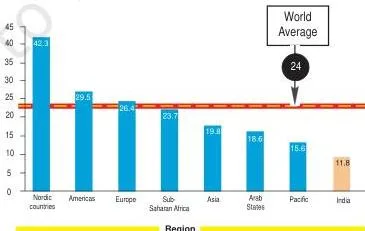
One-third of seats in local panchayats and municipalities are reserved for women, resulting in over 10 lakh elected representatives. The 2023 Nari Shakti Vandan Adhiniyam (Women’s Reservation Act) reserves 33% of seats in the Lok Sabha and State Assemblies for women (NCERT, p. 6).
Religion, Communalism and the Secular State
Religious differences are often expressed in politics. This expression is not always wrong. Gandhi believed politics must be guided by moral values drawn from religion. Human rights groups demand minority protection, and women’s groups demand equitable family laws. These acts are healthy as long as every religion is treated equally.
Healthy Religion-Politics vs Communal Politics
The danger arises when religion becomes the basis of national identity or a tool for majority dominance. This comparison table separates healthy political expression from communalism.
| Healthy Relationship | Communal Politics |
|---|---|
| Guiding politics by moral values drawn from all religions | Pitting one religion against another for dominance |
| Demanding government protection for religious minorities | Using state power to establish domination of one group |
| Reforming unequal family laws to make them equitable | Mobilising voters using sacred symbols and fear |
| Treating every religion equally in public life | Belief that different religions cannot live as equal citizens |
The Four Forms of Communalism
Communalism operates at various levels in politics (NCERT, p. 8):
- Everyday prejudices: Stereotypes and beliefs about religious superiority, so common they often go unnoticed.
- Quest for dominance: Majority communities seek majoritarian dominance; minorities may demand separate units.
- Political mobilisation: Using sacred symbols and emotional appeals to gather votes along religious lines.
- Communal violence: Riots and massacres, as seen during Partition and post-independence.
The Four Provisions Making India a Secular State
The Constitution combats communalism through specific provisions (NCERT, p. 9):
- No official religion: Unlike Sri Lanka or Pakistan, India gives no special status to any faith.
- Freedom of religion: All can profess, practice, and propagate any religion, or none.
- No discrimination: The Constitution prohibits discrimination on grounds of religion.
- State intervention for equality: The state can intervene to ensure equality within communities, such as banning untouchability.
Caste Inequalities and Politics: The Two-Way Street
Caste System: What Makes It Different
Caste division is unique to India (NCERT, p. 10). Hereditary occupational division was sanctioned by rituals. Members of the same caste practiced the same occupation, married within the group, and did not eat with outsiders. The system excluded outcastes through untouchability.
Caste Inequality Today: Why It Persists
Modern changes have altered the system but not erased it. Urbanisation, literacy, and occupational mobility have weakened old caste hierarchy notions (NCERT, p. 10). However, most people still marry within their caste. Effects of historical advantages and disadvantages persist. Upper castes remain overrepresented in the urban middle class.
Caste regulates access to resources. Poverty line data (NCERT, p. 41) shows that 45.8% of Scheduled Tribes and 35.9% of Scheduled Castes in rural areas live below the poverty line, compared to only 11.7% of Hindu Upper Castes.
Caste in Politics
Casteism, like communalism, rests on the flawed belief that caste is the sole basis of social community. Caste influences politics in several ways (NCERT, p. 12):
- Parties choose candidates based on the caste composition of the electorate.
- Parties appeal to caste sentiment to gather support.
- Universal adult franchise mobilised lower castes politically.
Politics in Caste: The Two-Way Mirror
Think of the relationship between caste and politics as a two-way mirror. Caste shapes politics as parties look at voters through caste identities. Simultaneously, politics reshapes caste when groups enter the political arena. Politics influences caste in three specific ways (NCERT, p. 14):
- Each caste group expands by incorporating neighbouring castes or sub-castes.
- Caste groups form coalitions with other communities through dialogue and negotiation.
- New political groupings emerge, such as backward and forward caste formations.
Why Caste Alone Cannot Determine Elections
While caste matters in elections, it is never the sole factor. Four reasons explain this (NCERT, p. 13-14):
- No parliamentary constituency has a clear majority from a single caste.
- No party wins all votes of a single caste.
- Multiple parties often field candidates from the same dominant caste.
- Ruling parties and sitting MPs frequently lose, proving voters are not frozen by caste loyalty.
Worked Examples: Applying the Concepts
Example 1: Unequal Candidate Selection
Scenario: A political party fields only upper-caste candidates in a mixed constituency with a substantial Dalit and OBC population.
- Step 1: Identify the problem. This is an example of caste-based political mobilisation, where party selection ignores the ground demographic reality.
- Step 2: Note the consequence. It restricts disadvantaged groups from accessing decision-making power.
- Step 3: Suggest the first corrective measure. The party should ensure representation from marginalised castes to reflect the electorate’s diversity.
- Step 4: Suggest the second measure. Instead of caste-only appeals, the party must address broader issues like poverty and development to win across caste lines.
Conclusion: Caste matters, but exclusive focus on it is unhealthy for democracy.
Example 2: Official Religion Declaration
Scenario: A state passes a law declaring one particular religion as its official state religion.
- Step 1: Identify the violated provision. This violates the constitutional principle that India has no official religion (NCERT, p. 9).
- Step 2: Explain why this matters. Giving one religion special status contradicts the model of a secular state.
- Step 3: Connect to the constitution. The Constitution mandates that no special status be given to any faith.
- Step 4: State the outcome. This move would lead to majoritarian dominance and threatens the idea of India.
Conclusion: Such a law is unconstitutional and goes against Indian secularism.
Common Mistakes Students Make in This Chapter
| Mistake | Correct Rule | How to check your answer |
|---|---|---|
| Confusing biological difference with the gender division. | Gender division is based on social expectations, not biology (NCERT, p. 2). | Check if the answer mentions social roles rather than physical traits. |
| Writing that caste has completely disappeared today. | Caste has changed but persists, closely linked to economic status (NCERT, p. 13). | Ensure the answer notes urbanisation impacts but still mentions continuing inequalities. |
| Assuming religion’s role in politics is always communalism. | Gandhi’s moral values and state intervention for equality are healthy, secular acts (NCERT, p. 8). | Distinguish between guiding politics ethically and using religion for dominance. |
| Confusing caste in politics with politics in caste. | Caste in politics is how caste influences elections; politics in caste is how politics reshapes caste identities (NCERT, p. 14). | Check the direction: is caste acting on politics, or is politics acting on caste? |
Exam Notes: What Examiners Look For
Examiners frequently test whether students can distinguish healthy political expression from dangerous division. Observe these patterns while revising:
- 3-mark questions often ask for different forms of communal politics with examples. Mentioning all four forms specifically earns full marks (NCERT, p. 8).
- 5-mark questions commonly ask how caste inequalities continue or why caste alone cannot determine election results. Stating all four reasons ensures full marks.
- Status of women: When asked about representation, citing the 14.36% Lok Sabha figure and the 919 child sex ratio earns marks for factual accuracy.
- Secular provisions: Listing the four constitutional provisions that make India a secular state is a standard direct question.
- Movement direction: Be prepared to explain how politics influences caste, not just how caste influences politics, as this distinction is heavily rewarded.
You can find more chapter summaries on our main Class 10 notes index and our general CBSE notes hub. The official source text is available on the NCERT digital textbook page for Chapter 3.
Revision Summary: One-Page Recap
| Division | Nature | Political Expression | Positive / Negative |
|---|---|---|---|
| Gender | Social expectations, not biology | Feminist movements, Women’s Reservation Act | Positive: empowers women in public life |
| Religion | Diverse faiths, risk of communalism | Secular state provisions, sometimes communal appeals | Negative: dominance and communal violence |
| Caste | Unique to India, ritual-sanctioned hierarchy | Candidate selection, coalition building | Mixed: empowers Dalits/OBCs but can divert attention from real issues |
Social divisions expressed in politics can empower disadvantaged groups when handled fairly. Gender politics and Dalit/OBC access to power show this positive potential. However, these same divisions become dangerous when used for religious dominance through communalism, or when they divert attention from pressing issues like poverty and development.
Frequently Asked Questions
Why is the gender division called a social division and not a biological one?
Because it is based on social expectations and stereotypes rather than physical differences. Society assigns roles like housework to women and outside work to men, creating a hierarchy. This division is taught and reinforced, not born into biology (NCERT, p. 2).
What is the difference between religion being involved in politics and communalism?
Religion in politics is healthy when it provides ethical guidance or protects minorities. Communalism occurs when religion is used as a tool for dominance, pitting one group against another. The difference lies in whether all religions are treated equally (NCERT, p. 8).
How does politics influence caste, not just how caste influences politics?
Politics influences caste by bringing caste identities into the political arena, which reshapes them. Caste groups expand by incorporating sub-castes, form coalitions, and create new backward and forward groupings. This is why it is a two-way relationship, not just one of caste dictating politics (NCERT, p. 14).
What are the specific constitutional provisions that make India a secular state?
The four provisions are having no official religion, providing freedom to practice any religion, prohibiting discrimination on religious grounds, and allowing state intervention to ensure equality within religious communities. These foundations separate Indian secularism from the models in Sri Lanka or Pakistan (NCERT, p. 9).
Why can caste alone not determine election results in India?
Because no parliamentary constituency has a clear majority of one single caste. No party wins all votes of a caste, and voters are influenced by party loyalty, economic condition, and leader performance. The fact that sitting MPs and ruling parties frequently lose proves voters are not frozen by caste identity (NCERT, p. 13).
Reference: NCERT Class 10 Democratic Politics textbook, chapter Gender, Religion and Caste. You can revisit the full chapter index via our Class 10 Civics notes or look ahead at Chapter 4 Political Parties notes.
Explore Class 10 Civics Notes
Class 10 Civics on LearnCBSE:
Related chapters: