
Introduction to Trigonometry in CBSE board papers
CBSE asked 303 different Introduction to Trigonometry questions in the Class 10 Mathematics board papers of 2023, 2024, 2025 and 2026 (main and compartment exams, Standard and Basic courses). 5 of these questions have a worked solution on this page. Most of them test Section 8.4, Trigonometric Identities (179 of 303).
Where Introduction to Trigonometry questions came from, 2023–2026
A question printed in several question-paper sets counts once in each table. A question asked in two exams counts in both rows of the first table.
Questions by exam
| Year | Exam | Questions asked | Marks | Question types |
|---|---|---|---|---|
| 2026 | Main | 66 | 27 × 1 mark · 20 × 2 marks · 19 × 3 marks | 23 MCQs, 4 Assertion–Reason and 39 written answers |
| 2025 | Main | 91 | 42 × 1 mark · 20 × 2 marks · 29 × 3 marks | 36 MCQs, 6 Assertion–Reason and 49 written answers |
| 2025 | Compartment | 14 | 6 × 1 mark · 2 × 2 marks · 6 × 3 marks | 6 MCQs and 8 written answers |
| 2024 | Main | 78 | 33 × 1 mark · 22 × 2 marks · 23 × 3 marks | 32 MCQs, 1 Assertion–Reason and 45 written answers |
| 2024 | Compartment | 24 | 10 × 1 mark · 7 × 2 marks · 7 × 3 marks | 10 MCQs and 14 written answers |
| 2023 | Main | 57 | 24 × 1 mark · 11 × 2 marks · 22 × 3 marks | 23 MCQs, 1 Assertion–Reason and 33 written answers |
| 2023 | Compartment | 17 | 6 × 1 mark · 3 × 2 marks · 2 × 3 marks · 6 × 5 marks | 6 MCQs and 11 written answers |
Questions by NCERT section and marks
| NCERT section | 1 mark | 2 marks | 3 marks | 5 marks | Total |
|---|---|---|---|---|---|
| 8.2 Trigonometric Ratios | 13 | 3 | 0 | 0 | 16 |
| 8.3 Trigonometric Ratios of Some Specific Angles | 56 | 48 | 2 | 2 | 108 |
| 8.4 Trigonometric Identities | 64 | 26 | 85 | 4 | 179 |
| All questions | 133 | 77 | 87 | 6 | 303 |
Most-tested sections
- 8.4 Trigonometric Identities: 179 questions
- 8.3 Trigonometric Ratios of Some Specific Angles: 108 questions
- 8.2 Trigonometric Ratios: 16 questions
From 2023 to 2026, CBSE took most Introduction to Trigonometry questions from Section 8.4 (179 of 303). These counts describe past papers; they are not predictions.
Topics in Introduction to Trigonometry
Each NCERT section of the chapter, in book order: what CBSE asked from it and where to practise it.
8.2 Trigonometric Ratios
CBSE asked 16 questions from this section in the 2023–2026 papers (13 of 1 mark; 3 of 2 marks): 13 MCQs and 3 written answers. 8 were printed in Standard papers and 8 in Basic papers.
| Marks | Questions asked | Years | Asked in Standard | Asked in Basic |
|---|---|---|---|---|
| 1 mark | 13 | 2023, 2024, 2025, 2026 | 5 | 8 |
| 2 marks | 3 | 2025, 2026 | 3 | 0 |
8.3 Trigonometric Ratios of Some Specific Angles
For 45°: sin A = cos A = 1/√2, tan A = 1. For 30°: sin A = 1/2, cos A = √3/2, tan A = 1/√3. For 60°: sin A = √3/2, cos A = 1/2, tan A = √3. For 0°: sin 0° = 0, cos 0° = 1, tan 0° = 0. For 90°: sin 90° = 1, cos 90° = 0. Also, as A increases from 0° to 90°, sin A increases from 0 to 1 and cos A decreases from 1 to 0. Ratios like tan 90°, cot 0°, cosec 0° and sec 90° are not defined.
How to answer questions on this section
- Identify the required angle and choose the ratio containing the known side.
- Replace the ratio by its exact value from the table of specific angles.
- Solve the resulting equation for the unknown side or angle.
- Use reciprocals correctly: cosec, sec, cot are 1 over sin, cos, tan.
- Check that the final angle lies within the range given in the question.
Mistakes to avoid in this section
- Writing sin 30° = √3/2 or cos 60° = √3/2; these two values are swapped.
- Saying tan 90° is infinity instead of writing not defined.
- Assuming sin (A + B) = sin A + sin B, which fails for these specific angles.
CBSE asked 108 questions from this section in the 2023–2026 papers (56 of 1 mark; 48 of 2 marks; 2 of 3 marks; 2 of 5 marks): 53 MCQs, 3 Assertion–Reason and 52 written answers. 56 were printed in Standard papers and 53 in Basic papers (1 in both).
| Marks | Questions asked | Years | Asked in Standard | Asked in Basic |
|---|---|---|---|---|
| 1 mark | 56 | 2023, 2024, 2025, 2026 | 30 | 27 |
| 2 marks | 48 | 2023, 2024, 2025, 2026 | 22 | 26 |
| 3 marks | 2 | 2025 | 2 | 0 |
| 5 marks | 2 | 2023 | 2 | 0 |
A question printed in both courses is counted in both columns (1 in both).
Solved on this page: question 1, question 2, question 3, question 4, question 5.
8.4 Trigonometric Identities
A trigonometric identity is an equation with trigonometric ratios that stays true for all allowed angles. For 0° ≤ A ≤ 90°, sin²A + cos²A = 1. For 0° ≤ A < 90°, 1 + tan²A = sec²A. For 0° < A ≤ 90°, cot²A + 1 = cosec²A.
How to answer questions on this section
- Write every ratio as sin and cos first. Example: tan A = sin A / cos A.
- Replace 1 - sin²A by cos²A, and 1 - cos²A by sin²A, using the first identity.
- For sec and tan expressions, divide numerator and denominator by cos θ, as in Example 12.
- Start from LHS and simplify until you get RHS. If needed, simplify both sides separately.
- For acute angles, take the positive square root when solving for sin A or cos A.
Mistakes to avoid in this section
- Using 1 + tan²A = sec²A at A = 90°, where tan A and sec A are not defined.
- Taking cos A = -√(1 - sin²A) for an acute angle; acute angles have positive cos A.
- Cancelling a factor like cos A without checking it is not zero, making the expression undefined.
CBSE asked 179 questions from this section in the 2023–2026 papers (64 of 1 mark; 26 of 2 marks; 85 of 3 marks; 4 of 5 marks): 58 MCQs, 6 Assertion–Reason and 115 written answers. 108 were printed in Standard papers and 75 in Basic papers (4 in both).
| Marks | Questions asked | Years | Asked in Standard | Asked in Basic |
|---|---|---|---|---|
| 1 mark | 64 | 2023, 2024, 2025, 2026 | 33 | 31 |
| 2 marks | 26 | 2023, 2024, 2025, 2026 | 18 | 8 |
| 3 marks | 85 | 2023, 2024, 2025, 2026 | 53 | 36 |
| 5 marks | 4 | 2023 | 4 | 0 |
A question printed in both courses is counted in both columns (4 in both).
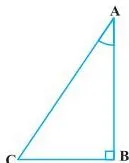
The figure below is the NCERT book’s own worked example for this section; the sentence under it is the book’s.
Key ideas used on this page
1 solved question last asked in 2026
Q1. Evaluate :
\[\frac{\sin 45^\circ}{\sec 30^\circ - \tan 30^\circ}\]
- Marks
- 2
- Level
- Basic
- Asked in
- 2 paper sets
- Years
- 2025, 2026
- Topic
- 8.3 Trigonometric Ratios of Some Specific Angles
- Source
- (CBSE 2026 Mathematics Basic, Set 430/2/2, Q22, 2 marks)
- Status
- Answer checked step by step
Step-by-step solution
Step 1: Write the standard values
½ marksin 45° = 1/√2, sec 30° = 2/√3, tan 30° = 1/√3.
Why? The trigonometric ratios of 30°, 45° and 60° have fixed standard values, so they can be substituted directly into the expression.
Step 2: Simplify the expression
1½ marks\(\frac{\sin 45^\circ}{\sec 30^\circ - \tan 30^\circ} = \frac{1/\sqrt{2}}{2/\sqrt{3} - 1/\sqrt{3}} = \frac{1/\sqrt{2}}{1/\sqrt{3}} = \frac{\sqrt{3}}{\sqrt{2}} = \frac{\sqrt{6}}{2}.\) Therefore, the value = √6/2.
Why? The two terms in the denominator are like surds, so they combine into one term. Dividing by a fraction multiplies by its reciprocal, and rationalising the denominator gives the simplest form.
Marks: ½ + 1½ = 2 · Split as in the CBSE marking scheme, 2025 · Basic 430/2/2 Q22 (the marks split is taken from the 2025 Basic paper, where this question also appeared)
Answer:
√6/2
Common mistakes to avoid
- Writing sec 30° as 1/√3, which is tan 30°, instead of 2/√3.
- Writing sin 45° as √2 instead of 1/√2.
- Subtracting the fractions as if the denominator also gets doubled, giving 1/(2√3) instead of 1/√3.
4 solved questions last asked in 2024
Q2. Evaluate :
\[\sin 30^\circ \cos 60^\circ + \cos 30^\circ \sin 60^\circ - \cot 45^\circ\]
- Marks
- 2
- Level
- Basic
- Asked in
- 2 paper sets
- Years
- 2024
- Topic
- 8.3 Trigonometric Ratios of Some Specific Angles
- Source
- (CBSE 2024 Mathematics Basic, Set 430/4/1, Q25, 2 marks)
- Status
- Answer checked step by step
Step-by-step solution
Step 1: Write the standard values
1 mark (suggested)sin 30° = 1/2, cos 60° = 1/2, cos 30° = √3/2, sin 60° = √3/2, cot 45° = 1.
Why? These are the trigonometric ratios of the specific angles given in Table 8.1. Substituting them changes the trigonometric expression into numbers.
Step 2: Evaluate the expression
1 mark (suggested)(1/2)(1/2) + (√3/2)(√3/2) − 1 = 1/4 + 3/4 − 1 = 0.
Why? Multiply the fractions first, then add the two products and subtract. The two products together make 1, and the subtracted value is also 1, so they cancel and the result is 0.
Marks: 1 + 1 = 2 · Suggested split (CBSE’s usual pattern for 2-mark questions)
Answer:
0
Common mistakes to avoid
- Writing cot 45° as 1/√2, which is the value of sin 45° or cos 45°, instead of 1.
- Multiplying (√3/2)(√3/2) as √3/4, forgetting that √3 × √3 is 3, so the second product must be 3/4.
- Doing the subtraction before adding the two products, so the 1 made by 1/4 + 3/4 is not available to cancel the −1 from cot 45°.
Q3. Evaluate :
\[5 \sin^2 60^\circ + 3 \cos^2 30^\circ - \sec^2 45^\circ\]
- Marks
- 2
- Level
- Basic
- Years
- 2024
- Topic
- 8.3 Trigonometric Ratios of Some Specific Angles
- Source
- (CBSE 2024 Mathematics Basic, Set 430/4/3, Q21, 2 marks)
- Status
- Verified solution
Step-by-step solution
Step 1: Substitute the standard values
1 mark (suggested)5(√3/2)² + 3(√3/2)² − (√2)²
Why? The angles 60°, 30° and 45° are specific angles whose trigonometric ratios have fixed exact values; substituting those values turns the expression into an arithmetic one.
Step 2: Simplify
1 mark (suggested)5(3/4) + 3(3/4) − 2 = 15/4 + 9/4 − 2 = 4. The value of the expression is 4.
Why? Squaring each ratio first and then adding and subtracting in order gives a single number, which is the value of the expression.
Marks: 1 + 1 = 2 · Suggested split (CBSE’s usual pattern for 2-mark questions)
Answer:
4
✓ Answer matches the CBSE marking scheme, 2024 Main, Paper 430/4/3.
Open CBSE’s official marking scheme for the 2024 main exam to see how the board gives marks for this question.
Common mistakes to avoid
- Taking the third term as (1/√2)² = 1/2 instead of 2, because cos 45° is 1/√2, gives 11/2.
- Forgetting to square the ratios and leaving 5(√3/2) + 3(√3/2) − √2 as the answer.
- Taking cos 30° as 1/2, which is actually the value of sin 30°, gives 15/4 + 3/4 − 2 = 5/2.
Q4. If \(x = \sin 60^\circ \cos 30^\circ + \cos 60^\circ \sin 30^\circ\) , then find the value of x.
- Marks
- 2
- Level
- Basic
- Years
- 2024
- Topic
- 8.3 Trigonometric Ratios of Some Specific Angles
- Source
- (CBSE 2024 Mathematics Basic, Set 430/5/3, Q24, 2 marks)
- Status
- Verified solution
Step-by-step solution
Step 1: Substitute the standard values
1 mark (suggested)x = sin 60° cos 30° + cos 60° sin 30° = (√3/2)(√3/2) + (1/2)(1/2).
Why? The trigonometric ratios of 30° and 60° have fixed standard values; replacing sin 60°, cos 30°, cos 60° and sin 30° by those values changes the expression into ordinary fractions.
Step 2: Simplify to get x
1 mark (suggested)x = 3/4 + 1/4 = 1. Hence, x = 1.
Why? Multiplying the fractions gives 3/4 and 1/4, and adding them gives the final value of x.
Marks: 1 + 1 = 2 · Suggested split (CBSE’s usual pattern for 2-mark questions)
Answer:
1
✓ Answer matches the CBSE marking scheme, 2024 Main, Paper 430/5/3.
Open CBSE’s official marking scheme for the 2024 main exam to see how the board gives marks for this question.
Common mistakes to avoid
- Mixing up the 30° and 60° columns, for example taking sin 60° as 1/2 or cos 30° as 1/2.
- Adding the fractions by adding numerators and denominators, giving 4/8 instead of 1.
- Treating sin 60° cos 30° as sin(60° × 30°) instead of multiplying the two separate ratio values.
Q5. Evaluate : \(\frac{5 \tan 60^\circ}{(\sin^2 60^\circ + \cos^2 60^\circ) \tan 30^\circ}\)
- Marks
- 2
- Level
- Standard
- Years
- 2024
- Topic
- 8.3 Trigonometric Ratios of Some Specific Angles
- Source
- (CBSE 2024 Mathematics Standard, Set 30/3/3, Q22, 2 marks)
- Status
- Verified solution
Step-by-step solution
Step 1: Substitute the standard values and simplify
1½ markssin²60° + cos²60° = (√3/2)² + (1/2)² = 3/4 + 1/4 = 1; tan60° = √3, tan30° = 1/√3; so (5√3)/(1 × 1/√3) = 5√3 × √3 = 15.
Why? The identity sin²A + cos²A = 1 collapses the bracket to 1, and the standard values of tan60° and tan30° turn the denominator into a single exact number.
Step 2: State the final value
½ markHence, the value of the expression is 15.
Why? A fraction divided by a unit fraction is simplified by multiplying by its reciprocal, which gives the exact whole number.
Marks: 1½ + ½ = 2 · Split as in the CBSE marking scheme, 2024 · Standard 30/3/3 Q22
Answer:
15
✓ Answer matches the CBSE marking scheme, 2024 Main, Paper 30/3/3.
Open CBSE’s official marking scheme for the 2024 main exam to see how the board gives marks for this question.
Common mistakes to avoid
- Writing sin²60° + cos²60° as (√3/2 + 1/2)² instead of using sin²A + cos²A = 1.
- Taking (5√3) ÷ (1/√3) as (5√3) ÷ √3, which gives 5 instead of 15.
- Confusing the two standard values: putting tan30° as √3 and tan60° as 1/√3, which makes the denominator √3 instead of 1/√3 and gives a wrong value.
Most repeated Introduction to Trigonometry questions
The questions CBSE printed in the most question-paper sets, 2023–2026. Each one is solved where the line points.
- Printed in 2 question-paper sets (2025 and 2026) · 2 marks · Basic · question 1 on this page
- Printed in 2 question-paper sets (2024) · 2 marks · Basic · question 2 on this page
Official papers behind this chapter
Introduction to Trigonometry was asked in 120 of the 120 question-paper sets of 2023–2026. The table names the official CBSE files for each exam in which it was asked.
The board publishes the question papers on cbse.gov.in and the marking schemes on cbse.gov.in, where you can see how marks are given.
| Year | Exam | Course | Sets with a Introduction to Trigonometry question | Question paper | Marking scheme |
|---|---|---|---|---|---|
| 2026 | Main | Standard (041) | 10 of 10 question-paper sets had a Introduction to Trigonometry question | Open CBSE's official question paper for the 2026 main exam (one ZIP file of about 61.9 MB, Class 10 Maths Standard and Basic together) to read the full paper. | Open CBSE's official marking scheme for the 2026 main exam (one ZIP file of about 22.8 MB, Class 10 Maths Standard (041)) to see how marks are given. |
| 2026 | Main | Basic (241) | 10 of 10 question-paper sets had a Introduction to Trigonometry question | Open CBSE's official question paper for the 2026 main exam (one ZIP file of about 61.9 MB, Class 10 Maths Standard and Basic together) to read the full paper. | Open CBSE's official marking scheme for the 2026 main exam (one ZIP file of about 29.1 MB, Class 10 Maths Basic (241)) to see how marks are given. |
| 2025 | Main | Standard (041) | 17 of 17 question-paper sets had a Introduction to Trigonometry question | Open CBSE's official question paper for the 2025 main exam (one ZIP file of about 54.5 MB, Class 10 Maths Standard (041)) to read the full paper. | Open CBSE's official marking scheme for the 2025 main exam (one ZIP file of about 56.9 MB, Class 10 Maths Standard and Basic together) to see how marks are given. |
| 2025 | Main | Basic (241) | 12 of 12 question-paper sets had a Introduction to Trigonometry question | Open CBSE's official question paper for the 2025 main exam (one ZIP file of about 49.9 MB, Class 10 Maths Basic (241)) to read the full paper. | Open CBSE's official marking scheme for the 2025 main exam (one ZIP file of about 56.9 MB, Class 10 Maths Standard and Basic together) to see how marks are given. |
| 2025 | Compartment | Standard (041) | 3 of 3 question-paper sets had a Introduction to Trigonometry question | Open CBSE's official question paper for the 2025 compartment exam (one ZIP file of about 3.4 MB, Class 10 Maths Standard (041)) to read the full paper. | Open CBSE's official marking scheme for the 2025 compartment exam (one ZIP file of about 8.1 MB, Class 10 Maths Standard (041)) to see how marks are given. |
| 2025 | Compartment | Basic (241) | 3 of 3 question-paper sets had a Introduction to Trigonometry question | Open CBSE's official question paper for the 2025 compartment exam (one ZIP file of about 2.4 MB, Class 10 Maths Basic (241)) to read the full paper. | Open CBSE's official marking scheme for the 2025 compartment exam (one ZIP file of about 18.7 MB, Class 10 Maths Basic (241)) to see how marks are given. |
| 2024 | Main | Standard (041) | 14 of 14 question-paper sets had a Introduction to Trigonometry question | Open CBSE's official question paper for the 2024 main exam (one ZIP file of about 35.3 MB, Class 10 Maths Standard (041)) to read the full paper. | Open CBSE's official marking scheme for the 2024 main exam (one ZIP file of about 23.4 MB, Class 10 Maths Standard (041)) to see how marks are given. |
| 2024 | Main | Basic (241) | 14 of 14 question-paper sets had a Introduction to Trigonometry question | Open CBSE's official question paper for the 2024 main exam (one ZIP file of about 43.4 MB, Class 10 Maths Basic (241)) to read the full paper. | Open CBSE's official marking scheme for the 2024 main exam (one ZIP file of about 23.8 MB, Class 10 Maths Basic (241)) to see how marks are given. |
| 2024 | Compartment | Standard (041) | 3 of 3 question-paper sets had a Introduction to Trigonometry question | Open CBSE's official question paper for the 2024 compartment exam (one ZIP file of about 3.2 MB, Class 10 Maths Standard (041)) to read the full paper. | Open CBSE's official marking scheme for the 2024 compartment exam (one ZIP file of about 7.1 MB, Class 10 Maths Standard (041)) to see how marks are given. |
| 2024 | Compartment | Basic (241) | 4 of 4 question-paper sets had a Introduction to Trigonometry question | Open CBSE's official question paper for the 2024 compartment exam (one ZIP file of about 2.2 MB, Class 10 Maths Basic (241)) to read the full paper. | Open CBSE's official marking scheme for the 2024 compartment exam (one ZIP file of about 5.6 MB, Class 10 Maths Basic (241)) to see how marks are given. |
| 2023 | Main | Standard (041) | 12 of 12 question-paper sets had a Introduction to Trigonometry question | Open CBSE's official question paper for the 2023 main exam (one ZIP file of about 44 MB, Class 10 Maths Standard (041)) to read the full paper. | Open CBSE's official marking scheme for the 2023 main exam (one ZIP file of about 17.4 MB, Class 10 Maths Standard (041)) to see how marks are given. |
| 2023 | Main | Basic (241) | 12 of 12 question-paper sets had a Introduction to Trigonometry question | Open CBSE's official question paper for the 2023 main exam (one ZIP file of about 49.4 MB, Class 10 Maths Basic (241)) to read the full paper. | Open CBSE's official marking scheme for the 2023 main exam (one ZIP file of about 26 MB, Class 10 Maths Basic (241)) to see how marks are given. |
| 2023 | Compartment | Standard (041) | 3 of 3 question-paper sets had a Introduction to Trigonometry question | Open CBSE's official question paper for the 2023 compartment exam (one ZIP file of about 7.6 MB, Class 10 Maths Standard (041)) to read the full paper. | Open CBSE's official marking scheme for the 2023 compartment exam (one ZIP file of about 3.3 MB, Class 10 Maths Standard (041)) to see how marks are given. |
| 2023 | Compartment | Basic (241) | 3 of 3 question-paper sets had a Introduction to Trigonometry question | Open CBSE's official question paper for the 2023 compartment exam (one ZIP file of about 7.2 MB, Class 10 Maths Basic (241)) to read the full paper. | Open CBSE's official marking scheme for the 2023 compartment exam (one ZIP file of about 7.5 MB, Class 10 Maths Basic (241)) to see how marks are given. |
Continue studying
Other chapters: Some Applications of Trigonometry previous year questions · Coordinate Geometry previous year questions.
To revise the lessons behind these questions, read NCERT Chapter 8 (official PDF), the chapter exactly as NCERT publishes it on ncert.nic.in.
Sources and data verification
The counts on this page come from 120 CBSE Class 10 Mathematics question-paper sets: 62 Standard (041) and 58 Basic (241), from the main exams of 2023, 2024, 2025 and 2026 and the compartment exams of 2023, 2024 and 2025. A question printed in several sets counts once; these counts describe past papers and are not predictions.
CBSE settles the question papers and the marking schemes: each question is reproduced as printed in its CBSE paper, with its year, paper code and question number, and each answer shown here matches the official marking scheme or answer key. NCERT settles the textbook: chapter and section names follow NCERT Mathematics Class X (reprint 2026-27).
Every solution is original. The mark beside each step follows the official CBSE marking scheme where the scheme shows it; a mark labelled “(suggested)” follows the board’s usual pattern for that type of question.
The official question-paper and marking-scheme links on this page were checked and open on 9 October 2026.
Reference: CBSE Class 10 Mathematics board question papers via cbse.gov.in; all solutions are original. learncbse.net is an independent website and is not affiliated with CBSE or NCERT.