
Coordinate Geometry in CBSE board papers
CBSE asked 200 different Coordinate Geometry questions in the Class 10 Mathematics board papers of 2023, 2024, 2025 and 2026 (main and compartment exams, Standard and Basic courses). 5 of these questions have a worked solution on this page. Most of them test Section 7.3, Section Formula (104 of 200).
Where Coordinate Geometry questions came from, 2023–2026
A question printed in several question-paper sets counts once in each table. A question asked in two exams counts in both rows of the first table.
Questions by exam
| Year | Exam | Questions asked | Marks | Question types |
|---|---|---|---|---|
| 2026 | Main | 34 | 15 × 1 mark · 5 × 2 marks · 10 × 3 marks · 4 × 4 marks | 15 MCQs, 4 case studies and 15 written answers |
| 2025 | Main | 50 | 30 × 1 mark · 8 × 2 marks · 9 × 3 marks · 3 × 4 marks | 30 MCQs, 3 case studies and 17 written answers |
| 2025 | Compartment | 12 | 6 × 1 mark · 4 × 2 marks · 2 × 3 marks | 6 MCQs and 6 written answers |
| 2024 | Main | 50 | 26 × 1 mark · 11 × 2 marks · 10 × 3 marks · 3 × 4 marks | 19 MCQs, 5 Assertion–Reason, 3 case studies and 23 written answers |
| 2024 | Compartment | 14 | 10 × 1 mark · 1 × 2 marks · 1 × 3 marks · 2 × 4 marks | 9 MCQs, 1 Assertion–Reason, 2 case studies and 2 written answers |
| 2023 | Main | 43 | 20 × 1 mark · 14 × 2 marks · 8 × 3 marks · 1 × 4 marks | 17 MCQs, 1 Assertion–Reason, 1 case study and 24 written answers |
| 2023 | Compartment | 14 | 5 × 1 mark · 9 × 2 marks | 5 MCQs and 9 written answers |
Questions by NCERT section and marks
| NCERT section | 1 mark | 2 marks | 3 marks | 4 marks | Total |
|---|---|---|---|---|---|
| 7.2 Distance Formula | 53 | 23 | 9 | 4 | 89 |
| 7.3 Section Formula | 43 | 27 | 29 | 5 | 104 |
| Mixed topics | 5 | 0 | 1 | 1 | 7 |
| All questions | 101 | 50 | 39 | 10 | 200 |
Most-tested sections
- 7.3 Section Formula: 104 questions
- 7.2 Distance Formula: 89 questions
From 2023 to 2026, CBSE took most Coordinate Geometry questions from Section 7.3 (104 of 200). These counts describe past papers; they are not predictions.
Topics in Coordinate Geometry
Each NCERT section of the chapter, in book order: what CBSE asked from it and where to practise it.
7.2 Distance Formula
The distance between P(x₁, y₁) and Q(x₂, y₂) is \(PQ = \sqrt{(x_2-x_1)^2 + (y_2-y_1)^2}\). Since distance is non-negative, take only the positive square root. The distance of P(x, y) from the origin O(0, 0) is \(OP = \sqrt{x^2 + y^2}\).
How to answer questions on this section
- Substitute the coordinates into \(PQ = \sqrt{(x_2-x_1)^2 + (y_2-y_1)^2}\).
- For a point on the y-axis, write it as (0, y); for the x-axis, write it as (x, 0).
- For equidistant points, set AP = BP and square both sides.
- To check if three points lie on one line, find AB, BC and AC, then check if AB + BC = AC.
- To name a triangle, compare side lengths and check if \(a^2 + b^2 = c^2\).
Mistakes to avoid in this section
- Taking the negative square root gives a negative distance, which is impossible.
- For a point on the y-axis, writing (y, 0) instead of (0, y) gives the wrong equation.
- Forgetting to square the differences before adding gives a wrong distance.
CBSE asked 89 questions from this section in the 2023–2026 papers (53 of 1 mark; 23 of 2 marks; 9 of 3 marks; 4 of 4 marks): 48 MCQs, 3 Assertion–Reason, 4 case studies and 34 written answers. 46 were printed in Standard papers and 44 in Basic papers (1 in both).
| Marks | Questions asked | Years | Asked in Standard | Asked in Basic |
|---|---|---|---|---|
| 1 mark | 53 | 2023, 2024, 2025, 2026 | 26 | 27 |
| 2 marks | 23 | 2023, 2024, 2025, 2026 | 16 | 8 |
| 3 marks | 9 | 2023, 2024, 2025, 2026 | 4 | 5 |
| 4 marks | 4 | 2024, 2025, 2026 | 0 | 4 |
A question printed in both courses is counted in both columns (1 in both).
Solved on this page: question 4.
7.3 Section Formula
For A(x1,y1) and B(x2,y2), if P(x,y) divides AB internally in ratio m1:m2, then x=(m1 × x2+m2 × x1)/(m1+m2) and y=(m1 × y2+m2 × y1)/(m1+m2). If the ratio is k:1, use ((k × x2+x1)/(k+1), (k × y2+y1)/(k+1)). The mid-point divides in ratio 1:1, so its coordinates are ((x1+x2)/2, (y1+y2)/2).
How to answer questions on this section
- Label the ratio as PA:PB=m1:m2, then put m1 with x2 and m2 with x1.
- To find an unknown ratio, substitute the given point into the section formula and solve.
- If a point lies on the y-axis, set its x-coordinate to 0 and solve for the ratio.
- For a parallelogram, equate the mid-points of the two diagonals using the mid-point formula.
- For trisection, use ratios 1:2 and 2:1 for the two dividing points.
Mistakes to avoid in this section
- Swapping m1 and m2 changes the point; keep the order PA:PB exactly as given.
- Using the distance formula to find the ratio without checking that A, P and B lie on one straight line.
- For a point on the y-axis, setting the y-coordinate to 0 instead of the x-coordinate.
CBSE asked 104 questions from this section in the 2023–2026 papers (43 of 1 mark; 27 of 2 marks; 29 of 3 marks; 5 of 4 marks): 38 MCQs, 3 Assertion–Reason, 5 case studies and 58 written answers. 60 were printed in Standard papers and 45 in Basic papers (1 in both).
| Marks | Questions asked | Years | Asked in Standard | Asked in Basic |
|---|---|---|---|---|
| 1 mark | 43 | 2023, 2024, 2025, 2026 | 23 | 20 |
| 2 marks | 27 | 2023, 2024, 2025, 2026 | 15 | 12 |
| 3 marks | 29 | 2023, 2024, 2025, 2026 | 21 | 9 |
| 4 marks | 5 | 2023, 2024, 2026 | 1 | 4 |
A question printed in both courses is counted in both columns (1 in both).
The figure below is the NCERT book’s own worked example for this section; the sentence under it is the book’s.
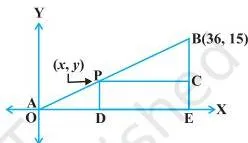
Solved on this page: question 1, question 2, question 3, question 5.
7 more questions use several sections at once; the tables above count them under Mixed topics.
Key ideas used on this page
1 solved question last asked in 2026
Q1. If the points A(4, 5), B(m, 6), C(4, 3) and D(1, n) taken in this order are the vertices of a parallelogram ABCD, then find the values of m and n.
- Marks
- 2
- Level
- Standard
- Asked in
- 2 paper sets
- Years
- 2026
- Topic
- 7.3 Section Formula
- Source
- (CBSE 2026 Mathematics Standard, Set 30/2/1, Q23, 2 marks)
- Status
- Verified solution
Step-by-step solution
Step 1: Mid-point of diagonal AC
1 mark (suggested)The diagonals of a parallelogram bisect each other, so the mid-point of AC equals the mid-point of BD. For AC, the x-coordinate is (4+4)/2 = 4 and the y-coordinate is (5+3)/2 = 4.
Why? The diagonals of a parallelogram bisect each other, so their mid-points are the same point. This turns the geometry into two coordinate equations.
Step 2: Equate mid-point of BD and solve
1 mark (suggested)For BD, the x-coordinate is (m+1)/2 and the y-coordinate is (6+n)/2. Equating x-coordinates: (m+1)/2 = 4, so m = 7. Equating y-coordinates: (6+n)/2 = 4, so n = 2. Therefore, m = 7 and n = 2.
Why? Two points are equal only when their x-coordinates are equal and their y-coordinates are equal. Solving each linear equation gives one unknown.
Marks: 1 + 1 = 2 · Suggested split (CBSE’s usual pattern for 2-mark questions)
Answer:
m = 7 and n = 2
✓ Answer matches the CBSE marking scheme, 2026 Main, Paper 30/2/1.
Open CBSE’s official marking scheme for the 2026 main exam to see how the board gives marks for this question.
Common mistakes to avoid
- Using the mid-points of AB and CD instead of the diagonals AC and BD; the diagonals of a parallelogram bisect each other.
- Solving (m+1)/2 = 4 but not solving (6+n)/2 = 4, so n remains unknown.
- Writing n as 1 by taking the y-coordinate sum as 7 instead of 8.
1 solved question last asked in 2025
Q2. Find the coordinates of the point C which lies on the line AB produced such that \(AC = 2BC\) , where coordinates of points A and B are \((-1, 7)\) and \((4, -3)\) respectively.
- Marks
- 2
- Level
- Standard
- Asked in
- 3 paper sets
- Years
- 2025
- Topic
- 7.3 Section Formula
- Source
- (CBSE 2025 Mathematics Standard, Set 30/4/1, Q23, 2 marks)
- Status
- Verified solution
Step-by-step solution
Step 1: Show that B is the mid-point of AC
1 mark (suggested)Let C = (x, y). C lies on AB produced beyond B, so A, B and C are collinear with B between A and C, and AC = AB + BC. Given AC = 2BC, AB + BC = 2BC, so AB = BC. Hence B is the mid-point of AC.
Why? On a straight line, the whole distance is the sum of the two adjacent distances. Equal adjacent distances mean the common point is the mid-point.
Step 2: Use the mid-point formula
1 mark (suggested)Since B is the mid-point of AC, C = 2B - A. So x = 2(4) - (-1) = 9 and y = 2(-3) - 7 = -13. Therefore the required point is C(9, -13).
Why? The mid-point formula says the coordinates of the mid-point are the averages of the coordinates of the endpoints. Rearranging gives C = 2B - A, so each coordinate of C is twice the corresponding coordinate of B minus the coordinate of A.
Marks: 1 + 1 = 2 · Suggested split (CBSE’s usual pattern for 2-mark questions)
Answer:
(9, -13)
✓ Answer matches the CBSE marking scheme, 2025 Main, Paper 30/4/1.
Open CBSE’s official marking scheme for the 2025 main exam to see how the board gives marks for this question.
Common mistakes to avoid
- Choosing the point that divides AB internally in the ratio 2 : 1; that point also gives AC = 2BC but lies on AB, not on AB produced.
- Taking A as the mid-point of BC instead of B as the mid-point of AC; the condition AC = 2BC with C beyond B makes B the middle point.
- Assuming C lies beyond A; then BC = AB + AC makes BC longer than AC, so AC = 2BC cannot hold.
1 solved question last asked in 2024
Q3. Find the ratio in which the point \((3, y)\) , divides the line segment joining the points \((-2, -5)\) and \((6, 3)\) . Also, find the value of \(y\) .
- Marks
- 2
- Level
- Basic
- Asked in
- 3 paper sets
- Years
- 2024
- Topic
- 7.3 Section Formula
- Source
- (CBSE 2024 Mathematics Basic, Set 430/5/1, Q22, 2 marks)
- Status
- Verified solution
Step-by-step solution
Step 1: Let the ratio be k : 1
1 mark (suggested)Let the point (3, y) divide AB in the ratio k : 1. Using the section formula, 3 = (6k − 2)/(k + 1). Solving, 6k − 2 = 3k + 3, so k = 5/3.
Why? The section formula connects an unknown ratio to the coordinates of the dividing point; using the given x-coordinate creates the equation that fixes the ratio.
Step 2: Find y and state the ratio
1 mark (suggested)Using the section formula for y, y = (3k − 5)/(k + 1) = (3(5/3) − 5)/((5/3) + 1) = 0. Hence the ratio is 5 : 3 and y = 0.
Why? With the ratio known, the section formula gives the other coordinate directly.
Marks: 1 + 1 = 2 · Suggested split (CBSE’s usual pattern for 2-mark questions)
Answer:
5 : 3 and y = 0
✓ Answer matches the CBSE marking scheme, 2024 Main, Paper 430/5/1.
Open CBSE’s official marking scheme for the 2024 main exam to see how the board gives marks for this question.
Common mistakes to avoid
- Reversing the ratio and writing 3 : 5; since the point is nearer to B(6, 3), the part from A to P is the bigger part, so it is 5 : 3.
- Forgetting the denominator k + 1 while equating the x-coordinate, which makes the ratio wrong.
- Taking the point (3, y) as one endpoint in the section formula, so the coordinates get mixed up.
2 solved questions last asked in 2023
Q4. Find the value(s) of 'x' so that \(PQ = QR\), where the coordinates of P, Q and R are \((6, -1)\), \((1, 3)\) and \((x, 8)\) respectively.
- Marks
- 2
- Level
- Basic
- Asked in
- 3 paper sets
- Years
- 2023
- Topic
- 7.2 Distance Formula
- Source
- (CBSE 2023 Mathematics Basic, Set 430/2/1, Q23, 2 marks)
- Status
- Verified solution
Step-by-step solution
Step 1: Apply distance formula to PQ
1 markPQ = √((6 − 1)² + (−1 − 3)²) = √(5² + (−4)²) = √41.
Why? The distance formula gives the length of the segment joining two points from their coordinates. Since the differences are squared, subtracting in either order gives the same distance.
Step 2: Apply distance formula to QR
½ markQR = √((x − 1)² + (8 − 3)²) = √((x − 1)² + 5²) = √((x − 1)² + 25).
Why? QR also comes from the distance formula. It is written with the unknown x because R's x-coordinate is x.
Step 3: Solve PQ = QR
½ markPQ = QR gives √41 = √((x − 1)² + 25), so 41 = (x − 1)² + 25, i.e. (x − 1)² = 16. Hence x − 1 = ±4, so x = 5 or x = −3.
Why? If two non-negative numbers are equal, their squares are equal. This removes the square roots and gives a simple equation in x.
Marks: 1 + ½ + ½ = 2 · Split as in the CBSE marking scheme, 2023 · Basic 430/2/1 Q23
Answer:
x = 5 or x = −3
✓ Answer matches the CBSE marking scheme, 2023 Main, Paper 430/2/1.
Open CBSE’s official marking scheme for the 2023 main exam to see how the board gives marks for this question.
Common mistakes to avoid
- Giving only x = 5 and missing x = −3, because (x − 1)² = 16 has two square roots, 4 and −4.
- Using the wrong pair of coordinates in QR, such as mixing Q's coordinates with P's; QR must use Q(1, 3) and R(x, 8).
- Forgetting to subtract 25 from 41 before taking the square root, so the root is taken from 41 instead of 16.
Q5. Find the ratio in which line \(y = x\) divides the line segment joining the points \((6, -3)\) and \((1, 6)\).
- Marks
- 2
- Level
- Standard
- Years
- 2023
- Topic
- 7.3 Section Formula
- Source
- (CBSE 2023 Mathematics Standard, Set 30/5/2, Q22, 2 marks)
- Status
- Verified solution
Step-by-step solution
Step 1: Let the ratio be k : 1
1 mark (suggested)Let the ratio be k : 1. By the section formula, the point of division is ((k×1 + 1×6)/(k+1), (k×6 + 1×(−3))/(k+1)).
Why? The section formula gives the coordinates of the point that divides a segment internally in the ratio k : 1.
Step 2: Solve for k
1 mark (suggested)Since the point lies on y = x, (k+6)/(k+1) = (6k−3)/(k+1), so k = 9/5. Hence the required ratio is 9 : 5.
Why? A point lies on y = x when its x-coordinate equals its y-coordinate; equating them determines k.
Marks: 1 + 1 = 2 · Suggested split (CBSE’s usual pattern for 2-mark questions)
Answer:
9/5
✓ Answer matches the CBSE marking scheme, 2023 Main, Paper 30/5/2.
Open CBSE’s official marking scheme for the 2023 main exam to see how the board gives marks for this question.
Common mistakes to avoid
- Taking the endpoints in the reverse order, A as (1, 6) and B as (6, −3), which changes k to 5/9 and gives the ratio 5 : 9.
- Using the section formula as (m₁x₁ + m₂x₂)/(m₁ + m₂), which mixes the coordinates of the endpoints.
- Equating the x-coordinate to 0, as in y-axis division problems, instead of equating x and y for the line y = x.
Most repeated Coordinate Geometry questions
The questions CBSE printed in the most question-paper sets, 2023–2026. Each one is solved where the line points.
- Printed in 3 question-paper sets (2023) · 2 marks · Basic · question 4 on this page
- Printed in 3 question-paper sets (2024) · 2 marks · Basic · question 3 on this page
- Printed in 3 question-paper sets (2025) · 2 marks · Standard · question 2 on this page
- Printed in 2 question-paper sets (2026) · 2 marks · Standard · question 1 on this page
Official papers behind this chapter
Coordinate Geometry was asked in 119 of the 120 question-paper sets of 2023–2026. The table names the official CBSE files for each exam in which it was asked.
The board publishes the question papers on cbse.gov.in and the marking schemes on cbse.gov.in, where you can see how marks are given.
| Year | Exam | Course | Sets with a Coordinate Geometry question | Question paper | Marking scheme |
|---|---|---|---|---|---|
| 2026 | Main | Standard (041) | 10 of 10 question-paper sets had a Coordinate Geometry question | Open CBSE's official question paper for the 2026 main exam (one ZIP file of about 61.9 MB, Class 10 Maths Standard and Basic together) to read the full paper. | Open CBSE's official marking scheme for the 2026 main exam (one ZIP file of about 22.8 MB, Class 10 Maths Standard (041)) to see how marks are given. |
| 2026 | Main | Basic (241) | 10 of 10 question-paper sets had a Coordinate Geometry question | Open CBSE's official question paper for the 2026 main exam (one ZIP file of about 61.9 MB, Class 10 Maths Standard and Basic together) to read the full paper. | Open CBSE's official marking scheme for the 2026 main exam (one ZIP file of about 29.1 MB, Class 10 Maths Basic (241)) to see how marks are given. |
| 2025 | Main | Standard (041) | 17 of 17 question-paper sets had a Coordinate Geometry question | Open CBSE's official question paper for the 2025 main exam (one ZIP file of about 54.5 MB, Class 10 Maths Standard (041)) to read the full paper. | Open CBSE's official marking scheme for the 2025 main exam (one ZIP file of about 56.9 MB, Class 10 Maths Standard and Basic together) to see how marks are given. |
| 2025 | Main | Basic (241) | 12 of 12 question-paper sets had a Coordinate Geometry question | Open CBSE's official question paper for the 2025 main exam (one ZIP file of about 49.9 MB, Class 10 Maths Basic (241)) to read the full paper. | Open CBSE's official marking scheme for the 2025 main exam (one ZIP file of about 56.9 MB, Class 10 Maths Standard and Basic together) to see how marks are given. |
| 2025 | Compartment | Standard (041) | 3 of 3 question-paper sets had a Coordinate Geometry question | Open CBSE's official question paper for the 2025 compartment exam (one ZIP file of about 3.4 MB, Class 10 Maths Standard (041)) to read the full paper. | Open CBSE's official marking scheme for the 2025 compartment exam (one ZIP file of about 8.1 MB, Class 10 Maths Standard (041)) to see how marks are given. |
| 2025 | Compartment | Basic (241) | 3 of 3 question-paper sets had a Coordinate Geometry question | Open CBSE's official question paper for the 2025 compartment exam (one ZIP file of about 2.4 MB, Class 10 Maths Basic (241)) to read the full paper. | Open CBSE's official marking scheme for the 2025 compartment exam (one ZIP file of about 18.7 MB, Class 10 Maths Basic (241)) to see how marks are given. |
| 2024 | Main | Standard (041) | 14 of 14 question-paper sets had a Coordinate Geometry question | Open CBSE's official question paper for the 2024 main exam (one ZIP file of about 35.3 MB, Class 10 Maths Standard (041)) to read the full paper. | Open CBSE's official marking scheme for the 2024 main exam (one ZIP file of about 23.4 MB, Class 10 Maths Standard (041)) to see how marks are given. |
| 2024 | Main | Basic (241) | 14 of 14 question-paper sets had a Coordinate Geometry question | Open CBSE's official question paper for the 2024 main exam (one ZIP file of about 43.4 MB, Class 10 Maths Basic (241)) to read the full paper. | Open CBSE's official marking scheme for the 2024 main exam (one ZIP file of about 23.8 MB, Class 10 Maths Basic (241)) to see how marks are given. |
| 2024 | Compartment | Standard (041) | 3 of 3 question-paper sets had a Coordinate Geometry question | Open CBSE's official question paper for the 2024 compartment exam (one ZIP file of about 3.2 MB, Class 10 Maths Standard (041)) to read the full paper. | Open CBSE's official marking scheme for the 2024 compartment exam (one ZIP file of about 7.1 MB, Class 10 Maths Standard (041)) to see how marks are given. |
| 2024 | Compartment | Basic (241) | 4 of 4 question-paper sets had a Coordinate Geometry question | Open CBSE's official question paper for the 2024 compartment exam (one ZIP file of about 2.2 MB, Class 10 Maths Basic (241)) to read the full paper. | Open CBSE's official marking scheme for the 2024 compartment exam (one ZIP file of about 5.6 MB, Class 10 Maths Basic (241)) to see how marks are given. |
| 2023 | Main | Standard (041) | 12 of 12 question-paper sets had a Coordinate Geometry question | Open CBSE's official question paper for the 2023 main exam (one ZIP file of about 44 MB, Class 10 Maths Standard (041)) to read the full paper. | Open CBSE's official marking scheme for the 2023 main exam (one ZIP file of about 17.4 MB, Class 10 Maths Standard (041)) to see how marks are given. |
| 2023 | Main | Basic (241) | 11 of 12 question-paper sets had a Coordinate Geometry question | Open CBSE's official question paper for the 2023 main exam (one ZIP file of about 49.4 MB, Class 10 Maths Basic (241)) to read the full paper. | Open CBSE's official marking scheme for the 2023 main exam (one ZIP file of about 26 MB, Class 10 Maths Basic (241)) to see how marks are given. |
| 2023 | Compartment | Standard (041) | 3 of 3 question-paper sets had a Coordinate Geometry question | Open CBSE's official question paper for the 2023 compartment exam (one ZIP file of about 7.6 MB, Class 10 Maths Standard (041)) to read the full paper. | Open CBSE's official marking scheme for the 2023 compartment exam (one ZIP file of about 3.3 MB, Class 10 Maths Standard (041)) to see how marks are given. |
| 2023 | Compartment | Basic (241) | 3 of 3 question-paper sets had a Coordinate Geometry question | Open CBSE's official question paper for the 2023 compartment exam (one ZIP file of about 7.2 MB, Class 10 Maths Basic (241)) to read the full paper. | Open CBSE's official marking scheme for the 2023 compartment exam (one ZIP file of about 7.5 MB, Class 10 Maths Basic (241)) to see how marks are given. |
Continue studying
Other chapters: Triangles previous year questions.
To revise the lessons behind these questions, read NCERT Chapter 7 (official PDF), the chapter exactly as NCERT publishes it on ncert.nic.in.
Sources and data verification
The counts on this page come from 120 CBSE Class 10 Mathematics question-paper sets: 62 Standard (041) and 58 Basic (241), from the main exams of 2023, 2024, 2025 and 2026 and the compartment exams of 2023, 2024 and 2025. A question printed in several sets counts once; these counts describe past papers and are not predictions.
CBSE settles the question papers and the marking schemes: each question is reproduced as printed in its CBSE paper, with its year, paper code and question number, and each answer shown here matches the official marking scheme or answer key. NCERT settles the textbook: chapter and section names follow NCERT Mathematics Class X (reprint 2026-27).
Every solution is original. The mark beside each step follows the official CBSE marking scheme where the scheme shows it; a mark labelled “(suggested)” follows the board’s usual pattern for that type of question.
The official question-paper and marking-scheme links on this page were checked and open on 9 October 2026.
Reference: CBSE Class 10 Mathematics board question papers via cbse.gov.in; all solutions are original. learncbse.net is an independent website and is not affiliated with CBSE or NCERT.