This chapter covers the formulas for work done by a constant force, kinetic energy, gravitational potential energy, the work-energy theorem, conservation of mechanical energy, power, and the mechanical advantage of simple machines (pulley, inclined plane, lever). These quantities let you describe motion and interactions without always using Newton’s laws directly.
Each formula below is grouped by the textbook sub-topic, with the meaning of every symbol, when to use it, and original worked examples. For the full explanation and derivation of each concept, visit the Class 9 Physics Notes page.
Formulas at a Glance
| Purpose (what you are finding) | Formula |
|---|---|
| Work done by a constant force | \( W = F \times s \) |
| Work-energy theorem | \( W = \Delta E \) |
| Kinetic energy of a moving object | \( K = \frac{1}{2}mv^2 \) |
| Gravitational potential energy near Earth’s surface | \( U = mgh \) |
| Conservation of mechanical energy (no friction) | \( K + U = \text{constant} \) |
| Speed at bottom of a free fall (from energy conservation) | \( v = \sqrt{2gh} \) |
| Average power | \( P = \frac{W}{t} \) |
| Mechanical advantage of a simple machine | \( \text{MA} = \frac{\text{load}}{\text{effort}} \) |
| Mechanical advantage of an inclined plane (ideal) | \( \text{MA} = \frac{L}{h} \) |
| Lever equilibrium (from work conservation) | \( \text{effort} \times \text{effort arm} = \text{load} \times \text{load arm} \) |
| Mechanical advantage of a lever | \( \text{MA} = \frac{\text{effort arm}}{\text{load arm}} \) |
All Formulas, Grouped by Topic
Work Done by a Constant Force
When a constant force \( F \) acts on an object and displaces it by a distance \( s \) in the direction of the force, the work done is:
\[ W = F \times s \]
The SI unit of work is the joule (J), where \( 1\ \text{J} = 1\ \text{N} \times 1\ \text{m} \).
If the displacement is in the opposite direction to the force, the work done is negative. If the displacement is perpendicular to the force, work done is zero.

The Work-Energy Theorem
\[ \text{Work done on an object} = \text{Change in its energy} \]
\[ W = \Delta E \]
This theorem holds for any kind of force, constant or variable, and for a system of objects.
Kinetic Energy
The energy an object possesses due to its motion. For an object of mass \( m \) moving with speed \( v \):
\[ K = \frac{1}{2}mv^2 \]
The kinetic energy is always positive and its SI unit is the joule (J).

Potential Energy (Gravitational)
Energy stored in an object due to its position in a gravitational field. For an object of mass \( m \) at a height \( h \) above the Earth’s surface (with \( g \) constant):
\[ U = mgh \]
The SI unit is the joule (J). This expression is valid only near the Earth’s surface.
Conservation of Mechanical Energy
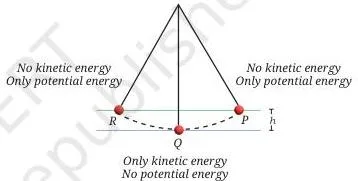
In the absence of friction or other non-conservative forces, the sum of kinetic energy and potential energy remains constant:
\[ K + U = \text{constant} \]
For a freely falling object from height \( h \):
At the top: \( K = 0, U = mgh \), so total mechanical energy = \( mgh \).
At the bottom: \( U = 0 \), so \( K = mgh \), giving \( v = \sqrt{2gh} \).
Power
Power is the rate at which work is done. Average power:
\[ P = \frac{W}{t} \]
The SI unit of power is the watt (W), where \( 1\ \text{W} = 1\ \text{J/s} \).
Simple Machines – Mechanical Advantage
\[ \text{MA} = \frac{\text{load}}{\text{effort}} \]
Inclined Plane
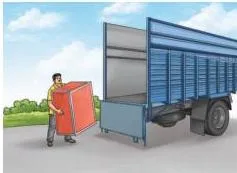
For an ideal inclined plane (no friction) of length \( L \) and height \( h \):
\[ \text{MA} = \frac{L}{h} \]
This is derived from \( F’ \times L = mgh \), where \( F’ \) is the effort.
Lever
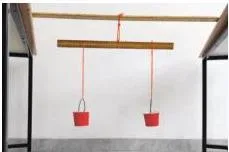
For a lever in equilibrium, the work done on the effort side equals the work done on the load side (ignoring friction):
\[ \text{effort} \times \text{effort arm} = \text{load} \times \text{load arm} \]
\[ \text{MA} = \frac{\text{effort arm}}{\text{load arm}} \]
What Each Symbol Means
| Symbol | What it means | SI unit |
|---|---|---|
| \( W \) | Work done by a force | joule (J) |
| \( F \) | Constant force applied | newton (N) |
| \( s \) | Displacement in the direction of the force | metre (m) |
| \( E \) | Energy of the object | joule (J) |
| \( \Delta E \) | Change in energy | joule (J) |
| \( K \) | Kinetic energy | joule (J) |
| \( m \) | Mass of the object | kilogram (kg) |
| \( v \) | Speed (magnitude of velocity) | m/s |
| \( u \) | Initial speed | m/s |
| \( U \) | Gravitational potential energy | joule (J) |
| \( g \) | Acceleration due to gravity (≈ 10 m/s² near Earth) | m/s² |
| \( h \) | Height above the reference level | metre (m) |
| \( t \) | Time interval | second (s) |
| \( P \) | Average power | watt (W) |
| \( L \) | Length of the inclined plane | metre (m) |
| MA | Mechanical advantage | dimensionless (ratio) |
| load | Force to be overcome (often weight of the object) | newton (N) |
| effort | Force applied to the machine | newton (N) |
| effort arm | Distance from fulcrum to point where effort is applied | metre (m) |
| load arm | Distance from fulcrum to point where load acts | metre (m) |
When to Use Each Formula
| Formula | When to use it |
|---|---|
| \( W = F \times s \) | When a constant force moves an object in the same direction as the force. For vertical lifting, \( F = mg \). If force and displacement are opposite, work is negative. |
| \( W = \Delta E \) | When you know the change in energy of an object and want the work done on it (or vice versa). Works for any type of force. |
| \( K = \frac{1}{2}mv^2 \) | To find the kinetic energy of a moving object of known mass and speed. The energy is always positive. |
| \( U = mgh \) | To find the gravitational potential energy of an object near Earth’s surface. Choose a reference level where \( U = 0 \). Only valid if \( g \) is constant. |
| \( K + U = \text{constant} \) | When no friction or air resistance acts. Use to relate speed and height at different positions of a moving object. Often written as \( \frac{1}{2}mv_1^2 + mgh_1 = \frac{1}{2}mv_2^2 + mgh_2 \). |
| \( v = \sqrt{2gh} \) | To find the speed of an object dropped from rest at height \( h \), or the speed at the bottom of a frictionless slide/ramp. |
| \( P = \frac{W}{t} \) | To find the average power when work is done over a time interval. If the work is done at a constant rate, this gives the instantaneous power. |
| \( \text{MA} = \frac{\text{load}}{\text{effort}} \) | To calculate the mechanical advantage of any simple machine. >1 means the machine reduces the effort needed. |
| \( \text{MA} = \frac{L}{h} \) | For an ideal inclined plane (no friction). The longer the ramp compared to its height, the smaller the effort needed. |
| \( \text{effort} \times \text{effort arm} = \text{load} \times \text{load arm} \) | For a lever in equilibrium (ignoring the lever’s own weight). Use to find an unknown force or distance. |
| \( \text{MA} = \frac{\text{effort arm}}{\text{load arm}} \) | For a lever, to find the mechanical advantage directly from the distances. A long effort arm relative to load arm gives a high MA. |
Worked Examples
Example 1: Work done by a constant force
Situation: A person pushes a box with a constant horizontal force of 50 N over a distance of 3 m on a frictionless floor. What is the work done by the person on the box?
Step 1: Identify the formula.
The force is constant and in the direction of displacement, so use \( W = F \times s \).
Step 2: Substitute the values: \( F = 50\ \text{N} \), \( s = 3\ \text{m} \).
\[ W = 50\ \text{N} \times 3\ \text{m} = 150\ \text{J} \]
Answer: The work done is 150 J.
Example 2: Finding height from kinetic energy (using conservation of mechanical energy)
Situation: A 2.0 kg ball is dropped from rest. When it reaches the ground, its kinetic energy is 100 J. From what height was it dropped? (Take \( g = 10\ \text{m/s}^2 \) and ignore air resistance.)
Step 1: Use conservation of mechanical energy.
At the top, kinetic energy is zero, potential energy is \( mgh \).
At the bottom, potential energy is zero, kinetic energy is \( \frac{1}{2}mv^2 = 100\ \text{J} \).
- Step 1: Equate the energies: \( mgh = 100\ \text{J} \).
- Step 2: Solve for \( h \): \( h = \frac{100\ \text{J}}{mg} = \frac{100\ \text{J}}{2.0\ \text{kg} \times 10\ \text{m/s}^2} \).
\[ h = \frac{100\ \text{J}}{20\ \text{N}} = 5\ \text{m} \]
Answer: The ball was dropped from a height of 5 m.
Example 3: Speed at the bottom of a frictionless incline (using \( v = \sqrt{2gh} \))
Situation: A child slides down a frictionless slide of height 4.0 m. What is the child’s speed at the bottom? (Use \( g = 10\ \text{m/s}^2 \).)
Step 1: The child starts from rest at the top, so initial kinetic energy is zero.
All potential energy converts to kinetic energy at the bottom (no friction).
Use \( v = \sqrt{2gh} \).
Step 2: Substitute \( g = 10\ \text{m/s}^2 \), \( h = 4.0\ \text{m} \).
\[ v = \sqrt{2 \times 10\ \text{m/s}^2 \times 4.0\ \text{m}} = \sqrt{80\ \text{m}^2/\text{s}^2} \approx 8.94\ \text{m/s} \]
Answer: The child’s speed at the bottom is approximately 8.9 m/s.
For more practice, see the Physics Formulas home for links to NCERT solutions.
Common Mistakes to Avoid
| Mistake | Correct rule | How to check your answer |
|---|---|---|
| Using \( W = F \times s \) when the force is not in the direction of displacement. | Work is done only by the component of force in the direction of displacement. If the force is perpendicular, work is zero. | Draw a diagram: does the force have a component along the motion? If not, work is zero. |
| Confusing the sign of work: thinking negative work means the object loses energy, but forgetting that the force doing negative work is actually removing energy from the object. | Negative work done on an object decreases its energy. The force does negative work when it opposes the motion. | Check direction: if force is opposite to displacement, the work is negative. |
| Using \( P = \frac{W}{t} \) but using the wrong time interval (e.g., total time instead of the time during which the work is done). | Power is work divided by the time taken to do that work. If the work is done in parts, use the actual time for each part. | Ask: “Over what time was this work actually done?” |
| Forgetting that the potential energy formula \( U = mgh \) is only valid near Earth’s surface where \( g \) is constant. | If the height is large compared to Earth’s radius (e.g., satellites), you must use the full gravitational potential energy formula, which is not covered in this chapter. | If the problem involves heights of a few hundred metres or less, the formula is fine. For space problems, it’s not. |
| Thinking that the mechanical advantage of a fixed pulley is greater than 1. | A fixed pulley only changes the direction of force, not the magnitude, so its mechanical advantage is exactly 1. | Check if the pulley is fixed or movable. Movable pulleys can have MA > 1. |
| Applying the lever equilibrium formula \( \text{effort} \times \text{effort arm} = \text{load} \times \text{load arm} \) without using the same units for distance. | Both distances must be in the same unit (e.g., both in metres or both in centimetres). The units cancel, so the equation works as long as they are consistent. | Convert all lengths to the same unit before plugging in. |
Frequently Asked Questions
What is the difference between work and energy?
Work is the transfer of energy via a force causing displacement. Energy is the capacity to do work. They share the same unit (joule). When work is done on an object, its energy changes.
When is work done zero even if a force is applied?
Work is zero if there is no displacement (e.g., pushing a wall that doesn’t move) or if the displacement is perpendicular to the force (e.g., carrying a box horizontally while applying an upward force).
Can a simple machine have a mechanical advantage less than 1?
Yes. For example, a class III lever (like tweezers) has an effort arm shorter than the load arm, so the mechanical advantage is less than 1. This means the effort is larger than the load, but the output end moves faster over a larger distance, which is useful for precision work.
Why does the speed at the bottom of a slide not depend on the mass of the child?
From conservation of mechanical energy, \( mgh = \frac{1}{2}mv^2 \). The mass \( m \) cancels out, leaving \( v = \sqrt{2gh} \). So the speed depends only on the height and \( g \), not on the mass.
Reference: NCERT Class 9 Science textbook, chapter Work, Energy, and Simple Machines.
Explore Class 9 Physics Formulas
More for this chapter:
Class 9 Physics on LearnCBSE:
Related chapters:
Official source: download the NCERT textbook free from ncert.nic.in.