
This page collects the Journey Inside the Atom Class 9 formulas — the relations you will use in numerical questions: atomic number, mass number, neutron count, electron distribution in shells, and average atomic mass. Each formula is given with its symbols and a line on when to use it.
The formulas are grouped by topic, followed by the meaning of every symbol, worked examples with original numbers, and the mistakes students make when applying them. For the full explanations and derivations, see the Class 9 chemistry formulas hub. Everything below follows the rationalised NCERT Class 9 Science textbook, which you can verify on the official NCERT website.
Journey Inside the Atom Class 9 Formulas at a Glance
This table is the quick index. Every row appears again, with symbol meanings, conditions and page references, in the grouped list below.
| Purpose | Formula |
|---|---|
| Charge on one electron (real value) | \( -1.602 \times 10^{-19}\ \text{C} \) |
| Electron count of a neutral atom | \( \text{electrons} = \text{protons} = Z \) |
| Atomic number | \( Z = \text{number of protons in the nucleus} \) |
| Mass number | \( A = p^+ + n^0 \) |
| Number of neutrons (derived from the mass number formula, valid when A and Z are both known) | \( n^0 = A – Z \) |
| Standard notation of an atom | \( {}^{A}_{Z}\text{X} \) |
| Maximum electrons a shell can hold (Bohr and Bury rule) | \( 2n^2 \) |
| Outermost shell limit (2 if it is the only shell) | \( 8 \) |
| Diameter of an atom | \( d_{\text{atom}} \approx 10^{-10}\ \text{m} \) |
| Diameter of the nucleus | \( d_{\text{nucleus}} \approx 10^{-15}\ \text{m} \) |
| Number of atoms stacked across a known thickness | \( N = \frac{t}{d_{\text{atom}}} \) |
| Weighted average atomic mass (isotopes with percent abundances) | \( \text{AAM} = m_1 \frac{x_1}{100} + m_2 \frac{x_2}{100} \) |
All Formulas, Grouped by Topic
The groups follow the chapter’s own sub-topics. A formula is valid only when the condition stated with it holds.
Symbols and Relative Charges of Subatomic Particles
Table 8.1 of the NCERT textbook fixes the symbols and relative charges of the three subatomic particles (NCERT, p. 148):
| Subatomic particle | Symbol | Relative charge |
|---|---|---|
| Electron | \( e^- \) | \( -1 \) |
| Proton | \( p^+ \) | \( +1 \) |
| Neutron | \( n^0 \) | \( 0 \) |
The measured charge of one electron is \( -1.602 \times 10^{-19}\ \text{C} \), which is taken as \( -1 \) by convention (NCERT, p. 143).
Because an atom as a whole is neutral, its protons and electrons must balance (NCERT, p. 150):
\[ \text{Number of electrons} = \text{Number of protons} = Z \]
Why it holds: each electron carries one unit of negative charge and each proton one unit of positive charge, so the totals must cancel to zero.
Rutherford’s Model of an Atom
The gold foil experiment produced the size relations below (NCERT, p. 145).
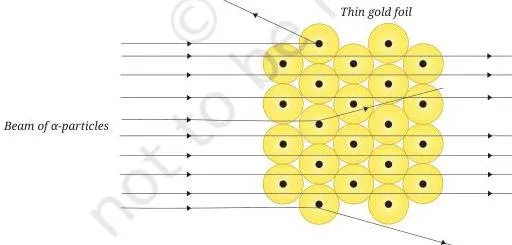
As Fig. 8.4 shows, most alpha particles passed straight through the foil because the atom is mostly empty space; the few that bounced back had struck the dense, positively charged nucleus.
\[ d_{\text{atom}} \approx 10^{-10}\ \text{m}, \qquad d_{\text{nucleus}} \approx 10^{-15}\ \text{m} \]
The nucleus is about \( 10^5 \) (one lakh) times smaller than the atom:
\[ \frac{d_{\text{atom}}}{d_{\text{nucleus}}} \approx \frac{10^{-10}}{10^{-15}} = 10^5 \]

The figure above gives the scale Rutherford arrived at: if an atom were a cricket ground, the nucleus would be a tiny pepper grain at the centre (NCERT, p. 145).
A direct consequence is counting atoms across a thickness. If a sheet has thickness \( t \), the number of atoms stacked across it is \[ N = \frac{t}{d_{\text{atom}}} \]
with \( t \) and \( d_{\text{atom}} \) in the same unit. For a paper sheet \( 0.1\ \text{mm} = 10^{-4}\ \text{m} \) thick, this gives about one million atoms lined up (NCERT, p. 145):
\[ N = \frac{10^{-4}}{10^{-10}} = 10^6 \]
Atomic Number and Mass Number
The atomic number is the number of protons in the nucleus. It decides which element the atom is and how it behaves chemically (NCERT, p. 150):
\[ Z = \text{number of protons in the nucleus} \]
The mass number is the total number of protons and neutrons, which together are called nucleons (NCERT, p. 151):
\[ A = p^+ + n^0 \]
Electrons are left out because their mass is negligible compared with a proton or neutron.
Rearranging the mass number formula gives the neutron count. This derived form is valid whenever \( A \) and \( Z \) are both known:
\[ n^0 = A – Z \]
For hydrogen it gives \( n^0 = 1 – 1 = 0 \), matching the fact that hydrogen has no neutrons.
In standard notation the two numbers bracket the symbol, mass number on the top-left and atomic number on the bottom-left (NCERT, p. 151):
\[ {}^{A}_{Z}\text{X} \]
For example, carbon with 6 protons and 6 neutrons is written \( {}^{12}_{6}\text{C} \).
Electron Distribution in Different Energy Levels
Bohr and Bury’s rule fixes the maximum number of electrons a shell can hold (NCERT, p. 152):
\[ \text{Maximum electrons in a shell} = 2n^2 \]
where \( n \) is the shell number: K = 1, L = 2, M = 3, N = 4, …
| Shell | Shell number \( n \) | Maximum electrons \( 2n^2 \) |
|---|---|---|
| K | 1 | \( 2 \times 1^2 = 2 \) |
| L | 2 | \( 2 \times 2^2 = 8 \) |
| M | 3 | \( 2 \times 3^2 = 18 \) |
| N | 4 | \( 2 \times 4^2 = 32 \) |
Two rules complete the picture:
- The outermost shell can hold at most 8 electrons; the first shell can hold at most 2.
- Shells fill in order, starting from the shell closest to the nucleus: K, then L, then M, then N.
The outermost-shell limit overrides \( 2n^2 \) for the last shell. That is why argon, with 18 electrons, is written 2, 8, 8 and not 2, 8, 18 (NCERT, p. 152).
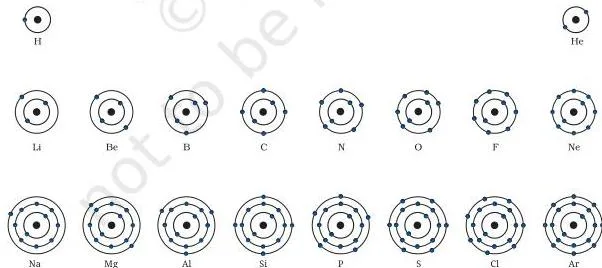
Fig. 8.11 shows the first eighteen elements built with these rules: each step adds one proton and one electron, and the new electron enters the next available shell.
A useful detail: the shell letters K, L, M, N come from early X-ray experiments, where the first observed line was named K — which is why the shells never started at A (NCERT, p. 147).
Combining Capacity of an Atom: Valency
The outermost shell of an atom is its valence shell, and the electrons in it are valence electrons. A full outer shell of 8 electrons is an octet (2 electrons in the case of helium) and makes an atom stable and largely unreactive.
Valency is the number of electrons an atom gains, loses, or shares to complete its octet (NCERT, p. 154). The chapter’s working rule:
- fewer than 4 valence electrons → the atom tends to lose them, so valency equals the number lost;
- more than 4 valence electrons → the atom tends to gain enough to reach 8, so valency equals the number gained;
- 4 valence electrons → the atom tends to share electrons, as carbon does.
Examples from the chapter: sodium (2, 8, 1) loses 1 electron, so its valency is 1; oxygen (2, 6) gains 2, so its valency is 2; carbon (2, 4) shares 4, so its valency is 4.
Why it matters: a complete octet is a stable arrangement, so atoms lose, gain, or share electrons to reach it.
Isotopes and Isobars
Isotopes are atoms of the same element with the same atomic number but different mass numbers — the same number of protons, different numbers of neutrons (NCERT, p. 155):
\[ \text{Isotopes: same } Z, \text{ different } A \]
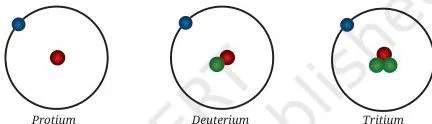
Fig. 8.12 shows hydrogen’s three isotopes: each has one proton, but protium ( \( {}^{1}_{1}\text{H} \) ) has no neutrons, deuterium ( \( {}^{2}_{1}\text{H} \) ) has one, and tritium ( \( {}^{3}_{1}\text{H} \) ) has two.
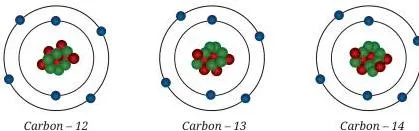
Fig. 8.13 shows the same pattern for carbon: \( {}^{12}_{6}\text{C} \), \( {}^{13}_{6}\text{C} \) and \( {}^{14}_{6}\text{C} \) all have six protons, with six, seven or eight neutrons respectively.
Because isotopes share the same electronic configuration, their chemical properties are the same; only physical properties such as boiling point and melting point differ (NCERT, p. 155). Heavier nuclei also need extra neutrons to stay bound — iron has 26 protons and 30 neutrons, while uranium has 92 protons and 146 neutrons (NCERT, p. 148).
Isobars are atoms of different elements with the same mass number but different atomic numbers (NCERT, p. 157):
\[ \text{Isobars: different } Z, \text{ same } A \]
Calcium, potassium and argon all have mass number 40 even though their atomic numbers are 20, 19 and 18, so they are written as the isobars \( {}^{40}_{20}\text{Ca} \), \( {}^{40}_{19}\text{K} \) and \( {}^{40}_{18}\text{Ar} \).
Average Atomic Mass
Most elements occur in nature as a mixture of isotopes, so the atomic mass of the element is an average. The chapter first shows the simple average and why it fails (NCERT, p. 156):
\[ \frac{m_1 + m_2}{2} \]
This assumes both isotopes are equally common. For chlorine it gives \( \frac{35 + 37}{2} = 36\ \text{u} \), which does not match nature because \( {}^{35}\text{Cl} \) is far more abundant than \( {}^{37}\text{Cl} \).
The correct value is the weighted average atomic mass — multiply each isotope’s mass by its percent relative abundance, then add (NCERT, p. 156):
\[ \text{AAM} = m_1\frac{x_1}{100} + m_2\frac{x_2}{100} \]
For chlorine, about 75% \( {}^{35}\text{Cl} \) and 25% \( {}^{37}\text{Cl} \):
\[ 35 \times \frac{75}{100} + 37 \times \frac{25}{100} = 35.5\ \text{u} \]
No single chlorine atom has mass 35.5 u; it is the weighted mean of a large sample, exactly the average of a 3:1 mixture of 35 u and 37 u atoms.
What Each Symbol Means
Every symbol used on this page, with its meaning and unit or nature:
| Symbol | What it means | Unit / nature |
|---|---|---|
| \( Z \) | Atomic number — the number of protons in the nucleus | Dimensionless (a count); identifies the element |
| \( A \) | Mass number — the total number of protons and neutrons (nucleons) | Dimensionless (a count) |
| \( p^+ \) | Proton — a positively charged particle in the nucleus | Relative charge \( +1 \) |
| \( n^0 \) | Neutron — an uncharged particle in the nucleus | Relative charge \( 0 \) |
| \( e^- \) | Electron — a negatively charged particle moving around the nucleus | Relative charge \( -1 \); real charge \( -1.602 \times 10^{-19}\ \text{C} \) |
| \( n \) | Shell number in the \( 2n^2 \) rule (K = 1, L = 2, M = 3, N = 4) | Dimensionless (a count) |
| \( d_{\text{atom}} \) | Diameter of an atom | Metre; \( \approx 10^{-10}\ \text{m} \) |
| \( d_{\text{nucleus}} \) | Diameter of the nucleus | Metre; \( \approx 10^{-15}\ \text{m} \) |
| \( t \) | Thickness of a sheet in the atoms-stacked calculation | Metre |
| \( N \) | Number of atoms stacked across the thickness | Dimensionless (a count) |
| \( m_1, m_2 \) | Masses of the two isotopes | Unified atomic mass unit (u) |
| \( x_1, x_2 \) | Percent relative abundances of the two isotopes | Percentage (dimensionless) |
| \( \text{AAM} \) | Average atomic mass of the element | Unified atomic mass unit (u) |
When to Use Each Formula
Start from the question, not from the formula list. This table tells you which relation to reach for:
| Formula or rule | Use it when … |
|---|---|
| \( Z = \text{number of protons} \) | You need the atomic number or the proton count; \( Z \) decides which element the atom is. |
| \( \text{electrons} = \text{protons} = Z \) | You need the electron count of a neutral atom. This chapter treats every atom as neutral. |
| \( A = p^+ + n^0 \) | You need the mass number from proton and neutron counts. |
| \( n^0 = A – Z \) | You know \( A \) and \( Z \) and need the neutron count; it gives 0 for hydrogen. |
| \( 2n^2 \) | You are distributing electrons into shells; \( n = 1, 2, 3, 4, \dots \) gives the capacity of that shell, not the number actually filled. |
| Outermost shell \( \leq 8 \) (or 2 for the first shell) | You are writing the electronic configuration; this limit overrides \( 2n^2 \) for the last shell. |
| \( {}^{A}_{Z}\text{X} \) | You are reading or writing the standard notation of an atom. |
| \( N = \frac{t}{d_{\text{atom}}} \) | You need to count how many atoms line up across a known thickness, with \( t \) and \( d_{\text{atom}} \) in the same unit. |
| \( \text{AAM} = m_1\frac{x_1}{100} + m_2\frac{x_2}{100} \) | Isotope masses and their percent abundances are given; this is the correct average whenever the abundances differ. |
| \( \frac{m_1 + m_2}{2} \) | Only if the two isotopes occur in equal amounts, which is rare; the chapter shows it misrepresents natural chlorine. |
Worked Examples
Three examples with original numbers show the formula selection, the substitution, and the final answer with its unit.
Example 1: Maximum electrons in the M and N shells
Step 1: Select the rule.
The maximum number of electrons a shell can hold is \( 2n^2 \), where \( n \) is the shell number.
- Step 1: For the M shell, \( n = 3 \): \( 2 \times 3^2 = 2 \times 9 = 18 \).
- Step 2: For the N shell, \( n = 4 \): \( 2 \times 4^2 = 2 \times 16 = 32 \).
Final answer: the M shell can hold 18 electrons and the N shell can hold 32. These are capacities — when M is the outermost shell, only 8 of its places are actually occupied.
Example 2: Working backwards from the mass number
Given: an atom of element X has mass number \( A = 39 \) and \( n^0 = 20 \) neutrons.
- Step 1: Rearrange the mass number formula to find the atomic number: \( Z = A – n^0 = 39 – 20 = 19 \).
- Step 2: The atom is neutral, so electrons = protons = 19.
- Step 3: Distribute 19 electrons: K takes 2 and L takes 8, leaving 9; the outermost shell cannot exceed 8, so the configuration is 2, 8, 8, 1.
- Step 4: The outermost shell has 1 valence electron, fewer than 4, so the atom tends to lose it: valency 1.
Final answer: \( Z = 19 \), electrons = 19, electronic configuration 2, 8, 8, 1, valency 1.
Example 3: Weighted average atomic mass from isotope abundances
Given: element X has two isotopes of masses 20 u (90% abundant) and 22 u (10% abundant).
- Step 1: Select the weighted average because the two isotopes are not equally abundant: \( \text{AAM} = m_1\frac{x_1}{100} + m_2\frac{x_2}{100} \).
- Step 2: Substitute: \( 20 \times \frac{90}{100} + 22 \times \frac{10}{100} = 18 + 2.2 = 20.2\ \text{u} \).
Check: the simple average would give \( \frac{20 + 22}{2} = 21\ \text{u} \), which is wrong here because it ignores the 90 : 10 ratio.
Final answer: the average atomic mass of X is \( 20.2\ \text{u} \). The value lies between 20 u and 22 u but closer to 20 u, since the lighter isotope dominates the sample.
Once the formulas are clear, practise them on the textbook’s own questions. For other chapters, browse the main chemistry formulas index.
Common Mistakes to Avoid
The errors below are specific to this chapter’s formulas. Each row gives the correction and a quick self-check.
| Mistake | Correct rule | How to check your answer |
|---|---|---|
| Writing cobalt as CO or chlorine as CL | The first letter of a symbol is capital and the second letter, if any, is small: Co, Cl, Al. | Read the symbol back; if the second letter is a capital, rewrite it. |
| Adding electrons into the mass number, e.g. \( A = p^+ + e^- \) | Mass number counts only nucleons: \( A = p^+ + n^0 \). Electrons are excluded because their mass is negligible. | Subtract \( Z \) from \( A \) and compare with the neutron count in the question; the two must match. |
| Forgetting to divide the percentage in the weighted average, e.g. \( 35 \times 75 + 37 \times 25 \) | Multiply each isotope mass by its percentage over 100: \( 35 \times \frac{75}{100} + 37 \times \frac{25}{100} \). | The average must lie between the two isotope masses; 35.5 u lies between 35 u and 37 u. |
| Reading the bottom number of \( {}^{23}_{11}\text{Na} \) as the mass number | Top-left is \( A \); bottom-left is \( Z \), the atomic number (number of protons). | The bottom number must equal the element’s proton count — 11 for sodium, not 23. |
| Claiming every chlorine atom has mass 35.5 u | No single atom has this mass; 35.5 u is the weighted average of a large sample of 35 u and 37 u atoms. | One atom cannot have a fraction of a proton; averages can be fractional, atoms cannot. |
Frequently Asked Questions
How do I find the number of neutrons from the standard notation?
The bottom-left number is \( Z \), the number of protons; the top-left number is \( A \), the mass number. Neutrons are the difference: \( n^0 = A – Z \). In \( {}^{23}_{11}\text{Na} \), for instance, neutrons \( = 23 – 11 = 12 \).
Why is the atomic mass of chlorine 35.5 u?
Natural chlorine is about 75% \( {}^{35}\text{Cl} \) and 25% \( {}^{37}\text{Cl} \). The weighted average, \( 35 \times \frac{75}{100} + 37 \times \frac{25}{100} \), equals 35.5 u. The simple average gives 36 u, which wrongly assumes the two isotopes occur in equal amounts.
Why does the M shell hold 18 electrons but argon has only 8 in its M shell?
The rule \( 2n^2 \) gives the maximum capacity of the shell; a separate rule limits the outermost shell to 8 electrons. Argon, with 18 electrons, fills K with 2 and L with 8, then stops M at 8 because M is its outermost shell — so its configuration is 2, 8, 8.
Are isotopes and isobars the same?
No. Isotopes have the same atomic number but different mass numbers — the same element with different neutron counts. Isobars have the same mass number but different atomic numbers — different elements with the same total number of nucleons. \( {}^{1}_{1}\text{H} \) and \( {}^{2}_{1}\text{H} \) are isotopes; \( {}^{40}_{20}\text{Ca} \) and \( {}^{40}_{19}\text{K} \) are isobars.
Reference: NCERT Class 9 Science textbook (Exploration), chapter Journey Inside the Atom.
Explore Class 9 Chemistry Formulas
More for this chapter:
Class 9 Chemistry on LearnCBSE:
Related chapters: