
This is the official NCERT Class 12 Economics chapter 5, Government Budget and the Economy, from Introductory Macroeconomics — about 19 printed pages covering budget receipts and expenditure, the three deficits, fiscal policy multipliers, government debt, FRBMA and GST. The official NCERT PDF is directly below.
Download the government budget and the economy class 12 NCERT chapter PDF — Chapter 5 of NCERT Class 12 Introductory Macroeconomics, printed pages 66-84 of the book. Open it to follow the section map and the worked examples below in your own copy.
| What the chapter holds | Count | Where it is used |
|---|---|---|
| Printed pages | 19 | |
| Sections in the chapter | 4 | |
| Figures with NCERT captions | 6 | |
| Tables | 1 | |
| Worked examples | 3 | solved step by step in our NCERT Solutions |
| Exercise questions | 10 | answered in our NCERT Solutions |
| Official NCERT PDF | Download the chapter PDF | the chapter exactly as NCERT publishes it |
Chapter at a glance
The table below lists what the chapter holds — sections, figures, worked examples and exercise questions — so you can see the size of the file before you open it.
| Content in the chapter | Count |
|---|---|
| Printed pages | 19 |
| Sections | 24 |
| Figures | 6 |
| Worked examples | 3 |
| Exercise questions | 10 |
This is Chapter 5 of one of the two Class 12 economics books published by NCERT (Introductory Macroeconomics; the other is Indian Economic Development). It builds directly on Chapter 4’s multiplier and is followed by Chapter 6, Open Economy Macroeconomics.
What the Government Budget and the Economy Class 12 chapter covers
The chapter moves in a clear order: what a budget is, how receipts and expenditure are classified, the three deficits, the fiscal-policy multiplier model, and finally government debt. Use this page-numbered map to jump straight to the part you need in the PDF.
- 5.1 Government Budget — meaning and components (p. 66): the constitutional requirement of the Annual Financial Statement, and the revenue and capital accounts.
- Objectives of the budget (p. 67): the allocation, redistribution and stabilisation functions.
- Classification of receipts (p. 68): revenue receipts versus capital receipts, and why the distinction matters.
- Classification of expenditure (p. 69): revenue expenditure versus capital expenditure, with the plan/non-plan footnote critique.
- 5.2 Balanced, surplus and deficit budget (p. 70): the three measures of deficit, with Table 5.1 on pp. 71-72.
- Box 5.1 Fiscal Policy and the multiplier model (pp. 72-78): the government in the income-determination model, with Examples 5.1-5.3.
- Debt (pp. 78-80): whether government debt is a burden, Ricardian equivalence, and deficit reduction.
- Summary and Key Concepts (pp. 80-81).
- Box 5.2 FRBMA (pp. 81-82) and Box 5.3 GST (pp. 82-83).
- Exercises (pp. 83-84): 10 questions mixing numericals and concepts.
Key concepts in this chapter, explained
The chapter’s content is mostly definitions (what counts as revenue or capital), one set of formulas (the three deficits), and one model (the fiscal-policy multipliers). This section walks through all three so you can follow along in your own book.
The budget and its three functions
The government budget is the statement of estimated receipts and expenditure that the government must present to Parliament every financial year (1 April to 31 March), under Article 112. Because this year’s budget affects later years too, the budget splits into the revenue account (current financial year only) and the capital account (the government’s assets and liabilities) (NCERT, p. 66).
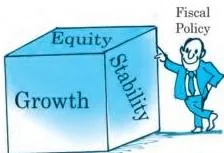
Why three functions? Each one names a job the market cannot do alone (NCERT, p. 67):
- Allocation function: public goods like defence, roads and administration are non-rivalrous and non-excludable, so private firms cannot collect fees and will not supply them. The government must step in. Note the distinction: public provision means the budget finances the good; public production means the government makes it itself.
- Redistribution function: by collecting taxes and making transfers, the government changes personal disposable income and can make the income distribution fairer — progressive income taxation is the main instrument.
- Stabilisation function: when demand is too low for full employment, the government raises aggregate demand; when demand exceeds output and causes inflation, it restrains demand.
How receipts and expenditure are classified
Every deficit formula depends on getting these two axes right, so the classification is the foundation of the chapter.
Receipts divide into (NCERT, p. 68):
- Revenue receipts — do not create a claim on the government (non-redeemable). They include tax revenue (direct taxes like income and corporation tax; indirect taxes like excise and customs) and non-tax revenue (interest receipts, dividends, fees, grants).
- Capital receipts — either create a liability (loans taken) or reduce financial assets (PSU disinvestment). They can be debt-creating or non-debt-creating — this distinction feeds directly into the fiscal deficit.
Expenditure divides into (NCERT, pp. 69-70):
- Revenue expenditure — creates no physical or financial asset. Interest payments are the single largest item; defence is committed expenditure; subsidies are a policy instrument.
- Capital expenditure — creates assets (land, buildings, machinery, shares) or reduces financial liabilities (loans and advances to states and PSUs).
The textbook itself criticises the plan/non-plan classification in a footnote on p. 69, noting it encouraged starting new schemes while neglecting maintenance, and wrongly made non-plan spending look wasteful. Three FRBMA-mandated policy statements accompany the budget (p. 70): the Medium-term Fiscal Policy Statement, the Fiscal Policy Strategy Statement and the Macroeconomic Framework Statement.
The three deficits and what a high value signals
All three deficits are simple subtractions, but each measures something different. Learn what each one signals before memorising formulas.
\[ \text{Revenue deficit} = \text{Revenue expenditure} – \text{Revenue receipts} \quad \text{(NCERT, p. 71)} \]
\[ \text{Gross fiscal deficit} = \text{Total expenditure} – (\text{Revenue receipts} + \text{Non-debt creating capital receipts}) \quad \text{(NCERT, p. 72)} \]
\[ \text{Gross primary deficit} = \text{Gross fiscal deficit} – \text{Net interest liabilities} \quad \text{(NCERT, p. 72)} \]
From the financing side, the fiscal deficit also equals net borrowing at home + borrowing from RBI + borrowing from abroad (NCERT, p. 72). The table below compares the three.
| Deficit | Formula | What it measures | What a large value signals |
|---|---|---|---|
| Revenue deficit | Revenue expenditure − Revenue receipts | How much of current (revenue) spending is not covered by current receipts | The government is dissaving — borrowing to finance consumption, not investment |
| Gross fiscal deficit | Total expenditure − (Revenue receipts + Non-debt creating capital receipts) | The government’s total borrowing requirement from all sources | A large share of revenue deficit within it means borrowing is funding consumption |
| Gross primary deficit | Fiscal deficit − Net interest liabilities | Borrowing due to current spending exceeding revenues, with interest set aside | Present fiscal imbalance — how much of the deficit is not just old interest obligations |
Walking through Table 5.1 (pp. 71-72, source: Economic Survey 2026-27): all figures are percentages of GDP. The three deficits are arithmetically linked:
- Revenue deficit: revenue expenditure (11.8) minus revenue receipts (9.2) = 2.6 — exactly the table’s row 3.
- Fiscal deficit: total expenditure (11.8 revenue + 3.2 capital = 15.0) minus non-debt receipts (9.4) = 5.6 — the table’s row 8. Non-debt receipts (9.4) are revenue receipts (9.2) plus recovery of loans (0.1) plus other receipts (0.1).
- Primary deficit: fiscal deficit (5.6) minus interest payments (3.6) = 2.0 — the table’s row 9.
Fiscal policy and the multiplier model
Box 5.1 puts the government into the income-determination model from Chapter 4. The government enters in two ways: its purchases \(G\) add directly to aggregate demand, and taxes \(T\) and transfers \(TR\) change the relation between income and disposable income (NCERT, p. 73).
With lump-sum taxes \(T\) and constant transfers \(\bar{T}\bar{R}\), disposable income is \(Y_D = Y – T + \bar{T}\bar{R}\), so consumption is:
\[ C = \bar{C} + cY_D = \bar{C} + c(Y – T + \bar{T}\bar{R}) \quad (5.1) \]
\[ Y = \bar{C} + c(Y – T + \bar{T}\bar{R}) + I + G \quad (5.3) \]
\[ Y’ = \frac{1}{1-c}(\bar{C} – cT + c\bar{T}\bar{R} + I + G) \quad (5.4) \]
The multiplier results are the heart of every numerical question. Memorise the formulas and know why each one looks the way it does.
| Multiplier | Formula | Why it has this value |
|---|---|---|
| Government spending | \( \dfrac{1}{1-c} \) (eq 5.6) | \(G\) enters aggregate demand directly, so a ₹1 rise in \(G\) raises demand by ₹1 at the first round |
| Tax | \( \dfrac{-c}{1-c} \) (eq 5.8) | Negative — a tax rise cuts disposable income, so consumption falls; the first-round effect is only \(c \times \Delta T\) |
| Transfer | \( \dfrac{c}{1-c} \) (eq 5.22) | Like taxes, transfers work through disposable income, so the first-round effect is \(c \times \Delta TR\) |
| Balanced budget | \( 1 \) (eq 5.9) | Spending multiplier plus tax multiplier: \( \frac{1}{1-c} + \frac{-c}{1-c} = 1 \) |
| Proportional tax | \( \dfrac{1}{1-c(1-t)} \) (eq 5.18) | The mpc out of income falls to \( c(1-t) \), so each round of spending leaks more into taxes |
Why the tax multiplier is smaller: a rise in \(G\) increases total spending directly. A tax cut works only through disposable income — households save part of it, so the first-round rise in spending is \(c \times \Delta T\), not the full \(\Delta T\) (NCERT, p. 74).
Worked example (a) — the tax multiplier is smaller in absolute value. Take MPC \(c = 0.6\).
Step 1: Government spending multiplier \( = \dfrac{1}{1-c} = \dfrac{1}{0.4} = 2.5 \).
Tax multiplier \( = \dfrac{-c}{1-c} = \dfrac{-0.6}{0.4} = -1.5 \).
- Step 1: A ₹200 rise in \(G\) raises income by \( 2.5 \times 200 = 500 \).
- Step 2: A ₹200 tax cut raises income by \( 1.5 \times 200 = 300 \).
Final answer: the same ₹200 stimulus gives ₹500 through spending but only ₹300 through taxes — because \(G\) enters aggregate demand directly while taxes pass through disposable income and saving.
Worked example (b) — the balanced budget multiplier equals one. Take MPC \(c = 0.75\) with \(\Delta G = \Delta T = 80\).
- Step 1: Spending multiplier \( = \dfrac{1}{1-0.75} = 4 \), so the \(G\) rise alone would add \( 4 \times 80 = 320 \).
- Step 2: Tax multiplier \( = \dfrac{-0.75}{0.25} = -3 \), so the matching tax rise subtracts \( 3 \times 80 = 240 \).
- Step 3: Net change \( = 320 – 240 = 80 \).
Final answer: income rises by exactly the ₹80 increase in \(G\), so the balanced budget multiplier is 1 (NCERT, p. 75).
Worked example (c) — a proportional tax shrinks the multiplier. Take MPC \(c = 0.9\) with a proportional tax rate \(t = 0.25\).
- Step 1: The mpc out of income falls to \( c(1-t) = 0.9 \times 0.75 = 0.675 \).
- Step 2: Multiplier \( = \dfrac{1}{1-0.675} = \dfrac{1}{0.325} \approx 3.08 \).
With lump-sum taxes the multiplier would be \( \dfrac{1}{0.1} = 10 \) — the tax cuts it to about a third.
Step 3: A ₹100 rise in \(G\) adds only \( 3.08 \times 100 \approx 308 \) to income.
Final answer: the proportional income tax acts as an automatic stabiliser: each round of income growth leaks part away as taxes, so consumption rises less and the economy settles sooner (NCERT, pp. 76-77).
Government debt: burden or not?
Deficits are a flow that adds to the stock of debt, and interest payments themselves add further to the debt (NCERT, p. 78). The chapter then presents competing arguments:
- The burden argument: borrowing today is repaid by taxes on future workers, lowering their disposable income; government borrowing can also crowd out private borrowers from the available savings pool (NCERT, p. 79).
- Ricardian equivalence: forward-looking consumers expect higher future taxes, so they save more now; taxation and borrowing are equivalent ways to finance spending (NCERT, p. 79).
- “We owe it to ourselves”: true only for domestic debt — purchasing power stays within the nation. Foreign debt is a real burden because goods must be sent abroad to service it (NCERT, p. 79).
- Are deficits inflationary? Not necessarily — with unutilised resources, higher demand is met by higher output rather than higher prices (NCERT, p. 79).
- Deficit reduction: raise direct taxes, sell PSU shares, and make expenditure more efficient. The textbook cites a Planning Commission study finding that transferring ₹1 to the poor through food subsidy costs the government ₹3.65, and warns against cutting vital programmes in agriculture, education, health and poverty alleviation (NCERT, pp. 79-80).
FRBMA and GST: the two boxes
These two policy boxes close the chapter, and exercise question 15 expects you to know the GST one. Learn what each law actually does.
Box 5.2, FRBMA (2003) (NCERT, pp. 81-82): binds the government by law to prudent fiscal policy. The main features:
- Fiscal deficit to be reduced to not more than 3% of GDP, and revenue deficit to be eliminated by March 2009 (later rescheduled to 2009-10).
- Annual reduction of fiscal deficit by 0.3% of GDP and revenue deficit by 0.5%.
- No borrowing from the RBI except short-term advances; RBI not to subscribe to primary issues from 2006-07.
- Three mandated statements laid before Parliament (the Medium-term Fiscal Policy, Fiscal Policy Strategy, and Macroeconomic Framework Statements) plus quarterly review.
- 26 states have enacted their own fiscal responsibility laws; the FRBM Review Committee was tasked with revamping the framework.
Box 5.3, GST (NCERT, pp. 82-83): a single comprehensive indirect tax, operational from 1 July 2017 under the 101st Constitutional Amendment (Article 246A). Key points:
- One nation, one tax, one market — one rate for one type of good or service across the country.
- Input tax credit removes the cascading of taxes: tax is charged at every stage, but credit for the previous stage’s tax is set off, so GST is effectively a tax on value added.
- Six standard rates: 0%, 3%, 5%, 12%, 18% and 28%.
- Five petroleum products kept out for now; alcohol taxed by states; tobacco attracts both GST and central excise.
Reading the diagrams in this chapter
Every diagram in this chapter tells the same story: a change in government spending or taxes moves the aggregate demand curve, and the size of the resulting income change is the multiplier. Each figure below is followed by what it shows.

This diagram (NCERT, p. 67) makes the redistribution function visual. National income splits into private income (households and firms) and public income (the government). Out of private income, what households can actually spend is personal disposable income — and the government changes that amount by collecting taxes and making transfers.
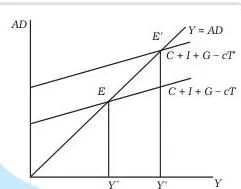
This is the diagram beside the rise in \(G\) (NCERT, p. 73). A higher \(G\) shifts AD up to AD’. At the old income, demand exceeds output, firms expand production, and the multiplier mechanism from Chapter 4 runs. The new equilibrium sits at a higher income — the change in \(Y\) equals \( \frac{1}{1-c} \times \Delta G \).
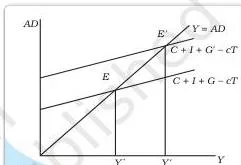
These two diagrams (NCERT, p. 74) make the spending-versus-tax comparison concrete. A rise in government spending shifts AD directly by the full \(\Delta G\), while a tax cut shifts the aggregate expenditure schedule upward by only \( c \times \Delta T \) — households save the rest. This is exactly why the tax multiplier is the smaller one.
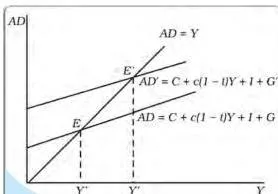
This is Fig 5.4, “Increase in Government Expenditure (with proportional taxes)” (NCERT, p. 76). The AD schedule is flatter because the marginal propensity to consume out of income is \( c(1-t) \) — each extra rupee of income leaks part away as tax. The same rise in \(G\) therefore produces a smaller income gain than in the lump-sum case.
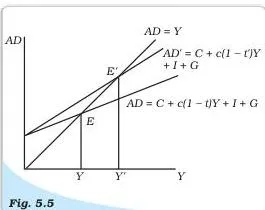
This is Fig 5.5, “Effects of a Reduction in the Proportional Tax Rate” (NCERT, p. 77). Cutting the tax rate works like an increase in the propensity to consume: the AD curve shifts up, at the initial income demand exceeds output, and income rises to a new equilibrium.
The caption of Fig 5.3 on p. 76 — “Government and Aggregate Demand (proportional taxes make the AD schedule flatter)” — describes the same idea without a separate diagram here: proportional taxes lower the slope of the consumption function, so the AD schedule pivots to be flatter than with lump-sum taxes.
Definitions to keep straight
This chapter’s questions mostly test whether you can use its terms precisely. Here is every term you must keep straight, with the page where the book defines it.
| Term | Plain meaning | Page |
|---|---|---|
| Public goods | Goods that are non-rivalrous and non-excludable — one person’s use does not reduce others’ use, and nobody can feasibly be excluded | pp. 66-67 |
| Free-rider | A user who enjoys the benefits of a public good without paying, because fees cannot be collected | p. 67 |
| Public provision vs public production | Provision = the budget finances the good; production = the government makes it itself | p. 67 |
| Revenue receipts | Receipts that do not create a claim on the government — tax and non-tax revenue | p. 68 |
| Capital receipts | Receipts that create a liability or reduce financial assets — loans and PSU disinvestment | p. 68 |
| Revenue expenditure | Spending that creates no physical or financial asset | p. 69 |
| Capital expenditure | Spending that creates assets or reduces liabilities | p. 70 |
| Revenue deficit | Revenue expenditure minus revenue receipts — dissaving by the government | p. 71 |
| Gross fiscal deficit | Total expenditure minus (revenue receipts + non-debt creating capital receipts) — total borrowing requirement | p. 72 |
| Gross primary deficit | Fiscal deficit minus net interest liabilities — present fiscal imbalance | p. 72 |
| Lump-sum tax | A tax that does not depend on income | p. 73 |
| Balanced budget multiplier | The multiplier when \( \Delta G = \Delta T \); it equals 1 | p. 75 |
| Automatic stabiliser | A feature of the fiscal system (like proportional taxes) that dampens fluctuations without new decisions | p. 77 |
| Discretionary fiscal policy | Deliberate changes in spending or taxes to offset shifts in investment demand | p. 77 |
| Ricardian equivalence | The view that consumers foresee future taxes from current borrowing, so they save more now — borrowing and taxation are equivalent | p. 79 |
| GST | A single comprehensive indirect tax on the supply of goods and services, with input tax credit | p. 82 |
Common mistakes in this chapter
The mistakes in this chapter are mostly about mixing up the three deficits, forgetting signs on multipliers, and over-generalising the debt arguments. Each correction below carries the page where the right idea is taught.
| Mistake | Correct rule | How to check your answer |
|---|---|---|
| Treating revenue deficit and fiscal deficit as the same thing | Fiscal deficit = revenue deficit + capital expenditure − non-debt creating capital receipts (pp. 71-72) | In Table 5.1, add capital expenditure (3.2) to revenue deficit (2.6), subtract non-debt capital receipts (0.2) — you get 5.6, the fiscal deficit |
| Forgetting the tax multiplier is negative | A tax cut raises income; a tax increase lowers it (p. 74) | Write the sign: \( \Delta Y = \dfrac{-c}{1-c} \Delta T \) — a positive \( \Delta T \) must give a negative \( \Delta Y \) |
| Thinking the tax multiplier is larger than the spending multiplier | It is always smaller in absolute value by exactly one (p. 75) | With c = 0.8: spending multiplier 5, tax multiplier −4 |
| Thinking a balanced budget leaves income unchanged | The balanced budget multiplier is 1, so income rises by exactly the increase in G (p. 75) | \( \frac{1}{1-c} + \frac{-c}{1-c} = 1 \) — income changes by \( \Delta G \) alone |
| Assuming every deficit is inflationary | With unutilised resources, higher demand calls forth higher output, not higher prices (p. 79) | Ask: is the economy at full employment? If not, the deficit need not raise prices |
| Reading “we owe it to ourselves” as true of all debt | It holds only for domestic debt; foreign debt is a real burden paid in goods (p. 79) | Check who holds the debt — if foreigners hold it, goods must leave the country to service it |
| Confusing deficit (a flow) with debt (a stock) | Each year’s deficit adds to the stock of debt, and interest payments add further (p. 78) | Deficit is measured per year; debt is the accumulated total |
| Confusing public provision with public production | The government can finance a good (provision) without producing it itself (p. 67) | Ask: who pays versus who makes the good |
Using this chapter for exam preparation
The best preparation is to be able to do what the chapter’s own exercises ask. The exercises divide cleanly into numerical and conceptual work, and each maps to a specific part of the chapter.
| Exercise | Concept tested | Where taught |
|---|---|---|
| Q6 | Equilibrium income and multipliers with lump-sum taxes and transfers | pp. 73-75 |
| Q7 | Transfer multiplier versus lump-sum tax multiplier | p. 78 |
| Q8 | Equilibrium with a proportional tax; balanced budget check | pp. 76-77 |
| Q9 | Proportional-tax multiplier and transfer multiplier | pp. 76-78 |
| Q10 | Why the tax multiplier is smaller in absolute value | pp. 74-75 |
| Q11 | Relation between deficit and debt | p. 78 |
| Q12 | Does public debt impose a burden | pp. 78-80 |
| Q13 | Are fiscal deficits inflationary | p. 79 |
| Q14 | Deficit reduction | pp. 79-80 |
| Q15 | GST and how it compares to the old tax system | pp. 82-83 |
Skills to leave with: compute equilibrium income from \(Y = AD\) with both lump-sum and proportional taxes; derive the government spending, tax, balanced budget, proportional tax and transfer multipliers; use the three deficit formulas on data; and explain the debt debates in your own words.
Syllabus note: textbook contents and the examinable syllabus are not always identical — check the current official CBSE syllabus for what is examinable this session.
Sequencing tip: revisit Chapter 4’s multiplier before working through Box 5.1, because the chapter explicitly builds on it (p. 73).
What to remember from this chapter
NCERT closes the chapter with six summary points and four key concepts. Here they are in plain words (NCERT, pp. 80-81):
- Public goods are non-rivalrous and non-excludable, so private firms cannot collect fees and will not supply them — the government must.
- The three functions — allocation, redistribution and stabilisation — all operate through the budget’s receipts and expenditure.
- The revenue account and the capital account separate the current financial year’s needs from investment in the country’s capital stock.
- A rising share of revenue deficit within fiscal deficit signals deteriorating quality of government expenditure — borrowing is being used for consumption.
- Proportional taxes reduce the multiplier because they lower the marginal propensity to consume out of income to \( c(1-t) \).
- Public debt is a burden if it reduces future growth in output, not merely because it exists.
The four key concepts the book lists: public goods, automatic stabiliser, discretionary fiscal policy, Ricardian equivalence.
Related resources
Continue with the rest of the Class 12 economics textbook set — the chapter before and after this one, plus the hubs that index them.
- Class 12 Economics notes and resources
- Previous chapter: Determination of Income and Employment — Chapter 4 introduces the multiplier that Box 5.1 uses and reuses (p. 73)
- Next chapter: Open Economy Macroeconomics — Chapter 6
- Class 12 hub
- All CBSE notes
Sources and data verification
This page describes NCERT Class 12 Introductory Macroeconomics, Chapter 5, Government Budget and the Economy, current NCERT reprint, official PDF on ncert.nic.in. It covers Chapter 5 only — not the rest of Introductory Macroeconomics, not Indian Economic Development, and not other classes. The page is maintained for the current academic session using the NCERT information available to us.
NCERT settles textbooks, editions and PDFs; CBSE settles the curriculum, syllabus and examinations. Textbook contents and the examinable syllabus are not always identical — check the current official CBSE syllabus.
Reference: NCERT Class 12 Introductory Macroeconomics textbook, chapter 5, official edition on ncert.nic.in.
Frequently asked questions
What is the difference between revenue deficit and fiscal deficit?
The revenue deficit is revenue expenditure minus revenue receipts — how much current spending is not covered by current receipts. The fiscal deficit is total expenditure minus (revenue receipts + non-debt creating capital receipts) — the government’s total borrowing requirement.
The fiscal deficit equals the revenue deficit plus capital expenditure minus non-debt creating capital receipts, so the revenue deficit is always a part of the fiscal deficit (NCERT, pp. 71-72).
Why is the tax multiplier smaller in absolute value than the government expenditure multiplier?
Because government spending enters aggregate demand directly, while a tax change works only through disposable income and consumption. Households save part of any tax cut, so the first-round rise in spending is only \(c \times \Delta T\), not the full \(\Delta T\).
With MPC c, the spending multiplier is \( \frac{1}{1-c} \) and the tax multiplier is \( \frac{-c}{1-c} \), which is one less in absolute value (NCERT, pp. 74-75).
Why is the balanced budget multiplier equal to one?
When the rise in government spending is matched by an equal rise in taxes, the spending multiplier and the tax multiplier act together: \( \frac{1}{1-c} + \frac{-c}{1-c} = 1 \). The spending rise adds income directly; the tax rise removes only the induced consumption part, so output rises by exactly the increase in \(G\) with no induced consumption spending (NCERT, p. 75).
Are fiscal deficits always inflationary?
No. If there are unutilised resources, higher demand from a deficit is met by higher output rather than higher prices. Inflation appears when demand exceeds the output the economy can produce at ongoing prices — near full employment. The same fiscal measures can produce a large or small deficit depending on the state of the economy (NCERT, p. 79).
What is the difference between government deficit and government debt?
Deficit is a flow measured over a period — the excess of expenditure over receipts in a year. Debt is the accumulated stock that results from running deficits year after year. Each year’s deficit adds to the debt, and the interest payments on that debt themselves add further to it (NCERT, p. 78).
What does Ricardian equivalence say about government borrowing?
It says forward-looking consumers understand that borrowing today means higher taxes in the future, so they save more now to offset the expected tax rise. National savings therefore do not change, which makes borrowing and taxation equivalent ways to finance government spending. The view is named after David Ricardo (NCERT, p. 79).
Reference: NCERT Class 12 Introductory Macroeconomics textbook, chapter 5, official edition on ncert.nic.in.
Explore Class 12 Economics Books
Related chapters: