
This page holds the official NCERT Class 11 Political Science Chapter 3, Equality, from the Political Theory textbook, as published for the 2026-27 session. The Equality Class 11 chapter runs over printed pages 31 to 52, and the official NCERT PDF of the chapter sits right below, followed by a plain-language account of what every section teaches.
The official NCERT Class 11 Political Science Political Theory Chapter 3 Equality PDF is published on the NCERT textbook portal (ncert.nic.in), where every chapter of the book opens as its own file.
Open the NCERT Class 11 Political Science Political Theory Chapter 3 Equality PDF there to read the chapter exactly as printed, including its two data tables, in-chapter boxes and all six exercises.
| What the chapter holds | Count | Where it is used |
|---|---|---|
| Printed pages | 22 | |
| Sections in the chapter | 4 | |
| Figures with NCERT captions | 4 | |
| Tables | 2 | |
| Exercise questions | 6 | answered in our NCERT Solutions |
| Official NCERT PDF | Download the chapter PDF | the chapter exactly as NCERT publishes it |
Chapter 3 Equality at a Glance
The chapter is one argument in four moves: why equality matters, what it means, which dimensions it has, and how to promote it. These are the syllabus sections and their printed pages:
- 3.1 Why Does Equality Matter? (pp. 32–34) — the moral ideal of equal worth and the paradox of accepted equality amid visible inequality.
- 3.2 What Is Equality? (pp. 35–37) — equal respect, equality of opportunity, and the natural-versus-social distinction.
- 3.3 Three Dimensions of Equality (pp. 38–42) — political, social and economic equality; the section then meets the ideologies, feminism, Marxism, liberalism and socialism, on pp. 42–44.
- 3.4 How Can We Promote Equality? (pp. 44–50) — formal equality, differential treatment and affirmative action.
- Exercises (pp. 51–52) — six questions that ask you to apply the chapter’s distinctions.
The chapter also carries two data tables — the Census of India 2011 household-amenities table (p. 34) and the NSSO 55th-round higher-education table (p. 40) — and closes with six exercise questions. In-chapter boxes such as LET’S DO IT, LET’S DEBATE, LET’S THINK and the FACT SHEET ON GLOBAL INEQUALITIES are classroom discussion prompts rather than content to memorise.
What This Chapter Covers
The chapter builds one continuous argument, and each section carries the next. It opens with four questions (p. 31): what equality is, whether it means treating everyone the same, how we may pursue it, and how its political, social and economic dimensions differ.
- Section 3.1 (pp. 32–34) presents equality as the equal worth of all human beings because of their common humanity — the idea behind universal human rights and ‘crimes against humanity’ — and behind the French Revolution’s ‘Liberty, Equality and Fraternity’.
- Section 3.2 (pp. 35–37) defines equal respect without identical treatment, adds equality of opportunity, and tests the natural-versus-social distinction.
- Section 3.3 (pp. 38–44) works through political, social and economic equality, then feminism (p. 42) and the ideologies, ending with Lohia’s five inequalities (p. 44).
- Section 3.4 (pp. 44–50) moves from formal equality to differential treatment to affirmative action, and closes with the identical-versus-equal master distinction.
The book states its own study rule on the opening page: the facts and figures about inequality are there for you to appreciate the nature of inequality; they need not be memorised (p. 31). The same instruction is repeated beside the global fact sheet (p. 32) and the Census table (p. 34).
Key Concepts in This Chapter
The chapter moves from a paradox to a definition to three dimensions to policy. These are the load-bearing ideas, in that order, each tied to its printed page.
Equal Worth and the Paradox of Inequality
Equality begins as a moral claim: all human beings have an equal worth regardless of colour, gender, race or nationality, and deserve equal consideration because of their common humanity (NCERT p. 32). This is why we speak of universal human rights and ‘crimes against humanity’.
The moral ideal has a political history. The French Revolution raised the slogan ‘Liberty, Equality and Fraternity’; anti-colonial liberation struggles in Asia and Africa took it up in the twentieth century; women and dalits continue to raise it today (p. 32).

Read the figure as the chapter’s paradox generator: everyone believes in a religion, every religion preaches equality, yet inequality is what surrounds us (pp. 32–34). Slums stand beside luxury housing, airconditioned classrooms beside schools without drinking water — glaring gaps between what the law promises and what we see (p. 33).
The global fact sheet (p. 33) gives the scale: the richest 50 people in the world have a combined income greater than that of the poorest 40 crore people, and the poorest 40 per cent of the world’s population receives only 5 per cent of global income.
The Census of India 2011 table (p. 34) shows the national version: 55 per cent of rural families have an electricity connection against 93 per cent of urban families, and tap water stands at 35 per cent versus 71 per cent.
Equal Respect Does Not Mean Identical Treatment
This is the chapter’s central distinction, stated early because every later section uses it. Distinctions made on grounds of race and colour violate our intuitive understanding of equality — that all human beings deserve the same respect and consideration (p. 35).
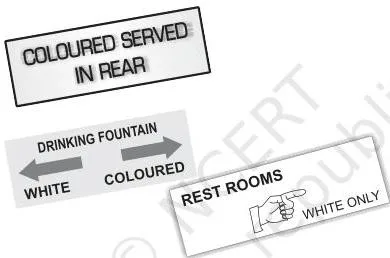
These images mark differences between people by race and colour, and most of us find them unacceptable (p. 35). But the follow-up matters more: equal respect does not require identical treatment.
No society treats all its members the same way under all conditions. Giving a prime minister or an army general a special official rank does not offend equality, as long as their privileges are not misused (p. 35).
What offends it is a child born in a slum being denied nutritious food or a good education through no fault of the child’s own (p. 35).
The chapter’s test collects this into one rule: the treatment we receive and the opportunities we enjoy must not be pre-determined by birth or social circumstance (p. 35). People may differ in ambition and success, and the ideal of equality does not imply the elimination of all forms of difference (p. 35).
Equality of Opportunity
If identical treatment is not the goal, equality of opportunity supplies the positive content of the ideal. All people, as human beings, are entitled to the same rights and opportunities to develop their skills and talents and pursue their goals and ambitions (p. 36).
Unequal results do not make a society unequal. That only some people become ace cricketers or successful lawyers is not a mark of inequality; what makes a society unequal is unequal access to basic goods such as education, health care and safe housing (p. 36).
Natural and Social Inequalities, and Why the Line Blurs
Political theory has distinguished natural inequalities — differences in capabilities and talents people are born with, assumed unalterable — from socially produced inequalities, which arise from inequalities of opportunity or exploitation (pp. 36–37). The distinction sounds clean; the chapter shows why it fails as a test of policy (p. 37).
It was used to justify slavery: colonial masters called black people child-like and better at manual work, sports and music, and used that belief to defend the institution (p. 37). It was used to deny women equal rights by calling women ‘the weaker sex’ (p. 37).
Both assessments are now questioned, and the book notes that women were for long described this way.
Second, ‘natural’ limits turn out to be alterable. Computers help blind people work, wheelchairs and artificial limbs help the physically disabled, cosmetic surgery can alter looks, and the physicist Stephen Hawking, who could hardly move or speak, made major contributions to science (p. 37).
Denying disabled people the help they need on the ground that they are naturally less capable would seem unjust to most people today (p. 37).
Because the natural/social line is not always clear or self-evident (p. 37), many theorists today prefer another line: inequality arising from personal choice versus inequality operating because of the family or circumstance into which a person is born. It is the second that advocates of equality wish to minimise and eliminate (p. 37).
Three Dimensions of Equality: Political, Social and Economic
This is the chapter’s analytical machinery: various thinkers and ideologies highlight three main dimensions of equality — political, social and economic — and only by addressing each of the three can a society move towards a more just and equal one (p. 38).
- Political equality (pp. 38–39): equal citizenship — the right to vote, freedom of expression, movement and association, and freedom of belief. These are legal rights guaranteed by the constitution and laws. Political and legal equality alone are not sufficient to build a just and egalitarian society, but they are an important component of it (p. 39).
- Social equality (p. 39): equality of opportunity plus minimum conditions of life — adequate health care, good education, adequate nourishment, a minimum wage. Without them, a huge pool of potential talent is wasted. In India a special problem comes from customs: women may not enjoy equal inheritance rights, face social prohibitions on some activities, and may be discouraged from higher education (pp. 39–40).
- Economic equality (pp. 40–41): the absence of significant differences in wealth, property or income. One measure is the relative gap between the richest and poorest groups; another is the number of people below the poverty line (p. 40). Inequalities that stay entrenched over generations, with wealth and power in the same classes, breed resentment and can give rise to violence (p. 41).
The section’s education table (p. 40) lists graduates per thousand persons in urban India: 47 for Scheduled Castes against 253 for Hindu-Upper Caste, with an all-India average of 155, and asks whether caste or the caste system is at work.
The READ A CARTOON box on racial inequality in the United States (p. 41) asks which Indian groups suffer similar inequality and what policies the US adopted.
Feminism: Patriarchy, Sex and Gender
Feminism is the chapter’s clearest worked example of inequality produced by society rather than by nature. Feminism is a political doctrine of equal rights for women and men, and feminists believe the inequalities between them are neither natural nor necessary and can be altered (p. 42).

Read the figure as a claim about structure. Patriarchy is a social, economic and cultural system that values men more than women and gives men power over women (p. 42). Feminists break its logic with two terms: sex, the biological difference between men and women, and gender — the different roles that men and women play in society (p. 42).
The pregnancy example clinches the argument: the biological fact that only women can become pregnant does not require that only women should look after children (p. 42). Women work outside the home and still carry sole responsibility for housework — the double burden — yet have little say in public decisions (p. 42).
Marxism, Liberalism and Socialism on Inequality
Four outlooks — feminism plus three ideologies — diagnose inequality differently and prescribe different remedies. The comparison students most often confuse sits in this table:
| Ideology | Cause of inequality it names | Remedy it prescribes |
|---|---|---|
| Feminism (p. 42) | Patriarchy — a system that values men over women, justifying unequal positions as natural | Eliminate the public/private division of labour and all forms of gender inequality |
| Marxism (p. 43) | Private ownership of essential resources — oil, land, forests, other property — which makes owners wealthy and gives them political power | Public control over essential resources and forms of property |
| Liberalism (pp. 43–44) | Unjust and entrenched inequalities that prevent people from developing their capabilities | Free and fair competition, the most just and efficient distributor of rewards, with the state securing a minimum standard of living |
| Socialism (p. 44) | Inequalities present in, and reproduced by, the industrial capitalist economy | Government regulation, planning and control in key areas such as education and health care |
The book closes the series with an Indian voice. Rammanohar Lohia’s five inequalities are inequality between man and woman, inequality based on skin colour, caste-based inequality, colonial rule of some countries over others, and economic inequality — each with independent roots, fought separately and simultaneously (p. 44).
His seven revolutions or Sapta Kranti add two more: a revolution for civil liberties against unjust encroachments on private life, and a revolution for non-violence, renouncing weapons in favour of Satyagraha (p. 44).
Promoting Equality: Formal Equality, Differential Treatment and Affirmative Action
The policy half of the chapter runs up a ladder: formal equality, then differential treatment, then affirmative action, guarded by one master distinction at the top. Recall that formal equality alone is necessary but not sufficient (p. 45).
- Formal equality (p. 45): end the legal systems of restriction and privilege that protected inequality — poor people refused the vote, women barred from professions, ‘lower’ castes confined to manual labour. The Indian Constitution prohibits discrimination on grounds of religion, race, caste, sex or place of birth, and abolishes untouchability (p. 45).
- Differential treatment (pp. 45–46): sometimes people must be treated differently so that they can enjoy equal rights. Disabled people may demand ramps in public buildings for an equal chance to enter them; women working in call centres at night may need special protection for the journey to and from work. These are enhancements, not infringements — the chapter calls them an enhancement of equality (pp. 45–46).
- Affirmative action (pp. 47–49): positive measures — scholarships and hostels, special consideration in admissions and jobs — that correct the cumulative effect of past inequalities (p. 47). India has relied on the policy of reservations — quotas or reserved seats in education and jobs (p. 47).
Defenders say deprived groups cannot immediately compete on equal terms after generations of exclusion and need special protection (p. 47). Critics call reservations a form of reverse discrimination that arbitrarily denies others equal treatment and reinforces caste prejudice (p. 47). The book reports both sides, then adds that affirmative action is expected to be a temporary, time-bound measure (p. 47).

This figure carries the chapter’s master distinction (pp. 49–50): treating everyone in an identical manner is one thing, treating everyone as equal quite another. The latter may need differential treatment, but only where the primary consideration is to promote equality (p. 49).
The women’s movement is the worked example: women demanded the same rights as men — the vote, degrees, the right to work — then found they also needed maternity leave and crèches to exercise those rights at all (pp. 49–50). Without them they could not seriously compete for jobs.
A worked method for judging differential treatment. Apply three questions to any proposed special measure: (1) Does the group face a hindrance to enjoying the same rights as the rest of society? (2) Does the measure remove that hindrance, or merely give extra comfort? (3) Could the measure create a new structure of dominance and oppression?
Differential treatment is justified only as a means to a just and egalitarian society, and caution must be exercised so that it does not become a new structure of dominance (p. 50).
Try the method on scenarios the textbook does not discuss. A news agency reserves two summer internships each year for applicants with disabilities: the group faces exclusion in hiring, the fixed places remove that hindrance, and the measure is time-bound — this passes the test.
The same agency pays a monthly bonus only to employees born in January: no hindrance is removed and an arbitrary privilege is created — under this test it fails the test.
The LET’S THINK box (p. 49) applies the same test to four situations: maternity leave for working women, special equipment for two visually challenged students, a basketball court for one brilliant player, and the turban-and-Friday-prayer case. Maternity leave passes; the basketball court rewards a gift rather than removing a hindrance.
Figures in the Chapter, Explained
The chapter’s four illustrations each carry part of the argument; they are not decoration. Each appears above in its section; what to notice about each one:
- Figure 1 (p. 32) — ‘Everyone I know believes in a religion.’ It states the paradox the whole chapter works on: every religion preaches equality, so why is there inequality in the world? The global fact sheet and the Census table that follow are the evidence the paradox asks for.
- Figure 2 (p. 35) — ‘Take a look at these images.’ Images that make distinctions between people on grounds of race and colour, which appear to most of us as unacceptable and feed into the identical-treatment discussion that opens section 3.2.
- Figure 3 (p. 42) — patriarchy’s division of labour. Women are made responsible for private and domestic matters, men for the public domain; feminists question the distinction because most women are also active in public work, giving women a double burden.
- Figure 4 (p. 49) — treating everyone identically versus treating everyone as equal. The chapter’s closing distinction, and the standard against which differential treatment and affirmative action must be judged.
Key Terms and Definitions
These are the terms the chapter itself defines, in the chapter’s own order. A student revising tonight can use this table as a glossary.
| Term | Meaning as the chapter gives it | NCERT page |
|---|---|---|
| Equality / equal worth | All human beings have equal worth and deserve equal consideration and respect because of their common humanity | p. 32 |
| Equality of opportunity | All people are entitled to the same rights and opportunities to develop skills and talents and pursue goals and ambitions | p. 36 |
| Natural inequality | Differences in capabilities and talents people are born with, assumed unalterable | pp. 36–37 |
| Social inequality | Inequalities produced by unequal opportunity or by the exploitation of some groups by others | p. 37 |
| Political equality | Equal citizenship — the rights to vote, express, move, associate and believe, guaranteed as legal rights | pp. 38–39 |
| Social equality | Equality of opportunity plus minimum conditions of life such as health care, education, nourishment and a minimum wage | p. 39 |
| Economic equality | The absence of significant differences in wealth, property or income between individuals or classes | p. 40 |
| Patriarchy | A social, economic and cultural system that values men more than women and gives men power over women | p. 42 |
| Feminism | A political doctrine of equal rights for women and men | p. 42 |
| Sex and gender | Sex is the biological difference between men and women; gender is the different roles society assigns them | p. 42 |
| Formal equality | Ending the legal systems of restriction and privilege, with identical treatment by law for all citizens | p. 45 |
| Differential treatment | Treating people differently when necessary so that they can enjoy equal rights | pp. 45–46 |
| Affirmative action | Positive measures to correct the cumulative effect of past inequalities, expected to be time-bound | p. 47 |
| Reverse discrimination | Critics’ name for reservations — the charge that any quota unfairly denies others equal treatment | p. 47 |
Common Mistakes in the Equality Class 11 Chapter
This chapter is built on distinctions, and students slip when they collapse them. The book warns against these errors; each row names the mistake before you make it.
| Mistake | Correct rule | How to check your answer |
|---|---|---|
| Reading equality as identical treatment | Equal respect does not mean treating everyone identically (p. 35); differential treatment may be needed for equal rights (p. 49) | Ask: is a hindrance being removed, or is special comfort being given to a group without one? |
| Thinking equality eliminates all differences | The commitment to equality does not imply the elimination of all forms of difference (p. 37) | Ask: does the case concern treatment and opportunity pre-determined by birth — or personal success and ambition? |
| Treating the natural/social distinction as a clean test | The line is not always clear or self-evident (p. 37), and ‘natural’ limits are alterable | Ask: would technology or assistance change the capability — the Stephen Hawking and wheelchair test (p. 37) |
| Treating political and legal equality as sufficient | It is an important component but not enough by itself (p. 39) | Ask: can great social and economic inequality coexist with equal legal rights — and does it? |
| Thinking affirmative action is permanent | Special assistance is assumed to be a temporary, time-bound measure (p. 47) | Ask: does the policy aim at enabling equal competition, and does it say when it ends (p. 47) |
| Memorising the statistics | The book says the figures need not be memorised, twice — they show the nature of inequality (pp. 32, 34) | Check yourself: know what the table shows — use it in an answer — never quote it as a tested fact |
How the Exercises Test These Ideas
Every exercise in this chapter asks you to apply a distinction rather than recall a fact. The table maps all six exercises to the concept they test, at a glance.
| Question | Concept it tests | How to approach it |
|---|---|---|
| Q1 | The natural-versus-society debate (pp. 36–37) | Take a clear position. Support it with the Hawking/choice-versus-birth argument and explain why the natural test is not a clean standard. |
| Q2 | Economic equality — possibility of absolute equality (pp. 40–41) | Define economic equality, name the two measures of it, then judge: reducing the richest-poorest gap and the poverty line is the attainable goal. |
| Q3 | Categorising: equal rights, equality of opportunity, affirmative action (pp. 36, 45, 47) | Do the matching, then justify each pair in one line. The matching approach is worked out below. |
| Q4 | Differential treatment for small and marginal farmers (pp. 45–46) | Yes, it is consistent, if the three-question test is passed: the market is the hindrance, the price support targets it, and no new dominance is created (pp. 45–46, 50). |
| Q5 | Identical treatment versus equal treatment (pp. 49–50) | Work each instance through the test: the senior-citizen counter and the tribal forest access are the defensible cases (pp. 49–50); the Canada migration policy (b) is not. |
| Q6 | Equal citizenship and common humanity as the ground of equality (pp. 32, 38) | Arguments (b) and (d) rest on equal citizenship and common humanity and are consistent with equality; ‘women are our mothers’ and family disharmony are not (p. 32, 38). |
Step-by-step approach for the matching question (Q3). In three moves: first, name the principle each instance expresses, not the policy label attached to it.
Then match by chapter definition: (i) every adult citizen has the right to vote — equal citizenship — Equal Rights (p. 38); (iii) every child should get free education — the same chance to develop — Equality of opportunity (p. 36); (ii) banks offering a higher rate of interest to senior citizens — a preferential measure for a disadvantaged group — Affirmative action (p. 47).
Finally, write the match as (a)–(ii), (b)–(iii), (c)–(i) with one justification line each.
A full-marks answer in this chapter states the position, names the distinction that supports it, and shows the test applied to the facts of the question. And one honest caution: textbook contents and the examinable syllabus are not always identical — check the current official CBSE syllabus for what is examinable.
The Chapter’s Argument in One Page
The whole chapter, rebuilt as one night-before recap, in the order the book builds it:
- Paradox: almost everyone accepts equality, yet inequality is what surrounds us, from the global fact sheet to the Indian Census table (pp. 32–34).
- Basis: equal worth from common humanity — universal human rights, human rights talk and ‘crimes against humanity’ (p. 32).
- Equal respect does not equal identical treatment; the test is whether treatment and opportunity are pre-determined by birth or circumstance (p. 35).
- Positive goal: equality of opportunity — equal access to education, health care and safe housing (p. 36).
- Three dimensions: political, social and economic equality (pp. 38–41).
- Ideologies: feminism attacks patriarchy on sex and gender; Marxism attacks private ownership; liberalism defends free and fair competition; socialism wants government regulation in key areas (pp. 42–44).
- Policy ladder: formal equality, then differential treatment, then affirmative action, then reservations in India (pp. 44–49).
- Master test: differential treatment is justified only where it is essential for a set of people to enjoy the same rights as the rest, and it must not create new structures of dominance (pp. 49–50).
Related Chapters and Resources
In the Political Theory book, Equality sits between the chapters that frame its questions: Freedom (Chapter 2) asks what we are free to be and do, and Social Justice (Chapter 4) asks how benefits and burdens should be distributed.
The chapter itself cross-references the book’s chapter on Citizenship for the content of equal citizenship (p. 38), linking equality to the legal rights of citizens.
Continue with the Freedom chapter overview, the Class 11 Political Science notes, or the wider Class 11 notes. The second Class 11 Political Science book, Indian Constitution at Work, includes the Executive chapter notes on the institutions that exercise public power.
The full set of CBSE notes covers every class, and the official NCERT textbook portal hosts the chapter PDFs of both Class 11 Political Science books.
Sources and Data Verification
- This page describes the NCERT Class 11 Political Science textbook Political Theory, Chapter 3 ‘Equality’, printed pages 31–52, as published in the official edition on ncert.nic.in.
- This page covers this chapter and its four figures, not the other chapters of the two Class 11 Political Science books, and no claim is made about later printings.
- This listing is maintained for the 2026-27 academic session using the NCERT information available to us.
- Which authority settles what: NCERT settles textbooks, editions and PDFs; CBSE settles the curriculum, syllabus and examinations. Textbook contents and the examinable syllabus are not always identical — check the current official CBSE syllabus.
Frequently Asked Questions
What does equality mean in Class 11 Political Theory?
Equality is the ideal that all human beings have equal worth and deserve equal consideration and respect because of their common humanity (NCERT p. 32). The chapter gives the ideal a positive content — equality of opportunity for every person to develop talents and pursue goals (p. 36) — and analyses it through the three dimensions of political, social and economic equality (p. 38).
Is treating everyone identically the same as treating everyone equally?
No. Treating everyone identically applies the same rule to all; treating everyone as equal sometimes requires treating people differently so they can enjoy the same rights (p. 49). The chapter’s examples are ramps for disabled people, night-transport protection for women in call centres and maternity leave with crèches (pp. 45–46, 49–50).
What is the difference between sex and gender in this chapter?
Sex is the biological difference between men and women; gender is the different roles that men and women play in society (p. 42). The pregnancy example shows the distinction: only women can become pregnant, but that does not require that only women should look after children — the inequality is produced by society, not nature (p. 42).
Do I need to memorise the statistics given in the chapter on equality?
No. The book says the facts and figures are only for you to appreciate the nature of inequality and need not be memorised (p. 31), and the same instruction is repeated beside the global fact sheet (p. 32) and the Census of India table (p. 34). Use them to understand the scale of inequality, not as data to quote in an answer.
What are the three dimensions of equality in the Class 11 chapter?
Political, social and economic equality (p. 38). Political equality means equal citizenship and equal legal rights (p. 38–39), social equality means equality of opportunity plus minimum conditions of life (p. 39), and economic equality means the absence of significant differences in wealth, property or income (p. 40).
Is affirmative action the same as reservation in India?
Affirmative action is the general family of positive measures used to correct the cumulative effect of past inequalities; India’s form of it is the policy of reservations — quotas or reserved seats in education and jobs, debated as reverse discrimination by critics (p. 47). Expect the policy to be time-bound and to pass the test of enabling equal competition (p. 47).
Reference: NCERT Class 11 Political Science Political Theory textbook, chapter 3, official edition on ncert.nic.in.
Explore Class 11 Political Science Books
- Previous: Freedom Overview
- Next: Social Justice
Related chapters:
- Constitution
- Political Theory: An Introduction
- Rights in the Indian Constitution