
This page hosts the NCERT Class 11 Biotechnology Chapter 11 Programming and Systems Biology PDF — the programming and systems biology class 11 chapter as NCERT publishes it. It runs over nine printed pages (NCERT pages 270–278) and has two halves: why biologists now need to program, and what systems biology is.
The official chapter PDF is offered directly below; the rest of the page explains what the chapter contains so you know what you are opening before you download it.
Get the Programming and Systems Biology Class 11 PDF
The PDF link below opens the official NCERT textbook, where the chapter is free to read and download. Use it when you want the textbook’s own wording, diagrams and exercises rather than a summary of them.
Open the NCERT Class 11 Biotechnology Chapter 11 Programming and Systems Biology PDF on the official NCERT portal: it is the full chapter exactly as printed, with both figures, the resource matrix table and all nine exercise questions.
This is the official NCERT PDF, free to access — no registration or payment is needed for NCERT textbooks.
| What the chapter holds | Count | Where it is used |
|---|---|---|
| Printed pages | 9 | |
| Sections in the chapter | 9 | |
| Figures with NCERT captions | 2 | |
| Tables | 1 | |
| Exercise questions | 9 | answered in our NCERT Solutions |
| Official NCERT PDF | Download the chapter PDF | the chapter exactly as NCERT publishes it |
Chapter 11 at a Glance
The chapter is short and conceptual, and the table below counts what it holds — sections, figures, worked examples and exercise questions — so you can see at a glance how much learning it demands.
What the Chapter Contains, Section by Section
The chapter falls into two halves. Section 11.1 introduces programming languages relevant to biologists, and section 11.2 introduces systems biology and how its experiments are run. The section numbers below are the book’s own numbers, so you can match each entry to your copy of the textbook.
- 11.1 Programming in Biology (NCERT pp. 270–271) — why high-throughput data forces biologists to program; the Linux platform; PERL’s historical role in sequence-data handling; and the languages Python, R, MATLAB, GEC and Kera.
- 11.2.1 Introduction (NCERT p. 272) — systems biology defined as an interdisciplinary field, and what a system model is.
- 11.2.2 Historical perspective (NCERT pp. 273–274) — the field’s growth from the 1952 Hodgkin–Huxley model of the action potential to the 2012 whole-cell model.
- 11.2.3 Theme behind the systems biology (NCERT p. 274) — why reductionism alone fails, and why the components of a system must be integrated together.
- 11.2.4 Protocol for systems biology experiments (NCERT pp. 274–276) — the experimental workflow and the three aspects of data management.
- Ontologies and Table 11.1 (NCERT pp. 276–277) — semantic annotation, Gene Ontology, Systems Biology Ontology, and the software resource matrix.
- 11.2.5 Model-analysis methods (NCERT p. 277) — sensitivity analysis, bifurcation and phase-space analysis, and metabolic control analysis.
- SUMMARY and EXERCISES (NCERT p. 278) — the chapter’s own recap and its nine questions.
Key Concepts: Programming and Systems Biology Class 11
Two big ideas run through the chapter. First, the flood of biological data has made programming an essential skill for biologists. Second, systems biology builds computational models of whole biological systems instead of studying one component at a time.
Why Biologists Need Programming
Biology used to be a manual-computation field; it is now a high-throughput field in which instruments generate enormous datasets. The challenge has moved to storing, visualising, transferring, analysing and interpreting that data (NCERT, p. 270).
Artificial intelligence and machine-learning techniques have changed research practices in almost every field, and the book’s point is blunt: biotechnology students working at the cutting edge will need basic programming knowledge as well as comfort with chemistry and statistics. The chapter is deliberately a gentle introduction to programming languages, not an exhaustive course (NCERT, p. 270).
A practical note comes early: most successful bioinformatics applications have been developed on the Linux platform, and PERL has been at the core of sequence-based large-data handling since the beginning of bioinformatics (NCERT, p. 271).
Python vs R: The Two Main Languages for Biological Data Analysis
Python and R are the two advanced languages the book recommends most strongly, and they complement each other. Biologists commonly use Python for sequence and structure analyses and R for statistics and high-volume visualisation (NCERT, pp. 271–272).
| Feature | Python | R |
|---|---|---|
| Created by | Guido van Rossum (1991) | Robert Gentleman and Robert Ihaka |
| Language style | High-level, general-purpose, object-oriented and interactive; runs on Unix, Mac and Windows | Functional; free and open source |
| Typical biological uses | Sequence and structure analyses, phylogenetics, visualisation | High-volume analysis, visualisation and simulation; genome sequence and biomolecular pathway analysis |
| Why biologists choose it | Clear statements, expressivity, and rich libraries and third-party toolkits | Rapid, reliable statistical facilities ideal for large datasets |
Two more languages get a mention: MATLAB offers a strong platform for bioinformatics data analysis, while PERL remains the historical workhorse of sequence-data handling (NCERT, pp. 271–272).
GEC and Kera: Languages for Designing Living Systems
Moving from analysing data to designing systems, two newer languages appear (NCERT, pp. 271–272). GEC — Genetic Engineering of living Cells — is a rule-based language developed by Microsoft.
Kera is an object-oriented, knowledge-based programming language developed by Dr. Umesh P. at the University of Kerala. Its name is short for Kerala and means ‘coconut’; it stores information on the genome, proteins and the cell using a user-edited biological library called Samhita.
What Systems Biology Is
Systems biology is an interdisciplinary field of study that focuses on complex biological interactions within biological systems (NCERT, p. 272). The tool it works with is the system model — a mathematical or computational model that mimics the behaviour of a real biological system observed in in-vitro or in-vivo experiments, or in real life.
The Human Genome Project was the seed of today’s systems biology. Models now provide a theoretical description of emergent functional properties of cells, tissues and organisms that previously could only be discovered experimentally. The chapter’s examples of efficient system models are metabolic and signalling networks, and their applications range from health and disease research to modern therapeutics (NCERT, p. 272).
The Timeline of Systems Biology: 1952 to 2012
Before systems biology, biological research moved around segmental components: physiology, population dynamics, enzyme kinetics, control theory and cybernetics. The history of the field is the story of those components being pulled into one integrated computational picture (NCERT, pp. 272–273).
| Year | Milestone |
|---|---|
| 1952 | Alan Lloyd Hodgkin and Andrew Fielding Huxley, both Nobel laureates, described a mathematical model for action potential propagation along the axon of a neuronal cell. |
| 1960 | Denis Noble developed the first computer model of the heart pacemaker. |
| 1966 | Systems theorist Mihajlo Mesarovic formally launched ‘Systems Theory and Biology’ at the Case Institute of Technology, Cleveland, Ohio. |
| 1968 | Ludwig von Bertalanffy published the first theory of systems biology — the precursor of the discipline. |
| 1960s–1970s | Metabolic control analysis and biochemical systems theory developed as ways of modelling complex molecular systems. |
| 1990s | Functional genomics began generating large quantities of high-quality biological data, helping build more realistic models. |
| 2003 | MIT, working with CytoSolve, took up the National Science Foundation’s challenge to mathematically model the whole cell. |
| 2012 | Mount Sinai School of Medicine, New York, produced the whole-cell model of Mycoplasma genitalium (a cell-wall-less bacterium), predicting cell viability in response to genetic mutations. |
This timeline explains the chapter’s answer to a common question — is systems biology the same as physiology? No: pre-1970 physiology was one segmental component of research, while systems biology integrates the components into computational models (NCERT, pp. 273–274).
The current flagship project is the Physiome (physiomeproject.org), a multi-scale modelling framework in which models can be combined and linked hierarchically. A heart model, for example, ties ion-channel, myofilament and signal-transduction models at the subcellular level to tissue mechanics, wavefront propagation and coronary blood flow (NCERT, p. 274).
The Systems Biology Protocol and Data Management
A standard systems biology experiment follows a fixed workflow. Once you know the order, the chapter’s diagram (Fig. 11.2) becomes easy to read (NCERT, pp. 274–275). The step-by-step workflow runs as follows:
- Define the problem.
- Design the experiment.
- Execute the experiment to generate data.
- Collect the resultant data and arrange them in appropriate file formats.
- Develop a precise, mechanism-based network interface.
- Build the model on that interface.
- Compare the model-based simulation results with the experimental data and analyse the discrepancies.
- Modify the hypothesis according to those discrepancies.
- Repeat the simulation and test it again and again, incorporating new hypotheses into the model.
The workflow therefore needs data management, optimisation of network development parameters, performance analysis and evaluation throughout (NCERT, p. 275).
The three aspects of data management are (NCERT, pp. 275–276):
- Minimum information — the essential supporting information that must accompany data from experiments such as microarray, proteomic, biological and biomedical investigations, together with metadata about the collected data.
- File formats — the stored data use specific formats, generally Extensible Markup Language (XML) based, which computers can process automatically.
- Ontologies — a semantic annotation of data showing the hierarchical relationships between terms; the chapter’s examples are Gene Ontology (GO) and Systems Biology Ontology (SBO).
Current data-management systems include spreadsheets, web-based electronic lab notebooks (ELN) and laboratory information management systems (LIMS). Workflow systems such as KNIME, caGrid, Taverna, Bio-STEER and Galaxy allow researchers to build, run and share computational pipelines for data exchange, data integration and inter-tool communication (NCERT, p. 276).
Table 11.1 (NCERT pp. 276–277) is a resource matrix with two columns: the facility that does the job and the software that performs it. Learn the job first — data management, network inference, curation, simulation, model analysis, molecular interaction, physiological modelling — and the tool name attaches to a job you already understand.
The chapter adds that system-modelling tools rest on sets of interconnected partial differential equations (PDEs) representing spatiotemporal systems, solved numerically by the Finite Element Method (FEM). Solvers include ANSYS, FreeFEM++, OpenFEM and MATLAB (NCERT, pp. 276–277).
Three Model-Analysis Methods
Once a model exists, you need mathematics to test how it behaves. The chapter presents three model-analysis methods (NCERT, p. 277):
- Sensitivity analysis — describes the stability and controllability of the system against various disturbances. Tools: SBML-SAT, MATLAB SimBiology, ByoDyn, SensSB.
- Bifurcation and phase-space analysis — discovers the possible steady and dynamical tendencies of a system model. Tools: AUTO, XPPAut, BUNKI, ManLab.
- Metabolic control analysis (MCA) — explains the relationship between a metabolic network’s steady-state properties and its component reactions. Tool: MetNetMaker.
Reading the Chapter’s Two Figures
These are the chapter’s only two figures, and each carries one of its central ideas: the first is a concept diagram, the second a workflow diagram.
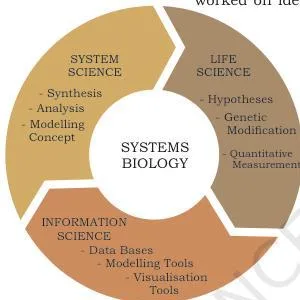
Fig. 11.1 (NCERT p. 274) sits beside the chapter’s discussion of the theme behind systems biology. The theme contrasts reductionism with integration: the reductionist identifies a system’s components and their interactions, but no convincing method could describe the pluralism of the whole system.
Pluralism only appears through quantitative measures of many components at once, which demands mathematical models with rigorous data integration. So the figure depicts systems biology as the study of a system by integrating its components together — focused on complex biological interactions within biological systems.
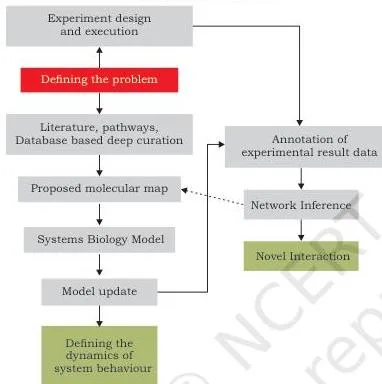
Fig. 11.2 (NCERT p. 275) is the protocol in picture form. Walk it from the start: define the problem, design the experiment, execute it to generate data, collect and arrange the data in proper file formats, develop the network interface, and build the model.
Now the part students often miss — the loop. Simulation results are compared with experimental data, discrepancies are analysed, the hypothesis is revised, and the simulation runs again, absorbing new hypotheses each time. The workflow is a cycle, not a one-way line, and that iterative loop is the whole point of systems biology modelling.
Key Terms and Definitions
This chapter introduces more than a dozen technical terms, and exam questions on this chapter often test whether you can define them precisely. Scan this table the night before: each definition restates the chapter’s idea in plain words.
| Term | What it means | NCERT page |
|---|---|---|
| Systems biology | An interdisciplinary field of study that focuses on complex biological interactions within biological systems. | p. 272 |
| System models | Mathematical or computational models that mimic complex biological systems observed in real in-vitro/in-vivo experiments or real life. | p. 272 |
| Minimum information | The essential supporting information required from experiments such as microarray, proteomic, biological and biomedical investigations, including metadata. | p. 275 |
| File formats (XML) | The specific formats in which collected data are stored, generally Extensible Markup Language (XML) based so computers can process them automatically. | p. 276 |
| Ontologies | A semantic annotation of data that represents the hierarchical relationships between terms. | p. 276 |
| Gene Ontology (GO) and Systems Biology Ontology (SBO) | The chapter’s two named examples of ontologies used to annotate systems biology data. | p. 276 |
| Finite Element Method (FEM) | A numerical technique for approximate solutions of the partial differential equations used in systems-modelling tools. | pp. 276–277 |
| Sensitivity analysis | Model analysis that describes the stability and controllability of a system against various disturbances. | p. 277 |
| Bifurcation and phase-space analysis | Model analysis for discovering the possible steady and dynamical tendencies of a system model. | p. 277 |
| Metabolic control analysis (MCA) | Model analysis of the relationship between a metabolic network’s steady-state properties and its component reactions. | p. 277 |
| Whole-cell model | A mathematical model of the entire cell of Mycoplasma genitalium, predicting cell viability in response to genetic mutations. | p. 274 |
Mistakes Students Make in This Chapter
The three multiple-choice questions in the exercises target the same confusions every year. Each row below names the mistake, the correct rule, and a way to check yourself.
| Mistake | Correct rule | How to check your answer |
|---|---|---|
| Thinking biologists can skip statistics and programming | Handling datasets requires statistical tools; Python and R both provide strong statistical facilities. The incorrect statement in exercise question 3 is (b). | Re-read NCERT pp. 270–271: the chapter says young biotechnologists need programming, chemistry and statistical methods. Verify that options (a), (c) and (d) are each true as stated. |
| Defining systems biology too broadly (‘the systematic study of all living organisms’) or too narrowly (‘the study of enzymes’) | Systems biology is the detailed study of biological systems through computational and experimental methods — option (c) of exercise question 4. | Match option (c) against the definition on p. 272: an interdisciplinary field focusing on complex biological interactions within biological systems. |
| Confusing data management with model analysis | Metabolic control analysis is a model-analysis method (p. 277), not a data-management system. Data-management systems are spreadsheets, electronic lab notebooks (ELN) and LIMS — so the answer to exercise question 5 is (a). | List the data-management examples on p. 276, then list the model-analysis methods on p. 277. No item appears in both lists. |
- Tool names stick better when you attach them to a job. Table 11.1 (p. 276) pairs each facility — curation, simulation, molecular interaction — with its tools, so learn the facility first and the tool name follows.
The chapter’s own SUMMARY (p. 278) closes with exactly the ideas NCERT thinks matter, which makes it a natural self-check list.
How to Revise This Chapter
This is a short, conceptual chapter — it has no solved examples and no equations to practise — so revision means definitions, contrasts and the workflow, in that order.
- Define systems biology and system models in your own words (p. 272).
- Contrast Python and R: creator, language style and typical biological use (pp. 271–272).
- List the three aspects of data management with one example of each (pp. 275–276).
- Name the three model-analysis methods and one tool for each (p. 277).
- Learn the timeline: the scientists, the years and the achievement (pp. 273–274).
- Attempt all nine exercises on p. 278 and self-check against the SUMMARY.
Of the nine exercises, questions 3, 4 and 5 are multiple-choice concept checks, questions 1, 2 and 6 to 9 are short-answer reasoning, and there are no numericals in this chapter. A full answer states the definition or distinction asked for in your own words and gives the chapter’s example where one exists — for instance, naming GO and SBO when defining ontologies.
Textbook contents and the examinable syllabus are not always identical — check the current official CBSE syllabus for Class 11 Biotechnology.
All Nine Exercise Questions, Answered
All nine exercises appear on p. 278. The three multiple-choice answers are explained in the mistakes table above; here is every question with a complete short answer.
- Q1. Why are programming languages a boon for biologists?
Answer: Because biology now produces enormous high-throughput datasets, and programming languages let scientists access, filter and manipulate data easily — without them the data cannot be stored, visualised, transferred, analysed or interpreted (NCERT, pp. 270, 278). - Q2. Name the various aspects of data management for systems biology.
Answer: Minimum information, file formats, and ontologies (NCERT, pp. 275–276). - Q3. Choose the INCORRECT statement.
Answer: Option (b) — biologists do require knowledge of statistical tools for handling datasets; the chapter points to the strong statistical facilities of Python and R (NCERT, pp. 270–271). - Q4. Systems biology is …
Answer: Option (c) — the detailed study of biological systems through computational and experimental methods. This matches the definition on p. 272: an interdisciplinary field focused on complex biological interactions within biological systems. - Q5. Which of the following is NOT included in data management systems?
Answer: Option (a) — metabolic control analysis. It is a model-analysis method (p. 277), while spreadsheets, ELN and LIMS are the data-management systems named on p. 276. - Q6. What is the need of systems biology?
Answer: It provides computational models that reveal emergent functional properties of cells, tissues and organisms that were previously discoverable only through experiments, and it feeds applications from health and disease to modern therapeutics (NCERT, p. 272). - Q7. What is the fundamental difference between systems biology and physiology?
Answer: Pre-1970 research treated physiology as one segmental component of biological science, studied on its own. Systems biology integrates all the components — physiology, enzyme kinetics, control theory and so on — into computational models of the whole system (NCERT, pp. 272–274). - Q8. Explain systems biology as collection of approaches and tools.
Answer: Systems biology brings together data management (minimum information, file formats, ontologies), workflow systems such as KNIME and Galaxy, model-building tools and model-analysis methods such as sensitivity analysis and metabolic control analysis — a toolkit that runs from raw experimental data to a tested computational model (NCERT, pp. 274–277). - Q9. Is systems biology cell-centric?
Answer: No. Models describe properties of cells, tissues and organisms at many scales — the Physiome project, for example, links ion-channel and myofilament models to tissue mechanics and coronary blood flow (NCERT, pp. 272–274).
The Chapter’s Main Points in Brief
NCERT closes this chapter with its own summary on p. 278. The four points below are that summary in plain words.
- The growing volume of biological data makes programming essential: languages help scientists access, filter and manipulate datasets.
- Python and R are among the most advanced languages — Python for visualisation and analysis of sequence and structure datasets (it runs on Unix, Mac and Windows), and R for its statistical tools and high-volume analysis and visualisation.
- Systems biology uses computational methods to analyse complex biological datasets; the example system models are metabolic and signalling networks.
- Its computation needs data management, optimisation of network development parameters, performance analysis and evaluation — and data management rests on minimum information, file formats and ontologies.
Related Chapters and Resources
This listing is maintained for the 2026-27 academic session using the NCERT textbook information available to us. NCERT remains the authority for confirming the latest edition.
This is Chapter 11 of the NCERT Class 11 Biotechnology book. The chapter just before it, Protein Informatics and Cheminformatics, and the one that follows, Tools and Techniques, cover the same data-heavy, computation-heavy side of biotechnology.
For revision support, see the Class 11 Biotechnology notes, the wider Class 11 study material hub, and the CBSE notes index.
The chapter also points beyond the book: the Physiome project (physiomeproject.org), named on NCERT p. 274, is an open multi-scale modelling effort, and the official NCERT textbook portal holds every chapter of the book.
Reference: NCERT Class 11 Biotechnology textbook, chapter 11, official edition on ncert.nic.in.
Sources and Data Verification
Plain facts about where this page’s information comes from:
- The figures and page numbers on this page describe the NCERT Class 11 Biotechnology textbook (official edition on ncert.nic.in), Chapter 11, ‘Programming and Systems Biology’, NCERT pages 270–278.
- This page covers that chapter’s sections, its two figures, its resource matrix table (Table 11.1) and all nine exercise questions. It does not cover the other chapters of the book or the full CBSE curriculum.
- This listing is maintained for the current academic session using the NCERT information available to us.
- NCERT settles textbooks, editions and PDFs; CBSE settles curriculum, syllabus and examinations. Textbook contents and the examinable syllabus are not always identical — always check the current official CBSE syllabus.
Frequently Asked Questions
What is systems biology in simple words?
Systems biology is the interdisciplinary study of the complex interactions within biological systems, using computational models rather than looking at one component at a time. The models it builds are called system models because they mimic real in-vitro or in-vivo behaviour (NCERT, p. 272).
What are the three aspects of data management in systems biology?
Minimum information, file formats and ontologies (NCERT, pp. 275–276). Minimum information is the essential supporting information, with metadata, that must accompany experimental data; file formats are generally XML-based so computers can process them automatically; ontologies are semantic annotations showing hierarchical relationships between terms, with Gene Ontology and Systems Biology Ontology as the named examples.
Which programming languages do biologists use, and how are Python and R different?
Python and R lead the list. Python, created by Guido van Rossum in 1991, is object-oriented, interactive and runs on Unix, Mac and Windows; it is used for sequence and structure analyses, phylogenetics and visualisation.
R, created by Robert Gentleman and Robert Ihaka, is a free, open-source functional language ideal for high-volume analysis, visualisation and simulation, and is used for genome sequence and biomolecular pathway analysis. MATLAB and the older PERL also appear (NCERT, pp. 271–272).
What are ontologies in systems biology?
Ontologies are semantic annotations of data that represent the hierarchical relationships between terms, so that computers and researchers share a common vocabulary. Gene Ontology (GO) and Systems Biology Ontology (SBO) are the chapter’s examples (NCERT, p. 276).
What is the whole cell model of Mycoplasma genitalium?
It is a mathematical model of the whole cell of Mycoplasma genitalium, a cell-wall-less bacterium, developed in 2012 at Mount Sinai School of Medicine, New York. It predicts cell viability in response to genetic mutations, and grew out of the push to model the whole cell that MIT and CytoSolve took up in 2003 toward an NSF challenge (NCERT, pp. 273–274).
Is systems biology the same as physiology?
No. Before systems biology, research moved around physiology, population dynamics and enzyme kinetics as separate segmental components. Systems biology integrates all the components into computational models of the whole system — physiological description became the starting point, not the whole discipline (NCERT, pp. 272–274).
Reference: NCERT Class 11 Biotechnology textbook, chapter 11, official edition on ncert.nic.in.
Explore Class 11 Biotechnology Books
- Previous: Protein Informatics and Cheminformatics
- Next: Tools and Techniques
Related chapters:
- An Introduction to Biotechnology
- G.N. Ramachandran (1922–2001)
- Biomolecules