
Class 10 Social Science covers globalisation and the Indian economy as Chapter 4 of the NCERT textbook Understanding Economic Development. The chapter runs from page 55 to page 73 of the book.
The official globalisation and the Indian economy class 10 PDF from NCERT is right here on this page, followed by a plain-language tour of what the chapter teaches — MNCs, foreign trade, trade barriers, the WTO and who gains or loses in India.
Download the Globalisation and the Indian Economy Class 10 PDF
The official NCERT Class 10 Social Science Chapter 4 — Globalisation and the Indian Economy PDF is published free by NCERT at its textbook portal. Open it to read the chapter exactly as printed, follow the page numbers used on this page, or save a copy for revision.
Reference: NCERT Class 10 Social Science textbook, chapter 4, official edition on ncert.nic.in.
| What the chapter holds | Count | Where it is used |
|---|---|---|
| Printed pages | 20 | |
| Figures with NCERT captions | 10 | |
| Tables | 1 | |
| Exercise questions | 44 | answered in our NCERT Solutions |
| Official NCERT PDF | Download the chapter PDF | the chapter exactly as NCERT publishes it |
Globalisation and the Indian Economy Class 10: Chapter at a Glance
Use the table below to see the size of the file before you start studying. It lists how many sections, figures and exercise questions the chapter holds.
What this chapter covers: from MNCs to fair globalisation
The chapter is one continuous argument: it starts from the explosion of brands in an Indian market and ends by asking who actually gains from globalisation. The flow below shows where each idea sits, with the NCERT page for each.
- The opening puzzle (p. 55): why Indian markets today stock cars, phones and fruit juices from nearly every top global maker — unthinkable two decades ago.
- Production across countries (pp. 56–58): what a multinational corporation is and how it spreads production to cut costs.
- Foreign trade and integration of markets (pp. 59–60): the Chinese toys story, ending with markets of different countries getting connected.
- The definition of globalisation (p. 61): the chapter’s formal meaning, built from foreign trade and foreign investment.
- What made it possible (pp. 62–64): technology, containers, IT, and the removal of trade barriers after 1991.
- The WTO (pp. 65–66): its rules and the cotton subsidy dispute between developed and developing countries.
- Impact in India (pp. 66–69): Special Economic Zones, flexible labour laws, Indian MNCs, struggling small producers and workers like Sushila.
- Fair globalisation (pp. 70–71): the government’s possible role, then the chapter’s own Summing Up.
- Exercises and project (pp. 72–73): the end-of-chapter questions and the two-task activity that close the book section.
Key concepts explained
These are the ideas that carry the whole chapter, in the order the book builds them. Learn them in this sequence and the chapter’s argument becomes one story.
What is a multinational corporation and why do MNCs spread production?
An MNC is not simply a big company; it is a company that produces in more than one country. The chapter defines it early because every later idea — foreign trade, the WTO, impact — runs through it.
A multinational corporation (MNC) owns or controls production in more than one nation (NCERT, p. 56). The reason MNCs go abroad is simple: cheap labour and resources keep the cost of production low, so profits stay high (NCERT, p. 56).
The book’s equipment-maker example shows the pattern: design happens in research centres in the United States, components are made in China, assembly takes place in Mexico and Eastern Europe, and customer care runs through call centres in India. NCERT reports this arrangement can save the MNC 50–60 per cent of costs (NCERT, p. 56).
The important consequence: goods and services are now produced globally, not just sold globally. Production gets divided into small parts and spread around the world (NCERT, pp. 56–57). The call-centre photograph on p. 56 is the face of this, and the figure walkthrough reads it below.
Three ways MNCs control production across countries
MNCs do not always build new factories from scratch. The chapter lists three routes they use to enter and control production in another country (NCERT, pp. 57–58).
- Joint production with local companies: the local firm gains money for additional investment, such as faster machines, and the latest production technology (NCERT, p. 57).
- Buying up local companies: the most common route. Cargill Foods, an American MNC, bought Parakh Foods with its marketing network and four oil refineries and became India’s largest edible-oil producer (NCERT, p. 57).
- Placing orders with small producers: women at home in Ludhiana stitch footballs for large MNCs, which set the price, quality and delivery conditions, then sell the goods under their own brands (NCERT, p. 58).
By these routes, production in widely separated locations becomes interlinked (NCERT, p. 58). To recall the three routes, remember the mnemonic JOB: Joint production, buying Out local companies, and Bulk orders to small producers.
Foreign trade and how markets become integrated
Foreign trade is an older force than the MNC, and its basic job is simple: producers reach beyond their own country’s market, and buyers get more choice (NCERT, p. 59).
The chapter’s Chinese toys example shows the logic. Chinese makers export cheap, well-designed plastic toys to India. Within a year, 70 to 80 per cent of toy shops replace Indian toys with Chinese ones — Indian buyers gain choice and lower prices, while Indian toy makers lose sales (NCERT, p. 60).
The general rule NCERT states: foreign trade connects the markets of different countries, or integrates them. Prices of similar goods tend to become equal and distant producers compete directly (NCERT, p. 60).
The chapter itself asks you to distinguish foreign trade from foreign investment (NCERT, p. 61). The table below shows the difference in one glance.
| Aspect | Foreign trade | Foreign investment |
|---|---|---|
| What it is | Buying and selling of goods and services across a country’s borders | Money spent by MNCs to buy assets such as land, buildings and machines in another country |
| Chapter example | Chinese toys imported into India (p. 60) | Cargill Foods buying Parakh Foods in India (p. 57) |
| How it connects countries | Brings buyers and producers of two countries into one market | Joins the host country’s production to the MNC’s global network |
What globalisation means in this chapter
Globalisation is the process the whole chapter is explaining, so the definition matters. NCERT defines it as the rapid integration or interconnection between countries, driven by greater foreign trade and greater foreign investment, with MNCs playing the major role (NCERT, p. 61).
More and more goods, services, investments and technology move between countries as a result (NCERT, p. 61). The chapter adds one careful limitation: the movement of people between countries has not increased much, because of various restrictions (NCERT, p. 61).
Technology, containers and IT: what made globalisation possible
None of the integration above would have happened without technology. NCERT treats rapid improvements in technology as one major factor that stimulated the globalisation process (NCERT, p. 62).
Two transport changes mattered. Goods now travel in containers that move intact from ship to rail to truck, which cut port handling costs and sped up delivery; the cost of air transport also fell (NCERT, p. 62).
Then came information and communication technology (IT): telecommunications, computers and the internet. They allow instant contact, instant access to information and e-mail at negligible costs, and they enabled the production of services to spread across countries (NCERT, pp. 62–63).
The chapter’s London magazine story shows how: text is sent by internet to a Delhi office, pages are designed on Delhi computers, the printed magazines are air-freighted to London, and payment moves between banks through e-banking (NCERT, p. 63).
Trade barriers, liberalisation and the 1991 shift
Liberalisation is the government removing its own restrictions. Before that idea, the chapter builds the idea of a trade barrier (NCERT, p. 64).
A trade barrier is any restriction that regulates foreign trade. The textbook’s example is a tax on imports; quotas — a government limit on the number of a good that can be imported — are a second kind (NCERT, p. 64).
Worked illustration with original numbers: an imported toy priced at ₹200 faces a 30 per cent import tax. The buyer pays \(200 + (30\% \times 200) = 200 + 60\), or ₹260. The foreign toy stops being cheap, so imports shrink. Remove the tax, the toy returns to ₹200, and foreign products become attractive again — that is the difference a barrier makes (the logic is the chapter’s toy-tax example, NCERT p. 64).
India kept barriers after Independence to protect industries that were just growing in the 1950s and 1960s; only essentials such as machinery, fertilisers and petroleum could be imported (NCERT, p. 64). Starting around 1991 the government decided Indian producers should compete with the world, convinced that competition would improve quality — a decision NCERT says powerful international organisations supported (NCERT, p. 64).
Liberalisation means removing barriers or restrictions set by the government. With liberalisation, businesses decide freely what to import and export (NCERT, p. 64).
The WTO and the fairness debate
The World Trade Organisation exists to liberalise international trade, and its pressure is the third factor in the chapter’s story. NCERT reports the WTO was started at the initiative of developed countries, establishes rules regarding international trade and sees that these rules are obeyed, with about 160 member countries (NCERT, p. 65).
Here is the fairness problem: US farmers receive massive sums of money from their government, which lets them sell surplus farm products abroad at abnormally low prices. That undercuts farmers in developing countries that have already removed their own barriers. NCERT voices the developing countries’ challenge — ‘Is this free and fair trade?’ (NCERT, p. 65).
Impact of globalisation in India: who gains, who loses
The chapter’s central judgment, stated early in the section, is that the impact of globalisation has not been uniform (NCERT, p. 66). The rest of the section is evidence for both halves.
On the gains side, well-off urban consumers enjoy more choice, improved quality and lower prices. MNCs raised their investments in industries such as cell phones, automobiles, electronics, soft drinks and fast food, creating jobs, and local suppliers of raw materials prospered (NCERT, p. 66).
Top Indian companies became multinationals themselves — Tata Motors, Infosys, Ranbaxy, Asian Paints and Sundaram Fasteners — and IT-based services such as call centres, data entry and accounting are now exported from India (NCERT, p. 67).
The government’s steps to attract foreign investment were Special Economic Zones with world-class facilities and no taxes for five years, plus flexibility in labour laws, which lets companies hire workers for short periods to cut labour costs (NCERT, p. 67).
On the losing side, Ravi’s capacitor factory in Hosur shows what competition did. Until imports were freed in 2001, he supplied television companies in bulk with 20 workers; production fell to less than half, and only seven workers remain (NCERT, p. 68). Batteries, capacitors, plastics, toys, tyres, dairy products and vegetable oil are industries where small manufacturers were hit hard.
These small and medium industries employ 11 crore workers, next only to agriculture (NCERT, p. 68).
Workers carry the same story. In garment exports, permanent jobs with benefits changed into temporary jobs with no security; Sushila, once a permanent worker with health insurance and provident fund, now earns less than half her earlier wage, and organised-sector conditions increasingly resemble the unorganised sector (NCERT, p. 69).
| Group | What globalisation brought | NCERT page |
|---|---|---|
| Well-off urban consumers | More choice, improved quality, lower prices | 66 |
| MNCs investing in India | New markets, new jobs, profitable operations | 66 |
| Top Indian companies | Newer technology, global operations | 67 |
| IT-based services | Export work such as call centres, data entry, accounting | 67 |
| Small producers | Falling sales and shutdowns — batteries, toys, vegetable oil | 68 |
| Workers | Temporary jobs, lower wages, lost benefits | 69 |
Fair globalisation: what the chapter argues
The chapter closes not with a verdict against globalisation but with a demand to make it fair. People with education, skill and wealth have used the new opportunities best, while many others have not shared the benefits (NCERT, p. 70).
Fair globalisation would create opportunities for all and share the benefits better. The government can make this possible by implementing labour laws properly, supporting small producers until they can compete, using trade and investment barriers when necessary, negotiating for fairer WTO rules, and aligning with other developing countries against the domination of developed countries (NCERT, p. 70).
People’s organisations matter too — their campaigns and representation have influenced WTO decisions, as at the Hong Kong demonstration of 2005 (NCERT, p. 70).
Figure walkthrough: reading the chapter’s ten NCERT figures
The chapter’s photographs and cartoons are evidence from real production sites. Reading them shows what trade and MNC production look like on the ground — read each with its caption and the section of the chapter it belongs to.
What MNC production looks like (pp. 56–58)
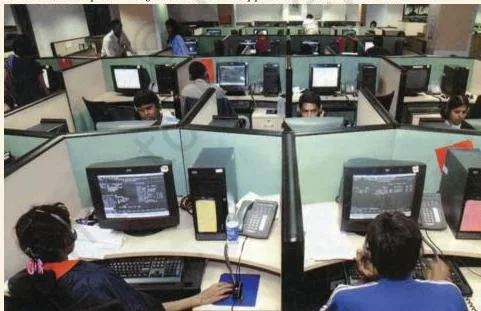
The call centre is the visible face of service globalisation: Indian workers, using telecom and internet facilities, provide support to customers abroad. It belongs with the equipment-maker example and returns when the chapter discusses IT-enabled services exported from India (NCERT, p. 56).
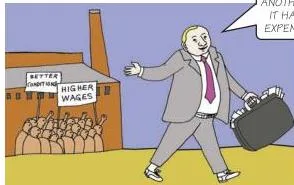
The factory owner’s threat — ‘WE WILL SHIFT THIS FACTORY TO ANOTHER COUNTRY. IT HAS BECOME EXPENSIVE HERE!’ — is the book’s humour doing serious work. It shows the bargaining power MNCs hold: if local conditions become costly, they can move production elsewhere (NCERT, p. 57).
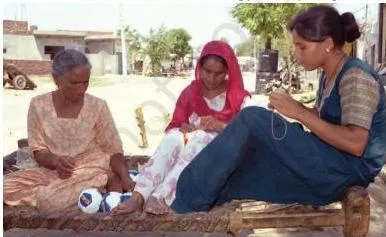
This is the third route in action: small home-based producers supplying a global brand. The MNC places the order and fixes price, quality, delivery and labour conditions, while the women work from home (NCERT, p. 58).
How trade and technology connect markets (pp. 61–63)
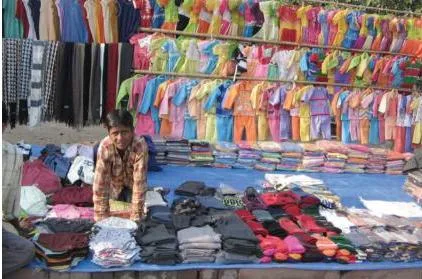
This photograph accompanies the integration-of-markets idea: the small garment traders shown face competition from both MNC brands and imports. It makes concrete what the Chinese toys example argued — opening trade brings distant goods and producers into one market (NCERT, p. 61).
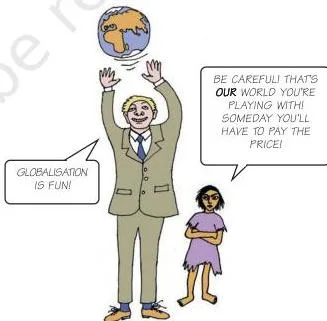
The cartoon supports the chapter’s key claim about MNCs: they search the globe for cheap locations to set up production. That search is why production gets divided into small pieces and spread across countries (NCERT, p. 61).
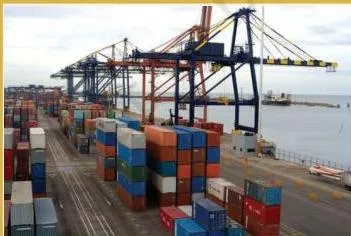
The speech bubble — ‘…WE’VE SEEN GREAT IMPROVEMENTS IN TRANSPORTATION…’ — pairs perfectly with the section it opens. Faster, cheaper transport, including containers, is the chapter’s first enabling factor for globalisation (NCERT, p. 62).
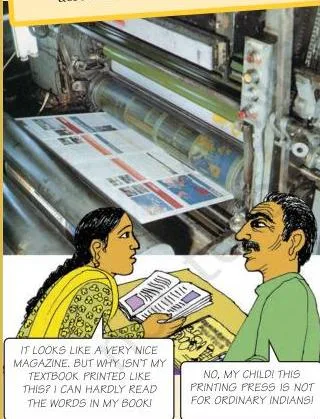
This figure belongs with the London magazine story: IT lets services like design, data entry and customer care be produced in one country and delivered to another (NCERT, p. 63).
Who gains and who loses in India (pp. 66–69)

This is the first piece of evidence on the gains side: MNCs keep investing because India works for them, and new jobs follow in industries like automobiles, cell phones and banking (NCERT, p. 66).
The caption states the chapter’s verdict in one line. Ravi’s capacitor factory and the shutdown of battery, toy and dairy units are the evidence behind this figure (NCERT, p. 68).
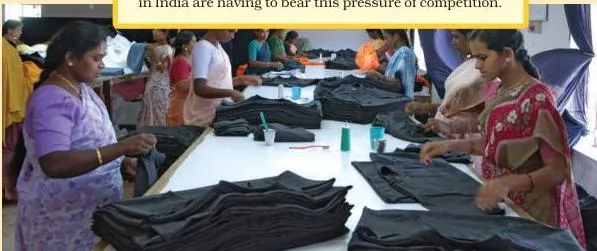
The photograph shows workers folding garments for export, but the text beside it tells the harder story: temporary contracts, long night shifts, low wages, and Sushila earning less than half her old wage. Globalisation created paid work for women here, yet denied them a fair share of its benefits (NCERT, p. 69).
Key terms and where the chapter defines them
This table holds the terms the chapter defines, in plain words, with the NCERT page where each is introduced. Use it as a quick lookup while answering the exercises.
| Term | Meaning in plain words | NCERT page |
|---|---|---|
| Multinational corporation | A company that owns or controls production in more than one nation | 56 |
| Investment | Money spent to buy assets such as land, buildings, machines and equipment | 57 |
| Foreign investment | Investment made by MNCs in another country — e.g. Cargill Foods buying Parakh Foods | 57 |
| Integration of markets | Foreign trade connecting the markets of different countries — e.g. Chinese toys in India | 60 |
| Globalisation | Rapid integration or interconnection between countries through greater foreign trade and foreign investment | 61 |
| Trade barrier | A government restriction, such as a tax on imports or a quota, that regulates foreign trade | 64 |
| Liberalisation | Removing barriers or restrictions set by the government — e.g. India’s policy changes from 1991 | 64 |
| World Trade Organisation (WTO) | Organisation that sets rules for international trade and sees they are obeyed; about 160 member countries | 65 |
| Special Economic Zones (SEZs) | Industrial zones with world-class facilities where companies pay no tax for the first five years | 67 |
| Flexibility in labour laws | Allowing companies to hire workers for short periods instead of on a regular basis, to cut labour costs | 67 |
Common mistakes students make in this chapter
The mistakes below are confusions students carry out of this chapter, and each comes from a distinction the book itself sets up. Check your answers against the correct rule before the exam.
| Mistake | Correct rule | How to check your answer |
|---|---|---|
| Confusing foreign trade with foreign investment | Trade moves goods across borders; investment spends money on assets abroad (p. 61 asks you to distinguish them) | Ask: did a product cross a border, or did money buy assets abroad? |
| Defining globalisation as only free trade | The definition on p. 61 includes both foreign trade AND foreign investment, with MNCs as the major force | Does your definition name both trade and investment? |
| Calling any big company an MNC | The test is owning or controlling production in more than one nation (p. 56); Ford Motors qualifies because it produces across many countries | Can you name the countries where it produces? |
| Thinking trade barriers are only taxes | Quotas — limits on the number of goods imported — are also barriers (p. 64) | Did you give at least two kinds of restriction? |
| Thinking the WTO treats all members equally | The chapter shows developed countries keeping subsidies, like US farm support, while developing countries remove barriers (p. 65) | Can you say who the chapter calls the injured party, and how? |
| Concluding globalisation helped everyone | The chapter repeats that impact has not been uniform — well-off consumers gained, many small producers and workers lost (pp. 66–69) | Does your answer name both a gainer and a loser? |
Exam notes: how the chapter’s exercises map to its ideas
These notes tell you which part of the chapter answers each end-of-chapter exercise, so you can revise a weak area instead of rereading everything. No question count or weight is promised here.
| Exercise | What it tests | Revise at |
|---|---|---|
| Q1 | Definition of globalisation in your own words | p. 61 |
| Q2 | Why India kept trade barriers, and why it removed them | p. 64 |
| Q3 | Flexibility in labour laws and why companies want it | p. 67 |
| Q4 | Ways MNCs set up, control or produce in other countries | pp. 57–58 |
| Q5 | WTO rules and what developing countries should demand in return | pp. 65–66 |
| Q6 | ‘The impact of globalisation has not been uniform | pp. 66–69 |
| Q7 | How liberalisation of trade and investment helped globalisation | p. 64 |
| Q8 | Integration of markets, with an example not given in the chapter | pp. 59–61 |
| Q9 | Opinion — what the world might look like twenty years from now | pp. 70–71 |
| Q10 | Argument — has globalisation hurt or helped India’s development | pp. 70–71 |
| Q11 | Fill-in-the-blanks on the chapter’s vocabulary | chapter-wide |
| Q12 | Matching: MNC routes, trade barriers, Indian MNCs, IT services | pp. 57–58, 64, 67 |
| Q13 | MCQs on movement, MNC investment route, and living conditions | pp. 57, 61, 66–69 |
Q12 matches are: (i) MNCs buying at cheap rates from small producers → garments, footwear, sports items; (ii) quotas and taxes → trade barriers; (iii) Indian companies investing abroad → Tata Motors, Infosys, Ranbaxy; (iv) IT spreading production of services → call centres; (v) MNCs setting up factories in India → automobiles.
For Q13, the correct options are (b), (b), and ‘none of the above’ — the chapter shows only some groups gained, so no listed group got universal improvement (NCERT, pp. 57, 61, 66–69).
The book also places ‘Let’s work these out’ practice sets inside the chapter. They sit at the Ford Motors passage (p. 59), the steel trade questions (p. 61) and the garment industry questions (p. 70). This chapter has no formulas to memorise; the only calculation it needs is the import-tax type shown in the worked illustration above.
One caution: textbook contents and the examinable syllabus are not always identical — check the current official syllabus.
Revision summary: the chapter in one page
This is the chapter’s own Summing Up, compressed so you can revise it in minutes. Every line below is the book’s conclusion in plainer words.
- Globalisation is the rapid integration of countries through greater foreign trade and foreign investment, and MNCs are the major force driving it; production is organised in increasingly complex ways across countries (NCERT, p. 71).
- Technology, especially IT, made this organisation of production possible, and liberalisation removed the barriers to trade and investment (NCERT, p. 71).
- The WTO has pressured developing countries to liberalise, while developed countries keep their own protection (NCERT, pp. 65, 71).
- Winners: well-off consumers, and producers with skill, education and wealth (NCERT, pp. 66–67, 71).
- Losers: many small producers and workers, hit by rising competition (NCERT, pp. 68–69, 71).
- Fair globalisation would create opportunities for all and share the benefits better — the government and people’s organisations both have a role (NCERT, pp. 70–71).
To keep the MNC routes in your head, reuse JOB: Joint production, buying Out local companies, Bulk orders to small producers.
The chapter’s project activity: two tasks the book suggests
The chapter ends with a project that turns its ideas into something you can check at home. Both tasks are described on p. 73 of the textbook and both connect to the concepts above.
- Task I — find the MNCs in your home. Take everyday branded products such as soaps, toothpaste, garments and electronic goods. Read the small print on the packet, note the manufacturer’s name and country, and identify which products are produced by MNCs. This is the chapter’s MNC definition (p. 56) applied to your own shopping.
- Task II — profile one Indian industry. Choose an Indian industry or service and collect information and photographs on seven aspects: the producers and companies in it; whether the product is exported; whether MNCs are among the producers; the level of competition; working conditions; major changes in the past 15 years; and problems people in the industry face (p. 73).
Each aspect maps to a chapter idea: competition links back to the Chinese toys example (p. 60), working conditions to the garment workers and Sushila (p. 69), and MNC presence to the three routes — partners, buy-outs or orders (pp. 57–58).
The chapter itself names MNC brands such as Nike, Coca-Cola, Pepsi, Honda and Nokia (p. 59) and Indian multinationals such as Tata Motors, Infosys and Ranbaxy (p. 67) as starting points.
Related Class 10 Social Science chapters
The chapter’s own notes say the impact section draws on Chapters 1 and 2 of this book — development goals, and the organised and unorganised sectors. Seeing those two ideas again in globalisation’s winners and losers is how the chapters fit together.
- Previous chapter: Money and Credit Class 10 notes — how credit, banks and formal loans shape Indian households.
- Next chapter: Consumer Rights continues the study of markets, from the consumer’s side of the counter.
- Subject hub: Class 10 Social Science notes — all four NCERT books of the subject in one place.
- Class hub: Class 10 notes — every subject on the site.
- Site home: CBSE notes — search any chapter by class and subject.
- Geography sibling: if you are studying the full Social Science set, Minerals and Energy Resources Class 10 notes sit alongside the Economics book.
Sources and data verification
This listing is maintained for the 2026-27 academic session using the NCERT textbook information available to us. NCERT remains the authority for confirming the latest edition.
- The page references and descriptions on this page describe the NCERT Class 10 Social Science textbook Understanding Economic Development, Chapter 4, in the current printed edition available on ncert.nic.in.
- This page covers only this one chapter — Globalisation and the Indian Economy — of that book. Other chapters of the book have their own pages on this site.
- The listing is maintained for the current academic session on the basis of NCERT publications.
- NCERT settles textbooks, editions and PDFs; CBSE settles curriculum, syllabus and examinations. Textbook contents and the examinable syllabus are not always identical — check the current official syllabus.
Reference: NCERT Class 10 Social Science textbook, chapter 4, official edition on ncert.nic.in.
Frequently asked questions
What is the difference between globalisation and liberalisation in Class 10 Economics?
Globalisation is the rapid integration or interconnection between countries, driven by greater foreign trade and foreign investment, with MNCs as the major force (NCERT, p. 61). Liberalisation is the government removing barriers or restrictions on trade and investment (NCERT, p. 64). In short, liberalisation is a policy that speeds up globalisation; globalisation is the broader process that results.
What are the ways in which MNCs set up and control production in other countries?
MNCs set up factories and offices where labour, resources and markets are favourable (p. 56), produce jointly with local companies (p. 57), buy up local companies — the most common route (p. 57) — or place orders with small producers who supply under the MNC’s brand (p. 58).
Why did the Indian government remove trade barriers in 1991?
India kept barriers after Independence to protect industries that were just growing in the 1950s and 1960s (p. 64). Starting around 1991, the government decided Indian producers should compete with the world, believing competition would improve quality; the decision was supported by powerful international organisations (NCERT, p. 64).
What are Special Economic Zones and why do some people oppose them?
SEZs are industrial zones with world-class facilities where companies pay no taxes for the first five years, set up to attract foreign investment (NCERT, p. 67). The chapter does not name who opposes them; it asks you to investigate (p. 67) and links the question to Chapter 1’s idea that development for one group can be destructive for others.
Who benefits from globalisation and who does not, according to this chapter?
The impact has not been uniform (p. 66). Well-off urban consumers gain more choice, better quality and lower prices; MNCs and top Indian companies gain new markets and technology; and skilled, educated workers gain new service jobs.
Many small producers — like Ravi’s capacitor factory, batteries, toys and vegetable oil units — and workers like Sushila lose, facing falling sales, temporary jobs and lower wages (NCERT, pp. 66–69).
What is the WTO and why do developing countries call its trade unfair?
The World Trade Organisation, started at the initiative of developed countries, sets rules for international trade and sees they are obeyed, with about 160 members (p. 65). Developing countries call it unfair because they have removed barriers while developed countries keep subsidies — US farmers, for example, sell surplus farm products abroad at abnormally low prices, hurting farmers in developing countries (NCERT, p. 65).
Explore Class 10 Social Science Books
- Previous: Money and Credit
- Next: Minerals and Energy Resources
Class 10 Social Science on LearnCBSE:
Related chapters:
- Resources and Development
- Power-sharing
- The Rise of Nationalism in Europe