
These journey inside the atom class 9 notes compress the whole chapter into a revision-ready page: where the atom idea came from, how subatomic particles were discovered, and why scientists kept improving atomic models.
You also get element symbols, atomic and mass numbers, electronic configuration, valency, isotopes, isobars and average atomic mass — with every definition, formula and worked numerical in one place. Everything below follows the NCERT Class 9 Science (Exploration) textbook, Chapter 8, so you can revise on its own the night before a test.
From Parmanu to Atom: How the Idea of Indivisible Particles Began
Over 2,000 years ago, thinkers in India and Greece asked the same question: what is everything made of? Their answers were ideas, not experiments — the atom was first imagined, only later proven (NCERT, p. 141).
- Acharya Kanada (India): if matter is divided repeatedly, you finally reach particles that cannot be divided further. He called them parmanus, and his ideas are recorded in the Sanskrit text Vaisesika Sutras (NCERT, p. 142).
- Leucippus and Democritus (Greece): proposed similar indivisible particles called atomos — Greek for “indivisible”.
- John Dalton (1808): first scientific atomic theory, based on the experiments of his time. He stated that all matter is made of indivisible atoms (NCERT, p. 142).
Dalton’s theory was a starting point, but it raised three questions no one could yet answer:
- What are atoms made up of?
- What would atoms look like if we could see them?
- What makes the atoms of one element different from those of another? (NCERT, p. 142)
For the wider picture of how these ideas connect, browse our notes on the atomic foundations of matter.
Subatomic Particles: Electron, Proton and Neutron
Two discoveries broke the belief that atoms were indivisible. Scientists found that some elements emit invisible energy and particles (radioactivity), and J. J. Thomson’s cathode ray experiments revealed the electron inside every atom (NCERT, p. 143).
| Year | Scientist | Particle | Where it is found | Relative charge |
|---|---|---|---|---|
| 1897 | J. J. Thomson | Electron | Present in every atom (cathode rays) | −1 |
| — | Rutherford | Proton | In the nucleus | +1 |
| 1932 | James Chadwick | Neutron | Nucleus of every atom except hydrogen | 0 |
The charge of an electron is \( -1.602 \times 10^{-19}\ \text{C} \), taken as −1 by convention (NCERT, p. 143). A proton has a charge equal and opposite to the electron but is much heavier.
Chadwick’s neutron has nearly the mass of a proton and no charge — which explains why helium (2 protons) is about four times as massive as hydrogen (1 proton): two extra neutrons add mass without adding charge (NCERT, p. 148).
Table 8.1 summarises the three particles (NCERT, p. 148):
| Subatomic particle | Symbol | Relative charge |
|---|---|---|
| Electron | \( e^- \) | −1 |
| Proton | \( p^+ \) | +1 |
| Neutron | \( n^0 \) | 0 |
Why atoms are neutral: the number of protons always equals the number of electrons. Helium has 2 protons and 2 electrons; sodium has 11 protons and 11 electrons — the positive and negative charges balance in every atom (NCERT, p. 146).
Atomic Models: From Plum Pudding to Planetary Orbits
As new experiments gave new evidence, scientists kept rebuilding their picture of the atom — each model explained what the earlier one could not. Use this comparison table to see the whole progression at a glance.
| Model | Year | Core idea | What it explains | Limitation |
|---|---|---|---|---|
| Dalton | 1808 | Atoms are indivisible particles | Matter is made of atoms | Says nothing about what an atom looks like or is made of |
| Thomson | After 1897 | Sphere of positive charge with electrons embedded | Why the atom is neutral | Fails the gold foil experiment — no concentrated nucleus |
| Rutherford | 1911 | Dense tiny nucleus, mostly empty atom, electrons orbit like planets | Alpha particle scattering | Cannot explain atomic stability |
| Bohr | 1913 | Fixed shells K, L, M, N with definite energy; no energy loss inside a shell | Why atoms are stable | Later shown incomplete — electrons are not on fixed paths |
Mnemonic: “Daring Teachers Reach Brilliantly” — Dalton (1808), Thomson (1897), Rutherford (1911), Bohr (1913). Say it once and the model order stays with you.
You can verify every figure and table against the official text in the NCERT Class 9 Science (Exploration) Chapter 8 PDF on the NCERT website.
Thomson’s Plum Pudding Model
After finding electrons in 1897, Thomson faced a puzzle: atoms are neutral, so where is the positive charge? He proposed that the atom is a sphere of positive charge with electrons embedded in it (NCERT, p. 143).
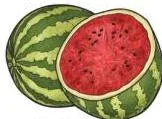
Think of a watermelon: the red pulp is the positive charge and the seeds are the electrons spread through it. The older picture — plums in a pudding — shows the same balance of charges. This was the first genuine attempt to show how positive and negative charge stay balanced inside an atom (NCERT, p. 143).
Rutherford’s Gold Foil Experiment
In 1911, Geiger and Marsden, working under Rutherford, tested Thomson’s model by firing a narrow beam of alpha particles at an extremely thin sheet of gold foil (NCERT, p. 144). An alpha particle is the nucleus of a helium atom — two protons and two neutrons — so it carries a positive charge.
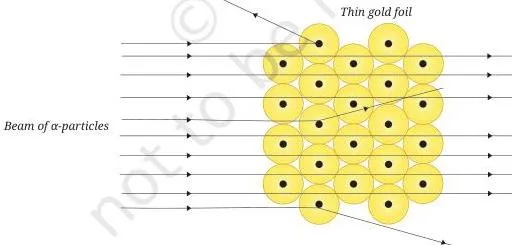
If Thomson were right, the spread-out positive charge would nudge the alpha particles only slightly. Instead, the experiment gave three results, and each revealed something about the atom:
- Most particles passed straight through → the atom is mostly empty space.
- Some were sharply deflected → all the positive charge is concentrated in a tiny central region called the nucleus.
- A few bounced back → the nucleus is dense and holds most of the atom’s mass (NCERT, p. 144).
This deflection from a straight path is called scattering, which is why the experiment is also called the α-ray scattering experiment (NCERT, p. 144).
From these results Rutherford proposed the planetary model: electrons revolve around the dense nucleus like planets orbiting the Sun (NCERT, pp. 144–145).

The sizes are dramatic. Atom diameter \( \approx 10^{-10}\ \text{m} \); nucleus diameter \( \approx 10^{-15}\ \text{m} \). If an atom were a cricket ground (about 100 m across), the nucleus would be a black pepper grain a few millimetres wide (NCERT, p. 145).
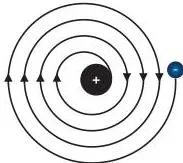
But the model had a fatal flaw — it could not explain stability. A charged electron moving in a circle is accelerating, so it should radiate energy, spiral inward and fall into the nucleus. If that really happened, atoms would collapse — yet matter around us stays intact (NCERT, pp. 145–146).
Bohr’s Model: The Stationary States
In 1913 Niels Bohr solved the stability problem by proposing stationary states (NCERT, p. 146). In his model:
- Electrons follow fixed circular paths called shells, orbits or energy levels, labelled K, L, M, N … or n = 1, 2, 3, 4 …
- K (n = 1) is closest to the nucleus and has the least energy; energy increases outward.
- While moving in a fixed shell an electron does not lose energy — the postulate that explains why atoms are stable.
- Each shell holds only a fixed number of electrons, and an electron jumps shells only by absorbing or releasing a fixed amount of energy (NCERT, p. 147).
The letters K, L, M, N come from Charles Barkla’s early X-ray work: he named the first observed X-ray line K, and Bohr adopted the same notation for atomic shells (NCERT, p. 147).
Symbols of Elements: Rules That Keep Chemistry Global
As scientists found more elements, chemistry needed a standard way to write them. Dalton introduced the first pictorial symbols in 1803; Berzelius switched to alphabetic symbols in 1813; today the International Union of Pure and Applied Chemistry (IUPAC) approves the names and symbols of elements (NCERT, p. 148–149).
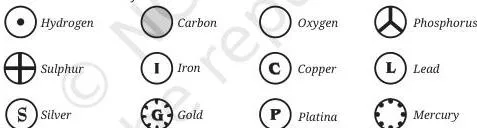
The IUPAC rules for writing symbols:
- The first letter is always capital (uppercase); the second letter, if any, is always small (lowercase).
- Many symbols use the first letter or the first two letters of the name: H, Al, Ca, Mg.
- Some use the first letter plus a letter other than the second: Cl, Zn (NCERT, p. 149).
- Some come from Latin, Greek or German names rather than English: Fe (iron, from Latin ferrum), Hg (mercury, from Greek hydrargyros), W (tungsten, from German wolfram) (NCERT, p. 149).
| Element | Symbol | Element | Symbol | Element | Symbol |
|---|---|---|---|---|---|
| Aluminium | Al | Copper | Cu | Nitrogen | N |
| Argon | Ar | Fluorine | F | Oxygen | O |
| Gold | Au | Hydrogen | H | Potassium | K |
| Iron | Fe | Lead | Pb | Silver | Ag |
| Sodium | Na | Tungsten | W | Zinc | Zn |
Standard symbols matter because they let scientists worldwide communicate clearly, regardless of language (NCERT, p. 149). The trap: Co (cobalt) is not CO — CO means carbon monoxide.
Atomic Number and Mass Number: The Identity Card of an Atom
Every element is identified by two numbers (NCERT, p. 150):
- Atomic number (Z) = the number of protons in the nucleus. Because the atom is neutral, Z also equals the number of electrons.
- Mass number (A) = the total number of protons and neutrons. The protons and neutrons packed in the nucleus are called nucleons.
\[ A = Z + n \]
where \( n \) is the number of neutrons (NCERT, p. 150). The standard notation places the mass number top-left and the atomic number bottom-left:
\[ {}^{12}_{6}\text{C} \]
Read this as carbon: Z = 6 protons, A = 12, so neutrons = 12 − 6 = 6.
| Element | Protons | Neutrons | Mass number (A) |
|---|---|---|---|
| Hydrogen | 1 | 0 | 1 |
| Helium | 2 | 2 | 4 |
| Lithium | 3 | 4 | 7 |
| Carbon | 6 | 6 | 12 |
| Nitrogen | 7 | 7 | 14 |
| Oxygen | 8 | 8 | 16 |
The electron has almost negligible mass, so it is ignored in atomic mass calculations (NCERT, p. 151).
Electronic Configuration: How Electrons Fill the Shells
The electronic configuration of an atom is the distribution of its electrons among the shells. It follows the Bohr-Bury rules (NCERT, pp. 151–152):
- Rule 1 (capacity): the maximum number of electrons in a shell is \( 2n^2 \), where n is the shell number. K (n = 1) holds \( 2 \times 1^2 = 2 \); L (n = 2) holds \( 2 \times 2^2 = 8 \); M (n = 3) holds \( 2 \times 3^2 = 18 \).
- Rule 2 (outer shell): the outermost shell holds at most 8 electrons, and the first (K) shell at most 2.
- Rule 3 (filling order): electrons fill from the shell closest to the nucleus outward — K completes before L fills, and so on.
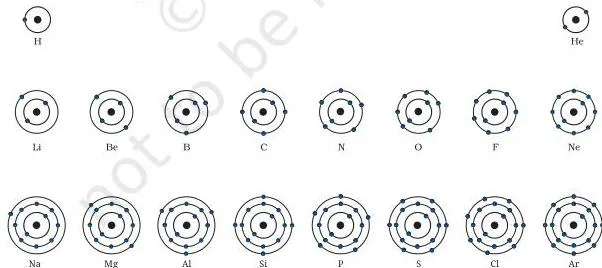
Figure 8.11 shows the clean K–L–M progression: each time the atomic number rises by 1, one electron is added to the next available shell (NCERT, p. 152).
| Element | Z | K | L | M | N |
|---|---|---|---|---|---|
| Hydrogen | 1 | 1 | − | − | − |
| Helium | 2 | 2 | − | − | − |
| Lithium | 3 | 2 | 1 | − | − |
| Beryllium | 4 | 2 | 2 | − | − |
| Boron | 5 | 2 | 3 | − | − |
| Carbon | 6 | 2 | 4 | − | − |
| Nitrogen | 7 | 2 | 5 | − | − |
| Oxygen | 8 | 2 | 6 | − | − |
| Fluorine | 9 | 2 | 7 | − | − |
| Neon | 10 | 2 | 8 | − | − |
| Sodium | 11 | 2 | 8 | 1 | − |
| Magnesium | 12 | 2 | 8 | 2 | − |
| Aluminium | 13 | 2 | 8 | 3 | − |
| Silicon | 14 | 2 | 8 | 4 | − |
| Phosphorus | 15 | 2 | 8 | 5 | − |
| Sulfur | 16 | 2 | 8 | 6 | − |
| Chlorine | 17 | 2 | 8 | 7 | − |
| Argon | 18 | 2 | 8 | 8 | − |
Worked examples: chlorine (Z = 17) fills as 2, 8, 7; silicon (Z = 14) fills as 2, 8, 4. Notice the M shell of both stays far below its 18 capacity because the outer shell caps at 8 electrons (NCERT, Table 8.4, p. 152).
Valency: Why Atoms Combine the Way They Do
An atom’s combining capacity is expressed through hydrogen or chlorine, since both have a combining capacity of one. In water \( \text{H}_2\text{O} \), oxygen combines with two hydrogen atoms, so oxygen’s combining capacity is 2; in \( \text{NH}_3 \), nitrogen’s is 3; in \( \text{MgCl}_2 \), magnesium’s is 2 (NCERT, pp. 153–154).
The outermost shell containing electrons is the valence shell, and its electrons are valence electrons. If the valence shell holds 8 electrons it is called an octet. Elements with a complete octet — or 2 electrons in the case of helium — are largely unreactive and stable (NCERT, p. 154).
Atoms with fewer than 4 valence electrons tend to lose them; with more than 4 they tend to gain them; with exactly 4 they share them. The number of electrons gained, lost or shared to complete the octet is the valency (NCERT, p. 154).
| Element | Configuration | What it does | Valency |
|---|---|---|---|
| Sodium | 2, 8, 1 | Loses 1 electron | 1 |
| Oxygen | 2, 6 | Gains 2 electrons | 2 |
| Carbon | 2, 4 | Shares 4 electrons | 4 |
| Neon / Argon | 2, 8 / 2, 8, 8 | Already a full octet — no reaction | 0 |
Elements that already hold a full octet do not try to lose or gain electrons — that is why the noble gases stay unreactive (NCERT, p. 154).
Isotopes, Isobars and Average Atomic Mass
Dalton assumed every atom of an element is identical, but nature disagreed. Isotopes are atoms of the same element (same atomic number Z) with different mass numbers A — they carry different numbers of neutrons (NCERT, p. 154).
Hydrogen is a natural mixture of three isotopes:
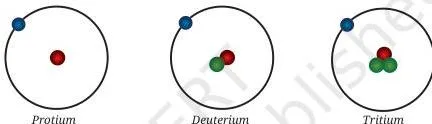
| Isotope | Protons | Neutrons | Electrons | Natural abundance |
|---|---|---|---|---|
| Protium \( {}^{1}_{1}\text{H} \) | 1 | 0 | 1 | ~99.98% |
| Deuterium \( {}^{2}_{1}\text{H} \) | 1 | 1 | 1 | ~0.015% |
| Tritium \( {}^{3}_{1}\text{H} \) | 1 | 2 | 1 | Traces |
Carbon likewise has three isotopes: \( {}^{12}_{6}\text{C} \), \( {}^{13}_{6}\text{C} \) and \( {}^{14}_{6}\text{C} \) (NCERT, p. 155).
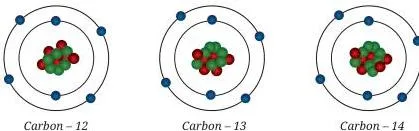
Isotopes share the same chemical properties because they have the same electrons and the same electronic configuration; they differ in physical properties such as boiling and melting points (NCERT, p. 155).
Some isotopes are put to practical use (NCERT, p. 156):
- \( {}^{235}_{92}\text{U} \) (uranium-235) — fuel in nuclear reactors to generate electricity.
- \( {}^{60}_{27}\text{Co} \) (cobalt-60) — radiation treatment for cancer.
- \( {}^{131}_{53}\text{I} \) (iodine-131) — treatment of goitre and thyroid cancer.
- \( {}^{14}_{6}\text{C} \) (carbon-14) — used in archaeology and geology to date ancient fossils and artefacts.
Isobars flip the idea: they are atoms of different elements with the same mass number but different atomic numbers. Calcium (Z = 20), potassium (Z = 19) and argon (Z = 18) each have mass number 40 (NCERT, p. 157).
Weighted average atomic mass. Chlorine occurs as \( {}^{35}\text{Cl} \) (about 75%) and \( {}^{37}\text{Cl} \) (about 25%). The simple average \( (35+37)/2 = 36\ \text{u} \) ignores abundance and is wrong. The accurate value is the weighted average (NCERT, p. 156):
\[ \text{Average} = \left(35 \times \frac{75}{100} + 37 \times \frac{25}{100}\right)\ \text{u} = 35.5\ \text{u} \]
No single chlorine atom has mass 35.5 u — it is the average over many atoms in the ratio they occur naturally (NCERT, p. 157). Scientists use the unified atomic mass unit (u) because atoms are far too tiny to weigh in kilograms (NCERT, p. 155).
Atomic Terms and Formulas: Quick Revision Cards
Every technical term in one table, written for speedy revision:
| Term | Meaning | Example |
|---|---|---|
| Atom | The smallest particle of an element that takes part in chemical reactions | Hydrogen atom |
| Electron | Negatively charged particle (−1) of almost negligible mass, found outside the nucleus | \( e^- \) |
| Proton | Positively charged particle (+1), found in the nucleus | \( p^+ \) |
| Neutron | Neutral particle with mass nearly equal to a proton, in the nucleus (absent in hydrogen) | \( n^0 \) |
| Nucleons | The protons and neutrons together in the nucleus | Carbon: 12 nucleons |
| Atomic number (Z) | Number of protons in the nucleus; equals electrons in a neutral atom | Carbon, Z = 6 |
| Mass number (A) | Total protons + neutrons in the nucleus | Carbon, A = 12 |
| Valence shell | The outermost shell that contains electrons | Sodium: M shell |
| Valence electrons | Electrons present in the valence shell | Sodium: 1 |
| Octet | Eight electrons in the outermost shell of an atom | Neon: 2, 8 |
| Valency | The number of electrons gained, lost or shared to complete the octet | Oxygen: 2 |
| Isotope | Same atomic number, different mass number | \( {}^{12}_{6}\text{C} \), \( {}^{14}_{6}\text{C} \) |
| Isobar | Same mass number, different atomic numbers | Ca-40, K-40, Ar-40 |
| Unified atomic mass unit (u) | Unit used to measure the tiny masses of atoms | Chlorine: 35.5 u |
Formulas box — know each symbol and its meaning:
- Mass number: \( A = \text{protons} + \text{neutrons} \)
- Maximum electrons in a shell: \( 2n^2 \)
- Weighted average atomic mass: \( \sum (\text{mass of isotope} \times \text{relative abundance}) \)
- Standard notation: \( {}^{A}_{Z}X \) — A (mass number) top-left, Z (atomic number) bottom-left
- Electron mass is ignored in atomic mass calculations.
Worked Examples: Solving Atomic Numericals Step by Step
Four original numericals (not from the textbook) covering the exam’s favourite calculations.
Example 1: Finding protons, electrons and neutrons from Z and A
Method: Use Z for protons, the neutrality rule (electrons = protons) and \( n = A – Z \) for neutrons.
Step 1: A nitrogen atom has atomic number 7 and mass number 15.
\[ \text{Protons} = Z = 7 \]
- Step 1: The atom is neutral, so electrons = protons = 7.
- Step 2: Subtract to get neutrons: \( 15 – 7 = 8 \).
Final answer: Protons 7, electrons 7, neutrons 8.
Example 2: Writing the electronic configuration and finding valency
Method: Fill shells with the \( 2n^2 \) capacity and the 8-electron outer-shell cap, starting from K.
- Step 1: Silicon has Z = 14, so it has 14 electrons.
- Step 2: K holds 2, L holds 8, leaving \( 14 – 10 = 4 \) electrons for M.
\[ \text{Configuration} = 2,\ 8,\ 4 \]
Step 3: Silicon has 4 valence electrons (exactly half of 8), so it shares electrons to complete its octet.
Final answer: Silicon is 2, 8, 4 with valency 4.
Example 3: Reading the standard notation of an atom
Method: The subscript is Z, the superscript is A.
- Step 1: In \( {}^{32}_{16}\text{S} \), the subscript 16 is the atomic number — that is the number of protons.
- Step 2: Electrons = protons = 16 (neutral atom).
- Step 3: Neutrons = A − Z = 32 − 16 = 16.
Final answer: Protons 16, electrons 16, neutrons 16.
Example 4: Weighted average atomic mass of copper
Method: Multiply each isotope mass by its relative abundance and add — this is the weighted average, not the simple mean.
Step 1: Copper occurs as Cu-63 (69%, mass 63 u) and Cu-65 (31%, mass 65 u).
\[ \text{Average} = \left(63 \times \frac{69}{100}\right) + \left(65 \times \frac{31}{100}\right) \]
Step 2: Compute each term: \( 63 \times 0.69 = 43.47\ \text{u} \) and \( 65 \times 0.31 = 20.15\ \text{u} \).
\[ \text{Average} = 43.47 + 20.15 = 63.62\ \text{u} \approx 63.6\ \text{u} \]
Final answer: The average atomic mass of copper is ≈ 63.6 u.
Common Mistakes Students Make and How to Avoid Them
| Mistake | Correct rule | How to check your answer |
|---|---|---|
| Writing CO for cobalt | The symbol is Co — the second letter is always lowercase. CO means carbon monoxide | Ask: is this an element symbol or a compound? Elements never have two capitals |
| Saying hydrogen has a neutron because A = Z + n | Hydrogen has 0 neutrons: A = 1, Z = 1, so n = A − Z = 0 | Compute A − Z for hydrogen and confirm it gives 0 |
| Using the simple average for chlorine: (35 + 37)/2 = 36 u | Use the weighted average 35.5 u because \( {}^{35}\text{Cl} \) and \( {}^{37}\text{Cl} \) occur unequally (75% and 25%) | Multiply each mass by its percentage and add — if you skip abundance, you are wrong |
| Filling the M shell of potassium to 18 because of \( 2n^2 \) | The outermost shell caps at 8, so potassium is 2, 8, 8, 1 — not 2, 8, 9 | Check the outer shell number is ≤ 8 before you finish |
| Mixing up isobars with isotopes | Isotopes share atomic number (same element); isobars share mass number (different elements) | Compare Z and A: “iso-topes” keep Z; “iso-bars” keep A |
Exam Notes: What CBSE Looks For in This Chapter
Observed patterns from how the chapter is examined — each point targets the exact step that earns the mark.
- Numericals on Z, A, protons, neutrons and electrons are standard. Write the explicit step neutrons = mass number − atomic number (A − Z) with the numbers substituted; this line is what earns the mark (NCERT, p. 150).
- Assertion-reason questions appear. The chapter’s own Pause and Ponder gives the pattern: Assertion — “Rutherford concluded most of the mass of an atom is concentrated in a small central nucleus”; Reason — “According to Thomson’s model, electrons are embedded in a uniformly distributed positive sphere.” Both are true, but the reason does not explain the assertion → option (ii) (NCERT, pp. 145–146).
- Electronic configuration and valency of the first 18 elements recur. Examiners expect the shell-by-shell breakdown (2, 8, …), not just the final digit (NCERT, Table 8.4, p. 152).
- Isotope and isobar questions use notation like \( {}^{12}_{6}\text{C} \). The subscript is Z (protons), the superscript is A (protons + neutrons) (NCERT, p. 154).
- Average atomic mass is a classic calculation. Write the weighted formula with the percentages shown, as in Example 4 above (NCERT, p. 156).
- Short-answer questions on models expect the year, the proposer and one limitation of each model — the comparison table in this page covers all three for Dalton, Thomson, Rutherford and Bohr (NCERT, pp. 158–160).
For how these ideas build on one another, see our atomic foundations of matter notes.
Journey Inside the Atom Class 9 Notes: Revision Summary
The entire chapter compressed for a two-minute sweep.
| Year | Contribution |
|---|---|
| 1808 | Dalton — scientific atomic theory |
| 1897 | Thomson — discovers the electron |
| 1911 | Rutherford — gold foil experiment, nucleus, planetary model |
| 1913 | Bohr — fixed shells K, L, M, N; stationary states explain stability |
| 1932 | Chadwick — discovers the neutron |
- Particles: electron (−1), proton (+1), neutron (0); protons and neutrons are nucleons in the nucleus.
- Two formulas: \( A = Z + n \); maximum electrons per shell \( = 2n^2 \).
- Configuration pattern: 2, 8, 8… with the outermost shell capped at 8; K caps at 2.
- Valency: electrons lost, gained or shared to complete the octet; a full octet (or helium’s 2) means no reaction.
- Isotopes vs isobars: isotopes — same Z, different A (H, C); isobars — same A, different Z (Ca-40, K-40, Ar-40).
- Isotope uses: U-235 (nuclear power), Co-60 (cancer), I-131 (goitre/thyroid), C-14 (dating fossils).
- Sizes: atom \( \approx 10^{-10}\ \text{m} \), nucleus \( \approx 10^{-15}\ \text{m} \).
- Symbols: first letter capital, second lowercase (Co, not CO).
For more revision across Class 9, see the Class 9 Science notes collection, including the nearby work, energy and simple machines notes. You can also browse all Class 9 notes or the full CBSE notes library.
FAQs: Quick Answers to Tricky Questions
Why don’t electrons fall into the nucleus even though protons attract them?
Because they stay in fixed shells (stationary states) where they do not lose energy — that is exactly the postulate Bohr added to fix Rutherford’s model. Rutherford’s model failed precisely because it predicted a spiralling, energy-losing electron that would collapse into the nucleus (NCERT, pp. 145–147).
What is the difference between isotopes and isobars?
Isotopes are atoms of the same element with the same atomic number but different mass numbers (hydrogen’s protium, deuterium and tritium). Isobars are atoms of different elements with the same mass number but different atomic numbers (Ca-40, K-40, Ar-40) (NCERT, pp. 154–157).
Why is the atomic mass of chlorine 35.5 u instead of 35 u or 37 u?
Because natural chlorine is a mixture of about 75% \( {}^{35}\text{Cl} \) and 25% \( {}^{37}\text{Cl} \). The weighted average — \( 35 \times 0.75 + 37 \times 0.25 = 35.5\ \text{u} \) — reflects that real abundance, which the simple average ignores (NCERT, p. 156).
Why is helium stable even though it has only 2 electrons in its valence shell?
Helium has only one shell (K), which can hold at most 2 electrons. A full shell is stable, just like a full octet — this is the stated exception to the 8-electron rule (NCERT, p. 154).
How do I find the number of neutrons from the standard notation of an atom?
Read the subscript (Z, protons) and the superscript (A, mass number), then subtract: neutrons = A − Z. In \( {}^{32}_{16}\text{S} \), that is 32 − 16 = 16 neutrons (NCERT, p. 150).
Reference: NCERT Class 9 Science textbook, chapter Journey Inside the Atom.
Explore Class 9 Science Notes
More for this chapter:
Class 9 Science on LearnCBSE:
Related chapters: