Here are the Types of Solutions Class 12 formulas from the NCERT Chemistry textbook, organised so you can find any one in seconds.
The sheet covers the concentration units — mass percentage, volume percentage, parts per million, mole fraction, molarity and molality — along with Henry’s law, Raoult’s law, the colligative properties (relative lowering of vapour pressure, elevation of boiling point, depression of freezing point, osmotic pressure) and the van’t Hoff factor for abnormal molar masses.
Every formula below is grouped by topic, with the meaning of each symbol in its unit and a line on when to reach for it. Three worked examples with fresh numbers show the formula being selected and substituted, and the common-mistakes table catches the sign and unit errors students make while applying these formulas.
For the rest of the unit’s formula sheets, browse the Class 12 chemistry formulas collection.
Formulas at a Glance
Every formula on this page in one lookup table. Symbol meanings come right below it; the conditions attached to each formula follow in the “When to Use” section.
| Purpose (what you are finding) | Formula |
|---|---|
| Mass percentage (w/w) | \( \text{Mass \%} = \frac{\text{mass of component}}{\text{total mass of solution}} \times 100 \) |
| Volume percentage (v/v) | \( \text{Volume \%} = \frac{\text{volume of component}}{\text{total volume of solution}} \times 100 \) |
| Mass by volume percentage (w/V) | \( \text{mass of solute (in g) dissolved in 100 mL of solution} \) |
| Parts per million (ppm) | \( \text{ppm} = \frac{\text{parts of component}}{\text{total parts of all components}} \times 10^6 \) |
| Mole fraction of a component | \( x_i = \frac{n_i}{n_1 + n_2 + \dots + n_i} = \frac{n_i}{\sum n_i} \) |
| Sum of all mole fractions | \( x_1 + x_2 + \dots + x_i = 1 \) |
| Molarity of a solution | \( M = \frac{\text{moles of solute}}{\text{volume of solution in litre}} \) |
| Molality of a solution | \( m = \frac{\text{moles of solute}}{\text{mass of solvent in kg}} \) |
| Henry’s law for a gas dissolved in a liquid | \( p = K_H x \) |
| Partial vapour pressure of a volatile component (Raoult’s law) | \( p_1 = p_1^0 x_1 \) |
| Total vapour pressure of a binary liquid mixture | \( p_{\text{total}} = x_1 p_1^0 + x_2 p_2^0 = p_1^0 + (p_2^0 – p_1^0) x_2 \) |
| Composition of the vapour phase | \( p_i = y_i p_{\text{total}} \) |
| Vapour pressure when the solute is non-volatile | \( p_1 = x_1 p_1^0 \) |
| Ideal solution condition | \( \Delta_{\text{mix}} H = 0,\ \Delta_{\text{mix}} V = 0 \) |
| Relative lowering of vapour pressure | \( \frac{p_1^0 – p_1}{p_1^0} = x_2 = \frac{n_2}{n_1 + n_2} \) |
| Relative lowering for dilute solutions (molar mass form) | \( \frac{p_1^0 – p_1}{p_1^0} = \frac{w_2 M_1}{M_2 w_1} \) |
| Elevation of boiling point | \( \Delta T_b = T_b – T_b^0 = K_b m \) |
| Molar mass from boiling point elevation | \( M_2 = \frac{1000 \times w_2 \times K_b}{\Delta T_b \times w_1} \) |
| Depression of freezing point | \( \Delta T_f = T_f^0 – T_f = K_f m \) |
| Molar mass from freezing point depression | \( M_2 = \frac{K_f \times w_2 \times 1000}{\Delta T_f \times w_1} \) |
| Osmotic pressure of a dilute solution | \( \Pi = C R T = \frac{n_2}{V} R T \) |
| Molar mass from osmotic pressure | \( M_2 = \frac{w_2 R T}{\Pi V} \) |
| van’t Hoff factor | \( i = \frac{\text{normal molar mass}}{\text{abnormal (observed) molar mass}} \) |
| Colligative formulas corrected for dissociation/association | \( \frac{p_1^0 – p_1}{p_1^0} = i \frac{n_2}{n_1},\ \Delta T_b = i K_b m,\ \Delta T_f = i K_f m,\ \Pi = \frac{i n_2 R T}{V} \) |
All Formulas, Grouped by Topic
All formulas below come from the NCERT chapter on Solutions, grouped by the section they appear in. Page citations refer to the NCERT Class 12 Chemistry textbook.
Expressing Concentration of Solutions
Section 1.2 defines the units for reporting how much solute a solution contains (NCERT, pp. 2–4). Mass percentage, volume percentage and ppm are ratios scaled by 100 or \( 10^6 \):
\[ \text{Mass \% of a component} = \frac{\text{Mass of the component}}{\text{Total mass of the solution}} \times 100 \]
\[ \text{Volume \% of a component} = \frac{\text{Volume of the component}}{\text{Total volume of the solution}} \times 100 \]
\[ \text{ppm} = \frac{\text{Number of parts of the component}}{\text{Total number of parts of all components}} \times 10^6 \]
Mass by volume percentage (w/V), used in medicine and pharmacy, is the mass of solute in grams dissolved in 100 mL of solution (NCERT, p. 2).
Mole fraction is the ratio of moles of one component to total moles (NCERT, p. 3):
\[ x_i = \frac{n_i}{n_1 + n_2 + \dots + n_i} = \frac{n_i}{\sum n_i} \]
\[ x_1 + x_2 + \dots + x_i = 1 \]
Molarity and molality are the two mole-based concentration units (NCERT, p. 4):
\[ M = \frac{\text{Moles of solute}}{\text{Volume of solution in litre}} \]
\[ m = \frac{\text{Moles of solute}}{\text{Mass of solvent in kg}} \]
Mass percentage, ppm, mole fraction and molality are independent of temperature; molarity is a function of temperature because volume depends on temperature (NCERT, p. 4).
Henry’s Law — Solubility of a Gas in a Liquid
Henry’s law states that at constant temperature the mole fraction of a gas dissolved in a liquid is proportional to the partial pressure of the gas above the solution (NCERT, p. 7):
\[ p = K_H x \]
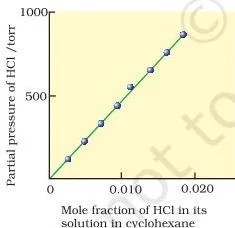
The diagram shows the mechanism: compressing the gas raises the rate at which gas particles strike the liquid surface, so more gas dissolves until a new equilibrium is reached.
Higher \( K_H \) at a given pressure means lower solubility, and \( K_H \) for gases like \( N_2 \) and \( O_2 \) increases with temperature — which is why gases dissolve less in warm water (NCERT, p. 7).
Raoult’s Law — Vapour Pressure of Liquid–Liquid Solutions
For a binary solution of two volatile liquids, the partial vapour pressure of each component is proportional to its mole fraction (NCERT, p. 9):
\[ p_1 = p_1^0 x_1 \quad \text{and} \quad p_2 = p_2^0 x_2 \]
By Dalton’s law of partial pressures, the total vapour pressure over the solution is the sum of the two partial pressures (NCERT, p. 10):
\[ p_{\text{total}} = p_1 + p_2 \]
\[ p_{\text{total}} = x_1 p_1^0 + x_2 p_2^0 = p_1^0 + (p_2^0 – p_1^0) x_2 \]
So the total vapour pressure varies linearly with the mole fraction of either component. The mole fractions in the vapour phase are found from (NCERT, p. 10):
\[ p_i = y_i p_{\text{total}} \]
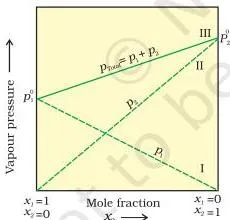
The plot makes the linearity visible: the partial-pressure lines pass through the pure-component pressures, and line III is the total pressure. At equilibrium the vapour phase is always richer in the more volatile component (NCERT, pp. 10–11).
Vapour Pressure of Solutions of Solids in Liquids
When the solute is non-volatile, only the solvent molecules contribute to the vapour pressure, and Raoult’s law takes the form (NCERT, p. 12):
\[ p_1 = x_1 p_1^0 \]
If the solution obeys Raoult’s law at all concentrations, the vapour pressure varies linearly from zero to the vapour pressure of the pure solvent (NCERT, p. 13).
Ideal and Non-ideal Solutions
An ideal solution obeys Raoult’s law over the entire range of concentration and has zero enthalpy and volume of mixing (NCERT, p. 13):
\[ \Delta_{\text{mix}} H = 0, \qquad \Delta_{\text{mix}} V = 0 \]
Real solutions deviate from Raoult’s law. If A–B interactions are weaker than A–A and B–B interactions, the vapour pressure is higher than predicted — positive deviation (e.g. ethanol–acetone). If A–B interactions are stronger, the vapour pressure is lower — negative deviation (e.g. chloroform–acetone) (NCERT, pp. 13–14).
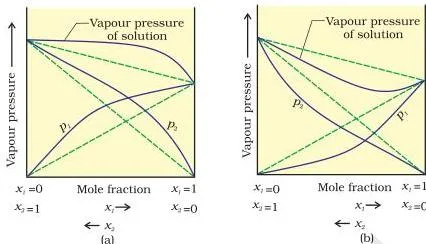
Large deviations produce azeotropes — binary mixtures whose liquid and vapour have the same composition and which boil at constant temperature, so they cannot be separated by fractional distillation. Large positive deviation gives a minimum-boiling azeotrope; large negative deviation gives a maximum-boiling azeotrope (NCERT, p. 14).
Relative Lowering of Vapour Pressure
The lowering of vapour pressure caused by a non-volatile solute depends only on the solute’s mole fraction (NCERT, p. 15):
\[ \Delta p_1 = p_1^0 – p_1 = x_2 p_1^0 \]
\[ \frac{p_1^0 – p_1}{p_1^0} = x_2 = \frac{n_2}{n_1 + n_2} \]
For dilute solutions, \( n_2 \ll n_1 \), so the relative lowering becomes (NCERT, p. 15):
\[ \frac{p_1^0 – p_1}{p_1^0} = \frac{n_2}{n_1} = \frac{w_2 \times M_1}{M_2 \times w_1} \]
Here \( w_1, w_2 \) are the masses and \( M_1, M_2 \) the molar masses of solvent and solute. This last form lets you calculate the molar mass of the solute.
Elevation of Boiling Point
For dilute solutions the elevation of boiling point is directly proportional to the molality of the solute (NCERT, pp. 16–17):
\[ \Delta T_b = T_b – T_b^0 = K_b m \]
\[ m = \frac{1000 \times w_2}{M_2 \times w_1} \]
\[ \Delta T_b = \frac{K_b \times 1000 \times w_2}{M_2 \times w_1} \]
\[ M_2 = \frac{1000 \times w_2 \times K_b}{\Delta T_b \times w_1} \]
The constant \( K_b \) is called the boiling point elevation constant or molal elevation constant (ebullioscopic constant); its unit is K kg mol⁻¹ (NCERT, p. 17).
Depression of Freezing Point
For dilute solutions the depression of freezing point is also proportional to molality (NCERT, p. 18):
\[ \Delta T_f = T_f^0 – T_f = K_f m \]
\[ \Delta T_f = \frac{K_f \times w_2 \times 1000}{M_2 \times w_1} \]
\[ M_2 = \frac{K_f \times w_2 \times 1000}{\Delta T_f \times w_1} \]
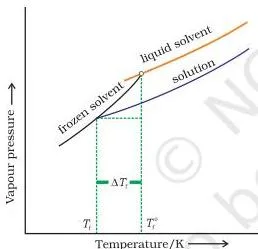
The figure shows why the solution freezes lower: its vapour pressure curve meets the solid solvent’s curve at a lower temperature than the pure solvent does. For the same solvent, \( K_f \) (cryoscopic constant) and \( K_b \) can be calculated from the solvent’s own properties (NCERT, p. 19):
\[ K_f = \frac{R \times M_1 \times T_f^2}{1000 \times \Delta_{\text{fus}} H}, \qquad K_b = \frac{R \times M_1 \times T_b^2}{1000 \times \Delta_{\text{vap}} H} \]
Here \( M_1 \) is the molar mass of the solvent, \( T_f, T_b \) its freezing and boiling points in kelvin, and \( \Delta_{\text{fus}} H, \Delta_{\text{vap}} H \) its enthalpies of fusion and vapourisation (NCERT, p. 19).
The table below lists \( K_b \) and \( K_f \) for common solvents (NCERT, p. 19).
| Solvent | Boiling point / K | \( K_b \) / K kg mol⁻¹ | Freezing point / K | \( K_f \) / K kg mol⁻¹ |
|---|---|---|---|---|
| Water | 373.15 | 0.52 | 273.0 | 1.86 |
| Ethanol | 351.5 | 1.20 | 155.7 | 1.99 |
| Cyclohexane | 353.74 | 2.79 | 279.55 | 20.00 |
| Benzene | 353.3 | 2.53 | 278.6 | 5.12 |
| Chloroform | 334.4 | 3.63 | 209.6 | 4.79 |
| Carbon tetrachloride | 350.0 | 5.03 | 250.5 | 31.8 |
| Carbon disulphide | 319.4 | 2.34 | 164.2 | 3.83 |
| Diethyl ether | 307.8 | 2.02 | 156.9 | 1.79 |
| Acetic acid | 391.1 | 2.93 | 290.0 | 3.90 |
Osmotic Pressure
Osmotic pressure is the excess pressure that must be applied to a solution to stop the flow of solvent through a semipermeable membrane (NCERT, p. 21). For dilute solutions it is proportional to molarity:
\[ \Pi = C R T = \frac{n_2}{V} R T \]
\[ \Pi V = \frac{w_2 R T}{M_2} \]
\[ M_2 = \frac{w_2 R T}{\Pi V} \]
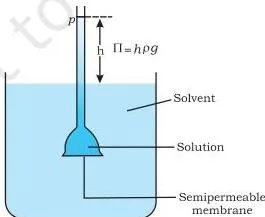
The funnel setup shows osmosis directly: solvent crosses the membrane into the solution because the solution has a lower solvent concentration. The osmotic pressure method is preferred for proteins, polymers and other macromolecules because pressure is measured near room temperature, molarity is used instead of molality, and the magnitude is large even for very dilute solutions (NCERT, p. 21).
Two solutions with the same osmotic pressure at the same temperature are isotonic; a more concentrated one is hypertonic and a less concentrated one is hypotonic (NCERT, p. 21).
Abnormal Molar Masses and the van’t Hoff Factor
Solute particles that dissociate or associate change the particle count, so the experimentally determined molar mass differs from the normal value — lower for dissociation, higher for association. The van’t Hoff factor \( i \) corrects for this (NCERT, pp. 23–24):
\[ i = \frac{\text{Normal molar mass}}{\text{Abnormal (observed) molar mass}} = \frac{\text{Observed colligative property}}{\text{Calculated colligative property}} \]
\[ i = \frac{\text{Total moles of particles after dissociation or association}}{\text{Moles of particles before dissociation or association}} \]
With \( i \), the colligative formulas become (NCERT, p. 24):
\[ \frac{p_1^0 – p_1}{p_1^0} = i \frac{n_2}{n_1}, \qquad \Delta T_b = i K_b m, \qquad \Delta T_f = i K_f m, \qquad \Pi = \frac{i n_2 R T}{V} \]
For dissociation \( i \gt 1 \); for association \( i \lt 1 \) (NCERT, p. 24). From the particle balance: a solute that dissociates into two ions gives \( i = 1 + x \), while a solute that dimerises gives \( i = 1 – \frac{x}{2} \), where \( x \) is the degree of dissociation or association (NCERT, pp. 25–26).
What Each Symbol Means
Units follow the NCERT chapter. Where a unit depends on the pressure unit you choose, the table says “same as \( p \)”.
| Symbol | What it means | Unit / nature |
|---|---|---|
| \( x_i \) | Mole fraction of component \( i \) in the solution | Dimensionless (a ratio) |
| \( n_i \) | Number of moles of component \( i \) | mol |
| \( M \) | Molarity — moles of solute per litre of solution | mol L⁻¹ (mol dm⁻³) |
| \( m \) | Molality — moles of solute per kilogram of solvent | mol kg⁻¹ |
| \( w_1, w_2 \) | Masses of solvent and solute | g (grams) |
| \( M_1, M_2 \) | Molar masses of solvent and solute | g mol⁻¹ |
| \( p \) | Partial pressure of a gas / vapour pressure | bar, mm Hg, atm, Pa or kPa |
| \( K_H \) | Henry’s law constant | Same unit as \( p \) (e.g. kbar, Pa) |
| \( p_1^0, p_2^0 \) | Vapour pressures of the pure components | Same unit as \( p \) |
| \( p_{\text{total}} \) | Total vapour pressure over the solution | Same unit as \( p \) |
| \( y_i \) | Mole fraction of component \( i \) in the vapour phase | Dimensionless |
| \( \Delta p_1 \) | Lowering of vapour pressure, \( p_1^0 – p_1 \) | Same unit as \( p \) |
| \( T_b^0, T_b \) | Boiling points of pure solvent and solution | K |
| \( T_f^0, T_f \) | Freezing points of pure solvent and solution | K |
| \( \Delta T_b, \Delta T_f \) | Boiling point elevation and freezing point depression | K |
| \( K_b, K_f \) | Molal elevation constant and molal depression constant | K kg mol⁻¹ |
| \( \Pi \) | Osmotic pressure | bar, atm or Pa |
| \( C \) | Molarity of the solution | mol L⁻¹ |
| \( V \) | Volume of solution | L |
| \( R \) | Gas constant | 0.083 L bar K⁻¹ mol⁻¹ in bar–L units |
| \( i \) | van’t Hoff factor | Dimensionless |
| \( \Delta_{\text{mix}} H, \Delta_{\text{mix}} V \) | Enthalpy and volume of mixing | J mol⁻¹ or kJ mol⁻¹; L or m³ |
When to Use Each Formula
| Formula | Use it when | Condition / point to check |
|---|---|---|
| Mass %, volume %, w/V, ppm | You have a composition ratio and need a label, e.g. 10% glucose, 35% v/v antifreeze, 15 ppm pollutant. | Same kind of parts top and bottom; scale by 100 or \( 10^6 \). |
| \( x_i = n_i/\sum n_i \) | Working with vapour pressure, Raoult’s law or gas mixtures. | All mole fractions add up to 1. |
| \( M \) (molarity) | The volume of the solution is known, or you need \( \Pi = C R T \). | Volume changes with temperature, so fix the temperature. |
| \( m \) (molality) | Any \( \Delta T_b \) or \( \Delta T_f \) problem — \( K_b \) and \( K_f \) are defined per kg of solvent. | Denominator is kg of solvent, never kg of solution. |
| \( p = K_H x \) | A gas dissolved in a liquid; find solubility from pressure or \( K_H \). | Constant temperature; higher \( K_H \) means lower solubility. |
| \( p_1 = p_1^0 x_1 \), \( p_{\text{total}} = x_1 p_1^0 + x_2 p_2^0 \) | Both components are volatile liquids. | Use each component’s own pure vapour pressure. |
| \( p_i = y_i p_{\text{total}} \) | To find the composition of the vapour phase. | Compute each partial pressure first, then divide by \( p_{\text{total}} \). |
| \( p_1 = x_1 p_1^0 \) | A non-volatile solid or liquid solute in a volatile solvent. | Only the solvent contributes vapour pressure. |
| \( \frac{p_1^0 – p_1}{p_1^0} = x_2 \) | Non-volatile solute; find the lowering or the solute’s mole fraction. | Dilute solutions: \( x_2 \approx n_2/n_1 \). |
| \( \Delta T_b = K_b m \) and its \( M_2 \) form | Molar mass from boiling point elevation. | Dilute solution; non-volatile, non-electrolyte solute. |
| \( \Delta T_f = K_f m \) and its \( M_2 \) form | Molar mass from freezing point depression. | Dilute solution; non-volatile, non-electrolyte solute. |
| \( \Pi = C R T \), \( M_2 = w_2 R T/(\Pi V) \) | Molar mass of proteins, polymers and biomolecules. | Room temperature; uses molarity, not molality. |
| van’t Hoff forms, e.g. \( \Delta T_f = i K_f m \) | The solute dissociates (electrolyte) or associates (dimer). | \( i \gt 1 \) for dissociation, \( i \lt 1 \) for association. |
Worked Examples
Three typical numericals with fresh numbers. Each one shows the formula being selected first, then the substitution.
Worked Example 1: Freezing point of a glucose solution
Problem: 18 g of glucose (\( C_6H_{12}O_6 \), molar mass 180 g mol⁻¹) is dissolved in 500 g of water.
\( K_f \) for water is 1.86 K kg mol⁻¹ and pure water freezes at 273.15 K.
Find the freezing point of the solution.
- Step 1: Glucose is a non-electrolyte, so \( i = 1 \) and the formula to use is \( \Delta T_f = K_f m \).
- Step 2: Moles of glucose and molality:
\[ n = \frac{18\ \text{g}}{180\ \text{g mol}^{-1}} = 0.10\ \text{mol}, \qquad m = \frac{0.10\ \text{mol}}{0.500\ \text{kg}} = 0.20\ \text{mol kg}^{-1} \]
Step 3: Freezing point depression:
\[ \Delta T_f = 1.86\ \text{K kg mol}^{-1} \times 0.20\ \text{mol kg}^{-1} = 0.372\ \text{K} \]
Step 4: The solution freezes below the pure solvent:
\[ T_f = T_f^0 – \Delta T_f = 273.15\ \text{K} – 0.372\ \text{K} = 272.78\ \text{K} \]
Final answer: The solution freezes at 272.78 K — lower than pure water, as a depression must be.
Worked Example 2: Molar mass from boiling point elevation
Problem: 0.45 g of a non-volatile, non-electrolyte solute dissolved in 30 g of water raises the boiling point by 0.13 K.
\( K_b \) for water is 0.52 K kg mol⁻¹.
Find the molar mass of the solute.
Step 1: The solute is non-volatile and does not dissociate, so use the molar-mass form directly:
\[ M_2 = \frac{1000 \times w_2 \times K_b}{\Delta T_b \times w_1} \]
Step 2: Substitute \( w_2 = 0.45\ \text{g} \), \( w_1 = 30\ \text{g} \), \( \Delta T_b = 0.13\ \text{K} \):
\[ M_2 = \frac{1000 \times 0.45 \times 0.52}{0.13 \times 30} = \frac{234}{3.9} = 60\ \text{g mol}^{-1} \]
Final answer: Molar mass of the solute is 60 g mol⁻¹. The 1000 in the formula converts the solvent mass from grams to kilograms.
Worked Example 3: Molar mass of a polymer from osmotic pressure
Problem: 2.0 g of a polymer dissolved in 250 mL of solution gives an osmotic pressure of \( 1.24 \times 10^{-3} \) bar at 300 K.
\( R = 0.083\ \text{L bar K}^{-1}\ \text{mol}^{-1} \).
Find the molar mass.
Step 1: For a dilute solution use the osmotic-pressure form:
\[ M_2 = \frac{w_2 R T}{\Pi V} \]
Step 2: Convert volume to litres: \( V = 250\ \text{mL} = 0.250\ \text{L} \).
Substitute:
\[ M_2 = \frac{2.0 \times 0.083 \times 300}{1.24 \times 10^{-3} \times 0.250} = \frac{49.8}{3.10 \times 10^{-4}} \approx 1.6 \times 10^5\ \text{g mol}^{-1} \]
Final answer: Molar mass of the polymer is approximately \( 1.6 \times 10^5 \) g mol⁻¹. Such large values are typical of polymers — which is exactly why the osmotic pressure method is used for macromolecules.
When you practise on the textbook’s own exercises, keep this sheet beside the chemistry formulas hub so you can jump between chapters in seconds.
Common Mistakes to Avoid
| Mistake | Correct rule | How to check your answer |
|---|---|---|
| Using molarity in \( \Delta T_b = K_b m \) or \( \Delta T_f = K_f m \) | \( K_b \) and \( K_f \) are defined per kilogram of solvent, so \( m \) here is molality — moles of solute per kg of solvent. | Your value of \( m \) must carry the unit mol kg⁻¹, not mol L⁻¹. |
| Subtracting the wrong way for freezing point | \( \Delta T_f = T_f^0 – T_f \), so the solution freezes below the pure solvent. | For water, the freezing point of a solution must come out below 273.15 K. |
| Leaving out the 1000 when solvent mass is in grams | \( M_2 = \frac{K_f \times w_2 \times 1000}{\Delta T_f \times w_1} \) — the 1000 converts \( w_1 \) from grams to kilograms. | Units should cancel to give g mol⁻¹. |
| Putting the solute’s mole fraction into Raoult’s law for the solvent | The solvent’s partial pressure uses the solvent’s mole fraction, \( p_1 = x_1 p_1^0 \); the relative lowering equals the solute’s \( x_2 = 1 – x_1 \). | Always check \( x_1 + x_2 = 1 \). |
| Ignoring the van’t Hoff factor for an electrolyte | Dissociation increases the particle count, so the observed \( \Delta T_b \), \( \Delta T_f \) or \( \Pi \) is larger than the \( i = 1 \) value. | If the observed molar mass comes out lower than the formula-unit molar mass, the solute is dissociating — multiply by \( i \). |
Frequently Asked Questions
Which Types of Solutions Class 12 formulas should I learn first?
Start with the three that do the most work in numericals: molality \( m = n_2/(\text{mass of solvent in kg}) \), freezing point depression \( \Delta T_f = K_f m \), and the osmotic pressure form \( M_2 = w_2 R T/(\Pi V) \).
Then add Raoult’s law \( p_{\text{total}} = x_1 p_1^0 + x_2 p_2^0 \), Henry’s law \( p = K_H x \), and the van’t Hoff corrections, because these are the formulas the chapter’s numericals are built on.
What is the difference between molarity and molality?
Molarity is moles of solute per litre of solution; molality is moles of solute per kilogram of solvent. Molarity depends on temperature because the volume of a solution changes with temperature, while molality uses only masses and is temperature-independent. Use molality wherever \( K_b \) or \( K_f \) appears, and molarity in \( \Pi = C R T \).
When do I use Henry’s law and when Raoult’s law?
Both state that the partial pressure of a volatile component is proportional to its mole fraction. Henry’s law, \( p = K_H x \), is used for a gas dissolved in a liquid, with a constant \( K_H \) that depends on the gas. Raoult’s law, \( p_i = x_i p_i^0 \), is used for volatile components of a solution.
Raoult’s law is a special case of Henry’s law in which \( K_H \) becomes equal to \( p_i^0 \) (NCERT, p. 12).
How does the van’t Hoff factor change a colligative property?
It multiplies the whole effect: \( \Delta T_f = i K_f m \), \( \Delta T_b = i K_b m \), \( \Pi = i n_2 R T / V \). For dissociation \( i \gt 1 \), so the observed effect is larger than the \( i = 1 \) value; for association \( i \lt 1 \), so the observed effect is smaller.
The observed molar mass is correspondingly lower than normal on dissociation and higher on association (NCERT, pp. 23–24).
All formulas on this page follow the Rationalised NCERT Class 12 Chemistry textbook; you can verify every equation against the official chapter PDF available at ncert.nic.in.
Reference: NCERT Class 12 Chemistry textbook, chapter Types of Solutions.
Explore Class 12 Chemistry Formulas
Class 12 Chemistry on LearnCBSE:
Related chapters: