
These application of integrals class 12 notes compress Chapter 8 of NCERT Mathematics Part II (pages 292–299) into one revision sheet: the single idea that an area is a definite integral, the two strip formulas, the signed-area trap, the banked circle and ellipse results, two fully worked examples with fresh numbers, and the errors that usually cost marks.
Only simple curves are in scope — lines and standard forms of circles, parabolas and ellipses (NCERT, p. 292). Use the page in this order: read the core idea and signed-area sections slowly, work both examples with pen and paper, then scan the tables. Every statement here can be checked against the official NCERT Class 12 Mathematics Part II textbook – Chapter 8.
Chapter Scope: What Application of Integrals Covers (and Skips)
Elementary geometry gives areas of triangles, rectangles, trapezia and circles — but those formulas fail for regions enclosed by curves. That gap is exactly what integral calculus fills (NCERT, p. 292).
Keep this checklist in mind when you read a question:
- Covered: area under a simple curve with the x-axis and vertical ordinates (NCERT, p. 293).
- Covered: areas between lines and arcs of circles, parabolas and ellipses — standard forms only (NCERT, p. 292).
- Covered: a curve written as \( x = g(y) \) with the y-axis and horizontal lines \( y = c \), \( y = d \) (NCERT, p. 293).
- Not covered: general curves and regions between two arbitrary curves — they fall outside this chapter’s scope.
The chapter builds straight on your Integrals notes from Chapter 7, where you already used the definite integral as a limit of a sum.
The Core Idea: Area as a Sum of Thin Strips
The whole chapter rests on one move: slice the region into extremely thin strips, find the area of one strip, and add all strips with a definite integral (NCERT, p. 293).
For a curve \( y = f(x) \) above the x-axis between ordinates \( x = a \) and \( x = b \), the region gets cut into vertical strips of height \( y \) and width \( dx \). The area of one elementary strip is \( dA = y\,dx \).
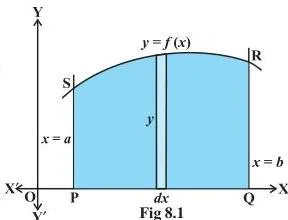
Adding every strip from \( x = a \) to \( x = b \) gives the total area:
\[ A = \int_a^b dA = \int_a^b y\,dx = \int_a^b f(x)\,dx \]
The same idea works sideways. When the region is bounded by the curve \( x = g(y) \), the y-axis and the lines \( y = c \), \( y = d \), use horizontal strips of width \( x \) and height \( dy \) (NCERT, p. 293).
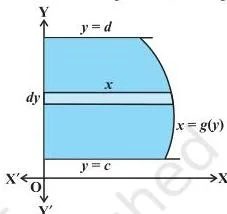
\[ A = \int_c^d x\,dy = \int_c^d g(y)\,dy \]
This earlier figure shows the same region idea that Chapter 7 used to reach the definite integral — every area problem here is just a sum of strips.

Vertical Strips vs Horizontal Strips: Which Formula Do I Use?
Your first decision on any question is the integration variable. This table settles it.
| Feature | Vertical strips | Horizontal strips |
|---|---|---|
| Curve is written as | \( y = f(x) \) | \( x = g(y) \) |
| Bounding lines | x-axis, ordinates \( x = a \), \( x = b \) | y-axis, lines \( y = c \), \( y = d \) |
| Strip dimensions | height \( y \), width \( dx \) | width \( x \), height \( dy \) |
| Integral to use | \( \int_a^b y\,dx \) — integrate with dx | \( \int_c^d x\,dy \) — integrate with dy |
| When to pick it | curve’s top edge is a function of x | curve’s right edge is a function of y |
Mnemonic: “y = gives dx, x = gives dy.” If the curve is written as y equals something, integrate with dx; if it is written as x equals something, integrate with dy. Read how the curve is written and the variable choice is made for you.
Signed Area: When the Curve Dips Below the x-axis
Here is the chapter’s biggest trap. The definite integral is a signed quantity: when \( f(x) \) is negative, the integral \( \int_a^b f(x)\,dx \) comes out negative (NCERT, p. 293).
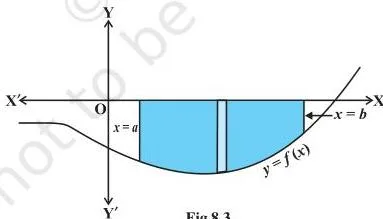
Area is a numerical value, never negative. If the integral is negative, take its absolute value: \( \left|\int_a^b f(x)\,dx\right| \).
Worse, a curve is often partly above and partly below the axis (NCERT, p. 294). Integrating over the whole interval in one go makes the negative part cancel the positive part — you get the wrong number.
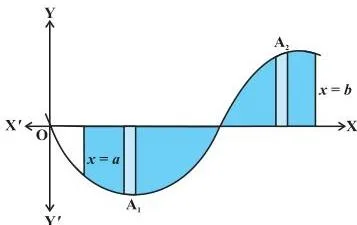
The rule: locate every x-intercept inside \( (a, b) \), split the integral at those roots, take the absolute value of each negative part, then add:
\[ A = |A_1| + A_2 \]
Why must you split? Because a single integral computes net signed area — above-axis strips and below-axis strips count against each other. Splitting first, then taking absolute values, forces every strip to count positively.
Symmetry Shortcuts: Banked Results for Circles and Ellipses
For figures symmetric about both axes, the strip integral from \( 0 \) to \( a \) covers only one quarter of the figure. Multiply by 4 to get the whole area — this is the symmetry reduction used in NCERT Examples 1 and 2 (NCERT, pp. 294–296).
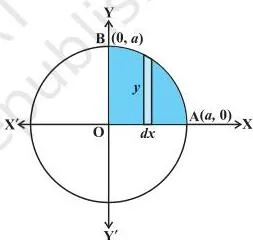
For the circle \( x^2 + y^2 = a^2 \), the first quadrant gives \( y = \sqrt{a^2 – x^2} \), and:
\[ \text{Area} = 4\int_0^a \sqrt{a^2 – x^2}\,dx = 4\left[\frac{x}{2}\sqrt{a^2-x^2} + \frac{a^2}{2}\sin^{-1}\frac{x}{a}\right]_0^a = \pi a^2 \]
For the ellipse \( \frac{x^2}{a^2} + \frac{y^2}{b^2} = 1 \), the same 4× logic gives \( \pi ab \). The two results come from one standard integral and one symmetry idea — do not memorise the two formulas as separate facts.
| Figure | Equation | y in the first quadrant | Full area (4 × quadrant) |
|---|---|---|---|
| Circle, radius a | \( x^2 + y^2 = a^2 \) | \( y = \sqrt{a^2 – x^2} \) | \( \pi a^2 \) |
| Ellipse, half-axes a, b | \( \frac{x^2}{a^2} + \frac{y^2}{b^2} = 1 \) | \( y = \frac{b}{a}\sqrt{a^2 – x^2} \) | \( \pi ab \) |
Quick Definitions: Terms You Must Know
These five terms carry the whole chapter. Learn them in the order they appear.
| Term | Meaning | Example |
|---|---|---|
| Elementary area | Area \( dA = y\,dx \) of one thin strip of height y and width dx (NCERT, p. 293) | A strip of height 5 and width dx has \( dA = 5\,dx \) |
| Vertical strips | Strips added from \( x = a \) to \( x = b \); integrates y with respect to dx | Area under \( y = x^2 \) uses \( \int x^2\,dx \) |
| Horizontal strips | Strips added from \( y = c \) to \( y = d \); integrates x with respect to dy | Area bounded by \( x = g(y) \) uses \( \int x\,dy \) |
| Signed area | The integral’s raw value, negative when the curve lies below the axis (NCERT, p. 293) | \( \int_a^b f(x)\,dx = -3 \) for a below-axis curve |
| Numerical (absolute) area | Actual area \( |\int f(x)\,dx| \), always reported as a positive number | Use 3, not −3, as the area |
| Symmetry reduction | Computing 4 × the first-quadrant area for figures symmetric about both axes | Circle of radius a: \( 4\int_0^a \sqrt{a^2-x^2}\,dx \) |
Formula Box: The Only Formulas You Need
Every question reduces to one of these. Cross-check all of them against the chapter Summary on NCERT page 298.
- Vertical strips — area above the x-axis between ordinates \( x = a \) and \( x = b \): \( A = \int_a^b y\,dx = \int_a^b f(x)\,dx \). Here \( y \) is the strip height, \( dx \) the strip width, \( a \) and \( b \) the lower and upper limits.
- Horizontal strips — area beside the y-axis between lines \( y = c \) and \( y = d \): \( A = \int_c^d x\,dy = \int_c^d g(y)\,dy \). Here \( x \) is the strip width and \( dy \) the strip height.
- Circle \( x^2 + y^2 = a^2 \): full area \( \pi a^2 \), built from \( 4\int_0^a \sqrt{a^2-x^2}\,dx \).
- Ellipse \( \frac{x^2}{a^2} + \frac{y^2}{b^2} = 1 \): full area \( \pi ab \), built from \( \frac{4b}{a}\int_0^a \sqrt{a^2-x^2}\,dx \).
- Standard integral used in both derivations: \( \int\sqrt{a^2 – x^2}\,dx = \frac{x}{2}\sqrt{a^2-x^2} + \frac{a^2}{2}\sin^{-1}\frac{x}{a} \).
Unit of every area answer: square units.
Worked Examples with Original Numbers
Both examples below use numbers NCERT never prints, so you can practise the method without remembering an answer. Work each one fully before checking.
Example A: Split-Integral Method — area under y = 2x + 1, the x-axis, x = −1 to x = 1
Step 1: Find where the line cuts the x-axis: \( 2x + 1 = 0 \) gives \( x = -\frac{1}{2} \).
The line is below the axis for \( -1 \lt x \lt -\frac{1}{2} \) and above it for \( -\frac{1}{2} \lt x \lt 1 \), so the region must be split at \( x = -\frac{1}{2} \).
Step 2: Integrate over the first interval and take the absolute value:
\[ \int_{-1}^{-1/2} (2x+1)\,dx = \left[ x^2 + x \right]_{-1}^{-1/2} = \left( \frac{1}{4} – \frac{1}{2} \right) – (1 – 1) = -\frac{1}{4} \]
\[ \Rightarrow \left| -\frac{1}{4} \right| = \frac{1}{4} \]
Step 3: Integrate over the second interval:
\[ \int_{-1/2}^{1} (2x+1)\,dx = \left[ x^2 + x \right]_{-1/2}^{1} = 2 – \left( \frac{1}{4} – \frac{1}{2} \right) = 2 – \left( -\frac{1}{4} \right) = \frac{9}{4} \]
Step 4: Add the two absolute values:
\[ A = \frac{1}{4} + \frac{9}{4} = \frac{10}{4} = \frac{5}{2} \]
Final answer: total area = \( \dfrac{5}{2} \) square units.
Example B: Symmetry Shortcut — area enclosed by the ellipse \( \frac{x^2}{36} + \frac{y^2}{16} = 1 \)
- Step 1: Read the half-axes: \( a^2 = 36 \) gives \( a = 6 \), and \( b^2 = 16 \) gives \( b = 4 \).
- Step 2: Solve for y in the first quadrant:
\[ \frac{x^2}{36} + \frac{y^2}{16} = 1 \Rightarrow y = \frac{4}{6}\sqrt{36 – x^2} = \frac{2}{3}\sqrt{36 – x^2} \]
Step 3: The ellipse is symmetric about both axes, so take 4 × the first-quadrant area:
\[ A = 4\int_0^6 y\,dx = 4\int_0^6 \frac{2}{3}\sqrt{36 – x^2}\,dx = \frac{8}{3}\int_0^6 \sqrt{36 – x^2}\,dx \]
Step 4: Apply the standard result with \( a = 6 \):
\[ \int_0^6 \sqrt{36 – x^2}\,dx = \left[ \frac{x}{2}\sqrt{36-x^2} + 18\sin^{-1}\frac{x}{6} \right]_0^6 = 18 \times \frac{\pi}{2} – 0 = 9\pi \]
Step 5: Multiply by the constant from Step 3:
\[ A = \frac{8}{3} \times 9\pi = 24\pi \]
Final answer: area = \( 24\pi \) square units.
For more revision on building and solving these strip integrals, revisit your Integrals class 12 notes — the antiderivatives you use here come straight from that chapter.
Common Mistakes That Cost Marks
These six traps are the difference between a full-working answer and a lost few marks. Check your work against the third column every time.
| Mistake | Correct rule | How to check your answer |
|---|---|---|
| Integrating \( y = 2x + 1 \) from −1 to 1 in one piece | Split at the root \( x = -\frac{1}{2} \), take \( |A_1| + A_2 \) | Does the curve cross the x-axis inside \( (a, b) \)? If yes, one integral is wrong |
| Reporting the area as −¼ (negative) | Area is the numerical value \( \left|\int f(x)\,dx\right| \) | An area can never be negative; if your integral is, take its absolute value |
| Writing \( \int_0^a \sqrt{a^2-x^2}\,dx \) and calling it the whole circle | That is the first quadrant only — multiply by 4 | Circle and ellipse are symmetric about both axes: 4 equal parts |
| Using \( \pi a^2 \) for an ellipse | Ellipse area is \( \pi ab \); \( \pi a^2 \) is the circle of radius a | Do the half-axes a and b differ? Keep both — never drop one |
| Integrating with dy when the boundaries are ordinates \( x = a \), \( x = b \) | y = f(x) bounded by ordinates → integrate dx; use dy only for x = g(y) bounded by y = c, y = d | Read how the curve is written: “y = gives dx, x = gives dy” |
| Picking \( y = -\sqrt{a^2-x^2} \) for a first-quadrant region | Take the positive branch because the region lies above the x-axis | First quadrant = both coordinates positive → positive y |
Exam Notes: What the Examiner Looks For
Written with an examiner’s mindset — which step earns the mark, not what “might come”.
- Set-up earns marks. For “area bounded by the curve y = f(x), the x-axis and the ordinates x = a, x = b”, writing \( \int_a^b f(x)\,dx \) with the correct limits is the first mark — do it explicitly before integrating.
- The root-finding step is examined. When a line or curve crosses the axis (like y = 3x + 2 at \( x = -\frac{2}{3} \) in NCERT Example 3, p. 297), the mark comes from stating the root and the two intervals, then writing \( |A_1| + A_2 \).
- The absolute-value bar is mandatory. A bare negative integral answer loses the area mark; keep \( \left|\int\right| \) visible.
- The 4× factor is expected for circles and ellipses. NCERT Example 1 and Example 2 (pp. 294–296) both show it; a solution that jumps straight to \( \pi a^2 \) without the 4 × first-quadrant logic may lose working marks.
- Exercise 8.1 pattern: Q1–Q2 are direct ellipse-area applications of the symmetry shortcut; Q3 and Q4 are MCQs testing the same idea — Q3 is a first-quadrant strip of a circle (so no 4× factor, just \( \int_0^2 \sqrt{4-x^2}\,dx \)), and Q4 needs the horizontal-strip form \( \int x\,dy \).
- State the unit. “square units” at the end of a numerical area is a clean finishing mark.
One-Screen Revision Recap
If you have two minutes, read this table. It carries the complete chapter.
| Concept | Key idea | Formula or result |
|---|---|---|
| Strip method (vertical) | Slice into strips of height y and width dx; add from a to b | \( A = \int_a^b y\,dx = \int_a^b f(x)\,dx \) |
| Strip method (horizontal) | Slice into strips of width x and height dy; add from c to d | \( A = \int_c^d x\,dy = \int_c^d g(y)\,dy \) |
| Signed area | Curve below the axis gives a negative integral | Area \( = \left|\int_a^b f(x)\,dx\right| \) |
| Mixed region | Split at the x-intercepts, take absolute values, then add | \( A = |A_1| + A_2 \) |
| Circle (radius a) | Symmetric about both axes → 4 × first quadrant | \( \pi a^2 \) |
| Ellipse (half-axes a, b) | Symmetric about both axes → 4 × first quadrant | \( \pi ab \) |
| Order of working a split region | Find root → split → integrate each part → |A| of the negative part → add | Root on the axis comes before any integral |
Cement the method with more practice — see our Class 12 Mathematics notes and the full Class 12 notes hub; the chapter also flows naturally into Differential Equations notes.
Application of Integrals Class 12 Notes: Frequently Asked Questions
Why do we multiply the first-quadrant area by 4 for a circle or ellipse?
Because the circle \( x^2 + y^2 = a^2 \) and the ellipse \( \frac{x^2}{a^2} + \frac{y^2}{b^2} = 1 \) are both symmetric about the x-axis and the y-axis. The strip integral from 0 to a covers only the quarter in the first quadrant, and the other three quadrants are identical copies of it — so the whole area is exactly 4 times that one quarter (NCERT, pp. 294–296).
When should I use \( \int y\,dx \) and when \( \int x\,dy \) while finding an area?
Look at how the curve is written and which lines bound it. If the boundary is \( y = f(x) \) with ordinates \( x = a \), \( x = b \) and the x-axis, use vertical strips: \( \int_a^b y\,dx \).
If the boundary is \( x = g(y) \) with lines \( y = c \), \( y = d \) and the y-axis, use horizontal strips: \( \int_c^d x\,dy \) (NCERT, p. 293). The mnemonic is “y = gives dx, x = gives dy”.
What do I do if the definite integral gives a negative value for area?
Take its absolute value: the area is \( \left|\int_a^b f(x)\,dx\right| \). A negative value simply means the curve lies below the x-axis on that interval, so the signed integral is negative — but area itself is a non-negative numerical quantity (NCERT, p. 293).
If part of the region is above and part below, split at the x-intercepts and add the absolute values.
Does Class 12 Application of Integrals ask for the area between two curves?
Not in this chapter. NCERT Chapter 8 restricts its scope to a single curve with the axes and given ordinates/lines — lines and standard forms of circles, parabolas and ellipses (NCERT, p. 292). Regions between two arbitrary curves are outside this chapter’s coverage, so revision should focus on one-curve strip integrals and the symmetry shortcuts.
What exactly does “area bounded by the curve, the x-axis and the ordinates x = a, x = b” mean in an exam question?
It names the three boundaries of the region: the curve \( y = f(x) \) on top, the x-axis below, and the two vertical lines \( x = a \) and \( x = b \) (with \( a \lt b \)) on the sides.
The expected answer is to write and evaluate \( \int_a^b f(x)\,dx \), and if the curve dips below the axis anywhere in between, to split the integral at the roots and report \( |A_1| + A_2 \).
Reference: NCERT Class 12 Mathematics Part II textbook, chapter Application of Integrals.
Explore Class 12 Mathematics Notes
More for this chapter:
Class 12 Mathematics on LearnCBSE:
Related chapters: