
These are complete revision notes for Chapter 3, “Public Nutrition and Health”, from the NCERT Class 12 Home Science textbook Human Ecology and Family Sciences Part I, for the 2026-27 session.
The page gives you the meaning of public health nutrition, India’s nutritional problems (PEM, IDA, VAD and IDD), their causes, the strategies and national programmes that answer them, the key statistics, career scope, and guidance for writing the textbook’s review questions — organised so you can revise from this page alone.
Best order of use: start with the chapter map to see how the ideas build, then revise each block. In a hurry? Jump to the definitions table, the key data points, or the one-page revision summary. This page is part of the Class 12 Home Science notes. Reference: NCERT Class 12 Home Science textbook, chapter Public Nutrition and Health.
Chapter Map: From Malnutrition Data to Policy, Programmes and Careers
The central idea of the chapter: public nutrition is population-level prevention, and India carries the double burden of malnutrition — undernutrition and overnutrition at the same time. The table below maps each part of the chapter to its textbook pages, in the order the ideas build: data first, then problems, then solutions.
| Part of the chapter | What it covers | NCERT pages |
|---|---|---|
| Significance and the data | Why malnutrition matters: under-five deaths, low birth weight, hidden hunger, productivity losses | pp. 47–48 |
| What public health nutrition means | Definition, community, problem-solving cycle | pp. 48–49 |
| India’s nutritional problems | PEM and micronutrient deficiencies (IDA, VAD, IDD) | pp. 49–53 |
| Causes of undernutrition | Fig 3.1 factor map | p. 50 |
| Strategies and POSHAN Abhiyaan | Direct and indirect interventions; food-based vs nutrient-based approaches | pp. 53–56 |
| Programmes and health care | Five programme groups; three levels of health care | pp. 56–57 |
| Scope and careers | Role, work settings, career avenues | pp. 57–59 |
| Practical 1 | Supplementary food costing and preparation | p. 60 |
If you are studying Unit II as a whole, the Food Processing and Technology notes build on the same nutrition foundation. You can also verify every figure, table and statistic against the official NCERT textbook PDF of Human Ecology and Family Sciences Part I, Chapter 3 at ncert.nic.in.
What Is Public Health Nutrition?
In Class XI you learned that good nutrition is the foundation and cornerstone of health. Adding the word “public” changes the scale: public health is the collective action taken by society to protect and promote the health of whole populations, not just individuals (NCERT, p. 46).
The mission of public health nutrition is to prevent both undernutrition and overnutrition and to maintain the optimal nutritional status of the population (p. 47).
Public health nutrition is the field of study concerned with the promotion of good health through prevention of nutrition-related illness in the population, together with the government policies and programmes aimed at solving these problems (p. 48).
Because it is built on both biological and social sciences, it is multidisciplinary, and it acts through large-scale, organised effort — group action for large numbers of people.
The professional’s clients are communities and their vulnerable groups, not a single patient. A community is a specific group of people who share common characteristics — a common language, exposure to similar conditions, a common lifestyle, or the same health problem (p. 48).
This is what separates the field from clinical nutrition and dietetics, which work with individuals one at a time.
- Clinical nutrition and dietetics: individual-level care and therapeutic diets.
- Public health nutrition: whole-population prevention, organised action, vulnerable-group focus.
Every public nutrition problem is solved in the same cycle: identify the problem and its magnitude → understand how and why it occurs → plan strategies and actions → implement → evaluate the impact (p. 49).
Nutritional Problems of Public Health Significance in India
Two facts frame the whole section: these problems are usually measured through anthropometry (weight, height, head-chest circumference), and most are micronutrient-based — invisible in a full stomach rather than visible starvation. Read the three blocks below, then the comparison table that pulls them together.
Protein-Energy Malnutrition (PEM)
PEM comes from inadequate intake of the macronutrients — energy and protein — relative to what the body needs (p. 49). Children are at greatest risk, but adults — especially the elderly — and people with diseases like TB and AIDS can also suffer it. It is assessed with anthropometric measurements such as weight, height and head-chest circumference (p. 49).
Three labels describe its milder forms (p. 51):
- Underweight: a child’s weight is less than expected for their age.
- Stunting (short stature): a child’s height is less than expected for their age.
- Wasting: weight is not adequate relative to height — the child looks thin for their length.
Memory rule: underweight and stunting are both judged against age; wasting is judged against height. Think “age for underweight and stunting, height for wasting.”
In severe form, PEM is named by its cause (p. 51): marasmus is severe undernutrition from a deficiency of food and energy; kwashiorkor is undernutrition caused by protein deficiency.
Micronutrient Deficiencies: IDA, VAD and IDD
“Hidden hunger” is the chapter’s name for micronutrient deficiency — the diet may fill the stomach but lacks vitamins and minerals (p. 51). The deficiencies of major public health concern are iron, vitamin A, iodine and zinc, with growing concern about vitamin B12, folic acid, calcium, vitamin D and riboflavin (p. 51).
Iron-deficiency anaemia (IDA). The most common nutritional disorder in the world, found in both developed and developing countries (p. 52). When haemoglobin production is considerably reduced, blood haemoglobin falls — and since haemoglobin carries oxygen, the body tires easily.
- Vulnerable groups: women of child-bearing age, adolescent girls, pregnant women and school-age children (p. 52).
- Signs: breathlessness on slight exertion, fatigue and lethargy; pallor of the conjunctiva of the eyes, tongue, nail beds and soft palate (p. 52).
- In children: cognitive functions — attention span, memory, concentration — are adversely affected (p. 52).
Vitamin A deficiency (VAD). Vitamin A maintains healthy epithelium, normal vision, growth and immunity (p. 52). Deficiency causes night blindness, which progresses to complete blindness if not corrected; it also lowers resistance to infection and slows growth. VAD and infection feed each other in a vicious cycle, and VAD is the most common cause of childhood blindness (p. 52).
Iodine deficiency disorders (IDD). IDD is an ecological phenomenon — largely a deficiency of iodine in the soil (p. 53). In India it is common from Jammu and Kashmir to Arunachal Pradesh in the Himalayan belt, and also in Andhra Pradesh, Karnataka, Kerala, Maharashtra and Madhya Pradesh (p. 53).
Iodine is needed for normal mental and physical growth; without it the thyroid gland makes too little thyroid hormone (p. 53).
- In adults: goitre — an enlarged thyroid — is the most common manifestation.
- In children: it manifests as cretinism.
- In pregnancy: iodine deficiency causes mental retardation and congenital abnormalities of the fetus — and this effect is irreversible (p. 53).
Edge-case alert: because the pregnancy effects cannot be reversed, prevention through iodised salt matters more than any cure. IDD affects about 13 per cent of the world’s population and about 30 per cent are at risk (p. 53).
The table below compares the three micronutrient problems side by side. You will often be asked to move between them, so learn the columns rather than the paragraphs.
| Deficiency | Most vulnerable groups | Hallmark signs | Control programme or strategy |
|---|---|---|---|
| IDA | Women of child-bearing age, adolescent girls, pregnant women, school-age children | Fatigue, breathlessness on slight exertion, pallor of conjunctiva, tongue, nail beds and soft palate; cognitive effects in children | National Nutritional Anemia Prophylaxis Programme; iron-folic acid supplementation |
| VAD | Children — it is the most common cause of childhood blindness | Night blindness progressing to complete blindness; low resistance to infection; growth affected | National Prophylaxis Programme for Prevention of Blindness due to Vitamin A deficiency; dietary diversification and fortification |
| IDD | Populations on iodine-deficient soil: Himalayan belt states (Jammu and Kashmir to Arunachal Pradesh), Andhra Pradesh, Karnataka, Kerala, Maharashtra, Madhya Pradesh | Goitre in adults; cretinism in children; irreversible mental retardation and congenital abnormalities in pregnancy | National Iodine Deficiency Disorder Control Programme; iodised salt |
The Double Burden of Malnutrition
The double burden of malnutrition is the coexistence of undernutrition and overnutrition in the same population (p. 48).
India mostly faces undernutrition, but overnutrition is rising: diets now include more processed foods, fast foods, snacks, sweets and soft drinks — high in energy, sugar, fat and salt and low in other nutrients and fibre — while whole grains, pulses, vegetables and fruits have dropped out of the daily diet, and lifestyles have become sedentary (p. 48).
- The result is undesirable weight gain, overweight and obesity, which lead to non-communicable diseases: hypertension, heart disease, diabetes, cancer and arthritis (p. 48).
- Communicable diseases — HIV/AIDS, TB, hepatitis and malaria — turn out far worse for people who are undernourished or have low immunity (p. 48).
Both sides of the burden press on doctors, nutritionists and the government for treatment, control and prevention — which is why the chapter argues for a trained cadre of public health professionals (p. 48).
Causes of Undernutrition: Reading Fig 3.1 Factor by Factor
The textbook gives the explanation for why nutritional problems happen in one diagram, Fig 3.1 (p. 50). Undernutrition is the hub of the figure; around it sit groups of interacting factors. Treat the figure as a web, not a list — every factor can worsen the others.
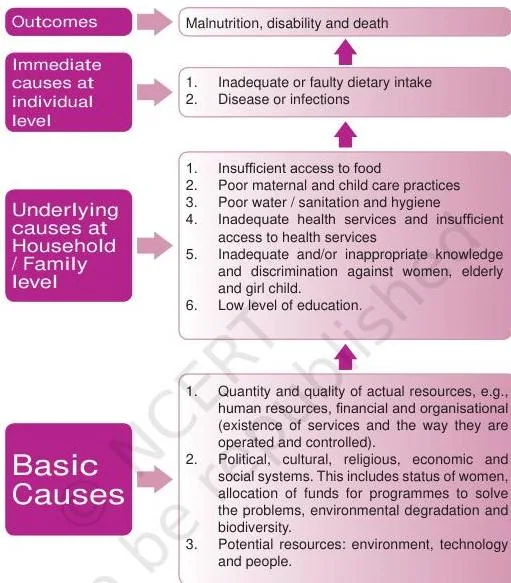
Read the factors exactly as the chapter lists them (p. 49):
- Poverty is often the underlying cause.
- Limited access to basic amenities: rural households have less access to toilets; poor sanitation means loss of work days and further economic loss.
- Unsafe drinking water: water-borne diseases cost working days every year.
- Economic factors: the availability of financial resources in the family or region.
- Agricultural policy: the production and prices of various foodstuffs.
- Health-care facilities and services: their availability and access.
- Government policies and political will.
- Socio-cultural factors.
This is the chapter’s complete argument that nutrition problems are never “just about food.” Because the causes span economics, agriculture, health services, policy and society, the solutions must be multi-sectoral — which is exactly the shape of the programmes later in the chapter.
Strategies to Tackle Malnutrition: Food-Based vs Nutrient-Based Approaches
POSHAN Abhiyaan
POSHAN Abhiyaan (the PM’s Overarching Scheme for Holistic Nutrition) was launched in Jhunjhunu, Rajasthan, in March 2018 (p. 53). It targets stunting, undernutrition and anaemia among young children, women and adolescent girls, and low birth weight.
The Ministry of Women and Child Development implements it in 315 districts in the first year, 235 in the second, and the remaining districts in the third year, working through multi-ministerial convergence to create synergy (p. 53).
Direct short-term and indirect long-term interventions
The government’s response splits into direct short-term interventions (p. 53) and indirect policy instruments (p. 54):
| Direct short-term interventions | Indirect long-term instruments |
|---|---|
| ICDS covering vulnerable children 0–6 years and all pregnant and lactating mothers | Food security — improving the availability of food |
| Fortification of essential foods — salt fortified with iodine | Better dietary patterns through nutritionally rich foods |
| Production and popularisation of low-cost nutritious foods from indigenous, locally available raw material, involving women | Poverty alleviation — employment generation schemes, Public Distribution System, land reforms |
| Supplementation of iron, vitamin A, folic acid and iodine — free tablets for children, pregnant women and nursing mothers | Health and family welfare, prevention of food adulteration, media involvement, nutrition education, monitoring of nutrition programmes, improving women’s status, education and literacy, community participation |
Food-based vs nutrient-based strategies
For combatting public nutrition problems, strategies fall into two families (p. 54):
- Food-based (diet-based) strategies use food to overcome deficiencies. They are preventive and comprehensive: sustainable with long-term benefits, cost-effective, adaptable to different cultural and dietary traditions, and free of the overdose or toxicity risk that a medicinal approach carries (p. 54). Examples: dietary diversification and modification, horticulture interventions such as home gardening, nutrition and health education, and food fortification (p. 54).
- Nutrient-based (medicinal) strategies give supplements to groups at risk of deficiency or already deficient. They are a short-term measure — used in India particularly for vitamin A, iron and folic acid — and are often expensive, with problems of coverage (p. 54).
Real-life application: you have used the food-based strategy without naming it — the iodised salt in your kitchen is fortification, and eating green leafy vegetables for iron is dietary diversification. Fortified staples in the market work on the same principle: the food-based strategy is invisible in daily life but enormous in scale.
The textbook’s long-term goal is explicit: shift away from supplementation towards food-based approaches (p. 54). Table 3.1 (p. 56) lays out how the three interventions compare.
| Intervention | Appropriate for | Advantages | Challenges / Disadvantages |
|---|---|---|---|
| Nutrient supplementation (medicinal) | Therapeutic treatment; prevention programmes for specific nutrients and target groups | Acts quickly (timely) | More costly than other measures; narrow scope of coverage |
| Fortification (fortifying food with nutrients) | Prevention — universal, for all | Highly cost-effective; wide coverage; sustainable | Requires research; needs participation of the food industry; does not create awareness about the importance of nutrition and nutrients; does not lead to long-term dietary or behavioural changes |
| Dietary diversification | Prevention — universal, for all | Highly cost-effective; wide coverage; sustainable; provides many micronutrients simultaneously; improves food security | Requires changes in eating behaviour; needs economic development to be feasible; needs changes in agricultural policies |
Adapted from Public Nutrition course material published by Indira Gandhi Open University (as presented in NCERT, Table 3.1).
Nutrition Programmes in India: The Five Groups to Memorise
All the programmes running in India fall into five groups (pp. 56–57). Learn them in this order:
- ICDS (Integrated Child Development Services) — an outreach programme for early childhood care and development, covering pregnant and nursing mothers and infants and young children up to 6 years (p. 56).
- Nutrient deficiency control programmes — the National Prophylaxis Programme for Prevention of Blindness due to Vitamin A deficiency, the National Nutritional Anemia Prophylaxis Programme, and the National Iodine Deficiency Disorder Control Programme (p. 57).
- Food supplementation — the Mid-Day Meal Programme (p. 57).
- Food security programmes — the Public Distribution System, Antodaya Anna Yojana, Annapurna Scheme and National Food for Work Programme (p. 57).
- Self-employment and wage employment schemes — social safety net programmes (p. 57).
Memory device — PAAN: the food-security group is Public Distribution System, Antodaya Anna Yojana, Annapurna Scheme, National Food for Work Programme. Say the Hindi word “paan” (betel leaf) to lock the four schemes together.
Health care: three levels
Health is a fundamental human right, and health care is more than medical care — it includes all services that promote, maintain, monitor or restore health (p. 57). India delivers it at three levels:
| Level | Role | Where it is delivered |
|---|---|---|
| Primary | First level of contact of the individual, family or community with the health system | Network of primary health centres (PHCs) |
| Secondary | Resolves more complex health problems; functions as the first referral level | District hospitals and community health centres |
| Tertiary | Highest level; deals with the most complex problems that cannot be handled at the first two levels | Medical college hospitals, regional and specialised hospitals, AIIMS |
Scope and Career Avenues in Public Health Nutrition
Nutrition is an important determinant of health, and the changing health scenario has widened the challenges for public nutritionists (p. 57). A well-trained public nutritionist (also called a community nutritionist) is equipped in eight key areas (p. 57):
- Nutritional science
- Nutritional needs throughout the life cycle
- Nutritional assessment
- Nutritional care
- Food science
- Educational methods
- Mass media and communication
- Programme management
With these skills, a community nutritionist can work in (p. 58):
- Hospital outreach programmes for prevention, promotion and education.
- The national ICDS at different levels, depending on qualifications and expertise.
- Government roles — consultant, advisor, or member of policy-making committees.
- Developmental programmes of government, voluntary organisations, NGOs and international bodies such as UNICEF, USAID, GAIN, Nutrition International, TATA Trust and IFPRI.
- Large-scale feeding programmes for young children, school children, adolescents, pregnant and lactating mothers, the elderly and challenged individuals.
- School health programmes as a nutritionist or school health counsellor.
- Corporate CSR programmes dealing with food and nutrition security for vulnerable groups.
Beyond these, there are avenues in teaching, research and entrepreneurship — for instance with agencies that develop communication materials and educational packages (p. 58). The textbook’s career list (p. 59):
- Community nutritionist in PSM departments of hospitals.
- Government nutrition programmes — e.g. ICDS and the Food and Nutrition Board.
- Voluntary organisations (regional, national, international) as nutritionists.
- Consultancy.
- Nutritionist or counsellor for schools and industries.
- Teaching and academics.
- Research.
Definitions at a Glance: Key Terms of the Chapter
Review question 1 asks you to explain eight of these terms. Each row pairs a term with its distinguishing sign or the chapter’s own evidence — exactly the shape of a complete answer.
| Term | Meaning | Sign or example |
|---|---|---|
| Nutritional status | How well nourished an individual or population is; the mission of public health nutrition is to keep it optimal (p. 47) | Assessed through anthropometry — weight, height, head-chest circumference |
| Undernutrition | Nutrient intake below what the body requires — India’s dominant problem | Growth retardation among pre-schoolers; PEM |
| Overnutrition | Intake beyond needs, linked to sedentary lifestyles and energy-dense foods | Overweight, obesity; non-communicable diseases |
| Malnutrition | Poor nutritional status of any kind — under or over | Underlying cause of at least 50 per cent of under-five deaths (p. 47) |
| Public health | Collective action by society to protect and promote the health of whole populations (p. 46) | The logic behind national nutrition programmes |
| Public health nutrition | Promotion of good health through prevention of nutrition-related illness in the population, plus the policies and programmes aimed at solving these problems (p. 48) | POSHAN Abhiyaan is one of its instruments |
| Community | A specific group of people sharing common characteristics — language, conditions, lifestyle or a health problem (p. 48) | Anganwadi children of one village |
| Low birth weight baby | A baby weighing less than 2500 g (2.5 kg) at birth (p. 47) | About one-fifth of Indian infants |
| Hidden hunger | Micronutrient deficiency in a diet that may otherwise look adequate (p. 51) | Iron, vitamin A, iodine and zinc deficiencies |
| Underweight | Weight less than expected for age (p. 51) | Judged against age standards |
| Stunting | Height less than expected for age — short stature (p. 51) | Judged against age; a marker of long-term deprivation |
| Wasting | Weight not adequate relative to height (p. 51) | Judged against height; a marker of current thinness |
| Marasmus | Severe undernutrition from deficiency of food and energy (p. 51) | The severe PEM form tied to overall shortage |
| Kwashiorkor | Undernutrition caused by protein deficiency (p. 51) | The severe PEM form tied specifically to protein |
| Double burden of malnutrition | Coexistence of undernutrition and overnutrition in the same population (p. 48) | India: child undernutrition plus rising adult obesity |
| Iron-deficiency anaemia (IDA) | The most common nutritional disorder in the world; low blood haemoglobin from reduced haemoglobin production (p. 52) | Pallor of conjunctiva and nail beds; fatigue |
| Vitamin A deficiency (VAD) | Deficiency causing night blindness, low infection resistance and growth problems (p. 52) | Most common cause of childhood blindness |
| Iodine deficiency disorders (IDD) | A spectrum of disabling conditions from fetal life to adulthood caused by low dietary iodine and low thyroid hormone (p. 53) | Goitre in adults; cretinism in children |
| Nutrition programmes | Government schemes that prevent and treat malnutrition at population level (pp. 56–57) | ICDS, Mid-Day Meal, the three nutrient-deficiency control programmes |
Key Data Points: The Numbers to Remember
This chapter has no formulas — its memory load is statistics and thresholds. Learn the numbers below as your evidence bank: when a question asks why malnutrition matters, a statistic followed by its consequence is a complete answer.
| Figure or fact | What it refers to | NCERT page |
|---|---|---|
| At least 50 per cent of under-five deaths have malnutrition as an underlying cause | Child mortality | p. 47 |
| About one-fifth of Indian infants are low birth weight — under 2500 g (2.5 kg) | Birth weight | p. 47 |
| Productivity losses exceed 10 per cent of lifetime earnings per individual and 2–3 per cent of GDP for the nation | Economic cost of malnutrition | p. 47 |
| IDD affects about 13 per cent of the world’s population; about 30 per cent are at risk | Iodine deficiency | p. 53 |
| POSHAN Abhiyaan launched in Jhunjhunu, Rajasthan, March 2018; 315 districts in year one, 235 in year two | Strategy rollout | p. 53 |
| ICDS covers children 0–6 years plus all pregnant and lactating mothers | Programme coverage | p. 53 |
| Practical 1 cost ceiling: not more than Rs 5 per serving | Practical budget | p. 60 |
Worked Example: Costing Supplementary Foods Under a Rs 5 Per Serving Budget
Method: budget-constrained recipe costing — the skill Practical 1 develops. The textbook gives no sample prices, so the figures below are original; replace them with your own local price list.
Step 1: Set the total budget.
The practical says plan 5 servings per recipe inside a ceiling of not more than Rs 5 per serving.
\[ 5 \times 5 = 25 \]
Step 2: Build the price list.
For a Group B (iron) snack, a sample list from local market rates is:
| Ingredient | Quantity | Market price | Cost |
|---|---|---|---|
| Greens | 250 g | Rs 40 per kg | Rs 10.00 |
| Besan | 100 g | Rs 60 per kg | Rs 6.00 |
| Jaggery | 50 g | Rs 50 per kg | Rs 2.50 |
| Oil | 15 ml | Rs 100 per litre | Rs 1.50 |
| Total | Rs 20.00 |
Step 3: Work out the cost per serving by dividing the total by 5 servings.
\[ 20.00 \div 5 = 4.00 \]
- Step 1: Check against the ceiling: Rs 4.00 is within the Rs 5 per serving limit, so this recipe is acceptable.
- Step 2: Test a richer variant to see the margin.
Add 50 g groundnuts at Rs 90 per kg: since 50 g is 0.05 kg, the groundnuts cost Rs 4.50.
The new recipe total is Rs 24.50, and per serving:
\[ 24.50 \div 5 = 4.90 \]
Rs 4.90 is still under Rs 5 but very close to the ceiling.
The first recipe is the safer choice because it leaves headroom in the budget.
Step 6: Know the evaluation criteria: serving size, cost, suitability for preschoolers, appearance, taste and acceptability by children (p. 60).
You are not required to calculate the nutritive values of the recipes (p. 60).
State the units — Rs, g, kg, ml, L, servings — at every step, as done above.
Practical 1 and the Chapter Activities: What to Prepare
Four chapter activities build the observation and communication side of the topic (pp. 58–59):
- Activity 1 — Anganwadi visit: visit an ICDS centre, interact with the supervisor or sevika, observe the activities — be present at food distribution if possible — and prepare a PowerPoint presentation.
- Activity 2 — Community session: an interactive session with a medical officer or health in-charge of a PSM department, PHC or Municipal Corporation on undernutrition and its causes.
- Activity 3 — Exhibition: an exhibition on India’s nutritional problems — causes, vulnerable groups and simple preventive measures.
- Activity 4 — Web research: browse the websites of WHO, UNICEF, Poshan Abhiyaan, the Ministry of Health and Family Welfare and the Ministry of Women and Child Development.
Practical 1 — Development and Preparation of Supplementary Foods for Nutrition Programmes (p. 60):
- Tasks: obtain the prices of commonly consumed, locally available foods; plan low-cost recipes; prepare them; evaluate them.
- Group split: Group A — energy and protein; Group B — iron; Group C — vitamin A or beta carotene; Group D — calcium.
- Plan: each group makes 2 recipes for 5 servings each within the cost limit; no calculation of nutritive values is required (p. 60).
- Evaluation: serving size, cost, suitability for preschoolers, appearance, taste and acceptability by children (p. 60).
Common Mistakes in This Chapter: PEM Terms, Fortification vs Supplementation, and More
These error → correction pairs are the confusions that most often weaken written answers in this chapter. Each row ends with a self-check.
| Students write… | Correct rule | How to check your answer |
|---|---|---|
| “Wasting and stunting are the same.” | Stunting is height inadequate for age; wasting is weight inadequate relative to height. | Compared with what? Age gives stunting; height gives wasting. |
| “Kwashiorkor is caused by overall food shortage.” | Kwashiorkor comes from protein deficiency; overall food-and-energy deficiency gives marasmus. | Match the nutrient: protein → kwashiorkor; food and energy → marasmus. |
| “IDA affects only pregnant women.” | Vulnerable groups also include women of child-bearing age, adolescent girls and school-age children; IDA is the world’s most common nutritional disorder. | List at least three vulnerable groups before you answer. |
| “Goitre and cretinism are different diseases.” | Both are manifestations of IDD — goitre in adults, cretinism in children, both from low thyroid hormone. | Trace both back to the same iodine-deficiency cause. |
| “Fortification and supplementation are the same thing.” | Fortification adds nutrients to staple foods for everyone — sustainable, wide coverage; supplementation gives targeted doses to at-risk groups — short-term and costlier. | Ask who receives it: everyone, or a specific vulnerable group? |
| “Hidden hunger means feeling hungry.” | Hidden hunger is micronutrient deficiency in a diet that may otherwise look adequate. | It is about vitamins and minerals, not an empty stomach. |
| “The double burden is a family with one thin and one overweight member.” | The double burden is the coexistence of undernutrition and overnutrition at population level. | Scale the statement to the whole population, not one household. |
Exam Notes: Structuring Answers to the Review Questions
The chapter closes with six review questions (p. 59). Below is the content each complete answer should carry — a skeleton, not a full model solution.
| Review question | Build the answer from |
|---|---|
| 1. Explain the terms… | One labelled point per term: definition plus distinguishing feature. Stunting (height vs age), low birth weight baby (under 2500 g), IDD (goitre in adults, cretinism in children), wasting (weight vs height), double burden (coexistence of under- and overnutrition), marasmus (food and energy deficiency), kwashiorkor (protein deficiency), community (shared characteristics). |
| 2. Discuss the strategies to combat public nutrition problems | Open with the two-way classification — food-based vs nutrient-based — then add the direct short-term interventions (ICDS, fortification, low-cost nutritious foods, supplementation) and the indirect long-term instruments (food security, poverty alleviation, PDS, education), and name POSHAN Abhiyaan. |
| 3. What is public health nutrition? | Definition centred on population-level prevention plus government policies and programmes; note the multidisciplinary base; add one contrast with clinical nutrition and dietetics. |
| 4. What are the common nutritional problems facing India? | PEM with its anthropometric markers and severe forms (marasmus, kwashiorkor); the micronutrient deficiencies IDA, VAD and IDD; close with the double burden. |
| 5. What are the consequences of IDA and IDD? | IDA — fatigue, breathlessness on exertion, pallor, cognitive effects in children. IDD — goitre, cretinism, and the irreversible pregnancy effects (mental retardation, congenital abnormalities). |
| 6. What is the scope? List some career choices. | Key areas of expertise, then work settings, then the career avenues list. |
General rule: pair every term with its sign or example — a definition without an example reads incomplete. For “consequences” questions, mark which effects are irreversible; the IDD pregnancy effects are the chapter’s clearest case. For the wider set of chapter notes across subjects, browse the CBSE notes collection.
Revision Summary: The Chapter on One Page
Revise the master table below plus the five-programme checklist, and you have the chapter on one page.
| Problem | Underlying cause | Key manifestation | Programme or strategy |
|---|---|---|---|
| PEM | Inadequate intake of energy and protein (macronutrients) | Underweight, stunting, wasting; severe forms marasmus and kwashiorkor | ICDS; Mid-Day Meal; supplementary feeding |
| IDA | Iron deficiency → reduced haemoglobin production | Fatigue, breathlessness on exertion, pallor, cognitive effects in children | National Nutritional Anemia Prophylaxis Programme; iron-folic acid supplementation |
| VAD | Vitamin A deficiency | Night blindness progressing to complete blindness; low infection resistance | National Prophylaxis Programme for Prevention of Blindness due to Vitamin A deficiency; dietary diversification; fortification |
| IDD | Iodine-deficient soil → low thyroid hormone | Goitre in adults; cretinism in children; irreversible fetal effects | National Iodine Deficiency Disorder Control Programme; iodised salt |
| Overnutrition | Excess energy intake; sedentary lifestyle; processed and fast foods | Overweight, obesity; non-communicable diseases | Food-based strategies; nutrition education |
If you remember only one chain, remember this: the data (at least 50 per cent of under-five deaths, one-fifth low birth weight) → the double burden (undernutrition plus rising overnutrition) → strategies (food-based for the long term, nutrient-based for the short term) → programmes (ICDS, deficiency-control programmes, Mid-Day Meal, food security, employment schemes) → careers for the trained public health nutritionist.
For the rest of the subject, return to the Class 12 Home Science notes, or see the full set of Class 12 notes for other subjects.
Frequently Asked Questions
What is the double burden of malnutrition in public nutrition?
The double burden is the coexistence of undernutrition and overnutrition in the same population (NCERT, p. 48). India still has widespread undernutrition — growth retardation among pre-schoolers and micronutrient deficiencies — while sedentary lifestyles and processed, high-energy foods push more people towards overweight and obesity. Both sides matter because both damage health and quality of life.
What is the difference between food-based and nutrient-based strategies?
Food-based (diet-based) strategies use food itself — dietary diversification, home gardening, nutrition education and fortification — to prevent deficiencies. They are preventive, comprehensive, sustainable, cost-effective and carry no overdose risk (NCERT, p. 54). Nutrient-based (medicinal) strategies give supplements such as vitamin A, iron and folic acid to at-risk or deficient groups; they are short-term, often expensive and can have coverage problems (p. 54).
The chapter’s long-term goal is to shift from supplementation towards food-based approaches (p. 54).
Which micronutrient deficiencies are of public health concern in India?
The major ones are iron, vitamin A, iodine and zinc, with growing concern about vitamin B12, folic acid, calcium, vitamin D and riboflavin (NCERT, p. 51). These are called “hidden hunger” because the diet can look adequate in calories yet lack vitamins and minerals. The big programme targets are iron (IDA), vitamin A (VAD) and iodine (IDD).
What are the consequences of iron deficiency anaemia and iodine deficiency disorders?
IDA: breathlessness on slight exertion, fatigue and lethargy, pallor of the conjunctiva, tongue, nail beds and soft palate, and adverse effects on children’s cognition — attention span, memory and concentration (NCERT, p. 52). IDD: goitre in adults and cretinism in children, and in pregnancy mental retardation and congenital abnormalities of the fetus, which are irreversible (p. 53).
Why are iodine deficiency disorders considered irreversible in some cases?
Because iodine deficiency during pregnancy can cause mental retardation and congenital abnormalities of the fetus, and that damage cannot be reversed after birth (NCERT, p. 53). This is why prevention through iodised salt matters more than a cure — the effect is permanent before it is ever noticed.
What are the key areas of expertise of a public health nutritionist?
The textbook lists eight: nutritional science; nutritional needs throughout the life cycle; nutritional assessment; nutritional care; food science; educational methods; mass media and communication; and programme management (NCERT, p. 57). These qualify the nutritionist for hospital outreach, ICDS, government advisory roles, NGOs and international organisations, school health, CSR programmes, teaching, research and consultancy (pp. 58–59).
Reference: NCERT Class 12 Home Science textbook, chapter Public Nutrition and Health.
Explore Class 12 Home Science Notes
- Class 12 Home Science Notes
- Class 12 CBSE Notes
- CBSE Notes for Classes 1 to 12
- Next: Food Processing and Technology
Class 12 Home Science on LearnCBSE:
Related chapters:
- Food Quality and Food Safety notes