
These fashion design and merchandising class 12 notes compress the NCERT chapter on Fashion Design and Merchandising into a revision-ready set: the key terms, the fashion cycle, merchandising levels, market segmentation, careers and the croquis practical, all in tables you can scan quickly. Work through the page in order, or jump straight to the section you are stuck on.
The notes follow the 2026-27 session and the rationalised NCERT textbook for Class 12 Home Science — Human Ecology and Family Sciences Part II, Unit IV (Fabric and Apparel), pages 176–189. Keep the textbook beside you for the review questions and the croquis practical, which are best done by hand. Cross-check any detail against the official NCERT Class 12 Home Science textbook PDF.
Fashion Design and Merchandising: What This Chapter Covers
Fashion design and merchandising are among the most exciting career options in the modern world, and in India the recent boom in fashion designing has widened the field further. The chapter trains you to understand how the fashion business works — from producing raw material and apparel to the retail stores that sell fashion merchandise to the public (NCERT, p. 177).
The chapter’s four learning objectives:
- explain the significance of fashion design and merchandising in the garment industry
- describe the fundamentals of fashion
- explain the knowledge and skills required to be in the fashion business
- discuss how a student can prepare for a career in the fashion industry
Merchandising’s origin story is short but worth remembering: in 1920 the “ready-to-wear” garment was born, retailers realised that selling such garments was big business, and fashion apparel became the most important merchandise in department stores. That economic opportunity created a new specialisation — fashion merchandising (NCERT, p. 177). The whole chapter reduces to one phrase: merchandising is planning, buying and selling.
This chapter sits in Unit IV (Fabric and Apparel) of Human Ecology and Family Sciences Part II. For the textile knowledge this chapter leans on, see our notes on the Design for Fabric and Apparel chapter. For everything else in the subject, browse the Class 12 Home Science notes hub, or start from the main CBSE notes index for other subjects.
Fashion Terminology: Fashion, Style, Fad and Classic
Four words carry the whole chapter. Notice that three of them describe what happens to a look over time; only style is about the look itself (NCERT, pp. 177–178).
| Term | Meaning | Example |
|---|---|---|
| Fashion | The style or styles most popular at a given time. | The silhouette that fills shops this season |
| Style | Any particular look or characteristic in apparel or accessories. A style may come and go in fashion, but the specific style always remains. | A pencil skirt exists as a style whether or not it is currently popular |
| Fad | A short-lived fashion that can come and go in a single season; it lacks the design strength to hold consumer attention for long. | Hot pants, baggy pants, unmatched buttons |
| Classic | A style that never becomes completely obsolete and stays accepted for an extended period; simplicity of design keeps it from being easily dated. | Blazer jackets, polo shirts, the Chanel suit |
One line fixes all four: a style can stay forever, but fashion is only the style that is popular right now. A fad is a style that fails to stay; a classic is a style that survives.
How Fashion Developed: From Royal Courts to Ready-to-Wear
Fashion as we know it is young. In ancient and medieval times, styles stayed practically unchanged for a century at a time. The Renaissance accelerated change by exposing the Western world to new cultures and costumes, and the Industrial Revolution turned dressmaking into an industry (NCERT, pp. 178–179). Learn the whole development as a timeline, not a story:
| Period / event | What changed in fashion |
|---|---|
| Renaissance | Western civilisation discovered different cultures, customs and costumes; new fabrics and ideas made people want more new things, speeding up fashion change. |
| Early 18th century, France | King Louis XIV’s court members became the trendsetters of taste, making Paris the fashion capital of Europe; French cities supplied the court with silk fabrics, ribbons and laces. |
| Couture era | Clothes were hand-made and custom-made to the customer’s exact measurements. Couture = the art of dressmaking; a male designer = couturier; a female designer = couturiere. |
| Industrial Revolution | The spinning jenny and power looms produced more fabric in less time, gave rise to the American textile industry, and created a middle class with money for better clothing. |
| 1859 | Isaac Singer developed the foot treadle for the sewing machine, leaving both hands free to guide fabric; early sewing machines made Civil War uniforms. Fashion became accessible to everyone. |
| 1849 | Levi Strauss made long-wearing pants with tool pockets from tent and wagon-cover fabric. These denims, made for labourers, have stayed the same for nearly 150 years. |
| 1880s | Women began wearing separate skirts and blouses. Adjustable lengths and waistlines let the working class add variety by mixing separates — a step towards ready-to-wear for women. |
| 19th century | Affordable fashion reached the public through fairs and bazaars where travelling merchants bargained with buyers; general stores and then retail stores grew in towns and cities. |
| 1960s | Prêt-à-porter (ready-to-wear) lines hit boutiques as the first radical alternative to couture — factory-made, sold finished, in standardised sizes. Yves Saint Laurent was the first French haute couturier to release a full prêt-à-porter line. |
Did You Know? Women did not start wearing jeans until the 1950s (NCERT, p. 177).
The Fashion Cycle: Reading the Bell-Shaped Curve
Fashion moves in a cycle. The textbook pictures a fashion’s life as a bell-shaped curve of time and sales: as time passes, sales climb, peak and fall, which is why a style’s rise and fall is drawn as a bell (NCERT, p. 179).
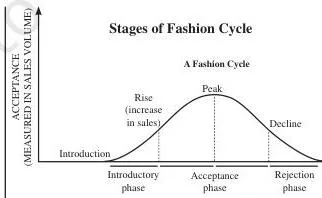
The curve in Fig. 12.1 shows five stages, each with a distinct event:
| Stage | What happens |
|---|---|
| 1. Introduction of a style | Designers interpret research and creative ideas into apparel by changing line, colour, shape, fabric and details, then offer the new styles to the public. |
| 2. Increase in popularity | As the new fashion is purchased, worn and seen by many people, it begins to rise. |
| 3. Peak of popularity | Demand is so high that many manufacturers copy the style or produce adaptations at different price levels. |
| 4. Decline in popularity | Mass-produced copies tire fashion-conscious people, who look for something new; declining styles land on sale racks in retail stores. |
| 5. Rejection or obsolescence | Consumers have already turned to new looks, and a new cycle begins. |
Memory device: the five stages in order are I – R – P – D – O (Introduction, Rise, Peak, Decline, Obsolescence). Fix them with the sentence “I Really Prefer Denim Outfits” — first letters I-R-P-D-O.
Fashion Merchandising: Definition, Rights and Three Levels
Fashion merchandising is the planning needed to have the right merchandise, at the right time, at the right place, at the right price and with the right sales promotion — when all these conditions are planned, maximum profits are possible (NCERT, p. 180).
A fashion merchandiser facilitates the conversion of an inspiration into a design, uses technology to conceptualise it, and handles the planning, production, promotion and distribution of products so that consumer needs and demands are met (NCERT, p. 180).
In practice the merchandiser works across four activities: manufacturing (choosing fabrics and the best way to make an item), buying (accurate ordering through trend analysis and forecasting), promoting (fashion shows, visual merchandising, finding the target market) and selling (selling to stores, with display suggestions).
Merchandising happens at three levels in the fashion industry (NCERT, p. 181):
| Level | What it does |
|---|---|
| Retail organisation merchandising | A specialised management function inside a retail firm: internal planning that moves fashion from the designer’s showroom to the retail sales floor and into consumers’ hands. It keeps enough merchandise on hand and prices it so the operation stays profitable. |
| Buying agency merchandising | A buying agency acts as a procurement office for buyers and provides goods-buying consultancy. Selling this way saves exporters significant cost and time. The buying agent identifies vendors, negotiates costs, checks in-process quality and performs pre-shipment quality inspection. |
| Export house merchandising | In an export house, two merchandisers work as a pair — see the box below. |
Buyer merchandiser vs production merchandiser — the pair students constantly swap:
- The buyer merchandiser is the link between the buyer and the manufacturer. The job: sourcing, sampling and communicating with the buyer, ensuring the product is developed as the buyer requires.
- The production merchandiser is the link between production and the buyer merchandiser. The job: ensuring production follows the schedule and the buyer’s requirements.
Watch out — five rights or six? The opening definition of fashion merchandising lists five conditions: right merchandise, right time, right place, right price and right promotion. The detailed “Merchandising Rights” list (NCERT, p. 183) gives six by adding right quantity. Quote the version the question asks about; when a definition is required, the five-condition version is the chapter’s working definition.
The six merchandising rights, each with its own balance problem:
| Right | Meaning |
|---|---|
| Right merchandise | Retailers fill their shelves with the merchandise the customer wants. |
| Right place | Location is of prime importance because it decides accessibility. |
| Right time | Much merchandise is seasonal and must be on hand when most needed. |
| Right quantity | A profitable balance between volume of sales and amount of inventory. |
| Right price | High enough for store profit, low enough to meet competition and customer expectations. |
| Right promotion | A balance between the investment made and the appeal created for customers. |
Target Market and Market Segmentation: Four Ways to Split Consumers
A target market is the category of consumers a product is aimed at. It matters because the sales department can then focus on the consumers “most likely” to buy, which gives the highest return on marketing and sales spending (NCERT, p. 182).
Market segmentation is the strategy of dividing a larger market into subsets of consumers who share common needs and applications for the goods and services offered. The chapter gives four bases:
| Base | Divides consumers by | Example |
|---|---|---|
| Demographic | Population, age, sex, occupation, education, income. | A brand of affordable formal shirts targeting salaried men aged 25–40. |
| Geographic | Cities, states, regions. Climate matters because clothing choice is climate-dependent. | A cotton kurta brand focusing on warm-climate regions of India. |
| Psychographic | Lifestyle: social activities, interests, leisure pursuits, needs and wants. | Sportswear aimed at people whose leisure is gym and running. |
| Behavioural | Opinions on specific products or services; usage of products is often rated. | A brand that rates how often customers re-buy, to improve its product. |
Putting it to work. Take a simple product — a cotton kurta. To interpret consumer demand, a merchandiser first identifies the target market, then segments it, then studies buying motivations.
One clean plan: geographic segmentation for warm climates, demographic segmentation by age and income, psychographic segmentation for a lifestyle of comfort and tradition, and behavioural segmentation for repeat buyers of ethnic wear. Each base narrows who the brand designs for, and together they define the customer (NCERT, p. 182).
Retail Organisations: Store Types and Major Divisions
A retail firm’s structure depends on the type of merchandise, the size of the firm and the target customer. The chapter covers three store types (NCERT, pp. 183–184):
| Store type | Key features |
|---|---|
| Small single-unit store | A neighbourhood store, owner-operated and family-run. |
| Department store | Separate sections or departments — clothing, sporting goods, automotive supplies, health and beauty products, electronics equipment; some also sell food products. |
| Chain store | Retail outlets that share a brand and central management, usually with standardised business methods and practices. |
A large store organises work into five major divisions (NCERT, p. 184):
- Merchandising division — buying, merchandise planning and control, selling, fashion coordination.
- Sales and promotion division — advertising, visual merchandising, special events, publicity and public relations.
- Finance and control division — credit, accounts payable and inventory control.
- Operational division — maintenance of facilities, store and merchandise protection, personnel, customer service, receiving and marking of merchandise.
- Personnel and branch store division — may function separately when store operations are very large.
Try it: the chapter asks you to visit a marketplace, observe, and list the types of stores you find there — a quick way to see all three store types in real life.
Preparing for a Fashion Career: Skills, Degrees and Scope
Flair alone will not bring success, because this career combines style with business sense. The chapter names three primary skills that a fashion designer, merchandiser and marketer must possess (NCERT, pp. 184–185):
- Forecasting ability — reading past and current trends, understanding how marketing shapes those trends, and staying well ahead of them in time to profit.
- Analytical ability — analysing the “dollars and sense” side: the economy as a whole, the company’s own economy, and how a style fits a consumer’s budget, juggling complex factors to make a profit.
- Communication ability — negotiating prices with manufacturers and selling fashion choices to the public, through direct contact plus advertising copy, press releases and personalised letters.
Education follows a sliding scale of time commitment (NCERT, p. 185):
| Programme | Duration | What it offers |
|---|---|---|
| Certificate or diploma | 6 months to 1 year | Coursework focused on the actual job of fashion merchandising; a faster route into the field. |
| Fashion merchandising degree | 2 years | A blend of general (liberal arts) education with fashion and business courses. |
| Bachelor’s degree | 4 years | A substantial liberal arts base plus fashion and business courses; suits those who want a broad education and wider promotional opportunities. |
Many are drawn to the industry by lucrative income and the chance to succeed on their own — about one-third of professional fashion designers are self-employed (NCERT, p. 185). The chapter lists four popular career roles (NCERT, p. 186):
- Visual merchandise designer — window displays, arranging store merchandise, creating props and accents, organising clothing placement, styling mannequins and spearheading marketing campaigns.
- Fashion designer — creating designs for clothing and apparel, either with popular designers or running their own fashion labels.
- Set designer — conceptualising designs for movies, television and theatre in line with the script or director; some design sets for trade shows and museums.
- Interior designer — combining form with function to increase the beauty, safety and functionality of spaces in retail stores, homes, offices, hospitals, hotels and more.
Because these careers touch institutions such as hospitals and hotels, the related chapter notes on the care and maintenance of fabrics in institutions give useful background. For the rest of the subject, return to the Class 12 Home Science notes hub.
The Only Proportion “Formula” Here: Head Units for a Croquis
This chapter has no algebraic formulas — it has proportions instead. The fashion figure, or croquis (an outline or rough sketch), is constructed using the head as the unit of measurement: the figure stands \( 8\frac{1}{2} \) to 10 heads tall, and multiples of the head measure every part of the body (NCERT, p. 188).
The landmarks, in head units:
| Landmark | Position (head units) |
|---|---|
| Eye line | \( \frac{1}{2} \) head |
| Shoulder line | \( 1\frac{1}{2} \) heads |
| Bust line | just below 2 heads |
| Waist line | just below 3 heads |
| Hip plane | \( 3\frac{1}{2} \) heads |
| End of torso | just above \( 4\frac{1}{2} \) heads |
| Knees | \( 6\frac{1}{2} \) heads |
| Ankles | above or at 9 heads |
Two supporting rules: the shoulders are the widest point, the waist the smallest, and the hips sit between the two; the figure is about half top-of-head-to-end-of-torso and half end-of-torso-to-ankle.
To build the body, horizontal guidelines (shoulder line, bust line, waist line, hip plane, end of torso) are crossed by vertical guides — centre front, armhole and princess lines — and the levels are joined with a pencil to develop the form (NCERT, p. 188).
The basic head measurement changes depending on the fashion look of the moment, and that shifts every landmark. That is why proportions are taught in head units, never fixed centimetres.
Worked Example: Drawing a 10 Head Croquis with 2 cm Heads
Method: the croquis head-unit method — every landmark is a multiple of one head, so the whole figure is 10 heads tall when we choose a 10-head croquis (NCERT, p. 189).
The textbook practises with a 1-inch head, making the centre front line 10 inches. Here is the same process with a 2 cm head: one head = 2 cm, so the centre front line = 10 × 2 cm = 20 cm.
Changing the head unit from 1 inch to 2 cm is exactly the kind of variation the textbook asks you to practise — the proportions stay identical, only the real measurements change.
- Draw a vertical centre front line 20 cm long — 10 heads × 2 cm.
- Divide the line into 10 equal divisions of 2 cm each.
- Mark the eye line at 1 cm — \( \frac{1}{2} \times 2 = 1\ \text{cm} \).
- Mark the shoulder line at 3 cm — \( 1\frac{1}{2} \times 2 = 3\ \text{cm} \).
- Mark the bust line just below 4 cm — just below \( 2 \times 2 = 4\ \text{cm} \).
- Mark the waist line just below 6 cm — just below \( 3 \times 2 = 6\ \text{cm} \).
- Mark the hip plane at 7 cm — \( 3\frac{1}{2} \times 2 = 7\ \text{cm} \).
- Mark the end of torso just above 9 cm — just above \( 4\frac{1}{2} \times 2 = 9\ \text{cm} \).
- Mark the knees at 13 cm — \( 6\frac{1}{2} \times 2 = 13\ \text{cm} \).
- Mark the ankles just above or at 18 cm — above or at \( 9 \times 2 = 18\ \text{cm} \).
- Join the levels with a pencil to develop the form.
- The croquis is ready to carry your design ideas.
Follow the textbook’s own advice: practise at least 5 croquis with different head measurements — repeat the same scaling with a 2.5 cm or 3 cm head and watch every landmark shift while the proportions hold (NCERT, p. 189).
Common Mistakes and How to Correct Them
Misconception autopsy. Two swaps cause most of the confusion in this chapter. Students treat fashion and style as the same word because both describe the same garment — but fashion is a statement about time, while style is a statement about look.
And students mix up the two export-house merchandisers because both names sound alike — but one faces the buyer, the other faces the production line. The table below fixes both swaps and three more slips (NCERT, pp. 177, 181, 188).
| Mistake | Correct rule | How to check your answer |
|---|---|---|
| Using fashion and style as synonyms. | Fashion is the style or styles popular now; a style is a particular look that remains a style even when out of fashion. | Ask: does the term still make sense when the look stops selling? If yes, it is a style. |
| Calling any short-lived item a classic. | A fad dies in a single season for lack of design strength; a classic endures because of simplicity of design (blazer, polo shirt, Chanel suit). | Ask: has the item stayed accepted over an extended period? |
| Writing the fashion cycle stages out of order. | Introduction → increase in popularity → peak of popularity → decline in popularity → rejection/obsolescence. | Recite the memory device I-R-P-D-O (“I Really Prefer Denim Outfits”). |
| Confusing the buyer merchandiser with the production merchandiser. | Buyer merchandiser links buyer ↔ manufacturer (sourcing, sampling, communication); production merchandiser links production ↔ buyer merchandiser (schedule, requirements). | Ask: between which two people is this merchandiser the link? |
| Measuring croquis landmarks in fixed centimetres. | Landmarks are head multiples, and the head unit itself varies with the fashion look. | Recalculate every landmark whenever the head size changes. |
Exam Notes: How to Answer the Textbook Review Questions
The chapter closes with seven review questions (NCERT, p. 187). Each is a descriptive question, so the same habit works for all: define key terms first, answer in the order the question asks, and give one concrete example where the question invites it. The question-to-strategy table below gives the skeleton for a complete answer.
| Review question | A complete answer must… |
|---|---|
| 1. Outline the major developments in fashion. | Walk the chronology: Renaissance discoveries → Louis XIV and Paris → couture → Industrial Revolution and the sewing machine → Levi Strauss denims → 1880s separates → 19th-century fairs and general stores → 1960s prêt-à-porter. Order matters; dates anchor the answer. |
| 2. Identify and explain the various stages of fashion cycle. | Name all five stages in order and explain each, using the bell-shaped curve of time vs sales as the opening frame. |
| 3. What do you understand by the term fashion merchandising? | Define it using the five conditions (right merchandise, time, place, price, promotion), then show the merchandiser’s role in manufacturing, buying, promoting and selling. |
| 4. Describe various levels of merchandising. | Cover all three levels — retail organisation, buying agency, export house — and inside export house distinguish the buyer merchandiser from the production merchandiser. |
| 5. “To interpret consumer demand one should understand target market and customer motivations”. Elaborate. | Define target market and market segmentation, list the four segmentation bases, then connect them to buying motivations. |
| 6. Enumerate the knowledge and skills that a fashion designer and merchandiser must possess. | List the three abilities — forecasting, analytical, communication — with an explanation of each, and add the degree pathways as the knowledge base. |
| 7. What advice would you give to your friend who wants to pursue fashion designing and merchandising as a career? | Combine skills + education + scope: the three abilities, the certificate-to-bachelor’s pathway, the specialised fields, and the fact that about one-third of designers are self-employed. |
One Page Revision Recap
Everything above, compressed into a single scan-ready table for the night before a test.
| Concept | Quick recall |
|---|---|
| Four terminology terms | Fashion = popular now; style = the look, always remains; fad = dies in a season; classic = endures by simple design. |
| Fashion cycle (5 stages) | Introduction → increase in popularity → peak → decline → rejection/obsolescence (I-R-P-D-O); a bell-shaped curve of time vs sales. |
| Merchandising levels (3) | Retail organisation; buying agency; export house (buyer merchandiser + production merchandiser). |
| Merchandising rights (6) | Right merchandise, right place, right time, right quantity, right price, right promotion. |
| Segmentation bases (4) | Demographic, geographic, psychographic, behavioural. |
| Career skills (3) | Forecasting, analytical, communication. |
| Degree durations | Certificate/diploma: 6 months–1 year; 2-year degree; 4-year bachelor’s. |
| Career roles (4) | Visual merchandise designer, fashion designer, set designer, interior designer. |
| Croquis proportions | \( 8\frac{1}{2} \)–10 heads tall; landmarks from \( \frac{1}{2} \) (eye) to 9 (ankles) heads; head unit varies with the fashion look. |
For other subjects in the same class, visit the Class 12 notes page.
Frequently Asked Questions
What is the difference between fashion and style in this chapter?
Fashion is the style or styles most popular at a given time — it is a statement about now. Style is any particular look or characteristic in apparel or accessories, and it remains a style even when nobody is wearing it.
A useful test: the Chanel suit is a classic and becomes a fashion only while it is popular (NCERT, p. 178).
What are the stages of the fashion cycle in order?
In order: introduction of a style, increase in popularity, peak of popularity, decline in popularity, and rejection of a style or obsolescence. The cycle is drawn as a bell-shaped curve of time against sales (NCERT, p. 179).
What are the three levels of merchandising?
Retail organisation merchandising (internal planning inside a retail firm), buying agency merchandising (a procurement office that acts for buyers), and export house merchandising. In an export house, the buyer merchandiser links the buyer with the manufacturer, while the production merchandiser links production with the buyer merchandiser (NCERT, p. 181).
What are the four bases of market segmentation?
Demographic (population, age, sex, occupation, education, income), geographic (cities, states, regions — including climate), psychographic (lifestyle, interests, leisure pursuits), and behavioural (opinions on products and usage ratings) (NCERT, p. 182).
What head proportions are used to draw a croquis?
The fashion figure is \( 8\frac{1}{2} \) to 10 heads tall, measured with the head as the unit. Key landmarks: eye at \( \frac{1}{2} \) head, shoulder at \( 1\frac{1}{2} \) heads, bust just below 2, waist just below 3, hip plane at \( 3\frac{1}{2} \), end of torso just above \( 4\frac{1}{2} \), knees at \( 6\frac{1}{2} \), and ankles above or at 9 heads (NCERT, p. 188).
Reference: NCERT Class 12 Home Science (Human Ecology and Family Sciences Part II) textbook, chapter Fashion Design and Merchandising.
Explore Class 12 Home Science Notes
- Class 12 Home Science Notes
- Class 12 CBSE Notes
- CBSE Notes for Classes 1 to 12
- Previous: Fabric and Apparel
- Next: Care and Maintenance of Fabrics in Institutions
Class 12 Home Science on LearnCBSE: