
These food quality and food safety class 12 notes give you the complete revision version of Chapter 6 of the NCERT Human Ecology and Family Sciences (Part I) textbook — the definitions, hazard types, food standards, HACCP and career avenues you need in one sitting. They follow the rationalised NCERT textbook for the 2026–27 session.
The chapter moves from why food safety matters globally, through the basic concepts (toxicity, hazard, contamination, adulteration), to food standards (FSSAI, Codex, ISO, WTO), the management systems GMP, GHP and HACCP, the six practical adulteration tests, and finally the career options in food quality.
If you need the original wording, the full chapter text is in the official NCERT PDF of Human Ecology and Family Sciences Part I. For the rest of the subject, browse the Class 12 Home Science notes or the full Class 12 notes collection. Use the jump links below to go straight to what you are revising.
Food Safety and Quality: The Chapter’s Big Picture
Food is a major determinant of health, nutritional status and productivity of a population, so the food we eat must be wholesome and safe (NCERT, p. 75). Unsafe food produces food-borne diseases — a major public-health problem worldwide. In India, the National Family Health Survey 2015–16 reported that more than 9 lakh children under five years of age suffered from acute diarrhea (NCERT, p. 76).
Food-borne illness does more than harm health. It can cause mortality, damage trade and tourism, lead to loss of earnings, unemployment and litigation, and so slow economic growth. That is why food safety and quality now carry worldwide significance (NCERT, p. 76).
A number of factors raised the importance of food safety:
- More people eat outside the home; food is prepared in bulk, handled by many persons and made hours in advance, so contamination and spoilage risk rise.
- Processed and packaged foods, including functional foods, are now common and their safety must be assessed.
- Pre-packaged spices, condiments and spice mixes have replaced home-processed ones; even raw foodstuffs now need quality checks.
- Bulk transport is complex, with a long gap between processing and consumption, so risk assessment during mass production and distribution is critical.
- Microbial adaptation, antibiotic resistance, altered human susceptibility and international travel have increased food-borne microbial disease; nearly half of all known food-borne pathogens were discovered in the past 25–30 years.
- India is a signatory to the WTO non-tariff agreement, so imported and exported foods must both meet standards.
- Pollution of atmosphere, soil and water, plus pesticides and additives (preservatives, colourants, flavouring agents, stabilisers), make analysis of food for nutrients and contaminants essential.
The chapter then builds its path: safety concepts → hazards → contamination and adulteration → food quality → standards → international bodies → management systems → careers.
Toxicity vs Hazard: The Two Ideas Food Safety Starts From
Food safety means assurance that food is acceptable for human consumption according to its intended use. Its two foundation concepts are toxicity and hazard (NCERT, p. 77).
- Toxicity is the capacity of a substance to produce harm or injury of any kind under any conditions.
- Hazard is the relative probability that harm or injury will result when a substance is not used in a prescribed manner and quantity.
Read the pair together: toxicity tells you how harmful a substance can be; hazard tells you how likely you are to be harmed. A highly toxic substance can present very little hazard if it is used exactly as prescribed — the hazard depends on probability and on misuse of manner and quantity.
Hazards can be physical, chemical or biological, and all three cause harmful or adverse effects on consumer health (NCERT, p. 77).
Physical, Chemical and Biological Hazards: Types With Examples
The chapter classifies hazards into three families, each with its own figure, and summarises them below.
| Hazard type | What the chapter includes | Examples |
|---|---|---|
| Physical hazard | Any physical material not normally found in food that causes illness or injury | Wood, stones, parts of pests, hair |
| Chemical hazard | Chemicals or deleterious substances intentionally or unintentionally added to food | Pesticides, chemical residues, toxic metals, polychlorinated biphenyls, preservatives, food colours and other additives |
| Biological hazard | Living organisms, including microbiological organisms; also pests, insects and parasites | Food-borne pathogens, infestation by pests and insects, tapeworm in pork |
The three definitions come from NCERT, pp. 78–81. Fig. 6.1 shows the physical hazards — the foreign objects named in the textbook: wood, stones, parts of pests and hair.
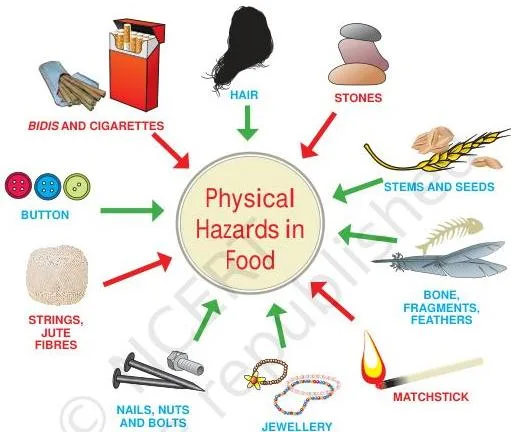
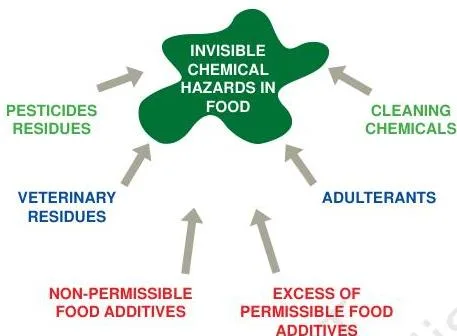
Fig. 6.2 shows chemical hazards — pesticide residues, toxic metals, preservatives and artificial colours that are intentionally or unintentionally added to food.
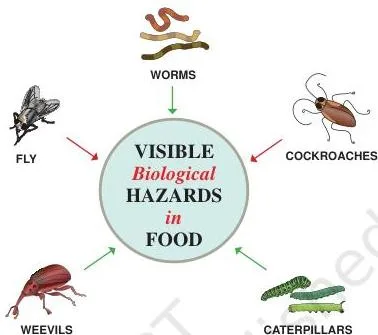
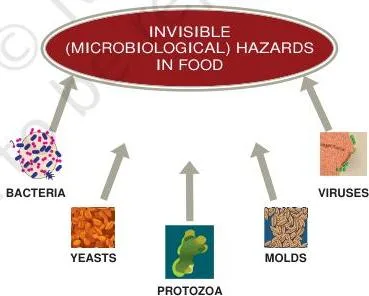
Biological hazards divide into two kinds. Fig. 6.3 shows visible biological hazards — organisms that can be seen with the naked eye. Fig. 6.4 shows invisible microbiological hazards — food-borne pathogens too small to see.
Infestation is the third form of biological hazard. Fig. 6.5 shows infestation of foods by pests and insects; parasites can also cause infestation, for example worm infestation by tapeworm in pork (NCERT, p. 81).
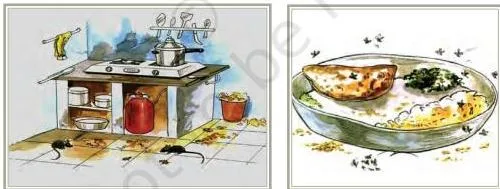
Biological hazards are an important cause of food-borne illness. Even with food-safety efforts, new pathogens keep emerging because of host, pathogen and environmental factors: changes in host susceptibility (malnutrition, age), genetic exchange or mutation in organisms, and exposure through changed eating habits, climate, mass production, processing and globalisation of the food supply.
Norovirus, Rotavirus and hepatitis E together contribute to about 70 per cent of cases (NCERT, p. 82).
Food Infection vs Food Intoxication: Salmonella and Staphylococcus
Microbial pathogens cause food-borne disease in two distinct ways (NCERT, p. 81):
- Food infection / food poisoning: live pathogenic organisms are ingested and multiply inside the body, causing disease. Salmonella is the classic example.
- Food intoxication: bacteria produce harmful toxins that remain in food even if the pathogen itself has been killed. Staphylococcus aureus is the textbook example.
Salmonella lives in the intestinal tract of animals; raw milk and eggs are also sources. Heat destroys it, but inadequate cooking lets some organisms survive.
It often spreads through cross-contamination — a cook cuts raw meat or poultry on a chopping board and, without cleaning it, uses the same board for food that is eaten raw, like salad — or when an infected food handler does not wash hands with soap after using the bathroom.
Salmonella doubles its numbers every 20 minutes, and its symptoms are diarrhea, fever and abdominal cramps (NCERT, p. 81).
Staphylococcus aureus exists in air, dust and water, and is present in the nasal passage, throat and on the skin and hair of 50 per cent of healthy individuals. Carriers contaminate food when they touch these body parts while handling food.
The exam-worthy point: toxins in food cannot be detected by smell, appearance or taste — food that looks and smells good is not necessarily safe (NCERT, p. 81). Diarrhea is one symptom.
| Basis | Food infection | Food intoxication |
|---|---|---|
| Cause | Ingestion of live organisms that multiply in the body | Toxins already present in food, even if the pathogen is killed |
| Example organism | Salmonella | Staphylococcus aureus |
| How it develops | Organism survives (e.g., inadequate cooking) and reaches the intestine | Food kept not hot or cold enough lets bacteria produce toxin |
| Does heat help? | Adequate cooking destroys the organism; inadequate cooking does not | Toxin can remain after the pathogen is destroyed |
| Can food look safe? | No visible change is needed for infection | Toxin cannot be detected by smell, appearance or taste |
| Symptoms | Diarrhea, fever, abdominal cramps | Diarrhea among the symptoms |
Parasites form a separate biological route: they cause infestation, the example given being tapeworm in pork (NCERT, p. 81).
Contamination, Adulteration and Adulterants: The Three Terms Students Mix Up
These three terms sit close together and are easy to confuse. The chapter defines them as follows (NCERT, p. 82):
- Contamination: the presence of harmful or objectionable foreign substances in food — such as chemicals, micro-organisms or dilutants — before, during or after processing or storage.
- Adulteration: the process in which food quality is lowered either by adding inferior-quality material or by extracting a valuable ingredient. It includes not only intentional addition or substitution but also biological and chemical contamination during growth, storage, processing, transport and distribution of food.
- Adulterants: the substances used to make food products unsafe for human consumption.
| Term | Meaning | Example / reminder |
|---|---|---|
| Contamination | Presence of harmful foreign substances at any stage | Micro-organisms, chemicals, dilutants entering food |
| Adulteration | Quality lowered by adding inferior material or removing a valuable ingredient | Metanil yellow in turmeric; the definition also covers contamination across the whole food chain |
| Adulterants | Substances that make food products unsafe for human consumption | Starch in milk, colophenial resins in asafoetida (from the practical tests) |
The trap to avoid: adulteration is broader than “mixing something cheap in”. The NCERT definition explicitly folds contamination that happens during growth, storage, processing, transport and distribution into adulteration, so both intentional cheating and accidental contamination can lower quality.
Food Quality: A Holistic Concept With Safety as Its Precursor
Food quality refers to the attributes that influence a product’s value to consumers. It includes negative attributes — spoilage, contamination, adulteration, food safety hazards — and positive attributes such as colour, flavour and texture.
Quality is therefore a holistic concept that integrates nutritional traits, sensorial properties (colour, texture, shape, appearance, taste, flavour, odour) and social considerations, with safety as a preliminary attribute and precursor of quality (NCERT, p. 82).
How is quality judged in practice? The chapter’s Activity 1 observation sheet is effectively a checklist of the visible signs of quality in fresh foods:
- Appearance: bright or dull, shrivelled, mouldy
- Texture: firm, soft or soggy
- Colour and odour
Food stored at room temperature for a week changes on all these counts — a simple demonstration that quality is assessed through the senses before any laboratory test. Food service providers must follow five salient points (NCERT, p. 83):
- Quality of raw materials and water
- Cleanliness of the premises, personnel, equipment, and food preparation, storage and serving areas
- Storage of food at appropriate temperature
- Food hygiene
- Good service practices
Definitions Table: The Terms You Must Write Correctly
This table is the quick-recall core of the chapter. Each row is written the way a definition answer should be structured — term + defining feature + example — and every term below is one the review questions can demand.
| Term | Meaning (condensed from the chapter) | Example or reminder |
|---|---|---|
| Food safety | Assurance that food is acceptable for human consumption according to its intended use | The goal of all standards and systems in this chapter |
| Toxicity | Capacity of a substance to produce harm or injury of any kind under any conditions | A chemical can be toxic yet low-hazard if used correctly |
| Hazard | Relative probability that harm or injury will result when a substance is not used in a prescribed manner and quantity | Depends on both probability and misuse |
| Physical hazard | Physical material not normally found in food that causes illness or injury | Wood, stones, hair, parts of pests |
| Chemical hazard | Chemicals or deleterious substances intentionally or unintentionally added to food | Pesticides, PCBs, preservatives, food colours |
| Biological hazard | Living organisms, including microbiological organisms | Pathogens, pests, parasites (tapeworm in pork) |
| Food infection | Disease from ingesting live pathogens that multiply in the body | Salmonella; symptoms: diarrhea, fever, cramps |
| Food intoxication | Disease from toxins present in food even if the pathogen is killed | Staphylococcus aureus; toxins undetectable by senses |
| Contamination | Presence of harmful or objectionable foreign substances in food before, during or after processing or storage | Chemicals, micro-organisms, dilutants |
| Adulteration | Quality lowered by adding inferior material or extracting a valuable ingredient; includes contamination across the food chain | Starch in milk; metanil yellow in turmeric |
| Adulterants | Substances that make food products unsafe for human consumption | Colophenial resins in asafoetida |
| Food quality | Attributes that influence a product’s value to consumers; holistic, with safety as its precursor | Negative: spoilage; positive: colour, flavour, texture |
| Food standards | Requirements laid down by governments and international bodies that manufacturers and suppliers must meet | Four levels: company, national, regional, international |
| HACCP | Hazard Analysis Critical Control Point: every step of a process is evaluated for its potential to add hazards | Preventive approach; acts where the problem occurs |
Food Standards: Four Levels, From Company to International
Food standards integrate quality into every aspect of food production and service and facilitate trade within and between nations. There are four well-coordinated levels (NCERT, p. 83–84):
- Company standards: prepared by a company for its own use; normally copies of national standards.
- National standards: issued by the national standards body — in India, the Food Safety and Standards Authority of India (FSSAI).
- Regional standards: set by regional groups with similar geography and climate through their legislation-standardisation bodies.
- International standards: published by ISO and the Codex Alimentarius Commission.
Voluntary certification in India. The Bureau of Indian Standards (BIS) runs a voluntary certification scheme, the ISI mark, for processed foods. Agmark is the voluntary certification of agricultural products, raw and processed, for safeguarding consumer health (NCERT, p. 84).
Why FSSA 2006? Food-related rules were scattered across several ministries and laws, and the industry found compliance cumbersome. The Food Safety and Standards Act, 2006 consolidated the different pieces of legislation under one umbrella, shifted Indian food law from compositional (vertical) standards to safety (horizontal) standards, and created FSSAI.
The old Prevention of Food Adulteration Act, 1954 — amended over 200 times — together with the Fruit and Vegetable Product Order, Meat Food Products Order and Vegetable Oil Products Order, was consolidated into this Act (NCERT, p. 84, 86).
FSSAI lays down science-based standards for food and regulates its manufacture, storage, distribution, sale and import. Its mandated functions (NCERT, p. 84–85):
- Frame regulations laying down standards and guidelines for articles of food and systems for enforcing them
- Accredit certification bodies for food safety management systems and accredit or notify laboratories
- Provide scientific advice and technical support to central and state governments on food safety and nutrition policy
- Collect data on food consumption, biological risk, contaminants and residues; identify emerging risks; run a rapid alert system
- Create an information network so the public, consumers and Panchayats get rapid, reliable and objective information
- Train people who are or intend to be in food businesses
- Contribute to international technical, sanitary and phyto-sanitary standards
- Promote general awareness about food safety and standards
The textbook directs students to the official FSSAI website for regulations and standards information.
Codex Alimentarius, ISO and WTO: Who Sets the Global Food Rules
Codex Alimentarius Commission (CAC) is an intergovernmental body formed to establish international standards that protect consumer health and facilitate food and agricultural trade. In 2017 its membership was 187 member countries plus one member organisation (the European Community); India is a member through the Ministry of Health and Family Welfare. CAC is the single most important international reference point for food standards.
Its document, Codex Alimentarius — literally “Food Code” — is a collection of internationally adopted food standards, codes of practice, guidelines and other recommendations, which countries use to develop their national standards (NCERT, p. 85–86).
ISO (International Organisation for Standardisation) is a worldwide, non-governmental federation of national standards bodies. Its mission is to promote standardisation so goods and services exchange across borders and cooperation grows in intellectual, scientific, technological and economic activity. ISO 9000 is the international reference for quality requirements, concerned with the quality management of an organisation.
Adoption of ISO standards is voluntary, and they are reviewed every five years (NCERT, p. 86–87).
WTO (World Trade Organisation), established in 1995, helps trade flow smoothly, freely, fairly and predictably by administering trade agreements, settling disputes and assisting countries on trade policy; its agreement covers goods, services and intellectual property.
Enforcing standards requires a strong food control system with two pillars: food inspection (verifying that products conform to standards; government or municipal authorities appoint food inspectors) and analytical capability (state-of-the-art accredited laboratories plus trained personnel for physical, chemical and microbiological analysis) (NCERT, p. 87).
| Aspect | Codex | ISO | WTO |
|---|---|---|---|
| What it is | Intergovernmental body setting international food standards | Non-governmental worldwide federation of national standards bodies | Intergovernmental trade organisation (est. 1995) |
| Compliance | Used by countries to develop national regulations | Voluntary | Members enforce standards through a food control system |
| Pace of change | Slow to change | Reviewed every five years | Administers trade agreements, settles disputes |
| Level they describe | Minimal acceptable practices | Current standard industrial practices | — |
| Role in food trade | Protects consumers and facilitates food and agricultural trade | Facilitates exchange of goods and services through standardisation | Makes trade flow smoothly, freely, fairly and predictably |
GMP, GHP and HACCP: Keeping Hazards Out of the Food Chain
A food hazard can enter at any stage of the food chain, so control must run through the whole chain. The chapter presents three food safety management systems (NCERT, p. 87–88):
- Good Manufacturing Practices (GMP): part of quality assurance; manufacturers and processors take proactive steps to ensure products are safe, minimising or eliminating contamination and false labelling, protecting consumers from being misled, and acting as a business tool to refine compliance and performance.
- Good Handling Practices (GHP): a comprehensive farm-to-store (or farm-to-consumer) approach that identifies potential sources of risk and the steps to minimise contamination; everyone who handles food must practise good hygiene.
- HACCP (Hazard Analysis Critical Control Point): evaluates raw materials and each individual step of a specific process for its potential to contribute to pathogenic micro-organisms or other hazards — across raw material procurement, manufacturing, distribution and usage — then identifies hazards, assesses their chance of occurring at each stage and defines control measures.
Why implement HACCP? The chapter gives five reasons (NCERT, p. 89):
- It is a preventive approach to food safety.
- End-product inspection and testing is time-consuming, expensive and detects problems only after they occur; HACCP detects hazards at any stage and lets action be taken where the problem occurs.
- It lets producers, processors, distributors and exporters use resources efficiently and cost-effectively.
- FSSA 2006 places primary responsibility for safe food on producers and suppliers through HACCP, GMP and GHP — important for consumer protection and international food trade.
- It assures consistently good quality products.
Scope and Career Avenues in Food Quality
The food industry in India accounts for about 26 per cent of GDP and is a major growth area; that growth, plus the FSSA 2006 requirement for sanitary and phyto-sanitary protection, has widened the scope and increased career options in this field (NCERT, p. 89).
Professionals need knowledge of Food Chemistry, Food Processing and Preservation, and Food Analysis and Quality Control, ideally backed by Food Microbiology, Food Laws and Sensory Evaluation (NCERT, p. 89).
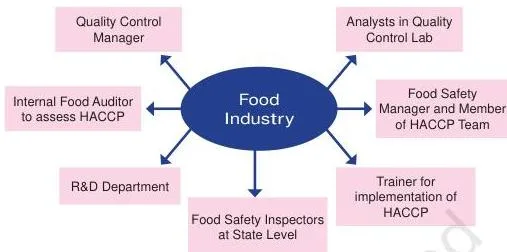
Fig. 6.6 maps the numerous opportunities available in a food industry — the same roles listed below. The chapter’s career avenues (NCERT, p. 89–90):
- Quality control laboratories in the food industry — as analysts or at managerial level
- Food testing laboratories in the public and private sectors — including food inspectors and food testing positions
- HACCP specialist
- Food auditor (after the required training)
- Quality certification such as ISO
- Teaching and academics
- Research
- Scientific writers
- Voluntary organisations, in various capacities
Placement is possible with regulatory and public health agencies (as food legislators, food safety officers/inspectors, food analysts or public analysts), with voluntary agencies such as Agmark and BIS, and in the in-house quality control units of large food industries and flight kitchens.
Self-employment options include running an analytical food laboratory, food safety consultancy and Food Safety and Sanitation Education (NCERT, p. 89–90). The processing side of this career base is covered in the food processing and technology notes.
Adulteration Quick Tests: All Six in One Table
The chapter’s Practical 2 teaches six qualitative tests for common adulterants. One table replaces re-reading all six procedures — the food, the adulterant it detects, the chemical used and the positive colour result (NCERT, p. 94–96):
| Food sample | Adulterant detected | Chemical used | Positive result |
|---|---|---|---|
| Ghee | Sesame oil in vanaspati (hydrogenated fat) | 1 per cent sucrose solution + concentrated hydrochloric acid | Pink colour develops |
| Tea leaves | Excessive stalks | Boiling water; stalks dried at 100°C | Stalks at or above 25 per cent of the sample (should be less than 25 per cent) |
| Black pepper | Light berries | Alcohol–water mixture (sp. gr 0.8–0.82) | Berries rise and float; a higher percentage suggests extraction from black berries |
| Turmeric | Metanil yellow (toxic adulterant) | Concentrated hydrochloric acid | Pink to magenta colour |
| Milk and ice cream | Starch | Iodine solution | Blue colour |
| Asafoetida (hing) | Colophenial resins (not permitted) | Petroleum ether + 0.5 per cent copper acetate solution | Blue or green colour in the ether layer |
Memory hook: “two pinks, two blues, one float, one fraction” — pink for ghee and turmeric, blue for milk and asafoetida, floating berries for pepper, and the 25 per cent stalk fraction for tea.
The observational counterpart is Practical 1’s worksheet: scan raw foods and cooked snacks for hazards such as hair, stones, stems and seeds, matchsticks, stapler pins, worms or insect parts, and infested grains (NCERT, p. 92), recording how much of each is present before commenting on quality.
Formulas and Worked Examples: The Percentage Calculations Behind the Tests
Two percentage formulas hide inside the practical tests (NCERT, p. 94–95):
\[ \text{Percentage of stalks in tea} = \frac{\text{mass of dry stalks}}{\text{mass of tea sample}} \times 100 \]
\[ \text{Percentage of light berries in pepper} = \frac{\text{mass of dried floating berries}}{\text{mass of pepper sample}} \times 100 \]
All masses are in grams and the result is a percentage. The tea test compares the result against the chapter’s limit of less than 25 per cent.
Worked Example 1: Tea stalks — a passing sample
Method: stalk-percentage test of Practical 2.
Step 1: Weigh the tea sample — 5.0 g.
Boil with water, filter, pick out the stalks and dry them at 100°C until all moisture is gone.
Step 2: Weigh the dry stalks — 0.7 g.
\[ \text{Percentage of stalks} = \frac{0.7}{5.0} \times 100 = 14\% \]
Step 3: Compare with the limit.
14 per cent is below the 25 per cent limit, so the sample passes — the tea does not contain excessive stalks.
Final answer: 14% stalks; within the 25 per cent limit.
Worked Example 2: Tea stalks — a failing sample
Method: stalk-percentage test of Practical 2.
Step 1: Weigh the tea sample — 4.0 g.
Boil, filter, pick out and dry the stalks.
Step 2: Weigh the dry stalks — 1.3 g.
\[ \text{Percentage of stalks} = \frac{1.3}{4.0} \times 100 = 32.5\% \]
Step 3: 32.5 per cent exceeds the 25 per cent limit, so the tea fails — it contains excessive stalks.
Final answer: 32.5% stalks; fails the 25 per cent limit.
Worked Example 3: Light berries in black pepper
Method: light-berry test of Practical 2.
Step 1: Weigh the pepper sample — 10 g.
Add 150–200 ml of alcohol–water mixture (sp. gr 0.8–0.82) and pick out the berries that float.
Step 2: Dry and weigh the floating berries — 0.9 g.
\[ \text{Percentage of light berries} = \frac{0.9}{10} \times 100 = 9\% \]
Step 3: Interpret.
The higher the percentage of light berries, the more likely the berries were extracted from black berries — 9 per cent is a measurable level, so the sample merits closer checking.
Final answer: 9% light berries.
Worked Example 4: Salmonella growth in two hours
Method: bacterial doubling, using the chapter’s fact that Salmonella doubles every 20 minutes.
Step 1: A dish starts with 50 Salmonella cells and is left at room temperature for 2 hours, which is 120 minutes.
\[ \text{Number of doublings} = \frac{120\ \text{minutes}}{20\ \text{minutes}} = 6 \]
Step 2: Apply the doubling formula.
\[ \text{Cells after 2 hours} = 50 \times 2^6 = 50 \times 64 = 3200 \]
Step 3: Interpret.
From 50 cells to 3200 cells in two hours shows exactly why time at the wrong temperature, inadequate cooking and poor hand hygiene are dangerous — and why prompt refrigeration and clean chopping boards matter.
Final answer: 3200 cells after 2 hours.
Common Mistakes Students Make in This Chapter
Each mistake below is a misconception → correction pair, with a quick way to verify your answer.
| Mistake | Correct rule | How to check your answer |
|---|---|---|
| Treating food infection and food intoxication as the same | Infection: live pathogens swallowed and multiplying in the body (Salmonella). Intoxication: toxins present in food even if the pathogen is killed (Staphylococcus aureus). | If your example is Salmonella and you wrote “multiply in the body”, it is infection. If you wrote “toxin remains in food”, it is intoxication. |
| Thinking food that looks and smells good is safe | Staphylococcal toxins cannot be detected by smell, appearance or taste; pleasant-looking food is not automatically safe. | Check that your answer contains the idea “cannot be detected by smell, appearance or taste”. |
| Writing contamination and adulteration as synonyms | Contamination is the presence of harmful foreign substances; adulteration is quality lowered by adding inferior material or extracting a valuable ingredient, and it includes contamination during growth, storage, processing, transport and distribution. | Check that your definition of adulteration mentions lowered quality and the food chain. |
| Quoting PFA 1954 as India’s main food law | PFA 1954 (amended over 200 times) and the product orders were consolidated into the Food Safety and Standards Act, 2006. | Check the year you wrote: the current Act is 2006. |
| Saying FSSAI and BIS do the same job | FSSAI lays down science-based standards and regulates manufacture, storage, distribution, sale and import. BIS runs the voluntary ISI mark for processed foods; Agmark certifies agricultural products. | Check the verb you used: FSSAI regulates; BIS certifies voluntarily. |
| Calling HACCP an end-product testing method | HACCP is preventive — it evaluates each step of the food chain so the problem is corrected at the stage where it occurs; end-product testing detects problems only after they occur. | Check that the word “preventive” appears in your answer. |
| Believing cooking always makes food safe | Adequate cooking destroys Salmonella, but inadequate cooking lets some organisms survive — and staphylococcal toxins remain even when the pathogen is killed. | Ask which organism your answer describes: live bacteria respond to adequate cooking; toxins do not. |
Exam Notes: How to Build Complete Answers for the Review Questions
The chapter closes with five review questions (NCERT, p. 91). Here is the component map for a complete answer to each — a strategy for writing.
- Explain why food safety and quality are of global concern. Include the health burden (National Family Health Survey 2015–16: more than 9 lakh children under five with acute diarrhea), the economic damage (mortality, damage to trade and tourism, loss of earnings, unemployment, litigation), India’s WTO obligations as a signatory to the non-tariff agreement, and the emergence of new pathogens such as Norovirus, Rotavirus and hepatitis E.
- Explain the terms: hazard, toxicity, contamination, food quality, adulteration. Use the definition formula — term + defining feature + how it happens + one example. A definition that only names a category (“a type of risk”) is incomplete; each term needs its precise mechanism.
- What is Codex Alimentarius? State what it literally means (“Food Code”), what it is (the document published by the Codex Alimentarius Commission — a collection of internationally adopted food standards), what it contains (standards, codes of practice, guidelines and recommendations) and its use (countries develop national standards from it).
- Discuss the significance of HACCP. Organise the answer by the five “why implement” reasons: preventive approach; overcomes the limits of end-product testing; efficient and cost-effective use of resources; FSSA 2006 places primary responsibility for safe food on producers and suppliers through HACCP, GMP and GHP; assures consistently good quality products.
- List the national and international food standards. Answer in two halves: national (FSSAI under FSSA 2006, BIS/ISI mark, Agmark) and international (Codex Alimentarius Commission, ISO). Optionally frame it with the four levels — company, national, regional, international.
Revision Summary: The Chapter on One Page
The whole chapter runs as one chain:
food safety → hazards (physical, chemical, biological) → contamination and adulteration → food quality (safety as its precursor) → standards (company, national, regional, international) → international bodies (Codex, ISO, WTO) → management systems (GMP, GHP, HACCP) → careers.
The key numbers of the chapter, gathered in one place:
| Figure or phenomenon | Value to remember |
|---|---|
| Children under five with acute diarrhea (NFHS 2015–16) | More than 9 lakh |
| Healthy individuals carrying Staphylococcus aureus in nasal passage, throat, skin, hair | 50 per cent |
| Salmonella doubling time | Every 20 minutes |
| Food-borne cases from Norovirus, Rotavirus, hepatitis E | About 70 per cent |
| Codex membership (2017) | 187 member countries + 1 member organisation |
| PFA amendments | Over 200 times |
| Tea stalks limit | Less than 25 per cent |
| Food industry share of Indian GDP | About 26 per cent |
| WTO established | 1995 |
| FSSA passed | 2006 |
Night-before instruction: revise the definitions table, the infection/intoxication pair and the six quick tests — that covers the chapter’s core. When you are done, the food processing and technology notes continue the story on the processing side, and the full CBSE notes index lets you jump to any subject.
Frequently Asked Questions About Food Quality and Food Safety
What is the difference between food infection and food intoxication?
Food infection comes from swallowing live pathogens that multiply in the body — Salmonella is the classic example. Food intoxication comes from toxins already present in food, which remain even if the pathogen is killed — Staphylococcus aureus is the example. The key distinction is live organisms versus pre-formed toxins.
Is food adulteration the same as food contamination?
No. Contamination is the presence of harmful or objectionable foreign substances in food at any stage of processing or storage. Adulteration is the lowering of food quality by adding inferior material or extracting a valuable ingredient; the NCERT definition is broader because it explicitly includes contamination that happens during growth, storage, processing, transport and distribution.
What is the difference between Codex Alimentarius and ISO?
Codex Alimentarius is a collection of internationally adopted food standards published by the Codex Alimentarius Commission; it is used to develop national regulations, describes minimal acceptable practices and is slow to change. ISO is a voluntary, non-governmental standardisation body; its standards are reviewed every five years and describe current standard industrial practices.
Codex is food-specific and regulation-oriented; ISO covers quality management generally and is voluntary.
Why is HACCP called a preventive approach to food safety?
Because it evaluates raw materials and each individual step of the food chain for hazards and lets the problem be corrected at the stage where it occurs, instead of testing the finished product after the problem has already happened. End-product testing is time-consuming, expensive and detects problems only after they occur; HACCP acts while the food is still being made.
What are the quick adulteration tests to remember from this chapter?
The six tests are ghee (pink colour for sesame oil/vanaspati), tea leaves (stalk percentage under 25 per cent), black pepper (floating light berries), turmeric (pink to magenta for metanil yellow), milk and ice cream (blue colour for starch), and asafoetida (blue or green in the ether layer for colophenial resins).
The table in the quick-tests section above gives the chemicals and positive results for all six.
Which law currently governs food safety in India and what did it replace?
The Food Safety and Standards Act, 2006 (FSSA) currently governs food safety in India. It consolidated the Prevention of Food Adulteration Act, 1954 (amended over 200 times) and the product orders — the Fruit and Vegetable Product Order, Meat Food Products Order and Vegetable Oil Products Order — under one umbrella and created FSSAI.
Reference: NCERT Class 12 Human Ecology and Family Sciences (Part I) textbook, chapter Food Quality and Food Safety.
Explore Class 12 Home Science Notes
- Class 12 Home Science Notes
- Class 12 CBSE Notes
- CBSE Notes for Classes 1 to 12
- Previous: Food Processing and Technology
Class 12 Home Science on LearnCBSE:
Related chapters:
- Public Nutrition and Health notes