
These Thinkers Beliefs and Buildings Class 12 notes revise Theme 4 of Themes in Indian History Part I — the chapter that follows how new religious ideas took shape in the Ganga valley and beyond, and how those ideas were turned into stupas, sculpture and temples. The page follows the Rationalised NCERT textbook for the 2026-27 session.
You get the chapter in revision form: a chapter map with a timeline, the thinkers (Mahavira and the Buddha) compared with the Vedic sacrificial tradition, the Sanchi stupa decoded (why it was built, who paid, its structure), a method for reading Sanchi’s sculpture, the later turn to Mahayana and Puranic Hinduism, a key-terms table, a worked inscription-reading example, six common mistakes with corrections, and a last-minute recap.
NCERT page references (p. …) point you back to the textbook wherever you need the full sources.
If you are revising the whole book, start from the Class 12 History notes hub, or browse the Class 12 CBSE notes collection and the wider CBSE notes library.
Thinkers, Beliefs and Buildings: Chapter Map and Timeline
The chapter spans roughly a thousand years — c. 600 BCE to 600 CE — as its subtitle states (p. 82). It moves in a deliberate order:
- Ideas first (pp. 84–95): Vedic sacrifice → new questions and debates → Mahavira and Jainism → the Buddha and the sangha.
- Material remains next (pp. 95–107): stupas → sculpture → painting → new religious directions → the first temples.
- The Sanchi story bookends the chapter (pp. 82–83, 98–99): the chapter opens with the nineteenth-century preservation of Sanchi and returns to it through the fates of Sanchi and Amaravati.
The skill that holds it together: historians combine texts, sculpture, architecture and inscriptions (p. 84). Every section below practises that combination.
This History chapter has no formulas, so the timing table plays the role of a formula box. The table below rebuilds the chapter’s “Major religious developments” list (p. 110) — read it down once, then cover one column and recall the other.
| Period | Major religious development |
|---|---|
| c. 1500–1000 BCE | Early Vedic traditions |
| c. 1000–500 BCE | Later Vedic traditions |
| c. sixth century BCE | Early Upanishads; Jainism, Buddhism |
| c. third century BCE | First stupas |
| c. second century BCE onwards | Development of Mahayana Buddhism, Vaishnavism, Shaivism and goddess cults |
| c. third century CE | Earliest temples |
Keep the earlier themes in mind while revising: the Ganga valley cities and the gahapatis you studied in kings, farmers and towns (Chapter 2) and kinship, caste and class (Chapter 3) are the social backdrop the new thinkers reacted to. The full Rationalised textbook, including the primary sources this chapter quotes, is available on the official NCERT portal (ncert.nic.in).
The Context: Vedic Sacrifices, Debates and New Questions
The chapter treats the mid-first millennium BCE as a turning point in world history (p. 84). Parallel thinkers appeared across Eurasia: Zarathustra in Iran, Kong Zi in China, Socrates, Plato and Aristotle in Greece, and Mahavira and Gautama Buddha in India — all trying to understand existence and the human place in the cosmic order.
In the Ganga valley, new kingdoms and cities were rising and social and economic life was changing (p. 84).
The sacrificial tradition the thinkers questioned
- Rigveda, compiled c. 1500–1000 BCE: hymns in praise of deities, especially Agni, Indra and Soma, chanted at sacrifices; people prayed for cattle, sons, good health and long life (p. 84).
- Change over time: sacrifices were first performed collectively; from c. 1000–500 BCE heads of households performed some for the domestic unit; chiefs and kings performed elaborate rituals — rajasuya and ashvamedha — which depended on Brahmana priests (p. 84).
New questions, debates and the break with the Vedas
- Upanishads (c. sixth century BCE onwards): people asked about the meaning of life, life after death, rebirth, and whether rebirth was caused by past actions; thinkers tried to express the nature of ultimate reality; some outside the Vedic tradition even asked whether a single ultimate reality existed (pp. 84–85).
- Crucibles of debate: Buddhist texts mention as many as 64 sects or schools of thought; teachers travelled to convince rivals and laypersons; debates occurred in the kutagarashala — literally “a hut with a pointed roof” — or in groves where travelling mendicants halted; winning over a rival converted the rival’s followers too, so a sect’s support could grow and shrink (p. 85).
- The key divergence: Mahavira and the Buddha questioned the authority of the Vedas and emphasised individual agency — men and women could strive for liberation from the trials of worldly existence. This clashed with the Brahmanical position, in which a person’s existence was determined by birth in a specific caste or gender (p. 85).
Fatalists and materialists
Two non-Brahmanical schools appear in a Sutta Pitaka conversation between King Ajatasattu and the Buddha (p. 87). Remember: their own texts are lost, so we know them only through other traditions’ accounts.
| School | Teacher | Core belief |
|---|---|---|
| Ajivikas (fatalists) | Makkhali Gosala | Everything is predetermined; karma cannot be lessened or increased in the course of samsara; pleasure and pain are measured out and unalterable — Gosala’s simile: “just as a ball of string will when thrown unwind to its full length, so fool and wise alike will take their course” (p. 87) |
| Lokayatas (materialists) | Ajita Kesakambalin | No alms, sacrifice or offerings; no this world or the next; a human being is made of four elements (earth, water, fire, air) that return to their sources at death; “the talk of gifts is a doctrine of fools” (p. 87) |
The chapter’s own “Discuss” asks whether the labels “fatalists” and “materialists” are appropriate at all — a reminder that these descriptions come from rival traditions, not from the schools themselves (p. 87).
How Buddhist texts were made and preserved
- The Buddha (like other teachers) taught orally, through discussion and debate; nothing was written down in his lifetime (p. 86).
- After his death (c. fifth–fourth century BCE) his disciples compiled his teachings at a council of elders at Vesali (Pali for Vaishali, present-day Bihar) (p. 86).
- The compilations formed the Tipitaka — literally “three baskets”: Vinaya Pitaka (rules for the sangha), Sutta Pitaka (the Buddha’s teachings) and Abhidhamma Pitaka (philosophical matters) (p. 86).
- The texts were first transmitted orally, then written, and classified by length and subject; scholars later added commentaries (p. 86).
- The oldest texts are in Pali, later compositions in Sanskrit (p. 86).
- As Buddhism reached Sri Lanka, texts such as the Dipavamsa (chronicle of the island) and Mahavamsa (great chronicle) recorded regional histories of Buddhism (p. 86).
- Pilgrims Fa Xian and Xuan Zang travelled from China to India in search of texts and carried them home for translation; Indian teachers also carried texts abroad (p. 86).
- Manuscripts were preserved for centuries in monasteries across Asia; modern translations draw on Pali, Sanskrit, Chinese and Tibetan versions (p. 86).
Mahavira and the Buddha: Jain and Buddhist Responses
Jainism in brief
- Vardhamana Mahavira (sixth century BCE) was, by Jaina tradition, the last of 24 teachers — tirthankaras, literally “those who guide men and women across the river of existence” (p. 88).
- The whole world is animated: even stones, rocks and water have life (p. 88).
- Ahimsa — non-injury to living beings, especially humans, animals, plants and insects — is central; the principle left its mark on Indian thinking as a whole (p. 88).
- The cycle of birth and rebirth is shaped by karma; asceticism and penance are needed to free oneself from it (p. 88).
- Salvation requires renouncing the world — monastic existence is a necessary condition (p. 88).
- Monks and nuns took five vows: abstain from killing, stealing and lying; observe celibacy; abstain from possessing property (p. 88).
- Jainism spread widely; its scholars produced literature in Prakrit, Sanskrit and Tamil, preserved for centuries in temple libraries; some of the earliest religious stone sculptures in the subcontinent are Jaina (p. 89).
The Buddha: sources and life
Historians reconstruct the Buddha’s teachings by carefully editing, translating and analysing the Buddhist texts described above. For his life they use hagiographies — biographies of a saint or religious leader that often praise the saint’s achievements and may not be literally accurate; they matter because they tell us what the followers believed.
Many were written at least a century after the Buddha’s time (p. 89).
- Siddhartha, son of a chief of the Sakya clan, had a sheltered palace upbringing (pp. 89–90).
- His first journey outside showed him an old man, a sick man and a corpse — he realised that decay and destruction of the human body were inevitable — then a homeless mendicant who seemed at peace with old age, disease and death (p. 90).
- He left the palace, tried bodily mortification to the point of near death, abandoned extreme methods, meditated for days and attained enlightenment — henceforth the Buddha, “the Enlightened One” (p. 90).
- For the rest of his life he taught dhamma, the path of righteous living (p. 90).
Core teachings
- anicca: the world is transient and constantly changing (p. 91).
- anatta: the world is soulless — nothing is permanent or eternal (p. 91).
- dukkha: sorrow is intrinsic to human existence (p. 91).
- Middle path: moderation between severe penance and self-indulgence (p. 91).
- In the earliest Buddhism, whether god existed was irrelevant (p. 91).
- Persuasion over miracle: to a grief-stricken woman whose child had died, the Buddha gently argued the inevitability of death rather than restore the child (p. 91).
- Teachings were narrated in the language of ordinary people (p. 91).
- To the householder Sigala the Buddha gave duties: a master should assign work by strength, supply food and wages, tend servants in sickness, share delicacies and grant leave; clansmen should treat samanas and Brahmanas with affection in act, speech and mind, keep open house and supply their needs (p. 91).
- The social world is a human creation, not of divine origin — so kings and gahapatis were advised to be humane and ethical (p. 92).
- nibbana — literally the extinguishing of the ego and desire — ends the cycle of suffering for those who renounce the world; his last words: “Be lamps unto yourselves as all of you must work out your own liberation” (p. 92).
The sangha
- The sangha was an organisation of monks who became teachers of dhamma; monks lived simply, owning only essentials such as a bowl to receive food once a day from laypeople — hence bhikkhus (p. 92).
- Women were admitted later, through the mediation of Ananda; the Buddha’s foster mother Mahapajapati Gotami was the first bhikkhuni; women who attained liberation became theris (p. 92).
- Members came from all social groups — kings, wealthy men, gahapatis, workers, slaves, craftspeople; once inside, all were equal and shed their earlier social identities (p. 92).
- The sangha’s internal working followed the traditions of ganas and sanghas: consensus through discussion, and a vote if consensus failed (p. 92).
- The Therigatha (part of the Sutta Pitaka) collects verses by bhikkhunis and gives an insight into women’s social and spiritual experiences. Punna, a dasi (slave woman) who fetched water daily, challenged a Brahmana’s bathing rituals — if washing in water freed one from evil, she asked, all frogs and turtles would go to heaven (p. 93).
- Vinaya rules show the discipline of detachment: a new felt blanket must be kept six years; a bhikkhu may accept only two or three bowlfuls of cakes and must share them; bedding must be put away before leaving a sangha lodging (p. 94).
Why Buddhism grew: it prized conduct and values over claims of superiority based on birth, emphasised metta (fellow feeling) and karuna (compassion) — especially for the younger and weaker — and appealed to people dissatisfied with existing practices and confused by rapid social change (p. 94).
Three traditions compared
The differences that matter for answers:
| Criterion | Vedic-Brahmanical tradition | Jainism | Buddhism |
|---|---|---|---|
| Authority | Vedas accepted; sacrifice and priests conduct the rituals (p. 84) | Veda authority questioned by Mahavira (p. 85) | Veda authority questioned by the Buddha (p. 85) |
| World and self | Sacrifice-centred order; an individual’s existence determined by birth in a caste or gender (pp. 84–85) | Entire world animated — stones, rocks and water have life; karma shapes rebirth (p. 88) | World transient (anicca) and soulless (anatta); sorrow (dukkha) intrinsic to existence (p. 91) |
| Path to liberation | Elaborate royal sacrifices (rajasuya, ashvamedha) conducted by Brahmana priests (p. 84) | Asceticism and penance; five vows; monastic existence necessary for salvation (p. 88) | Middle path between penance and self-indulgence; individual agency and righteous action; nibbana — extinguishing ego and desire (pp. 91–92) |
| Social order | Birth-based and gender-based determination of existence (p. 85) | Birth is not the key — salvation comes by renouncing the world, so monastic life is emphasised (p. 88) | Egalitarian sangha — all shed old social identities; conduct and values over birth (pp. 92, 94) |
The Great Stupa at Sanchi: Why, How and What It Looked Like
The nineteenth-century survival story
Shahjehan Begum, Nawab of Bhopal (ruled 1868–1901), recorded a visit to Sanchi in her Taj-ul Iqbal Tarikh Bhopal (A History of Bhopal, translated by H.D. Barstow, 1876): she inspected the stone sculptures, statues of the Buddha and an ancient gateway, and noted the strong interest of European gentlemen — Alexander Cunningham had stayed weeks, taken drawings, deciphered the inscription and bored shafts down the domes (p. 82).
- The French asked permission to carry away the best-preserved eastern gateway for a museum in France; some Englishmen wanted the same; both sides settled for plaster-cast copies, and the original stayed at the site (p. 83).
- The rulers of Bhopal — Shahjehan Begum and her successor Sultan Jehan Begum — funded the preservation of the site. Sultan Jehan also paid for the museum, the guesthouse where John Marshall lived and wrote, and the publication of his Sanchi volumes; Marshall dedicated those volumes to her (p. 83).
- Survival also meant escaping railway contractors, builders and collectors looking for finds to carry to European museums (p. 83).
- The discovery of Sanchi transformed historians’ understanding of early Buddhism; today it testifies to restoration by the Archaeological Survey of India (p. 83).
Keep this sequence ready whenever the textbook asks you to discuss the begums’ role (exercise Q3): inspection → threat of removal → the begums’ funding → Marshall’s volumes → survival.
Why the place was sacred: chaityas and the four sites
- From earliest times, certain places were considered sacred — sites with special trees, unique rocks, or awe-inspiring natural beauty — often with small shrines; these were called chaityas. The word may derive from chita, a funeral pyre, and by extension a funerary mound (p. 95).
- The Buddha’s life fixed four sacred sites: Lumbini (birth), Bodh Gaya (enlightenment), Sarnath (first sermon) and Kusinagara (nibbana). About 200 years after the Buddha, Asoka erected a pillar at Lumbini recording his visit (p. 96).
Memory device: L-B-S-K → “Learn Best, Stay Kind” → Lumbini, Bodh Gaya, Sarnath, Kusinagara.
Why stupas were built
- Relics — the Buddha’s bodily remains or objects he used — were buried under the mounds; the whole stupa came to be venerated as an emblem of the Buddha and of Buddhism (p. 96).
- Mahaparinibbana Sutta: pressed by Ananda, the dying Buddha instructed that a thupa (Pali for stupa) be erected at the four crossroads; whoever places garlands or perfume there, makes a salutation, or becomes calm of heart, gains “profit and joy” (p. 96).
- Ashokavadana: Asoka distributed portions of the Buddha’s relics to every important town and ordered stupas built over them (p. 96).
- By the second century BCE stupas existed at Bharhut, Sanchi and Sarnath (p. 96).
Who paid for them
Inscriptions found on stupa railings and pillars record donations (pp. 96–97). The votive inscription in Fig. 4.9 is one of hundreds of similar records at Bharhut and Amaravati — together they are the historian’s main evidence for who funded these monuments.
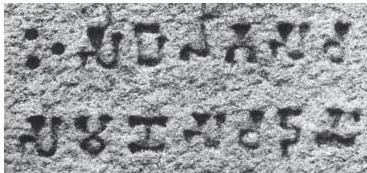
- Kings: the Satavahanas donated.
- Guilds: the ivory workers financed part of one gateway at Sanchi.
- Individuals: hundreds of named women and men, sometimes adding hometown, occupation and relatives.
- Monastics: bhikkhus and bhikkhunis also contributed (pp. 96–97).
The structure of the stupa
Stupa means “heap” in Sanskrit. From bottom to top (p. 97):
- anda — the original semi-circular mound of earth.
- harmika — a balcony-like structure above the anda, representing the abode of the gods.
- yashti — the mast rising from the harmika, often topped by a chhatri (umbrella).
- Railing around the mound, separating the sacred space from the secular world.
- Four richly carved gateways at the four cardinal points.
The ritual: worshippers entered through the eastern gateway and walked clockwise around the mound — pradakshina — keeping the mound on the right, imitating the sun’s course (p. 97). Later stupas such as Amaravati and Shah-ji-ki-Dheri in Peshawar had their mounds elaborately carved with niches and sculpture (p. 97).
Figure walkthrough: the plan versus the photograph
The “Discuss” on p. 97 asks what the plan of the Great Stupa (Fig. 4.10a) shows that a photograph cannot. The caption gives the key: a plan provides a horizontal perspective of a building.
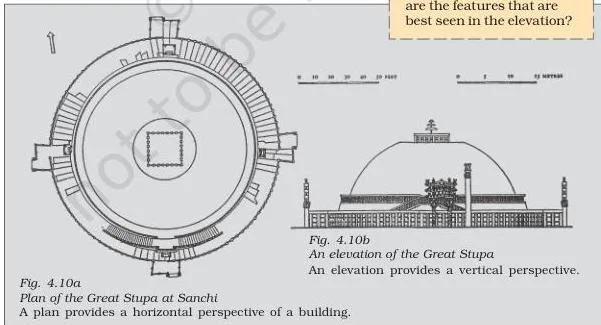
Read the plan as the building seen from directly overhead: you see the enclosing railing as a ring, the four gateways placed at the cardinal points, the circular shape of the anda, and the path the worshipper walked during pradakshina. A photograph (such as Fig. 4.3) instead shows elevation — the mound’s height, the carving and the gateways as standing structures.
So: layout, positions and the walking path come from the plan; mass, decoration and height come from the photograph. State exactly that separation when you answer.
Why Sanchi survived and Amaravati did not
- 1796: a local raja building a temple stumbled on the Amaravati ruins and suspected treasure (p. 98).
- A British official, Colin Mackenzie, visited later and made detailed drawings — never published (p. 98).
- 1854: Walter Elliot, commissioner of Guntur, removed sculpture panels to Madras — the so-called “Elliot marbles” — and concluded Amaravati was one of the largest and most magnificent Buddhist stupas ever built (p. 98).
- By the 1850s, slabs had gone to Calcutta, Madras and London; sculptures adorned the gardens of British administrators, and new officials kept removing them on the grounds that earlier ones had done so (p. 98).
- H.H. Cole’s protest: “It seems to me a suicidal and indefensible policy to allow the country to be looted of original works of ancient art.” He wanted plaster-cast copies in museums and originals kept in place — his plea for in situ (“on the spot”) preservation was accepted for Sanchi but not Amaravati (pp. 98–99).
- Sanchi in 1818: three of four gateways standing, the fourth fallen on the spot, the mound in good condition; even so, moving the gateway to Paris or London was suggested — “a number of factors” kept Sanchi as it was (p. 99).
- Result: Sanchi stands; the mahachaitya at Amaravati is now a denuded little mound (p. 99).
Reading Sanchi’s Sculptures: Stories, Symbols and Popular Motifs
Stories in stone
A panel of the northern gateway (Fig. 4.13) seems at first sight to be a rural scene — thatched huts and trees.
Art historians who studied it carefully, however, identify it as a scene from the Vessantara Jataka, the story of a generous prince who gave away everything to a Brahmana and went to live in the forest with his wife and children (pp. 99–100).
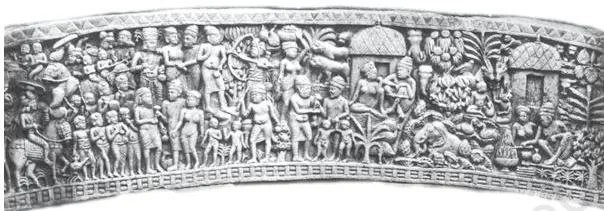
The method is explicit: historians understand sculpture by comparing it with textual evidence (p. 100). The scroll-based storytelling technique helps explain the crowded panels — wandering storytellers used charanachitras, scrolls with pictures, pointing to pictures as they narrated (p. 99).
Symbols of worship
Many early sculptors did not show the Buddha in human form; they showed his presence through symbols (pp. 100–101).
| Symbol at Sanchi | What it stood for |
|---|---|
| Empty seat | The Buddha’s meditation — his enlightenment (p. 100) |
| Stupa | The mahaparinibbana (p. 100) |
| Wheel | The first sermon at Sarnath — setting in motion the wheel of dharma (p. 100) |
| Tree | An event in the Buddha’s life — the tree does not stand simply for a tree (pp. 100–101) |
Popular (non-Buddhist) motifs
- Shalabhanjika: a woman swinging from a tree branch, whose touch was believed to make trees flower and bear fruit — an auspicious symbol integrated into the stupa’s decoration; it shows converts enriching Buddhism with pre-Buddhist and non-Buddhist beliefs (p. 101).
- Animals: elephants, horses, monkeys and cattle appear in lively scenes to draw viewers, and as symbols — the elephant signified strength and wisdom (p. 101).
- Gajalakshmi or Maya: a woman surrounded by lotuses and elephants sprinkling water as if performing an abhisheka (consecration) — some historians identify her as Maya, the Buddha’s mother, others as Gajalakshmi, the goddess of good fortune; devotees may have seen both figures in the one image (pp. 102–103).
- Serpents on several pillars came from popular traditions not always recorded in texts (p. 103).
- A cautionary tale: James Fergusson, one of the earliest modern art historians, concluded that Sanchi was a centre of tree and serpent worship — he was unfamiliar with Buddhist literature (most was untranslated) and studied only the images on their own, and reached a wrong conclusion (p. 103).
Paintings at Ajanta
Stone survives time best, but painting was also used; the best-preserved paintings are on cave walls at Ajanta (Maharashtra). They depict Jataka stories — courtly life, processions, men and women at work, festivals — and the artists used shading to give a three-dimensional quality; some paintings are extremely naturalistic (p. 102).
New Directions: Mahayana Buddhism, Puranic Hinduism and First Temples
Mahayana Buddhism (developing from c. the second century BCE onwards)
- Early teaching had stressed self-effort in achieving nibbana; the Buddha was seen as a human being who attained enlightenment through his own efforts (p. 103).
- Gradually the idea of a saviour emerged — someone who could ensure salvation (p. 103).
- The Bodhisatta: a deeply compassionate being who accumulates merit but postpones nibbana in order to help others (p. 103).
- Worship of images of the Buddha and Bodhisattas became an important part of this tradition (p. 103).
- This new way of thinking was called Mahayana — literally the “great vehicle”; its supporters called the older tradition Hinayana, the “lesser vehicle” (p. 103).
- The label trap: followers of the older tradition described themselves as theravadins — followers of the path of the old, respected teachers (theras). “Hinayana” is an outsider’s label, not the group’s self-name (p. 103).
Puranic Hinduism: Vaishnavism and Shaivism
- Vaishnavism — Vishnu worshipped as the principal deity; Shaivism — Shiva regarded as the chief god; both emphasised worship of a chosen deity, the bond visualised as love and devotion — bhakti (p. 104).
- Ten avatars of Vishnu — divine forms assumed to save the world whenever it was threatened by evil; different avatars were popular in different regions, and recognising local deities as forms of Vishnu created a more unified tradition (p. 104).
- Shiva was symbolised by the linga, though occasionally shown in human form (p. 104).
- Iconographic codes conveyed ideas: head-dresses, ornaments, ayudhas (weapons or auspicious objects held in the hands) and seated postures (p. 104).
- The Puranas: compiled by Brahmanas by about the middle of the first millennium CE, but containing material that had been composed and in circulation for centuries; written in simple Sanskrit verse meant to be read aloud to everybody — including women and Shudras who had no access to Vedic learning; they evolved through the interaction of priests, merchants and ordinary travellers. Vasudeva-Krishna, important in Mathura, spread across the country over centuries (p. 105).
The first temples
- The earliest temple was a small square room, the garbhagriha, with a single doorway through which the worshipper entered to offer worship (p. 105).
- A tall structure, the shikhara, was later built over the central shrine; walls were decorated with sculpture (pp. 105–106).
- Later temples grew elaborate — assembly halls, huge walls and gateways, and water-supply arrangements (p. 106).
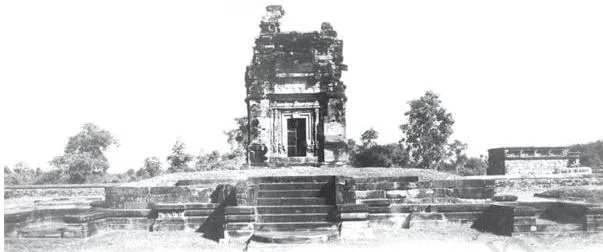
Fig. 4.25 is the textbook’s practice ground: identify the remains of the shikhara (the tower over the central shrine) and the entrance to the garbhagriha (the single doorway of the inner sanctum) (p. 106).
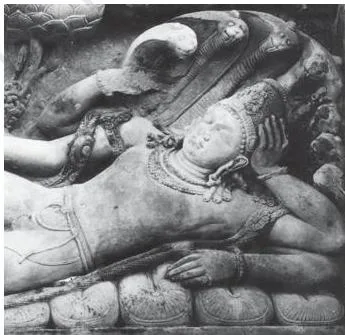
Fig. 4.26 pairs with the textual ground above: the reclining Vishnu on the serpent Sheshnag is Vaishnava iconography that only becomes readable because historians know the stories behind the image — most contained in the Puranas (pp. 104–105).
Cave temples and the Kailashnatha climax
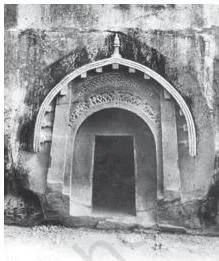
The artificial-cave tradition was old: some of the earliest caves were constructed in the third century BCE on Asoka’s orders for Ajivika renouncers at Barabar (p. 107).
The tradition culminated in the eighth century CE in the Kailashnatha temple at Ellora — an entire temple carved out of a single rock. A copperplate inscription records the chief sculptor’s amazement: “Oh how did I make it!” (p. 107).
Can We “See” Everything? How Historians Read Visual Evidence
The chapter closes with a warning: we cannot automatically know what these images meant to people who saw and venerated them about 2,000 years ago (p. 107). Three problems follow:
| Problem | What it is | Example |
|---|---|---|
| The unfamiliar | Nineteenth-century European scholars judged Indian sculpture by a Greek yardstick — they were sometimes horrified by multi-armed, multi-headed, part-human part-animal figures, and found early Indian sculpture inferior to Greek works | They celebrated Buddha and Bodhisatta images from the northwest (Taxila, Peshawar — Indo-Greek kingdoms of the second century BCE) because these resembled Greek statues; “devising yardsticks derived from the familiar to make sense of the unfamiliar” (pp. 107–108) |
| Text and image out of step | Even with texts in hand, art historians can disagree about what a scene means | The Mahabalipuram rock-cut panel: some read it as the descent of the river Ganga (the natural cleft as the river), others as Arjuna’s penance from the Mahabharata (the central ascetic figure) — experts are sharply divided (pp. 108–109) |
| The unrecorded | Many daily rituals and practices were never fixed in monument, sculpture or painting | The spectacular instances in this chapter are “just the tip of the iceberg” of what was believed and practised (p. 109) |
This is the chapter-wide method in reverse: if reconstructing the past needs texts, sculpture, architecture and inscriptions together (p. 84), then silences in the record — lost texts, unlucky discoveries, unrecorded practices — are part of the evidence too.
Key Terms Quick Reference Table
Rehearse these terms by meaning first, then by context.
| Term | Meaning in one sentence | Where you meet it |
|---|---|---|
| Tipitaka | Literally “three baskets” — the Buddhist canon: Vinaya Pitaka (sangha rules), Sutta Pitaka (the Buddha’s teachings), Abhidhamma Pitaka (philosophical matters) | p. 86 |
| Sangha | The monastic order of the Buddha’s followers | pp. 86, 92 |
| Bhikkhu / bhikkhuni | Buddhist monk / nun who lived on alms, owning only essentials | pp. 92–93 |
| Theri | A respected woman who had attained liberation | p. 92 |
| Tirthankara | Literally “one who guides men and women across the river of existence” — Mahavira’s 23 predecessors | p. 88 |
| Ahimsa | Non-injury to living beings; central to Jainism and a lasting mark on Indian thinking | p. 88 |
| Anicca / anatta / dukkha | The world is transient / soulless (nothing permanent) / characterised by intrinsic sorrow | p. 91 |
| Nibbana | Literally extinguishing the ego and desire; ends the cycle of suffering | p. 92 |
| Metta / karuna | Fellow feeling / compassion, especially for the younger and weaker | p. 94 |
| Chaitya | A sacred place, often with a small shrine; possibly from chita (funeral pyre) | p. 95 |
| Anda / harmika / yashti / chhatri | The stupa’s mound / balcony-like “abode of the gods” / mast / umbrella | p. 97 |
| Bodhisatta | A deeply compassionate being who postpones nibbana to help others | p. 103 |
| Mahayana / Theravada | “Great vehicle” (the newer, saviour-centred tradition) versus the older tradition whose followers called themselves theravadins, after the theras | p. 103 |
| Bhakti | Worship of a chosen deity, the bond visualised as love and devotion | p. 104 |
| Avatar | A divine form Vishnu assumed to save the world from evil — ten recognised | p. 104 |
| Garbhagriha / shikhara | The small square inner room of the earliest temples / the tall structure built over the central shrine | pp. 105–106 |
| Hagiography | A saint’s biography that may not be literally accurate but reveals the followers’ beliefs | p. 89 |
| In situ | “On the spot” — keeping original sculpture where it was found | p. 99 |
Worked Example: Decoding the Dhanavati Inscription
This is the History equivalent of a solved numerical: the same five-step loop works for any inscription exercise in the chapter. The inscription is the textbook’s exercise Q4 (p. 111):
In the year 33 of the maharaja Huvishka (a Kushana ruler), in the first month of the hot season on the eighth day, a Bodhisatta was set up at Madhuvanaka by the bhikkhuni Dhanavati, the sister’s daughter of the bhikkhuni Buddhamita, who knows the Tipitaka, the female pupil of the bhikkhu Bala, who knows the Tipitaka, together with her father and mother.
The five-step reading framework
- Date the record. Read the ruler’s regnal year and the season/day: Huvishka, year 33, first month of the hot season, eighth day. “Year 33” is a relative date — it becomes absolute only when the king is identified as the Kushana maharaja Huvishka.
- Identify the donor. The bhikkhuni (Buddhist nun) Dhanavati — the record is her act of devotion.
- Identify the act. A Bodhisatta image was set up at Madhuvanaka — direct evidence of Bodhisatta devotion in the Kushana period.
- Trace the relationships. Dhanavati is the sister’s daughter (niece) of the bhikkhuni Buddhamita; Dhanavati is the female pupil of the bhikkhu Bala; the inscription says Buddhamita and Bala know the Tipitaka; the donation was made “together with her father and mother”.
- State its historical value. Women appear as donors and as learned in the texts; religious learning passed through a family (aunt–niece); Kushana dating used regnal years.
The five sub-answers
| Part | Question | Answer with reasoning |
|---|---|---|
| (a) | How did Dhanavati date her inscription? | By the regnal year of the Kushana ruler Huvishka — year 33 — adding the month (first of the hot season) and the day (eighth). |
| (b) | Why do you think she installed an image of the Bodhisatta? | Bodhisatta devotion was current in her time: a Bodhisatta postpones nibbana to help others, and image worship of the Buddha and Bodhisattas had become important from about the first century CE. |
| (c) | Who were the relatives she mentioned? | Her father and mother, named together; and her mother’s sister — the bhikkhuni Buddhamita — since Dhanavati is described as Buddhamita’s sister’s daughter. |
| (d) | What Buddhist text did she know? | The Tipitaka, the three baskets of Buddhist texts. The inscription places the Tipitaka at the centre of the women’s circle: Buddhamita is described as knowing it. |
| (e) | From whom did she learn this text? | Through the teacher–pupil–family chain headed by bhikkhu Bala: Buddhamita was Bala’s female pupil and Bala knew the Tipitaka, and Dhanavati, as Buddhamita’s niece, belonged to the same line of learning. |
The same who–when–why–relationships–value loop will decode any “read this inscription” question in the chapter.
Common Mistakes in This Chapter (and the Corrections)
Six confusions students most often write — with the corrected rule and a way to check:
| Students write… | Correct is… | How to check your answer |
|---|---|---|
| “The Buddha’s teachings were written down during his lifetime.” | His teaching was oral; after his death disciples compiled it at the council of elders at Vesali; the Tipitaka was first transmitted orally, then written and classified (p. 86). | Run the chain: oral teaching → Vesali council → Tipitaka. No step happens in the Buddha’s lifetime. |
| “Asoka built the Great Stupa at Sanchi.” | Stupas at Bharhut, Sanchi and Sarnath existed by the second century BCE; Asoka’s recorded acts are the Lumbini pillar and, per the Ashokavadana, distributing relics and ordering stupas over them (p. 96). | Separate “promoter” from “builder” — the chapter’s evidence ties Asoka to Lumbini and relic distribution, not to constructing the Sanchi mound. |
| “The Theravadins called the other group Hinayana.” | Reversed: it was supporters of Mahayana (“great vehicle”) who labelled the older tradition Hinayana (“lesser vehicle”); its followers called themselves theravadins, after the old respected teachers (theras) (p. 103). | Use each group’s self-name: theravadins ← theras; “Hinayana” is an outsider’s label, never the group’s own. |
| “The Ajivikas and Lokayatas were the same school.” | Two distinct schools: Ajivikas (Makkhali Gosala — everything predetermined, karma unalterable) and Lokayatas (Ajita Kesakambalin — no sacrifice, no next world, humans made of four elements) (p. 87). | Pair teacher with doctrine: Gosala → Ajivika/fatalist; Kesakambalin → Lokayata/materialist. |
| “Early Buddhist sculpture never shows the Buddha.” | Early Sanchi sculptors avoided the human form and used symbols (empty seat, wheel, stupa, tree); but Buddha images appear from about the first century CE — the Mathura image is the example — and image worship grew with Mahayana (pp. 100–103). | Narrow the claim to “early Sanchi sculpture” — the word “never” makes it too absolute. |
| “The Puranas were composed fresh in the middle of the first millennium CE.” | They were compiled by Brahmanas by about the middle of the first millennium CE but contain material that had been composed and in circulation for centuries (p. 105). | Compiled ≠ freshly composed — the date given is for the compilation, not for the ideas. |
Writing Complete Answers to This Chapter’s Questions
The chapter’s exercises (pp. 111–113) come in five formats. Match the format to the answering move:
| Format | Questions | What a complete answer contains |
|---|---|---|
| 100–150 word answers | Q1–5 | A direct opening claim, 2–3 supporting points, and a closing source reference |
| Inscription reading | Q4 | The five-step framework in the worked example above — date, donor, act, relationships, value |
| Short essays (~500 words) | Q6–9 | A claim, evidence from texts/inscriptions/architecture, and a conclusion — skeletons below |
| Map work | Q10 | Land routes through Central Asia to China, Korea and Japan; sea routes via Sri Lanka to Myanmar, Thailand and Indonesia — the spread is described on p. 89 |
| Projects | Q11–12 | Observation, comparison and a written report (outline below) |
Answer skeletons to have ready:
- Q1 (Upanishadic thinkers vs fatalists and materialists): the Upanishads asked questions about the meaning of life, rebirth, karma and ultimate reality; the Ajivikas held that everything is predetermined and karma unalterable (Makkhali Gosala); the Lokayatas denied the next world and sacrifice altogether (Ajita Kesakambalin). The difference: open questions versus fixed doctrines (pp. 84–87).
- Q2 (central teachings of Jainism): the world is animated; ahimsa is central; karma shapes rebirth; asceticism and penance are required; the five vows and monastic existence complete the picture (p. 88).
- Q3 (begums of Bhopal): Shahjehan Begum and Sultan Jehan Begum funded preservation; Sultan Jehan funded the museum, the guesthouse and the publication of Marshall’s Sanchi volumes; the original gateway stayed because the French and English accepted plaster casts (pp. 82–83).
- Q5 (why men and women joined the sangha): equality within the sangha (old social identities shed), conduct and values over birth, metta and karuna, and the appeal of a new path to people dissatisfied with existing practices (pp. 92–94).
- Q6 (Buddhist literature and Sanchi sculpture): the Vessantara Jataka identifies the northern-gateway panel; hagiographies explain the symbol language (empty seat, wheel, stupa); Fergusson’s tree-and-serpent error shows what happens without the literature (pp. 99–103).
- Q8 (sculpture and architecture of Vaishnavism and Shaivism): avatars, ayudhas, head-dresses and ornaments for Vaishnavism; the linga and occasional human form for Shaivism; temple architecture from garbhagriha to shikhara to the elaborate later temples (pp. 104–106).
- Q9 (how and why stupas were built): why — relics, the Mahaparinibbana Sutta, the four sacred sites, the Ashokavadana’s relic distribution; who paid — Satavahana kings, the ivory-workers’ guild, named men and women, bhikkhus and bhikkhunis; structure — anda, harmika, yashti, chhatri, railing, gateways; ritual — eastern entry and pradakshina (pp. 96–97).
- Q7 (rural vs urban scene): for each scene describe architecture, plants and animals, and activities; then decide rural or urban with explicit reasons from those descriptions.
- Q11–12 (projects): Q11 observes a living neighbourhood tradition (texts, images, religious buildings) and compares it with early stupas and temples; Q12 collects five sculpture or painting pictures, removes captions, asks two people to describe each, and compares their descriptions in a report.
The “Discuss” boxes placed through the chapter (pp. 84, 87, 89, 92, 94, 97, 99, 103, 109) train exactly the source-comparison reasoning the written answers need — treat each as a mini-practice in combining text and image.
One-Page Last-Minute Revision Recap
- Era and setting: c. 600 BCE–600 CE; new cities and kingdoms; parallel thinkers worldwide — Zarathustra, Kong Zi, Greek philosophers, Mahavira and the Buddha (pp. 82, 84).
- From Vedic sacrifice to Upanishadic questioning: rajasuya and ashvamedha under Brahmana priests; debates on rebirth and karma; the kutagarashala; 64 sects (pp. 84–85).
- The heterodox turn: Mahavira and the Buddha questioned Veda authority and stressed individual agency (p. 85).
- Jainism in one line: tirthankaras, an animated world, ahimsa, karma, five vows and monastic renunciation (p. 88).
- The Buddha: four encounters, enlightenment, dhamma; anicca, anatta, dukkha; the middle path; nibbana — “Be lamps unto yourselves” (pp. 89–92).
- The sangha: bhikkhus and bhikkhunis; Mahapajapati Gotami; the Therigatha; metta and karuna (pp. 92–94).
- Stupas: relics, the four sacred sites (L-B-S-K), donations recorded in inscriptions, the anda–harmika–yashti–chhatri structure, pradakshina; Sanchi survives while Amaravati was looted (pp. 96–99).
- Sculpture: the Vessantara Jataka panel, the early symbol language (empty seat, wheel, stupa, tree), the shalabhanjika and popular motifs; Fergusson’s error (pp. 99–103).
- New traditions: Mahayana and the Bodhisatta; Vaishnavism and Shaivism with bhakti and avatars; from the garbhagriha to the Kailashnatha temple (pp. 103–107).
- The historian’s cautions: the Greek yardstick, the Mahabalipuram debate, and “just the tip of the iceberg” (pp. 107–109).
Hold the whole arc in one line: early Vedic traditions (c. 1500–1000 BCE) → later Vedic traditions (c. 1000–500 BCE) → Upanishads, Jainism and Buddhism (c. sixth century BCE) → first stupas (c. third century BCE) → Mahayana, Vaishnavism, Shaivism and goddess cults (c. second century BCE onwards) → earliest temples (c. third century CE) (p. 110).
Frequently Asked Questions
Why did early Buddhist sculptors at Sanchi avoid showing the Buddha in human form?
Many early sculptors chose not to show the Buddha’s body and instead indicated his presence through symbols — the empty seat for his meditation and enlightenment, the wheel for the first sermon at Sarnath, and the stupa for the mahaparinibbana.
Such symbols cannot be read literally: the tree stands for an event in his life, not simply for a tree (pp. 100–101).
What is the difference between Hinayana and Mahayana Buddhism, and why is the label “Hinayana” tricky?
Mahayana, the “great vehicle” (from c. the first century CE), developed the idea of a saviour, the compassionate Bodhisatta, and the worship of images of the Buddha and Bodhisattas. Its supporters described the older tradition as Hinayana, the “lesser vehicle”.
The label is tricky because the older tradition’s own followers called themselves theravadins — followers of the path of the old, respected teachers (theras) — so “Hinayana” is an outsider’s label, not the group’s self-description (p. 103).
Why did the Sanchi stupa survive while the Amaravati stupa was destroyed?
Mostly timing and policy. Amaravati was discovered in 1796, before scholars understood the value of in situ preservation, and its panels were carried off to Calcutta, Madras and London. Sanchi was “discovered” in 1818 with three gateways still standing; H.H. Cole’s plea for in situ preservation was accepted for Sanchi, and the begums of Bhopal funded its upkeep.
The result: Sanchi stands, while Amaravati’s mahachaitya is a denuded little mound (pp. 98–99).
How do historians know who built and decorated the Sanchi stupa?
From votive inscriptions on the railings and pillars, which record donations. The donors include Satavahana kings, guilds such as the ivory workers who financed part of one gateway, hundreds of named women and men with their occupations and hometowns, and bhikkhus and bhikkhunis (pp. 96–97). Hundreds of similar inscriptions at Bharhut and Amaravati confirm the pattern (p. 97).
Why is the Therigatha important for historians of this period?
Because it is a collection of verses composed by bhikkhunis — part of the Sutta Pitaka — and gives a rare direct view of women’s social and spiritual experiences.
The slave woman Punna’s debate with a Brahmana about bathing rituals, where she argues that washing in water cannot wash away evil, is exactly the kind of voice that survives almost nowhere else in this period’s sources (p. 93).
Reference: NCERT Class 12 History textbook, chapter Thinkers, Beliefs and Buildings.
Explore Class 12 History Notes
- Class 12 History Notes
- Class 12 CBSE Notes
- CBSE Notes for Classes 1 to 12
- Previous: Kinship, Caste and Class
Class 12 History on LearnCBSE:
Related chapters:
- Kings, Farmers and Towns notes