
Colonialism and the Countryside Class 12 Notes help you revise how colonial revenue laws reshaped rural society in three very different regions — wet, rice-growing Bengal; the dry Rajmahal hills; and the cotton fields of the Bombay Deccan.
These notes follow the 2026-27 session and cover the Permanent Settlement, the rise of jotedars, the Paharia–Santhal story, the ryotwari system, and the Deccan revolt of 1875 — with dates, terms, key figures and source-criticism skills.
Three countrysides, one colonial logic
The chapter is built around three case studies, all connected by the same colonial logic: the state fixed its revenue demand through law, and the people who lived under those laws resisted, adjusted, or used the laws to their own advantage (NCERT, p. 227).
- Bengal: zamindars, ryots and the rising jotedars under the Permanent Settlement.
- Rajmahal hills: Paharias (shifting cultivators) and Santhals (plough settlers) under Damin-i-Koh.
- Bombay Deccan: ryots and sahukars under the ryotwari system.
Keep this core idea in mind: colonial law reordered who held land and who paid what. But peasants were not passive victims — they shaped how the laws actually operated (NCERT, p. 227).
Why the Company needed a new revenue system
By the 1770s, Bengal’s rural economy was in crisis — recurrent famines and declining agricultural output. Officials believed that only investment could revive agriculture, trade and state revenue. Their solution had two parts (NCERT, pp. 228-229):
- Secure property rights so entrepreneurs would risk capital.
- Fix the revenue demand permanently, so the state could never increase its claim and profits would stay with the investor.
The logic: a fixed demand would create a class of yeomen farmers and rich landowners with capital and enterprise — a class that would also stay loyal to the Company.
The problem was who could both improve agriculture and reliably pay the fixed revenue. After long debate, the Permanent Settlement (1793) was made with the rajas and taluqdars of Bengal, who were now classified as zamindars. Under this definition the zamindar was not a village landowner but a revenue collector of the state (NCERT, p. 229).
His income was the difference between the rent he collected from villages and the revenue he paid to the Company — and if he failed to pay regularly, his estate could be auctioned.
The Permanent Settlement: why zamindars defaulted
Company officials expected zamindars to prosper and improve their estates. Instead, in the early decades, zamindars regularly defaulted. The reasons (NCERT, pp. 229-230):
| Cause of default | How it worked |
|---|---|
| High initial demand | The Company fixed revenue high to guard against future price rises and expansion — arguing the burden would ease over time. |
| Depressed prices in the 1790s | Low prices made it hard for ryots to pay rent to the zamindar; he in turn could not pay the Company. |
| Invariable revenue + Sunset Law | Payment was due regardless of the harvest; if it did not arrive by sunset on the due date, the zamindari could be auctioned. |
| Restrictions on zamindar power | Troops disbanded, customs duties abolished, “cutcheries” (courts) put under a Company Collector, and control of local justice and police lost. |
Rent collection itself failed often: bad harvests, low prices, and rich ryots and village headmen — jotedars and mandals — who deliberately delayed payment and were happy to see the zamindar in trouble. In Burdwan alone there were over 30,000 pending rent suits in 1798 (NCERT, p. 230).
The rise of the jotedars
The real winners were the jotedars — rich peasants who, by the early nineteenth century, held thousands of acres, controlled local trade and moneylending, and wielded immense power over poorer cultivators (NCERT, p. 231).
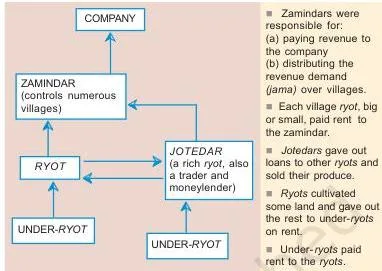
The diagram in Fig. 9.5 maps the flow of resources in rural Bengal. Practise labelling the arrows with the terms the chapter lists: rent (ryot to zamindar), revenue (zamindar to Company), loan and interest (between jotedar and ryot), and produce (sharecropper to jotedar).
The jotedars cultivated much of their land through sharecroppers (adhiyars or bargadars) who brought their own ploughs and handed over half the produce (NCERT, p. 231).
Jotedars resisted zamindars fiercely: they opposed increases in the village jama, blocked zamindari officials, mobilised dependent ryots, delayed revenue payments — and were often among the buyers when zamindari estates were auctioned. They were strongest in North Bengal (where Francis Buchanan’s survey recorded them) but similar rich peasants — haoladars, gantidars, mandals — appeared everywhere (NCERT, p. 231).
How zamindars survived: benami sales, lathyals and loyal ryots
The zamindars’ authority did not collapse. Faced with high demand and the threat of auction, they devised new strategies (NCERT, pp. 232-233).
The Burdwan strategy is a stepwise example of fictitious sale:
- The Raja of Burdwan transferred part of his zamindari to his mother, because the Company had decreed that women’s property would not be taken over.
- He deliberately withheld revenue, letting arrears accumulate.
- When an estate was auctioned, his agents outbid other buyers.
- They refused to pay the purchase money, forcing a resale.
- The cycle repeated — auction, purchase, non-payment — until other bidders were exhausted and the estate was sold back to the zamindar at a low price.
The zamindar never paid the full revenue demand, and the Company rarely recovered the balances. Such benami (anonymous) purchases were huge: between 1793 and 1801 four big zamindaris of Bengal made benami purchases worth Rs 30 lakh, and over 15 per cent of all auction sales were fictitious (NCERT, p. 233).
There were other shields. Outside buyers could not always take possession: their agents were sometimes attacked by lathyals (zamindar’s strongmen), and ryots themselves often refused to accept outsiders — they felt loyalty to their own zamindar and saw themselves as his proja (subjects). The sale of the zamindari disturbed their pride and identity (NCERT, p. 233).
This evidence is why historians doubt the Fifth Report’s image of total zamindar collapse. Once the price depression ended and revenue rules became more flexible, surviving zamindars actually strengthened — they only finally collapsed during the Great Depression of the 1930s (NCERT, p. 233).
The hoe and the plough: Paharias, Santhals and Damin-i-Koh
The chapter contrasts two symbols of life in the Rajmahal hills: the hoe (shifting cultivation, used by the Paharias) and the plough (settled cultivation, brought by the Santhals).
The Paharias — people of the forest
- Subsistence: forest produce, shifting cultivation, collection of mahua flowers for food, silk cocoons and resin for sale, wood for charcoal.
- Shifting cultivation: they cleared patches by cutting bushes and burning undergrowth; the ash enriched the soil so they could grow pulses and millets. They scratched the ground with hoes, cultivated for a few years, then left the land fallow and moved on (NCERT, pp. 236-237).
- Raids on the plains were a means of survival in scarcity, a way of asserting power, and a tool for negotiating political relations. Zamindars paid tribute to the hill chiefs, and traders paid tolls to use the passes — in return the chiefs protected the traders (NCERT, p. 238).
- British policy changed twice: brutal extermination in the 1770s, then Augustus Cleveland’s policy of pacification in the 1780s — Paharia chiefs were given an annual allowance and made responsible for their men’s conduct. Many chiefs refused the allowance; those who accepted lost authority and were seen as stipendiary (paid) subordinates of the colonial government (NCERT, p. 239).
Why did the British switch to the Santhals? The Paharias refused to cut forests and resisted touching the plough. By contrast the Santhals, who had begun entering Bengal around the 1780s, appeared as ideal settlers — clearing forests and ploughing with vigour (NCERT, p. 240).
Damin-i-Koh and the Santhals
In 1832, a large area of the foothills was demarcated as Damin-i-Koh — declared the land of the Santhals (NCERT, p. 241). The terms:
- Santhals were to live within it, practise plough agriculture, and become settled peasants.
- At least one-tenth of the area had to be cleared and cultivated within the first ten years.
- The territory was surveyed, mapped, and enclosed with boundary pillars — separated from both the plains peasants and the Paharias.
Growth was explosive: from 40 Santhal villages in 1838 to 1,473 by 1851; population from 3,000 to over 82,000 (NCERT, p. 241).
But the Santhals soon found the land slipping away: the state levied heavy taxes, moneylenders (dikus) charged high interest and took land for unpaid debts, and zamindars asserted control over the Damin. The Santhal Revolt of 1855-56 followed, against zamindars, moneylenders and the colonial state — the rebels wanted to create a world where they would rule themselves.
After the revolt, the Santhal Pargana was carved out of Bhagalpur and Birbhum (about 5,500 square miles) in the hope of conciliating the Santhals (NCERT, p. 242).
The Paharias, pushed deeper into the barren, rocky upper hills, were the losers: restricted from moving down, their shifting agriculture could not work, the forests they hunted in were cleared, and they were impoverished in the long term (NCERT, pp. 241-242).
The Deccan: ryotwari, debt and the cotton boom
Why was the Permanent Settlement rarely extended beyond Bengal (NCERT, p. 247)?
- After 1810, agricultural prices rose, so the income of Bengal zamindars increased — but because the revenue demand was fixed, the state could not claim any share. The colonial state wanted to maximise revenue, so temporarily settled territories got temporary settlements.
- Officials were influenced by economist David Ricardo’s theory of average rent: a landowner should claim only the average rent; any surplus above it should be taxed by the state, otherwise cultivators would turn into rentiers who lived off rental income without improving land. Bengal seemed to prove this — its zamindars had become rentiers.
The result was the ryotwari settlement (NCERT, pp. 247-248):
- Revenue was settled directly with the ryot, not with an intermediary zamindar.
- The average income from different soil types was estimated, the ryot’s revenue-paying capacity assessed, and a proportion fixed as the state’s share.
- Lands were resurveyed every 30 years and rates increased — so the demand was never permanent.
The debt cycle
The first Deccan settlement (1820s) demanded so much that peasants deserted villages; collectors seized crops and fined whole villages to show efficiency. After 1832, prices fell sharply for over a decade, and the famine of 1832-34 killed one-third of the Deccan’s cattle and half its human population (NCERT, p. 248). Survivors had no stocks, and unpaid revenue mounted.
So peasants borrowed — from sahukars (who were both moneylenders and traders). Once in debt, they could not escape it and needed loans even for everyday needs. In the 1840s-50s, as the revenue demand was moderated and prices recovered, cultivators expanded acreage but again needed loans for ploughs, cattle, seeds and land (NCERT, p. 249).
The cotton boom and its collapse
The American Civil War (1861) cut off American cotton supplies to Britain — imports fell from over 2,000,000 bales in 1861 to 55,000 in 1862. Britain turned to India (NCERT, p. 250). Cotton prices soared, merchants gave advances to urban sahukars, who extended credit to rural moneylenders — credit flowed easily.
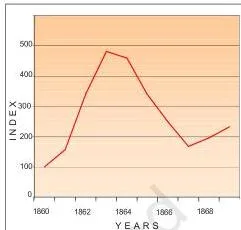
The graph in Fig. 9.15 shows the rise and fall of cotton prices. The vertical climb during 1861-64 was the boom; the descent after 1865, when the Civil War ended, was the crash. During the boom, ryots received advances of as much as Rs 100 per acre planted with cotton (NCERT, p. 251).
Between 1860 and 1864, cotton acreage doubled; by 1862, over 90 per cent of British cotton imports came from India (NCERT, p. 251). But the boom did not bring prosperity to all producers: for most, cotton expansion meant heavier debt.
After 1865, American cotton revived and Indian exports declined. Merchants restricted credit and demanded repayment; the next revenue settlement (now due under the 30-year rule) raised the demand dramatically — by 50 to 100 per cent (NCERT, p. 252). Peasants had to borrow again — but moneylenders now refused to lend, having lost confidence in the ryots’ ability to repay.
The customary norm that governed this relationship was simple: interest charged could not exceed the principal. Under colonial rule this norm broke down — in one case investigated by the Deccan Riots Commission, a moneylender charged over Rs 2,000 as interest on a Rs 100 loan (NCERT, p. 253).
The Limitation Law of 1859 — meant to limit the validity of loan bonds to three years — was twisted by moneylenders into a device for compounding debt: every three years the ryot was forced to sign a new bond in which the unpaid balance (original loan plus accumulated interest) became the new principal (NCERT, p. 254).
Peasants came to fear the written word itself: they signed deeds without knowing their clauses, got no receipts for repayments, had their harvest taken at low prices without credit to their account, and ultimately lost their land, carts and animals — only to hire those same animals back under a deed of hire (NCERT, pp. 253-254).
The revolt of 1875 and the Deccan Riots Commission
The trigger was not a tax increase — it was the sahukars’ refusal to give new loans, on top of crushing accumulated debt (NCERT, p. 252).
The factual spine of the revolt (NCERT, pp. 246, 255):
- 12 May 1875: the movement began at Supa, a market village in Poona (Pune) district, where ryots attacked shopkeepers and demanded their bahi khatas (account books) and debt bonds, then burnt them, looted grain shops, and set fire to sahukars’ houses.
- It spread from Poona to Ahmednagar over an area of 6,500 square km, affecting more than thirty villages.
- British officials saw the spectre of 1857; police posts were set up, troops called in, and 951 people were arrested.
- The Deccan Riots Commission was set up — the Government of India, remembering 1857, pressurised Bombay — and its report went to the British Parliament in 1878.
The Commission recorded ryot and sahukar statements, compiled statistics on revenue rates, prices and interest, and collated collectors’ reports. Its conclusion: government revenue demand was not the cause of the revolt; the moneylenders were to blame (NCERT, p. 255).
The source-criticism point: the Commission was asked specifically whether the revenue demand caused the revolt, and its answer conveniently let the government off the hook. Official reports reflect official concerns — and this one shows a persistent colonial reluctance to admit that popular discontent ever arose from government action (NCERT, p. 255).
The chapter’s numbers: dates and data at a glance
Table 1: Timeline of the chapter
| Date | Event |
|---|---|
| 1765 | E.I.C. acquires Diwani of Bengal |
| 1773 | Regulating Act passed by the British Parliament |
| 1793 | Permanent Settlement in Bengal |
| 1800s | Santhals begin to come to the Rajmahal hills |
| 1818 | First revenue settlement in the Bombay Deccan |
| 1820s | Agricultural prices begin to fall |
| 1840s-50s | Agrarian expansion in the Bombay Deccan |
| 1855-56 | Santhal rebellion |
| 1861 | Cotton boom begins |
| 1875 | Ryots in Deccan villages rebel |
Table 2: Key magnitudes
| Statistic | Significance |
|---|---|
| Over 75% of zamindaris changed hands after the Permanent Settlement | Scale of zamindar displacement |
| Over 95% of the Burdwan auction was fictitious | Zamindar resistance through benami purchases |
| Over 15% of all auction sales were fictitious | Scope of the benami strategy across Bengal |
| Rs 30 lakh in benami purchases, 1793-1801 | Four big zamindaris including Burdwan |
| 30,000 pending rent suits in Burdwan, 1798 | Breakdown of zamindar-ryot rent collection |
| 40 → 1,473 Santhal villages (1838-1851) | Rapid Santhal settlement in Damin-i-Koh |
| 3,000 → 82,000 Santhals (1838-1851) | Population growth of Santhal settlers |
| 6,500 square km, over 30 villages, 951 arrests (1875) | Spread and scale of the Deccan revolt |
| 90% of British cotton imports from India by 1862 | India’s dominance during the cotton boom |
| Cotton acreage doubled 1860-1864 | Deccan expansion during the boom |
Memory device: group dates by region. Bengal — 1765, 1773, 1793. Rajmahal — 1800s (Santhal arrival), 1832 (Damin-i-Koh), 1855-56 (Santhal revolt). Deccan — 1818 (first settlement), 1861 (cotton boom), 1875 (revolt). Three regions, nine dates, three clusters.
Terms you must know: from zamindar to sahukar
| Term | Meaning in this chapter | Where it appears |
|---|---|---|
| Permanent Settlement | 1793 settlement fixing the revenue demand on Bengal zamindars in perpetuity (NCERT, p. 229) | Bengal’s revenue system |
| Zamindar | A revenue collector of the state, not a village landowner; income = rent collected − revenue paid (NCERT, p. 229) | Bengal |
| Mahal | A revenue estate; villages within one zamindari formed one mahal for revenue purposes (NCERT, p. 229) | Bengal |
| Taluqdar | “One who holds a taluq (connection)”; a taluq came to mean a territorial unit (NCERT, p. 229) | Bengal |
| Ryot | British spelling of raiyat (peasant); ryots often leased land to under-ryots (NCERT, p. 230) | Bengal, Deccan |
| Jotedar | Rich peasant with large lands, controlling trade, moneylending and sharecroppers (NCERT, p. 231) | Bengal — esp. North Bengal |
| Adhiyar / Bargadar | Sharecropper who brought his own plough and handed over half the produce (NCERT, p. 231) | Bengal |
| Benami | “Anonymous” — a transaction in the name of a fictitious or insignificant person (NCERT, p. 233) | Bengal — e.g. Raja of Burdwan’s fictitious sales |
| Lathyal | “One who wields the lathi (stick)” — a zamindar’s strongman (NCERT, p. 233) | Bengal |
| Paharia | Hill folk of the Rajmahal hills, living on forest produce and shifting cultivation (NCERT, p. 236) | Rajmahal hills |
| Santhal | Plough-cultivating settlers who entered Bengal from the 1780s and cleared the Rajmahal forests (NCERT, p. 240) | Rajmahal hills |
| Damin-i-Koh | Area demarcated in 1832 as the land of the Santhals (NCERT, p. 241) | Rajmahal hills |
| Diku | Term for the outsiders (moneylenders) who exploited the Santhals (NCERT, p. 242) | Rajmahal hills |
| Sahukar | Someone who acted as both moneylender and trader (NCERT, p. 246) | Bombay Deccan |
| Bahi khata | Account book of the moneylender; burnt by ryots in 1875 (NCERT, p. 246) | Bombay Deccan |
| Ryotwari settlement | Revenue settled directly with the ryot; rates revised every 30 years (NCERT, pp. 247-248) | Bombay Deccan |
| Rentier | One who lives on rental income from property (NCERT, p. 247) | Bombay Deccan (and Bengal) |
| Sunset Law | If revenue was not paid by sunset of the due date, the zamindari was auctioned (NCERT, p. 230) | Bengal |
| Fifth Report | 1813 report by a Select Committee that criticised Company misrule and exaggerated zamindar collapse (NCERT, pp. 233-235) | Source study |
Worked example: how a Deccan loan grew
Method: under the effect of the 1859 Limitation Law, a moneylender renewed the bond every three years, converting the unpaid balance (principal + interest) into the new principal. Interest compounded because each renewal added new interest on top of old interest.
Suppose a ryot borrows Rs 500 at 15 per cent per year and cannot repay. Interest compounds on each three-year bond renewal:
- Step 1: After the first 3 years, the unpaid balance is the principal grown by 15% each year: \( 500 \times 1.15^3 \approx 500 \times 1.521 = 760\ \text{rupees} \).
- Step 2: The bond is renewed — Rs 760 becomes the new principal.
After another 3 years: \( 760 \times 1.15^3 \approx 760 \times 1.521 \approx 1,157\ \text{rupees} \).
Step 3: If renewal happens again at year 9, the new principal is about Rs 1,760.
After the third renewal at year 12: \( 1760 \times 1.15^3 \approx 1760 \times 1.521 \approx 2,677\ \text{rupees} \) — but note that the textbook’s petition recorded that after 12 years a Rs 1,000 debt had accrued about Rs 2,028 in interest (NCERT, p. 254).
The point here is the mechanism, not the exact figure.
Final answer: Over 12 years of three-year bond renewals, a Rs 500 loan grows to well over Rs 2,600 — roughly five times the original amount.
Connect this to the chapter: the customary norm was that interest should not exceed the principal (NCERT, p. 253). This calculation shows how fast that norm broke down — and why peasants feared documents, signed bonds without reading them, and associated their misery with the new regime of bonds and deeds (NCERT, p. 254).
Note: these are illustrative round numbers, not a figure from the textbook.
Reading the sources: official reports and visual propaganda
Historians of this chapter work from official sources — and every one of them has a purpose, an audience and a blind spot. Compare the three main ones:
| Source | Who made it | Purpose | Evidence it gives | Its blind spot |
|---|---|---|---|---|
| Fifth Report (1813) | A Select Committee of the British Parliament, criticising the East India Company (NCERT, p. 234) | To expose Company misrule and justify reform or charter changes | Petitions of zamindars and ryots, collectors’ reports, revenue statistics (NCERT, p. 233) | Exaggerated the collapse of traditional zamindari power and the scale of land loss (NCERT, p. 235) |
| Buchanan’s journal | Francis Buchanan, a Company employee and physician (NCERT, p. 236) | To record commercially valuable resources for the Company — minerals, soils, crops | Detailed notes on rocks, soils, cultivation, and village life in Rajmahal and elsewhere | Saw forests as “waste” to be cleared; judged landscapes by their potential productivity for the Company (NCERT, p. 244) |
| Deccan Riots Commission | Commission of enquiry set up by the Government of India after 1875 (NCERT, p. 255) | To judge whether the government’s revenue demand caused the revolt | Statements of ryots, sahukars and eyewitnesses; data on revenue rates, prices, interest (NCERT, p. 255) | Concluded the revenue demand was blameless and moneylenders alone were at fault — letting the government off the hook (NCERT, p. 255) |
Now apply the same eye to the Illustrated London News images of the Santhal rebellion.
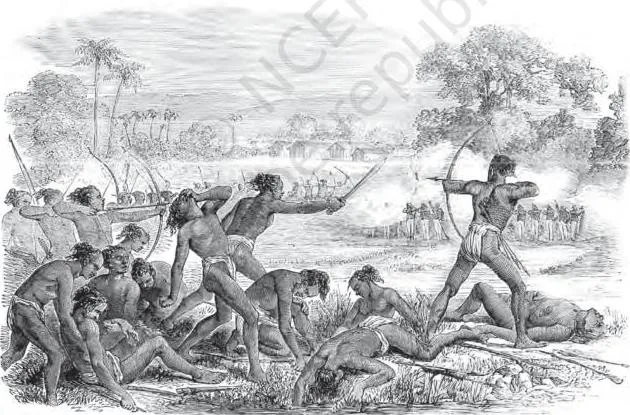
Fig. 9.12 shows Santhals in fierce combat with sepoys. To a British reader of 1856, it presented the Santhals as violent and savage — a sharp contrast to the calm, idyllic village shown earlier in Fig. 9.10. To a Santhal viewer, the same image would read very differently: as a scene of their people fighting to protect their land and way of life.
The illustration helped change British perception of the Santhals from peaceful settlers to dangerous rebels (NCERT, p. 242).
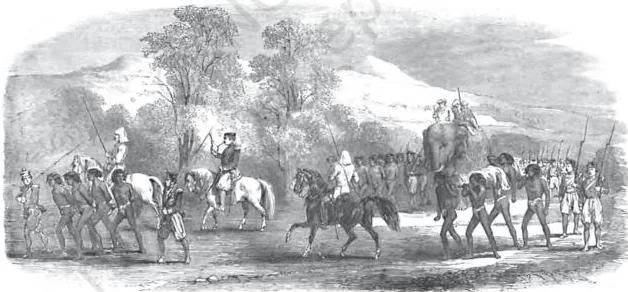
Fig. 9.14 carries an even clearer political message: at the centre, British officials ride triumphantly on an elephant, while one officer on a horse smokes a hookah — a deliberate touch signalling that the trouble was over and the rebellion crushed. The rebels march in chains, surrounded by Company soldiers.
The message to British readers was colonial might and restored order (NCERT, p. 243).
A reusable four-step method for any source in this chapter: (1) identify the source and its maker; (2) state what it shows; (3) infer the maker’s perspective and purpose; (4) cross-check with other evidence — petitions, newspapers (like the Native Opinion report quoted in the chapter), and local records (NCERT, pp. 246, 255).
What students get wrong about this chapter
| Mistake | Correction | How to check your answer |
|---|---|---|
| “The Permanent Settlement made zamindars the owners of village land.” | Zamindars were revenue collectors of the state; their income was the difference between rent collected and revenue paid (NCERT, p. 229). | If you define zamindar as “landowner,” you lose the point that the state kept ultimate control — check whether you mention the Company’s claim. |
| “Ryotwari was settled with zamindars.” | Ryotwari was settled directly with the ryot, with rates revised every 30 years — no permanent fixing (NCERT, pp. 247-248). | Ask yourself: who signed the settlement — the peasant or the landlord? |
| “The Santhals were the original inhabitants of the Rajmahal hills.” | The Paharias were the hill folk; Santhals came into Bengal from the 1780s onwards and moved into the hills around 1800 (NCERT, pp. 236-240). | Check the symbols: the hoe belongs to the Paharias, the plough to the Santhals. |
| “The Deccan revolt of 1875 was caused only by high revenue demand.” | The trigger was moneylenders refusing new credit, on top of crushing debt, the cotton price crash, and a steeply increased new settlement (NCERT, pp. 252-253). | Look for the chain: debt → boom → crash → refusal of loans → revolt. Revenue demand is one link, not the whole story. |
| “Official reports are trustworthy, neutral records.” | Every official report has an author, purpose and bias — the Fifth Report exaggerated zamindar collapse, and the Deccan Riots Commission let the government off the hook (NCERT, pp. 235, 255). | For any source, ask: who wrote it, why, and what would they want the reader to believe? |
| “The Permanent Settlement was extended across India.” | It was rarely extended beyond Bengal — rising prices (post-1810) and Ricardo’s average-rent theory led the British to prefer temporary settlements elsewhere (NCERT, p. 247). | Map mentally: Bengal got Permanent Settlement; Deccan got ryotwari. Why the difference? Prices and Ricardo. |
How to write complete answers from this chapter
This is a notes page, not a solutions page — but you should know what a complete answer to the textbook’s questions needs to include (questions on NCERT, pp. 256-257).
- “Why was the jotedar a powerful figure in many areas of rural Bengal?” Include: vast lands (thousands of acres), control of local trade and moneylending, power over sharecroppers (adhiyars/bargadars), and open resistance to zamindars (Buchanan’s Dinajpur survey).
- “How did zamindars manage to retain control over their zamindaris?” Include: fictitious sales (the Burdwan example with his mother’s property), benami purchases, withholding revenue, lathyals attacking outside buyers, and ryots’ loyalty to their zamindar as proja.
- “How did the Paharias respond to the coming of outsiders?” Include: raids on settled villages, tolls on traders using passes, refusal of Cleveland’s allowances, and withdrawal deeper into the hills.
- “Why did the Santhals rebel against British rule?” Include: heavy taxes on cleared land, moneylenders (dikus) taking over land for unpaid debts, zamindars asserting control over Damin, and the desire to rule themselves.
- “What explains the anger of the Deccan ryots against the moneylenders?” Include: interest exceeding the principal, forged accounts, no receipts for repayments, the Limitation Law renewal trick, and deeds of hire that made peasants rent their own animals.
- Essay questions on official sources (Q.9): name the author, date, purpose, and limitation of each source — Fifth Report, Buchanan’s journal, the Deccan Riots Commission — and suggest what to cross-check against.
- Map work (Q.10): mark Bengal, the Rajmahal hills, and the Bombay Deccan; add other areas where Permanent Settlement and ryotwari were used.
One-page revision summary: Bengal, Rajmahal, Deccan
| Region | System or settlement | Key groups | Turning point | Outcome |
|---|---|---|---|---|
| Bengal | Permanent Settlement (1793) | Zamindars, ryots, jotedars | Auctions and fictitious sales | Zamindars weakened but jotedars strong; zamindars collapsed only in the 1930s |
| Rajmahal hills | Damin-i-Koh (1832) | Paharias (hoe), Santhals (plough) | Santhal revolt (1855-56) | Santhal Pargana created; Paharias pushed into barren upper hills |
| Bombay Deccan | Ryotwari settlement (1820s) | Ryots and sahukars | Cotton boom (1861) and crash | 1875 revolt; Deccan Riots Commission blamed moneylenders |
Five big ideas that carry the chapter:
- Colonial law fixed revenue demands and reordered rights in the countryside.
- Each system produced its own winners — jotedars in Bengal, Santhals in Rajmahal, rich peasants in the Deccan.
- People resisted through legal loopholes (benami sales) and open revolt (1855-56, 1875).
- Revolts produced official records that need careful reading.
- Sources must be cross-checked with petitions, newspapers and local records.
For quick revision: explore all Class 12 History notes, or jump to the Rebels and the Raj notes for the 1857 revolt that officials compared the Deccan rising to. You can also browse all Class 12 notes or the main CBSE notes hub.
Frequently asked questions
What is the difference between the Permanent Settlement and the ryotwari system?
The Permanent Settlement (1793, Bengal) fixed the revenue demand forever and settled it with zamindars, who were revenue collectors, not owners. Ryotwari (Bombay Deccan, from the 1820s) settled revenue directly with the ryot and revised rates every 30 years, so the demand was never permanent (NCERT, pp. 229, 247-248). In short: one intermediary, one direct; one fixed, one revisable.
Why did the Paharias and the Santhals clash over the Rajmahal hills?
The Paharias practised shifting cultivation (the hoe) and lived in the hills; the Santhals, arriving from the 1780s, cleared forests and ploughed the land (the plough).
As the lower hills were taken over by Santhal settlers and Damin-i-Koh was demarcated in 1832, the Paharias were pushed into the barren upper hills — losing the fertile soils their shifting cultivation depended on (NCERT, pp. 239-242).
Why did the Deccan ryots burn account books and debt bonds in 1875?
The ryots destroyed the documents of their oppression. Bonds and bahi khatas symbolised the new regime of deeds that had swallowed their land and kept them in debt — interest exceeded principal, accounts were forged, no receipts were given, and the Limitation Law was used to compound debt (NCERT, pp. 246, 253-254).
Why is the Fifth Report not a neutral source for the history of rural Bengal?
Because it was a Select Committee report written to criticise East India Company misrule. Recent research using zamindari archives and district records shows it exaggerated the collapse of zamindari power and overestimated the scale of land loss (NCERT, pp. 233-235). It is invaluable evidence, but it must be read as an argument, not a mirror.
What was Damin-i-Koh and why did its creation matter?
Damin-i-Koh (1832) was a large area of the Rajmahal foothills demarcated as the land of the Santhals, who were to practise plough agriculture there, with at least one-tenth of the area cleared in the first ten years.
It mattered because it made the Santhals settled peasants, drove the Paharias deeper into barren hills, and later became the base from which the Santhals revolted in 1855-56 (NCERT, pp. 241-242).
How should students read the Illustrated London News images in this chapter?
Read them as visual propaganda, not neutral illustrations. Fig. 9.12 (Santhals fighting sepoys) presents the Santhals as savage; Fig. 9.14 (prisoners marched away) emphasises British triumph and restored order. Ask who made the image, what message it sends to a British reader, and how a Santhal viewer would read it differently (NCERT, pp. 242-243).
Reference: NCERT Class 12 History textbook, chapter Colonialism and the Countryside.
Explore Class 12 History Notes
- Class 12 History Notes
- Class 12 CBSE Notes
- CBSE Notes for Classes 1 to 12
- Next: Rebels and the Raj
Class 12 History on LearnCBSE:
Related chapters:
- Mahatma Gandhi and the Nationalist Movement: Civil Disobedience and Beyond notes