
These are revision notes for Rebels and the Raj, the Class 12 History chapter from Themes in Indian History Part III that studies the revolt of 1857 — both as an event and as a chain of representations. The notes follow the 2026-27 session and the rationalised NCERT edition.
The chapter carries a double focus, and this page mirrors it. First, the events: how a cantonment mutiny at Meerut became a widespread rebellion, why Awadh turned into the storm centre, what the rebels wanted, and how the British repressed them.
Second, the sources: the British wrote most of the record, so the rebel perspective survives only in a few proclamations and petitions, and in images made by both British and Indian hands.
What you get on this page: the pattern of the uprising, Awadh’s chain of grievances, rebel aims, British repression, a full breakdown of the chapter’s images, key terms, a timeline, the chapter’s scattered numbers in one table, common mistakes, worked source analyses, and a map of how to structure answers to the textbook’s own questions.
Everything is compressed for a one-sitting revision.
Reference: NCERT Class 12 History textbook, chapter Rebels and the Raj.
Chapter map: from Meerut’s mutiny to the images that shaped memory
The chapter is organised in five blocks and ends with a timeline and exercises. This map shows what each block covers and where it sits in the book.
| Block | Book pages | Core material |
|---|---|---|
| 1. Pattern of the uprising | pp. 259-265 | How cantonment mutinies spread, planning, leaders, rumour |
| 2. Awadh: the storm centre | pp. 265-270 | Annexation, taluqdars, sepoys, the village–sepoy link |
| 3. What the rebels wanted | pp. 270-274 | Proclamations (ishtahars), petitions (arzis), rebel administration |
| 4. British repression | pp. 275-276 | Martial law, reconquest, divide-and-rule |
| 5. Images of the revolt | pp. 277-283 | Paintings, cartoons, photographs, nationalist imageries |
| Timeline and exercises | pp. 284-285 | Chapter timeline; short-answer questions, essays, map work |
One problem runs through all five blocks: the evidence is lopsided. Most records of 1857 were written by the victors — official histories, letters, diaries, memos and reports that reveal the British official mind but say little about what the rebels wanted (NCERT, p. 270).
The chapter therefore trains you in source-reading: telling the ishtahar (proclamation) and arzi (petition) that carry the rebel voice apart from the British accounts and images that dominate the record. A good answer to any 1857 question shows you know whose record you are reading.
If you want to check the chapter against the original text, the official NCERT PDF of Themes in Indian History Part III contains it.
The outbreak: how a cantonment mutiny became a rebellion
The Meerut outbreak and the ride to Delhi
Late in the afternoon of 10 May 1857, sepoys in the Meerut cantonment broke out in mutiny. It began in the lines of the native infantry, spread quickly to the cavalry and then to the city, with ordinary people of the town and surrounding villages joining in (NCERT, p. 258).
Their first military target was the bell of arms — the storeroom in which weapons were kept (NCERT, p. 259). Then they attacked white people, ransacked and burned bungalows, and destroyed government buildings: record office, jail, court, post office, treasury. The telegraph line to Delhi was cut, and as darkness fell a group of sepoys rode off towards Delhi (NCERT, p. 258).
Early on 11 May, during Ramzan, the sepoys reached the Red Fort. They told the old Mughal emperor Bahadur Shah they had come from Meerut after killing all the Englishmen there, because they had been asked to bite bullets coated with the fat of cows and pigs — which, they said, had corrupted the faith of Hindus and Muslims alike.
Europeans were killed in large numbers, the rich of Delhi were attacked and looted, and Delhi slipped out of British control (NCERT, p. 258).
Sepoys then rode into the Red Fort without observing court etiquette and demanded the emperor’s blessing. Surrounded, Bahadur Shah had no option but to comply. The revolt thus acquired legitimacy: it could now be carried on in the name of the Mughal emperor (NCERT, p. 258).
The pattern repeated in every cantonment
- Signal — the firing of the evening gun or the sounding of the bugle.
- Bell of arms seized and the treasury plundered.
- Government buildings attacked — jail, treasury, telegraph office, record room, bungalows — with all records burned.
- Proclamations posted in Hindi, Urdu and Persian, calling on Hindus and Muslims to unite, rise and exterminate the firangis (NCERT, p. 259).
Memory anchor: the four actions after the signal run “bell, treasury, buildings, proclamations” — arms, then money, then records, then the appeal to the people. Anchor the dates with “Meerut tenth, Delhi eleventh”: mutiny at Meerut on 10 May, Red Fort at Delhi on 11 May.
When civilians joined, the targets widened: in Lucknow, Kanpur and Bareilly, moneylenders and the rich were looted and their houses destroyed, because peasants saw them as oppressors and allies of the British. What began as a sepoy mutiny quickly became a rebellion — a general defiance of all authority and hierarchy (NCERT, p. 259).
In May and June the British had no answer; one British officer noted that British rule “collapsed like a house made of cards” (NCERT, p. 260).
Planning and coordination: the evidence
Documents cannot tell us who the planners were, but they show clearly that planning and communication existed (NCERT, p. 261). The key pieces of evidence:
- The 7th Awadh Irregular Cavalry letter: after refusing the new cartridges in early May, the regiment wrote to the 48th Native Infantry that “they had acted for the faith and awaited the 48th’s orders” (NCERT, p. 260).
- The Sisten–tahsildar exchange: at Saharanpur, a Muslim tahsildar from Bijnor asked a visitor from Awadh, “What news from Awadh? How does the work progress, brother?” and assured him, “we will succeed this time. The direction of the business is in able hands.” The tahsildar was later identified as Bijnor’s principal rebel leader (NCERT, p. 261).
- Panchayats in the Kanpur sepoy lines: when the 41st Native Infantry demanded that Captain Hearsey be killed or handed over, the matter was settled by a panchayat of native officers drawn from each regiment. The early historian Charles Ball noted that panchayats were a nightly occurrence in the Kanpur lines — some decisions were taken collectively (NCERT, p. 261).
The chapter’s conclusion: sepoys lived together in lines, shared a common lifestyle and often a common caste, so it is easy to imagine them sitting together to decide their own future — “The sepoys were the makers of their own rebellion” (NCERT, p. 261).
Mutiny and revolt: two words that must not be confused
The textbook’s glossary draws a precise line between the two terms (NCERT, p. 261). This distinction is the foundation of any answer on 1857.
| Term | Meaning | Who acted in 1857 |
|---|---|---|
| Mutiny | A collective disobedience of rules and regulations within the armed forces (NCERT, p. 261) | The sepoys |
| Revolt / rebellion | A rebellion of people against established authority and power; the two terms are synonymous (NCERT, p. 261) | The civilian population — peasants, zamindars, rajas, jagirdars |
| The two fused | The sepoy mutiny quickly turned into a rebellion once civilians joined | One uprising: sepoy mutiny plus popular revolt |
Leaders and followers
Rebels often turned to those who had led before the British conquest — but such leadership was frequently forced on reluctant rulers. Bahadur Shah’s first reaction was horror and rejection; he accepted under pressure as a nominal leader.
Nana Sahib, successor to Peshwa Baji Rao II, was given no choice in Kanpur; Rani Lakshmi Bai was pushed by popular pressure in Jhansi; Kunwar Singh, a local zamindar, led at Arrah in Bihar; in Lucknow the populace hailed Birjis Qadr, the young son of the deposed Nawab (NCERT, p. 262).
Leadership was not confined to courts. Religious men carried the message of rebellion — a fakir on an elephant in Meerut, self-styled prophets in Lucknow. Local leaders emerged from villages and tribal lands too: Shah Mal mobilised the cultivators of pargana Barout; Gonoo, a tribal cultivator of Singhbhum in Chotanagpur, led the Kol tribals (NCERT, p. 262).
Maulvi Ahmadullah Shah, popularly called Danka Shah because he moved with drumbeaters before him, preached jehad against the British, was elected leader by the mutinous 22nd Native Infantry, and fought at the Battle of Chinhat where Henry Lawrence’s forces were defeated (NCERT, p. 263).
Shah Mal’s story shows how deep the revolt’s roots went: he moved at night from village to village across the chaurasee des (eighty-four villages), urging people to rebel against oppressive revenue demand; cultivators plundered moneylenders’ houses, displaced proprietors took back lost lands, and his men destroyed bridges and dug up metalled roads because they symbolised British rule.
He set up a “hall of justice” in an English officer’s bungalow and was killed in battle in July 1857 (NCERT, p. 263).
Rumours, prophecies and why people believed
- The greased cartridge rumour — its origin can be traced. In January 1857 at Dum Dum, a “low-caste” khalasi working in the magazine asked a Brahmin sepoy for water from his lota; refused, the khalasi retorted that the sepoy would soon have to bite cartridges covered with the fat of cows and pigs (NCERT, p. 264). Whether true or not, no British assurance could stop it.
- Bone dust in atta — the belief that the British had mixed the bone dust of cows and pigs into flour sold in the market; sepoys and common people refused to touch the atta (NCERT, p. 264).
- Forced conversion — the fear that the British wanted to convert Indians to Christianity (NCERT, p. 264).
- The Plassey prophecy — British rule would end on the centenary of the Battle of Plassey, 23 June 1857 (NCERT, p. 264).
- The chapattis — reports of chapattis passed from village to village at night; the meaning remains unclear even today, but people read them as an omen of upheaval (NCERT, pp. 264-265).
Rumours matter not for factual accuracy but for what they reflect about the people who believed them; they circulate only when they resonate with deeper fears (NCERT, p. 265).
Those fears had a real basis in British policy from the late 1820s: Western education and institutions under Bentinck, the abolition of sati (1829), permission for widow remarriage, the annexation of states like Awadh, Jhansi and Satara, new laws and land settlements, and missionary activity.
To many people it seemed that everything sacred — kings, customs, landholding, revenue patterns — was being replaced by an impersonal, alien and oppressive system (NCERT, p. 265).
Why Awadh became the storm centre of 1857
In 1851 Governor General Dalhousie described Awadh as “a cherry that will drop into our mouth one day”; in 1856 the kingdom was formally annexed (NCERT, p. 266). No other region produced such an intense, long-lasting revolt, because a chain of grievances linked prince, taluqdar, peasant and sepoy.
The annexation and the exile of Wajid Ali Shah
The Subsidiary Alliance had been imposed on Awadh in 1801. Its terms, devised by Lord Wellesley in 1798, were:
- The British would protect the ally from external and internal threats.
- A British armed contingent would be stationed in the ally’s territory.
- The ally would provide the resources for maintaining that contingent.
- The ally could make agreements with other rulers or wage war only with British permission (NCERT, p. 266).
Deprived of his armed forces, the Nawab became dependent on the British to keep law and order and could no longer control rebellious chiefs and taluqdars.
Meanwhile the British wanted Awadh’s soil for indigo and cotton and saw the region as ideally placed to be the principal market of Upper India; by the early 1850s all major areas — Maratha lands, the Doab, the Carnatic, the Punjab, Bengal — had been conquered, and taking Awadh in 1856 completed a process begun with the conquest of Bengal almost a century earlier (NCERT, p. 266).
Nawab Wajid Ali Shah was dethroned on the plea of misgovernment and exiled to Calcutta. The British assumed he was unpopular; in fact he was widely loved, and crowds followed him all the way to Kanpur singing songs of lament. One contemporary observer wrote: “The life was gone out of the body” (NCERT, p. 266).
The dissolution of the court destroyed livelihoods — musicians, dancers, poets, artisans, cooks, retainers and administrative officials all lost their income (NCERT, p. 267).
The taluqdars: dispossession and the broken bond with peasants
The taluqdars controlled the Awadh countryside — estates and forts, armed retainers, and a degree of autonomy under the Nawab’s suzerainty. The biggest had as many as 12,000 foot-soldiers; even the smaller ones had about 200 (NCERT, p. 268).
Immediately after annexation the British disarmed the taluqdars and destroyed their forts. Then the Summary Settlement of 1856 treated them as interlopers — men who had established their hold over land through force and fraud — and removed them wherever possible.
The taluqdars’ share of Awadh’s villages fell from 67 per cent to 38 per cent; southern Awadh was hardest hit, with some taluqdars losing more than half their villages, and the revenue demand rose by 30 to 70 per cent in some places. Neither taluqdars nor peasants had reason to be happy (NCERT, p. 268).
The land-revenue machinery behind such settlements is the core of the separate chapter notes on Colonialism and the Countryside.
The dispossession of the taluqdars broke an entire social order. Before the British, taluqdars were oppressors, yet many appeared as generous father figures — considerate in times of need. Under the British, the peasant stood directly exposed to overassessment and inflexible collection: no reduction of revenue in hardship, no postponement in crop failure, no festival loans.
The speech of Hanwant Singh, Raja of Kalakankar, captures the taluqdar’s attitude: the British had driven out the Nawab and taken lands held by his family from time immemorial; when misfortune fell on the British, he had saved one of their officers — but now he marched at the head of his retainers to Lucknow to drive them out (NCERT, p. 269).
Because of this shared grievance, in Awadh the fighting was carried out by taluqdars and their peasants together. Many taluqdars stayed loyal to the Nawab — they joined Begum Hazrat Mahal, the Nawab’s wife, in Lucknow, and some remained with her even in defeat (NCERT, p. 269).
The sepoys: the village–sepoy link
Awadh was the “nursery of the Bengal Army”: the large majority of Bengal Army sepoys were recruited from the villages of Awadh and eastern Uttar Pradesh, and many were Brahmins or from upper castes (NCERT, p. 270). Sepoys had long complained of low pay and of the difficulty of getting leave (NCERT, p. 269).
The officer–sepoy relation also soured. In the 1820s officers wrestled, fenced and went hawking with their men, spoke fluent Hindustani, and were disciplinarian and father figure in one. By the 1840s they treated sepoys as racial inferiors, and abuse and physical violence became common (NCERT, p. 269).
Most important was the two-way traffic between village and cantonment. What families saw and feared in the villages was carried quickly into the sepoy lines; the sepoys’ fears about the cartridges, their grievances about leave, their grouse about racial abuse were carried back.
When sepoys defied their officers and took up arms, their village brethren joined almost immediately — everywhere peasants poured into towns in collective acts of rebellion (NCERT, p. 270). This village–sepoy link is the single best explanation for how fast the revolt spread.
What the rebels wanted: proclamations, arzis and an alternative world
As victors, the British recorded their own trials and heroism and dismissed the rebels as ungrateful and barbaric. Few rebels had the chance to record their version — most were sepoys and ordinary non-literate people — so what survives is a small set of ishtahars (proclamations issued by rebel leaders to persuade people to join) and arzis (petitions), plus some letters.
Attempts to reconstruct 1857 depend heavily on British sources, which reveal official minds but tell us very little about what the rebels wanted (NCERT, p. 270).
The vision of unity
- Proclamations appealed to all sections irrespective of caste and creed; even those issued by Muslim princes took care to address Hindu sentiments (NCERT, p. 271).
- The rebellion was presented as a war in which Hindus and Muslims had equally to lose or gain; the ishtahars harked back to the pre-British Hindu-Muslim past and glorified coexistence under the Mughal Empire (NCERT, p. 271).
- The proclamation issued in Bahadur Shah’s name urged people to fight under the standards of both Muhammad and Mahavir (NCERT, p. 271).
- Religious division was hardly noticeable during the uprising. At Bareilly in December 1857 the British spent Rs 50,000 to incite Hindus against Muslims — the attempt failed (NCERT, p. 271).
The Azamgarh Proclamation (introduction)
Issued on 25 August 1857, the Azamgarh Proclamation is one of the main sources of our knowledge of what the rebels wanted (NCERT, p. 271). It is the full worked example later on this page — study it there with the grievance-by-group table.
Against the symbols of oppression
The proclamations rejected everything connected with firangi raj: the annexations, the broken treaties, the land settlements that dispossessed landholders big and small, and the foreign commerce that drove artisans and weavers to ruin.
Every aspect of British rule was attacked, and the firangi was accused of destroying a familiar and cherished way of life — the rebels wanted to restore that world (NCERT, p. 273).
The rebellion against the British also widened into an attack on local oppressors: account books were burned, moneylenders’ houses were ransacked, city elites were deliberately humiliated. This impulse to overturn traditional hierarchies gives a glimpse of a more egalitarian vision — one that was never articulated in the proclamations, which needed to unify all social groups against firangi raj (NCERT, p. 274).
The search for alternative power
Where British rule collapsed — Delhi, Lucknow, Kanpur — rebels built short-lived structures of authority: appointments to posts, arrangements for land revenue collection and payment of troops, orders against loot and plunder, battle plans, chains of command in the army.
In all this they harked back to the eighteenth-century Mughal world, which became a symbol of all that had been lost (NCERT, p. 274). In Awadh, where resistance lasted longest, the Lucknow court was drawing up counter-attack plans and hierarchies of command as late as the last months of 1857 and early 1858 (NCERT, p. 274).
The rebel voice at its most direct survives in the sepoy arzi: after describing how the troopers were jailed for refusing the cartridges, the petitioners explain what they fought for. “If the religion of a Hindoo or Mussalman is lost, what remains in the world?” (NCERT, p. 273).
How the British repressed the revolt: laws, guns and divide-and-rule
Emergency laws
Before sending troops to reconquer North India, the British passed a series of Acts in May and June 1857. The whole of North India was put under martial law; military officers — and even ordinary Britons — were given the power to try and punish Indians suspected of rebellion, with the ordinary processes of law and trial suspended.
The declared punishment for rebellion was death (NCERT, p. 275).
The reconquest
- Delhi’s symbolic value was recognised by both sides. The British mounted a two-pronged attack — one force moved from Calcutta into North India, the other from the largely peaceful Punjab (NCERT, p. 275).
- Delhi fell late. Attempts to recover the city began in earnest in early June 1857, but it was captured only in late September, after heavy fighting and losses on both sides — rebels from all over North India had gathered to defend the capital (NCERT, pp. 275-276).
- Village-by-village reconquest. In the Gangetic plain the countryside was entirely hostile; villagers were described as “nearly intangible to Europeans, melting away before them and collecting again” (NCERT, p. 275).
- The scale of resistance. The British realised they were facing not a mere mutiny but an uprising with huge popular support; the British official Forsyth estimated that three-fourths of Awadh’s adult male population was in rebellion (NCERT, p. 276).
- Slow victory. Awadh was brought under control only in March 1858 after protracted fighting (NCERT, p. 276).
Divide-and-rule
Military power was not the only instrument. Where big landholders and peasants had offered united resistance, the British tried to break that unity by promising to give back estates to the big landholders. Rebel landholders were dispossessed and the loyal rewarded; many rebel landholders died fighting, or escaped into Nepal where they died of illness or starvation (NCERT, p. 276).
Images of the revolt: saviours, victims, vengeance and terror
The pictorial records of the mutiny are remarkably varied: paintings, pencil drawings, etchings, posters, cartoons and bazaar prints (NCERT, p. 277). Alongside them sit official accounts — letters, diaries, autobiographies, official histories, memos and reports — and British newspapers that narrated the violence of the mutineers in gory detail, inflaming public feelings and provoking demands for retribution (NCERT, p. 277).
The table below lines up the chapter’s main images, what each shows, and the message it was designed to carry.
| Image | Artist / source, year | What it shows | Message it carries |
|---|---|---|---|
| Relief of Lucknow (un-numbered plate) | Thomas Jones Barker, 1859 | Campbell, Outram and Havelock at the centre; the gestures of those around lead the eye to them; heroes on well-lit ground, shadows in the foreground, the damaged Residency behind; dead and injured in the foreground; triumphant horses in the middle ground | A celebration of British heroes — the siege as survival, heroic resistance and ultimate triumph; reassures the British public that British power had been re-established (NCERT, pp. 277-278) |
| In Memoriam (Fig. 10.11) | Joseph Noel Paton, 1859 | English women and children huddled in a helpless circle, waiting for dishonour and death; rebels invisible; British rescue forces arriving in the background | Violence is suggested, never shown; stirs anger and fury; represents the rebels as violent and brutish even though they remain absent (NCERT, p. 279) |
| Miss Wheeler defending herself (Fig. 10.12) | British sketch/painting, undated | A woman at the centre defends her honour, single-handedly killing four attackers armed with swords and guns; a book — the Bible — lies on the floor | Frames the rebellion as a battle to save the honour of Christianity; demonises the rebels as attackers of a woman (NCERT, p. 280) |
| Justice (Fig. 10.13) | Punch cartoon, 12 September 1857 | An allegorical female figure of justice with sword and shield, aggressive posture and rage on her face, trampling sepoys while Indian women and children cower | Justice re-imagined as vengeance; its caption ties the mood to the news of the Cawnpore massacre — an outburst of fiery indignation and a wild desire for revenge throughout England (NCERT, p. 280) |
| The British Lion’s Vengeance on the Bengal Tiger (Fig. 10.14) | Punch cartoon, 1857 | A lion attacking a tiger, with the figures of a woman and a child in the scene | The title names the allegory — the lion as British power, the tiger as the Bengal rebels — justifying vengeance; the woman and child are the textbook’s own open analytical question (NCERT, p. 281) |
| Execution of mutineers: blowing from the guns, Peshawar (Fig. 10.15) | Illustrated London News, 3 October 1857 | An execution staged like a drama; mounted soldiers and sepoys in uniform dominate, forced to watch the execution of their fellow sepoys | Punishment as open-air theatre — an enactment of brutal power to show the chilling consequences of rebellion (NCERT, p. 281) |
| Execution of mutinous sepoys, Peshawar (Fig. 10.16) | Illustrated London News, 3 October 1857 | Twelve rebels hang in a row, with cannons all around them | The performance of terror: punishment had to be theatrically performed in the open, because its purpose was to instil fear (NCERT, p. 282) |
| The Clemency of Canning (Fig. 10.17) | Punch cartoon, 24 October 1857 | Canning as a looming father figure, his protective hand over a sepoy whose unsheathed sword and dagger both drip with blood | Mocks Canning’s plea for leniency — the caption has him promising the sepoy he will not be blown from “nasty guns” if he promises to be a good little sepoy (NCERT, p. 282) |
| A mosque on the Delhi Ridge (Fig. 10.8) and Secundrah Bagh (Fig. 10.9) | Photographs by Felice Beato, 1857-58 | A mosque on the Delhi Ridge; and Secundrah Bagh — once the pleasure garden built by Nawab Wajid Ali Shah — shown desolate with skeletons strewn on the ground | After 1857 British photographers recorded innumerable images of desolation and ruin; the skeletons were left deliberately as “a cold warning of the futility of rebellion” (NCERT, p. 276) |
Nationalist imageries
The twentieth-century national movement drew inspiration from 1857 and celebrated it as the First War of Independence, in which all sections of the people came together against imperial rule.
Leaders were presented as heroic figures rousing the country; the Rani of Jhansi was represented as a masculine warrior — in popular prints she rides in battle armour with a sword in hand, a symbol of the determination to resist injustice and alien rule.
The lines of Subhadra Kumari Chauhan keep the image alive: “Khoob lari mardani woh to Jhansi wali rani thi” (NCERT, p. 283). The comparison to hold for answers: British images shaped a public that sanctioned brutal repression of the rebels, while nationalist imageries shaped the nationalist imagination (NCERT, p. 283); films and posters have kept the warrior-Rani circulating ever since.
Reading the images: a step-by-step walkthrough
Any British visual of 1857 can be decoded with the same five questions. Use this method whenever a question hands you an image.
- Name the scene and genre — painting, cartoon, allegory, illustrated-news engraving or photograph.
- Identify every symbol — each figure, object and animal, and who or what it stands for.
- Read the composition — who is central, who is in shadow, what the gestures do to the viewer’s eye.
- Infer the maker’s perspective — British official painter, Punch satirist, news illustrator or photographer.
- Judge the intended effect — what emotion the maker wants the viewer to feel, and what action that emotion justifies.
Worked application: The British Lion’s Vengeance on the Bengal Tiger
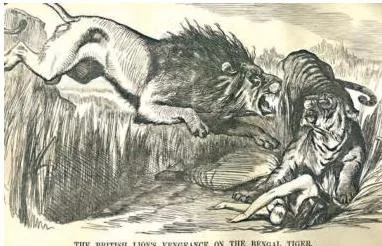
Apply the five steps. The genre is a political cartoon from Punch, a British journal of comic satire. The title names the allegory: the lion stands for British power, the tiger for the Bengal rebels — one predator overcoming another, so the picture invites the viewer to see vengeance as natural.
The composition drives the eye to the struggle of the two animals; the figures of a woman and a child appear in the scene — and what these two figures depict is exactly the question the textbook asks of this image (NCERT, p. 281), so treat their identity as an open interpretative question in an answer, not a settled fact.
The perspective is British satire at the height of the demand for retribution; the intended effect is to justify vengeance by casting the British as the wronged, victorious party.
In Memoriam: violence implied, never shown
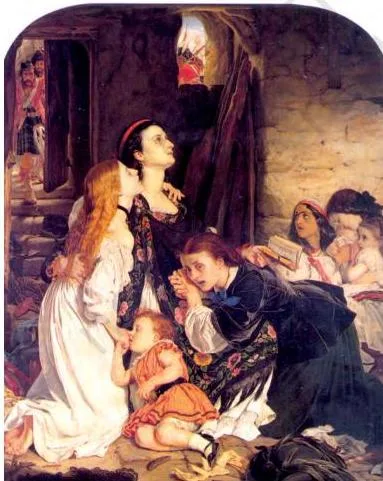
Paton’s painting of 1859 shows English women and children huddled in a helpless circle, waiting for dishonour, violence and death. The rebels are entirely invisible — the picture represents them as violent and brutish without showing a single one. The rescue forces arrive in the background as saviours.
Because the violence is suggested, not shown, it stirs the spectator’s imagination and provokes anger and fury (NCERT, p. 279).
Reading it with the five steps: the genre is a painting; the symbols are huddled innocence and approaching rescue; the composition hides the enemy completely; the perspective is a British artist painting two years after the mutiny; the intended effect is rage and a call for retribution.
Justice: retribution dressed as law
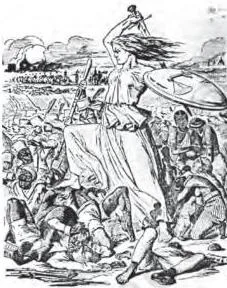
This Punch cartoon shows an allegorical female figure of justice — sword in one hand, shield in the other, rage on her face — trampling sepoys underfoot while Indian women and children cower in fear. The caption ties the mood to the news of the Cawnpore massacre: an outburst of fiery indignation and a wild desire for revenge throughout England (NCERT, p. 280).
The five-step read: the genre is political allegory; the central symbol, justice, has been transformed into vengeance; the composition makes the avenger the moral centre; the perspective is Punch’s in the week of the massacre news; the intended effect is to make violent reprisal look like justice itself.
Execution at Peshawar: punishment as theatre
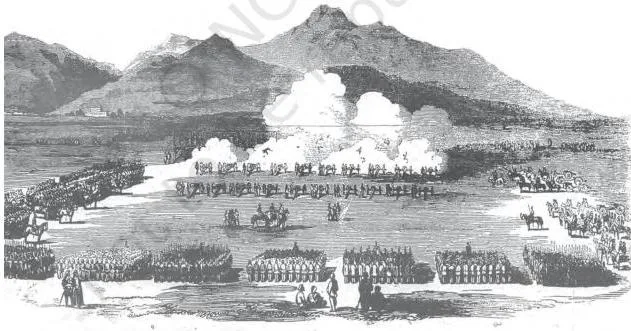
This Illustrated London News engraving shows rebels blown from the guns. The scene is arranged like a stage: mounted soldiers and sepoys in uniform dominate, and they are forced to watch the execution of their fellow sepoys — an enactment of brutal power whose lesson is the chilling consequence of rebellion (NCERT, p. 281).
The five-step read: the genre is illustrated news; the key symbol is the crowd of watching sepoys; the composition makes the punishment itself the spectacle; the perspective is a British paper circulating executions widely; the intended effect is terror.
The chapter makes the same point for the companion scene, where twelve rebels hang in a row with cannons around them: punishment could not be discreetly meted out in enclosed spaces — it had to be theatrically performed in the open, because its purpose was to instil fear (NCERT, p. 282).
Secundrah Bagh: what photographs both show and hide
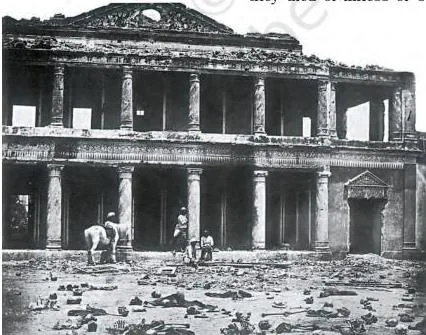
Finally, contrast the constructed images with Felice Beato’s photograph of Secundrah Bagh, Lucknow (1858). The place had been the pleasure garden built by Nawab Wajid Ali Shah; in 1857 British forces under Campbell killed over 2,000 rebel sepoys who held it.
Beato’s photograph shows a desolate space with four solitary figures, the skeletons deliberately left strewn on the ground — “a cold warning of the futility of rebellion” (NCERT, p. 276). Photographs claim documentary truth, but they are composed like any image: the skeletons were left in place as a warning, so the picture persuades even as it records.
Always ask what a photograph of 1857 hides as well as what it shows.
Key terms of 1857 at a glance
| Term | Student-friendly meaning | Where it matters |
|---|---|---|
| bell of arms | A storeroom in which weapons are kept (NCERT, p. 259) | The first objective of mutinous sepoys; seizing it armed the rising |
| firangi | A term of Persian origin, probably from “Frank”; used in Urdu and Hindi, often derisively, for foreigners (NCERT, p. 259) | Proclamations urged Hindus and Muslims to unite and exterminate the firangis |
| firangi raj | The rebels’ name for British rule (NCERT, p. 273) | Everything associated with it was rejected and attacked |
| mutiny | Collective disobedience of rules and regulations within the armed forces (NCERT, p. 261) | The sepoys’ actions in 1857 |
| revolt / rebellion | A rebellion of people against established authority; the terms are synonymous. In 1857 the word revolt refers especially to the civilian uprising of peasants, zamindars, rajas and jagirdars (NCERT, p. 261) | With the mutiny, the two fused into one uprising |
| ishtahar | A notification or proclamation issued by rebel leaders to propagate their ideas (NCERT, p. 270) | The Azamgarh Proclamation of 25 August 1857 is one |
| arzi | A petition or application (NCERT, p. 273) | The surviving sepoy arzis are rare rebel-voice sources |
| jehad | Religious war (NCERT, p. 263) | Maulvi Ahmadullah Shah preached jehad against the British |
| Danka Shah | “The maulvi with the drum” (danka) — the popular name of Maulvi Ahmadullah Shah (NCERT, p. 263) | Thousands followed him as an inspired prophet |
| chaurasee des | Eighty-four villages (NCERT, p. 263) | Shah Mal’s kinship network in pargana Barout |
| Resident | The Governor General’s representative who lived in a state not under direct British rule (NCERT, p. 266) | The Nawab of Awadh had to act on the Resident’s advice |
| Subsidiary Alliance | A system devised by Lord Wellesley in 1798: allies accepted British protection, a British contingent, payment for it, and a ban on independent wars or alliances (NCERT, p. 266) | Imposed on Awadh in 1801 |
| taluqdar | A landholder who controlled land and power in the Awadh countryside, with armed retainers and forts (NCERT, p. 268) | Dispossessed by the Summary Settlement |
| Summary Settlement of 1856 | The first British revenue settlement of Awadh, which treated taluqdars as interlopers (NCERT, p. 268) | Cut the taluqdars’ share of villages from 67 to 38 per cent |
Timeline and the numbers of 1857
The timeline below is the chapter’s own chronology (NCERT, p. 284), extended only with dates the chapter itself gives elsewhere in the text.
| Date | Event |
|---|---|
| 1801 | Subsidiary Alliance introduced by Wellesley in Awadh |
| 1856 | Nawab Wajid Ali Shah deposed; Awadh annexed |
| 1856-57 | Summary revenue settlements introduced in Awadh |
| 10 May 1857 | Mutiny starts in Meerut |
| 11-12 May 1857 | Delhi garrisons revolt; Bahadur Shah accepts nominal leadership |
| 20-27 May 1857 | Sepoys mutiny in Aligarh, Etawah, Mainpuri, Etah |
| 30 May 1857 | Rising in Lucknow |
| May-June 1857 | Mutiny turns into a general revolt of the people |
| 23 June 1857 | Plassey-centenary prophecy: the predicted day of the end of British rule (NCERT, p. 264) |
| 30 June 1857 | British suffer defeat at the Battle of Chinhat |
| July 1857 | Shah Mal killed in battle |
| 25 September 1857 | British forces under Havelock and Outram enter the Residency, Lucknow |
| Late September 1857 | Delhi recaptured after heavy fighting (NCERT, p. 276) |
| March 1858 | Awadh brought under control after protracted fighting (NCERT, p. 276) |
| June 1858 | Rani of Jhansi killed in battle |
Notice how the months of May to September 1857 concentrate the rebellion, and how long the reconquest of Awadh dragged into 1858.
The numbers of 1857
The chapter scatters its statistics across the narrative; here they are compiled into one reference table for revision.
| Number | What it measures | Source |
|---|---|---|
| 67% → 38% | Share of Awadh’s villages held by taluqdars before the British, and after the Summary Settlement of 1856 | NCERT, p. 268 |
| 30-70% | Increase in the revenue demand in some places after annexation | NCERT, p. 268 |
| 12,000 / 200 | Foot-soldiers of the biggest taluqdars / of the smaller ones | NCERT, p. 268 |
| Rs 50,000 | Spent by the British at Bareilly (December 1857) to incite Hindus against Muslims — the attempt failed | NCERT, p. 271 |
| 1,400 / 84 | European soldiers prepared for the Meerut parade / new troopers jailed in irons, in the sepoy arzi’s account | NCERT, p. 273 |
| Three-fourths | Of Awadh’s adult male population in rebellion, by the estimate of British official Forsyth | NCERT, p. 276 |
| 2,000 | Rebel sepoys killed at Secundrah Bagh in 1857 | NCERT, p. 276 |
The taluqdar and revenue figures explain why the Awadh countryside rose; the Bareilly and arzi figures support the chapter’s points about failed religious division and the sepoys’ religious fear.
Worked example: reading the Azamgarh Proclamation like a historian
Method first: to answer a question on rebel aims from this source, identify each social group the proclamation addresses, extract that group’s specific grievance, and note the remedy it is promised.
The Azamgarh Proclamation was issued on 25 August 1857 as an ishtahar and is one of the main sources of our knowledge of what the rebels wanted (NCERT, p. 271).
It opens by declaring that the people of Hindustan, Hindu and Muslim, are being ruined under the tyranny of the “infidel and treacherous English”; it promises daily subsistence to those who wish to join the cause without means; and it cites the writings of miracle workers and the calculations of pundits and astrologers as proof that the English will soon have no footing in India (NCERT, p. 271).
The heart of the document is the five sections below.
| Group addressed | Grievance under British rule | Promise of the Badshahi (imperial) government |
|---|---|---|
| Zemindars | Exorbitant jumas (revenue demands); estates auctioned for arrears; respectable zemindars summoned, arrested and jailed in suits brought even by a servant; heavy stamp costs; forced subscriptions for schools, hospitals and roads | Light jumas; dignity and honour safe; every zemindar will have absolute rule in his own zemindary |
| Merchants | British monopoly of fine merchandise such as indigo and cloth; profits taxed through postages, tolls and subscriptions; imprisonment at the complaint of a worthless man | All trade thrown open, by land and water; fraudulent practices done away with; merchants to aid the war with men and money |
| Public servants | Natives in civil and military service had little respect, low pay and no influence; all posts of dignity and emolument were reserved for Englishmen | Salaries of 200-300 rupees a month for the present, and high posts in the future |
| Artisans | English goods had thrown weavers, cotton dressers, carpenters, blacksmiths and shoemakers out of work, reducing every native artisan to beggary | Exclusive employment in the service of kings, rajahs and the rich |
| Pundits and fakirs | They are the guardians of the Hindu and Muslim religions; the Europeans are enemies of both faiths | Called to present themselves and take their share in the holy war |
What the document as a whole reveals:
- Targeted propaganda: each section names a precise grievance and gives a precise promise, so every constituency has a reason to join. The proclamation is a recruiting instrument as much as a statement of aims (NCERT, pp. 271-272).
- A backward-looking vision: the promised world — zemindars ruling absolutely in their zemindaries, artisans employed by rajas and the rich — is a restoration of the eighteenth-century world the rebels had lost, not a new order (NCERT, pp. 273-274).
- Its limit: the egalitarian impulse seen in attacks on moneylenders and the burning of account books is never articulated in the proclamations, because those documents needed to unify every group against firangi raj (NCERT, p. 274).
Second worked example: the sepoy arzi against Hanwant Singh’s speech
An arzi (petition) of rebel sepoys is one of the few rebel-voice documents to survive (NCERT, p. 273). It recounts a century of loyal service, then the 1857 order for new cartridges and muskets in which the fats of cows and pigs were mixed — and attah (wheat flour) mixed with powdered bones.
The sowars of the 3rd Light Cavalry refused to bite the cartridges; the British paraded the three regiments, prepared 1,400 European soldiers, placed six guns loaded with grape before each infantry regiment, and jailed 84 new troopers in irons.
The petition’s conclusion: they have fought for two years so that their religion might not be polluted — “If the religion of a Hindoo or Mussalman is lost, what remains in the world?” (NCERT, p. 273).
Now compare the two texts. The arzi frames everything through religion and faith; Hanwant Singh’s speech frames everything through land, loss and honour. Both reject British rule — but for different losses.
This pairing is the cleanest answer to the question “did the rebels share one vision?”: they shared the rejection of firangi raj, yet different groups wanted different restorations (NCERT, pp. 269, 273).
Common mistakes: what students get wrong about 1857
Remove these habitual errors during revision — each row is an error-to-correction pair drawn from the chapter itself.
| Students write X | Correct is Y because Z |
|---|---|
| “The revolt began in Delhi.” | It began as a mutiny at Meerut on 10 May 1857; the sepoys reached Delhi’s Red Fort only on 11 May (NCERT, p. 258). |
| “Bahadur Shah joyfully led the revolt.” | His first reaction was horror and rejection; he blessed the sepoys under pressure and was only a nominal leader (NCERT, p. 262). |
| “The greased cartridges caused the revolt.” | They were the immediate spark; the deeper causes were annexations, revenue policy, dispossession of the taluqdars, and fear for religion and caste (NCERT, pp. 264-265). |
| “Mutiny and revolt are the same thing.” | The textbook reserves revolt for the civilian uprising of peasants, zamindars, rajas and jagirdars, and mutiny for the sepoys’ collective disobedience; in 1857 the two fused (NCERT, p. 261). |
| “The taluqdars’ share of villages rose under the British.” | It fell — from 67 per cent of Awadh’s villages to 38 per cent after the Summary Settlement of 1856 (NCERT, p. 268). |
| “The British punished rebels in secret.” | The opposite: punishment was performed publicly — blowing from guns, hanging in rows — as a theatre of terror staged in the open to instil fear (NCERT, pp. 281-282). |
| “Canning was praised for mercy.” | The British press mocked his “Clemency” — a Punch cartoon shows him shielding a sepoy whose sword and dagger drip with blood (NCERT, p. 282). |
| “The rebels were united by a single vision.” | Proclamations preached unity, but the egalitarian impulse in attacks on moneylenders was never articulated; different groups wanted different restorations (NCERT, pp. 271-274). |
| “British images show the rebels as they really were.” | Images are perspectives, not facts: they demonise or erase the rebels — In Memoriam hides them entirely — to justify vengeance (NCERT, pp. 279-281). |
Exam notes: writing complete answers to this chapter’s questions
This chapter belongs to a themes-based book, so its questions test source-based reasoning: what a source says, whose perspective it carries, and what it can and cannot prove. That is why the two worked methods on this page — the proclamation analysis and the five-step image reading — are your core tools.
The table below maps every textbook question (the 100-150 word answers, the 250-300 word essays and the map work, NCERT pp. 284-285) to the evidence you should deploy and the shape of a complete answer.
| Textbook question | Evidence to deploy | Shape of a complete answer |
|---|---|---|
| 1. Why did the mutinous sepoys in many places turn to erstwhile rulers to provide leadership to the revolt? | Bahadur Shah in Delhi, Nana Sahib in Kanpur, Rani Lakshmi Bai in Jhansi, Kunwar Singh in Arrah, Birjis Qadr in Lucknow; the pattern that pre-British leaders carried legitimacy and were often forced into leadership by popular pressure (NCERT, p. 262) | Context sentence → three named leaders with one detail each → a one-line conclusion on legitimacy. |
| 2. Discuss the evidence that indicates planning and coordination on the part of the rebels. | The 7th Awadh Irregular Cavalry’s letter to the 48th Native Infantry; the Sisten–tahsildar conversation at Saharanpur; the Kanpur panchayats and the Hearsey affair (NCERT, pp. 260-261). State the honest limit — the identities of the planners are not recoverable from documents (NCERT, p. 261) | One paragraph per evidence piece → a closing line on collective decision-making, ending with the sources’ limit. |
| 3. Discuss the extent to which religious beliefs shaped the events of 1857. | Greased cartridges, the bone-dust-in-atta rumour, fear of forced conversion, missionaries, jehad preaching — balanced against non-religious grievances like revenue demand and annexation (NCERT, pp. 264-265, 269) | Acknowledge both sides (“religion mattered, but not alone”) → two religious examples → two non-religious examples → a conclusion on how they worked together. |
| 4. What were the measures taken to ensure unity among the rebels? | The appeal to fight under the standards of both Muhammad and Mahavir; the Azamgarh Proclamation addressing every social group; the failed Rs 50,000 attempt at Bareilly to set Hindus against Muslims (NCERT, p. 271) | Three measures, each shown with its evidence → a one-line conclusion that unity held despite British attempts to break it. |
| 5. What steps did the British take to quell the uprising? | The May-June 1857 Acts (martial law; death as the punishment for rebellion); the two-pronged attack on Delhi; village-by-village reconquest of the Gangetic plain; rewarding loyal landholders and dispossessing rebels (NCERT, pp. 275-276) | Three short sections — laws, military steps, divide-and-rule → a conclusion on what made repression possible. |
| 6. (Essay) Why was the revolt particularly widespread in Awadh? What prompted the peasants, taluqdars and zamindars to join the revolt? | Annexation and Wajid Ali Shah’s exile; the taluqdars’ loss of villages (67 to 38 per cent); revenue overassessment of 30 to 70 per cent; the village–sepoy link of the “nursery of the Bengal Army” (NCERT, pp. 266-270) | Thesis in the introduction (a chain of grievances linked every class) → one paragraph each on prince, taluqdars, peasants and sepoys → a conclusion on why resistance lasted longest in Awadh. |
| 7. (Essay) What did the rebels want? To what extent did the vision of different social groups differ? | Use the five-group table from the worked example; then contrast the sepoy arzi (faith) with Hanwant Singh’s speech (land and honour) (NCERT, pp. 271-273) | Define the shared rejection of firangi raj → show the different groups’ grievances and promises → conclude that the unity was real, but the vision was not single. |
| 8. (Essay) What do visual representations tell us about the revolt of 1857? How do historians analyse these representations? | The master image table (Relief of Lucknow, In Memoriam, Justice, the executions, the photographs) and the five-step reading method | State that images carry their makers’ perspectives → analyse two or three images with the five steps → conclude with the contrast between British and nationalist imageries (NCERT, p. 283). |
| 9. (Essay) Examine any two sources presented in the chapter, choosing one visual and one text, and discuss how these represent the point of view of the victor and the vanquished. | Pair one visual — for example Relief of Lucknow or an execution scene — with one text — for example Hanwant Singh’s speech or the sepoy arzi — and contrast their perspectives (NCERT, pp. 278-281; 269, 273) | Introduce both sources → analyse the visual as the victor’s story → analyse the text as the vanquished’s grievance → conclude that the same event carries two different stories. |
| 10. (Map work) Mark Calcutta (Kolkata), Bombay (Mumbai) and Madras (Chennai); refer to Maps 1 and 2 and plot the areas where the revolt was most widespread; assess how close or far these areas were from the colonial cities. | Maps 1 and 2 in the chapter — one of British-controlled territories in 1857, one of the centres of revolt and the lines of British attack — give the plot points: Meerut, Delhi, Lucknow, Kanpur, Bareilly, Arrah and Jhansi (NCERT, pp. 267, 284-285) | Mark the colonial cities and the named centres of revolt, shade the main revolt regions, and write one line on distance: the main revolt areas lay far from Calcutta, Bombay and Madras. |
Structure for 100-150 word answers: context (one or two sentences) → two or three evidence points → a one-line conclusion. Structure for 250-300 word essays: a thesis in the introduction, three body paragraphs each carrying one evidence cluster, and a conclusion that returns to the thesis.
Keep every claim anchored to a named source or figure — that is the habit this chapter is designed to build.
Revision summary: the revolt in one page
The cause chain in one line
Military grievances (pay, leave, racial abuse, cartridges) + rural grievances (revenue, moneylenders, dispossession) + elite grievances (annexations, taluqdar losses) + cultural fear (conversion, reform) → mutiny at Meerut → rebellion across the Gangetic plain.
Leaders at a glance
| Leader | Where active | Why they led |
|---|---|---|
| Bahadur Shah | Delhi | Mughal emperor; nominal leader who blessed the revolt under pressure |
| Nana Sahib | Kanpur | Successor to Peshwa Baji Rao II; given no choice but to lead |
| Rani Lakshmi Bai | Jhansi | Forced by popular pressure to assume leadership |
| Kunwar Singh | Arrah, Bihar | Local zamindar who took up the revolt |
| Birjis Qadr and Begum Hazrat Mahal | Lucknow | The Nawab’s young son hailed by the populace; his mother fought on with loyal taluqdars |
| Shah Mal | Pargana Barout, UP | Jat cultivator who mobilised the chaurasee des; killed in July 1857 |
| Gonoo | Singhbhum, Chotanagpur | Tribal cultivator; rebel leader of the Kol tribals |
| Maulvi Ahmadullah Shah (Danka Shah) | Faizabad / Chinhat | Preached jehad; elected leader of the 22nd Native Infantry |
Key dates in one line
10 May Meerut → 11-12 May Delhi → 30 May Lucknow → 23 June Plassey-centenary prophecy date → 30 June Chinhat defeat → 25 September Residency relief → late September Delhi recaptured → March 1858 Awadh subdued → June 1858 Rani killed.
The four British image types
Saviours (Relief of Lucknow) · suffering victims (In Memoriam) · vengeance (Justice, the Lion and the Tiger) · the performance of terror (the execution scenes) — against the nationalist image of the warrior Rani. That contrast is the chapter’s whole point about representation.
When you move to other chapters, the Class 12 notes index and the full CBSE notes library keep everything in one place, and the story of how 1857 was remembered connects directly to the Class 12 notes on Mahatma Gandhi and the Nationalist Movement (Civil Disobedience and Beyond).
FAQs on Rebels and the Raj
Why did the Meerut sepoys ride to Delhi instead of staying to fight?
They needed legitimacy. The Mughal emperor was the recognised authority of the pre-British world, and only his blessing allowed the revolt to be carried on in his name; Delhi was also the imperial capital. The sepoys reached the Red Fort on 11 May, and a pressured Bahadur Shah gave that blessing (NCERT, p. 258).
What is the difference between a mutiny and a revolt in this chapter?
The textbook’s glossary fixes the difference. A mutiny is a collective disobedience of rules within the armed forces — the sepoys’ action. A revolt (or rebellion) is the uprising of people against established authority; in 1857 the term refers primarily to the civilian uprising of peasants, zamindars, rajas and jagirdars. In May-June 1857 the two fused into one uprising (NCERT, p. 261).
Why was the revolt of 1857 most widespread in Awadh?
Because every layer of society had a grievance there.
The annexation and Wajid Ali Shah’s exile angered those who loved the Nawab; the Summary Settlement of 1856 dispossessed the taluqdars (their village share fell from 67 to 38 per cent) and overassessment burdened the peasants; and because Awadh was the “nursery of the Bengal Army”, village and sepoy line communicated constantly — so when the sepoys rose, the villages rose with them (NCERT, pp. 266-270).
What was the Azamgarh Proclamation and why is it important for historians?
It is a rebel ishtahar issued on 25 August 1857, and one of the main sources of what the rebels wanted (NCERT, p. 271). It addresses five social groups — zemindars, merchants, public servants, artisans, and pundits and fakirs — pairing each group’s grievance with a promise under the Badshahi government.
For historians it is a rare direct window into rebel aims, preserved only because the victors collected it.
How do historians use images of the revolt of 1857?
As records of the makers’ perspective rather than of the events themselves. The habit is to ask who made the image, for whom, what it shows and what it hides. British images demonise or erase the rebels — In Memoriam hides them completely — while photographs like Beato’s compose scenes to warn against rebellion, and nationalist images heroise the Rani.
Each image tells you more about its audience than about 1857 (NCERT, pp. 277-283).
Was the revolt of 1857 the First War of Independence?
The nationalist movement celebrated it as such and wove heroic imageries around it — a war in which all sections of the people came together against imperial rule (NCERT, p. 283). The chapter’s own job is to study both the events and the many representations that grew from them, leaving the label itself as a matter of interpretation.
Reference: NCERT Class 12 History textbook, chapter Rebels and the Raj.
Explore Class 12 History Notes
- Class 12 History Notes
- Class 12 CBSE Notes
- CBSE Notes for Classes 1 to 12
- Previous: Colonialism and the Countryside
- Next: Mahatma Gandhi and the Nationalist Movement: Civil Disobedience and Beyond
Class 12 History on LearnCBSE: