
Revising Chapter 3 of your Class 12 History book? These Kinship, Caste and Class Class 12 notes compress the chapter (c. 600 BCE-600 CE) into definitions, evidence, comparisons and answer-writing pointers you can reread in one sitting. They follow the 2026-27 session and the rationalised NCERT edition of Themes in Indian History Part I.
The chapter studies how social differences sharpened in early India as agriculture expanded, craft specialisation grew and wealth was distributed unevenly (NCERT, p. 53). Its richest source is the Mahabharata — a colossal epic of over 100,000 verses composed over about 1,000 years — supported by inscriptions, Dharmashastra texts, and Buddhist and Tamil sources.
Keep the habit the historians in this chapter use: ask who composed each text, for whom, and in what language, before trusting what it says.
Below you get the chapter’s three threads — kinship (patriliny and marriage), caste (varna and jati) and class (access to resources) — plus the historian’s toolkit, common mistakes and the chapter’s own exercise map. The full chapter is on the official NCERT textbook portal, and this page is part of our Class 12 History notes collection.
The Big Picture: Early Indian Society, c. 600 BCE-600 CE
Studying society needs evidence. Historians of this period work with textual traditions — texts that lay down norms of behaviour, and texts that describe or comment on social situations — plus inscriptions that name real people (NCERT, p. 53).
Each source was written from the perspective of a specific social category, so the guiding questions are: who composed it, for whom, in which language, and how did it circulate?
The chapter organises society into three threads:
- Kinship — how families and lineages were defined: patriliny, gotra rules, exogamy and endogamy.
- Caste — the Brahmanical ideal of the four varnas versus the lived reality of jatis, guilds and untouchability.
- Class — how access to land, cattle, money and gifts shaped social position.
Notice the chapter’s method: it sets an ideal (what Brahmanical texts prescribed) against evidence of practice (inscriptions, Buddhist and Tamil texts, archaeology) and shows the two rarely matched.
Why the Mahabharata: Texts and the Critical Edition
The Mahabharata is the chapter’s main source: a colossal epic of over 100,000 verses depicting every kind of social group, composed over roughly 1,000 years from c. 500 BCE onwards (NCERT, p. 53). Its central story is the feud between two sets of warring cousins, the Kauravas and the Pandavas — but it also carries long passages laying down norms of behaviour.
When characters obey those norms or break them, historians read the gap as evidence.
The Critical Edition: reconstructing a growing text
The epic grew through centuries of copying, so no two manuscripts matched. In 1919, the Sanskritist V.S. Sukthankar launched one of the most ambitious projects of Indian scholarship: a Critical Edition. The method:
- Dozens of scholars collected Sanskrit manuscripts in many scripts from Kashmir, Nepal, Kerala and Tamil Nadu.
- They compared verses and kept those common to most versions as the main text.
- Regional variations were documented in footnotes and appendices — more than half of the 13,000+ pages of the edition record these variations.
- The project took 47 years (1919-1966).
Why does this matter for social history? The variations reveal a text alive with dialogue between dominant traditions and resilient local ideas — moments of conflict as well as consensus (NCERT, p. 54).
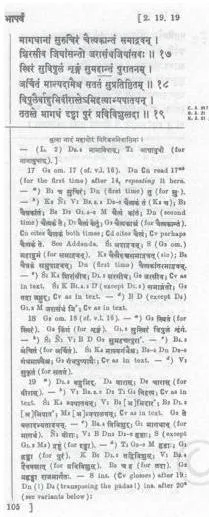
The page above is a section of that edition. The large bold print is part of the accepted main text; the smaller print lists how other manuscripts differ at that point. Reading a Critical Edition, a student or historian can see both the common core of the story and the range of regional retellings side by side.
The big caution: most of these texts were composed in Sanskrit, by and for Brahmanas. Early historians took them at face value and assumed everything prescribed was actually practised. Later work on Pali, Prakrit and Tamil traditions showed that Brahmanical norms were recognised as authoritative but also questioned, and occasionally rejected (NCERT, p. 54).
That makes Sanskrit texts normative — statements of what should happen, not descriptions of what always did.
Kinship: Patriliny and the Rules of Marriage
Family, kin and lineage
- kula — the family; jnati — the wider network of kinfolk; vamsha — lineage (NCERT, p. 55).
- Patriliny — descent traced from father to son to grandson; under it, sons could claim their father’s resources, including the throne (p. 55).
- Matriliny — descent traced through the mother.
The epic itself is a story about patriliny. The feud between the cousins of the Kuru lineage ends with the Pandavas victorious and patrilineal succession proclaimed — reinforcing a value that had existed earlier (p. 55).
The concern was not limited to kings: a Rigveda marriage mantra (probably inserted c. 1000 BCE, and used in Hindu weddings today) prays that through Indra’s grace the bride “will have fine sons” — the same elite anxiety about continuing the male line (p. 56).
Rules of marriage
Exogamy — marrying outside the kin group — was considered desirable for daughters, who had no claim on the household’s resources. This made kanyadana, the “gift of a daughter” in marriage, a father’s religious duty (NCERT, p. 57). As towns grew and older beliefs were questioned, Brahmanas responded by codifying detailed social codes: the Dharmasutras from c.
500 BCE, and the most important such work, the Manusmriti, compiled between c. 200 BCE and 200 CE (p. 57-58).
The Manusmriti recognised eight forms of marriage; the first four counted as “good” and the rest were condemned — likely because the “bad” forms were practised by people who did not accept Brahmanical norms (p. 58). Keep three key terms distinct:
- Endogamy — marriage within the unit (kin group, caste, or a group living in the same locality).
- Polygyny — a man having several wives.
- Polyandry — a woman having several husbands.
The gotra rules and the Satavahana test
From c. 1000 BCE, Brahmanas classified people — especially themselves — into gotras, each named after a Vedic seer. Two rules mattered: women were expected to give up their father’s gotra and adopt their husband’s on marriage, and members of the same gotra could not marry each other (NCERT, p. 58).
Did people actually follow these rules? The Satavahanas, who ruled parts of western India and the Deccan (c. second century BCE-second century CE), left inscriptions that let historians test the ideal (p. 58-59).
The sculpture below — one of the rare depictions of a ruler and his wife — comes from the wall of a cave donated to Buddhist monks, a reminder that this ruling family was itself embedded in non-Brahmanical patronage.
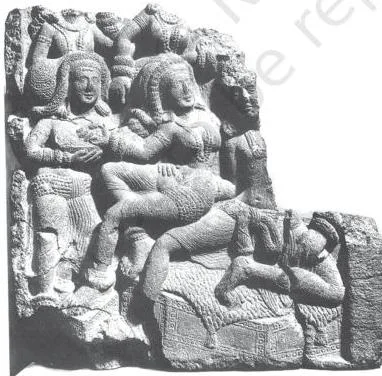
Seven Satavahana names appear in the inscription list in the textbook (Source 4, p. 59). Counting them is a small worked model of the inference this chapter wants:
| Metronymic in the list (puta = Prakrit for “son”) | Number of rulers |
|---|---|
| raja Gotami-puta — “son of Gotami” | 3 |
| raja Vasithi-puta / Vasathi-puta — “son of Vasistha’s gotra” | 2 |
| raja Madhari-puta | 1 |
| raja Hariti-puta | 1 |
These names are metronymics — names derived from the mother’s gotra. Here is what historians can and cannot infer.
We can infer that royal names were drawn from the mother’s gotra (Gotami is the feminine form of the seer Gotama) — but we cannot infer that mothers held power, because succession to the Satavahana throne was generally patrilineal, as the textbook explicitly cautions (NCERT, p. 60).
Second inference: the names of women who married Satavahana rulers show they retained their father’s gotra names, and some married within the same gotra — the opposite of the Brahmanical exogamous ideal, and a working example of endogamy (p. 60). Such close-kin marriages kept communities tight, as several south Indian communities still practise.
Naming children today
The textbook asks whether children’s names today resemble these patterns. A modern application of the same logic: gotra-based exogamy still operates in many Indian marriages — same-gotra matches are still avoided in several communities, exactly as the old rules demanded.
Surnames also show the patrilineal bias: most children still carry the father’s family name, though some families use both parents’ names or the mother’s, which is closer to the Satavahanas’ metronymic pattern. The norms of 2,000 years ago are not dead — they bend to new practices, which is precisely the tension the chapter finds between ideal and practice.
Caste in Practice: Varna, Jati and Untouchability
The varna ideal and its “right” occupations
The varnas are the four social categories whose ideal order the Dharmasutras and Dharmashastras laid down (NCERT, p. 61). The table shows each varna’s prescribed occupation and its body-part origin in the Purusha sukta:
| Varna | Part of Purusha’s body | Prescribed occupation (summary) |
|---|---|---|
| Brahmana | mouth | study and teach the Vedas; perform sacrifices and get them performed; give and receive gifts |
| Kshatriya | arms | warfare, protect people, administer justice; also study the Vedas, get sacrifices performed, make gifts |
| Vaishya | thighs | the last three Kshatriya duties, plus agriculture, pastoralism, trade |
| Shudra | feet | one occupation only — service to the three “higher” varnas |
Note the order of the body parts: mouth, arms, thighs, feet — top to bottom, matching the hierarchy.
Memory device: recall the Purusha sukta body map with the sentence “Brave Kings Value Service” — Brahmana, Kshatriya, Vaishya, Shudra — reading top to bottom, and attach the body parts in the same downward order: mouth (Brahmana), arms (Kshatriya), thighs (Vaishya), feet (Shudra).
The Brahmanas used three strategies to enforce this order: they asserted it was divinely ordained (the Purusha sukta); they advised kings to ensure the norms were followed; and they tried to persuade people that status was fixed by birth.
When persuasion failed, stories did the work — the tale of Drona demanding the right thumb of the nishada (hunting-community) archer Ekalavya as a teacher’s fee was meant to tell marginal groups where they belonged (NCERT, p. 61-62).
Kings who were not Kshatriyas
According to the Shastras, only Kshatriyas could be kings. The evidence disagrees (NCERT, p. 62-63):
- The Mauryas’ background was debated — Buddhist texts called them Kshatriyas, Brahmanical texts described them as of “low” origin.
- The Shungas and Kanvas, the Mauryas’ successors, were Brahmanas.
- The Shakas from Central Asia were labelled mlechchhas (outsiders or barbarians), yet the best-known Shaka, Rudradaman (c. second century CE), rebuilt the Sudarshana lake and issued one of the earliest Sanskrit inscriptions.
- The Satavahana Gotami-puta Siri-Satakani claimed to be a unique Brahmana and a destroyer of Kshatriya pride, yet still married into Rudradaman’s kin.
The conclusion is blunt: political power was effectively open to anyone who could muster support and resources; birth as a Kshatriya mattered far less in practice than in theory.
Jati, shrenis and the Mandasor weavers
Jati is the second term for social category.
Like varna it was birth-based, but where the number of varnas was fixed at four, jatis were unlimited in number — whenever Brahmanical authorities met a new group (forest people such as the nishadas) or an occupational group that did not fit the four varnas (the goldsmith, or suvarnakara), they classified it as a jati.
Jatis sharing an occupation were sometimes organised into shrenis, or guilds (NCERT, p. 63).
Worked example — the Mandasor inscription (c. fifth century CE): a guild of silk weavers migrated from Lata (Gujarat) to Mandasor, then called Dashapura, along with their children and kin (p. 63-64).
The inscription shows they shared more than a craft: they collectively invested their wealth to build a temple to the sun god, and among their members were people skilled in music, biographies, religious discourses and even Vedic astronomy (p. 64).
The point: these weavers were not doing what the Shastras assigned to their varna — real occupations diverged from prescription, and a guild was a community, not just a workplace.
Beyond the four varnas
Whole populations lived outside Brahmanical influence: forest-dwellers for whom hunting and gathering remained central (the category of the nishada), nomadic pastoralists who did not fit the frame of settled agriculture, and speakers of non-Sanskritic languages who were labelled mlechchhas (NCERT, p. 64-65).
The Mahabharata nonetheless shows interaction — in the story of Bhima’s marriage to the rakshasa woman Hidimba, some historians read “rakshasa” as a term for people whose practices differed from Brahmanical norms (p. 65).
Untouchability: purity, pollution and the chandalas
Brahmanical thought drew a sharp line between the pure (connected with ritual) and the polluting (handling corpses and dead animals). Those who performed such tasks, designated chandalas, were placed at the very bottom of the hierarchy (NCERT, p. 65-66).
The Manusmriti ordered them to live outside the village, use discarded utensils, wear the clothes of the dead and iron ornaments, stay out of villages and cities at night, dispose of the bodies of those who had no relatives, and serve as executioners (p. 66).
Chinese pilgrims confirm the practice from outside: Fa Xian (c. fifth century CE) wrote that “untouchables” had to sound a clapper in the streets so that people could avoid seeing them, and Xuan Zang (c. seventh century) observed executioners and scavengers forced to live outside the city (p. 66).
Did chandalas accept this? The Matanga Jataka, a Pali text, tells of the Bodhisattva born as a chandala who defies the order — he tells his own Brahmana son that “those who are proud of their birth and are ignorant do not deserve gifts” (p. 67).
It is one of the chapter’s clearest counter-voices: a non-Brahmanical text showing the hierarchy being challenged from the bottom.
Class and Resources: Who Owned What
The chapter’s third lens is property. A famous episode sets the tone: at the dice game, Yudhishtira stakes and loses his gold, kingdom, brothers and himself, then their common wife Draupadi (NCERT, p. 68).
Two contradictory opinions were offered — that a wife remained under her husband’s control and could be staked, or that a man who had lost himself could not stake another person. The matter stayed unresolved; Dhritarashtra finally restored their freedom. The episode raised, in story form, the question of whether wives could be treated as property (p. 68).
Gendered access to property
- The Manusmriti: the paternal estate was divided equally among sons, with a special share for the eldest; women could not claim a share (NCERT, p. 68).
- Stridhana (literally “woman’s wealth”): gifts a woman received at marriage; her children could inherit it and her husband had no claim on it — yet the Manusmriti still warned women against hoarding property without the husband’s permission (p. 68).
- The asymmetry in acquiring wealth: seven means for men (inheritance, finding, purchase, conquest, investment, work, and gifts from good people) versus six for women (gifts at marriage or the bridal procession, tokens of affection, gifts from brother, mother or father, subsequent gifts, and whatever her husband gave her) (p. 69).
Women like the Vakataka queen Prabhavati Gupta were exceptions — see our Kings, Farmers and Towns notes for her case. The cumulative evidence, epigraphic and textual, is that upper-class women may have had access to resources, but land, cattle and money were generally controlled by men, so differences in access to resources sharpened the social gap between men and women (p. 68).
Varna and access to wealth
The Shudra’s only prescribed occupation was service, so if the rule were implemented, the wealthiest men would have been Brahmanas and Kshatriyas (NCERT, p. 69). But other traditions disagreed. In the Majjhima Nikaya (in Pali), the disciple Kachchana asks King Avantiputta: if a Shudra had wealth, could he command even a Brahmana as an obedient servant?
The king concedes he could, after Kachchana asks, “are not these four varnas exactly the same?” (p. 70). Hindu— actually, Buddhist evidence shows that wealth, not birth, could create hierarchy in practice.
An alternative value system: Tamilakam
Not every society ranked people by accumulation.
In ancient Tamilakam (c. 2,000 years ago), the Tamil Sangam anthology Puranaruru (c. first century CE) praises a generous chief who does not have wealth to lavish — so he goes to the village blacksmith and asks him to “shape me a long spear for war”, to win wealth by raiding and share it with his bards (NCERT, p. 70-71).
Here generosity outranks accumulation: the miser is despised, the sharer is honoured.
Across all three settings the rule is the same: social position was shaped by access to resources, but gender and varna regulated that access — who could inherit, what counted as legitimate wealth, and who was allowed to accumulate at all.
Two Views of Society: Brahmanical Order and the Buddhist Social Contract
The chapter’s central contrast is between two origin stories of society (NCERT, p. 61 and p. 72).
The Brahmanical view begins with the Purusha sukta, a hymn in the Rigveda describing the sacrifice of Purusha, the primeval man: the Brahmana sprang from his mouth, the Kshatriya from his arms, the Vaishya from his thighs, the Shudra from his feet (p. 61). The social order is therefore divine in origin and fixed by birth.
The Buddhist view, in a myth from the Sutta Pitaka, starts from the opposite end: humans once lived in an idyllic state, then greed and deceit crept in.
So the people decided to elect one among themselves to be angry when anger is right, to censure what deserves censure and to banish who deserves banishment; in return they gave him a share of their rice. He was called mahasammata, “the great elect” (p. 72).
| Basis of comparison | Brahmanical order (Purusha sukta) | Buddhist social contract (Sutta Pitaka) |
|---|---|---|
| Origin of the social order | divine — the four varnas emanate from the body of the primeval man in a sacrifice | human — people elect one of themselves to keep order |
| Basis of status | birth into a varna, fixed forever | conduct, wealth and agreement; birth rejected as a ground |
| Kingship | hereditary, ideally by Kshatriya birth | chosen by the people, paid a share of rice (taxes) for services |
| Possibility of change | fixed and eternal | changeable — because humans created it, humans can alter it |
Work out the implication the chapter wants you to see: if humans made the system, humans could change it. That single idea explains why Buddhist texts reject birth as a basis of status and why their stories of wealthy Shudras and chandala Bodhisattvas read as critiques of the Brahmanical order.
This contrast is the skeleton for textbook Q4, and the birth-versus-wealth logic reappears in the essay on gender (Q8). The Buddhist ideas themselves belong to the wider religious ferment covered in our Thinkers, Beliefs and Buildings notes.
How Historians Date and Read the Mahabharata
Historians do not take any text at face value. Before drawing on its content, they assess six elements (NCERT, p. 72-73) — a checklist you can apply to any source extract in an answer:
- Language — Sanskrit was meant almost exclusively for priests and elites; Pali, Prakrit and Tamil were languages ordinary people probably used.
- Kind of text — a mantra chanted by ritual specialists differs from a story people could read, hear and retell.
- Author(s) — whose perspectives and ideas shaped the text?
- Intended audience — authors often keep the audience’s interests in mind while composing.
- Possible date — when was it composed or compiled?
- Place of composition — where did it come from?
Applied to the epic: its Sanskrit is far simpler than Vedic Sanskrit or the prashastis, so it was probably widely understood (NCERT, p. 73). Historians split its contents into narrative (stories) and didactic (prescriptions of norms) sections, and generally agree that the didactic portions were probably added later (p. 73).
The text calls itself itihasa, “thus it was”, which is why it is translated as “history” — yet whether a real battle lies behind the epic is debated: some see a memory of an actual kin conflict, others find no corroborating evidence (p. 74).
Who wrote it and when
The original story was probably composed by sutas, charioteer-bards who accompanied Kshatriya warriors and composed poems celebrating their victories. These verses circulated orally (NCERT, p. 74).
From the fifth century BCE, Brahmanas took over the story and began committing it to writing — exactly the period when the Kuru and Panchala chiefdoms were becoming kingdoms and new kings perhaps wanted their itihasa recorded more systematically (p. 74-75). The four phases of this growth are set out as a table in the timeline section below (p. 75).
Convergence with archaeology: Hastinapura
In 1951-52 the archaeologist B.B. Lal excavated at Hastinapura in Meerut (Uttar Pradesh), in the Upper Ganga doab where the Kuru kingdom lay (NCERT, p. 75). He found five occupational levels, of which two matter here:
- Phase 2 (c. twelfth-seventh century BCE): walls of mud and mud-brick; mud-plaster with prominent reed-marks, suggesting reed-walled houses plastered over with mud.
- Phase 3 (c. sixth-third century BCE): houses of mud-brick and burnt brick; soakage jars and brick drains for waste water; terracotta ring-wells used as wells or drainage pits (p. 75-76).
The epic describes Hastinapura bursting “like the ocean, packed with hundreds of mansions”. Lal’s modest houses do not match that glory — so historians ask whether the description was added later, when urban centres flourished after the sixth century BCE, or was a flight of poetic fancy that cannot be verified by other evidence (p. 76).
Either way, the episode shows how archaeology converges with — and tests — a literary text.
The polyandry case as method
Draupadi’s marriage to the five Pandavas is a testing case (NCERT, p. 76-77). The text itself offers three explanations: Kunti’s command to share whatever they had got; the Pandavas were incarnations of Indra; and a woman who had prayed five times for a husband was reborn as Draupadi with her prayer fulfilled (p. 76). Why three explanations for one event?
Historians read it as evidence that polyandry existed among ruling elites at some point, and that it fell into disfavour among the Brahmanas who reworked the text — hence the need to explain it away (p. 77).
Others note polyandry’s prevalence in the Himalayan region and the possibility of a shortage of women during warfare; and the chapter’s final caution: creative literature has its own narrative requirements and does not always literally reflect social realities (p. 77).
A Dynamic Text: Regional Retellings and Mahashweta Devi
The Mahabharata never stopped growing (NCERT, p. 77):
- Versions were written in many languages across the subcontinent.
- Regional stories entered the epic, while the central story was retold differently in different places.
- Episodes were shown in sculpture, painting, plays and dance.
The terracotta panel below — from seventeenth-century West Bengal — is a late, regional proof of that afterlife: a scene from the epic centuries after the Sanskrit text took shape.
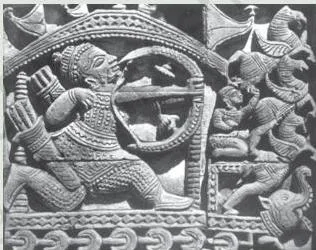
Modern writers continue the reworking. The Bengali author Mahashweta Devi built a counter-narrative on a moment the Sanskrit text passes over: the house of lac. In the epic, the Pandavas escape a palace built to burn them, and a nishada woman and her five sons die in the fire in their place (NCERT, p. 78).
Devi’s short story “Kunti O Nishadi” begins where the epic falls silent:
- After the war, Kunti retires to a forest and confesses her failings to the earth.
- A nishadi (a nishada woman) listens and finally confronts her: the woman who died was her mother-in-law.
- She asks the question the Sanskrit text never raises: why did Kunti never remember the six innocent lives that were lost?
- The flames close in; the nishadi escapes to safety, Kunti stays.
The point is methodological as much as literary: counter-narratives fill the gaps where the dominant tradition is silent, and they force us to ask whose voices the Sanskrit text erased — the nishadas, the women, the marginal. That is the question the chapter keeps circling.
Kinship, Caste and Class: Key Terms Table
This table gathers the technical terms the chapter explains in boxes and margins, with the page where each appears:
| Term | Meaning | Where it appears |
|---|---|---|
| kula | the family as a social unit | p. 55 |
| jnati | the wider network of kinfolk | p. 55 |
| vamsha | lineage — a line of descent | p. 55 |
| patriliny | tracing descent from father to son to grandson | p. 55 |
| matriliny | tracing descent through the mother | p. 55 |
| exogamy | marriage outside the kin group or unit | p. 57 |
| endogamy | marriage within the unit — kin group, caste or locality | p. 57 |
| polygyny | a man having several wives | p. 57 |
| polyandry | a woman having several husbands | p. 57 |
| gotra | a group named after a Vedic seer, regarded as his descendants | p. 58 |
| kanyadana | the “gift of a daughter” in marriage, a father’s religious duty | p. 57 |
| varna | one of the four ideal social categories of Brahmanical theory | p. 61 |
| jati | a birth-based social group; unlimited in number | p. 63 |
| shreni | a guild of jatis sharing an occupation | p. 63 |
| stridhana | “woman’s wealth” — gifts a woman received at marriage | p. 68 |
| mlechchha | outsider or barbarian, used for those outside Sanskritic norms | p. 63 |
| nishada | a hunting community; a forest-dwelling group outside the varna order | p. 62 |
| chandala | a group at the very bottom, assigned polluting work | p. 66 |
| sutas | charioteer-bards, the original composers of the epic’s poems | p. 74 |
| itihasa | “thus it was” — the early Sanskrit term translated as history | p. 74 |
| narrative | the story sections of the Mahabharata | p. 73 |
| didactic | sections that prescribe norms, meant for instruction | p. 73 |
| mahasammata | “the great elect” — the king chosen by the people in the Buddhist myth | p. 72 |
| metronymics | names derived from the mother, e.g. Gotami-puta | p. 59 |
| normative text | a text that lays down norms — what should happen, not necessarily what did | p. 54 |
Timeline Tables: Texts and the Mahabharata
Dates anchor every answer in this chapter. Two compact tables cover the textual traditions and the modern study of the epic — treat them like formula boxes: worth memorising, and each row has a source behind it.
| Major textual tradition | Date (c.) |
|---|---|
| Major Dharmasutras (Sanskrit) | 500-200 BCE |
| Early Buddhist texts including the Tripitaka (Pali) | 500-100 BCE |
| Ramayana and Mahabharata (Sanskrit) | 500 BCE-400 CE |
| Manusmriti (Sanskrit) and Tamil Sangam literature | 200 BCE-200 CE |
| Compilation of the Puranas (Sanskrit) | 200 CE onwards |
| Other Dharmashastras (Sanskrit) | 300-600 CE |
(NCERT, p. 79)
| Landmark in the study of the Mahabharata | Date |
|---|---|
| Preparation and publication of the Critical Edition | 1919-66 |
| J.A.B. van Buitenen begins an English translation of the Critical Edition; left incomplete after his death | 1973 (incomplete after 1978) |
(NCERT, p. 79)
The Mahabharata’s four composition phases
| Phase | What happened | When |
|---|---|---|
| Oral poems | charioteer-bards (sutas) accompanying Kshatriya warriors composed and circulated verses | originally, before writing |
| First writing | Brahmanas committed the story to writing as the Kuru and Panchala chiefdoms became kingdoms | from the fifth century BCE |
| Vishnu-Krishna phase | worship of Vishnu grew; Krishna was identified with Vishnu | c. 200 BCE-200 CE |
| Didactic additions | large sections resembling the Manusmriti added; the text grew from fewer than 10,000 to about 100,000 verses | c. 200-400 CE |
(NCERT, p. 74-75)
Common Mistakes Students Make
Each row corrects a confusion that can weaken a source-based answer:
| Mistake (students write…) | The correct view | How to check your answer |
|---|---|---|
| “Satavahana metronymics prove the society was matrilineal.” | Correct: succession remained patrilineal; a name like Gotami-puta only identifies the mother’s gotra. | Name the succession pattern, not just the names — the throne passed in the male line even though names used the mother’s gotra (NCERT, p. 60). |
| “Gotra rules in Brahmanical texts were universally followed.” | Correct: inscriptions show women keeping their father’s gotra names and some same-gotra marriages — endogamy in practice, against the Brahmanical ideal. | Ask what the ideal prescribed and what the inscription records; the two may contradict (p. 60). |
| “Varna and jati are the same thing.” | Correct: varna is fixed at four; jati is unlimited in number and absorbs new groups such as nishadas and suvarnakaras. | Check by counting: any group that did not fit the four boxes was classified as a jati (p. 63). |
| “The Mahabharata was written by Vyasa at one time.” | Correct: Vyasa is the traditional attribution; the text grew over about 1,000 years through sutas, Brahmana redaction and later didactic additions. | Cite the phases — oral poems, fifth-century BCE writing, the Vishnu phase, and the c. 200-400 CE didactic additions (p. 74-75). |
| “Sanskrit texts describe what people actually did.” | Correct: most were normative, written by and for Brahmanas; Pali, Prakrit and Tamil sources show the norms being questioned or rejected. | Identify the text’s author and audience before using it as evidence of practice (p. 54). |
| “All kings in early states were Kshatriyas.” | Correct: the Mauryas were disputed, the Shungas and Kanvas were Brahmanas, the Shakas were mlechchhas — power was open to anyone with resources and support. | Attach a dynasty to every royal claim — Maurya, Shunga, Kanva, Shaka, Satavahana — and state its recorded background (p. 62-63). |
Writing the Textbook Answers (Q1-Q12)
This is a method and evidence map, not a set of model answers — compose your own sentences, but anchor every generalisation to a named source from this chapter.
| Questions | Type | What a complete answer needs |
|---|---|---|
| Q1-Q5 (100-150 words each) | direct concept | a clear definition, supporting evidence with its source named (Rigveda mantra, inscriptions, Jataka), and the “so what” — the implication for society. |
| Q6-Q9 (short essays, about 500 words) | argument | a stated position, key terms defined, evidence from named sources, counter-evidence acknowledged, and a conclusion that answers the question. |
| Q10 | map work | compare with Map 1 of Chapter 2; list the mahajanapadas and cities located near the Kuru-Panchala lands. |
| Q11-Q12 | project | choose two retellings or one episode; analyse how a shared episode is handled, noting similarities and differences. |
Q1 (Why patriliny mattered to elites): line up the throne and patrimony passing through sons, the epic’s proclamation of patrilineal succession after the Kuru war, the Rigveda marriage mantra about producing “fine sons”, and Prabhavati Gupta as the exceptional woman ruler whose case proves the rule by being exceptional (NCERT, p. 55-56).
Q2 (Were kings invariably Kshatriyas?): answer “no” and parade the dynasty list — Mauryas (disputed), Shungas and Kanvas (Brahmanas), Shakas (mlechchhas), Satavahanas (claimed Brahmana status). Close with the generalisation: political power was open to anyone who could muster support (p. 62-63).
Q3 (Dharma in the Drona, Hidimba and Matanga stories): a three-row comparison works best — for each story state who sets the norm, who deviates, and what the story punishes or rewards:
| Story | Who sets the norm | What the story punishes or rewards |
|---|---|---|
| Drona-Ekalavya (Adi Parvan) | Drona, the Brahmana teacher | punishes a nishada’s ambition — Ekalavya must give his thumb, so no one surpasses Arjuna |
| Hidimba-Bhima (Adi Parvan) | the Pandavas’ kin group | accepts a non-Brahmanical marriage on condition — Hidimba leaves after a son is born |
| Matanga Jataka (Pali) | the chandala Bodhisattva | punishes birth-pride — Matanga is worthy while his Brahmana son is corrected |
Q4 (Buddhist social contract vs Purusha sukta): build on the comparison table in the Two Views section — divine origin versus human election, birth versus conduct, hereditary Kshatriya kingship versus the chosen, paid mahasammata, and fixed versus changeable order (p. 61, 72).
Q5 (Yudhishtira’s greetings): work through the criteria the list uses.
Sort the people addressed by age (the old king, elderly ladies first), gender (men, then wives, then daughters, then courtesans and slave women), kinship tie (teachers and preceptors before kin; kin ordered by closeness — brothers, sons, grandsons), and status (Brahmanas and the chief priest first; courtesans, slave women, then aged/maimed/helpless last).
One detail worth a comment: the wise Vidura, born of a slave woman, is greeted with special warmth — a curiosity the birth-based ranking does not explain (NCERT, p. 80).
For the essays (Q6-Q9), use a five-step skeleton:
- Open with a clear position that answers the question.
- Define the key term (patriliny, gender, normative text).
- Present evidence with the source named — Manusmriti, Majjhima Nikaya, Puranaruru, Matanga Jataka.
- Acknowledge counter-evidence (Prabhavati Gupta against the general pattern; Mandasor weavers against prescribed varna occupations).
- Close with a conclusion that returns to the question.
Q8 (gender): gather the ammunition — stridhana and the seven-versus-six means of acquiring wealth (p. 68-69), the dice-game episode’s property question (p. 68), and Prabhavati Gupta as the exceptional case — and argue that gender differences were sharpened precisely by unequal access to resources (p. 68).
Q10 (map work): open Chapter 2’s Map 1 alongside this chapter’s map and list the mahajanapadas and cities lying near the Kuru-Panchala lands; the chapter notes Hastinapura may have been the Kuru capital in the Upper Ganga doab (p. 75).
Q11-Q12 (project): for Q11, choose any two retellings of the epic in other languages and analyse how they handle one shared episode; for Q12, rewriting Ekalavya’s story from a chosen perspective works best if you keep the Drona-Ekalavya scene intact and change only whose voice tells it (p. 81).
Last-Minute Revision Summary
The whole chapter, theme by theme, for the night before you need it:
| Theme | Core idea | Key evidence to cite |
|---|---|---|
| Kinship | patriliny valued among elites; sons inherit throne and property | Kuru-cousins feud; Rigveda marriage mantra; Prabhavati Gupta as exception |
| Marriage | exogamy ideal, kanyadana, eight forms; endogamy practised | Manusmriti’s eight forms; Satavahana marriage records |
| Varna theory | four divinely ordered categories, fixed by birth | Purusha sukta body map; prescribed occupations |
| Caste in practice | kings not always Kshatriyas; jatis and guilds absorb real life | Mauryas, Shungas, Kanvas, Shakas; Mandasor silk weavers |
| Untouchability | purity versus pollution; chandalas at the bottom | Manusmriti duties; Fa Xian’s clapper; Matanga Jataka |
| Class and property | gendered and varna-regulated access to wealth | stridhana; seven versus six means; the wealthy Shudra (Majjhima Nikaya) |
| Buddhist alternative | social order made by humans, hence changeable | Sutta Pitaka myth; mahasammata |
| Historian’s method | six questions; narrative versus didactic; archaeology tests texts | the six-element checklist; Hastinapura phases |
| A dynamic text | the epic keeps growing and being retold | regional versions; terracotta panels; Kunti O Nishadi |
For dates, attach each row to the timeline tables above — the Critical Edition (1919-66), the composition phases, and the textual tradition dates. Every answer you write should be able to name at least one source; these rows give you one source per theme.
For every subject in this class, browse the full CBSE notes library, or jump to our Class 12 notes hub.
Frequently Asked Questions
What does the Critical Edition of the Mahabharata mean, and why was it made?
The Critical Edition is a reconstructed version of the epic: scholars compared Sanskrit manuscripts from Kashmir, Nepal, Kerala and Tamil Nadu, kept the verses common to most versions as the main text, and documented regional differences in footnotes and appendices (NCERT, p. 54). It was started in 1919 under V.S.
Sukthankar and took 47 years, because no single manuscript could stand for the whole tradition — and the differences themselves are evidence of how the text grew and travelled.
What is the difference between varna and jati in this chapter?
Both are birth-based categories, but varna is fixed at four ideal divisions, while jati is unlimited in number (NCERT, p. 63). Whenever Brahmanical authorities met a group that did not fit the four varnas — forest-dwelling nishadas or occupational groups like goldsmiths — they classified it as a jati.
The Mandasor inscription shows a jati (silk weavers) acting as a community, something the four-varna scheme could not capture.
Why were some Satavahana kings named after their mothers?
Names such as Gotami-puta, “son of Gotami”, are metronymics — they use the mother’s gotra name (NCERT, p. 59). This does not mean the society was matrilineal: succession to the throne remained patrilineal, and the names simply record the mother’s gotra.
Historians take them as evidence that women kept their father’s gotra names after marriage — against the Brahmanical rule — and that some same-gotra marriages occurred (p. 60).
How is the Buddhist theory of a social contract different from the Brahmanical varna order?
The Brahmanical order, based on the Purusha sukta, says the four varnas came from the body of the primeval man — divine in origin, fixed by birth and unchangeable (NCERT, p. 61). The Buddhist myth in the Sutta Pitaka says people elected the mahasammata, “the great elect”, to keep order, paying him a share of rice (p. 72).
Because humans created the arrangement, humans could change it — which is why Buddhist texts reject birth as a basis of status.
What did the Mandasor inscription tell historians about silk weavers?
The inscription (c. fifth century CE) records a guild of silk weavers who migrated from Lata to Dashapura (Mandasor) and collectively built a sun temple (NCERT, p. 63-64). Its members included musicians, biographers and students of Vedic astronomy — so a guild was a shared community, not just a common craft, and its members’ occupations diverged from what the Shastras prescribed.
That makes it key evidence that real practice did not match Brahmanical prescription.
How do historians decide whether the Mahabharata is history or fiction?
They apply the six-question checklist — language, kind of text, author, audience, date and place — and separate narrative sections from didactic ones (NCERT, p. 72-73). The text calls itself itihasa, “thus it was”, but no corroborating evidence confirms a historical battle, and the city described in the epic does not match B.B. Lal’s modest archaeological finds at Hastinapura (p. 74-76).
Historians therefore treat it as a text that preserves attitudes and norms rather than as a literal record of events.
Reference: NCERT Class 12 Themes in Indian History Part I textbook, chapter Kinship, Caste and Class.
Explore Class 12 History Notes
- Class 12 History Notes
- Class 12 CBSE Notes
- CBSE Notes for Classes 1 to 12
- Previous: Kings, Farmers and Towns
- Next: Thinkers, Beliefs and Buildings
Class 12 History on LearnCBSE: