
These are complete revision notes for Open Economy Macroeconomics, Chapter 6 of the NCERT Class 12 Introductory Macroeconomics textbook. Everything you need to revise from alone is here: the balance of payments accounts, the foreign exchange market, the three exchange rate systems, and the open economy multiplier — with every formula, definition and distinction that commonly confuses students. The notes follow the 2026-27 session.
Worked examples use fresh numbers, so you can practise the method instead of memorising answers.
For the other chapters in the book, start from the Class 12 Economics notes hub, or browse the Class 12 notes and general CBSE notes index. Every definition on this page follows the NCERT text published on the NCERT portal.
From a Closed to an Open Economy: The Three Linkages
A closed economy is a simplification used earlier in the book — an economy with no linkages to the rest of the world. An open economy interacts with other countries through three channels (NCERT, p. 85):
- Output market: trade in goods and services. Consumers and producers can choose between domestic and foreign products.
- Financial market: buying and selling financial assets, so investors can choose between domestic and foreign assets.
- Labour market: firms choose where to locate production and workers where to work, though immigration laws restrict this movement.
The chapter focuses on the first two linkages. Foreign trade changes aggregate demand in two directions (NCERT, p. 85):
- Leakage: when residents buy foreign goods, that spending escapes from the domestic circular flow of income and lowers aggregate demand.
- Injection: when foreigners buy our exports, income enters the circular flow and raises aggregate demand.
Example: an Indian consumer choosing an imported rather than a domestic smartphone moves that spending abroad (a leakage); a foreign tourist paying for a Mumbai hotel room brings income into the country (an injection).
Key Terms and Definitions: The Language of an Open Economy
Every exam-facing term of the chapter in one place, with a plain meaning and the textbook page it comes from.
| Term | Meaning in simple words | NCERT page |
|---|---|---|
| Open economy | An economy that trades goods, services and financial assets with other nations | p. 85 |
| Balance of payments (BoP) | Record of transactions in goods, services and assets between a country’s residents and the rest of the world, usually over a year | p. 86 |
| Current account | The account recording trade in goods and services plus transfer payments | p. 86 |
| Capital account | Records all international transactions of assets — money, stocks, bonds, government debt | p. 88 |
| Foreign exchange rate | Price of one currency in terms of another | p. 91 |
| Balance of trade (BOT) | Exports minus imports of goods only | p. 87 |
| Net invisibles | Exports minus imports of invisibles — services, transfers and income flows | pp. 87-88 |
| Transfer payments | Receipts obtained “for free” — gifts, remittances and grants | pp. 86-87 |
| Autonomous transactions | Transactions made for their own reasons, independent of the BoP position (“above the line”) | p. 89 |
| Accommodating transactions | Transactions determined by the BoP gap (“below the line”); official reserves are the accommodating item | p. 89 |
| Depreciation / Appreciation | Fall / rise in a currency’s value under flexible rates, driven by market forces | p. 92 |
| Devaluation / Revaluation | Official change making the domestic currency cheaper / costlier under fixed rates | p. 94 |
| Managed floating | Mixed system in which central banks intervene to moderate exchange rate movements | p. 95 |
| Purchasing power parity | Long-run theory: exchange rates adjust so the same product costs the same across currencies | p. 93 |
| Marginal propensity to import | Fraction of an extra rupee of income spent on imports | p. 98 |
| Net exports (NX) | Exports minus imports | p. 97 |
Watch the four “regime words” — depreciation, appreciation, devaluation, revaluation. They are the chapter’s most-confused pair; the full comparison table is in the exchange rate section below.
The Current Account: Goods, Services and Transfers
The current account is the record of trade in goods and services plus transfer payments (NCERT, p. 86). It has three components:
- Trade in goods: exports and imports of physical goods.
- Trade in services, of two kinds —
- factor income: net international earnings on factors of production like labour, land and capital;
- non-factor income: net receipts from service products like shipping, banking, tourism and software (NCERT, p. 88).
- Transfer payments: receipts residents get for free, without giving goods or services in return — gifts, remittances and grants, from governments or private citizens abroad (NCERT, pp. 86-87).
The textbook presents the same breakdown in a diagram titled “Components of Current Account”; the list above is exactly what the diagram contains.
The overall position of the current account depends on receipts compared with payments (NCERT, p. 87):
| Status | Condition | What it means |
|---|---|---|
| Current account surplus | Receipts > Payments | The nation is a lender to other countries |
| Balanced current account | Receipts = Payments | Neutral position |
| Current account deficit | Receipts < Payments | The nation is a borrower from other countries |
Two building blocks make up the balance on current account (NCERT, pp. 87-88):
- Balance of trade (BOT): value of exports of goods minus value of imports of goods. Exports are entered as credits, imports as debits.
- Net invisibles: value of exports of invisibles minus value of imports of invisibles. Invisibles include services, transfers and income flows between countries.
So current account balance = trade balance + net invisibles. A goods trade deficit can be offset by strongly positive invisibles — which is exactly what happens in India’s sample BoP (see below).
The Capital Account and the Identity That Balances Everything
What the Capital Account Records
The capital account records all international transactions of assets — any form in which wealth can be held: money, stocks, bonds, government debt (NCERT, p. 88).
- Buying assets is a debit — foreign exchange flows out. Example: an Indian buying a UK car company.
- Selling assets is a credit — foreign exchange flows in. Example: a Chinese customer buying shares of an Indian company.
The main items are Foreign Direct Investments (FDIs), Foreign Institutional Investments (FIIs), external borrowings and external assistance (NCERT, p. 88).
The Identity: Current Account + Capital Account ≡ 0
The logic mirrors an individual: someone who spends more than income must finance the difference by selling assets or borrowing. Likewise, a country with a current account deficit must finance it by selling assets or borrowing abroad — that is, through a capital account surplus (NCERT, pp. 88-89). Hence:
\[ \text{Current account} + \text{Capital account} \equiv 0 \]
When the current account deficit is financed entirely by net capital inflow with no reserve movements, the country is in balance of payments equilibrium. If not, the central bank steps in: it sells foreign exchange from its reserves when there is a deficit. This is an official reserve sale (NCERT, p. 89).
Here is the chapter’s sign convention, a frequent source of confusion (NCERT, p. 89):
| BoP Deficit | Balanced BoP | BoP Surplus | |
|---|---|---|---|
| Overall balance | \( \lt 0 \) | \( = 0 \) | \( \gt 0 \) |
| Reserve change | \( \gt 0 \) | \( = 0 \) | \( \lt 0 \) |
A decrease in official reserves is called the overall BoP deficit; an increase is called the overall BoP surplus. The monetary authorities are the ultimate financiers of any BoP deficit (or recipients of any surplus).
Autonomous and Accommodating Transactions
- Autonomous transactions (“above the line” items): made for reasons other than bridging the BoP gap — earning profit, for example. They are independent of the state of the BoP. The BoP is in surplus (deficit) when autonomous receipts are greater (less) than autonomous payments (NCERT, p. 89).
- Accommodating transactions (“below the line” items): determined by the size of the BoP gap — that is, by the net result of autonomous transactions. Official reserve transactions are the accommodating item; all other items are autonomous (NCERT, p. 89).
Errors and Omissions
It is difficult to record every international transaction accurately. A third element of the BoP — errors and omissions — absorbs these recording mistakes (NCERT, p. 89).
Reading Table 6.1: India’s BoP in Nine Rows
The textbook’s sample BoP for India (in million USD) shows the cascade logic row by row (NCERT, p. 90):
| No. | Item | Million USD |
|---|---|---|
| 1 | Exports (of goods only) | 150 |
| 2 | Imports (of goods only) | 240 |
| 3 | Trade balance [2 − 1] | -90 |
| 4 | (Net) Invisibles | 52 |
| 5 | Current account balance [3 + 4] | -38 |
| 6 | Capital account balance | 41.15 |
| 7 | Errors and omissions | 3.15 |
| 8 | Overall balance [5 + 6 + 7] | 0 |
| 9 | Reserves change | 0 |
Read it as a cascade. A goods trade deficit of -90 is partly offset by net invisibles of +52, leaving a current account deficit of -38. The capital account surplus of +41.15 plus errors and omissions of +3.15 exactly finances that deficit, so the overall balance is zero and reserves do not move.
The capital account itself aggregates six items — external assistance 0.15, external commercial borrowings 2, short-term debt 10, banking capital 15 (of which NRI deposits 9), foreign investments 19 (FDI 13 and portfolio investment 6) and other flows -5.
Reading Rupee-Dollar Headlines
The chapter’s concepts appear in financial news every day. Here is how real headlines map onto the accounts:
| Headline | Chapter concept |
|---|---|
| “RBI sells dollars to steady the rupee” | Official reserve sale — central bank intervention under managed floating (NCERT, pp. 89, 95) |
| “NRI remittances hit a record high” | Current account transfer payments, part of net invisibles (NCERT, pp. 86-87; NRI deposits also appear in Table 6.1, p. 90) |
| “FDI inflows rise; FIIs pull out of equities” | Capital account asset transactions — FDI (direct investment) vs FII (portfolio investment) (NCERT, p. 88) |
The Foreign Exchange Market: Demand and Supply of a Currency
The foreign exchange market is the market in which national currencies are traded for one another (NCERT, p. 91). The foreign exchange rate is, in the textbook’s words, “the price of one currency in terms of another” (NCERT, p. 91) — it links currencies and enables comparison of international costs and prices.
The major participants are commercial banks, foreign exchange brokers, other authorised dealers, and monetary authorities. Although participants have their own trading centres, the market itself is worldwide, with close and continuous contact between centres (NCERT, p. 91).
People demand foreign exchange because they want to:
- purchase goods and services from other countries;
- send gifts abroad;
- purchase foreign financial assets (NCERT, pp. 91-92).
A rise in the price of foreign exchange raises the rupee cost of foreign goods, so import demand falls and the demand for foreign exchange falls with it.
Foreign exchange is supplied because:
- foreigners buy our exports of goods and services;
- foreigners send gifts or make transfers;
- foreigners buy the home country’s assets (NCERT, pp. 91-92).
A rise in the price of foreign exchange lowers the foreigner’s cost, in dollars, of Indian products, so India’s exports tend to rise and the supply of foreign exchange may increase. The textbook adds an honest caveat: whether supply actually rises depends on several factors, particularly the elasticities of demand for exports and imports (NCERT, p. 92).
Flexible, Fixed and Managed Floating Exchange Rates
Equilibrium under Flexible Rates
Under a flexible (floating) exchange rate, the rate is determined entirely by the market forces of demand and supply of foreign exchange (NCERT, p. 92). Figure 6.1 shows this equilibrium.
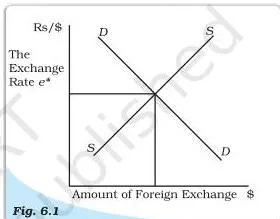
Read the axes first: the exchange rate is on the vertical axis and the quantity of US dollars on the horizontal axis. The demand curve slopes down — a higher rate makes foreign goods costlier in rupees. The supply curve slopes up — a higher rate attracts more dollars into the market.
The equilibrium rate \( e \) and quantity \( q \) sit at the intersection of the two curves (NCERT, p. 92). In a completely flexible system, central banks do not intervene.
Now suppose the demand for foreign goods and services increases — say, because Indians are travelling abroad more. Figure 6.2 shows what happens.
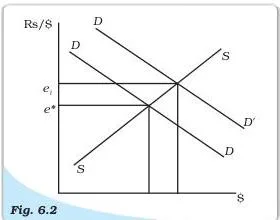
The demand curve shifts upward and to the right of its original position. The old equilibrium rate is \( e_0 = 50 \) (Rs 50 per dollar); at the new equilibrium the rate is \( e_1 = 70 \) (Rs 70 per dollar).
We must now pay more rupees for one dollar, so the value of the rupee in terms of dollars has fallen and the value of the dollar in terms of rupees has risen.
An increase in the exchange rate — a rise in the price of foreign currency in terms of domestic currency — is called depreciation of the domestic currency (NCERT, p. 92).
Memory device: treat the exchange rate as the price tag on a dollar. If the price tag rises from Rs 50 to Rs 70, your rupee buys less — the domestic currency has fallen. A rising exchange rate number always means a cheaper home currency.
The reverse is appreciation: under flexible rates, when the price of the domestic currency in terms of foreign currency rises, we pay fewer rupees per dollar (NCERT, pp. 92-93).
Depreciation vs Devaluation: A Comparison Table
| Term | Regime | Who acts | Effect on the exchange rate number |
|---|---|---|---|
| Depreciation | Flexible (floating) | Market forces of demand and supply | Rises — domestic currency becomes cheaper |
| Appreciation | Flexible (floating) | Market forces | Falls — domestic currency becomes dearer |
| Devaluation | Fixed | Deliberate government action | Rises — domestic currency becomes cheaper |
| Revaluation | Fixed | Deliberate government action | Falls — domestic currency becomes dearer |
The key distinction: depreciation and devaluation both raise the exchange rate and make the domestic currency cheaper, but depreciation happens through market forces under a flexible regime, while devaluation is a deliberate government action under a fixed regime (NCERT, pp. 92, 94).
Fixed Rates and the Central Bank’s Role
Under a fixed exchange rate, the government sets the rate. If it fixes the rate above the market rate (\( e_1 \gt e \), say Rs 70 per dollar while the market rate is Rs 50), the supply of dollars exceeds the demand.
The RBI intervenes, buying the excess dollars with rupees — marked AB in the textbook’s figure — and in doing so accumulates foreign exchange reserves. If the government instead fixes the rate below the market rate (\( e_2 \)), there is excess demand for dollars; the RBI must withdraw dollars from its past holdings.
If it cannot, a black market for dollars may arise (NCERT, p. 94).
Merits, Demerits and Managed Floating
- Fixed rates need credibility. If people doubt that reserves are adequate, they begin to speculate on a devaluation; aggressive buying of the currency that forces the government to devalue is a speculative attack. Fixed systems are prone to such attacks — as was witnessed before the collapse of the Bretton Woods system (NCERT, p. 95).
- Flexible rates give room to policy. Governments do not need to hold large reserves, exchange rate movements automatically adjust the BoP, and countries gain independence in running monetary policy (NCERT, p. 95).
- Managed floating (“dirty floating”) is the practical middle ground: the flexible float is moderated because central banks buy and sell foreign currencies to limit exchange rate movements whenever they think it appropriate. Because they do intervene, official reserve transactions are not equal to zero (NCERT, p. 95).
What Moves Exchange Rates: Speculation, Interest Rates, Income and PPP
Four factors drive exchange rate movements, from the short run to the long run.
Speculation
Money in any country is an asset. If Indians expect the British pound to rise in value relative to the rupee, they choose to hold pounds. That extra demand pushes today’s pound-rupee rate up — the expectation becomes self-fulfilling (NCERT, p. 93). The mechanism is immediate, not deferred: the belief itself raises the rate now.
Interest Rate Differentials
Huge funds owned by banks, multinational corporations and wealthy individuals move around the world hunting for the highest interest rates. If equally safe government bonds pay 8% in country A and 10% in country B, investors sell A’s currency and buy B’s. A’s demand curve shifts left and its supply curve shifts right — so A’s currency depreciates and B’s appreciates (NCERT, p. 93).
The working assumption is that no restrictions exist on buying foreign government bonds. General rule: a rise in interest rates at home often leads to an appreciation of the domestic currency.
Income Changes
When domestic income rises, consumer spending rises and imports are likely to rise too, shifting the demand for foreign exchange to the right — depreciation pressure. If foreign income rises as well, our exports rise and the supply of foreign exchange shifts outward — offsetting pressure.
Whether the domestic currency actually depreciates depends on whether exports are growing faster than imports (NCERT, p. 93).
Long Run: Purchasing Power Parity
The purchasing power parity (PPP) theory makes long-run predictions under flexible rates. As long as there are no barriers to trade — no tariffs (taxes on trade) or quotas (quantitative limits on imports) — exchange rates should eventually adjust so that the same product costs the same in every currency, except for differences in transportation.
Over the long run, exchange rates adjust to reflect differences in price levels between countries (NCERT, pp. 93-94). The textbook’s Example 6.1 illustrates this idea with a shirt; the Worked Examples section below does the same arithmetic with fresh numbers.
Key Formulas: Identities, the Import Function and the Multiplier
This is the chapter’s formula sheet. Every symbol is explained below the table, with the textbook page for each formula.
| Formula | Meaning of each symbol | NCERT page |
|---|---|---|
| \( Y = C + I + G \) | Closed economy identity: output = consumption + investment + government spending | p. 97 |
| \( Y = C + I + G + X – M \) | Open economy identity: exports add demand, imports subtract it | p. 97 |
| \( Y = C + I + G + NX \) | \( NX \) = net exports = exports − imports; positive NX means trade surplus, negative NX means trade deficit | p. 97 |
| \( M = \bar{M} + mY \) | Import function: \( \bar{M} \) = autonomous imports; \( m \) = marginal propensity to import | p. 98 |
| \( Y^* = \frac{1}{1 – c + m}\bar{A} \) | Equilibrium income: \( \bar{A} \) = total autonomous expenditure; \( c \) = marginal propensity to consume | p. 98 |
| \( \frac{\Delta Y}{\Delta \bar{A}} = \frac{1}{1 – c + m} \) | Open economy autonomous expenditure multiplier | p. 98 |
| \( \frac{1}{1 – c} \) | Closed economy multiplier, for comparison — always larger than the open multiplier | p. 98 |
| \( \frac{\Delta Y^*}{\Delta \bar{X}} = \frac{1}{1 – c + m} \) | Export multiplier: a rise in exports raises equilibrium income | p. 99 |
| \( \frac{\Delta Y^*}{\Delta \bar{M}} = \frac{-1}{1 – c + m} \) | Autonomous import multiplier: a rise in autonomous imports lowers equilibrium income | p. 99 |
| Current account + Capital account \( \equiv 0 \) | The BoP identity: any current account deficit is financed by net capital inflow | p. 89 |
Here \( c \) is the marginal propensity to consume and \( m \) the marginal propensity to import — a unitless fraction with \( 0 \lt m \lt 1 \). \( \bar{A} \) collects all the autonomous components: autonomous consumption, investment, government spending and exports, minus autonomous imports. \( NX \)
is net exports, \( \bar{X} \) exogenous exports (foreign income, and therefore exports, are exogenous from our country’s point of view), and \( \bar{M} \) autonomous imports. The intermediate steps behind equation (6.9) are \( Y = \bar{A} + cY – mY \) and \( (1 – c + m)Y = \bar{A} \) (NCERT, p. 98).
The Open Economy Multiplier: Why Trade Weakens the Multiplier
The National Income Identity in an Open Economy
In a closed economy there are three sources of demand for domestic goods — consumption, investment and government spending — so \( Y = C + I + G \). In an open economy, exports add an extra source of demand from abroad, while imports are that part of domestic demand that falls on foreign goods and services. Adding both to the identity (NCERT, p. 97):
\[ Y + M = C + I + G + X \]
Rearranging gives the open economy identities:
\[ Y = C + I + G + X – M \quad \text{or} \quad Y = C + I + G + NX \]
This is where the chapter draws an important distinction: the demand for domestic goods is not the same as the domestic demand for goods. Imports satisfy domestic demand without adding to domestic output, while exports add to the demand for domestic output without being part of domestic spending (NCERT, p. 97).
Imports as a Leakage: The Marginal Propensity to Import
Imports depend on domestic income \( Y \) and on the real exchange rate \( R \) — the relative price of foreign goods in terms of domestic goods. Higher income leads to higher imports; a higher \( R \) makes foreign goods relatively more expensive and cuts the quantity of imports. With price levels and the nominal exchange rate held constant, \( R \) is fixed.
Exports, by contrast, depend on foreign income and \( R \), and are exogenous from our country’s point of view: \( X = \bar{X} \) (NCERT, pp. 97-98).
\[ M = \bar{M} + mY, \quad \bar{M} \gt 0, \quad 0 \lt m \lt 1 \]
The parameter \( m \) is the marginal propensity to import: the fraction of an extra rupee of income spent on imports, a concept analogous to the marginal propensity to consume (NCERT, p. 98).
Why the Multiplier Is Smaller
Collecting all the autonomous components as \( \bar{A} \) gives the equilibrium condition \( (1 – c + m)Y = \bar{A} \), so:
\[ Y^* = \frac{1}{1 – c + m}\bar{A} \]
Since \( m \gt 0 \), the denominator \( 1 – c + m \) is larger than the closed economy denominator \( 1 – c \). The open economy multiplier is therefore smaller:
\[ \frac{\Delta Y}{\Delta \bar{A}} = \frac{1}{1 – c + m} \quad \text{compared with the closed multiplier} \quad \frac{1}{1 – c} \]
The mechanism, in the textbook’s own logic: at every round of the multiplier process, a fraction \( m \) of the induced spending leaks abroad as imports. The induced effect on the demand for domestic goods — and hence on domestic income — is therefore smaller. Imports are an extra leakage from the circular flow of domestic income at each round (NCERT, p. 98).
The multiplier process behind this — each round of spending becoming income and then more spending — is developed in Chapter 4; our notes on Determination of Income and Employment walk through it step by step.
Export and Import Shocks
Because exports and autonomous imports are part of \( \bar{A} \), changes in their levels are additional shocks to equilibrium income (NCERT, p. 99):
\[ \frac{\Delta Y^*}{\Delta \bar{X}} = \frac{1}{1 – c + m}, \qquad \frac{\Delta Y^*}{\Delta \bar{M}} = \frac{-1}{1 – c + m} \]
A rise in the demand for our exports raises aggregate demand for domestic output just like a rise in government spending or an autonomous rise in investment. An autonomous rise in import demand does the opposite: it cuts demand for domestic output and lowers equilibrium income.
Worked Examples: BoP, Multiplier and PPP with Fresh Numbers
The chapter has three numerical skills: building a balance of payments, comparing multipliers, and applying purchasing power parity. Each is shown below step by step with original numbers.
Example 1: Constructing a Balance of Payments
Method: build the BoP account row by row, then verify that the current account plus capital account equals zero.
- Step 1: Trade balance = exports − imports = 300 − 420 = -120 (million USD).
- Step 2: Net invisibles = services + income + transfers = 50 + (-15) + 35 = +70 (million USD).
- Step 3: Current account = trade balance + net invisibles = -120 + 70 = -50 (million USD).
- Step 4: Capital account = FDI + FII + external borrowings + other flows = 20 + 30 + 15 + (-5) = +60 (million USD).
- Step 5: Errors and omissions = -10 (million USD).
- Step 6: Overall balance = current account + capital account + errors = -50 + 60 + (-10) = 0.
With an overall balance of zero, the reserves change is also 0.
Final answer: The BoP balances. The current account deficit of 50 is financed by a capital account surplus of 60, adjusted by -10 of errors and omissions. Check: -50 + 60 – 10 = 0, so the identity CA + KA ≡ 0 holds once the balancing residual is included.
Example 2: Closed vs Open Multiplier
Method: compute both multipliers for the given \( c \) and \( m \), then apply them to the same autonomous spending change.
- Step 1: Given \( c = 0.75 \) and \( m = 0.25 \), find the closed multiplier: \( \frac{1}{1 – c} = \frac{1}{1 – 0.75} = \frac{1}{0.25} = 4 \).
- Step 2: Find the open multiplier: \( \frac{1}{1 – c + m} = \frac{1}{1 – 0.75 + 0.25} = \frac{1}{0.5} = 2 \).
- Step 3: Suppose autonomous spending rises by \( \Delta \bar{A} = 150 \) (in the units in which income is measured, say crore rupees).
Closed economy: \( \Delta Y = 4 \times 150 = 600 \) crore rupees.
Step 4: Open economy: \( \Delta Y = 2 \times 150 = 300 \) crore rupees.
Final answer: The same 150-unit autonomous shock raises income by 600 in the closed economy but only 300 in the open economy. The missing 300 has leaked abroad — at every round of the multiplier process, 25% of induced spending goes to imports instead of to domestic goods.
Example 3: PPP and the Direction of Appreciation
Method: apply purchasing power parity to find the equilibrium rate, then recompute it after price changes and state which currency appreciated.
Step 1: A burger costs $6 in the US and Rs 270 in India.
The PPP exchange rate is \( 270 \div 6 = 45 \), that is, Rs 45 per dollar.
Step 2: Let Indian prices double: the burger now costs Rs 540 in India.
Let US prices rise 25%: the burger now costs $7.50 in the US.
- Step 1: For parity, Rs 540 must equal $7.50, so the new rate is \( 540 \div 7.5 = 72 \), that is, Rs 72 per dollar.
- Step 2: Read the direction: the rate rose from Rs 45 to Rs 72 per dollar, so a dollar now costs more rupees.
Final answer: The dollar has appreciated and the rupee has depreciated. General rule: higher domestic inflation relative to abroad depreciates the domestic currency under the PPP theory.
Common Mistakes: Direction, Sign and Regime Confusions
These are the exact errors that cost marks on this chapter. Each one is paired with the correction and the reason.
| Students write… | Correct is… | Why |
|---|---|---|
| “When the rate rises from Rs 50 to Rs 70 per dollar, the rupee has strengthened.” | The rupee has depreciated. | A dollar now costs more rupees, so the rupee buys fewer dollars — its value has fallen (NCERT, p. 92). |
| “Depreciation and devaluation are the same thing.” | Both raise the exchange rate, but in different regimes. | Depreciation happens through market forces under flexible rates; devaluation is a deliberate government action under fixed rates (NCERT, pp. 92, 94). |
| “A BoP deficit means the current account is in deficit.” | A BoP deficit specifically means official reserves have fallen. | A current account deficit is normal when capital inflows finance it; the overall BoP deficit refers to the change in official reserves (NCERT, pp. 88-89). |
| “A trade surplus guarantees a current account surplus.” | Not necessarily — the current account also includes net invisibles. | Strong positive invisibles can turn a goods-trade deficit into a current account surplus, or vice versa (NCERT, pp. 87-88). |
| “The open economy multiplier is \( \frac{1}{1 – c} \).” | It is \( \frac{1}{1 – c + m} \). | Forgetting the \( +m \) overstates the multiplier; since \( m \) is always positive, the open multiplier is smaller (NCERT, p. 98). |
| “Under a BoP deficit the recorded reserve change is negative.” | The recorded reserve change is positive under the textbook convention. | A decrease in official reserves is called the overall BoP deficit and is entered with a positive reserve change (NCERT, p. 89). |
Exam Notes: Structuring Complete Answers
The chapter closes with 19 exercises (NCERT, p. 96). This page does not solve them — here is the pattern a complete answer follows for each type of question. The official curriculum documents and academic notifications for Class 12 Economics are published on the CBSE website.
- Differentiation questions (for example, balance of trade vs current account balance; devaluation vs depreciation): answer in basis-wise distinctions — define each term, then compare on meaning, items included, the account each belongs to, and one example of each.
- Definition-plus-role questions (for example, official reserve transactions; managed floating): give the definition, then the mechanism — the RBI buying or selling foreign exchange — then the implication: reserves are the ultimate financier of any BoP gap, and under managed floating official reserve transactions are not zero (NCERT, pp. 89, 95).
- Explanation or derivation questions (for example, how the rate is determined under flexible rates; why the open economy multiplier is smaller): for the rate, describe the demand-supply diagram in words or with a labelled sketch — Fig. 6.1 with \( e \) and \( q \) labelled; for the multiplier, derive from \( M = \bar{M} + mY \) through \( Y^* = \frac{1}{1 – c + m}\bar{A} \) and add one line of intuition: imports are an extra leakage at every round of the multiplier process (NCERT, pp. 91-98).
- Numerical questions: first identify \( c \), \( m \) and every autonomous component; then state which multiplier applies; then substitute, keeping units at each step.
Revision Recap: The Chapter on One Page
The chapter in six ideas.
| Idea | Where it lives |
|---|---|
| Open economy = output, financial and labour linkages; imports leak, exports inject | p. 85 |
| BoP = current account + capital account (+ errors and omissions) | pp. 86-89 |
| Current account = trade balance + net invisibles | p. 87 |
| Current account + capital account ≡ 0 | p. 89 |
| Exchange rate regimes: flexible, fixed, managed floating | pp. 92-95 |
| Open economy multiplier = \( \frac{1}{1 – c + m} \) — smaller than the closed multiplier | p. 98 |
The five formulas that matter.
| Formula | NCERT page |
|---|---|
| \( Y = C + I + G + NX \) | p. 97 |
| \( M = \bar{M} + mY \) with \( 0 \lt m \lt 1 \) | p. 98 |
| Current account + Capital account \( \equiv 0 \) | p. 89 |
| Multiplier \( = \frac{1}{1 – c + m} \) | p. 98 |
| \( \frac{\Delta Y^*}{\Delta \bar{X}} = \frac{1}{1 – c + m} \), \( \frac{\Delta Y^*}{\Delta \bar{M}} = \frac{-1}{1 – c + m} \) | p. 99 |
Five-line self-check. Before the test, make sure you can:
- classify any transaction into the current or capital account;
- say who acts under each regime — market forces, the government, or the central bank;
- read the demand-supply diagram and predict which shift moves the rate up or down;
- state why the multiplier shrinks when the economy opens up;
- compute a PPP rate and the direction of appreciation.
Frequently Asked Questions
Why does the balance of payments always balance even when a country runs a big deficit?
Because the BoP is an accounting identity, not a prediction. Any current account deficit must be financed by a capital account surplus (selling assets or borrowing abroad) or by running down official reserves (NCERT, p. 89). By construction, current account + capital account (+ errors and omissions) always sum to zero.
What is the difference between depreciation and devaluation of a currency?
In both cases the exchange rate rises and the domestic currency becomes cheaper, but they belong to different regimes. Depreciation occurs under flexible rates through market forces of demand and supply; devaluation is a deliberate government action under fixed rates (NCERT, pp. 92, 94).
Why is the open economy multiplier smaller than the closed economy multiplier?
Because imports are an additional leakage. With \( m \gt 0 \), a fraction of induced spending at every round of the multiplier process goes abroad as imports, so the induced demand for domestic goods — and hence domestic income — is smaller. The formula changes from \( \frac{1}{1 – c} \) to \( \frac{1}{1 – c + m} \) (NCERT, p. 98).
If inflation at home is higher than abroad, what happens to the exchange rate?
Under flexible rates, higher domestic inflation relative to abroad tends to depreciate the domestic currency. The purchasing power parity theory predicts that exchange rates adjust over the long run to differences in price levels, so the currency of the higher-inflation country loses value (NCERT, pp. 93-94).
What exactly is the marginal propensity to import and why does it matter?
It is the fraction of an extra rupee of income spent on imports, analogous to the marginal propensity to consume (NCERT, p. 98). It matters because it is the extra leakage in an open economy: the larger \( m \) is, the smaller the multiplier and the weaker the effect of any autonomous spending change on domestic income.
Is a current account deficit always bad news for a country?
Not necessarily. A current account deficit means the country spends more abroad than it receives; it is financed by a capital account surplus — selling assets or borrowing abroad (NCERT, pp. 88-89). Whether it is a problem depends on why the deficit exists and whether the inflows finance productive investment rather than consumption.
Reference: NCERT Class 12 Introductory Macroeconomics textbook, chapter Open Economy Macroeconomics.
Explore Class 12 Economics Notes
- Class 12 Economics Notes
- Class 12 CBSE Notes
- CBSE Notes for Classes 1 to 12
- Previous: Determination of Income and Employment
Class 12 Economics on LearnCBSE:
Related chapters:
- National Income Accounting notes
- Money and Banking notes