
These bioprocessing and biomanufacturing Class 12 notes map the whole of NCERT Biotechnology Chapter 10 in revision form: how a metabolite made by a living cell is turned into a purified, marketable product.
The notes follow the rationalised NCERT textbook for the 2026-27 session, so you can revise from this page and open the printed book only where a detail needs its full context.
The page covers the bioreactor and its parts, the upstream and downstream stages, the three modes of operation, and the recovery and purification techniques — then compresses the product tables that pair each commercial product with the organism that makes it.
Inline page references (for example, NCERT, p. 235) let you jump back to the exact spot in the chapter, and all figures shown on this page appear beside the text that explains it.
Short on time? Start with the One-Page Revision Recap, then scan the common-mistakes table, and only then come back to any section you are unsure about. The worked example shows the cellular yield coefficient in action, and the FAQ answers the five questions students most often look up after this chapter.
This page is part of the Class 12 Biotechnology notes collection, which lives inside the full Class 12 revision notes; you can also jump to any subject from the main CBSE notes index. If you want to check a figure or a number against the official text, the complete textbook is freely downloadable from the NCERT website.
Chapter Map: How Penicillin Started the Bioprocessing Industry
Bioprocessing’s origin story is a lucky accident. In 1928, Alexander Fleming at St. Mary’s Hospital in London was trying to isolate the boil-causing bacterium Staphylococcus aureus when one of his Petri dishes was accidentally contaminated. Instead of discarding the plate, he noticed that no bacteria grew near the intruding organism.
The intruder turned out to be the common mould Penicillium notatum, and the antibacterial metabolite it secreted was penicillin. Its full potential as an antibiotic was established by Ernest Chain and Howard Florey, who shared the Nobel Prize with Fleming in 1945 (NCERT, p. 233).
The discovery created an industrial problem: the mould produced penicillin in amounts far too small for treating patients. Commercial use demanded bulk production in culture volumes of roughly 100 to 10,000 litres (NCERT, p. 232). Meeting that demand required microbial physiologists, life scientists and engineers working together — and it gave birth to the field now called bioprocessing.
Formally, bioprocessing involves biological or living systems or their components (such as enzymes and chloroplasts) together with chemical engineering processes, to obtain desired products at a commercial level (NCERT, p. 232). All such processes run at industrial scale in vessels called fermenters or bioreactors (NCERT, p. 232).
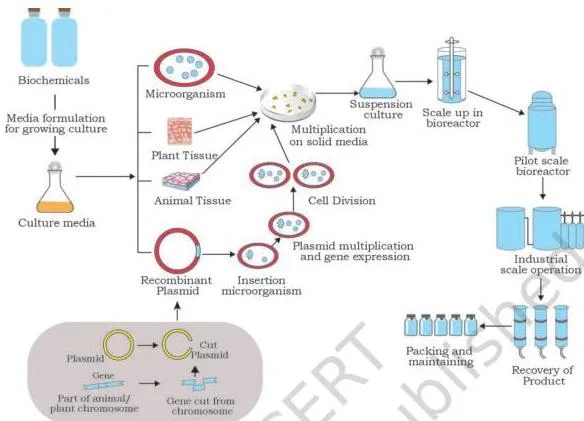
Fig. 10.4 is the chapter’s visual summary: the typical stages of bioprocess development are summarised in this diagram. Keep this master flow in mind — every later section on this page fills in one part of this diagram.
Primary vs Secondary Metabolites: What a Bioprocess Makes
Before a product can be made in bulk, the chapter wants you to know what is being made and why it is hard to get. Living organisms carry out many metabolic processes that form chemical compounds called metabolites, classified into two broad groups (NCERT, p. 231).
| Term | Meaning | Examples |
|---|---|---|
| Primary metabolites | Compounds produced directly by primary metabolic pathways; they support essential functions such as growth and development. | Amino acids, organic acids |
| Secondary metabolites | Intermediate or indirect products made by entirely separate secondary metabolic pathways; they are not needed for the organism’s growth. | Penicillin, shikonin, taxol |
Secondary metabolites take part in a range of functions (NCERT, p. 231):
- Defence against pathogens and herbivores.
- Tolerance to abiotic stresses.
- Attraction of insects and animals for fertilisation and seed dispersal.
- Discouraging unwanted feeders.
The economic point decides everything that follows: secondary metabolites have huge applications as pharmaceuticals, dyes, food additives, enzymes and vitamins (NCERT, p. 232), yet they are synthesised naturally in very small amounts. Bulk production is therefore impossible without bioprocessing — which is why the product tables later on this page are worth memorising.
Key Bioprocessing Terms at a Glance
One pass through this vocabulary makes every later section read smoothly. Each entry is one clear sentence with an example drawn from the chapter.
| Term | Meaning | Example from this chapter |
|---|---|---|
| Bioprocessing | Using living systems or their components with chemical-engineering processes to get products at a commercial level. | Making penicillin with Penicillium species |
| Bioreactor / fermenter | An engineered glass or steel vessel that supports a biologically active, aseptic environment for cell cultivation. | The vessel where the fermentation runs |
| Upstream processing | The pre-fermentation work: media, sterilisation, inoculum and environmental conditions. | Formulating medium in a shake flask |
| Downstream processing | The post-fermentation work: extraction, recovery, purification and effluent disposal. | Filtering and distilling the broth |
| Inoculum | Viable, healthy, fast-growing cells or organisms used to start the process. | A suspension culture in the log phase |
| Cellular yield coefficient (Y) | Dry cell weight produced per unit of carbon substrate utilised. | 0.375 g dry cells per g glucose |
| Extract / raffinate | After liquid-liquid extraction, the solute-rich phase (extract) and the residual liquid (raffinate). | Solvent-rich phase and leftover broth |
| Reverse osmosis | Pressure-driven membrane separation that pushes water against its concentration gradient. | Desalting saline water |
| Dialysis | Removal of low-molecular-weight solutes through a selectively permeable membrane. | Removing urea in an artificial kidney |
Bioreactor Anatomy: Parts, Functions and Three Types
A bioreactor is an engineered vessel made of glass or steel that supports a biologically active environment, where microbial, plant or animal cells are cultivated under aseptic conditions with the right nutrients and surroundings (NCERT, p. 233).
The five requirements of a bioreactor
- A sterile environment, so a pure culture can grow without contamination.
- Adequate air supply for cellular respiration in the culture.
- Uniform mixing of nutrients, cells and air throughout the vessel without causing shear stress to the cells.
- Maintenance of optimum temperature for growth and product formation.
- Monitoring of environmental parameters such as pH and dissolved oxygen (NCERT, p. 233).
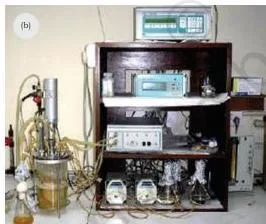
Parts and their functions
Fig. 10.1(a) shows the labelled anatomy: a cylindrical glass or steel vessel fitted with an agitator shaft whose impeller sits at its base, a sparger, baffles, a water jacket, temperature and pH probes, and a digital controller. Each part exists to meet one of the five requirements above.
| Part | Function | Why it matters |
|---|---|---|
| Agitator shaft (with impeller at its base) | Mixes the contents and keeps cells in homogeneous conditions for better transport of nutrients and oxygen. | Even conditions in every part of the vessel (NCERT, p. 235). |
| Sparger | Supplies sterilised air continuously through microfilters. | Submerged cells need oxygen for respiration. |
| Baffle | Breaks the vortex formed during stirring. | A vortex shifts the centre of gravity and makes the system consume extra power. |
| Jacket | Circulates water at the desired temperature. | Keeps the optimum temperature for growth and product formation. |
| Temperature and pH probes | Sense temperature and hydrogen-ion concentration. | Give the controller feedback on the process. |
| Digital controller | Displays and adjusts temperature, pH and stirring speed (rpm); commands addition of 1M NaOH or 1N HCl. | Holds process parameters at their set values (NCERT, p. 235). |
Memory device — A-S-B-J: the four main hardware parts are Agitator, Sparger, Baffle and Jacket. The probes and the digital controller form the sensing-and-control layer that watches over those four.
Three types of bioreactors
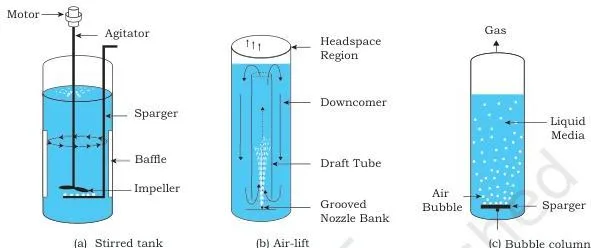
| Type | How mixing happens | Defining feature |
|---|---|---|
| Stirred tank | Agitator mixes nutrients, oxygen and growing cells. | Most conventional type; the presence of an agitator shaft is the characteristic feature, and impeller design varies with the process (NCERT, p. 235-236). |
| Air-lift | A draft tube creates an air current that lifts the broth and cells up and down, inside-out. | No impeller — moving air itself drives the circulation. |
| Bubble column | Air bubbles produced through a sparger jet mix nutrients and oxygen. | Low-shear environment with high oxygen transfer per unit of power input (NCERT, p. 236). |
Notice the recurring phrase: mixing without shear. The bubble column exists precisely because some cells cannot tolerate the mechanical stress of a stirred tank — shear sensitivity returns under upstream processing.
Upstream and Downstream Processing: The Two Stages
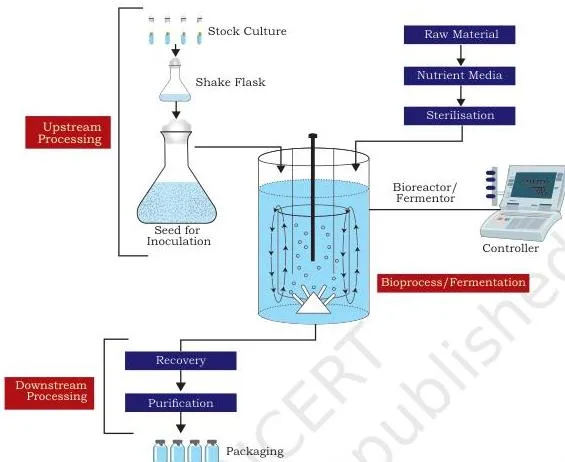
A bioprocess has two broad stages (NCERT, p. 236). Upstream processing is everything done before the fermentation; downstream processing is everything after it. Fig. 10.3 shows the complete pipeline:
- Formulation and optimisation of the nutrient media.
- Sterilisation of the media, bioreactor and additional tools and equipment.
- Production of a pure, healthy inoculum in sufficient quantity.
- Optimisation of environmental conditions for growth and product formation.
- Growth and product formation in the bioreactor.
- Extraction, recovery and purification of the product.
- Disposal of the effluents produced by the process (NCERT, p. 237).
Steps 1–4 are upstream, step 5 is the bioreactor itself, and steps 6–7 are downstream.
Factory line analogy: think of a factory production line. Upstream processing is the preparation bay — raw materials are measured, mixed and sterilised and the tools are laid out. The bioreactor is the production floor where the actual fermentation happens.
Downstream processing is the finishing bay, where the product is separated, purified and packaged, and the waste water is treated before it leaves the factory.
Inside Upstream Processing: Media, Yield, Inoculum and Sterilisation
Media design and the stoichiometric balance
The growth medium’s constituents vary with the species being grown and its biosynthetic needs, so the medium has to be formulated deliberately for each culture (NCERT, p. 238). The stoichiometric skeleton of growth and product formation is:
\[ \text{Carbon and energy source} + \text{Nitrogen source} \rightarrow \text{cell biomass} + \text{products} + \text{CO}_2 + \text{water} + \text{heat} + \text{other requirements} \]
Reading this as a balance sheet lets a producer design the media economically by minimising wastage of media components — you can calculate how much carbon the culture actually needs instead of overfeeding it (NCERT, p. 238).
Under aerobic conditions, the carbon requirement of a culture is estimated through the cellular yield coefficient (Y):
\[ Y = \frac{\text{Quantity of cell dry weight produced by the culture}}{\text{Quantity of carbon substrate utilised}} \]
The units are g dry cells per g substrate (NCERT, p. 238). The same logic applies to other media components — each is set for minimum wastage and optimum productivity.
Inoculum criteria
The inoculum is the viable, healthy, fast-growing, high-producing culture used to start a run. It may be grown on solid or liquid medium; a liquid culture grown in a shake flask is called a suspension culture. A usable inoculum must meet six criteria (NCERT, p. 239):
- Healthy and in the log or exponential phase — actively dividing.
- Shows no long lag phase after transfer.
- Available in sufficient amount for an inoculum of optimum size.
- Available in a suitable morphological form.
- Free of contamination.
- Retains its product-forming capability.
Aeration, agitation and shear sensitivity
Submerged suspension cultures need oxygen: ideally the maximum dissolved oxygen in pure water is about 8 g/L (NCERT, p. 239). In a bioreactor, pure sterilised air is sent through the sparger to maintain oxygen levels.
A mild agitation distributes oxygen and other nutrients uniformly. In a shake flask the shear stress on cells is controlled by adjusting the shaker speed in rpm; in a bioreactor it is controlled by the agitator speed. The shear sensitivity ladder matters for choosing equipment (NCERT, p. 240):
- Animal cells are more shear sensitive than plant cells.
- Plant cells are more sensitive to shear than microbial cells.
- Microbial cells are the least sensitive.
Temperature, pH and sterilisation
The optimum temperature for growth and for product formation may be the same or different, and both must be maintained (NCERT, p. 240). Hydrogen-ion concentration (pH) similarly affects growth and product formation, so its optimum must be held for an efficient bioprocess.
Sterilisation is an essential requirement. Contamination is avoided by following a five-point checklist (NCERT, p. 240):
- Sterilise the nutrient media.
- Sterilise the bioreactor vessel.
- Sterilise all materials added to the vessel during the process.
- Maintain aseptic conditions during fermentation.
- Use a pure culture as the inoculum.
Worked Example: Cellular Yield Coefficient Step by Step
Method: the cellular yield coefficient tells us how efficiently a culture converts its carbon substrate into dry cell biomass. It has the same shape as an efficiency — output of cells divided by input of carbon.
Step 1: Write the formula for the yield coefficient: cell dry weight produced divided by carbon substrate utilised.
\[ Y = \frac{\text{cell dry weight produced}}{\text{carbon substrate utilised}} \]
Step 2: Pull the data from the culture.
A bacterial culture in a bioreactor consumes 120 g of glucose as its carbon source and produces 45 g of dry cell biomass.
Substitute into the formula.
\[ Y = \frac{45\ \text{g}}{120\ \text{g}} = 0.375 \]
Step 3: Attach the units and interpret.
\( Y = 0.375\ \text{g dry cells per g glucose} \), which means about 37.5% of the carbon consumed ends up as biomass.
The remaining carbon leaves as CO₂, water, heat and secreted products — which is exactly why media design cares about yield.
Step 4: Scale the result up.
A production batch must deliver 90 kg of dry biomass at the same yield.
Glucose required = 90 kg divided by 0.375.
\[ \text{Glucose required} = \frac{90\ \text{kg}}{0.375} = 240\ \text{kg} \]
Final answer: The culture converts glucose to biomass with \( Y = 0.375\ \text{g/g} \), and a 90 kg biomass batch needs 240 kg of glucose. Note how the units flow: yield in g/g is dimensionless in effect, so kg of biomass divided by g/g gives kg of substrate.
Batch vs Fed-Batch vs Continuous: Three Modes of Operation
One key decision in designing a bioprocess is the mode of operation. The chapter distinguishes three modes (NCERT, p. 241):
| Feature | Batch | Fed-batch | Continuous |
|---|---|---|---|
| What is added | An initial fixed amount of nutrients only. | The limiting substrate, fed intermittently or continuously. | Fresh nutrient medium, added continuously. |
| What is removed | Nothing until the end. | No volume is removed, so the volume rises. | Used medium is removed continuously. |
| What stays constant | Nothing — the culture passes through the phases of the growth cycle. | Substrate concentration and substrate utilisation rate stay constant while biomass and product keep rising. | A steady state: growth rate, substrate concentration and utilisation rate all stay constant. |
| When it is preferred | For simple closed systems. | When growth is limited by one or more substrate components and high residual substrate is toxic. | When a continuous, steady supply of the product is needed. |
Fig. 10.5 (graphs of cell biomass X, substrate concentration S and substrate utilisation rate Qs against time for each mode) shows these trends: in batch mode the culture passes through the growth cycle as nutrients are consumed; in fed-batch mode, S and Qs hold steady while biomass climbs; in continuous mode a steady state forms in which the new biomass formed by the culture is balanced by the loss of cells, so all three quantities level off (NCERT, p. 241-242).
Each mode exists for a reason: batch for simplicity, fed-batch to keep residual substrate low and avoid toxic effects, and continuous for an uninterrupted product stream.
Downstream Processing: Solid-Liquid Separation and Cell Disruption
Downstream processing recovers the product efficiently. Two governing rules apply to any recovery process: it must be quick, and it must run with minimum investment and operating cost (NCERT, p. 243).
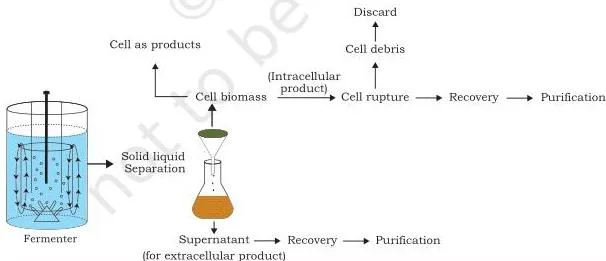
Fig. 10.6 shows the toolbox of downstream operations: separation of particulates, dialysis, reverse osmosis, solid-liquid separations, adsorption, liquid-liquid extraction, distillation and drying (NCERT, p. 242-243). The route you choose depends on where the product lives — in the cell biomass, in the extracellular broth, or inside the cells.
Solid-liquid separation
- Filtration is the most common cost-effective method for large particles and cell biomass, using canvas, synthetic fabrics or glass fibre as the filter medium. Continuous rotary filters are the most widely used filters in industry. Some broths need pre-treatment first, such as heating, pH adjustment, or treatment with coagulating and flocculating agents (NCERT, p. 243).
- Centrifugation separates particles of roughly 100 µm down to 0.1 µm in a centrifuge or ultracentrifuge (NCERT, p. 243).
Cell disruption
If the product is intracellular, it must be released by rupturing the cells. The rupture method must be powerful yet mild enough not to damage the product (NCERT, p. 243). Methods include:
- Physical: milling in high-speed bead mills, homogenisation under high pressure, and ultrasonic vibrations in an ultrasonicator — the last is very effective with most cell suspension cultures.
- Non-mechanical: treatment with surfactants, alkalis or organic solvents, or osmotic shock.
- Biological: enzymatic degradation of the cell wall.
Recovery and Purification: Extraction, Membrane Filtration, RO and Dialysis
After solids and liquid are separated, the product sits in a dilute aqueous solution and must be recovered and purified. The choice of recovery process rests on five criteria (NCERT, p. 244):
- Intracellular or extracellular location of the product.
- Concentration of the product in the culture fluid.
- Physical and chemical properties of the desired product.
- The minimal acceptable standard of purity.
- The impurities present in the culture fluid.
Liquid-liquid extraction and precipitation
Liquid-liquid extraction separates a component from a liquid mixture by treating it with a solvent in which the desired component is preferentially soluble. After extraction, the solute-rich phase is the extract and the residual liquid is the raffinate (NCERT, p. 244).
Precipitation is a purification technique widely used for proteins and antibiotics, induced by adding salts or organic solvents, or by ultrafiltration (NCERT, p. 244).
Membrane filtration: choosing the right pore size
The three pressure-driven membrane separations differ only in pore size, and the decision rule follows directly from what each membrane retains (NCERT, p. 245):
| Process | Pore size | What it retains |
|---|---|---|
| Microfiltration | 0.1 to 10 \( \mu\text{m}\) | Suspended material such as bacteria |
| Ultrafiltration | 0.01 to 0.1 \( \mu\text{m}\) | Biological colloids and macromolecules (proteins) |
| Reverse osmosis | \( \lt 0.001\ \mu\text{m}\) | All suspended and dissolved materials |
- Microfiltration for suspended material such as bacteria — the coarsest of the three membranes.
- Ultrafiltration for biological colloids and macromolecules such as proteins, which fall inside its molecular-weight range.
- Reverse osmosis when every suspended and dissolved material must be removed.
The book’s table also records molecular-weight cut-offs — ultrafiltration handles roughly 300–300,000 Da and reverse osmosis retains even molecules below about 300 Da — which is why protein products sit within the ultrafiltration range (NCERT, p. 245). These are pressure-driven processes, and the pressure needed rises with pore tightness: about 10 psi for microfiltration, 10–100 psi for ultrafiltration, and 100–800 psi for reverse osmosis.
Reverse osmosis
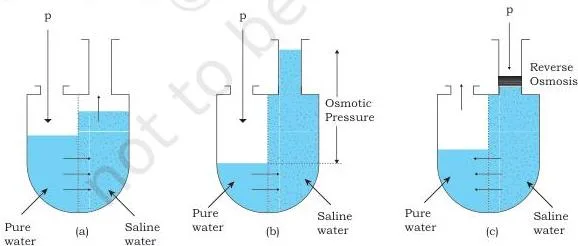
Fig. 10.7 walks the logic in three panels. If saline water is separated from pure water by a semipermeable membrane, ordinary osmosis moves water from the pure side into the saline side; as water moves over, the pressure on the saline side rises, and that pressure is the osmotic pressure.
Reverse osmosis applies pressure to the salt-containing phase that is slightly larger than the osmotic pressure, driving water in the reverse direction — against the concentration gradient (NCERT, p. 245).
Dialysis
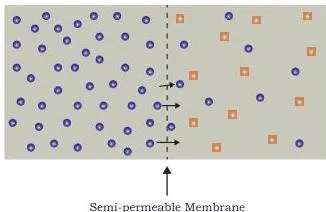
Dialysis removes low-molecular-weight solutes through a selectively permeable membrane: organic acids (100–500 Da), inorganic ions (10–100 Da) and urea (MW 60) cross from the high-concentration side to the low-concentration side. Because the membrane’s pore cut-off is very small, only small molecules move, until at equilibrium the chemical potentials of the diffusing compounds on both sides are equal (NCERT, p. 246).
Real-life hook: you already use both ideas. Household reverse-osmosis purifiers apply exactly this pressure-driven separation, and the artificial kidney is a dialysis device that removes urea (MW 60) from the blood.
Commercial Products and the Microbes That Make Them
Bioprocessing industries now deliver valuable products from primary metabolites (amino acids and organic acids) as well as secondary metabolites (antibiotics), using microbial, animal and plant cells and their constituents (NCERT, p. 246).
Where the product lives
| Type | Products |
|---|---|
| Cell biomass | Baker’s yeast, single cell protein |
| Extracellular | Alcohols, organic acids, amino acids, enzymes, antibiotics |
| Intracellular | Recombinant DNA proteins |
Major commercial products
| Product | Category | Microorganism, plant or animal cells used |
|---|---|---|
| Ethanol | Alcohol | Saccharomyces cerevisiae |
| L-glutamic acid | Amino acid | Corynebacterium glutamicum |
| Lactic acid | Organic acid | Lactobacillus delbrueckii |
| Proteases | Enzymes | Bacillus spp. |
| Pectinase | Enzymes | Aspergillus niger |
| Penicillin | Antibiotic | Penicillium chrysogenum |
| Vitamin B12 | Vitamin | Propionibacterium or Pseudomonas denitrificans |
| Diphtheria vaccine | Vaccine | Corynebacterium diphtheriae |
| Insulin | Recombinant protein | Recombinant Escherichia coli |
| Shikonin | Pigment (naphthaquinone) | Lithospermum erythrorhizon |
| Taxol | Plant alkaloid | Taxus brevifolia |
These pairs come from Table 10.3 of the textbook (NCERT, p. 247). Revision habit: cover the organism column and try to recall the microbe behind each product, then reverse the direction.
Highlights worth remembering
- Alcohol: wine and beer are made without distillation, while whisky, brandy and rum are produced by distillation of the fermented broth (NCERT, p. 246).
- Enzymes: lipases remove oily stains in detergents; pectinases and proteases clarify bottled fruit juices bought from the market; proteases are used in the leather industry (NCERT, p. 248).
- Medical bioactives: streptokinase (from Streptococcus, modified by genetic engineering) is a “clot buster” for patients after myocardial infarction; cyclosporin A from Trichoderma polysporum is an immunosuppressant for organ-transplant patients; statins from Monascus purpureus lower blood cholesterol by competitively inhibiting the enzyme that synthesises cholesterol (NCERT, p. 248).
- Vitamins: vitamin B12 was first obtained as a by-product of antibiotic fermentation (streptomycin, chloramphenicol, neomycin); riboflavin is made by biotransformation as well as fermentation, with Ashbya gossypii the preferred high-yielding strain (NCERT, p. 248-249).
- Vaccines: diphtheria toxin from Corynebacterium diphtheriae is processed into toxoid and then vaccine; influenza vaccine production uses mammalian cell cultures (NCERT, p. 249).
- Plant cell culture: the dye shikonin from Lithospermum erythrorhizon was the first dye commercially developed through cell culture, followed by berberine, ginseng, saponin and taxol (NCERT, p. 249).
- Recombinant human insulin is produced by a two-phase cultivation: a glycerol batch followed by a continuous methanol fed-batch (NCERT, p. 250).
Plant cell and tissue culture runs throughout this product list; you can follow the cultivation side with the Stem Cell Culture and Organ Culture notes. The chapter ends by noting that many more compounds are in the development pipeline (NCERT, p. 250) — related chapter notes such as the Recent Innovations in Biotechnology notes are available to pair with this one.
Common Mistakes in Bioprocessing (and the Corrections)
These are the traps students fall into most often with this chapter. Each row gives the wrong idea, the correct rule, and a quick way to check your own answer.
| Mistake | Correct rule | How to check your answer |
|---|---|---|
| “A fermenter and a bioreactor are different machines.” | In this chapter the two words name the same engineered vessel used for cultivation under aseptic conditions. | Replace one word with the other in a sentence about the growth phase — the sentence must still make sense. |
| “The sparger mixes the culture.” | The sparger supplies sterilised air through microfilters; the agitator shaft and impeller do the mixing. | Ask which part is connected to the air supply and which one stirs the contents. |
| “Baffles create the vortex.” | Baffles break the vortex, because a vortex shifts the centre of gravity and consumes extra power. | Ask what happens to the vortex when baffles are fitted — it is suppressed. |
| “Cell disruption is needed for every product.” | Disruption is needed only for intracellular products; extracellular products are recovered directly from the broth. | Locate the product first: inside the cell, or floating in the culture fluid? |
| “Ultrafiltration removes bacteria like microfiltration.” | Microfiltration retains suspended material including bacteria; ultrafiltration retains colloids and macromolecules; reverse osmosis retains nearly everything. | Compare pore sizes: microfiltration is the coarsest, reverse osmosis the finest. |
| “Secondary metabolites are waste by-products.” | They are not needed for growth, but they defend, buffer stress and attract — and they drive the whole bioprocessing industry. | Name the functions of one secondary metabolite, such as shikonin or taxol. |
| “Microbial cells are the most shear sensitive.” | Animal cells are more shear sensitive than plant cells, which are more sensitive than microbial cells. | Order the ladder: animal, then plant, then microbial — microbial cells are the toughest. |
| “Every alcoholic drink needs distillation.” | Wine and beer are produced without distillation; distilled drinks such as whisky, brandy and rum are different. | Separate fermented drinks from distilled spirits before answering. |
Exam Notes: How to Structure Complete Answers
The chapter closes with ten exercises. Here is how to structure a complete answer for each one, tied to the textbook’s own reasoning.
| Textbook exercise | What a complete answer contains |
|---|---|
| 1. Differentiate primary and secondary metabolites | A two-column table based on functions, plus at least one example on each side. |
| 2. Challenges during the development of a bioprocess | Build the answer around the five bioreactor requirements (sterile environment, air supply, mixing without shear, temperature, monitoring), and close with scale-up and economics. |
| 3. Design and components of a typical bioreactor | Name each component, give one function and one application for it; a labelled sketch in the style of Fig. 10.1 is the fastest complete answer. |
| 4. Basic operational stages using a concept map | Central node “bioprocess” with three branches: upstream (four components), bioreactor, downstream (two steps). |
| 5(a),(b). Upstream and downstream processing | Short descriptive paragraphs listing the four upstream components and the two downstream components. |
| 6. Recovery and purification of an intracellular product | Flow diagram: cell disruption (physical and non-mechanical methods) → separation → recovery → purification; state why disruption is needed (the product is inside the cell). |
| 7. Short notes on reverse osmosis and dialysis | For each: a one-line definition, the mechanism (pressure against the concentration gradient for RO; diffusion through a selectively permeable membrane for dialysis), and one application. |
| 8. Matching bioreactor parts | Agitator — mixing the contents; sparger — continuous air supply; baffle — breaking the vortex; jacket — circulating water at the desired temperature (NCERT, p. 235). |
| 9. Closed-vessel culture (MCQ) | Apply the definition of a closed system: no additional medium is added and none is removed, so the culture is a batch culture (NCERT, p. 241). |
| 10. Assertion and reason on secondary metabolites | Both statements are true, but the reason describes the origin of secondary metabolites and does not explain the functions listed in the assertion — so the reason is not the correct explanation (NCERT, p. 231). |
One-Page Revision Recap
The pipeline in one line
The whole chapter in one line: a desired metabolite needs upstream processing (media, sterilisation, inoculum, conditions) → the bioreactor for fermentation → downstream processing (recovery and purification) → the recovered product, with effluent disposal as the last step.
Bioreactor parts mini table
| Part | One-line function |
|---|---|
| Agitator shaft | Mixes the contents and keeps conditions homogeneous. |
| Sparger | Supplies sterilised air through microfilters. |
| Baffle | Breaks the vortex and saves power. |
| Jacket | Circulates water to hold the desired temperature. |
| Probes + controller | Sense temperature and pH, then adjust process parameters. |
Modes mini table
| Mode | One-line descriptor |
|---|---|
| Batch | Closed system: fixed nutrients, nothing added or removed. |
| Fed-batch | Limiting substrate fed in; volume rises and residual substrate stays low. |
| Continuous | Fresh medium in, used medium out; a steady state is maintained. |
Product-organism mini table
| Product | Organism |
|---|---|
| Ethanol | Saccharomyces cerevisiae |
| L-glutamic acid | Corynebacterium glutamicum |
| Lactic acid | Lactobacillus delbrueckii |
| Proteases | Bacillus spp. |
| Pectinase | Aspergillus niger |
| Penicillin | Penicillium chrysogenum |
| Vitamin B12 | Propionibacterium or Pseudomonas denitrificans |
| Insulin | Recombinant Escherichia coli |
| Shikonin | Lithospermum erythrorhizon |
| Taxol | Taxus brevifolia |
Frequently Asked Questions
What is the difference between upstream and downstream processing?
Upstream processing is everything done before fermentation: formulation and optimisation of the growth medium, sterilisation of the medium and equipment, production of a pure healthy inoculum, and optimisation of environmental conditions. Downstream processing is everything after fermentation: extraction, recovery and purification of the product, plus disposal of the process effluents (NCERT, p. 237).
What is the function of each part of a bioreactor?
Each part has one main job.
The agitator shaft (with an impeller at its base) mixes the contents; the sparger supplies sterilised air through microfilters; the baffle breaks the vortex so the system does not waste power; the jacket circulates water at the desired temperature; the temperature and pH probes sense the process; and the digital controller displays and adjusts parameters, commanding acid or base addition to hold the pH (NCERT, p. 235).
How do you calculate the cellular yield coefficient?
Use the definition: Y = cell dry weight produced divided by carbon substrate utilised (NCERT, p. 238). If a culture uses 120 g of glucose and produces 45 g of dry biomass, then Y = 45/120 = 0.375 g dry cells per g glucose. The higher Y is, the more of the carbon substrate is being converted into biomass.
What is the difference between reverse osmosis and dialysis?
Both separate through membranes, but differently. Reverse osmosis is pressure-driven: applied pressure slightly larger than the osmotic pressure pushes water against its concentration gradient, so it removes all suspended and dissolved materials (NCERT, p. 245). Dialysis is concentration-driven: low-molecular-weight solutes such as urea (MW 60) diffuse through a selectively permeable membrane from high to low concentration until chemical potentials balance (NCERT, p. 246).
Which microorganisms are used to produce ethanol, penicillin and insulin?
Ethanol is produced by the brewer’s or baker’s yeast Saccharomyces cerevisiae; penicillin by the mould Penicillium chrysogenum; and human insulin by recombinant Escherichia coli (NCERT, p. 247).
Reference: NCERT Class 12 Biotechnology textbook, chapter Bioprocessing and Biomanufacturing.
Explore Class 12 Biotechnology Notes
- Class 12 Biotechnology Notes
- Class 12 CBSE Notes
- CBSE Notes for Classes 1 to 12
- Previous: Stem Cell Culture and Organ Culture
- Next: Recent Innovations in Biotechnology
Class 12 Biotechnology on LearnCBSE:
Related chapters:
- Recombinant DNA Technology notes
- Host–Vector System notes
- Gene Cloning notes
Official source: download the NCERT textbook free from ncert.nic.in.