
These appraisal class 11 notes cover the whole NCERT chapter “Liberalisation, Privatisation and Globalisation: An Appraisal” in a compact, revision-ready format: the 1991 crisis that pushed India into reform, the three reform heads — liberalisation, privatisation and globalisation — and the balance-sheet of three decades of change. They follow the NCERT Class 11 Indian Economic Development textbook for the 2026-27 session.
Use this page as your second read of the chapter: skim the tables and worked examples first, then revisit any section before a test. Every term, figure and data point is drawn from the textbook itself, with page references so you can cross-check quickly. The same treatment of every chapter in this book lives in the Class 11 economics notes collection.
What this chapter appraises: the 1991 reforms in one paragraph
The chapter sets itself four jobs at the start (NCERT, p. 38): understand why India changed its policies in 1991, understand the mechanism through which the reforms were introduced, comprehend globalisation and its implications for India, and see how the reform process affected various sectors.
The word appraisal signals a judgement passed after the fact. This chapter is not just a description of the New Economic Policy — it is a balance-sheet drawn up after the reforms had decades of experience behind them.
The verdict is deliberately mixed: faster GDP growth and vastly larger foreign exchange reserves stand against decelerating agriculture, fluctuating industry and widening disparities (NCERT, p. 52). Keep this two-sided frame in mind; every later section feeds into it.
The 1991 crisis: why India changed its economic policies
India was pushed into reform by a balance of payments crisis, not by choice. The causal chain the chapter builds is worth memorising as a sequence (NCERT, pp. 39-40):
- Through the 1980s the government spent more than it earned; the gap — the deficit — was financed by borrowing from banks, from people within the country, and from international financial institutions.
- Much of the borrowed foreign exchange reserves was spent on meeting consumption needs rather than on investment that could generate returns.
- Exports were not boosted, while imports grew at a very high rate — the two trends moved in opposite directions.
- Foreign exchange reserves fell to a level not sufficient to finance imports for even a fortnight — two weeks of imports.
- India also lacked the foreign exchange to pay interest to international lenders, and no country or international funder was willing to lend further.
- India approached the International Bank for Reconstruction and Development (IBRD), popularly known as the World Bank, and the International Monetary Fund (IMF), and received $7 billion as a loan to manage the crisis.
- The loan carried conditions: liberalise and open up the economy, remove restrictions on the private sector, reduce the government’s role, and remove trade restrictions between India and other countries.
- India accepted these conditionalities and announced the New Economic Policy (NEP) — wide-ranging reforms whose thrust was a more competitive environment and the removal of barriers to the entry and growth of firms.
Three terms from this chain should be fixed before you go further:
- Deficit — the excess of government expenditure over government income, financed by borrowing.
- Foreign exchange reserves — foreign currency holdings used to pay for imports such as petroleum and for international obligations.
- Financial institutions — international organisations, such as the World Bank and IMF, from which governments borrow.
Stabilisation vs structural reform: the two halves of the NEP
The NEP’s policies split into two groups that students constantly mix up. The comparison table below is the fastest way to separate them (NCERT, pp. 40-41).
| Basis | Stabilisation measures | Structural reform measures |
|---|---|---|
| Time horizon | Short-term | Long-term |
| Problem targeted | Weakness in the balance of payments; inflation | Rigidities in the economy that lower efficiency |
| Goal | Maintain sufficient foreign exchange reserves; keep rising prices under control | Improve efficiency and international competitiveness |
| Nature of action | Immediate correction | Gradual restructuring |
| Examples in this chapter | Rupee devaluation; controlling price rise | Delicensing; financial sector reform; trade liberalisation |
Beneath these two umbrella groups sit the three heads of policy: liberalisation, privatisation and globalisation. One memory hook keeps the order straight: LPG is the fuel of the reform engine — first liberalise the economy (free firms from controls), then privatise (pass ownership to private hands), then go global (integrate with the world).
The sequence is logical: freeing firms comes first, reducing state ownership second, and opening to the world last.
Liberalisation: five sectors opened up after 1991
Liberalisation means putting an end to the rules, licences and controls that had become hindrances to growth, and opening various sectors of the economy (NCERT, p. 41). The 1991 reforms touched five areas.
| Area | What changed |
|---|---|
| Industrial sector | Industrial licensing abolished for almost all categories; market allowed to determine prices in most industries; many small-scale industry goods dereserved. |
| Financial sector | RBI’s role reduced from regulator to facilitator; private Indian and foreign banks established; foreign investment limit in banks raised to around 74 per cent; banks meeting conditions can open branches without RBI approval; Foreign Institutional Investors (FIIs) such as merchant bankers, mutual funds and pension funds allowed to invest in Indian markets (NCERT, pp. 41-42). |
| Tax reforms | Continuous reduction in individual income tax and corporation tax; indirect tax reform for a common national market; 2016 constitutional amendment led to GST — “one nation, one tax and one market”; procedures simplified and rates lowered (NCERT, p. 42). |
| Foreign exchange | Rupee devalued in 1991 to resolve the crisis; exchange rates now determined by market demand and supply of foreign exchange. |
| Trade and investment | Quantitative restrictions dismantled; tariff rates reduced; import licensing abolished except for hazardous and environmentally sensitive industries; export duties removed; quantitative restrictions on manufactured consumer goods and agricultural imports fully removed from April 2001 (NCERT, p. 43). |
What did not change: three sets of exceptions survive the reforms, and questions love to test them.
- Industrial licensing still applies to seven categories: alcohol, cigarettes, hazardous chemicals, industrial explosives, electronics, aerospace, and drugs and pharmaceuticals (NCERT, p. 41). Memory hook: the first letters spell ACHIEAD — “achieve” without the v.
- The public sector remains in a part of atomic energy generation and some core railway activities. Hook: “trains and atoms stay with the state”.
- In banking, the RBI did not vanish — it moved from controller to facilitator while keeping certain managerial aspects to safeguard the interests of account-holders and the nation (NCERT, p. 42).
Privatisation: disinvestment, Navratnas and the PSE debate
Privatisation means shedding the ownership or management of a government-owned enterprise. It happens in two ways: the government withdraws from ownership and management, or the enterprise is sold outright (NCERT, p. 44).
Disinvestment is the specific mechanism India used: selling off part of the equity of public sector enterprises (PSEs) to the public. The government’s stated purposes were to improve financial discipline, facilitate modernisation, and use private capital and managerial capability to improve the performance of PSUs (NCERT, p. 44).
To improve efficiency and professionalism, the government granted graded autonomy to selected PSEs as Maharatnas, Navratnas and Miniratnas (NCERT, p. 44, Box 3.1).
| Status | Examples from Box 3.1 |
|---|---|
| Maharatnas | Indian Oil Corporation Limited (IOCL); Steel Authority of India Limited (SAIL) |
| Navratnas | Hindustan Aeronautics Limited (HAL); Mahanagar Telephone Nigam Limited (MTNL); Indian Railway Catering and Tourism Corporation Limited (IRCTC) |
| Miniratnas | Bharat Sanchar Nigam Limited (BSNL); Airports Authority of India |
Two sides of this story matter for your answers. The government argued that the new status improved performance and that privatisation would give a strong impetus to the inflow of foreign direct investment.
Scholars countered that profitable PSEs were partly privatised through disinvestment, that their assets were undervalued, and that the proceeds were used to offset revenue shortages rather than to develop PSEs or build social infrastructure (NCERT, pp. 44, 50).
Globalisation: outsourcing, IT and the WTO
Globalisation means the integration of the domestic economy with the world economy, turning the world into “one whole” or a borderless world — happenings miles away can influence events in India. It is the outcome of the policies of liberalisation and privatisation (NCERT, p. 45).
Outsourcing is one of the important outcomes of globalisation. A company hires regular services from external sources — mostly in other countries — that were previously provided internally, such as legal advice, computer service, advertisement and security (NCERT, p. 45).
The rise of fast communication and Information Technology intensified it: voice-based processes (popularly called BPO or call centres), record keeping, accountancy, banking services, music recording, film editing, book transcription, clinical advice and even teaching are outsourced to India. Text, voice and visual data are digitised and transmitted in real time across continents.
India is a favoured destination because services can be had at a cheaper cost with reasonable skill and accuracy, and because low wage rates combine with skilled manpower (NCERT, p. 46).
World Trade Organisation (WTO): the WTO was founded in 1995 as the successor to the General Agreement on Trade and Tariffs (GATT), which was established in 1948 with 23 countries (NCERT, p. 46).
The WTO is expected to establish a rule-based trading regime in which nations cannot place arbitrary restrictions on trade, to enlarge production and trade of services, to ensure optimum utilisation of world resources, and to protect the environment. India, an important WTO member, has kept its commitments by removing quantitative restrictions and reducing tariff rates (NCERT, p. 47).
The chapter also records the criticism: a major volume of world trade occurs among developed nations, and developing countries feel forced to open their markets while not getting equal access to developed countries’ markets (NCERT, p. 48).
See the reforms in your daily life: the GST line on every bill you receive is the 2016 tax reform; the private and foreign bank branches on city streets reflect the financial sector opened after 1991; and when you call a helpline and reach a call-centre employee, you have met outsourcing — the same BPO industry shown in Fig. 3.1 below.
Two figures that capture globalisation
The chapter carries two visual sources that you can cite in answers to show you know the reform record.
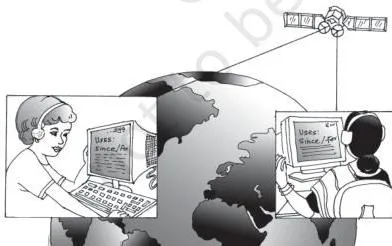
Fig. 3.1 appears inside the outsourcing discussion (NCERT, p. 46). Read it as the face of the BPO boom: voice-based business processes create new employment opportunities in big cities — exactly the service jobs the chapter lists, such as call centres, record keeping, accountancy and banking services.
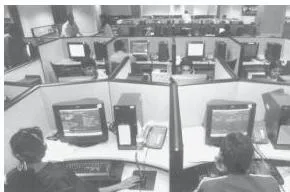
Fig. 3.2 opens the assessment section (NCERT, p. 48). It makes the same point as the chapter’s data: since 1991 India has become a successful exporter of IT software, and the IT industry is a major contributor to export earnings.
Three decades of reforms: the appraisal
The assessment section measures growth through GDP and compares sectors across periods using Table 3.1 (NCERT, p. 47). The condensed version below shows the whole story at a glance: total growth rose from 5.6 per cent (1980-91) to 9.4 per cent (2021-22), but the three sectors behaved very differently.
| Sector | 1980-91 | 1992-2001 | 2002-07 | 2007-12 | 2012-13 | 2013-14 | 2021-22 |
|---|---|---|---|---|---|---|---|
| Agriculture | 3.6 | 3.3 | 2.3 | 3.2 | 1.5 | 4.2 | 4.8* |
| Industry | 7.1 | 6.5 | 9.4 | 7.4 | 3.6 | 5.0 | 12.7* |
| Services | 6.7 | 8.2 | 7.8 | 10.0 | 8.1 | 7.8 | 9.2* |
| Total | 5.6 | 6.4 | 7.8 | 8.2 | 5.6 | 6.6 | 9.4 |
*Data pertaining to Gross Value Added (GVA). The GVA is estimated from GDP by adding subsidies on production and subtracting indirect taxes (NCERT, p. 47).
Read the table as the chapter does: agriculture’s growth decelerated, industry fluctuated, and services climbed — so GDP growth was mainly driven by the service sector (NCERT, p. 48).
Two financial indicators underline the turnaround: foreign investment (FDI plus FII) rose from about $100 million in 1990-91 to $23 billion in 2022-23, and foreign exchange reserves from about $6 billion to about $646 billion in 2023-24, making India one of the largest reserve holders in the world (NCERT, p. 48).
The chapter’s sector-wise verdict, positive and negative together, forms its appraisal scorecard:
| Sector | Positive outcome recorded | Negative outcome recorded |
|---|---|---|
| Agriculture | High growth rate in 2013-14 | Fall in public investment; fertiliser subsidy cuts raised costs; import competition; shift to cash crops pressured food grain prices |
| Industry | Continuous positive growth after the 2012-13 slump | Cheaper imports replaced domestic demand; weak infrastructure and power supply; non-tariff barriers in developed country markets |
| Services | Growth stayed higher than overall GDP through 2007-22; IT software a major export | Growth concentrated in select segments (IT, finance, telecom, real estate) rather than sectors providing mass livelihoods |
Four more results complete the assessment. First, growth and employment: reform-led growth did not generate sufficient employment opportunities (NCERT, p. 49) — a theme the book develops further in a later unit, and in the revision page on Human Capital Formation in India.
Second, the Mahadeva case (NCERT, p. 49) illustrates agriculture’s plight: a groundnut farmer in drought-prone Anantpur, Andhra Pradesh, spent Rs 10,000 on half an acre, earned Rs 14,000, then faced higher input costs after subsidy cuts, cheap imported edible oils, and no government irrigation or research support.
Third, disinvestment: the 1991-92 target was Rs 2,500 crore and the government mobilised Rs 3,040 crore; by 2022-23 it mobilised about Rs 46,000 crore — yet critics say assets were undervalued and proceeds plugged revenue gaps instead of building PSEs or social infrastructure (NCERT, p. 50). The sector’s human cost is captured in the Siricilla tragedy, where 50 powerloom weavers died after power tariff hikes (NCERT, p. 51).
The fiscal result was also disappointing: tax cuts meant to curb evasion did not raise revenue, tariff cuts reduced customs earnings, and incentives to foreign investors further narrowed the tax base — squeezing developmental and welfare expenditure (NCERT, p. 51).
Definitions at a glance
These are the terms a Class 11 answer may ask you to define or use. The meanings below are student-friendly rewrites of the textbook’s own explanations.
| Term | Meaning | Example or context |
|---|---|---|
| Foreign exchange reserves | Foreign currency held by the central bank to pay for imports and foreign obligations | Fell below two weeks of imports in 1991; about $646 billion in 2023-24 |
| Deficit | Excess of government expenditure over income, financed by borrowing | 1980s deficits made borrowing unsustainable |
| Stabilisation measures | Short-term NEP measures to correct balance of payments weakness and control inflation | Keeping reserves adequate; controlling price rise |
| Structural reform measures | Long-term NEP measures to improve efficiency and international competitiveness by removing rigidities | Delicensing; financial sector reform |
| Liberalisation | Ending restrictions that hindered growth and opening up sectors of the economy | Industrial delicensing after 1991 |
| Privatisation | Shedding the ownership or management of a government-owned enterprise | Outright sale or government withdrawal |
| Disinvestment | Selling part of a PSE’s equity to the public | Rs 2,500 crore target in 1991-92 |
| Globalisation | Integration of the domestic economy with the world economy — a borderless world | Events abroad influencing India |
| Outsourcing | Hiring services from external, often foreign, sources that were earlier provided internally | BPO call centres, record keeping, accountancy |
| WTO | World Trade Organisation, founded 1995 as successor to GATT | Rule-based trading regime |
| FDI and FII | Foreign direct investment and foreign institutional investment (merchant bankers, mutual funds, pension funds) | Rose from about $100 million to $23 billion |
| Quantitative restrictions | Limits on the quantity of goods that can be imported | Removed on consumer and agricultural imports from April 2001 |
| Tariff | A tax imposed on imported goods | Kept very high before 1991 to protect domestic industry |
| Devaluation | Official reduction of the rupee’s value against foreign currencies | Done in 1991 to ease the balance of payments crisis |
| GST | Goods and Services Tax, an indirect tax creating a common national market | Introduced after the 2016 constitutional amendment |
Formulas and key numbers: the GVA to GDP link
The chapter contains one explicit quantitative relation, stated in the note under Table 3.1 (NCERT, p. 47):
\[ \text{GVA} = \text{GDP} + \text{subsidies on production} – \text{indirect taxes} \]
Rearranged to recover GDP:
\[ \text{GDP} = \text{GVA} – \text{subsidies on production} + \text{indirect taxes} \]
- GVA — Gross Value Added: the value of output produced in the economy; the starred figures in Table 3.1 are GVA data.
- GDP — Gross Domestic Product: the total value of final goods and services produced in the economy.
- Subsidies — government payments that lower producers’ costs; added to GDP because GDP is measured at market prices.
- Indirect taxes — taxes on goods and services that raise market prices; subtracted because they are not income of producers.
Key numbers worth quoting in answers:
- $7 billion — crisis loan from the World Bank and IMF (NCERT, p. 40).
- FDI plus FII: about $100 million (1990-91) to $23 billion (2022-23) (NCERT, p. 48).
- Foreign exchange reserves: about $6 billion (1990-91) to about $646 billion (2023-24) (NCERT, p. 48).
- Disinvestment: target Rs 2,500 crore (1991-92), mobilised Rs 3,040 crore; about Rs 46,000 crore (2022-23) (NCERT, p. 50).
- Overall GDP growth: 5.6 per cent (1980-91) to 9.4 per cent (2021-22) (NCERT, p. 48).
Worked examples: applying the chapter’s numbers
Worked example 1: Applying the GVA–GDP relation
Method: use the relation from Table 3.1’s note, \( \text{GVA} = \text{GDP} + \text{subsidies} – \text{indirect taxes} \).
- Step 1: Write the given values: GDP = Rs 120 crore, subsidies on production = Rs 6 crore, indirect taxes = Rs 18 crore.
- Step 2: Substitute into the relation:
\[ \text{GVA} = 120 + 6 – 18 \]
Step 3: Add first, then subtract: \( 120 + 6 = 126 \), and \( 126 – 18 = 108 \).
Final answer: GVA = Rs 108 crore.
Check: \( \text{GDP} = \text{GVA} – \text{subsidies} + \text{indirect taxes} = 108 – 6 + 18 = 120 \) crore.
The numbers return to the starting GDP, so the calculation is consistent.
Worked example 2: The cost logic of outsourcing
Method: compare the in-house cost with the outsourced vendor’s charge.
The annual saving is the difference; the saving percentage is the saving divided by the original in-house cost.
- Step 1: Write the given values: in-house support function = Rs 2.4 crore per year; Indian vendor charge = Rs 0.6 crore per year.
- Step 2: Annual saving = \( 2.4 – 0.6 = 1.8 \) crore rupees.
- Step 3: Saving percentage = \( \frac{1.8}{2.4} \times 100 = 75 \) per cent.
Final answer: annual saving of Rs 1.8 crore, which is 75 per cent of the in-house cost.
Why it matters: this is the same cost logic the chapter uses — low wage rates and skilled manpower make India a destination for global outsourcing.
Common mistakes to avoid in this chapter
Two confusions cause most lost clarity in answers. Settle them first:
| Confusion | Correct position |
|---|---|
| Disinvestment = privatisation | Disinvestment is selling part of a PSE’s equity to the public; privatisation is shedding the ownership or management of a government enterprise. Disinvestment is one route towards privatisation, but a partial equity sale does not by itself transfer full ownership or management (NCERT, p. 44). |
| GATT = WTO | GATT was established in 1948 with 23 countries; the WTO was founded in 1995 as its successor. GATT administered multilateral trade agreements; the WTO runs a rule-based trading regime (NCERT, p. 46). |
The table below corrects the other slips students make in this chapter.
| Mistake | Correct rule | How to check your answer |
|---|---|---|
| “All industries were delicensed in 1991” | Seven categories still need licensing: alcohol, cigarettes, hazardous chemicals, industrial explosives, electronics, aerospace, and drugs and pharmaceuticals (ACHIEAD) | List the exceptions; if your sentence says “all”, it is wrong |
| “The RBI stopped regulating banks” | RBI’s role changed from controller to facilitator, but it retained safeguards for account-holders and the nation | Quote the retained safeguards from NCERT, p. 42 |
| “Quantitative restrictions ended in 1991” | They were dismantled gradually; restrictions on manufactured consumer goods and agricultural imports were fully removed only from April 2001 | Write the date April 2001 alongside the policy |
| “Reforms created enough jobs” | The chapter states reform-led growth did not generate sufficient employment | Re-read the Growth and Employment section, NCERT, p. 49 |
| “Privatisation means selling loss-making PSEs only” | Privatisation applies to ownership or management of any government enterprise; the chapter debates even profit-making PSEs | Check the purpose in NCERT, p. 44 and the debate in Q9 |
How to write answers to the NCERT exercises
The chapter’s sixteen exercises (NCERT, p. 53) fall into a few repeating types. Match your answer structure to the question type.
- Why-questions (for example Q1, Q4, Q13, Q14, Q15): open with the direct reason in one line — for Q1, “reforms were introduced because of the 1991 balance of payments crisis” — then build the cause→effect chain from deficit spending to the World Bank–IMF loan.
- Distinguish questions (Q6): answer in a point-by-point table with a “basis” column, comparing strategic vs minority sale, bilateral vs multilateral trade, and tariff vs non-tariff barriers.
- Do-you-agree questions (Q9, Q10, Q12): give the chapter’s supporting side, then the critical side (for Q9, the efficiency argument for privatising profit-making PSEs versus the scholars’ charge of undervaluation), then a clearly reasoned conclusion.
- Define-and-apply questions (Q5, Q8): state the definition first — devaluation is the official reduction of the rupee’s value against foreign currencies; quantitative restrictions are limits on the quantity of imports — then apply it to the 1991 context.
- Discussion questions (Q16): treat it as a structured debate — one paragraph on growth and competitiveness, one on social justice and welfare, and a concluding balance.
Revision recap: the chapter in one page
This scorecard condenses the whole chapter into problem → response → outcome → criticism. If you remember this table, you remember the chapter.
| Problem faced | Policy response | Observed outcome | Criticism / unfinished business |
|---|---|---|---|
| Balance of payments crisis, 1991 | NEP with World Bank–IMF loan; liberalise, privatise, globalise | GDP growth up from 5.6% to 9.4%; reserves from $6 bn to ~$646 bn | Growth concentrated in select services; disparities widened |
| Industrial licensing and controls | Delicensing (except ACHIEAD categories); market-set prices | Industry freed; prices market-determined | Industrial growth fluctuated; cheaper imports and weak infrastructure |
| Public sector inefficiency | Disinvestment; Maharatna/Navratna/Miniratna autonomy | Disinvestment mobilisation ~Rs 46,000 crore (2022-23) | Assets undervalued; proceeds used to fill revenue gaps |
| Trade restrictions | Quantitative restrictions dismantled; tariffs cut; export duties removed | Exports strong in auto parts, pharma, IT software, textiles | Non-tariff barriers in developed markets (e.g., US textile quota) |
| Agriculture deceleration | Subsidy, import duty and MSP-related policy changes | High growth in 2013-14 | Public investment fell; cash-crop shift pressures food grain prices |
| Industrial slowdown | Opening to imports and foreign investment | Continuous positive growth after the 2012-13 slump | Import competition replaced domestic demand |
| Fiscal imbalance | Tax cuts and tariff reduction | Rising prices kept under control | Tax revenue did not rise; welfare spending squeezed |
The chapter closes on a tension rather than a final verdict: globalisation as opportunity — access to global markets, high technology and the chance for large industries of developing countries to become international players (NCERT, p. 51) — versus globalisation as a force that has widened economic disparities among nations and people, raising the income and consumption of only high-income groups while leaving vital sectors like agriculture and industry struggling (NCERT, p. 52).
That tension is the chapter’s conclusion, and a strong final line for any essay answer.
Frequently asked questions
Why were economic reforms introduced in India in 1991?
Because a balance of payments crisis left India unable to repay foreign borrowings, with foreign exchange reserves insufficient even for a fortnight of imports and no lender willing to help. India borrowed $7 billion from the World Bank and IMF, accepted their conditions, and announced the New Economic Policy (NCERT, p. 40).
What is the difference between stabilisation measures and structural reform measures?
Stabilisation measures are short-term policies that correct balance of payments weakness and bring inflation under control, mainly by keeping reserves adequate and prices stable. Structural reform measures are long-term policies that remove rigidities in the economy to improve efficiency and international competitiveness (NCERT, pp. 40-41).
What is disinvestment and how is it different from privatisation?
Privatisation means shedding the ownership or management of a government-owned enterprise. Disinvestment — selling part of a PSE’s equity to the public — is one route towards it. Selling a fraction of equity does not by itself transfer full ownership or management (NCERT, p. 44).
Why did the agriculture sector not benefit from the reforms?
Public investment in agriculture fell, the partial removal of the fertiliser subsidy raised production costs for small and marginal farmers, and reduced import duties plus removal of quantitative restrictions exposed farmers to international competition. Policy also shifted production towards export-oriented cash crops, pressuring food grain prices (NCERT, p. 50).
Why is India a favourite destination for outsourcing?
Because services are available at a cheaper cost with reasonable skill and accuracy, wage rates are low, and skilled manpower is available. Fast IT and telecommunication links allow work to be digitised and transmitted in real time across continents (NCERT, pp. 45-46).
What does the chapter mean by an appraisal of liberalisation, privatisation and globalisation?
It means a balance-sheet of the reform policies after decades of experience. The chapter records both sides: faster GDP growth, higher foreign exchange reserves and export strength on one side, and decelerating agriculture, fluctuating industry, insufficient employment and widening disparities on the other (NCERT, pp. 48-52).
For the full text, original tables and the official data, the NCERT textbook PDF for Indian Economic Development, Chapter 3 is the authoritative source to verify any figure. If you are revising the whole book, the Class 11 revision notes hub and the full CBSE notes index keep related chapters together.
Reference: NCERT Class 11 Indian Economic Development textbook, chapter “Liberalisation, Privatisation and Globalisation: An Appraisal”.
Explore Class 11 Economics Notes
- Class 11 Economics Notes
- Class 11 CBSE Notes
- CBSE Notes for Classes 1 to 12
- Next: Human Capital Formation in India
Class 11 Economics on LearnCBSE:
Related chapters:
- Rural Development notes
- Environment and Sustainable Development notes
- Development Experiences of India: a Comparison with Neighbours notes