
Some Basic Concepts of Chemistry Class 11 notes — the whole of NCERT Chapter 1 on one revision page.
Matter and its classification, SI units, significant figures, the mole, stoichiometry and solution concentration are covered in the order a teacher builds them, with every definition and formula traceable to the NCERT Class 11 Chemistry Part I textbook — you can cross-check any point against the official NCERT chapter PDF.
These notes are part of our Class 11 Chemistry notes hub; read the sections in order, or jump straight to what you need.
Some Basic Concepts of Chemistry Class 11 Notes: Matter and Its Classification
Matter is anything that has mass and occupies space — the book in your hand, the air around you, the water you drink (NCERT, p. 4). Chemistry studies matter as atoms and molecules, so every later calculation in this chapter (moles, molar mass, stoichiometry) begins with knowing what kind of matter you are counting.
Matter exists in three physical states, which differ only in how their particles are arranged (NCERT, p. 5):
| State | Shape | Volume | Particle behaviour |
|---|---|---|---|
| Solid | Definite | Definite | Closely packed in an orderly fashion; little freedom of movement |
| Liquid | No definite shape | Definite | Close together but free to move around |
| Gas | No definite shape | No definite volume | Far apart; easy, fast movement, fills the container |
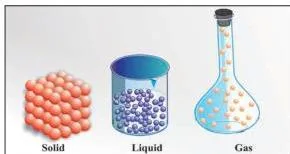
The three states are interconvertible by changing temperature (NCERT, p. 5):
\[ \text{Solid} \xrightarrow{\text{heat}} \text{Liquid} \xrightarrow{\text{heat}} \text{Gas} \]
Cooling reverses the process: a gas liquifies, a liquid freezes to a solid.
At the bulk level, matter is classified as a mixture or a pure substance; a pure substance is further an element or a compound (NCERT, p. 5). The flow chart below shows the full tree.
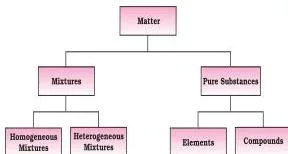
| Term | Meaning | Example |
|---|---|---|
| Pure substance | All constituent particles identical in chemical nature; fixed composition | Copper, glucose, water |
| Mixture | Particles of two or more pure substances in any ratio; composition is variable | Air, sugar solution, tea |
| Homogeneous mixture | Components uniformly distributed; composition uniform throughout | Sugar solution, air |
| Heterogeneous mixture | Composition not uniform; components may be visible | Salt and sugar, grains with dirt |
| Element | Particles consist of only one type of atom, existing as atoms or molecules | Sodium, copper, hydrogen |
| Compound | Atoms of different elements combined in a fixed, definite ratio | Water, carbon dioxide |
| Atom | Smallest particle of an element | One hydrogen atom |
| Molecule | Two or more atoms combined together | \( \text{O}_2 \), \( \text{H}_2\text{O} \) |
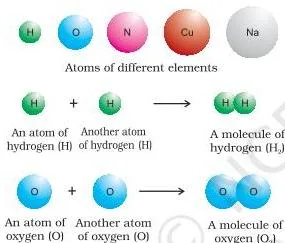
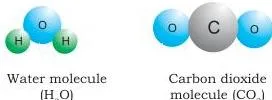
Two exam-relevant facts from this classification (NCERT, p. 6):
- A compound has a fixed and characteristic ratio of atoms; its constituents can be separated only by chemical methods, not by physical ones.
- The properties of a compound differ from those of its elements: hydrogen and oxygen are gases (hydrogen burns with a pop sound; oxygen supports combustion), yet their compound water is a liquid used as a fire extinguisher.
SI Units, Prefixes and Measuring Physical Quantities
Every quantitative measurement is a number followed by a unit. The scientific community agreed on the International System of Units (SI) for uniformity; it has seven base units (NCERT, p. 7).
| Base physical quantity | Symbol | SI unit | Unit symbol |
|---|---|---|---|
| Length | \( l \) | metre | m |
| Mass | \( m \) | kilogram | kg |
| Time | \( t \) | second | s |
| Electric current | \( I \) | ampere | A |
| Thermodynamic temperature | \( T \) | kelvin | K |
| Amount of substance | \( n \) | mole | mol |
| Luminous intensity | \( I_v \) | candela | cd |
Prefixes express multiples and sub-multiples of any unit (NCERT, p. 8). The ones you will actually use in numerical problems are:
| Prefix | Symbol | Multiple |
|---|---|---|
| pico | p | \( 10^{-12} \) |
| nano | n | \( 10^{-9} \) |
| micro | \( \mu \) | \( 10^{-6} \) |
| milli | m | \( 10^{-3} \) |
| centi | c | \( 10^{-2} \) |
| deci | d | \( 10^{-1} \) |
| kilo | k | \( 10^{3} \) |
| mega | M | \( 10^{6} \) |
| giga | G | \( 10^{9} \) |
Memory device: the order from smallest to largest is captured by the sentence “Please Never Make My Coffee Decent, Keep Mugs Great” — Pico, Nano, Micro, Milli, Centi, Deci, Kilo, Mega, Giga. So \( 1\ \text{nm} = 10^{-9}\ \text{m} \) and \( 1\ \text{mg} = 10^{-3}\ \text{g} \).
Two quantities students confuse: mass is the amount of matter in a substance and is constant, while weight is the gravitational force on it and varies from place to place (NCERT, p. 9). The SI unit of mass is the kilogram, but laboratories use the gram because chemical amounts are small.
Volume has the SI unit \( \text{m}^3 \), but chemists use \( \text{cm}^3 \), \( \text{dm}^3 \) and the non-SI litre (NCERT, p. 9):
\[ 1\ \text{L} = 1000\ \text{mL} = 1000\ \text{cm}^3 = 1\ \text{dm}^3 \]
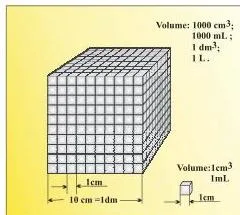
Density is mass per unit volume: \( \rho = \frac{\text{mass}}{\text{volume}} \). Its SI unit is \( \text{kg m}^{-3} \), but chemists usually express it in \( \text{g cm}^{-3} \). Higher density means particles are more closely packed (NCERT, p. 10).
Temperature has three scales — Celsius, Fahrenheit and kelvin (the SI unit). The relations are (NCERT, p. 10):
\[ ^{\circ}\text{F} = \frac{9}{5}(^{\circ}\text{C}) + 32 \qquad K = ^{\circ}\text{C} + 273.15 \]
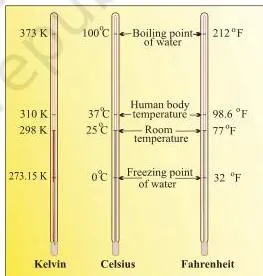
For example, \( 25\ ^{\circ}\text{C} = (25 + 273.15)\ \text{K} = 298.15\ \text{K} \). Negative kelvin is impossible because the kelvin scale ends at absolute zero. In India, the National Physical Laboratory (NPL), New Delhi maintains the national standards of measurement (NCERT, p. 7).
Scientific Notation, Significant Figures and Unit Conversion
Chemistry deals with numbers as large as \( 6.022 \times 10^{23} \) and as small as \( 1.66 \times 10^{-24} \) g. Scientific notation writes any number as \( N \times 10^n \), where \( N \) lies between 1 and 9.999… (NCERT, p. 11).
- Decimal moved left → positive exponent: \( 232.508 = 2.32508 \times 10^2 \).
- Decimal moved right → negative exponent: \( 0.00016 = 1.6 \times 10^{-4} \).
- Multiply/divide: add/subtract the exponents: \( (4.2 \times 10^6) \times (3.0 \times 10^3) = 1.26 \times 10^{10} \).
- Add/subtract: first make the exponents equal: \( 3.1 \times 10^5 + 2.0 \times 10^4 = (3.1 + 0.20) \times 10^5 = 3.3 \times 10^5 \) (NCERT, p. 12).
Significant figures are the meaningful digits in a measurement — the digits known with certainty plus one estimated digit (NCERT, p. 12).
| Rule | Example | Significant figures |
|---|---|---|
| All non-zero digits are significant | 285 cm | 3 |
| Leading zeros are not significant | 0.0052 | 2 |
| Zeros between non-zero digits are significant | 2.005 | 4 |
| Trailing zeros are significant only after a decimal point | 0.200 g has 3; 100 has 1 | 3 vs 1 |
| Exact counting numbers have infinite significant figures | 20 eggs | infinite |
To show how many digits 100 really means, use scientific notation: \( 1 \times 10^2 \) (one), \( 1.0 \times 10^2 \) (two), \( 1.00 \times 10^2 \) (three significant figures) (NCERT, p. 12-13).
Rounding rules (NCERT, p. 13): remove 6 → round up (\( 1.386 \rightarrow 1.39 \)); remove 4 → keep (\( 4.334 \rightarrow 4.33 \)); remove exactly 5 → round so the preceding digit becomes even: \( 6.35 \rightarrow 6.4 \) but \( 6.25 \rightarrow 6.2 \).
For addition/subtraction, the result has no more digits after the decimal than the value with the fewest; for multiplication/division, no more significant figures than the value with the fewest. Example: \( 3.2 \times 1.5 = 4.80 \), reported as \( 4.8 \) because 3.2 has only two significant figures.
Precision is the closeness of repeated measurements to each other; accuracy is the closeness of a result to the true value. In the textbook example, student A is precise but not accurate, student B is neither, and student C is both (NCERT, p. 13).
A precise but inaccurate result comes from a systematic error — the readings cluster, but around the wrong value.
Dimensional analysis (unit-factor method) converts units by multiplying by a fraction equal to 1. Choose the unit factor whose numerator carries the desired unit, then cancel units like numbers (NCERT, p. 13-14).
Worked example: convert 90 km/h into m/s
- Step 1: Write the known equivalences as unit factors: \( 1\ \text{km} = 1000\ \text{m} \) and \( 1\ \text{h} = 3600\ \text{s} \).
- Step 2: Arrange the factors so that km and h cancel and m s⁻¹ remains.
\[ 90\ \text{km h}^{-1} \times \frac{1000\ \text{m}}{1\ \text{km}} \times \frac{1\ \text{h}}{3600\ \text{s}} = \frac{90 \times 1000}{3600}\ \text{m s}^{-1} \]
\[ = 25\ \text{m s}^{-1} \]
Final answer: \( 90\ \text{km h}^{-1} = 25\ \text{m s}^{-1} \).
Laws of Chemical Combination and Dalton’s Atomic Theory
Five experimental laws describe how elements combine to form compounds (NCERT, pp. 14-15). They are a one-mark favourite — memorise the scientist, the year and the statement.
| Law | Scientist (year) | Statement | Example from the text |
|---|---|---|---|
| Conservation of mass | Lavoisier (1789) | In all physical and chemical changes, the total mass stays unchanged; matter is neither created nor destroyed | Mass of reactants = mass of products |
| Definite proportions | Proust | A given compound always contains the same elements in the same proportion by mass, whatever its source | Natural and synthetic cupric carbonate both give 51.35% Cu, 9.74% C, 38.91% O |
| Multiple proportions | Dalton (1803) | If two elements form more than one compound, the masses of one that combine with a fixed mass of the other are in a ratio of small whole numbers | Water: 2 g H + 16 g O; hydrogen peroxide: 2 g H + 32 g O; oxygen masses 16 : 32 = 1 : 2 |
| Gay Lussac’s law of gaseous volumes | Gay Lussac (1808) | Gases combine or are produced in simple whole-number ratios by volume, at the same temperature and pressure | 100 mL H₂ + 50 mL O₂ → 100 mL water vapour (2 : 1 : 2) |
| Avogadro’s law | Avogadro (1811) | Equal volumes of all gases at the same temperature and pressure contain equal numbers of molecules | Explains the 2 : 1 : 2 volume ratio above |
As Fig 1.9 shows, two volumes of H₂ and one of O₂ give two volumes of water vapour without leaving any oxygen unreacted — this is only possible if hydrogen and oxygen are diatomic molecules, which is why Avogadro’s distinction between atoms and molecules mattered (NCERT, p. 15-16).
Dalton’s atomic theory (1808) rests on four postulates (NCERT, p. 16):
- Matter consists of indivisible atoms.
- All atoms of a given element are identical in mass and properties; atoms of different elements differ in mass.
- Compounds form when atoms of different elements combine in a fixed ratio.
- Chemical reactions only reorganise atoms — atoms are neither created nor destroyed.
Dalton’s theory successfully explained the laws of chemical combination, but it could not explain the law of gaseous volumes, and it gave no reason why atoms combine (NCERT, p. 16).
Atomic Mass, Molecular Mass and Formula Mass
Atoms are far too small to weigh directly, so their masses are measured relative to a standard. Since 1961 the standard is carbon-12 (\( ^{12}\text{C} \)), assigned a mass of exactly 12 u (NCERT, p. 16-17):
\[ 1\ \text{u} = \frac{1}{12} \times \text{mass of one } ^{12}\text{C atom} = 1.66056 \times 10^{-24}\ \text{g} \]
On this scale, a hydrogen atom has mass \( 1.0080\ \text{u} \) and an oxygen-16 atom \( 15.995\ \text{u} \). The symbol u (unified mass) replaces the older amu.
Average atomic mass: most elements exist as isotopes, so the periodic-table value is a weighted average over natural abundance. For carbon, \( 98.892\% \) \( ^{12}\text{C} \) (12 u) and \( 1.108\% \) \( ^{13}\text{C} \) (13.00335 u) give the familiar \( 12.011\ \text{u} \) (NCERT, p. 17).
Molecular mass is the sum of the atomic masses of all atoms in a molecule (NCERT, p. 17). For methane:
\[ \text{CH}_4 = 12.011\ \text{u} + 4(1.008\ \text{u}) = 16.043\ \text{u} \]
Worked example: molecular mass of sucrose \( \text{C}_{12}\text{H}_{22}\text{O}_{11} \)
- Step 1: Read the formula: 12 carbon atoms, 22 hydrogen atoms, 11 oxygen atoms.
- Step 2: Multiply each atomic mass by its atom count, keeping the unit u.
\[ \text{C: } 12 \times 12.011\ \text{u} = 144.132\ \text{u} \]
\[ \text{H: } 22 \times 1.008\ \text{u} = 22.176\ \text{u} \]
\[ \text{O: } 11 \times 16.00\ \text{u} = 176.00\ \text{u} \]
Step 3: Add the three contributions.
\[ 144.132 + 22.176 + 176.00 = 342.308\ \text{u} \]
Final answer: Molecular mass of sucrose \( = 342.308\ \text{u} \).
Formula mass is used for ionic compounds like sodium chloride, which have no discrete molecules. As Fig 1.10 shows, each \( \text{Na}^+ \) ion is surrounded by six \( \text{Cl}^- \) ions and vice versa, so NaCl is a formula unit, not a molecule (NCERT, p. 17-18):
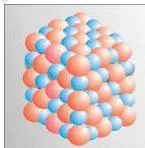
\[ \text{Formula mass of NaCl} = 23.0\ \text{u} + 35.5\ \text{u} = 58.5\ \text{u} \]
The most common slip here: a molecule like water counts hydrogen twice — \( 2(1.008\ \text{u}) + 16.00\ \text{u} = 18.02\ \text{u} \), never \( 1.008 + 16.00 \).
Mole Concept and Molar Mass
You already count everyday objects in dozen (12), score (20) and gross (144). Chemistry’s counting unit for particles is the mole (NCERT, p. 18):
\[ 1\ \text{mol} = 6.02214076 \times 10^{23}\ \text{elementary entities} \]
This number is the Avogadro constant \( N_A \), with unit \( \text{mol}^{-1} \). The mole exists because atoms are too small to weigh individually and too numerous to count one by one — it is the bridge between the gram balance and the particle count: mass → moles → number of particles.
Always specify the entity (NCERT, p. 18):
- 1 mol of hydrogen atoms = \( 6.022 \times 10^{23} \) atoms
- 1 mol of water molecules = \( 6.022 \times 10^{23} \) molecules
- 1 mol of sodium chloride = \( 6.022 \times 10^{23} \) formula units
Molar mass is the mass of one mole of a substance in grams; it is numerically equal to the atomic/molecular/formula mass in u (NCERT, p. 18). So water is 18.02 u and its molar mass is 18.02 g mol⁻¹.
Worked example: number of molecules in 9.0 g of water
Step 1: Convert mass to moles using molar mass \( 18.02\ \text{g mol}^{-1} \).
\[ n = \frac{9.0\ \text{g}}{18.02\ \text{g mol}^{-1}} = 0.50\ \text{mol} \]
Step 2: Multiply moles by Avogadro’s number.
\[ N = 0.50\ \text{mol} \times 6.022 \times 10^{23}\ \text{mol}^{-1} = 3.0 \times 10^{23} \]
Final answer: 9.0 g of water contains \( 3.0 \times 10^{23} \) water molecules.
The next chapter, Structure of Atom, builds directly on this idea — it explains the sub-atomic particles you are counting with the mole.
Percentage Composition and Empirical Formula
Mass per cent tells you what a compound is made of by mass (NCERT, p. 19):
\[ \text{Mass \% of element} = \frac{\text{mass of that element in the compound}}{\text{molar mass of the compound}} \times 100 \]
For water, molar mass 18.02 g: hydrogen \( = \frac{2 \times 1.008}{18.02} \times 100 = 11.18\% \), oxygen \( = 88.79\% \).
Two formulas to keep distinct (NCERT, p. 19):
- Empirical formula — the simplest whole-number ratio of atoms in a compound.
- Molecular formula — the exact number of each type of atom in one molecule.
The five-step method for converting per cent data into a formula (NCERT, pp. 19-20):
- Take 100 g of the compound, so each per cent becomes a mass in grams.
- Convert each mass to moles by dividing by the atomic mass.
- Divide every mole value by the smallest mole value.
- If needed, multiply to reach whole numbers, then write the empirical formula.
- Compute \( n = \frac{\text{molar mass}}{\text{empirical formula mass}} \) and multiply the empirical formula by \( n \) to get the molecular formula.
Worked example: empirical formula from 40.0% C, 6.7% H, 53.3% O
- Step 1: In 100 g of compound: 40.0 g C, 6.7 g H, 53.3 g O.
- Step 2: Convert each mass to moles (divide by atomic mass).
\[ n_{\text{C}} = \frac{40.0\ \text{g}}{12.011\ \text{g mol}^{-1}} = 3.33\ \text{mol} \]
\[ n_{\text{H}} = \frac{6.7\ \text{g}}{1.008\ \text{g mol}^{-1}} = 6.65\ \text{mol} \]
\[ n_{\text{O}} = \frac{53.3\ \text{g}}{16.00\ \text{g mol}^{-1}} = 3.33\ \text{mol} \]
Step 3: Divide each by the smallest value (3.33).
\[ \text{C : H : O} = \frac{3.33}{3.33} : \frac{6.65}{3.33} : \frac{3.33}{3.33} = 1 : 1.996 : 1 \approx 1 : 2 : 1 \]
Final answer: Empirical formula \( = \text{CH}_2\text{O} \).
If the molar mass of this compound were 180 g mol⁻¹, then empirical formula mass \( = 12 + 2(1) + 16 = 30\ \text{u} \), so \( n = 180/30 = 6 \) and the molecular formula would be \( \text{C}_6\text{H}_{12}\text{O}_6 \) — the formula of glucose. In step 5, the ratio \( n \) is a pure number: the empirical mass is in u and the molar mass in g, but the units cancel.
Stoichiometry, Balancing Equations and the Limiting Reagent
Stoichiometry (from Greek stoicheion, element, and metron, measure) is the calculation of masses and volumes of reactants and products from a balanced chemical equation (NCERT, p. 20).
The combustion of methane shows what the coefficients mean:
\[ \text{CH}_4\text{(g)} + 2\text{O}_2\text{(g)} \rightarrow \text{CO}_2\text{(g)} + 2\text{H}_2\text{O}\text{(g)} \]
- Moles: 1 mol CH₄ + 2 mol O₂ → 1 mol CO₂ + 2 mol H₂O
- Molecules: 1 molecule CH₄ + 2 molecules O₂ → 1 molecule CO₂ + 2 molecules H₂O
- Volumes (gases at same T and P): 22.7 L CH₄ + 45.4 L O₂ → 22.7 L CO₂ + 45.4 L H₂O
- Grams: 16 g CH₄ + 64 g O₂ → 44 g CO₂ + 36 g H₂O
To balance, adjust coefficients in steps (C, then H, then O) and verify at the end. Propane, for example, balances as \( \text{C}_3\text{H}_8 + 5\text{O}_2 \rightarrow 3\text{CO}_2 + 4\text{H}_2\text{O} \) (NCERT, p. 21-22). The iron rule: never change subscripts to balance an equation — only coefficients, because changing a subscript changes the substance itself.
Limiting reagent: when reactants are mixed in amounts different from the balanced ratio, the reactant that gets consumed first stops the reaction and fixes the amount of product — it is the limiting reagent (NCERT, p. 21).
Two-step test:
- Convert every reactant mass to moles.
- Compare the available moles with the mole ratio required by the balanced equation; the reactant that runs short is limiting.
Worked example: 12 g carbon burned in 24 g oxygen
- Step 1: Write the balanced equation: \( \text{C(s)} + \text{O}_2\text{(g)} \rightarrow \text{CO}_2\text{(g)} \).
- Step 2: Convert both reactants to moles.
\[ n_{\text{C}} = \frac{12\ \text{g}}{12.011\ \text{g mol}^{-1}} \approx 1.0\ \text{mol} \]
\[ n_{\text{O}_2} = \frac{24\ \text{g}}{32.00\ \text{g mol}^{-1}} = 0.75\ \text{mol} \]
Step 3: Compare with the 1 : 1 mole ratio.
1.0 mol C needs 1.0 mol O₂, but only 0.75 mol O₂ is available — so oxygen runs out first.
Step 4: Scale the product from the limiting reagent, 0.75 mol O₂.
\[ m_{\text{CO}_2} = 0.75\ \text{mol} \times 44.01\ \text{g mol}^{-1} \approx 33\ \text{g} \]
Final answer: O₂ is the limiting reagent; about 33 g CO₂ forms and about 3 g of carbon remains unreacted.
Show the unit-factor lines in your answer — that visible working is what earns the mark, even if the final arithmetic slips.
Concentration of Solutions: Mass %, Mole Fraction, Molarity, Molality
Most reactions run in solution, so you need four ways to state how much solute is present (NCERT, p. 21):
| Expression | Formula | Key point |
|---|---|---|
| Mass per cent (w/w %) | \( \frac{\text{mass of solute}}{\text{mass of solution}} \times 100 \) | Denominator is solution = solute + solvent |
| Mole fraction | \( x_A = \frac{n_A}{n_A + n_B} \) | Dimensionless; mole fractions of all components sum to 1 |
| Molarity (M) | \( \frac{\text{moles of solute}}{\text{volume of solution in litres}} \) | Most widely used unit; temperature dependent |
| Molality (m) | \( \frac{\text{moles of solute}}{\text{mass of solvent in kg}} \) | Temperature independent |
The molarity–molality comparison is a favourite two-mark question:
| Basis | Molarity (M) | Molality (m) |
|---|---|---|
| Denominator | Volume of solution (L) | Mass of solvent (kg) |
| Effect of temperature | Changes — volume expands/contracts with temperature | Stays constant — mass is not affected by temperature |
| Units | mol L⁻¹ | mol kg⁻¹ |
| Ease of measurement | Easy — just measure volume | Needs mass of solvent, not volume |
Dilution: the number of moles of solute does not change when you add solvent, so \( M_1 V_1 = M_2 V_2 \) (NCERT, p. 23). The textbook’s stock-solution logic: taking 200 mL of 1 M NaOH and diluting to 1 L gives 0.2 M — the 0.2 mol of NaOH stays 0.2 mol, only the volume changes.
Worked example: molarity of 5.85 g NaCl made up to 500 mL
- Step 1: Convert solute mass to moles: \( 5.85\ \text{g} / 58.5\ \text{g mol}^{-1} = 0.10\ \text{mol} \).
- Step 2: Convert volume to litres: \( 500\ \text{mL} = 0.500\ \text{L} \).
\[ M = \frac{0.10\ \text{mol}}{0.500\ \text{L}} = 0.20\ \text{mol L}^{-1} \]
Final answer: \( M = 0.2\ \text{mol L}^{-1} \) (0.2 M).
For molality, the denominator is the solvent, not the solution: if the same 0.10 mol of solute were dissolved in 500 g of water, \( m = \frac{0.10\ \text{mol}}{0.500\ \text{kg}} = 0.2\ \text{mol kg}^{-1} \) (0.2 m).
Common Mistakes Students Make
Each of these slips costs a mark you did earn the reasoning for. The third column tells you how to catch it before submitting:
| Mistake | Correct rule | How to check your answer |
|---|---|---|
| Writing “100” with three significant figures | Trailing zeros without a decimal point are not significant — 100 has one significant figure. Write \( 100. \) or \( 1.00 \times 10^2 \) to show three | Count zeros only after the decimal point |
| Always rounding the digit 5 up | The even/odd rule applies: \( 6.25 \rightarrow 6.2 \), \( 6.35 \rightarrow 6.4 \) | Look at the digit before 5; round it to even |
| Using solvent mass instead of solution mass in mass per cent | Denominator is mass of solution = solute + solvent | 2 g solute in 18 g water gives \( \frac{2}{20} \times 100 = 10\% \), not \( \frac{2}{18} \times 100 \) |
| Comparing reactant masses to find the limiting reagent | Convert to moles first, then compare with the balanced equation’s ratio | 12 g C vs 24 g O₂: moles are about 1.0 vs 0.75 — O₂ is limiting |
| Forgetting the atom count in molecular mass (writing water as 1.008 + 16.00) | \( 2(1.008) + 16.00 = 18.02\ \text{u} \) — multiply hydrogen by its subscript 2 | Check every subscript in the formula before adding |
| Plugging volume in mL into the molarity formula | Molarity needs volume in litres; 250 mL = 0.250 L | Write the volume conversion line before dividing |
Exam Notes: What Earns the Marks
The NCERT exercise set for this chapter (pp. 25-28) clusters into a few repeatable calculation families — the map below is an observed pattern from that set, not a prediction of any particular paper.
| NCERT exercises | Concept family | What a full-marks answer must include |
|---|---|---|
| 1.1 | Molar mass of a formula | Atomic mass × atom count for each element, then the summed total, with unit u |
| 1.2 | Mass per cent of elements | Formula, substitution with units, per cent for every element |
| 1.3, 1.8 | Empirical and molecular formula from per cent data | The five-step mole method, with the simplest ratio stated explicitly |
| 1.5, 1.11, 1.29 | Molarity, molality, mole fraction | Moles first; divide by litres (M) or kg solvent (m); convert mL → L |
| 1.18–1.20 | Scientific notation and significant figures | Correct digits, correct exponent, rounding rule applied |
| 1.21, 1.22, 1.27 | Unit conversion / dimensional analysis | The unit-factor chain written line by line |
| 1.4, 1.23, 1.24 | Limiting reagent and amount of product | Moles of each reactant, comparison with the balanced ratio, product scaled from the limiting reagent |
Examiner’s mindset:
- In stoichiometry, write every unit-factor conversion as a visible chain — the working earns the mark even if the final arithmetic slips.
- Attach units to every line; a number without a unit is not a chemistry answer.
- Specify the entity when counting moles — atoms, molecules or formula units.
- End with the conclusion stated separately: which reactant is limiting, how much product forms, what remains unreacted.
One-Shot Revision Summary
The whole chapter in one table, in the order it builds:
| Concept | Key point | Formula / constant |
|---|---|---|
| Matter | Anything with mass and volume | Three states interconvertible by heating/cooling |
| Classification | Pure substance vs mixture | Element/compound; homogeneous/heterogeneous |
| SI base units | Seven fundamental quantities | m, kg, s, A, K, mol, cd |
| Prefixes | Multiples and sub-multiples | pico \( 10^{-12} \) … giga \( 10^{9} \) |
| Density | Mass per unit volume | SI \( \text{kg m}^{-3} \); lab use \( \text{g cm}^{-3} \) |
| Temperature | Three scales | \( ^{\circ}\text{F} = \frac{9}{5}\,^{\circ}\text{C} + 32 \); \( K = \,^{\circ}\text{C} + 273.15 \) |
| Scientific notation | Any number as \( N \times 10^n \) | \( 1 \le N \lt 10 \) |
| Significant figures | Certain digits + one uncertain digit | Five counting rules; even/odd rounding for 5 |
| Laws of combination | Five laws | Conservation, definite, multiple, gaseous volumes, Avogadro |
| Atomic mass | Relative to \( ^{12}\text{C} = 12 \text{ u} \) | \( 1\ \text{u} = 1.66056 \times 10^{-24}\ \text{g} \) |
| Average atomic mass | Weighted average over isotopes | Carbon → 12.011 u |
| Molecular mass | Sum of atomic masses of all atoms | \( \text{CH}_4 = 16.043\ \text{u} \); water \( = 18.02\ \text{u} \) |
| Formula mass | For ionic solids with no discrete molecules | \( \text{NaCl} = 58.5\ \text{u} \) |
| Mole | Counting unit for particles | \( N_A = 6.022 \times 10^{23}\ \text{mol}^{-1} \) |
| Molar mass | Mass of one mole in grams | Water \( = 18.02\ \text{g mol}^{-1} \) |
| Mass per cent | Element mass ÷ molar mass × 100 | Water: 11.18% H, 88.79% O |
| Empirical formula | Simplest whole-number ratio of atoms | From 40.0% C, 6.7% H, 53.3% O → \( \text{CH}_2\text{O} \) |
| Molecular formula | Exact atom count in one molecule | \( n = \frac{\text{molar mass}}{\text{empirical formula mass}} \) |
| Stoichiometry | Mole ratios from a balanced equation | \( \text{CH}_4 + 2\text{O}_2 \rightarrow \text{CO}_2 + 2\text{H}_2\text{O} \) |
| Limiting reagent | Consumed first; caps the product | Compare available moles with the balanced ratio |
| Molarity | Moles of solute ÷ litres of solution | Temperature dependent |
| Molality | Moles of solute ÷ kg of solvent | Temperature independent |
| Mole fraction | \( n_A \div (n_A + n_B) \) | Dimensionless; components sum to 1 |
| Volume units | Litre is not an SI unit | \( 1\ \text{L} = 1000\ \text{mL} = 1000\ \text{cm}^3 = 1\ \text{dm}^3 \) |
Constants to memorise: \( 1\ \text{u} = 1.66056 \times 10^{-24}\ \text{g} \); \( N_A = 6.022 \times 10^{23}\ \text{mol}^{-1} \); \( K = \,^{\circ}\text{C} + 273.15 \); \( 1\ \text{L} = 1000\ \text{cm}^3 = 1\ \text{dm}^3 \); molarity is temperature dependent, molality is not.
Need the wider picture? Browse the complete set of Class 11 notes or the full CBSE notes library.
Frequently Asked Questions
Why is molarity temperature dependent but molality is not?
Because molarity’s denominator is volume of solution, and volume changes with temperature, while molality’s denominator is mass of solvent, which does not change. Heat a solution and it expands, so the number of moles per litre drops even though the solute is unchanged; the mass of solvent, and therefore molality, stays the same (NCERT, p. 24).
What exactly is 1 atomic mass unit and why is it based on carbon-12?
One atomic mass unit is exactly one-twelfth of the mass of one carbon-12 atom: \( 1\ \text{u} = 1.66056 \times 10^{-24}\ \text{g} \) (NCERT, p. 17). Carbon-12 was agreed as the standard in 1961 because it is a stable, convenient isotope; assigning it exactly 12 u gives other elements near-whole-number relative masses — hydrogen ≈ 1.008 u, oxygen-16 ≈ 15.995 u — which makes the scale practical.
What is the difference between empirical formula and molecular formula?
The empirical formula is the simplest whole-number ratio of atoms in a compound; the molecular formula is the actual number of each atom in one molecule. In NCERT Problem 1.2, the empirical formula \( \text{CH}_2\text{Cl} \) with \( n = 2 \) gives the molecular formula \( \text{C}_2\text{H}_4\text{Cl}_2 \).
You need the molar mass to make the conversion: \( n = \frac{\text{molar mass}}{\text{empirical formula mass}} \).
How do I find the limiting reagent in a reaction?
Convert each reactant’s mass to moles, then compare those moles with the ratio in the balanced equation — the reactant that provides fewer moles than required is the limiting reagent, and it decides the amount of product.
In the worked example above, 12 g C (1.0 mol) and 24 g O₂ (0.75 mol) react 1 : 1, so oxygen runs out first and caps the CO₂ at about 33 g.
When are zeros significant in a measurement?
Zeros between non-zero digits are significant (\( 2.005 \) → 4); trailing zeros after a decimal point are significant (\( 0.200 \) → 3); leading zeros are never significant (\( 0.0052 \) → 2); and trailing zeros without a decimal point are not significant (\( 100 \) → 1). To show that trailing zeros are significant, write the number in scientific notation: \( 1.00 \times 10^2 \) has three significant figures (NCERT, p. 12-13).
Reference: NCERT Class 11 Chemistry Part I textbook, Chapter 1: Some Basic Concepts of Chemistry.
Explore Class 11 Chemistry Notes
More for this chapter:
Class 11 Chemistry on LearnCBSE:
Related chapters: