This formula sheet gathers the quantitative tools of Some Basic Concepts of Chemistry (Class 11): scientific notation and significant figures, density and temperature conversions, atomic and molecular masses, the mole concept with Avogadro’s number, percentage composition with empirical and molecular formulas, and the concentration units — mass per cent, mole fraction, molarity and molality (NCERT, pp. 10–24).
Each formula appears grouped by topic with the meaning and unit of every symbol, a one-line note on when to reach for it, and worked examples using original numbers. For full derivations and the chapter’s own questions, browse the Class 11 chemistry formulas collection and the general all-class formulas index.
You can verify every value against the official Rationalised NCERT Class 11 Chemistry Part I textbook on ncert.nic.in.
Formulas at a Glance
| Purpose (what you are finding) | Formula |
|---|---|
| Density from mass and volume | \( \text{Density} = \dfrac{\text{Mass}}{\text{Volume}} \) |
| Celsius to Fahrenheit | \( ^{\circ}\text{F} = \dfrac{9}{5}(^{\circ}\text{C}) + 32 \) |
| Celsius to Kelvin | \( K = ^{\circ}\text{C} + 273.15 \) |
| Number in scientific notation (digit term) | \( N \times 10^n \), with \( 1 \leq N \lt 10 \) |
| Average atomic mass from isotopes | \( \bar{A} = \sum (\text{fractional abundance} \times \text{isotopic mass}) \) |
| Molecular mass | \( M = \sum (\text{atomic mass} \times \text{number of atoms}) \) |
| Entities in one mole | \( 1\ \text{mol} = 6.022 \times 10^{23}\ \text{entities} \) |
| Mass per cent of an element in a compound | \( \text{Mass \%} = \dfrac{\text{mass of element}}{\text{molar mass of compound}} \times 100 \) |
| Mass per cent of a solution | \( \text{Mass per cent} = \dfrac{\text{mass of solute}}{\text{mass of solution}} \times 100 \) |
| Mole fraction of component A | \( x_A = \dfrac{n_A}{n_A + n_B} \) |
| Molarity | \( M = \dfrac{\text{moles of solute}}{\text{volume of solution in litres}} \) |
| Dilution of a stock solution (from the molarity definition) | \( M_1 V_1 = M_2 V_2 \) |
| Molality | \( m = \dfrac{\text{moles of solute}}{\text{mass of solvent in kg}} \) |
All Formulas, Grouped by Topic
Measurement: Density and Temperature
Density relates the two measurable properties of mass and volume (NCERT, p. 10):
\[ \text{Density} = \frac{\text{Mass}}{\text{Volume}} \]
Temperature is measured on three scales. The two conversion relations used constantly in numericals (NCERT, p. 10):
\[ ^{\circ}\text{F} = \frac{9}{5}(^{\circ}\text{C}) + 32 \]
\[ K = ^{\circ}\text{C} + 273.15 \]
Negative temperatures are possible on the Celsius scale, but never on the Kelvin scale (NCERT, p. 10).
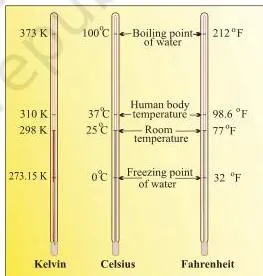
The three thermometers above show the same physical temperature on all three scales — the conversion formulas just move between them. Kelvin is the SI unit; Celsius and Fahrenheit are not.
Scientific Notation
Any number can be written as a digit term and an exponent (NCERT, pp. 11–12):
\[ N \times 10^n \]
where \( N \) lies between 1.000 and 9.999 and \( n \) is a positive or negative integer. For example, \( 0.00016 = 1.6 \times 10^{-4} \).
Operations follow exponent rules (NCERT, p. 12):
- Multiplication: \( (5.6 \times 10^5)(6.9 \times 10^8) = (5.6 \times 6.9) \times 10^{5+8} = 3.864 \times 10^{14} \)
- Division: \( \dfrac{2.7 \times 10^{-3}}{5.5 \times 10^4} = (2.7 \div 5.5) \times 10^{-3-4} = 4.909 \times 10^{-8} \)
- Addition/subtraction: first make exponents equal, then add or subtract the coefficients, e.g. \( 6.65 \times 10^4 + 8.95 \times 10^3 = (6.65 + 0.895) \times 10^4 = 7.545 \times 10^4 \)
Atomic and Molecular Masses
Atomic masses are relative to carbon-12, assigned exactly \( 12\ \text{u} \); one atomic mass unit equals one-twelfth of a carbon-12 atom’s mass (NCERT, p. 17). Many elements exist as several isotopes, so the value used in calculations is the average atomic mass:
\[ \bar{A} = \sum (\text{fractional abundance} \times \text{isotopic mass}) \]
For carbon, this gives \( (0.98892)(12\ \text{u}) + (0.01108)(13.00335\ \text{u}) = 12.011\ \text{u} \) (NCERT, p. 17).
Molecular mass is the sum of the atomic masses of every atom in a molecule (NCERT, p. 17):
\[ M = \sum (\text{atomic mass} \times \text{number of atoms}) \]
For ionic solids such as sodium chloride, which have no discrete molecules, the same sum is called the formula mass (NCERT, p. 17).
Mole Concept and Molar Mass
One mole is the amount of substance containing exactly \( 6.022 \times 10^{23} \) elementary entities — the Avogadro constant, \( N_A \) (NCERT, p. 18). The mole is an SI base unit, symbol mol.
The molar mass of a substance is the mass of one mole of it in grams, and is numerically equal to its atomic, molecular or formula mass in u (NCERT, p. 18). Example: molar mass of water = \( 18.02\ \text{g mol}^{-1} \), molar mass of NaCl = \( 58.5\ \text{g mol}^{-1} \).
Percentage Composition
Mass per cent of an element in a compound (NCERT, p. 19):
\[ \text{Mass \% of an element} = \frac{\text{mass of that element in the compound} \times 100}{\text{molar mass of the compound}} \]
The empirical formula is the simplest whole-number ratio of atoms; the molecular formula shows the exact number of each atom. To convert empirical to molecular, use (NCERT, p. 19):
\[ n = \frac{\text{molar mass}}{\text{empirical formula mass}} \]
Concentration of Solutions
Mass per cent of a solution (NCERT, p. 23):
\[ \text{Mass per cent} = \frac{\text{Mass of solute}}{\text{Mass of solution}} \times 100 \]
Mole fraction — the ratio of moles of one component to total moles (NCERT, p. 23):
\[ x_A = \frac{n_A}{n_A + n_B} \]
Molarity — moles of solute per litre of solution (NCERT, p. 23):
\[ M = \frac{\text{No. of moles of solute}}{\text{Volume of solution in litres}} \]
For dilution, the moles of solute stay the same, giving (NCERT, p. 23):
\[ M_1 V_1 = M_2 V_2 \]
Molality — moles of solute per kilogram of solvent (NCERT, p. 24):
\[ m = \frac{\text{No. of moles of solute}}{\text{Mass of solvent in kg}} \]
What Each Symbol Means
| Symbol | What it means | Unit |
|---|---|---|
| \( M \) | Molarity | \( \text{mol L}^{-1} \) (or \( \text{mol dm}^{-3} \)) |
| \( m \) | Molality | \( \text{mol kg}^{-1} \) |
| \( n \) | Amount of substance (number of moles) | \( \text{mol} \) |
| \( N_A \) | Avogadro constant | \( 6.022 \times 10^{23}\ \text{mol}^{-1} \) |
| \( x_A \) | Mole fraction of component A | Dimensionless (no unit) |
| \( M_1, V_1 \) | Molarity and volume before dilution | \( \text{mol L}^{-1} \), \( \text{L} \) |
| \( M_2, V_2 \) | Molarity and volume after dilution | \( \text{mol L}^{-1} \), \( \text{L} \) |
| \( \bar{A} \) | Average atomic mass | \( \text{u} \) (or \( \text{g mol}^{-1} \)) |
| \( N \), \( n \) | Digit term, exponent in scientific notation | Dimensionless |
| \( K \), \( ^{\circ}\text{C} \), \( ^{\circ}\text{F} \) | Temperature on Kelvin, Celsius, Fahrenheit scales | \( \text{K} \), \( ^{\circ}\text{C} \), \( ^{\circ}\text{F} \) |
| Density | Mass per unit volume | \( \text{kg m}^{-3} \) or \( \text{g cm}^{-3} \) |
When to Use Each Formula
| Formula | Use it when… | Condition to check |
|---|---|---|
| Density = mass/volume | You know two of mass, volume, density and need the third, or are converting between mass and volume of a substance. | Volume in the SI formula is \( \text{m}^3 \); chemists usually work in \( \text{g cm}^{-3} \). |
| \( ^{\circ}\text{F} = \tfrac{9}{5}(^{\circ}\text{C}) + 32 \) | Converting a Celsius reading to Fahrenheit. | Use the inverse \( ^{\circ}\text{C} = \tfrac{5}{9}(^{\circ}\text{F} – 32) \) when going the other way. |
| \( K = ^{\circ}\text{C} + 273.15 \) | Converting a Celsius reading to kelvin, or using temperature in gas-law numericals. | Never a negative kelvin value. |
| \( N \times 10^n \) | Handling very large or very small numbers (atoms, molecules, Avogadro-scale counts). | \( 1 \leq N \lt 10 \) for standard form. |
| Average atomic mass | An element has more than one naturally occurring isotope. | Use fractional (not percentage) abundance in the product. |
| Molecular / formula mass | Summing atomic masses of all atoms in a molecule or formula unit. | Multiply each atomic mass by the atom count first, then add. |
| Mass % of element | Finding how much of a compound’s mass one element contributes. | Include every atom of that element in the numerator. |
| Mole fraction | Expressing composition by moles rather than mass, e.g. for gas mixtures. | The two mole fractions of a two-component solution sum to 1. |
| Molarity | Stating concentration in moles per litre; the standard lab unit. | Volume is of the solution, in litres. Molarity changes with temperature. |
| \( M_1 V_1 = M_2 V_2 \) | Diluting a stock solution to a desired concentration. | Moles of solute are unchanged by adding solvent. |
| Molality | Stating concentration per kilogram of solvent; preferred when temperature varies. | Mass of solvent in kg, not mass of solution. |
Worked Examples
Example 1 — Molarity.
5.85 g of NaCl (molar mass 58.5 g mol−1) is dissolved in enough water to make 250 mL of solution.
Find the molarity.
Step 1: Convert the volume to litres.
\( 250\ \text{mL} = 0.250\ \text{L} \).
Step 2: Convert mass to moles.
\( \text{moles} = \dfrac{5.85\ \text{g}}{58.5\ \text{g mol}^{-1}} = 0.100\ \text{mol} \).
Step 3: Apply the molarity formula.
\[ M = \frac{0.100\ \text{mol}}{0.250\ \text{L}} = 0.400\ \text{mol L}^{-1} \]
Final answer: \( 0.400\ \text{M} \).
Example 2 — Dilution.
What volume of 2.0 M stock solution is needed to prepare 500 mL of 0.40 M solution?
Step 1: Identify the knowns.
\( M_1 = 2.0\ \text{M} \), \( M_2 = 0.40\ \text{M} \), \( V_2 = 500\ \text{mL} \) (any volume unit is fine as long as it is the same on both sides).
Step 2: Rearrange \( M_1 V_1 = M_2 V_2 \).
\[ V_1 = \frac{M_2 V_2}{M_1} = \frac{0.40 \times 500}{2.0} = 100\ \text{mL} \]
Final answer: Take 100 mL of the 2.0 M stock and dilute to 500 mL.
Example 3 — Mass per cent.
Calculate the mass per cent of carbon in carbon dioxide, \( \text{CO}_2 \) (atomic masses: C = 12 u, O = 16 u).
Step 1: Find the molar mass.
\( 12 + 2(16) = 44\ \text{u} \).
Step 2: Apply the mass-per-cent formula for the element carbon.
\[ \text{Mass \% of C} = \frac{12}{44} \times 100 = 27.27\% \]
Final answer: Carbon is \( 27.27\% \) of \( \text{CO}_2 \) by mass.
For more practice on the textbook’s own questions, work through the exercises and compare your working with the Class 11 chemistry formulas materials.
Common Mistakes to Avoid
| Mistake | Correct rule | How to check your answer |
|---|---|---|
| Using the volume of solvent instead of solution in molarity | Molarity uses the total volume of the solution after dissolving. | Molarity must be slightly less than the value you would get with solvent volume alone. |
| Entering volume in mL directly into the molarity formula | Convert mL to litres first, or keep both sides of \( M_1 V_1 = M_2 V_2 \) in the same unit. | Check the unit: molarity answers must be \( \text{mol L}^{-1} \), never \( \text{mol mL}^{-1} \). |
| Confusing molality and molarity | Molality uses mass of solvent in kg; molarity uses volume of solution in L. | Molality does not change with temperature; molarity does. If a question stresses temperature, it wants molality (NCERT, p. 24). |
| Using percentage abundance instead of fractional abundance in average atomic mass | Divide the percentage by 100 first, e.g. 98.892% becomes 0.98892. | The sum of all fractional abundances must equal 1. |
| Wrong factor in temperature conversion | \( ^{\circ}\text{F} \) is numerically larger at the same temperature, so multiply by \( \tfrac{9}{5} \) when going Celsius to Fahrenheit. | Water boils at \( 100^{\circ}\text{C} = 212^{\circ}\text{F} \); freeze at \( 0^{\circ}\text{C} = 32^{\circ}\text{F} \). Sanity-check against these. |
| Forgetting that molar mass in g mol−1 is numerically equal to the atomic/molecular mass in u | Use \( \dfrac{\text{mass in g}}{\text{molar mass in g mol}^{-1}} \) to get moles. | 1 mol of any substance always contains \( 6.022 \times 10^{23} \) entities. |
Frequently Asked Questions
What is the difference between molarity and molality?
Molarity is moles of solute per litre of solution; molality is moles of solute per kilogram of solvent. Because volume changes with temperature but mass does not, molarity varies with temperature while molality stays constant (NCERT, pp. 23–24).
How do I find the empirical formula from percentage composition?
Assume 100 g of the compound, convert each element’s mass to moles by dividing by its atomic mass, then divide every mole value by the smallest one. If the ratios are not whole numbers, multiply all of them by a suitable integer to get whole numbers (NCERT, p. 19).
Why is the mole defined with Avogadro’s number?
Atoms and molecules are far too small to count individually, so chemists need a fixed counting unit. One mole — \( 6.022 \times 10^{23} \) entities — was chosen so that the molar mass in grams is numerically equal to the atomic or molecular mass in u (NCERT, p. 18).
Does molarity change when I dilute a solution?
No — the number of moles of solute stays the same; only the volume increases. That is exactly why \( M_1 V_1 = M_2 V_2 \) holds: the product of molarity and volume (moles of solute) is unchanged by adding solvent (NCERT, p. 23).
Reference: NCERT Class 11 Chemistry textbook, chapter Some Basic Concepts of Chemistry.
Explore Class 11 Chemistry Formulas
More for this chapter:
Class 11 Chemistry on LearnCBSE:
Related chapters: