
These periodic classification of elements class 11 notes condense Chapter 3 of NCERT Chemistry Part I into a revision-ready format: the historical road to the periodic table, the modern periodic law, the s/p/d/f block division, and every periodic trend — atomic and ionic radii, ionization enthalpy, electron gain enthalpy and electronegativity — each with a worked example so you can apply it in an exam.
This chapter ties atomic structure to bonding. Almost every question asks you to do one of four things: locate an element (block, period, group) from its configuration, arrange species by size or energy, explain a trend anomaly, or predict a compound formula.
Use the table of contents to jump straight to the topic you need, and finish with the quick revision sheet if you are cramming the night before.
Everything here follows the NCERT Class 11 Chemistry Part I textbook, Chapter 3 — you can open the official NCERT Class 11 Chemistry Part I PDF to verify any detail. These notes also build directly on the Structure of Atom notes from the previous chapter, so revise quantum numbers and the aufbau principle there if any configuration feels shaky.
Why Classify Elements? The Road to the Periodic Table
In 1800 only 31 elements were known. By 1865 the number had more than doubled to 63, and today 114 are known, many of them man-made. Nobody can study the chemistry of that many elements and their countless compounds one by one, so scientists looked for a systematic arrangement that would organise known facts and predict new ones.
A useful analogy: classifying elements is like organising a library. When books are shelved by a logical system you can find any book quickly, and you can guess where a newly arrived book belongs without scanning every shelf. The periodic table does the same for chemistry — it groups similar elements together and leaves a natural “shelf” for undiscovered ones.
The early attempts each contributed one idea, and each hit a limit (NCERT, p. 76):
| System (year) | Arrangement | Key idea | Why it failed / limit |
|---|---|---|---|
| Dobereiner’s Triads (1829) | Groups of three elements | The middle element’s atomic weight is about the average of the other two; its properties lie between them (Ca–Sr–Ba, Cl–Br–I) | Worked for only a few triads; dismissed as coincidence |
| de Chancourtois (1862) | Cylindrical table | Elements in order of atomic weight showed periodic recurrence | Did not attract attention |
| Newlands’ Law of Octaves (1865) | Rows of eight | Every eighth element resembles the first, like a musical octave | Held only up to calcium |
| Mendeleev & Lothar Meyer (1869) | Groups and periods | Properties are a periodic function of atomic weight | Atomic weight order sometimes had to be ignored |
Mendeleev’s Periodic Law
Mendeleev published the Periodic Law first, in 1869: “the properties of the elements are a periodic function of their atomic weights.” He arranged elements by increasing atomic weight into columns of similar properties, relying heavily on the empirical formulas of their compounds (hydrides, oxides, chlorides) to decide similarity.
- When the strict atomic weight order separated similar elements, he ignored the atomic weight and grouped them by properties — for example, iodine was placed in Group VII with the halogens even though its atomic weight is slightly lower than tellurium’s.
- He left gaps for elements he believed were undiscovered and predicted their properties — eka-aluminium (gallium) and eka-silicon (germanium) (NCERT, p. 77).
| Property | Eka-aluminium (predicted) | Gallium (found) | Eka-silicon (predicted) | Germanium (found) |
|---|---|---|---|---|
| Atomic weight | 68 | 70 | 72 | 72.6 |
| Density (g/cm³) | 5.9 | 5.94 | 5.5 | 5.36 |
| Formula of oxide | E₂O₃ | Ga₂O₃ | EO₂ | GeO₂ |
| Formula of chloride | ECl₃ | GaCl₃ | ECl₄ | GeCl₄ |
The success of these quantitative predictions is what made Mendeleev famous — he had not just organised the known elements but predicted the properties of elements nobody had seen.
Modern Periodic Law and the Long-Form Table
Mendeleev worked before anyone knew the internal structure of the atom. In 1913 the English physicist Henry Moseley observed regularities in the characteristic X-ray spectra of elements: a plot of \( \sqrt{\nu} \) (where \( \nu \) is the frequency of the emitted X-rays) against atomic number \( Z \) gave a straight line, while a plot against atomic mass did not (NCERT, p. 79).
Atomic number, not atomic mass, is therefore the more fundamental property.
This corrected Mendeleev’s law. The Modern Periodic Law states: “the physical and chemical properties of the elements are periodic functions of their atomic numbers.” Since \( \text{atomic number} = \text{nuclear charge} = \text{number of electrons in a neutral atom} \), the law is really a consequence of the periodic variation in electronic configurations.
Structure of the long-form table
- Periods (horizontal rows): seven in all. The period number equals the highest principal quantum number \( n \) of the elements in it.
- Groups (vertical columns): numbered 1 to 18 by IUPAC, replacing the old notation IA…VIIA, VIII, IB…VIIB, 0 (NCERT, p. 79).
- Elements per period: 2, 8, 8, 18, 18, 32; the seventh period is incomplete but has a theoretical maximum of 32.
- The 14 elements of the sixth period (lanthanoids) and the seventh period (actinoids) are placed in separate panels at the bottom to preserve the column principle.
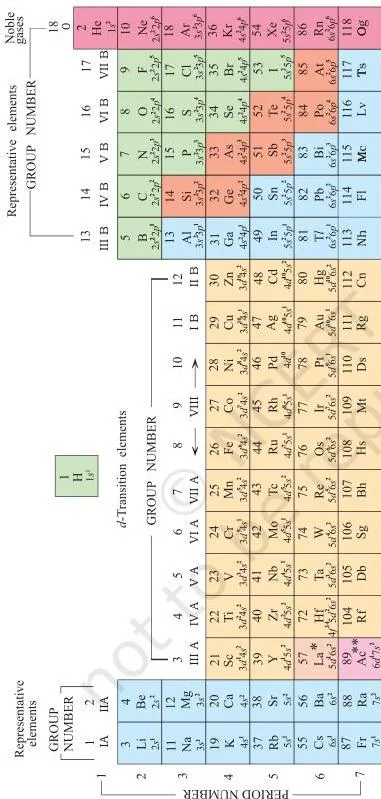
The figure above is the version you will use in problems. Notice how the s-block (groups 1–2), p-block (groups 13–18), d-block (groups 3–12) and the bottom f-block panels are laid out — this block division is the key to locating any element.
Electronic Configurations and Period Building
The period indicates the value of \( n \) for the outermost (valence) shell. Successive periods correspond to filling the next higher principal energy level, and the number of elements in a period equals twice the number of orbitals being filled (NCERT, p. 82).
| Period (n) | Orbitals filled (aufbau order) | Number of elements |
|---|---|---|
| 1 | 1s | 2 (H, He) |
| 2 | 2s, 2p | 8 (Li–Ne) |
| 3 | 3s, 3p | 8 (Na–Ar) |
| 4 | 4s, 3d, 4p | 18 (K–Kr) |
| 5 | 5s, 4d, 5p | 18 (Rb–Xe) |
| 6 | 6s, 4f, 5d, 6p | 32 (Cs–Rn) |
| 7 | 7s, 5f, 6d, 7p | 32 (theoretical) |
Why does the fourth period hold 18 elements? The 3d subshell becomes energetically favourable before the 4p subshell fills. So the filling is \( 4s \, (2) + 3d \, (10) + 4p \, (6) = 18 \) electrons. The 3d transition series (Sc to Zn) sits inside this period (NCERT, p. 82).
Derivation: why the 5th period has 18 elements
- Step 1: For \( n = 5 \), the possible azimuthal quantum numbers are \( l = 0, 1, 2, 3 \) (s, p, d and f subshells).
- Step 2: But only the subshells that fit this period’s aufbau order are filled here: \( 5s, 4d, 5p \) (the 4f level lies higher and belongs to period 6).
- Step 3: Count the orbitals: \( 1 \, (5s) + 5 \, (4d) + 3 \, (5p) = 9 \) orbitals.
- Step 4: Each orbital holds up to 2 electrons: \( 9 \times 2 = 18 \) electrons.
Final answer: The 5th period contains 18 elements.
Practical tip: locate any element instantly from its configuration
- Period = highest principal quantum number \( n \) in the configuration.
- Block = the subshell that receives the last electron (s, p, d or f).
- Group: s-block → number of valence s electrons (ns¹ → group 1; ns² → group 2); p-block → \( 12 + \) number of np electrons (ns²np⁴ → 16); d-block → number of (n−1)d + ns electrons for the outer edges of the block, with groups 8–10 spanning the middle; f-block elements sit with group 3.
Check it on \( Z = 114 \): the configuration ends \( 7s^2 5f^{14} 6d^{10} 7p^2 \), so highest \( n = 7 \), last subshell p, valence \( ns^2 np^2 \) → period 7, group 14.
s, p, d and f Blocks: Grouping by Orbital Filling
Elements in the same vertical column have the same number and distribution of electrons in their outermost orbitals, which is why they behave alike. The aufbau principle lets us split the table into four blocks by the orbital receiving the last electron (NCERT, p. 83).
| Block | Groups | General outer configuration | Key characteristics |
|---|---|---|---|
| s | 1, 2 | ns¹ (group 1), ns² (group 2) | Reactive metals with low ionization enthalpies; form 1+ or 2+ ions; never found free in nature; compounds usually ionic (except Li, Be) |
| p | 13–18 | ns²np¹ to ns²np⁶ | Representative (main group) elements; include metals, non-metals and metalloids; noble gases end the period with a closed ns²np⁶ shell and very low reactivity |
| d | 3–12 | (n−1)d¹⁻¹⁰ ns⁰⁻² (exception: Pd is 4d¹⁰5s⁰) | Transition metals: mostly coloured ions, variable oxidation states, paramagnetism, catalytic activity |
| f | Lanthanoids, actinoids | (n−2)f¹⁻¹⁴ (n−1)d⁰⁻¹ ns² | Inner-transition metals; very similar properties within each series; actinoids are radioactive |
Two placement exceptions matter (NCERT, p. 83): helium has \( 1s^2 \), so it belongs to the s-block, but it sits in the p-block (group 18) because its valence shell is completely filled like the other noble gases.
Hydrogen can lose one electron (behaving like group 1) or gain one to reach a noble gas configuration (behaving like group 17), so it is placed alone at the top of the table.
Metals, Non-metals and Metalloids
Metals make up more than 78% of all known elements and sit on the left of the table. Non-metals sit at the top right, and metalloids border the thick zig-zag line running diagonally across the table (NCERT, p. 84-85).
| Property | Metals | Non-metals | Metalloids |
|---|---|---|---|
| Position | Left of the table | Top right | Along the zig-zag diagonal (Si, Ge, As, Sb, Te) |
| Physical state | Solid at room temperature (Hg is the exception; Ga, Cs melt near 303 K/302 K) | Usually solid or gas, low melting/boiling points (B, C are exceptions) | Solid |
| Conductivity | Good conductors of heat and electricity | Poor conductors | Intermediate |
| Malleable / ductile | Yes (hammered into sheets, drawn into wires) | Brittle, neither malleable nor ductile | Often intermediate |
Metallic character increases down a group and decreases across a period (left to right).
Problem type: Arrange Si, Be, Mg, Na, P in increasing order of metallic character.
- Step 1: Metallic character decreases across a period (Na → P in period 3) and increases down a group.
- Step 2: Na (group 1) is most metallic; Mg (group 2) next; Be is below but in period 2, so less metallic than Mg but more than Si (period 3, group 14); P (period 3, group 15) is least metallic.
Final answer: P < Si < Be < Mg < Na.
Atomic and Ionic Radii: How Size Changes
An atom has no sharp boundary, so its size is estimated from the distance between bonded atoms (NCERT, p. 87).
- Covalent radius (non-metals) = half the distance between two atoms joined by a single covalent bond. Example: bond distance in \( \text{Cl}_2 \) is 198 pm, so the atomic radius of Cl is 99 pm.
- Metallic radius (metals) = half the internuclear distance between metal cores. Example: adjacent Cu atoms in solid copper are 256 pm apart, so the metallic radius of Cu is 128 pm.
- Noble gases are excluded from trend data — being monoatomic, their non-bonded radii are very large and should be compared with van der Waals radii instead.
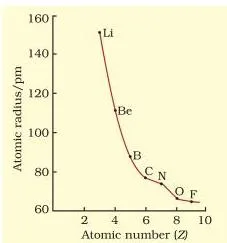
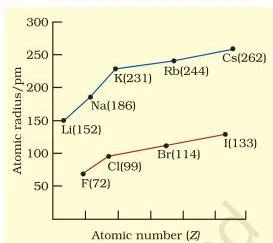
Across a period: electrons join the same valence shell, effective nuclear charge rises and the atom shrinks (Li 152 pm → F 64 pm). Down a group: \( n \) increases and inner filled shells shield the valence electrons, so the atom grows (Li 152 pm → Cs 262 pm).
Ionic radius and isoelectronic species
A cation is smaller than its parent atom (same nuclear charge, fewer electrons): Na 186 pm → Na⁺ 95 pm. An anion is larger than its parent atom (added electrons increase repulsion and lower effective nuclear charge): F 64 pm → F⁻ 136 pm (NCERT, p. 88).
Species with the same number of electrons are isoelectronic — for example \( \text{O}^{2-}, \text{F}^{-}, \text{Na}^{+} \) and \( \text{Mg}^{2+} \) all have 10 electrons. Among isoelectronic species the radius decreases as nuclear charge increases: the cation with the larger positive charge is the smallest, and the anion with the more negative charge is the largest (NCERT, p. 88).
- Step 1: Arrange \( \text{S}^{2-}, \text{Cl}^{-}, \text{Ar}, \text{K}^{+}, \text{Ca}^{2+} \) in increasing ionic radius.
- Step 2: All five are isoelectronic with 18 electrons.
- Step 3: Nuclear charges are 16, 17, 18, 19 and 20 respectively; greater nuclear charge pulls the same 18 electrons in tighter.
Final answer: \( \text{Ca}^{2+} < \text{K}^{+} < \text{Ar} < \text{Cl}^{-} < \text{S}^{2-} \).
Ionization Enthalpy: The Energy Cost of Removing an Electron
Ionization enthalpy is the energy required to remove an electron from an isolated gaseous atom in its ground state (NCERT, p. 88).
\[ \text{X(g)} \rightarrow \text{X}^{+}\text{(g)} + e^{-} \]
It is always positive (energy is always required), expressed in kJ mol⁻¹. The second ionization enthalpy is higher than the first because removing an electron from a positively charged ion is harder, and so on.
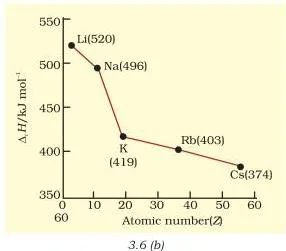
Trends: ionization enthalpy generally increases across a period and decreases down a group. The reason is shielding: valence electrons are screened from the nucleus by inner core electrons. Across a period the rise in nuclear charge outweighs shielding, so electrons are held tighter; down a group shielding outweighs nuclear charge, so electrons are easier to remove (NCERT, p. 89).
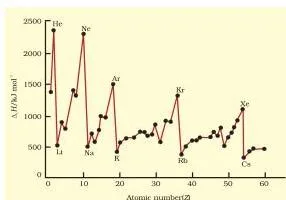
In Fig. 3.5 you can see the maxima at the noble gases (closed, very stable shells) and minima at the alkali metals (a single loosely held ns electron — which is why they are so reactive).
The two anomalies you must be able to explain
| Comparison | Order | Reason |
|---|---|---|
| Be vs B | \( \Delta_i H \, (\text{Be}) > \Delta_i H \, (\text{B}) \) | Be’s removed electron is 2s (penetrates more, held tighter); B’s removed electron is 2p (more shielded from the nucleus) |
| N vs O | \( \Delta_i H \, (\text{N}) > \Delta_i H \, (\text{O}) \) | N has three half-filled 2p orbitals (Hund’s rule, stable); O has two electrons sharing one 2p orbital, so electron–electron repulsion makes removal easier |
- Step 1: Given Na = 496, Mg = 737, Si = 786 kJ mol⁻¹ in the third period, predict Al’s first \( \Delta_i H \).
- Step 2: Al lies between Mg and Si but its value should be lower than Mg’s, because the 3p electron in Al is shielded by the 3s electrons (the same effect that lowers B below Be).
Final answer: Al’s \( \Delta_i H \) is closer to 575 than to 760 kJ mol⁻¹.
Electron Gain Enthalpy: Adding an Electron
Electron gain enthalpy is the enthalpy change when an electron is added to a neutral gaseous atom to form an anion (NCERT, p. 90):
\[ \text{X(g)} + e^{-} \rightarrow \text{X}^{-}\text{(g)} \]
The process can be exothermic (negative) or endothermic (positive), with units kJ mol⁻¹. Halogens have the most negative values because gaining one electron gives them a noble gas configuration. Noble gases have large positive values: the extra electron must enter the next higher principal quantum level, creating a very unstable arrangement (e.g., Ne +116, Ar +96 kJ mol⁻¹).
Trends: electron gain enthalpy becomes more negative across a period (the added electron sits closer to the increasing nuclear charge) and less negative down a group (the atom is larger, the added electron is farther from the nucleus).
The F vs Cl twist
Fluorine is less negative (−328 kJ mol⁻¹) than chlorine (−349 kJ mol⁻¹) (NCERT, p. 90-91). When an electron is added to F or O it enters the small \( n = 2 \) level and suffers significant repulsion from electrons already there. For S or Cl the electron enters the larger \( n = 3 \) level, where there is more room and much less repulsion.
The same logic makes O (−141) less negative than S (−200).
- Step 1: Arrange P, S, Cl, F from least to most negative electron gain enthalpy.
- Step 2: Across a period we move P → S → Cl, becoming more negative (P least negative, Cl most negative).
- Step 3: F lies below the general trend because of n = 2 repulsion, so it is less negative than Cl but more negative than S.
Final answer: P < S < F < Cl (least to most negative).
Watch the terminology: some books define electron affinity as the negative of this enthalpy change and take it as positive when energy is released; it is defined at absolute zero, with \( \Delta_{eq}H = -A_e – \tfrac{5}{2} RT \) (NCERT, p. 91, footnote).
Electronegativity: The Pull on Shared Electrons
Electronegativity is the ability of an atom in a chemical compound to attract shared electrons to itself (NCERT, p. 91). Unlike ionization enthalpy and electron gain enthalpy it is not measurable directly; the most widely used scale is the Pauling scale, which assigns fluorine an arbitrary value of 4.0.
Trends: electronegativity increases across a period and decreases down a group, following the same direction as ionization enthalpy. A smaller atom holds shared electrons more tightly, so the trend parallels atomic size. Electronegativity is directly related to non-metallic character and inversely related to metallic character (NCERT, p. 92).
| Period 2 | Li 1.0 | Be 1.5 | B 2.0 | C 2.5 | N 3.0 | O 3.5 | F 4.0 |
|---|---|---|---|---|---|---|---|
| Group 17 | F 4.0 | Cl 3.0 | Br 2.8 | I 2.5 | At 2.2 | ||
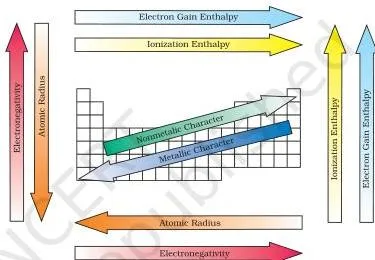
One trap: the electronegativity of an element is not constant — it varies with the element it is bonded to. Nitrogen is not exactly 3.0 in every nitrogen compound (NCERT, p. 92).
Valence and Oxidation States: The Periodic Pattern
Valence for representative elements is usually the number of outermost electrons, or eight minus that number. Group 15 elements, for example, show valences of 3 and 5. The modern term oxidation state is the charge assigned to an atom on the basis of electronegativity (NCERT, p. 92-93).
- In \( \text{OF}_2 \), fluorine (more electronegative) is −1 and oxygen is +2: it shares two electrons with two F atoms.
- In \( \text{Na}_2\text{O} \), oxygen accepts two electrons (one from each Na) and is −2; sodium, losing one electron, is +1.
You can predict compound formulas by crossing valences: silicon (group 14, valence 4) and bromine (group 17, valence 1) give SiBr₄; aluminium (group 13, valence 3) and sulphur (group 16, valence 2) give Al₂S₃ (NCERT, p. 93).
| Group | 1 | 2 | 13 | 14 | 15 | 16 | 17 |
|---|---|---|---|---|---|---|---|
| Valence | 1 | 2 | 3 | 4 | 3, 5 | 2, 6 | 1, 7 |
| Formula of hydride | LiH, NaH | CaH₂ | B₂H₆, AlH₃ | CH₄, SiH₄ | NH₃, PH₃ | H₂O, H₂S | HF, HCl |
| Formula of oxide | Li₂O | MgO | B₂O₃, Al₂O₃ | CO₂, SiO₂ | N₂O₅, P₄O₁₀ | SO₃, SeO₃ | Cl₂O₇ |
Transition elements and actinoids commonly show variable valence (e.g., one transition metal appears in several oxidation states in different compounds).
Anomalous Properties of Second-Period Elements
The first element of each group (Li, Be, B to F) behaves differently from the rest of its group. The reasons are its small size, large charge/radius ratio, high electronegativity, and only four valence orbitals (2s, 2p) available for bonding — so its maximum covalency is 4.
Later members have nine valence orbitals (3s, 3p, 3d) and can expand their shell beyond four bonds (NCERT, p. 94).
| Property | Li | Na | Be | Mg | B | Al |
|---|---|---|---|---|---|---|
| Metallic radius / pm | 152 | 186 | 111 | 160 | 88 | 143 |
| Cation radius / pm | 76 (Li⁺) | 102 (Na⁺) | 31 (Be²⁺) | 72 (Mg²⁺) | — | — |
| Maximum covalency | 4, covalent character | up to 6, ionic | 4 | up to 6 | 4, e.g. [BF₄]⁻ | 6, e.g. [AlF₆]³⁻ |
Diagonal relationship: the first element of one group resembles the second element of the next group — Li resembles Mg, and Be resembles Al. The second-period p-block elements also form strong pₓ–pᵧ multiple bonds to themselves and to other second-period elements (C=C, C≡C, N≡N, C=O, C≡N), which heavier members do much less readily.
One question that tests the distinction: in \( [\text{AlCl}(\text{H}_2\text{O})_3]^{2+} \), the oxidation state of Al is +3 but its covalency is 6 — oxidation state and covalency are not the same thing.
Chemical Reactivity and Oxide Nature
Across a period, chemical reactivity is highest at the two extremes and lowest in the centre (NCERT, p. 95).
- Left extreme (alkali metals): easy electron loss (low ionization enthalpy) → form cations, act as reductants, and give basic oxides: \( \text{Na}_2\text{O} + \text{H}_2\text{O} \rightarrow 2\text{NaOH} \).
- Right extreme (halogens): high electron gain → form anions and give acidic oxides: \( \text{Cl}_2\text{O}_7 + \text{H}_2\text{O} \rightarrow 2\text{HClO}_4 \).
- Centre: amphoteric oxides (Al₂O₃, As₂O₃ behave as acids with bases and as bases with acids) or neutral oxides (CO, NO, N₂O).
Down a group, metallic character increases and non-metallic character decreases. Among transition metals the change in atomic radius across a period is much smaller than for representative elements (and smaller still for inner-transition metals), and their ionization enthalpies are intermediate between the s- and p-blocks — so they are less electropositive than group 1 and 2 metals.
Solved Examples: Applying Periodic Trends
Example 1: Locate the element with Z = 34
Step 1: Write the electronic configuration: \( 1s^2 2s^2 2p^6 3s^2 3p^6 3d^{10} 4s^2 4p^4 \), i.e.
[Ar]\( 3d^{10}4s^2 4p^4 \).
- Step 1: Highest principal quantum number \( n = 4 \) → period 4.
- Step 2: The last electron enters 4p → p-block.
- Step 3: Valence shell \( 4s^2 4p^4 \) means 6 valence electrons; p-block group = 12 + 4 = group 16.
Final answer: Period 4, group 16, p-block (selenium).
Example 2: Arrange cations and anions of a fixed electron count
- Step 1: Arrange \( \text{N}^{3-}, \text{O}^{2-}, \text{F}^{-}, \text{Na}^{+}, \text{Mg}^{2+} \) in increasing ionic radius.
- Step 2: All five have 10 electrons — they are isoelectronic.
- Step 3: Nuclear charges are 7, 8, 9, 11 and 12.
Greater charge pulls the same 10 electrons in more strongly.
Final answer: \( \text{Mg}^{2+} < \text{Na}^{+} < \text{F}^{-} < \text{O}^{2-} < \text{N}^{3-} \) (increasing radius).
Example 3: IUPAC name and symbol for Z = 126
- Step 1: Write the atomic number as digits: 126 → 1, 2, 6.
- Step 2: Convert each digit to its IUPAC root (Table 3.4): 1 → un (u), 2 → bi (b), 6 → hex (h).
- Step 3: Join the roots in digit order and add “ium”: un + bi + hex + ium = unbihexium.
- Step 4: The symbol is the first letter of each root: u + b + h = Ubh.
Final answer: Unbihexium, symbol Ubh — a temporary systematic name until IUPAC ratifies an official name.
Example 4: Predict a compound formula from group valences
- Step 1: Calcium is group 2, valence 2 (loses 2 electrons → \( \text{Ca}^{2+} \)).
- Step 2: Phosphorus is group 15, valence 3 (gains 3 electrons → \( \text{P}^{3-} \)).
- Step 3: Cross the valences: Ca₃P₂.
- Step 4: Check charge balance: \( 3 \times (+2) = +6 \) and \( 2 \times (-3) = -6 \), so the compound is neutral.
Final answer: Ca₃P₂.
Common Mistakes Students Make in This Chapter
| Mistake | Correct rule | How to check your answer |
|---|---|---|
| Writing fluorine as the element with the most negative electron gain enthalpy | Chlorine is the most negative (−349 kJ mol⁻¹); for F the added electron enters the small n = 2 level and suffers repulsion, while n = 3 in Cl leaves more room | Remember the pair rule: the 3rd-period element beats the 2nd-period one in the same family (O vs S, F vs Cl) |
| Mixing up atomic radius and ionic radius | Cation < parent atom < anion, e.g. Na 186 pm → Na⁺ 95 pm; F 64 pm → F⁻ 136 pm | Ask: was an electron lost or gained? Lost → smaller; gained → larger |
| Thinking ionization enthalpy falls across a period | It generally increases across a period (nuclear charge beats shielding) and decreases down a group; only the Be/B and N/O dips break the rise | Compare neighbours: Li → Ne climbs from 520 to 2081 kJ mol⁻¹, so a rising pattern is expected |
| Confusing electronegativity with electron gain enthalpy | Electronegativity is the pull on a shared pair in a compound (not measurable, Pauling scale, no units); electron gain enthalpy is the energy change of an isolated gaseous atom gaining an electron (kJ mol⁻¹) | Units! Electronegativity has none; electron gain enthalpy always carries kJ mol⁻¹ |
| Getting IUPAC names or symbols wrong for Z > 100 | Convert each digit to its root (0 = nil, 1 = un, 2 = bi, 6 = hex…) in order, add “ium”; symbol = first letter of each root | Test a known one: Z = 120 → un + bi + nil = unbinilium, Ubn |
Exam-Focused Notes: What the Board Likes to Test
These patterns come from the NCERT exercise set for this chapter — each is a question shape you should be ready for, and in each the explanation, not the bare answer, earns the marks.
- Block / period / group from configuration (e.g., Exercises 3.5, 3.6, 3.30): write the configuration, then state each answer separately — period (highest n), block (last subshell), group (valence rule). One mark per label.
- Ordering radii of isoelectronic species (Exercise 3.12): quote the electron count, rank by nuclear charge, and state “smaller nuclear charge → larger radius” before giving the order.
- Be vs B and N vs O ionization anomalies (Exercise 3.16): cite the reason — 2s vs 2p penetration, and paired-electron repulsion in O. The why is the mark.
- O/F vs S/Cl electron gain anomaly (Exercise 3.20): mention n = 2 repulsion explicitly.
- Oxide nature (Exercise 3.30-adjacent reasoning): left of a period → basic oxide; right → acidic; centre → amphoteric/neutral. Back it with a reaction like \( \text{Na}_2\text{O} + \text{H}_2\text{O} \rightarrow 2\text{NaOH} \).
- IUPAC nomenclature for Z > 100 (Problem 3.1): show the roots, then the assembled name and three-letter symbol.
In the exercise set, questions 3.1–3.32 are largely direct concept, reasoning and numerical work (3.15 is a numerical using the mole concept; 3.16 and 3.31 are reasoning/data interpretation), while 3.33–3.40 are single-answer MCQs testing definitions, block structure and trend orderings.
Periodic Classification of Elements Class 11 Notes: Quick Revision Sheet
The whole chapter on one page. Revision mnemonic to hold it: “Across the period, the atom shrinks; down the group, the atom grows.” And for the energy trends, “follow fluorine” — the top-right corner holds electrons the tightest (highest ionization enthalpy, highest electronegativity), with only the F/Cl electron-gain twist breaking the pattern.
| Property | Across a period (→) | Down a group (↓) | Reason |
|---|---|---|---|
| Atomic / ionic radius | Decreases | Increases | Across: nuclear charge rises in the same shell; down: higher n and more shielding |
| Ionization enthalpy | Increases (dips at Be/B, N/O) | Decreases | Across: electrons held tighter; down: shielding grows |
| Electron gain enthalpy | More negative (halogens); noble gases positive | Less negative (F anomaly vs Cl) | Across: added electron closer to nucleus; down: larger atom, electron farther |
| Electronegativity | Increases | Decreases | Smaller radius → stronger pull on the shared pair |
| Metallic character | Decreases | Increases | Ease of losing electrons falls across, rises down |
| Block | Groups | General configuration | Nature |
|---|---|---|---|
| s | 1, 2 | ns¹, ns² | Reactive metals |
| p | 13–18 | ns²np¹–np⁶ | Metals, non-metals, metalloids, noble gases |
| d | 3–12 | (n−1)d¹⁻¹⁰ ns⁰⁻² | Transition metals (Pd exception: 4d¹⁰5s⁰) |
| f | Lanthanoids, actinoids | (n−2)f¹⁻¹⁴ (n−1)d⁰⁻¹ ns² | Inner-transition metals; actinoids radioactive |
Remember the block exceptions: helium sits in the p-block despite being s-block, and hydrogen is placed on its own at the top.
Reading the Periodic Table and Ionization Plots
Exam questions often paraphrase the figures, so learn to read them rather than memorise values.
- Long-form table (Fig. 3.2): read the period from the row, the group from the column, and the block from the position — s-block = groups 1–2, p-block = 13–18, d-block = the 3–12 centre, f-block = the bottom panels. The ground-state outer configuration printed under each symbol tells you the valence shell directly.
- Atomic radius graph (Fig. 3.4a): the x-axis is atomic number and the y-axis is atomic radius. Each period slopes downward — the alkali metal at the start of a period is the largest, and the halogen/noble-gas region at the end is the smallest in that period.
- Ionization enthalpy plot (Fig. 3.5): maxima sit at the noble gases and minima at the alkali metals — so the plot is a sawtooth that climbs toward the top-right of the table. A question like “which element in the second period has the smallest radius?” is answered directly from the shape of these curves.
Frequently Asked Questions
Why is the first ionization enthalpy of nitrogen higher than oxygen?
Nitrogen has three half-filled 2p orbitals (\( 1s^2 2s^2 2p^3 \), Hund’s rule), which is a relatively stable arrangement. Oxygen (\( 1s^2 2s^2 2p^4 \)) must place two electrons in one 2p orbital, and the resulting electron–electron repulsion makes it easier to remove one of them. Hence \( \Delta_i H \, (\text{N}) > \Delta_i H \, (\text{O}) \).
What is the difference between electron gain enthalpy and electronegativity?
Electron gain enthalpy is the energy change when an isolated gaseous atom gains an electron — it is measurable, with units kJ mol⁻¹. Electronegativity is an atom’s ability to attract a shared pair of electrons in a chemical compound — it is not directly measurable, uses the Pauling scale and has no units.
Electronegativity even varies with the element an atom is bonded to, while electron gain enthalpy is a property of the isolated atom.
How do I predict the block, period, and group of an element from its electronic configuration?
Block = the subshell receiving the last electron. Period = the highest principal quantum number n. Group: for the s-block, the number of valence s electrons; for the p-block, 12 + the number of np electrons; for the d-block, the number of (n−1)d + ns electrons (with groups 8–10 spanning the middle); f-block elements sit in group 3 with the lanthanoids/actinoids.
Why do noble gases have large positive electron gain enthalpy?
Their valence shell is completely filled and very stable. Adding an electron forces it into the next higher principal quantum level, producing a highly unstable configuration that requires energy — so the values are positive (e.g., Ne +116, Ar +96 kJ mol⁻¹) rather than negative.
What are the main differences between Mendeleev’s periodic law and the modern periodic law?
Mendeleev’s law is based on atomic weight — properties are periodic functions of atomic weight — which forced him to ignore the weight order occasionally (iodine/tellurium) and left gaps for undiscovered elements.
The modern periodic law, based on Moseley’s X-ray work, uses atomic number — properties are periodic functions of atomic number — and is justified by the periodic variation in electronic configurations, removing the anomalies of the weight-based ordering.
These notes continue naturally into the Chemical Bonding and Molecular Structure notes, where electronegativity and oxidation states are put to work. For the full set, browse the Class 11 Chemistry notes, the Class 11 revision notes hub, or the main CBSE notes collection.
Reference: NCERT Class 11 Chemistry Part I textbook, chapter “Classification of Elements and Periodicity in Properties”.
Explore Class 11 Chemistry Notes
Class 11 Chemistry on LearnCBSE:
Related chapters: