
These chemical bonding and molecular structure class 11 notes give you the whole NCERT Chapter 4 in a tighter, exam-ready form — Lewis structures, ionic bonding and lattice enthalpy, bond parameters, resonance, VSEPR shapes, valence bond theory with hybridisation, MO theory, and hydrogen bonding — all following the rationalised NCERT Class 11 Chemistry Part I textbook.
Use them as a revision pass: read the storyline first, then jump from the contents below to any weak area. Definitions, formulas and worked examples are kept separate so you can find them fast the night before an exam.
Why Atoms Bond: The Storyline of This Chapter
Atoms combine because bonding lowers the energy of the system. A bonded pair of atoms sits in a lower-energy, more stable state than the two isolated atoms — that single idea drives every theory in this chapter (NCERT, p. 101).
The theories build on one another in a strict teaching order. Each one answers the question the previous theory could not:
- Electronic configuration and periodic trends — who has how many valence electrons, and which atoms attract electrons.
- Kossel-Lewis approach — atoms transfer or share valence electrons to reach an octet.
- Ionic bonding and lattice enthalpy — why electron transfer produces stable crystals.
- Covalent bonds and bond parameters — how to measure the bonds sharing creates.
- Resonance — when one Lewis structure cannot tell the truth.
- Bond polarity and dipole moment — how shape decides net charge separation.
- VSEPR theory — shapes from electron-pair repulsion.
- Valence bond theory and hybridisation — shapes from orbital overlap.
- Molecular orbital theory — molecule-wide orbitals that explain magnetism.
- Hydrogen bonding — the weak bond behind water’s unusual behaviour.
Learning in this order matters more than the textbook section order. Skip a step and the next theory looks arbitrary.
Kossel-Lewis Approach and the Octet Rule
In 1916, Kossel and Lewis independently explained valence using electrons. Lewis pictured an atom as a positive kernel (nucleus plus inner electrons) surrounded by an outer shell that holds up to eight electrons placed at the corners of a cube.
An octet is a particularly stable arrangement, so Lewis postulated that atoms achieve it when they link by chemical bonds (NCERT, p. 102).
Only the outer-shell electrons take part in combination. These are the valence electrons, and Lewis symbols show them as dots around the element symbol:
- Number of dots = number of valence electrons.
- Group valence is either the number of dots or 8 minus the number of dots (NCERT, p. 102).
The octet rule follows directly: atoms combine either by transferring or by sharing valence electrons so that each atom ends with eight electrons in its valence shell — except hydrogen, which needs only two, a duplet (NCERT, p. 103).
Two ways to reach the octet:
- Electron transfer → ionic bond. Na gives its one valence electron to Cl, forming \( Na^+ \) and \( Cl^- \), held by electrostatic attraction. This bond was called the electrovalent bond, and the electrovalence equals the number of unit charges on the ion (NCERT, p. 102).
- Electron sharing → covalent bond. Each Cl atom contributes one electron to a shared pair; both atoms now look like argon. Langmuir (1919) introduced the term covalent bond (NCERT, p. 103).
The number of shared pairs names the bond: one shared pair = single bond (\( Cl_2 \), \( H_2 \), \( F_2 \)); two shared pairs between the same atoms = double bond (the two C=O bonds in \( CO_2 \), the C=C bond in ethene); three shared pairs = triple bond (\( N_2 \), ethyne).
Writing Lewis Structures: The Five Steps That Never Fail
The five-step method below works for any molecule or ion. NCERT applies it to CO and \( NO_2^- \) (Problems 4.1 and 4.2); the worked example later applies it to HCN so you see the method on a fresh molecule.
- Add the valence electrons of all the atoms in the molecule.
- Adjust for charge: add one electron for each negative charge, subtract one for each positive charge. \( CO_3^{2-} \) gains two electrons; \( NH_4^+ \) loses one (NCERT, p. 104).
- Choose the skeletal structure — the least electronegative atom goes in the centre. N is central in \( NF_3 \), C is central in \( CO_3^{2-} \).
- Place shared pairs (bonds). The remaining electrons become lone pairs or extra bonds, using a double or triple bond wherever an atom still lacks an octet.
- Check: every bonded atom must have an octet, and hydrogen must have a duplet (NCERT, p. 104).
The rule that makes step 5 work: a shared pair counts fully for both atoms. So a carbon with only four electrons around it forces a multiple bond.
Formal Charge and Why the Octet Rule Has Exceptions
Formal charge is a bookkeeping tool, not a real charge on an atom. It is the difference between the valence electrons of the free atom and the electrons assigned to that atom in the Lewis structure (NCERT, p. 105):
\[ \text{Formal charge} = V – L – \frac{1}{2}S \]
where \( V \) = valence electrons in the free atom, \( L \) = lone-pair electrons, and \( S \) = bonding (shared) electrons. The counting assumes the atom owns one electron of every shared pair and both electrons of every lone pair. In ozone, the central O carries +1 and the two end oxygens carry 0 and −1.
Formal charge helps select the lowest-energy Lewis structure — generally the one with the smallest formal charges (NCERT, p. 105).
The octet rule is useful but not universal. Three types of exceptions exist (NCERT, p. 106):
- Incomplete octet: the central atom ends with fewer than eight electrons — \( BeH_2 \), \( BCl_3 \), \( BF_3 \), \( AlCl_3 \), \( LiCl \).
- Odd-electron molecules: one unpaired electron means octets cannot close for every atom — NO and \( NO_2 \).
- Expanded octet: third-period and later elements use d orbitals to hold more than eight electrons — \( PF_5 \), \( SF_6 \), \( H_2SO_4 \).
Further drawbacks: some noble gases do form compounds (\( XeF_2 \), \( KrF_2 \)), the rule says nothing about molecular shape, and it is silent on bond energies (NCERT, p. 107).
Ionic Bonds and Lattice Enthalpy: Why NaCl Is Stable
An ionic (electrovalent) bond is the electrostatic attraction between oppositely charged ions. Ionic bonds form most easily between a metal with a low ionization enthalpy and a non-metal with a highly negative electron gain enthalpy (NCERT, p. 107). The ammonium ion \( NH_4^+ \) is the well-known exception — its cation is built from two non-metals.
Why is NaCl stable? The energy bookkeeping (NCERT, p. 107):
- Ionization: \( Na(g) \rightarrow Na^+(g) + e^- \), enthalpy +495.8 kJ mol⁻¹.
- Electron gain: \( Cl(g) + e^- \rightarrow Cl^-(g) \), enthalpy −348.7 kJ mol⁻¹.
- Net cost of forming the ions: +147.1 kJ mol⁻¹ — endothermic.
- Lattice formation of \( NaCl(s) \): −788 kJ mol⁻¹ — more than enough to cover that cost.
Lattice enthalpy is the energy required to completely separate one mole of a solid ionic compound into its gaseous constituent ions (NCERT, p. 108). The stability of an ionic solid therefore comes from lattice enthalpy, not simply from achieving octets — a qualitative measure of stability (NCERT, p. 107). The enthalpy conventions used here are developed in the thermodynamics notes.
Bond Parameters: Length, Angle, Enthalpy, Order
Bond length is the equilibrium distance between the nuclei of two bonded atoms, \( R = r_A + r_B \), where \( r_A \) and \( r_B \) are covalent radii — each roughly half the distance between two similar bonded atoms. The van der Waals radius is the larger, nonbonded size of the atom (NCERT, p. 108).
Bond angle is the angle between the orbitals containing bonding electron pairs around the central atom; it reveals the molecular shape (NCERT, p. 109). Bond enthalpy is the energy needed to break one mole of a particular bond in the gaseous state, in kJ mol⁻¹: H–H 435.8, O=O 498, N≡N 946.0, H–Cl 431.0 (NCERT, p. 109).
In polyatomic molecules the two O–H bonds of water need 502 and 427 kJ mol⁻¹ respectively — the second bond breaks in a changed environment — so we use the average: \( (502 + 427)/2 = 464.5 \) kJ mol⁻¹ (NCERT, p. 109-110).
Bond order is the number of bonds between two atoms in the Lewis picture: 1 for \( H_2 \), 2 for \( O_2 \), 3 for \( N_2 \) and CO. Isoelectronic species have identical bond orders — \( F_2 \) and \( O_2^{2-} \) both 1; \( N_2 \), CO and \( NO^+ \) all 3. The correlation that matters: as bond order increases, bond enthalpy increases and bond length decreases (NCERT, p. 110).
| Bond | Bond length (pm) |
|---|---|
| C–C | 154 |
| C=C | 133 |
| C≡C | 120 |
| C–H | 107 |
| O–H | 96 |
| C=O | 121 |
| N≡N | 109 |
| O=O | 121 |
| H–H | 74 |
Selected average bond lengths from NCERT Tables 4.2 and 4.3 (NCERT, p. 109). Notice the same triple bond pattern: more shared pairs pull the nuclei closer.
Resonance: When One Lewis Structure Cannot Tell the Truth
Sometimes a single Lewis structure cannot match measured bond lengths. In ozone, a normal O–O single bond is 148 pm and an O=O double bond is 121 pm, but both oxygen-oxygen bonds in \( O_3 \) measure 128 pm — exactly between the two (NCERT, p. 110).
Resonance solves this. When one Lewis structure is inadequate, several structures with the same positions of nuclei but different electron placement are written as canonical forms. Their average — the resonance hybrid — represents the molecule accurately. A double-headed arrow links the forms (NCERT, p. 110).
Examples: the carbonate ion \( CO_3^{2-} \) is a hybrid of three canonical forms, so all three C–O bonds are equivalent. In \( CO_2 \), the measured 115 pm C–O bonds lie between a C=O double bond (121 pm) and a C≡O triple bond (110 pm), so \( CO_2 \) is also a resonance hybrid (NCERT, p. 111).
Four misconceptions to erase (NCERT, p. 111):
- The canonical forms have no real existence.
- The molecule does not spend part of its time in one form and part in another.
- There is no equilibrium between canonical forms, unlike keto-enol tautomerism.
- The molecule has one structure — the resonance hybrid, which no single Lewis structure can draw.
Resonance stabilises the molecule (the hybrid is lower in energy than any single canonical form) and averages bond characteristics (NCERT, p. 111).
Bond Polarity and Dipole Moment: How to Compare Molecules
A bond between identical atoms (\( H_2 \), \( O_2 \), \( Cl_2 \), \( N_2 \), \( F_2 \)) shares electrons equally — a nonpolar covalent bond. In HF, the shared pair shifts toward fluorine, creating a polar covalent bond with partial charges \( \delta^+ \) and \( \delta^- \) (NCERT, p. 111).
The dipole moment measures this charge separation:
\[ \mu = Q \times r \]
where \( Q \) is the magnitude of charge and \( r \) the distance between charge centres. The unit is the debye (D), with \( 1\ \text{D} = 3.33564 \times 10^{-30}\ \text{C m} \). Dipole moment is a vector — bond dipoles add like forces (NCERT, p. 112).
Vector addition explains why molecular shape decides net polarity:
- \( H_2O \) is bent at 104.5°, so the two O–H dipoles add to a net 1.85 D.
- \( BeF_2 \), \( BF_3 \), \( CO_2 \) and \( CCl_4 \) have polar bonds, but their symmetric geometry cancels the bond dipoles → zero net dipole moment.
- \( NH_3 \) versus \( NF_3 \): both pyramidal with one lone pair, yet \( NH_3 \) (4.90 × 10⁻³⁰ C m) beats \( NF_3 \) (0.80 × 10⁻³⁰ C m). In \( NH_3 \) the lone-pair orbital dipole points in the same direction as the N–H resultants; in \( NF_3 \) it points opposite to the N–F resultants and cancels part of them (NCERT, p. 112).
Fajans’ rules describe the partial covalent character of ionic bonds: covalent character grows as the cation gets smaller, the anion gets larger, the cation charge increases, and — for cations of the same size and charge — when the cation has a transition-metal configuration rather than a noble-gas configuration (NCERT, p. 112-113).
VSEPR Theory: Predicting Shapes from Electron Pairs
The VSEPR (Valence Shell Electron Pair Repulsion) theory predicts shapes from one idea: valence-shell electron pairs repel one another and therefore occupy positions that maximise their distance apart on a sphere around the central atom. A multiple bond is treated as a single super pair (NCERT, p. 113).
Repulsion decreases in the order (NCERT, p. 113):
\[ \text{lp–lp} \gt \text{lp–bp} \gt \text{bp–bp} \]
Memory device: keep it as LL > LB > BB — “lone lions battle boldly“. Two lone pairs push hardest, a lone pair and a bond pair next, and two bond pairs push least.
A lone pair occupies more space than a bonding pair because a bond pair is pulled between two nuclei, so it squeezes the bond pairs closer together: ammonia falls from 109.5° to 107° and water to 104.5° (NCERT, p. 116).
Fresh analogy: tie four balloons together and they push to the four corners of a tetrahedron. Now tie one large balloon with three smaller ones — the large one shoves the others down and compresses the angles between them. A lone pair is that large balloon.
| Total electron pairs | Lone pairs | Electron-pair geometry | Molecular shape | Angle | Example |
|---|---|---|---|---|---|
| 2 | 0 | Linear | Linear | \( 180^\circ \) | \( BeCl_2 \) |
| 3 | 0 | Trigonal planar | Trigonal planar | \( 120^\circ \) | \( BF_3 \) |
| 3 | 1 | Trigonal planar | Bent | \( 119.5^\circ \) | \( SO_2 \) |
| 4 | 0 | Tetrahedral | Tetrahedral | \( 109.5^\circ \) | \( CH_4 \), \( NH_4^+ \) |
| 4 | 1 | Tetrahedral | Trigonal pyramidal | \( 107^\circ \) | \( NH_3 \) |
| 4 | 2 | Tetrahedral | Bent | \( 104.5^\circ \) | \( H_2O \) |
| 5 | 0 | Trigonal bipyramidal | Trigonal bipyramidal | \( 90^\circ, 120^\circ \) | \( PCl_5 \) |
| 5 | 1 | Trigonal bipyramidal | See-saw | — | \( SF_4 \) |
| 5 | 2 | Trigonal bipyramidal | T-shape | — | \( ClF_3 \) |
| 6 | 0 | Octahedral | Octahedral | \( 90^\circ \) | \( SF_6 \) |
| 6 | 1 | Octahedral | Square pyramidal | — | \( BrF_5 \) |
| 6 | 2 | Octahedral | Square planar | — | \( XeF_4 \) |
This comparison of electron-pair geometry versus molecular shape follows NCERT Tables 4.6 and 4.7 (NCERT, p. 114-116). The electron-pair geometry is set by all pairs; the molecular shape names only the atoms.
Valence Bond Theory: Why Orbitals Overlap
The valence bond (VB) theory (Heitler and London, 1927; developed by Pauling) explains covalent bonds as orbital overlap. In \( H_2 \), two hydrogen atoms approach and new forces begin: attractions (each nucleus with both electrons) pull them together; repulsions (electron–electron and nucleus–nucleus) push them apart.
Attraction wins until the potential energy reaches a minimum at 74 pm — the bond length — releasing 435.8 kJ mol⁻¹ of bond enthalpy (NCERT, p. 118-119).
The partial merging of atomic orbitals is overlap, which pairs electrons of opposite spin. Greater overlap means a stronger bond. Overlap may be positive (same phase), negative (opposite phase) or zero (wrong orientation) (NCERT, p. 119-120).
Two bond types arise:
- Sigma (σ) bond — head-on (axial) overlap along the internuclear axis: s–s, s–p or p–p. Stronger, because the overlap region is larger.
- Pi (π) bond — sidewise overlap of parallel p orbitals, with electron density above and below the internuclear axis. Weaker.
A multiple bond always means one sigma bond plus the rest pi: C=C is one σ + one π, and C≡C is one σ + two π (NCERT, p. 121).
But simple orbital overlap fails for \( CH_4 \), \( NH_3 \) and \( H_2O \). Carbon’s three 2p orbitals would give three 90° C–H bonds, with the fourth bond in an unknown direction — yet the real HCH angle is 109.5°. Similarly \( NH_3 \) and \( H_2O \) should come out at 90° instead of 107° and 104.5° (NCERT, p. 120).
NCERT’s Figures 4.7 (forces in \( H_2 \)), 4.8 (potential energy curve) and 4.9 (positive, negative and zero overlap) carry the visual argument. This failure forces the idea of hybridisation.
Hybridisation: sp, sp2, sp3 and d-Orbital Schemes
Hybridisation is the intermixing of valence-shell orbitals of slightly different energies to form a new set of equivalent hybrid orbitals (NCERT, p. 121). Salient features: the number of hybrid orbitals equals the number of orbitals mixed; hybrid orbitals are equal in energy and shape; they form stronger bonds than pure atomic orbitals; and their directions set the molecular geometry.
Conditions: only valence-shell orbitals of nearly equal energy hybridise; promotion of an electron is not essential beforehand; and even filled orbitals can participate (NCERT, p. 122).
| Hybridisation | Orbitals mixed | Electron-pair arrangement | Angle | Examples |
|---|---|---|---|---|
| \( sp \) | 1 s + 1 p | Linear | \( 180^\circ \) | \( BeCl_2 \), \( C_2H_2 \) |
| \( sp^2 \) | 1 s + 2 p | Trigonal planar | \( 120^\circ \) | \( BCl_3 \), \( C_2H_4 \) |
| \( sp^3 \) | 1 s + 3 p | Tetrahedral | \( 109.5^\circ \) | \( CH_4 \), \( NH_3 \), \( H_2O \), \( C_2H_6 \) |
| \( sp^3d \) | 1 s + 3 p + 1 d | Trigonal bipyramidal | \( 90^\circ, 120^\circ \) | \( PCl_5 \), \( PF_5 \) |
| \( sp^3d^2 \) | 1 s + 3 p + 2 d | Octahedral | \( 90^\circ \) | \( SF_6 \) |
| \( dsp^2 \) | 1 d + 1 s + 2 p | Square planar | \( 90^\circ \) | \( [Ni(CN)_4]^{2-} \) |
Applications to remember (NCERT, p. 122-125):
- sp: \( BeCl_2 \) is linear at 180°. In ethyne each carbon uses two unhybridised p orbitals, so C≡C is one σ + two π.
- sp2: \( BCl_3 \) is trigonal planar at 120°. In ethene the unhybridised p orbital on each carbon forms the π bond, so C=C is one σ + one π.
- sp3: \( CH_4 \) is tetrahedral at 109.5°. In \( NH_3 \) one hybrid holds the lone pair; in \( H_2O \) two hybrids hold lone pairs, which is why the angles drop to 107° and 104.5°.
- sp3d: \( PCl_5 \) is trigonal bipyramidal. The two axial bonds suffer more repulsion from the equatorial pairs, so they are slightly longer and weaker — which is why \( PCl_5 \) is reactive.
- sp3d2: \( SF_6 \) is a regular octahedron.
Molecular Orbital Theory for Homonuclear Diatomics
The molecular orbital (MO) theory (Hund and Mulliken, 1932) treats electrons as occupying molecular orbitals spread over the whole molecule.
Key rules: the number of MOs formed equals the number of combining atomic orbitals; bonding MOs are lower in energy and antibonding MOs higher; and filling follows the aufbau principle, Pauli’s exclusion principle and Hund’s rule, exactly as in atoms (NCERT, p. 126).
MOs are built by linear combination of atomic orbitals: \( \psi_{MO} = \psi_A \pm \psi_B \). Addition gives a bonding MO (constructive interference, electron density between the nuclei); subtraction gives an antibonding MO (destructive interference, a nodal plane between the nuclei) (NCERT, p. 127).
Three conditions for combination: the atomic orbitals must have nearly equal energy, the same symmetry about the molecular axis, and maximum overlap (NCERT, p. 128).
The energy order of MOs is different for the two halves of the second period — a common exam trap. For \( O_2 \) and \( F_2 \):
\[ \sigma 1s \lt \sigma^* 1s \lt \sigma 2s \lt \sigma^* 2s \lt \sigma 2p_z \lt (\pi 2p_x = \pi 2p_y) \lt (\pi^* 2p_x = \pi^* 2p_y) \lt \sigma^* 2p_z \]
For \( B_2 \), \( C_2 \) and \( N_2 \), the order flips — \( \sigma 2p_z \) sits above the two \( \pi \) orbitals (NCERT, p. 129):
\[ \sigma 1s \lt \sigma^* 1s \lt \sigma 2s \lt \sigma^* 2s \lt (\pi 2p_x = \pi 2p_y) \lt \sigma 2p_z \lt (\pi^* 2p_x = \pi^* 2p_y) \lt \sigma^* 2p_z \]
Bond order is one half the difference between the numbers of electrons in bonding and antibonding orbitals:
\[ \text{Bond order} = \frac{1}{2}(N_b – N_a) \]
Positive bond order means a stable molecule; zero or negative means unstable. Higher bond order also means shorter bond length (NCERT, p. 130).
Homonuclear results to memorise (NCERT, p. 130-131):
- \( H_2 \): \( (\sigma 1s)^2 \), bond order 1, diamagnetic.
- \( He_2 \): \( (\sigma 1s)^2 (\sigma^* 1s)^2 \), bond order 0 — does not exist.
- \( Li_2 \): \( KK(\sigma 2s)^2 \), bond order 1, diamagnetic, exists in vapour.
- \( C_2 \): bond order 2, diamagnetic; unusually, both bonds are π bonds.
- \( O_2 \): bond order \( \frac{1}{2}(10 – 6) = 2 \), with two unpaired electrons in \( \pi^* 2p_x \) and \( \pi^* 2p_y \) — hence paramagnetic.
\[ O_2 : (\sigma 1s)^2 (\sigma^* 1s)^2 (\sigma 2s)^2 (\sigma^* 2s)^2 (\sigma 2p_z)^2 (\pi 2p_x)^2 (\pi 2p_y)^2 (\pi^* 2p_x)^1 (\pi^* 2p_y)^1 \]
This is the theory’s triumph: the Lewis structure of \( O_2 \) looks fully paired, but the MO picture predicts two unpaired electrons, matching the observed paramagnetism (NCERT, p. 131). NCERT Figure 4.21 shows the MO occupancy and properties for \( B_2 \) through \( Ne_2 \).
Hydrogen Bonding: The Weak Bond That Shapes Water
A hydrogen bond is the attractive force between a hydrogen atom carrying a partial positive charge — because it is covalently bonded to N, O or F — and an electronegative atom of another molecule. It is drawn as a dotted line and is weaker than a covalent bond (NCERT, p. 132).
Cause of formation: F, O and N pull the shared pair so far toward themselves that hydrogen becomes \( \delta^+ \), and this \( \delta^+ \) hydrogen is attracted to a \( \delta^- \) atom nearby. The magnitude of H-bonding depends on physical state: strongest in the solid state, weakest in the gaseous state (NCERT, p. 132).
Two types (NCERT, p. 133):
- Intermolecular hydrogen bond — between two different molecules of the same or different compounds: HF chains, water molecules, alcohols.
- Intramolecular hydrogen bond — within one molecule, when hydrogen sits between two electronegative atoms of that molecule: o-nitrophenol, where the H atom lies between two oxygen atoms.
Real-life consequence: intermolecular H-bonding in water builds an open structure in ice, so ice is less dense than liquid water and floats. The textbook notes H-bonds have a powerful effect on structure and properties (NCERT, p. 132); this is one of its largest effects.
Key Terms and Definitions at a Glance
| Term | Meaning in one line | Example |
|---|---|---|
| Chemical bond | Attractive force holding atoms or ions together in a chemical species | Na–Cl bond in NaCl |
| Valence electrons | Outer-shell electrons that take part in bonding | C: 4, N: 5 |
| Octet rule | Atoms transfer or share electrons to gain eight in the valence shell; H needs a duplet | NaCl, \( Cl_2 \) |
| Covalent bond | Bond formed by sharing an electron pair between atoms | Cl–Cl |
| Ionic (electrovalent) bond | Electrostatic attraction between oppositely charged ions | NaCl |
| Bond length | Equilibrium distance between the nuclei of bonded atoms | C–C 154 pm |
| Bond angle | Angle between orbitals holding bonding pairs around the central atom | H–O–H 104.5° |
| Bond enthalpy | Energy to break one mole of a given bond in the gaseous state, kJ mol⁻¹ | H–H 435.8 |
| Bond order | Number of bonds between two atoms in a molecule | \( N_2 \): 3 |
| Resonance hybrid | True structure as the average of canonical forms | \( O_3 \), \( CO_3^{2-} \) |
| Formal charge | Bookkeeping charge assuming equal sharing of bonding electrons | O atoms in \( O_3 \): +1, 0, −1 |
| Dipole moment | Product of charge and separation; vector measure of polarity | \( H_2O \): 1.85 D |
| Hybridisation | Mixing orbitals of nearly equal energy into equivalent hybrids | \( sp^3 \) in \( CH_4 \) |
| Bonding MO | Lower-energy MO with electron density between nuclei | \( \sigma 1s \) in \( H_2 \) |
| Antibonding MO | Higher-energy MO with a nodal plane between nuclei | \( \sigma^* 1s \) in \( He_2 \) |
| Hydrogen bond | Attraction between \( \delta^+ \) H (bonded to F, O or N) and an electronegative atom | HF chains |
Formulas and Equations You Must Know
| Formula | Symbols | Units and notes |
|---|---|---|
| \( \text{Formal charge} = V – L – \frac{1}{2}S \) | \( V \) = valence electrons in free atom; \( L \) = lone-pair electrons; \( S \) = bonding electrons | Dimensionless; sums to the ion’s charge |
| \( R = r_A + r_B \) | \( r_A, r_B \) = covalent radii | pm; bond length adds the two radii |
| \( \mu = Q \times r \) | \( Q \) = charge, \( r \) = separation of charge centres | C m; \( 1\ \text{D} = 3.33564 \times 10^{-30}\ \text{C m} \) |
| Average bond enthalpy | Total dissociation enthalpy ÷ number of bonds broken | kJ mol⁻¹; water: (502 + 427)/2 = 464.5 |
| \( \text{Bond order} = \frac{1}{2}(N_b – N_a) \) | \( N_b \) = bonding electrons, \( N_a \) = antibonding electrons | \( O_2 \): \( \frac{1}{2}(10 – 6) = 2 \) |
| O2/F2 MO order | \( \sigma 2p_z \) below \( \pi 2p_x = \pi 2p_y \) | Used for \( O_2 \), \( F_2 \) |
| B2/C2/N2 MO order | \( \sigma 2p_z \) above \( \pi 2p_x = \pi 2p_y \) | Used for \( B_2 \), \( C_2 \), \( N_2 \) |
Worked Examples: Lewis Structure, Formal Charge, Dipole Moment, Bond Order
Example 1: Lewis structure of hydrogen cyanide (HCN) by the five-step method
Step 1 — count valence electrons.
H contributes 1, C contributes 4, N contributes 5.
Total = 10 electrons.
Step 2 — charge adjustment.
HCN is neutral, so no change.
Step 3 — skeleton.
The least electronegative atom goes central: H–C–N.
Step 4 — distribute electrons.
Place the C–H single bond (2 electrons).
Carbon still needs an octet, so place a C≡N triple bond (6 electrons).
That accounts for 8 electrons; the remaining 2 become a lone pair on N.
Step 5 — check octets.
H has 2 (duplet).
C has 4 from the C–H bond + 4 from the triple bond = 8.
N has 6 from the triple bond + 2 lone = 8.
All satisfied.
Final answer: H–C≡N with one lone pair on nitrogen; the C–N bond order is 3.
Example 2: Formal charges in carbon dioxide (O=C=O)
Method: apply \( \text{F.C.} = V – L – \frac{1}{2}S \) to each atom using equal sharing of bonding electrons.
Step 1: Lewis structure O=C=O, each O carrying two lone pairs.
Step 2 — each O: \( V = 6, L = 4, S = 4 \), so F.C.
= \( 6 – 4 – \frac{1}{2}(4) = 0 \).
Step 3 — C: \( V = 4, L = 0, S = 8 \), so F.C.
= \( 4 – 0 – \frac{1}{2}(8) = 0 \).
Final answer: every atom in \( CO_2 \) carries zero formal charge, and the sum of formal charges is 0, matching the neutral molecule.
Example 3: Dipole moment of a model bond in debye units
Method: \( \mu = Q \times r \), then convert C m to debye using \( 1\ \text{D} = 3.33564 \times 10^{-30}\ \text{C m} \).
Step 1 — data: \( Q = 1.6 \times 10^{-19}\ \text{C} \), \( r = 100\ \text{pm} = 100 \times 10^{-12}\ \text{m} = 1.0 \times 10^{-10}\ \text{m} \).
Step 2 — multiply: \( \mu = 1.6 \times 10^{-19} \times 1.0 \times 10^{-10} = 1.6 \times 10^{-29}\ \text{C m} \).
Step 3 — convert: \( \mu = \frac{1.6 \times 10^{-29}}{3.33564 \times 10^{-30}}\ \text{D} = 4.80\ \text{D} \).
Final answer: the model bond has \( \mu = 1.6 \times 10^{-29}\ \text{C m} = 4.80\ \text{D} \).
Example 4: Bond order and magnetism of \( O_2^+ \)
Method: write the MO configuration using the O2/F2 energy order, count bonding and antibonding electrons, then apply \( \text{Bond order} = \frac{1}{2}(N_b – N_a) \).
Step 1 — electrons: \( O_2 \) has 16 electrons; removing one electron for the + charge gives 15 for \( O_2^+ \).
Step 2 — configuration: \( (\sigma 1s)^2 (\sigma^* 1s)^2 (\sigma 2s)^2 (\sigma^* 2s)^2 (\sigma 2p_z)^2 (\pi 2p_x)^2 (\pi 2p_y)^2 (\pi^* 2p_x)^1 \).
Step 3 — count: \( N_b = 2+2+2+2+2 = 10 \); \( N_a = 2+2+1 = 5 \).
Step 4 — bond order: \( \frac{1}{2}(10 – 5) = 2.5 \).
Step 5 — magnetism: one electron sits singly in \( \pi^* 2p_x \), so the ion is paramagnetic.
Final answer: \( O_2^+ \) has bond order 2.5 and is paramagnetic.
Common Mistakes and How to Avoid Them
| Students write… | Correct rule | How to check your answer |
|---|---|---|
| CO with only a double bond, C=O | CO is C≡O with a lone pair on each atom; carbon must complete its octet (NCERT, p. 105) | Count 10 valence electrons and require octets on both atoms |
| Formal charge is a real charge on the atom | Formal charge is bookkeeping that assumes equal sharing of bonding electrons (NCERT, p. 105) | Sum of all formal charges equals the ion’s total charge |
| \( O_2 \) is diamagnetic because its Lewis structure shows a double bond | MO theory places two unpaired electrons in \( \pi^* 2p_x \) and \( \pi^* 2p_y \), so \( O_2 \) is paramagnetic (NCERT, p. 131) | Write the MO configuration and look for singly occupied MOs |
| \( NH_3 \) has a 109.5° bond angle | Lone pair–bond pair repulsion compresses it to 107°; water’s two lone pairs push it to 104.5° (NCERT, p. 116) | Apply lp–bp > bp–bp before quoting angles |
| Using the O2/F2 MO energy order for \( N_2 \) | For \( B_2 \), \( C_2 \) and \( N_2 \), \( \sigma 2p_z \) sits above \( \pi 2p_x = \pi 2p_y \) (NCERT, p. 129) | Pick the order by element family before filling electrons |
| Resonance canonical forms are real, switching structures | The molecule has one structure — the resonance hybrid; canonical forms have no real existence (NCERT, p. 111) | Check that measured bond lengths are intermediate, e.g. \( O_3 \) at 128 pm |
Exam Pointers: What Earns the Mark in This Chapter
- In Lewis structure questions, the first mark usually comes from counting valence electrons and applying the charge adjustment — add for anions, subtract for cations. Write that step explicitly (NCERT, p. 104).
- In VSEPR questions, state the repulsion order (lp–lp > lp–bp > bp–bp) before writing the shape. That statement is what earns the shape mark (NCERT, p. 113).
- In bond order questions, write \( \text{Bond order} = \frac{1}{2}(N_b – N_a) \), substitute actual numbers, then interpret: order 1, 2 or 3 means single, double or triple bond (NCERT, p. 130).
- For \( O_2 \) paramagnetism, the mark goes to naming the two unpaired \( \pi^* \) electrons, not just writing the word “paramagnetic” (NCERT, p. 131).
- For the \( NH_3 \)/\( NF_3 \) dipole comparison, the examiner wants the direction of the lone-pair orbital dipole relative to the bond-pair resultants — that contrast is the answer (NCERT, p. 112).
- For a hydrogen bond definition, include the electronegative atom (F, O or N), the \( \delta^+/\delta^- \) picture, and the dotted-line convention (NCERT, p. 132).
- The two MO energy orders are a favourite trap. A safe reconstruction: for \( O_2 \) and \( F_2 \), \( \sigma 2p_z \) fills before the \( \pi \) pair; for \( B_2 \), \( C_2 \) and \( N_2 \), the two \( \pi \) orbitals fill before \( \sigma 2p_z \) (NCERT, p. 129).
Reading the NCERT Figures: From Lewis Dots to Bonding
The four diagrams in the early pages of the chapter carry the visual meaning of Lewis structures. Here is what each shows and what to check in it (NCERT, pp. 102-103).

The Lewis symbols figure shows one dot on Li growing to eight dots on Ne. In exams, count the dots to state the group valence: either the number of dots or 8 minus the number of dots.
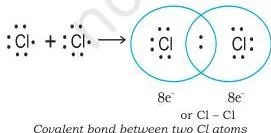
The Langmuir figure shows the shared pair counted as belonging to both chlorine atoms — the reason a shared pair counts fully toward each atom’s octet.
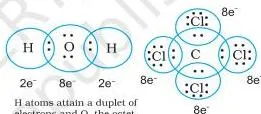
The water-carbon tetrachloride figure is the place to see lone pairs drawn but never double-counted — the octet check in action.
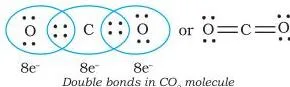
The multiple-bond figure compares two, four and six shared electrons. Count the shared pairs: two pairs = double bond, three pairs = triple bond.
Related Chapters: Where Bonding Ideas Come From
This chapter leans on two prerequisites. Revise electronic configuration — which orbitals fill in what order — from the structure of atom notes, and revise electronegativity, ionization enthalpy and electron gain enthalpy from the classification of elements and periodicity in properties notes before attempting bond polarity and ionic bonding.
The energy bookkeeping of ionic solids connects to the enthalpy conventions in the thermodynamics notes.
To verify any figure or table against the official source, open the NCERT Class 11 Chemistry Part I Chapter 4 PDF (kech104) on the NCERT website — the potential-energy curves and MO occupancy charts are worth seeing at full size. For the rest of the syllabus, browse the Class 11 Chemistry notes hub, the full Class 11 notes collection, or the main CBSE notes index.
One-Page Revision Recap: Chemical Bonding and Molecular Structure Class 11 Notes
- Octet rule: atoms transfer or share valence electrons to gain eight in the valence shell; hydrogen needs two.
- Electron transfer gives ionic bonds; electron sharing gives covalent bonds.
- Lattice enthalpy, not octets, stabilises ionic solids — NaCl releases 788 kJ mol⁻¹ of lattice energy.
- Bond parameters: length, angle, enthalpy and order. Higher bond order means shorter, stronger bonds.
- Resonance: canonical forms are fiction; the hybrid is the one real structure.
- VSEPR: lp–lp > lp–bp > bp–bp; lone pairs compress angles (NH₃ 107°, H₂O 104.5°).
- VB theory: bonds form by orbital overlap; sigma is head-on and stronger, pi is sidewise.
- Hybridisation: sp (180°), sp2 (120°), sp3 (109.5°), sp3d, sp3d2 — hybrids set geometry.
- MO theory: bond order = ½(Nb − Na); O₂ is paramagnetic with two unpaired π* electrons.
- Hydrogen bonding: intermolecular (HF, water) versus intramolecular (o-nitrophenol).
Night-before checklist: can you write the five Lewis steps, the VSEPR repulsion order, the two MO energy orders, and the NH₃/NF₃ dipole contrast? If yes, this chapter is under control.
FAQs: Your Chemical Bonding Doubts Answered
Why is oxygen paramagnetic even though its Lewis structure shows a double bond?
The Lewis structure only shows a double bond with all electrons paired, but the correct picture is the MO one: two electrons occupy \( \pi^* 2p_x \) and \( \pi^* 2p_y \) singly. Any molecule with singly occupied MOs is paramagnetic — and oxygen is indeed drawn into a magnetic field, which experiment confirms (NCERT, p. 131).
Why is the bond angle in ammonia 107° and in water 104.5° when both are sp³ hybridised?
Both are sp³, so the electron-pair arrangement is tetrahedral with an ideal angle of 109.5°. But lone pairs occupy more space than bond pairs. NH₃ has one lone pair, so lp–bp repulsion compresses the H–N–H angle to 107°; H₂O has two lone pairs, so the extra lp–lp and lp–bp repulsion compresses it further to 104.5° (NCERT, p. 116).
What is the difference between a sigma bond and a pi bond?
A sigma bond forms by head-on overlap along the internuclear axis (s–s, s–p or p–p) and is stronger because the overlap is larger. A pi bond forms by sidewise overlap of parallel p orbitals, with electron density above and below the axis, and is weaker.
Every multiple bond consists of one sigma bond plus the remaining pi bonds (NCERT, p. 121).
Why does carbon dioxide have zero dipole moment but water has 1.85 D?
Both molecules have polar bonds, but dipole moment is a vector sum. CO₂ is linear, so the two C=O bond dipoles point in exactly opposite directions and cancel. Water is bent at 104.5°, so the two O–H dipoles add to a net 1.85 D (NCERT, p. 112).
Why can sulphur form SF₆ but oxygen cannot?
Sulphur is in the third period and has accessible 3d orbitals, so it can expand its octet and use sp³d² hybridisation to hold six bonds. Oxygen is in the second period and has no d orbitals in its valence shell, so it cannot exceed an octet (NCERT, pp. 106, 125).
What is the difference between intermolecular and intramolecular hydrogen bonding?
Intermolecular H-bonding joins two different molecules of the same or different compounds — for example HF chains, water molecules and alcohols. Intramolecular H-bonding occurs within a single molecule, as in o-nitrophenol, where the hydrogen sits between two oxygen atoms of the same molecule (NCERT, p. 133).
Reference: NCERT Class 11 Chemistry textbook, chapter Chemical Bonding and Molecular Structure.
Explore Class 11 Chemistry Notes
More for this chapter:
Class 11 Chemistry on LearnCBSE:
Related chapters: