
These are revision notes for NCERT Class 11 Biology Chapter 4, Animal Kingdom. The page gives you the seven basis features used to sort animals, all 11 phyla in one comparison grid, the chordate subphyla and vertebrate classes, worked classification examples and the mistakes students make most while revising. These notes follow the 2026-27 session.
Start with the quick-reference grid if you are short on time — it is the whole chapter in one table. Then return to any section the grid makes you unsure about. Every detail here follows the NCERT Class 11 Biology textbook; you can verify anything against the official NCERT Class 11 Biology textbook PDF for the Animal Kingdom chapter.
Why classify animals? The seven features that decide the phylum
Over a million animal species have been described so far (NCERT, p. 37). No one can memorise them one by one, so classification groups them by shared fundamental features. It also gives a newly described species a systematic position — a place in the scheme — the moment its features are read.
Every phylum description in this chapter is built on the same seven checks:
- Level of organisation — how cells are arranged: cellular, tissue, organ or organ system.
- Symmetry — asymmetric, radial or bilateral.
- Germ layers — diploblastic or triploblastic.
- Coelom — coelomate, pseudocoelomate or acoelomate.
- Segmentation — present or absent (metameric in annelids).
- Notochord — present (chordates) or absent (non-chordates).
- Special phylum features — the signature structure of each phylum: choanocytes, cnidoblasts, comb plates, water vascular system, and so on.
Before you study animal groups, revise how living things are sorted in general in the Biological Classification notes. These Animal Kingdom notes are part of the Class 11 Biology notes; you can browse every chapter from the Class 11 notes index or the main CBSE notes page.
Levels of organisation: cellular to organ system
All animals are multicellular, but their cells are arranged in four possible patterns, in order of increasing complexity (NCERT, p. 37-38):
- Cellular level — cells as loose aggregates. Sponges show some division of labour among these loosely arranged cells.
- Tissue level — cells doing the same job are grouped into tissues. Seen in coelenterates and ctenophores.
- Organ level — tissues grouped into organs, each specialised for one function. Seen in Platyhelminthes and higher phyla.
- Organ system level — organs associated into functional systems. Seen in annelids, arthropods, molluscs, echinoderms and chordates.
Two organ-system patterns are worth separating:
| Feature | Two types | Who shows which |
|---|---|---|
| Digestive system | Incomplete: single opening serves as both mouth and anus | Platyhelminthes |
| Complete: two openings, mouth and anus | Aschelminthes and higher phyla | |
| Circulatory system | Open: blood pumped out of the heart, cells and tissues bathed directly | Arthropods, molluscs, hemichordates |
| Closed: blood circulated through arteries, veins and capillaries | Annelids, chordates |
Symmetry and germ layers: sorting animals by body plan
Symmetry is how a body can be cut into matching halves (NCERT, p. 38):
- Asymmetrical — no plane through the centre divides the body into equal halves. Sponges are mostly asymmetrical.
- Radial symmetry — any plane passing through the central axis gives two identical halves. Seen in coelenterates, ctenophores and echinoderms.
- Bilateral symmetry — only one plane divides the body into identical left and right halves. Seen in annelids, arthropods and most higher phyla.
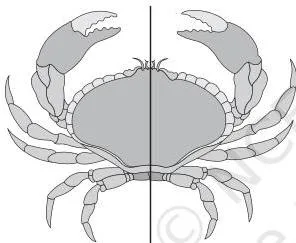
Figure 4.1(b) shows the single vertical plane that splits a bilaterally symmetrical animal into left and right mirror images — the body plan of annelids, arthropods and chordates. Germ layers are the embryonic layers of the body wall (NCERT, p. 38-39):
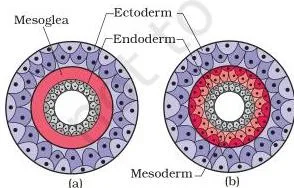
Figure 4.2 compares two cross-sections. The diploblastic one has an outer ectoderm and an inner endoderm with an undifferentiated mesoglea between them. The triploblastic one adds a third layer, mesoderm, between ectoderm and endoderm. Read the middle layer in each section — mesoglea means diploblastic, true mesoderm means triploblastic.
| Feature | Diploblastic | Triploblastic |
|---|---|---|
| Embryonic layers | Two: ectoderm, endoderm | Three: ectoderm, mesoderm, endoderm |
| Middle layer | Mesoglea (undifferentiated) | Mesoderm (true layer) |
| Examples | Coelenterates, ctenophores | Platyhelminthes to chordates |
Coelom, segmentation and notochord: the last three sorting features
A coelom is the cavity between the body wall and the gut wall, lined by mesoderm (NCERT, p. 39). Its presence or absence is a major classification split:
| Type | Definition | Examples |
|---|---|---|
| Coelomate | Body cavity lined by mesoderm | Annelids, arthropods, molluscs, echinoderms, hemichordates, chordates |
| Pseudocoelomate | Body cavity present but not lined by mesoderm | Aschelminthes |
| Acoelomate | No body cavity between body wall and gut wall | Platyhelminthes |
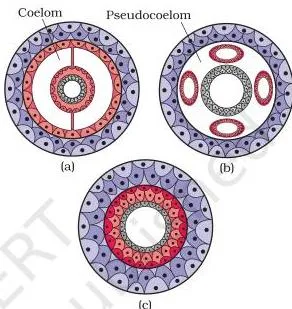
Figure 4.3 shows the three arrangements side by side: in the coelomate, mesoderm lines the cavity completely; in the pseudocoelomate, the cavity sits between layers without a mesodermal lining; in the acoelomate, the space between body wall and gut wall is simply filled with tissue.
This figure is the key to coelom questions — read the mesoderm (middle layer) in each section, not the cavity itself.
Metameric segmentation is the division of the body into segments, externally and internally, with serial repetition of at least some organs. The earthworm is the textbook example (NCERT, p. 39).
Notochord is a mesodermally derived rod-like structure formed on the dorsal side during embryonic development. Animals with a notochord are chordates; those without it are non-chordates (NCERT, p. 39).
Definitions: key terms used in every phylum
This table is your lookup sheet — every term you will meet in the phylum descriptions, with its meaning and an example.
| Term | Meaning | Example |
|---|---|---|
| Cellular level | Cells arranged as loose aggregates with some division of labour | Sponges |
| Tissue level | Cells of one function grouped into tissues | Coelenterates |
| Organ level | Tissues grouped into organs, each specialised for a function | Platyhelminthes |
| Organ system level | Organs associated into functional systems | Annelids to chordates |
| Radial symmetry | Any plane through the central axis divides the body into identical halves | Coelenterates, ctenophores |
| Bilateral symmetry | Only one plane divides the body into left and right halves | Arthropods, chordates |
| Diploblastic | Two embryonic layers, ectoderm and endoderm, with mesoglea between | Coelenterates |
| Triploblastic | Three embryonic layers, with mesoderm present | Annelids to chordates |
| Mesoglea | Undifferentiated layer between ectoderm and endoderm | Coelenterates |
| Coelom | Body cavity lined by mesoderm | Annelids, chordates |
| Pseudocoelom | Body cavity not lined by mesoderm | Aschelminthes |
| Metameric segmentation | Body divided into segments with serial repetition of organs | Earthworm |
| Notochord | Mesodermally derived dorsal rod formed in embryos | Chordates |
| Hermaphrodite | Eggs and sperms produced by the same individual | Sponges, earthworms |
| Dioecious | Sexes separate, males and females distinct | Aschelminthes, arthropods |
| Monoecious | Both sexes in the same individual | Earthworms, leeches |
| Oviparous | Lays eggs; young develop outside the mother | Birds, most reptiles |
| Viviparous | Gives birth to young ones | Most mammals |
| Choanocytes | Flagellated collar cells lining the spongocoel and canals | Sponges |
| Cnidoblasts | Stinging cells containing nematocysts | Coelenterates |
| Polyp | Sessile, cylindrical body form | Hydra, Adamsia |
| Medusa | Umbrella-shaped, free-swimming body form | Aurelia |
| Metagenesis | Alternation of generations: polyp asexual, medusa sexual | Obelia |
| Comb plates | Eight external rows of ciliated plates for locomotion | Ctenophores |
| Bioluminescence | Ability of a living organism to emit light | Ctenophores |
| Flame cells | Specialised cells for osmoregulation and excretion | Flatworms |
| Parapodia | Lateral appendages that help in swimming | Nereis |
| Nephridia | Tubular organs for osmoregulation and excretion | Annelids |
| Malpighian tubules | Excretory organs | Arthropods |
| Radula | File-like rasping organ for feeding | Molluscs |
| Water vascular system | Canals for locomotion, food capture and transport, respiration | Echinoderms |
| Stomochord | Rudimentary notochord-like structure in the collar region | Hemichordates |
| Protochordates | Chordates without a vertebral column (Urochordata + Cephalochordata) | Ascidia, Branchiostoma |
The 11 phyla quick-reference grid
This grid condenses NCERT Table 4.2 (p. 51). Revise it first; the detailed notes below fill in the reasoning and examples.
| Phylum | Organisation | Symmetry | Coelom | Segmentation | Distinctive feature | Examples |
|---|---|---|---|---|---|---|
| Porifera | Cellular | Various (mostly asymmetrical) | Absent | Absent | Body with pores and canals; choanocytes | Sycon, Spongilla, Euspongia |
| Coelenterata (Cnidaria) | Tissue | Radial | Absent | Absent | Cnidoblasts with nematocysts | Physalia, Adamsia, Meandrina |
| Ctenophora | Tissue | Radial | Absent | Absent | Eight comb plates; bioluminescence | Pleurobrachia, Ctenoplana |
| Platyhelminthes | Organ | Bilateral | Absent (acoelomate) | Absent | Flat body; flame cells; suckers in parasites | Taenia, Fasciola |
| Aschelminthes | Organ-system | Bilateral | Pseudocoelomate | Absent | Complete gut with muscular pharynx | Ascaris, Wuchereria, Ancylostoma |
| Annelida | Organ-system | Bilateral | Coelomate | Present (metameric) | Ringed segments; parapodia; nephridia; closed circulation | Nereis, Pheretima, Hirudinaria |
| Arthropoda | Organ-system | Bilateral | Coelomate | Present | Chitinous exoskeleton; jointed appendages; malpighian tubules | Apis, Bombyx, Limulus |
| Mollusca | Organ-system | Bilateral | Coelomate | Absent | Calcareous shell; mantle; radula | Pila, Octopus, Sepia |
| Echinodermata | Organ-system | Radial (adults), bilateral (larvae) | Coelomate | Absent | Water vascular system; no excretory system | Asterias, Echinus, Ophiura |
| Hemichordata | Organ-system | Bilateral | Coelomate | Absent | Worm-like; proboscis, collar, trunk; stomochord | Balanoglossus, Saccoglossus |
| Chordata | Organ-system | Bilateral | Coelomate | Present | Notochord; dorsal hollow nerve cord; gill slits | Petromyzon, Rana, Macropus |
One footnote matters: echinoderms show radial or bilateral symmetry depending on the stage — adults are radial, larvae are bilateral (NCERT, p. 40).
Non-chordate phyla: what makes each one different
Ten of the 11 phyla are non-chordates — everything from sponges to hemichordates. Pair this section with the quick-reference grid: the grid gives the pattern, these notes give the signature structures and examples.
Porifera to Aschelminthes: the first five phyla
Porifera — the sponges (NCERT, p. 40):
- Cellular level of organisation; mostly marine and asymmetrical.
- Water canal system: water enters through ostia into the spongocoel and leaves through the osculum. This current supplies food, oxygen and waste removal.
- Choanocytes (collar cells) line the spongocoel and canals; digestion is intracellular.
- Skeleton of spicules or spongin fibres; hermaphrodite; internal fertilisation, indirect development.
- Examples: Sycon, Spongilla (freshwater), Euspongia (bath sponge).
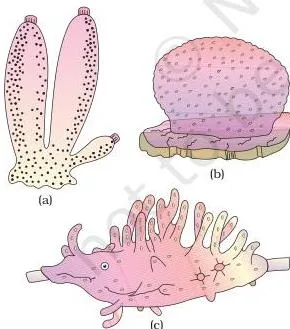
Figure 4.5 shows how different sponge bodies can look — vase-shaped, rounded and encrusting — but all share the pore-and-canal water transport plan.
Coelenterata (Cnidaria) (NCERT, p. 41):
- Tissue level, diploblastic, radial; aquatic, mostly marine.
- Cnidoblasts (cnidocytes) carry stinging nematocysts on tentacles and body — used for anchorage, defence and prey capture.
- Central gastro-vascular cavity with one opening, the mouth, on the hypostome; digestion extracellular and intracellular.
- Two body forms: polyp (sessile, cylindrical — Hydra, Adamsia) and medusa (umbrella-shaped, free-swimming — Aurelia).
- Metagenesis — alternation of generations — occurs in Obelia: polyps produce medusae asexually, medusae produce polyps sexually.
- Examples: Physalia, Adamsia, Pennatula, Gorgonia, Meandrina.
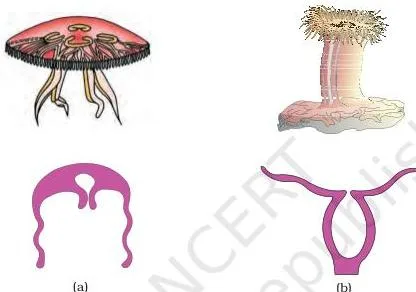
Figure 4.6 contrasts the two body plans of the phylum: the free-floating medusa of Aurelia and the attached polyp of Adamsia.
Ctenophora — sea walnuts or comb jellies (NCERT, p. 42):
- Tissue level, diploblastic, radial; exclusively marine.
- Eight external rows of ciliated comb plates for locomotion.
- Bioluminescence is well marked; digestion extracellular and intracellular.
- Sexes not separate; only sexual reproduction; external fertilisation, indirect development.
- Examples: Pleurobrachia, Ctenoplana.
Platyhelminthes — flatworms (NCERT, p. 42):
- Organ level, bilateral, triploblastic, acoelomate; dorsoventrally flattened body.
- Mostly endoparasites; parasitic forms have hooks and suckers and can absorb nutrients through the body surface.
- Flame cells do osmoregulation and excretion.
- Internal fertilisation, development through many larval stages; Planaria has high regeneration capacity.
- Examples: Taenia (tapeworm), Fasciola (liver fluke).
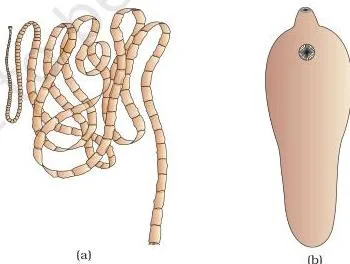
Figure 4.9 shows the flattened, ribbon-like bodies of the two classic flatworm parasites.
Aschelminthes — roundworms (NCERT, p. 43):
- Organ-system level, bilateral, triploblastic, pseudocoelomate; body circular in cross-section.
- Complete alimentary canal with a well-developed muscular pharynx; excretory tube opens through an excretory pore.
- Dioecious — sexes separate, females often longer than males.
- Free-living or parasitic; internal fertilisation; development direct or indirect.
- Examples: Ascaris, Wuchereria (filaria worm), Ancylostoma (hookworm).
Annelida to Hemichordata: the next five phyla
Annelida — segmented worms (NCERT, p. 43):
- Organ-system level, bilateral, triploblastic, coelomate, metamerically segmented — the body is marked into segments (metameres); the name comes from Latin annulus, little ring.
- Longitudinal and circular muscles for locomotion; aquatic Nereis has lateral parapodia for swimming.
- Closed circulatory system; nephridia for osmoregulation and excretion.
- Nerve cord double and ventral, with paired ganglia.
- Nereis is dioecious; earthworms and leeches are monoecious.
- Examples: Nereis, Pheretima (earthworm), Hirudinaria (leech).
Arthropoda — the largest phylum (NCERT, p. 44):
- Over two-thirds of all named species on Earth are arthropods; organ-system level, bilateral, triploblastic, coelomate, segmented.
- Body covered by a chitinous exoskeleton; divided into head, thorax and abdomen.
- Jointed appendages (arthros = joint, poda = appendage).
- Respiration by gills, book gills, book lungs or tracheal system; open circulation.
- Excretion by malpighian tubules; sensory organs include antennae, compound and simple eyes, statocysts.
- Mostly dioecious, usually internal fertilisation, mostly oviparous.
- Examples: Apis (honey bee), Bombyx (silkworm), Laccifer (lac insect), Anopheles/Culex/Aedes (mosquitoes), Locusta (locust), Limulus (king crab).
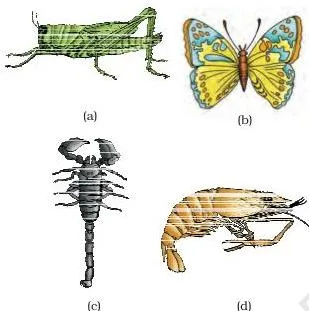
Figure 4.12 samples the phylum’s range — insect, arachnid and crustacean — all built on the same jointed-appendage plan.
Mollusca — the second largest phylum (NCERT, p. 44):
- Organ-system level, bilateral, triploblastic, coelomate; terrestrial or aquatic.
- Body unsegmented with a distinct head, a muscular foot and a visceral hump; usually covered by a calcareous shell.
- The mantle is a soft spongy skin layer over the hump; the mantle cavity holds feather-like gills.
- Radula — a file-like rasping organ — is used for feeding.
- Usually dioecious, oviparous, indirect development.
- Examples: Pila, Pinctada, Sepia, Loligo, Octopus, Aplysia, Dentalium, Chaetopleura.
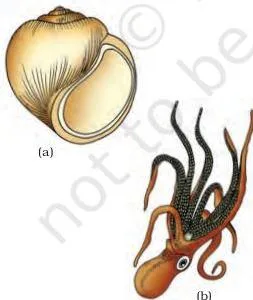
Figure 4.13 pairs a shelled snail with a shell-less octopus to show how varied the mollusc body plan can be.
Echinodermata — spiny-skinned, all marine (NCERT, p. 45):
- Organ-system level, triploblastic, coelomate; endoskeleton of calcareous ossicles.
- Adults radially symmetrical, larvae bilaterally symmetrical.
- Complete digestive system: mouth ventral, anus dorsal.
- Water vascular system — the phylum’s most distinctive feature — helps in locomotion, food capture and transport, and respiration.
- No excretory system; sexes separate; external fertilisation; indirect development.
- Examples: Asterias (starfish), Echinus (sea urchin), Antedon (sea lily), Cucumaria (sea cucumber), Ophiura (brittle star).
Hemichordata — worm-like marine animals (NCERT, p. 45):
- Organ-system level, bilateral, triploblastic, coelomate.
- Cylindrical body in three parts: proboscis, collar and trunk.
- The stomochord, a rudimentary structure in the collar, resembles a notochord — this is why the phylum was once grouped with chordates, but it is now placed among non-chordates.
- Open circulation; respiration through gills; excretion by the proboscis gland.
- Examples: Balanoglossus, Saccoglossus.
Chordata: three subphyla and seven vertebrate classes
Chordates share three fundamental features: a notochord, a dorsal hollow nerve cord and paired pharyngeal gill slits (NCERT, p. 45). They are bilateral, triploblastic, coelomate, with organ-system organisation, a post-anal tail and closed circulation.
The five chordate checks
NCERT Table 4.1 (p. 46) gives five quick checks that separate chordates from non-chordates:
| Feature | Chordates | Non-chordates |
|---|---|---|
| Notochord | Present | Absent |
| Central nervous system | Dorsal, hollow, single | Ventral, solid, double |
| Pharynx | Perforated by gill slits | Gill slits absent |
| Heart | Ventral | Dorsal (if present) |
| Post-anal tail | Present | Absent |
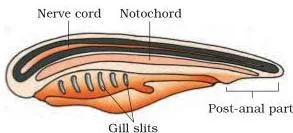
Figure 4.16 labels the chordate hallmarks on a body outline: the dorsal notochord and nerve cord running along the back, gill slits in the pharyngeal region and the tail extending past the anus. When you classify a specimen, check these features in this order.
Protochordates: Urochordata and Cephalochordata
Protochordates are Urochordata plus Cephalochordata — both exclusively marine (NCERT, p. 46). They explain why all chordates are not vertebrates:
- Urochordata: notochord present only in the larval tail. Examples: Ascidia, Salpa, Doliolum.
- Cephalochordata: notochord persistent from head to tail throughout life. Example: Branchiostoma (Amphioxus).
- Vertebrata: notochord present in the embryo, replaced in adults by a cartilaginous or bony vertebral column.
So the rule stands: all vertebrates are chordates, but not all chordates are vertebrates.
Cyclostomata: the jawless ectoparasites
Cyclostomes are the most primitive chordates (NCERT, p. 53):
- Ectoparasites on fishes; elongated body with 6–15 pairs of gill slits.
- Circular sucking mouth without jaws; body without scales and paired fins.
- Cranium and vertebral column cartilaginous; closed circulation.
- Marine, but migrate to fresh water for spawning and die soon after; larvae metamorphose and return to the ocean.
- Examples: Petromyzon (lamprey), Myxine (hagfish).
Chondrichthyes and Osteichthyes: the two fish classes
| Feature | Chondrichthyes (cartilaginous fishes) | Osteichthyes (bony fishes) |
|---|---|---|
| Endoskeleton | Cartilaginous | Bony |
| Mouth | Ventral | Mostly terminal |
| Gills | Separate gill slits, no operculum | Four pairs covered by operculum |
| Scales | Placoid | Cycloid or ctenoid |
| Notochord | Persistent throughout life | Replaced by vertebral column |
| Air bladder | Absent — must swim constantly to avoid sinking | Present — regulates buoyancy |
| Heart | Two-chambered | Two-chambered |
| Temperature | Cold-blooded | Cold-blooded |
| Fertilisation | Internal; claspers in males; many viviparous | Usually external; mostly oviparous, direct development |
| Examples | Scoliodon, Pristis, Carcharodon, Trygon | Exocoetus, Hippocampus, Labeo, Catla, Clarias, Betta, Pterophyllum |
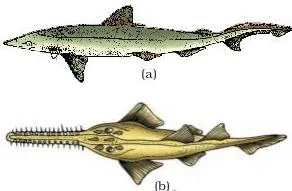
Figure 4.19 shows the streamlined bodies of two cartilaginous fishes — the shark Scoliodon and the sawfish Pristis.
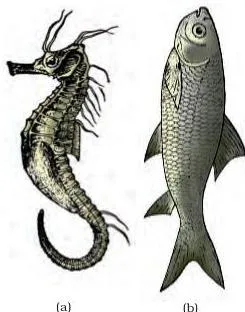
Figure 4.20 contrasts the unusual upright sea horse with a typical freshwater carp, both bony fishes.
Amphibia and Reptilia: the first tetrapods
Amphibia — “dual life” (NCERT, p. 48):
- Two pairs of limbs; body in head and trunk; tail may be present.
- Moist skin without scales; eyelids present; tympanum represents the ear.
- Alimentary canal, urinary and reproductive tracts open into a common cloaca.
- Respiration by gills, lungs and through the skin.
- Three-chambered heart (two auricles, one ventricle); cold-blooded.
- External fertilisation; oviparous; indirect development.
- Examples: Bufo (toad), Rana (frog), Hyla (tree frog), Salamandra, Ichthyophis (limbless amphibian).
Reptilia — creeping or crawling (NCERT, p. 49):
- Mostly terrestrial; dry, cornified skin with epidermal scales or scutes.
- No external ear openings; tympanum represents the ear; two pairs of limbs when present.
- Heart usually three-chambered, but four-chambered in crocodiles; cold-blooded.
- Internal fertilisation; oviparous; direct development; snakes and lizards shed scales as skin cast.
- Examples: Chelone, Testudo, Chameleon, Calotes, Crocodilus, Alligator, Hemidactylus; poisonous snakes Naja, Bangarus, Vipera.
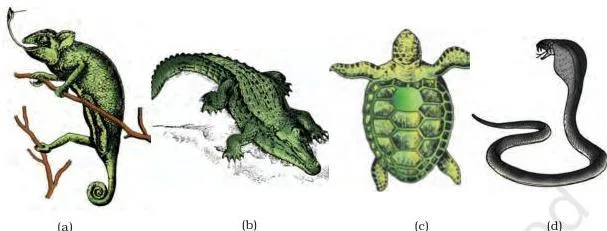
Figure 4.22 spans the reptilian body plans — lizard, crocodile, turtle and snake — all sharing dry scaly skin.
Aves and Mammalia: the warm blooded classes
Aves — birds (NCERT, p. 49-50):
- Feathers and a beak; forelimbs modified into wings; hind limbs adapted for walking, swimming or clasping.
- Skin dry without glands except the oil gland at the tail base.
- Endoskeleton fully ossified; long bones hollow with air cavities (pneumatic bones).
- Digestive tract has extra chambers, the crop and gizzard.
- Completely four-chambered heart; warm-blooded (homoiothermous).
- Lungs with air sacs supplementing respiration; internal fertilisation; oviparous; direct development.
- Examples: Corvus, Columba, Psittacula, Struthio, Pavo, Aptenodytes, Neophron.
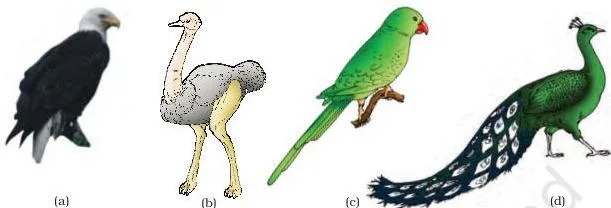
Figure 4.23 shows flying and flightless birds — vulture, ostrich, parrot and peacock — all with feathers and beaks.
Mammalia — mammals (NCERT, p. 50-51):
- The most unique feature is mammary glands, which nourish the young.
- Skin bears hair; external ears (pinnae) present; different types of teeth in the jaw.
- Two pairs of limbs adapted for walking, running, climbing, burrowing, swimming or flying.
- Four-chambered heart; warm-blooded; respiration by lungs.
- Internal fertilisation; viviparous with few exceptions (platypus lays eggs); direct development.
- Examples: Ornithorhynchus (platypus), Macropus (kangaroo), Pteropus (flying fox), Camelus, Macaca, Rattus, Canis, Felis, Elephas, Equus, Delphinus, Balaenoptera, Panthera tigris, Panthera leo.
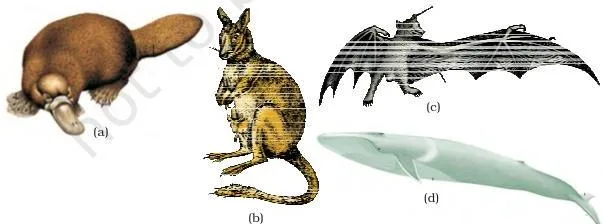
Figure 4.24 includes the egg-laying platypus and a whale — proof that mammals occupy land, air and water. The heart and temperature table below is the fastest way to compare the classes.
Heart chambers and body temperature across vertebrate classes
| Class | Heart chambers | Body temperature | Example |
|---|---|---|---|
| Chondrichthyes | 2 | Cold-blooded | Scoliodon |
| Osteichthyes | 2 | Cold-blooded | Labeo |
| Amphibia | 3 | Cold-blooded | Rana |
| Reptilia | Usually 3; 4 in crocodiles | Cold-blooded | Chelone |
| Aves | 4 | Warm-blooded | Pavo |
| Mammalia | 4 | Warm-blooded | Macropus |
The pattern is a simple climb: fishes 2 chambers, amphibians and most reptiles 3, crocodiles, birds and mammals 4; fishes, amphibians and reptiles cold-blooded, birds and mammals warm-blooded. For how lungs, gills and air sacs actually move gases in these animals, see the Breathing and Exchange of Gases notes.
Worked examples: how to classify a specimen
Method first: the seven-feature classification key. Read the features in this order — level of organisation, symmetry, germ layers, coelom, segmentation, notochord, then signature structures — and let each answer narrow the phylum.
Worked example: classifying a marine specimen
Specimen data: a marine animal is radially symmetrical, diploblastic, has tissue level organisation, bears cnidoblasts on its tentacles and has a gastro-vascular cavity with a single opening.
Step 1 — Symmetry: radial symmetry (any plane through the central axis gives identical halves) points to coelenterates, ctenophores or adult echinoderms.
Step 2 — Germ layers: diploblastic (ectoderm and endoderm with mesoglea) — this removes echinoderms, which are triploblastic.
Step 3 — Level of organisation: tissue level — this removes the higher phyla, which are at organ or organ-system level.
Step 4 — Signature cells: cnidoblasts with nematocysts are found only in coelenterates.
Step 5 — Digestive plan: a single-opening gastro-vascular cavity matches coelenterates.
Conclusion: Phylum Coelenterata (Cnidaria). The deciding feature is the presence of cnidoblasts.
Worked example: is it a chordate?
Specimen data: an animal has a notochord only in its larval tail, a dorsal hollow nerve cord, paired pharyngeal gill slits, a ventral heart and a post-anal tail.
Step 1 — Notochord: present, so the animal is a chordate.
Step 2 — Central nervous system: dorsal and hollow — a chordate character, not the ventral solid cord of non-chordates.
Step 3 — Gill slits: paired pharyngeal gill slits present — chordate character.
Step 4 — Heart position: ventral — chordate character.
Step 5 — Post-anal tail: present — chordate character.
All five checks pass, so the animal is a chordate.
Step 6 — Which subphylum?
The notochord is restricted to the larval tail.
That is the defining condition of Urochordata; Cephalochordata keeps the notochord from head to tail throughout life, and Vertebrata replaces it with a vertebral column in adults.
Conclusion: Subphylum Urochordata.
Common mistakes to avoid in Animal Kingdom
| Students write | Correct is | Why |
|---|---|---|
| Sponges have tissue level organisation | Sponges have cellular level organisation | Their cells are loose aggregates; only some division of labour occurs, no true tissues |
| Any body cavity is a coelom | A coelom must be lined by mesoderm | A cavity without a mesodermal lining is a pseudocoelom, as in aschelminthes |
| Echinoderm adults are simple because they are radial | Adults are radial but triploblastic, coelomate, organ-system level | Radial symmetry describes the body plan, not the complexity of organisation |
| All chordates have a vertebral column | Protochordates (Urochordata, Cephalochordata) do not | Vertebrata is only one of the three chordate subphyla; the vertebral column replaces the notochord in adults |
| Amphibians have two-chambered hearts | Amphibians have three-chambered hearts (two auricles, one ventricle) | Two chambers belong to fishes; three chambers appear first in amphibians |
| Arthropods have closed circulation | Arthropods have open circulation | Blood is pumped out of the heart and bathes cells and tissues directly |
| Platypus is a bird because it lays eggs | Platypus is a mammal | It has mammary glands and hair — the defining mammal features — and is a rare egg-laying exception |
Exam notes: how to write complete answers
These are answer structures for the chapter’s textbook exercises (NCERT, p. 53-54). Q8 and Q13 are direct single-answer questions, Q14 is a matching exercise, and the rest need short reasoned answers. Work out the full sentences yourself; the table tells you what each complete answer must include.
| Exercise | What a complete answer must contain |
|---|---|
| Q1. Difficulties if common fundamental features are not considered | Mention that over a million species exist; without shared features each species would have to be studied separately; a newly described species could not be assigned a systematic position |
| Q2. Steps to classify a given specimen | Write the seven features as a numbered checklist: level of organisation → symmetry → germ layers → coelom → segmentation → notochord → signature structures and examples |
| Q3. Usefulness of body cavity and coelom in classification | State the three-way split the coelom creates — coelomate, pseudocoelomate, acoelomate — and give one example of each |
| Q4. Intracellular vs extracellular digestion | Contrast where digestion occurs: inside cells (sponges) versus in the digestive cavity (coelenterates) |
| Q5. Direct vs indirect development | Direct: young resemble adults; indirect: a larval stage distinct from the adult intervenes |
| Q6. Peculiar features of parasitic platyhelminthes | Hooks and suckers for attachment; absorbing nutrients through the body surface; internal fertilisation with many larval stages |
| Q7. Why arthropods are the largest group | Chitinous exoskeleton, jointed appendages, diverse respiratory organs (gills, book lungs, tracheae) and adaptability to many habitats |
| Q8. Water vascular system belongs to which group | Echinodermata; it aids locomotion, food capture and transport, and respiration |
| Q9. “All vertebrates are chordates but all chordates are not vertebrates” | Define notochord and vertebral column; state that Vertebrata is one of three chordate subphyla; cite protochordates (Urochordata and Cephalochordata) as chordates without a vertebral column |
| Q10. Importance of air bladder in Pisces | It regulates buoyancy; fishes without it (Chondrichthyes) must swim constantly to avoid sinking |
| Q11. Modifications in birds for flight | Forelimbs as wings, feathers, pneumatic (hollow) bones, crop and gizzard, air sacs supplementing lungs |
| Q12. Could egg numbers and young numbers be equal? | Compare survival and parental investment: oviparous mothers produce many eggs because each has low survival; viviparous young are protected and nourished inside the mother, so fewer are produced |
| Q13. Segmentation first observed in which group | Annelida — metameric segmentation is first clearly seen there |
| Q14. Matching structures to groups | Link each structure to exactly one group: operculum → Osteichthyes; parapodia → Annelida; scales → Reptilia; comb plates → Ctenophora; radula → Mollusca; hairs → Mammalia; choanocytes → Porifera; gill slits → Cyclostomata and Chondrichthyes |
| Q15. Animals parasitic on human beings | Taenia, Fasciola, Ascaris, Wuchereria, Ancylostoma |
One-minute revision summary
Phylum flow (learn this order):
Porifera → Coelenterata → Ctenophora → Platyhelminthes → Aschelminthes → Annelida → Arthropoda → Mollusca → Echinodermata → Hemichordata → Chordata Mnemonic: “Please Come, Come, Please Aunty, Aunty Aunty, Mummy Eats Hot Chips” — the first letters match the 11 phyla in order.
Vertebrate class flow: Cyclostomata → Chondrichthyes → Osteichthyes → Amphibia → Reptilia → Aves → Mammalia Mnemonic: “Can Cats Often Attack Rabbits And Mice”.
One-line facts:
- Cold-blooded: fishes, amphibians, reptiles. Warm-blooded: birds, mammals.
- Heart chambers climb 2 (fishes) → 3 (amphibians, most reptiles) → 4 (crocodiles, birds, mammals).
- Pseudocoelomate: only Aschelminthes. Acoelomate: only Platyhelminthes.
- Closed circulation: annelids and chordates. Open circulation: arthropods, molluscs, hemichordates.
- The quick-reference grid is the whole chapter in one table — make it your final revision pass.
Frequently asked questions
Why are echinoderms radially symmetrical as adults but bilaterally symmetrical as larvae?
The adult and larval stages have different lifestyles. The free-swimming larva is bilaterally symmetrical; the adult, which is often sedentary or slow-moving, becomes radially symmetrical. Both stages are triploblastic and coelomate — only the symmetry changes (NCERT, p. 45).
What is the difference between diploblastic and triploblastic animals?
Diploblastic animals have two embryonic layers — ectoderm and endoderm — with an undifferentiated mesoglea in between, as in coelenterates. Triploblastic animals have a third layer, mesoderm, between ectoderm and endoderm, as in animals from Platyhelminthes to chordates (NCERT, p. 38-39).
Why are all vertebrates chordates but not all chordates vertebrates?
A chordate is defined by a notochord, dorsal hollow nerve cord and paired pharyngeal gill slits. Vertebrates are chordates in which the notochord is replaced by a vertebral column in adults. Protochordates (Urochordata and Cephalochordata) are chordates that never develop a vertebral column (NCERT, p. 46).
What is the difference between oviparous and viviparous animals?
Oviparous animals lay eggs, and the young develop outside the mother’s body — most reptiles and all birds. Viviparous animals give birth to young ones that develop inside the mother — most mammals. The platypus is the famous exception: a mammal that lays eggs (NCERT, p. 50-51).
Which is the largest phylum in the animal kingdom and why?
Arthropoda is the largest phylum; over two-thirds of all named species on Earth are arthropods. Their success is linked to the chitinous exoskeleton, jointed appendages and varied respiratory organs (gills, book gills, book lungs, tracheae) that suit many habitats (NCERT, p. 44).
What is metagenesis in coelenterates?
Metagenesis is the alternation of generations seen in some cnidarians such as Obelia: the sessile polyp stage produces medusae asexually, and the free-swimming medusa stage produces polyps sexually. The two forms alternate in the life cycle (NCERT, p. 41).
Reference: NCERT Class 11 Biology textbook, chapter Animal Kingdom.
Explore Class 11 Biology Notes
- Class 11 Biology Notes
- Class 11 CBSE Notes
- CBSE Notes for Classes 1 to 12
- Previous: Biological Classification
- Next: Breathing and Exchange of Gases
Class 11 Biology on LearnCBSE:
Related chapters:
- Excretory Products and Their Elimination notes