
Paths to Modernisation Class 11 is Chapter 7 of the NCERT Class 11 History textbook Themes in World History, and it is the book’s final chapter — a long study of Japan, China, Korea and Taiwan from the nineteenth century to the present.
The official NCERT chapter PDF is available right below, and the rest of this page tells you what is inside it, country by country, before you open it.
| What the chapter holds | Count | Where it is used |
|---|---|---|
| Printed pages | 36 | |
| Figures with NCERT captions | 13 | |
| Tables | 1 | |
| Activities | 4 | |
| Official NCERT PDF | Download the chapter PDF | the chapter exactly as NCERT publishes it |
Official NCERT PDF
Download the NCERT Class 11 History Paths to Modernisation chapter PDF directly from ncert.nic.in, the official NCERT site, so the file you get is the authoritative edition — the same text, section order and page numbering your school follows. It contains the full chapter, from the East Asia introduction to the exercise block and the book’s Conclusion.
Textbook contents and the examinable syllabus are not always identical, so check the current official CBSE syllabus before deciding which parts to study in depth.
Chapter at a Glance
The table below shows how much the chapter holds — its sections, figures, activities and exercises — so you know what is in the file before opening it.
Beyond the numbered sections, the chapter carries discussion activities, a TIMELINE table that lines up Japanese and Chinese events side by side, and an exercise block split between “Answer in Brief” and “Answer in a Short Essay”.
Paths to Modernisation Class 11: What the Chapter Covers
The chapter is organised as four country studies inside one argument: modernisation is not a single road. The main blocks run in this order:
- Japan’s story — the Tokugawa political system, the Meiji Restoration of 1868, modernising the economy, industrial workers, aggressive nationalism, the ‘Westernisation’ and ‘Tradition’ debate, daily life, the ‘Overcoming Modernity’ symposium, and Japan’s post-war re-emergence as a global economic power.
- China’s story — the opium trade, the examination system, the 1911 republic, the rise of the Communist Party of China, the New Democracy of 1949–65, the Cultural Revolution, reforms from 1978 and the story of Taiwan.
- Korea’s story — Japanese colonial rule, partition, the Korean War, Park Chung-hee’s industrialisation, democratisation and the 1997 IMF crisis.
- The closing reflection — ‘Two Roads to Modernisation’ states the chapter’s own conclusion, and the book’s Conclusion closes Themes in World History.
How Japan, China and Korea Took Different Roads to Modernity
“Modernisation” in this chapter does not mean “turning into the West”. It means building an industrial society — but each society did it differently because each faced different pressures. The chapter compares four East Asian societies to prove that industrial nations do not converge on one model.
| Society | Path taken | Led by | Turning points | Economic model | Where the chapter leaves it |
|---|---|---|---|---|---|
| Japan | Capitalist, elite-led | Meiji state-builders and the emperor system | 1868 Restoration; defeat in 1945; 1964 Tokyo Olympics | Railways, banks, zaibatsu, export industry | Industrial superpower with a democratic post-war constitution |
| China | Revolutionary | Communist Party of China under Mao Zedong | 1949 People’s Republic; 1978 market reforms | State planning, then a socialist market economy | Economically powerful, politically tightly controlled |
| Taiwan | Authoritarian then democratic | Guomindang under Chiang Kai-shek | 1949 flight to Taiwan; martial law lifted 1987 | Export-led growth after land reforms | Democratising island, rich-poor gap steadily declining |
| South Korea | State-led growth then democracy | Park Chung-hee | 1961 coup; 1987 June Democracy Movement; 1997 IMF crisis | Five-year plans and export-oriented heavy industry | Mature democracy after peaceful transfers of power |
The chapter’s verdict is that modernisation meant creatively using tradition in new ways — not merely preserving it, and not abandoning it. The Meiji school system imported Western subjects but made loyalty its main aim; changes in family life mixed foreign and indigenous ideas into something new.
Japan: Tokugawa Shogunate to Economic Superpower
Japan’s section asks how a small island state, apparently locked in isolation, modernised so fast that it defeated China in 1894 and Russia in 1905.
Tokugawa political system
- The shogun ruled in the emperor’s name; the Tokugawa family held that office from 1603 to 1867.
- The country was divided into over 250 domains under lords called daimyo, who were ordered to live in the capital Edo so they could not rebel.
- The samurai were the only class allowed to carry swords — the peasantry had been disarmed in the late sixteenth century, ending the constant wars.
- Edo became the world’s most populated city; Osaka and Kyoto grew too, creating a commercial economy with credit systems, a rice stock market, and a culture where writers could live by their work.
The Meiji Restoration
- In 1853 Commodore Perry of the USA arrived with ‘black ships’ and demanded trade; news of China’s defeat by Britain spread real fear that Japan would be colonised.
- In 1868 the shogun was removed and the emperor was brought to Edo, renamed Tokyo (‘eastern capital’).
- The new government’s slogan was fukoku kyohei — ‘rich country, strong army’.
- It built an emperor system, made schooling compulsory for boys and girls from the 1870s, and enacted the 1889 constitution creating a Diet (parliament) with limited powers.
- The military stayed under the emperor’s direct command, outside government control — the tension between a democratic constitution and a modern army had far-reaching consequences.
Economy, workers and empire
- The first railway, Tokyo to Yokohama, was built in 1870–72; modern banking began in 1872.
- Family-run conglomerates called zaibatsu dominated the economy until after the Second World War.
- Over half of modern factory workers were women, and women organised Japan’s first modern strike in 1886.
- Rapid, unregulated growth destroyed the environment: Tanaka Shozo launched the first agitation against industrial pollution in 1897 over the Ashio Mine.
- Aggressive nationalism brought wars with China and Russia, and a colonial empire that absorbed Taiwan (1895) and Korea (1910).
Defeat and the post-war ‘miracle’
- Defeat in the Pacific War was followed by the US-led Occupation (1945–52), demilitarisation, and a new constitution whose Article 9 renounced war as an instrument of state policy.
- Women voted for the first time in the 1946 elections.
- The 1964 Tokyo Olympics and the Shinkansen bullet trains symbolised Japan’s return; US support and demand from the Korean and Vietnamese wars helped the economy rebuild.
China: Qing Decline, the Communist State and Market Reforms
China’s section asks why the Qing dynasty collapsed before the Western challenge while Japan survived — and how the communists eventually rebuilt the country.
Qing crisis and the opium trade
- Britain’s demand for tea, silk and porcelain created a trade deficit, paid in silver; the East India Company sold opium grown in India instead — the ‘triangular trade’ between Britain, India and China.
- The Opium Wars (1839–60) undermined the Qing. The 1905 abolition of the examination system ended the route into the elite ruling class, which had tested only literary skills.
Reformers, republic and the May Fourth Movement
- Kang Youwei and Liang Qichao tried to use traditional ideas to meet the Western challenge; Liang pointed to India as a warning, saying it was “a country that was destroyed by a non-country that is the East India Company”.
- Sun Yat-sen became the first president of the 1911 republic; his Three Principles were nationalism, democracy and socialism (regulating capital and equalising landholdings).
- The May Fourth Movement of 1919, sparked by the post-war peace conference, turned a generation against tradition and toward science, democracy and nationalism.
The CCP, Mao and the New Democracy
- The CCP was founded in 1921; Mao Zedong differed from the Soviet model by basing revolution on the peasantry.
- The Long March (1934–35), about 6,000 gruelling miles, carried the party to a new base at Yanan where it built a strong social base through land reform.
- The People’s Republic was established in 1949. The Great Leap Forward (1958) pushed rapid industrialisation with backyard steel furnaces — but the steel produced was industrially unusable.
- The Cultural Revolution, launched in the mid-1960s, used the Red Guards to campaign against old culture, customs and habits; ideology outweighed expertise and the economy was severely disrupted.
Reforms from 1978 and the Fifth Modernisation
- From 1978 Deng Xiaoping kept party control strong while introducing a socialist market economy, declaring the goal of the Four Modernisations (science, industry, agriculture, defence).
- On 5 December 1978 a wall poster called ‘The Fifth Modernisation’ demanded democracy, arguing that without it the other modernisations would come to nothing; the demand was suppressed.
- The chapter notes that Communist rule removed age-old inequalities and spread education, but built a highly centralised and repressive state.
The story of Taiwan
- Chiang Kai-shek fled to Taiwan in 1949, taking gold reserves and art treasures, and set up the Republic of China there.
- The Guomindang ruled repressively but carried out land reforms; by 1973 Taiwan’s GNP was second only to Japan’s in Asia.
- Martial law was lifted in 1987 and Taiwan democratised; most countries keep only trade missions there because Taiwan is considered part of China.
Korea: Colony, Authoritarian Growth and Democracy
Korea’s section is the shortest but the most contemporary, ending with the 2026-27 candlelight protests.
- The Joseon dynasty (1392–1910) ended when Japan annexed Korea as a colony in 1910; after liberation in 1945 the peninsula was divided along the 38th parallel.
- The Korean War broke out in June 1950 and ended in July 1953 in an armistice, not a peace treaty — Korea remained divided.
- Syngman Rhee was forced out by the April Revolution of 1960; a military coup by General Park Chung-hee in 1961 began state-led, export-oriented industrialisation with five-year plans.
- The Saemaul (New Village) Movement (1970) mobilised rural people to modernise villages; the Yusin Constitution (1972) gave the president absolute authority.
- The Gwangju Democratisation Movement of May 1980 was brutally suppressed by Chun Doo-hwan’s military faction; in 1987 the June Democracy Movement forced direct presidential elections.
- The 1997 foreign-currency crisis was met with IMF emergency support and the Gold Collection Movement; Kim Dae-jung’s election that December marked the first peaceful transfer of power.
The section closes with Park Geun-hye’s impeachment in March 2017 after the candlelight protests of 2016 — evidence, the chapter says, of how mature Korean democracy has become.
Key Figures in the Chapter — What They Show
This chapter is unusually rich in visual sources — maps, photographs, prints and woodcuts — because one of its themes is how historians use primary material as evidence. Each image below is discussed so you can read it, not just look at it.
Japan’s illustrations
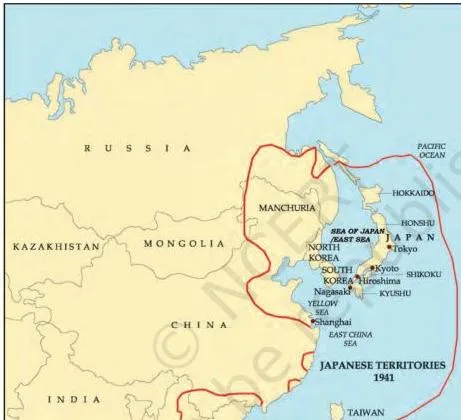
The chapter opens with this contrast because geography shaped the two countries’ fates: China is a vast continental country dominated by the Yellow, Yangtze and Pearl river systems, while Japan is a mountainous island string in an active earthquake zone. China’s size gave it confidence; Japan’s island position and dependence on the sea made it watchful.
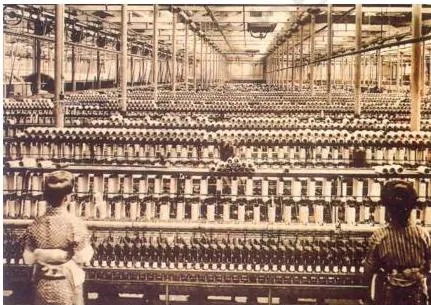
The textile factory picture goes with the ‘Industrial Workers’ section: over half of those in modern factories were women, and it was women who organised the first modern strike in 1886. The image is evidence of who actually built Japan’s industrial economy.
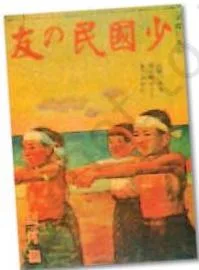
This image accompanies ‘Aggressive Nationalism’. The Meiji constitution created a parliament — the Diet, a German word the Japanese adopted under the influence of German legal ideas — but the franchise was restricted and the army and navy sat outside government control under the emperor, so militarism grew inside a constitutional order.
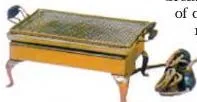
The ‘Daily Life’ section uses this image to show the shift from the multi-generational patriarchal household to the nuclear family — the new homu, as the Japanese said using the English word “home”. New homes created demand for new goods, entertainments and housing, and by the 1920s cheap housing was sold for a 200-yen down payment.
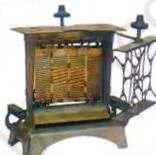
This advertisement is about what modernity looked like in the home. Western appliances combined with Japanese staples like rice show exactly what the chapter means by ‘Westernisation and Tradition’ being mixed, not opposed.
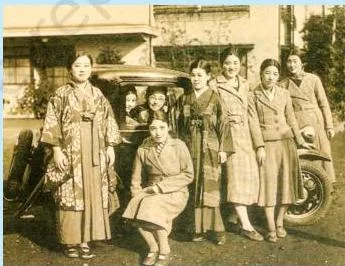
The moga represented the twentieth-century meeting of gender equality, cosmopolitan culture and a developed economy. The same section notes the first radio stations in 1925, department stores, and actress Matsui Sumako starring in Ibsen’s A Doll’s House — a period of questioning traditional norms.
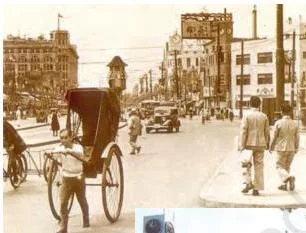
This image belongs to the post-war section: cadmium and mercury poisoning (Minamata) and air pollution provoked grass-roots pressure groups to demand recognition and compensation. Government action and new regulations followed — the chapter’s reminder that growth had a price.
China’s illustrations
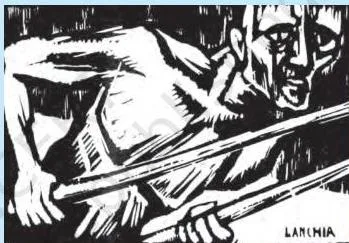
This woodcut, ‘Rickshaw Puller’ by Lan Jia, illustrates Activity 4’s account by the black American musician Buck Clayton. It captures the human cost of Guomindang China: workers “nothing but human horses”, earning only enough for rice and a place to sleep.

This image supports the chapter’s point about the Guomindang’s failure: between 1945 and 1949 prices rose 30 per cent per month, utterly destroying the lives of ordinary people. The party’s narrow social base and limited political vision cost it the peasantry.
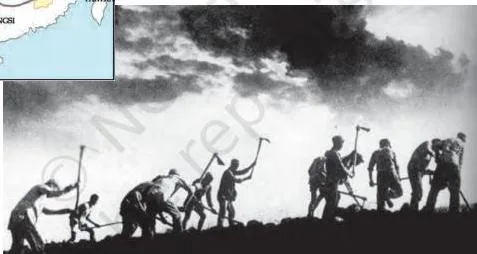
This is a photograph of soldiers on the Long March reclaiming wasteland. The 1934–35 march of about 6,000 gruelling miles took the CCP to Yanan, where land reform and resistance to the Japanese invasion won it a strong social base — the foundation of its 1949 victory.
Korea’s illustrations
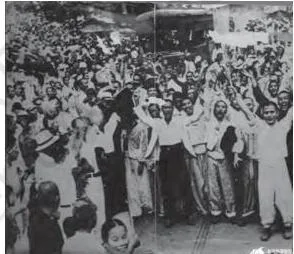
This image anchors the Korean War section: the war was a vintage proxy war of the Cold War era, ended not by a peace treaty but by an armistice in July 1953, leaving Korea divided and delaying both economic development and democratisation.
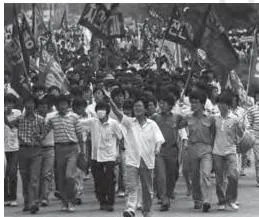
This photograph of the June Democracy Movement of 1987 is the turning point of Korea’s democratic story: what began as student protest broadened to include the middle class, and forced the constitutional amendment that allowed direct presidential elections.
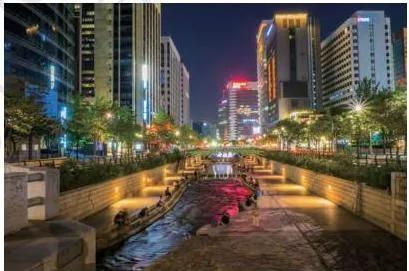
The final Korean image proves the chapter’s argument about democratic maturity: Kim Dae-jung’s election, followed by further peaceful transfers in 2008, 2012 and 2017, showed that citizens’ political awareness — not just economic growth — carried Korean democracy forward.
Key Terms and Concepts — Translated
Half the difficulty of this chapter is its Japanese, Chinese and Korean vocabulary. Use this table to keep the terms straight while you read.
| Term | What it means in the chapter |
|---|---|
| Shogun | Military ruler who governed Japan in the emperor’s name after the twelfth century |
| Daimyo | Lords who ruled over 250+ domains under the shogun |
| Samurai | The warrior class; the ruling elite and the only group allowed to carry swords |
| Tokugawa | The family that held the shogunate from 1603 to 1867 |
| Meiji Restoration | The 1868 overthrow of the shogun and restoration of the emperor as head of a modernising state |
| Fukoku kyohei | ‘Rich country, strong army’ — the Meiji government’s slogan |
| Emperor system | The emperor plus the bureaucracy and military that exercised power in his name |
| Diet | The Japanese parliament created by the 1889 constitution, with limited powers |
| Zaibatsu | Large business organisations controlled by individual families |
| Tale of the Genji | Murasaki Shikibu’s classic of Heian court life, central to Japanese literature |
| Hiragana / katakana | Two phonetic scripts the Japanese developed beside Chinese characters |
| Kang Youwei / Liang Qichao | Qing reformers who tried to strengthen the system by using traditional ideas in new ways |
| Sun Yat-sen’s Three Principles | Nationalism, democracy and socialism — the programme of the 1911 republic’s founder |
| Guomindang | The National People’s Party led after Sun’s death by Chiang Kai-shek |
| CCP | The Communist Party of China, founded 1921, victorious in 1949 |
| Long March | The CCP’s 1934–35 retreat of about 6,000 miles to a new base at Yanan |
| Great Leap Forward | The 1958 drive to industrialise rapidly, including backyard steel furnaces |
| Cultural Revolution | The mid-1960s ideological campaign by the Red Guards against old culture, customs and habits |
| Four Modernisations | The 1978 goal to develop science, industry, agriculture and defence |
| Yusin Constitution | Park Chung-hee’s 1972 constitution giving the president absolute authority |
| Saemaul Movement | The 1970 New Village Movement to mobilise rural Koreans to modernise their communities |
| IMF crisis | South Korea’s 1997 foreign-currency crisis, met with IMF support and the Gold Collection Movement |
Common Mistakes Students Make in This Chapter
This chapter mixes three countries, two Chinas and several slogans — exactly where answers go wrong. Check yourself against these pairs.
| Mistake | Correct rule | How to check your answer |
|---|---|---|
| Confusing the 1911 Republic of China with the 1949 People’s Republic of China | The 1911 republic under Sun Yat-sen was led later by the Guomindang; in 1949 the CCP established the People’s Republic, while Chiang Kai-shek’s Guomindang continued as the Republic of China in Taiwan | Read the date: ‘Republic of China’ after 1949 means Taiwan only |
| Mixing up the Great Leap Forward and the Cultural Revolution | Great Leap Forward: 1958, rapid industrialisation, backyard furnaces. Cultural Revolution: launched in the mid-1960s, ideological campaign against old culture | Ask which aim: industry or ideology? |
| Thinking fukoku kyohei was a democratic slogan | It meant a rich country and strong army under the emperor system — a military, not democratic, priority | The slogan’s second half is ‘army’ |
| Treating the Korean War as ended by a peace treaty | The war ended in an armistice in July 1953, not a peace treaty, and Korea remained divided | Look for the word ‘armistice’ in the chapter |
| Assuming Mao’s industrialisation succeeded | The chapter states the steel from backyard furnaces was industrially unusable and communes were inefficient | Check the 1953–58 paragraph before judging |
| Merging the Four Modernisations and the Fifth Modernisation | The Four (science, industry, agriculture, defence) were the Party’s 1978 goal; the Fifth was a wall poster demanding democracy, without which the others ‘would come to nothing’ | The Fifth is a demand, not a plan — and it was suppressed |
Exam Notes: What the Chapter Asks and How to Use It
Textbook contents and the examinable syllabus are not always identical — check the current official CBSE syllabus. But the chapter’s own exercise block is a reliable map of what it considers important.
- The five ‘Answer in Brief’ questions test narrative precision, roughly one per country: developments before the Meiji Restoration, the transformation of daily life in Japan, the Qing response to the West, Sun Yat-sen’s Three Principles, and Korea’s 1997 crisis. A full answer should name the event, give its date and state its consequence.
- The three ‘Answer in a Short Essay’ questions test argument: Question 6 links Japan’s rapid industrialisation to wars and environmental destruction; Question 7 asks whether Mao and the CCP liberated China; Question 8 asks whether economic growth produced South Korean democracy. These are the chapter’s own big arguments, so use the evidence from each country section.
- The TIMELINE table is the fastest revision tool: cover the Japan column, reconstruct it, then do the same for China — it contains the dates (1868, 1912, 1919, 1921, 1934, 1949, 1966, 1976) the chapter most wants you to remember.
- The closing ‘Two Roads to Modernisation’ section is the chapter’s own conclusion and a ready-made essay frame: opening claim, Japan’s road, China’s road, and the judgment on each.
Revision Summary
The chapter’s closing argument, in brief, is that industrial societies do not become like each other — they find their own paths to modernity, and the four case studies prove it.
- Japan kept its independence by creatively using traditional skills and practices, but its elite-driven modernisation generated aggressive nationalism, sustained a repressive regime and built a colonial empire that left a legacy of hatred.
- China took a revolutionary path through foreign imperialism, warlordism, civil war and Japanese invasion. The Communist state removed centuries-old inequalities and spread education, but its repressive system turned liberation and equality into slogans; market reforms after 1978 made China economically powerful under tight political control.
- Korea moved from Japanese colony to authoritarian state-led growth to democracy — citizens’ political awareness, not just the economy, drove the final stage.
- The book’s own Conclusion closes Themes in World History by noting that historians construct history from primary sources, and that the craft is the same whether the period is ancient, medieval or modern.
Related Resources
If you are working through the whole book, browse the Class 11 History notes hub for this chapter’s neighbours, and the Class 11 study resources for the other subjects in your stream.
For the chapter immediately before this one, see the notes page for the preceding chapter, and start from the top with the CBSE notes index if you need a broader subject map.
The official source for everything on this page is the NCERT Class 11 History Paths to Modernisation chapter PDF on ncert.nic.in — download it for the full text, figures and exercises.
Reference: NCERT Class 11 Themes in World History textbook, chapter 7, official edition on ncert.nic.in.
Sources and Data Verification
The section titles, figures and events described on this page come from NCERT’s Class 11 Themes in World History textbook, Chapter 7, ‘Paths to Modernisation’, official edition. This page covers material in that chapter only, set alongside the chapter’s own exercises and TIMELINE.
It is maintained for the current academic session using the NCERT information available to us. NCERT settles the textbook, its edition and the official PDF; CBSE settles the curriculum, syllabus and examinations — so for questions about what is examinable, always check the current official CBSE syllabus.
Frequently Asked Questions
Where is the Paths to Modernisation chapter in the NCERT Class 11 History book?
It is Chapter 7 — the final chapter — of Themes in World History. It is followed directly by the book’s own Conclusion, which closes the textbook.
How does the Japanese path to modernisation differ from the Chinese path?
Japan modernised on capitalist principles through an elite-led Meiji state, retained its independence by defeating China and Russia, and ended with a democratic post-war constitution. China modernised through revolution: after foreign imperialism and civil war, the CCP built a centralised state, removed old inequalities, and then turned to market reforms from 1978 while keeping tight political control.
What was China’s Fifth Modernisation and how does it differ from the Four Modernisations?
The Four Modernisations, declared in 1978, were the Party’s goal to develop science, industry, agriculture and defence. The Fifth Modernisation was a wall poster of 5 December 1978 demanding democracy, arguing that without it the other four “would come to nothing”; the demand was suppressed.
How many exercise questions does the chapter contain and what types are they?
Eight: five ‘Answer in Brief’ questions that test precise narrative recall, and three ‘Answer in a Short Essay’ questions that test argument — on Japan’s industrialisation and war, Mao’s success in liberating China, and whether South Korean growth caused democratisation.
What is the chapter’s own conclusion about modernisation?
That industrial societies far from becoming like each other find their own paths to becoming modern. Japan’s path succeeded through creative use of tradition but produced aggressive nationalism and empire; China’s revolutionary path removed inequalities but suppressed freedom. Modernisation is not a single destination.
Why is the Korean War called a proxy war in this chapter?
Because it was a “vintage proxy war of the Cold War era”: South Korea was supported by US-led United Nations forces while North Korea was supported by communist China, so the two superpower blocs fought through the two Koreas. It ended in an armistice in 1953, not a peace treaty, and Korea remained divided.
Explore Class 11 History Books
- Previous: Towards Modernisation
Related chapters:
- Early Societies
- Empires
- Changing Traditions