
A student revising Empires Class 11 History tonight needs two things: the official chapter file and a clear map of what is inside it — both are on this page. This is the NCERT Class 11 History textbook (Themes in World History), Chapter 2, “Empires”, a chapter of about 48 pages in the official PDF.
It studies two very different empires: the Roman Empire across three continents, and the Mongol Empire under Genghis Khan. The official PDF is directly below, followed by a section-by-section guide to the file, its maps, its key terms and its exercise questions.
NCERT Class 11 History Chapter 2 Empires PDF
The chapter sits inside the official Themes in World History book, and NCERT publishes every chapter as a free PDF on its portal. Open the NCERT Class 11 History Chapter 2 Empires PDF on ncert.nic.in — the portal lists the full textbook, and Chapter 2 is filed there under the code kehs102, ready to read online or save.
| What the chapter holds | Count | Where it is used |
|---|---|---|
| Printed pages | 48 | |
| Figures with NCERT captions | 16 | |
| Tables | 6 | |
| Activities | 9 | |
| Official NCERT PDF | Download the chapter PDF | the chapter exactly as NCERT publishes it |
Chapter at a Glance: What the File Holds
The table below is the file’s map before you open it — how the chapter is organised, how many figures and activities it holds, and where its exercise blocks fall.
The chapter opens with a full timeline running from c. 100 BCE to 1300 CE, with parallel columns for Africa, Europe, Asia, South Asia, the Americas and the Pacific islands.
Egypt, Rome, China, India and the Mongols all appear on the same spread — this was the period when major religious and cultural traditions took shape, books were written and ideas travelled across continents.
The chapter then divides into two halves: “An Empire Across Three Continents” on Rome, and “Nomadic Empires” on the Mongols. Each half ends with its own question blocks, “Answer in Brief” and “Answer in a Short Essay”.
What This Chapter Covers: Rome and the Mongols
Rome and the Mongols look nothing alike — one was a city-centred Mediterranean state, the other a steppe confederacy that built no cities of its own. The chapter places them side by side to answer one question: what actually holds a large, diverse empire together?
The opening pages set the scene. After Alexander’s campaigns, the lands he ruled became “Hellenised” — Greek became a widely known language and Hellenistic culture stayed influential for nearly three centuries.
Alexander’s empire disintegrated quickly after his death, but the small, well-organised forces of republican Rome took advantage of the political discord and established control over North Africa and the eastern Mediterranean from the second century BCE.
- What came after Rome: the eastern Roman Empire centred on Constantinople; the Arab empire and its successors from the seventh century; and, last, the Mongols under Genghis Khan in the thirteenth century.
- The chapter’s argument: every attempt to make and maintain an empire was driven by the search to control trading networks and to profit from links with regions such as India and China.
- Empires evolved administrative systems to give stability to trade, and the achievements of one empire were often taken up by its successor.
- Not all empires were city-centric: the Mongol empire is the chapter’s proof that pastoral people could maintain an empire for a long time and with success.
- Universal religions mattered: Christianity (originating in Palestine in the early first century CE) and Islam (seventh century CE) appealed across ethnic and language boundaries and helped bind large empires together.
The timeline on the opening spread situates all of this — the rivals, neighbours and successor states are all on one page, spanning Africa, Europe, Asia, South Asia and the Americas.
The Roman Empire: An Empire Across Three Continents
The Roman Empire was a mosaic of territories and cultures chiefly bound together by a common system of government — that is why the chapter studies it as a single empire. At its second-century peak it stretched from Scotland to the borders of Armenia, and from the Sahara to the Euphrates, with a population of some 60 million by the mid-second century.
Rome’s great rival was Iran; the two empires lay next to each other, separated only by a narrow strip of land along the river Euphrates.
The Three Players: Emperor, Senate and Army
The political core of the early empire is a trio — emperor, aristocracy, army — and it is worth memorising as a set of three.
- Emperor and Principate: Augustus founded the regime in 27 BCE. He was the sole real source of authority, but the fiction was kept alive that he was only the “leading citizen” (princeps), out of respect for the Senate.
- Senate and aristocracy: the Senate represented the wealthiest families, mainly landowners, and had controlled Rome in the days of the Republic. Most surviving Roman histories were written by men of senatorial background, so emperors tend to be judged by how they treated the Senate.
- Army: paid and professional, unlike Iran’s conscripted force. Soldiers served a minimum of 25 years; by the fourth century the army numbered 600,000 and was the largest organised body in the empire, with the power to make or break emperors.
- Succession ran through family descent, natural or adoptive — Augustus adopted Tiberius to guarantee a smooth transition, and the first two centuries stayed relatively free of civil war.
How did one ruler govern such a vast territory? The chapter’s answer is urbanisation.
- The great urban centres — Carthage, Alexandria, Antioch — were the bedrock of the imperial system: through the cities, government taxed the rich provincial countryside.
- Local upper classes actively collaborated with Rome, administering their own territories and raising taxes; a Roman “city” had its own magistrates, council and a territory of villages under its jurisdiction.
- Provincial elites rose so far that the emperor Gallienus (253-68) excluded senators from military command to keep control out of their hands.
Crisis, Recovery and Late Antiquity
The first two centuries were largely a period of peace, prosperity and economic expansion; the third century brought the first serious internal strain, and it is the watershed between the “early” and “late” empire.
- The third-century crisis: from the 230s Rome fought on several fronts at once. A new Sasanian dynasty in Iran expanded towards the Euphrates — Shapur I’s rock inscription claims he annihilated a Roman army of 60,000 and captured Antioch — while Germanic confederacies, the Alamanni, Franks and Goths, pressed the Rhine and Danube frontiers. There were 25 emperors in 47 years.
- Diocletian (284-305): cut back overexpansion by abandoning territories with little strategic value, fortified the frontiers, reorganised provincial boundaries, and separated civilian from military functions — the military commanders (duces) became a more powerful group.
- Constantine: introduced the solidus, a coin of 4.5 gm of pure gold that outlasted the empire itself, built a second capital at Constantinople, and made Christianity the official religion.
Late antiquity is the chapter’s term for the fourth to seventh centuries, a period of religious transformation — Christianisation, then the rise of Islam.
- The west fragmented: Goths, Vandals and Lombards took over the provinces and set up post-Roman kingdoms — Visigothic Spain (destroyed by the Arabs between 711 and 720), Frankish Gaul (c. 511-687), Lombard Italy (568-774).
- The east remained united and exceptionally prosperous; Justinian’s reign was its high-water mark, though his recovery of Italy devastated the peninsula and opened the way for the Lombard invasion.
- By 642, barely ten years after the Prophet Muhammad’s death, large parts of both the eastern Roman and Sasanian empires had fallen to the Arabs — the chapter notes that the expansion of Islam has been called the greatest political revolution the ancient world saw.
Women, Work, Trade and Social Hierarchies
This is the chapter’s evidence section — what the empire looked like from inside a household, a shop and a workshop.
- Family and women: the nuclear family was the norm, with slaves included in it as the Romans understood the family. In law a married couple was two financial entities: wives kept full rights in their natal family’s property, became independent property owners, and could divorce by simple notice. The picture was mixed — marriages were arranged, husbands were usually a decade older, and domestic domination was common (Augustine tells us his mother was regularly beaten by his father).
- Literacy: rates varied hugely. Pompeii, buried in 79 CE, shows widespread casual literacy — graffiti and wall advertisements — while in Egypt most formal documents were written by professional scribes and many people could not read or write.
- Languages: Latin and Greek were the only administrative languages; Aramaic dominated the Near East, with Coptic in Egypt, Punic and Berber in North Africa, Celtic in Spain and the northwest. Armenian began to be written only in the fifth century.
- Trade: wheat, wine and olive oil moved in huge quantities; liquids travelled in pottery containers called amphorae. Spanish olive oil in Dressel 20 jars (peak c. 140-160) captured markets from Italian producers; North African producers then dominated, and later the eastern Mediterranean — the Aegean, Asia Minor, Syria and Palestine — took over.
- Sophistication: water-powered milling, hydraulic mining in the Spanish gold and silver mines (with output unmatched until the nineteenth century), banking networks and widespread use of money.
Slavery was deeply rooted in the ancient world, but the chapter corrects a popular overstatement: the bulk of Roman labour was not performed by slaves.
- Slaves were an investment who had to be fed and maintained all year, so for many jobs free wage labour was cheaper and more easily dispensable; free labour was used extensively on public works at Rome precisely because slave labour would have been too expensive.
- Slaves and freedmen were widely used as business managers, where they were not needed in large numbers; masters often gave them capital to run businesses on their behalf.
- Labour control was tight: Columella recommended squads of ten; Pliny the Elder condemned slave gangs because workers were chained by the feet; the frankincense factories of Alexandria sealed workers’ aprons and made them strip before leaving the premises.
- Hierarchy: senators and equites merged into one late-Roman aristocracy, at least half of it of African or eastern origin; below stretched the humiliores — rural labourers, miners, migrants, casual city workers and thousands of slaves. Olympiodorus records aristocratic incomes of up to 4,000 lbs of gold a year, not counting produce consumed directly.
- Silver coinage broke down because the Spanish silver mines were exhausted; Constantine re-based the monetary system on gold.
The Mongol Empire: Nomadic Empires
“Nomadic empires” sounds like a contradiction — nomads are the quintessential wanderers, while an empire implies stable territory and elaborate administration. The chapter argues that the contradiction collapses when you study the Mongols, who adapted their social and political customs to build a fearsome military machine and a sophisticated method of governance.
The Sources Problem: Who Wrote Mongol History?
The Mongols are hard to study because they did not write their own history — almost everything we know was written by outsiders, often hostile ones.
- The steppe dwellers produced little literature of their own; knowledge comes mainly from chronicles, travelogues and documents written by city-based literati, who often produced ignorant and biased reports of nomadic life.
- Barbarian comes from Greek barbaros — a non-Greek whose speech sounded like random noise. The stereotype passed to the Romans for the Germanic tribes, the Gauls and the Huns, and the Chinese terms were equally negative. Not all accounts were hostile: Buddhist, Confucian, Christian, Turkish and Muslim writers sometimes produced sympathetic accounts, even eulogies.
- Sources survive in Chinese, Mongolian, Persian, Arabic, Italian, Latin, French and Russian; the Mongolian and Chinese versions of The Secret History of the Mongols differ, and the Italian and Latin versions of Marco Polo do not match — so historians often have to double as philologists.
- Russian scholarship mattered most: Vladimirtsov did excellent research on Mongol languages and society, while Bartold’s sympathetic assessment of Genghis Khan troubled the censors, and his works appeared in nine volumes only in the 1960s.
From Temujin to Genghis Khan
Genghis Khan’s career is the chapter’s story of how a hard early life produced the ruler of the largest land empire the world had seen.
- Born c. 1162 near the Onon river and named Temujin, son of Yesugei of the Kiyat; his father was murdered, his mother Oelun-eke raised him in great hardship, he was captured and enslaved, and his wife Borte was kidnapped.
- Allies and enemies: Boghurchu, his first and trusted friend; Jamuqa, his blood-brother (anda) who became a hostile foe; and Ong Khan, his father’s old blood-brother.
- Victory: Jamuqa defeated, then the Tatars (his father’s assassins), the Kereyits and Ong Khan himself in 1203; the Naiman and Jamuqa fell by 1206.
- Quriltai of 1206: an assembly of Mongol chieftains proclaimed Temujin Genghis Khan — the “Oceanic Khan” or “Universal Ruler”.
- Campaigns: Hsi Hsia defeated by 1209, the Great Wall breached in 1213, Peking sacked in 1215; after Khwarazm’s sultan executed Mongol envoys, the great cities fell in 1219-21 — Bukhara, Samarqand, Merv, Nishapur among them. Juwaini reports Genghis Khan telling Bukhara’s wealthy residents: “I am the punishment of God.”
- He died in 1227, having spent most of his life in combat.
- War machine: horse-riding archery, with hunting expeditions doubling as field manoeuvres; winter campaigns treated frozen rivers as highways; siege engines and naphtha bombardment were mastered quickly, and equipment was kept light and portable.
How the Mongols Organised an Empire
The administrative machine is the chapter’s answer to how a “nomadic empire” could govern a settled world.
- All able-bodied adult males bore arms; the army was re-formed in decimal units of 10s, 100s, 1,000s and roughly 10,000 (tuman) — remember the ladder: ten, hundred, thousand, ten thousand.
- Old tribal identities were deliberately erased: tribes were broken up and their members distributed across new units, so loyalty ran to Genghis Khan, not the clan. Moving without permission brought harsh punishment.
- A new aristocracy — anda (blood-brothers) and naukar (bondsmen) — took rank from closeness to the Khan, not from clan chieftainship; his four sons received the four ulus, and decisions were taken collectively at quriltais.
- The yam courier system, with fresh mounts and riders at regular intervals, connected the far ends of the empire; it was funded by the qubcur, a tax of a tenth of the herd that nomads paid willingly for the benefits it brought.
- Pax Mongolica: the peace opened trade — the Silk Route reached its peak, and unlike before, routes did not terminate in China but continued north into Mongolia and to Karakorum; travellers carried a paiza/gerege pass and traders paid the baj tax.
- The cost was real: cities destroyed, agriculture laid waste, and the underground canals (qanats) of the Iranian plateau fell into disrepair, so parts of Khurasan never recovered.
- Attitudes shifted: in the 1230s some Mongol leaders urged turning farmland into pasture, but by the 1270s Qubilai Khan appeared as the protector of peasants and cities, and Ghazan Khan in the 1290s warned his generals against pillaging the peasantry.
The Mongols after Genghis Khan and Their Place in History
The empire outlived its founder, then split apart — and the chapter ends by asking what the Mongols mean for world history.
- Two expansion phases: 1236-42, when Batu’s campaigns devastated Russia, seized Poland and Hungary and camped outside Vienna; and 1255-1300, which brought the conquest of China (1279), Iran, Iraq and Syria.
- Western expansion ended because of succession politics: descendants of Jochi and Ogodei allied to control the office of Great Khan, then the Toluyid branch marginalised them; forces were diverted to China, leaving a small, understaffed army that was defeated by the Egyptians.
- Fragmentation into lineages: the Toluyids (Yuan dynasty in China, Il-Khanid state in Iran), the Chaghataids, and the Jochids, whose realm in the Russian steppes observers called the “Golden Horde”.
- Significance: Genghis Khan’s line echoed into Timur, who claimed descent through the Chaghatai lineage, and through Timur to Babur, who founded the Mughal empire in India in 1526.
- The Mongols also force historians to rethink the stereotype of nomads as primitive — they ran a decimal army, a courier system and a tax system across the largest empire the world had seen.
Reading the Maps and Images in This Chapter
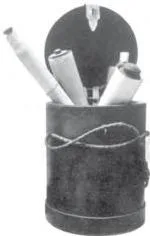
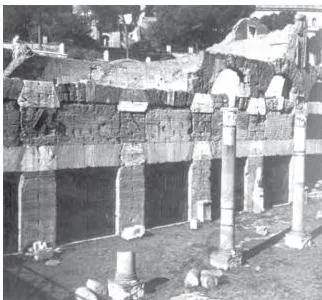
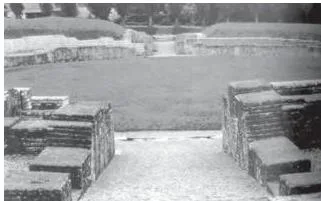
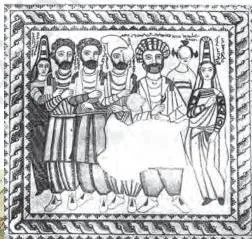
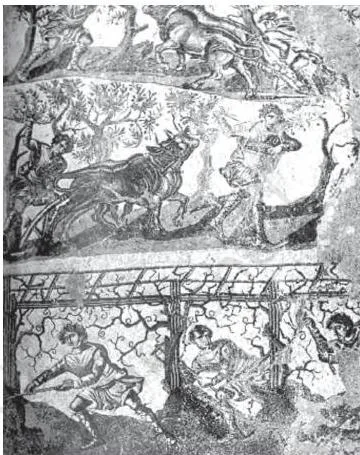
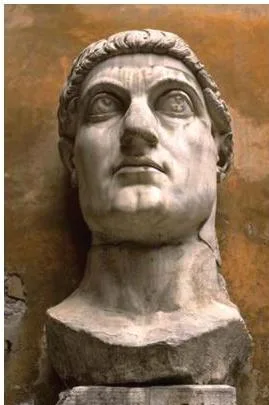
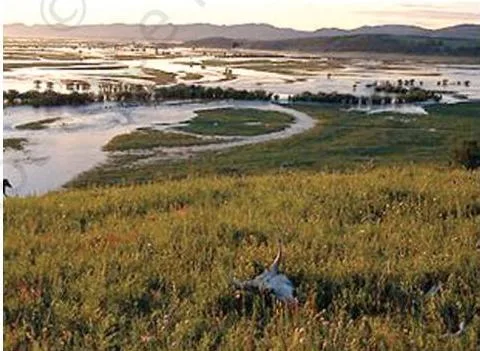
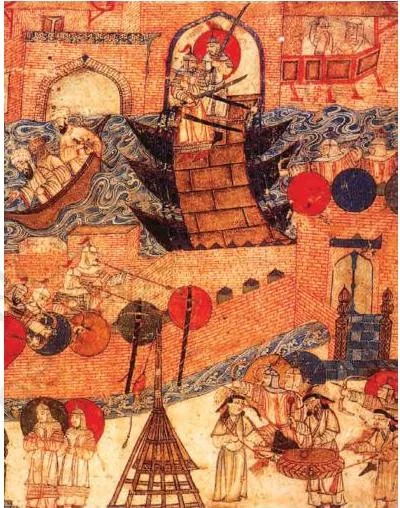
Each figure below is an original NCERT diagram or photograph from the chapter, and each one carries a specific argument. Reading them actively is part of revising the chapter.
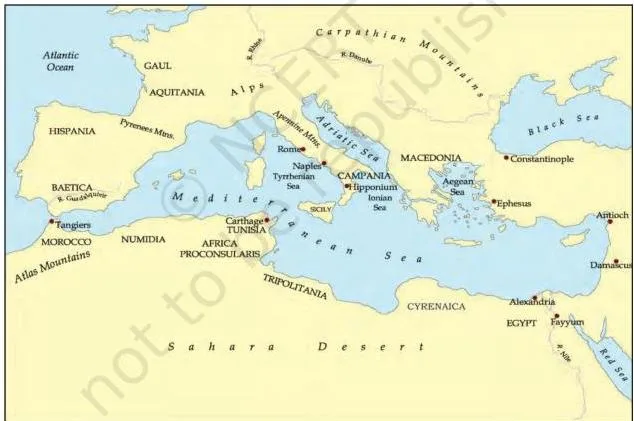
Read the geography out of this map first: the Mediterranean, stretching from Spain to Syria, was the heart of Rome’s empire, and Rome dominated the regions around that sea in both directions. To the north the boundaries were the Rhine and the Danube; to the south, the Sahara desert.
The map is why Rome is called an empire across three continents — and it explains the internal split: Latin-speaking provinces to the west of the Mediterranean, Greek-speaking provinces to the east.
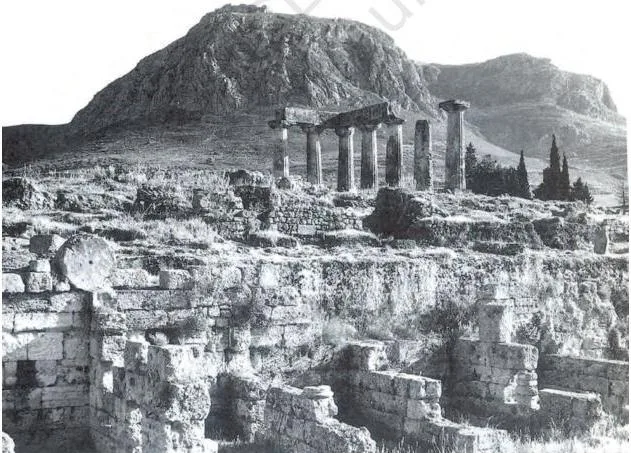
This photograph opens the chapter as a visual reminder of the world Rome inherited. Corinth belonged to the Greek world that Alexander’s conquests spread and “Hellenised”; even after Rome took control, Greek remained the language of the eastern upper classes and Rome respected Hellenic culture deeply.
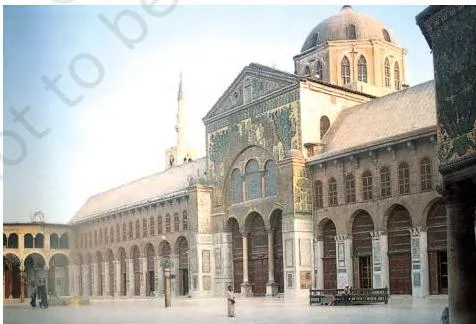
Damascus was the capital of the Arab empire that took over most of the eastern Roman lands between the seventh and fifteenth centuries. The mosque, completed in 714, shows the urban, religious and architectural traditions that Rome’s eastern empire passed on — the chapter stresses the close interaction between Greek and Islamic traditions in this region.
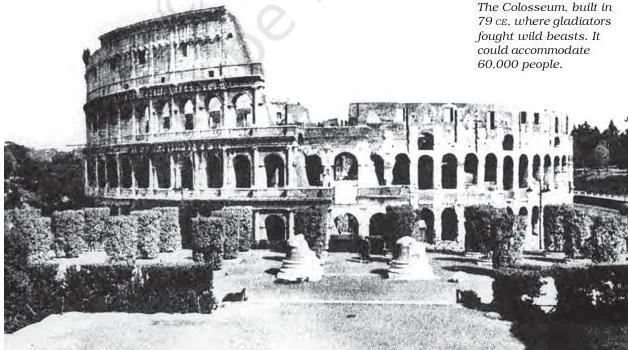
The Colosseum connects to the chapter’s point about cities as the bedrock of the empire: urban populations enjoyed a high level of entertainment, and one calendar shows that spectacula (shows) filled 176 days of the year. The arena could hold 60,000 people — urban life was one of the rewards of the imperial system.
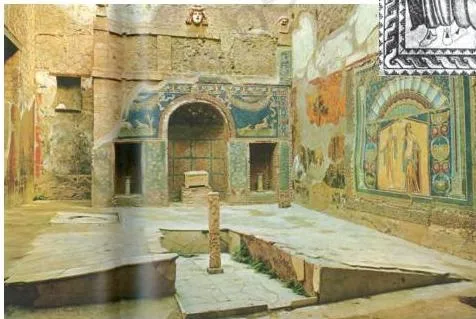
Pompeii, buried by the eruption of Vesuvius in 79 CE, is the chapter’s best everyday-life evidence. Its walls carry advertisements and graffiti that show widespread casual literacy, and rooms like this wine-merchant’s dining room put a face on the trade in wine and oil that the amphora evidence describes.
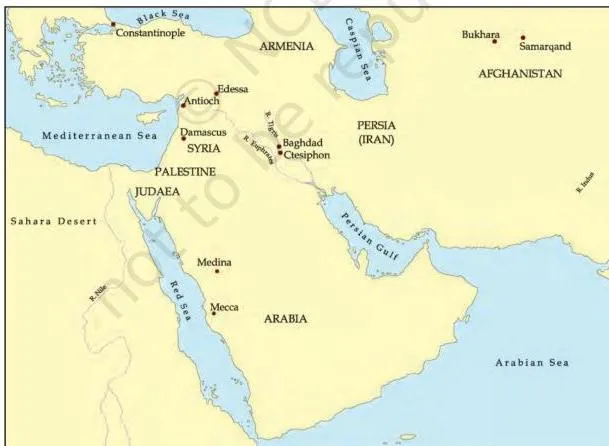
This map shows Rome’s eastern frontier — the provinces of Syria, Palestine and Mesopotamia, and the “Near East” beyond. Just across a narrow strip of land along the Euphrates lay Rome’s great rival Iran; this is the zone where Trajan campaigned down to the Persian Gulf, and where the Sasanian wars of the third century were fought.
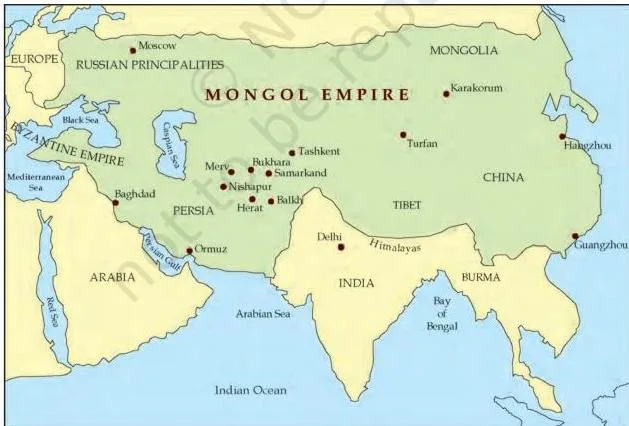
The Mongol map makes the scale of the story visible: a transcontinental empire straddling Europe and Asia in the thirteenth and fourteenth centuries, the largest the world had ever seen.
It began in the Central Asian steppes — the homeland of Temujin — and stretched outwards in every direction, which is why the chapter treats Mongol expansion as a world event, not a regional one.
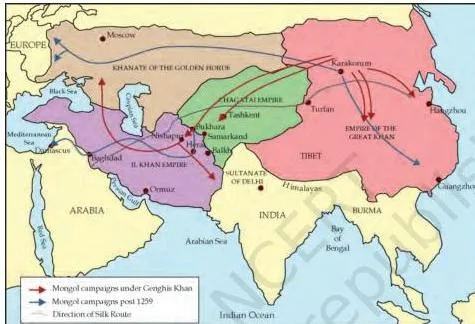
This trade-route map illustrates the chapter’s most surprising point about the Silk Route: under the Mongols, trade did not terminate in China but continued north into Mongolia and to Karakorum, the new capital.
The yam courier system and the paiza pass made this long-distance traffic possible — and Activity 2 in the chapter asks you to place a missing eastern terminal city on this same map.
Key Terms and Definitions for Empires
These are the specialised terms the chapter expects you to know, each defined in the sense the textbook uses it.
| Term | What it means in this chapter |
|---|---|
| Principate / princeps | The regime founded by Augustus in 27 BCE; he ruled alone but kept the fiction of being only the “leading citizen” (princeps). |
| Denarius | Roman silver coin containing about 4.5 gm of pure silver. |
| Amphorae | Pottery containers used to transport wine and olive oil. |
| Dressel 20 | The standard container for Spanish olive oil at its peak (c. 140-160), named after the archaeologist who identified its form. |
| Transhumance | The herdsman’s regular seasonal movement between high mountain regions and low ground in search of pasture. |
| Solidus | Constantine’s gold coin of 4.5 gm pure gold, minted in millions and lasting beyond the empire itself. |
| Late antiquity | The final period of the Roman world, roughly the fourth to seventh centuries. |
| Christianisation | The gradual process by which Christianity spread and became the dominant religion of the empire. |
| Humiliores | “The lower” — the vast mass of the lower classes, from rural labourers to casual city workers. |
| Plebs sordida | The “unkempt lower class” Tacitus describes, addicted to circus and theatrical displays. |
| Papyrus / papyrologists | A reed-like plant processed into writing material; the scholars who publish the documents that survive on it. |
| Hellenistic | The period after Alexander when Greek culture remained influential across the region. |
| Quriltai | Assembly of Mongol chieftains; the 1206 quriltai proclaimed Temujin as Genghis Khan. |
| Qa’an / Genghis Khan | “Great Khan of the Mongols” — the “Oceanic Khan” or “Universal Ruler”. |
| Ger | The tent in which the Mongols lived as they moved with their herds between pastures. |
| Tuman | A decimal unit of roughly 10,000 soldiers. |
| Anda / naukar | Blood-brother / bondsman — the new aristocracy whose rank came from closeness to the Khan. |
| Ulus | The dominions apportioned to Genghis Khan’s four sons. |
| Yam | The courier system of fresh mounts and despatch riders that connected the empire. |
| Qubcur | The herd tax of one tenth that funded the yam courier system. |
| Paiza / gerege | The pass giving travellers safe conduct; traders paid the baj tax for the same protection. |
| Pax Mongolica | The peace brought by Mongol conquest, under which Silk Route trade reached its peak. |
Common Mistakes Students Make in This Chapter
These are the wrong turns the chapter reliably produces — the correction comes from the chapter’s own argument.
| Mistake | What the chapter actually says | How to check your answer |
|---|---|---|
| “The Roman economy ran on slaves.” | Free wage labour was extensive — cheaper because slaves had to be fed and maintained year-round. Slaves worked where few were needed (business managers) or where the cost was justified; that was true of parts of Republican Italy, not the empire as a whole. | Ask why a landowner would prefer wage labour at harvest — a slave costs upkeep in idle months. |
| “Nomads were primitive barbarians.” | Barbarian comes from Greek barbaros — a non-Greek whose speech sounded like noise. The Mongols ran a decimal army, a courier system and a tax system. | Can you name three Mongol institutions? If yes, the stereotype collapses. |
| Taking the Mongol casualty figures literally. | The numbers are medieval chroniclers’ estimates: Juwaini reached 1,300,000 dead at Merv by counting 100,000 corpses a day for 13 days. The chapter itself asks how such figures were arrived at. | For any casualty figure, ask: who counted, and by what method? |
| “The Mongols were only destroyers.” | The chapter balances destruction with the Pax Mongolica: the Silk Route at its peak, routes running to Karakorum, and Qubilai and Ghazan protecting peasants. | Compare the 1230s “fields to pasture” view with the 1270s and 1290s reforms. |
| Misdating — the solidus as a republican coin, or the empire as Christian from the start. | Principate: 27 BCE under Augustus. Solidus: Constantine’s gold coin (c. 310). The empire was substantially Christianised only after Constantine’s conversion in the fourth century. | Attach a date to each term: Principate 27 BCE, solidus c. 310, Christianisation fourth century. |
| “Roman women had no standing.” | In law wives held property, kept legal independence in marriage, and could divorce by simple notice — but marriage was arranged, the age gap bred inequality, and domestic domination was common. | Give one point on each side; the chapter insists the picture is a mixed one. |
Exam Notes: How the Chapter’s Questions Work
The Roman half closes with four “Answer in Brief” questions and two “Answer in a Short Essay” questions; the Mongol half has its own pair of blocks. Here is what the Roman questions are testing.
- Q1 (towns or countryside): tests the urbanisation argument and the Galen famine account — cities taxed and stored the countryside’s grain, leaving peasants to unhealthy foods by spring.
- Q2 (towns, cities, rivers, seas, provinces): tests the maps. Name Carthage, Alexandria and Antioch; the Rhine, Danube and Euphrates; the Mediterranean; and provinces such as Tripolitania, Cyrenaica, Syria, Palestine and Mesopotamia.
- Q3 (a Roman housewife’s shopping list): tests Economic Expansion — wheat, wine and olive oil, with wine from Campania and olive oil travelling in amphorae.
- Q4 (why silver coinage stopped): tests the exhaustion of the Spanish silver mines and Constantine’s gold solidus.
- Q5 (Trajan conquers India — a counterfactual): the Cassius Dio passage has Trajan gazing at a ship for India at the Persian Gulf; answer by extending the chapter’s own mechanisms — urbanisation, taxation through cities, trade networks, citizenship — to India.
- Q6 (what looks modern): water power, hydraulic mining, banking, money, wage labour, women’s legal rights and a professional army are the chapter’s candidates.
A worked model answer for Q1. “I would rather have lived in a town. Towns were the bedrock of the imperial system: they were better provided for during famines, offered public baths and shows that filled 176 days of the year, and were where government, tax and justice actually operated.
The countryside, by contrast, was what the cities taxed: Galen describes city-dwellers carrying off the next year’s grain after the harvest and leaving peasants pulses, then twigs and roots by spring. A town gave security and amenity; the peasant’s lot was the cost that paid for it.”
A full answer states the choice, then supports it with both the famine evidence and the urban-amenity evidence.
The counterfactual style of Q5 and the evidence-based style of Q6 are worth practising: Q5 rewards logic that stays inside the chapter’s framework, while Q6 rewards a list of concrete features with one line of explanation each.
Textbook contents and the examinable syllabus are not always identical — check the current official CBSE syllabus before deciding what to prepare.
The Chapter’s Activities as Revision Prompts
The activities inside the chapter are better than revision questions — each one tests one section’s core idea. Try answering each aloud without the book.
- Identify five events that involved the movement of peoples across regions or continents, and their significance (opening activity).
- Who were the three main players in Roman politics? Whose collaboration was crucial to governing the empire? (early empire)
- How independent were Roman women, and how does the Roman family compare with the family in India today? (gender, literacy, culture)
- Why are pottery archaeologists like detectives, and what can amphorae reveal about Mediterranean economic life? (economic expansion)
- Identify the three writers on how Romans treated workers, and describe two methods of labour control. (controlling workers)
- If Juwaini’s account of Bukhara is accurate, what impact would the speeches have had on a resident of Bukhara and Khurasan? (sources)
- Trace the Silk Route on the trade map and place the missing eastern terminal city — could it have been on the route in the twelfth century? (Mongol organisation)
- Why was there a conflict of interests between pastoralists and peasants, and would Genghis Khan have spoken as Ghazan Khan did? (Mongol organisation)
How the Chapter Fits Together: A Ten-Minute Read-Through
Start with the comparison the whole chapter is built around, then run the argument in order.
| Feature | Roman Empire | Mongol Empire |
|---|---|---|
| Scale | Most of Europe, the Fertile Crescent and North Africa; from Scotland to Armenia and the Sahara to the Euphrates; about 60 million people by the mid-second century. | The largest empire the world had seen, straddling Europe and Asia in the thirteenth and fourteenth centuries. |
| Army | Paid and professional; minimum 25 years’ service; 600,000 by the fourth century. | All able-bodied adult males; decimal units of 10, 100, 1,000 and 10,000 (tuman). |
| Government | Emperor, Senate and army; rule through cities, with local upper classes collaborating. | Great Khan with his four sons’ ulus; collective decisions at quriltais; the yam courier system for control. |
| Economy | Wheat, wine and olive oil in amphorae; banking, money, water power; slave and wage labour side by side. | Pastoral herding; qubcur tax of a tenth of the herd; baj tax on traders; Silk Route at its peak. |
| Cities | Cities were the bedrock of government — they taxed the countryside and hosted the shows. | Early campaigns destroyed cities (Bukhara, Nishapur); later rulers like Qubilai and Ghazan protected them. |
Now the argument in fifteen steps:
- The post-Alexander world was “Hellenised” — Greek culture stayed influential for nearly three centuries.
- Republican Rome exploited the discord after Alexander and took the eastern Mediterranean from the second century BCE.
- Augustus founded the Principate in 27 BCE, ruling alone behind the fiction of being first citizen.
- The three players — emperor, aristocracy, army — decided everything; the army could make or break emperors.
- One ruler governed 60 million people through cities, which taxed the countryside with local elite collaboration.
- The third century brought crisis: Sasanian and Germanic pressure, 25 emperors in 47 years.
- Diocletian reorganised the state; Constantine added the gold solidus, Constantinople and Christianity.
- Roman society mixed strong women’s legal rights with arranged marriage and domestic domination.
- The economy expanded — amphorae, water power, mining, banking — and wage labour was often cheaper than slave labour.
- Late antiquity saw the west fragment into post-Roman kingdoms while the east stayed prosperous; by 642 the Arabs had taken much of both empires.
- The Mongol half opens with a paradox: “nomadic empire” collapses as a contradiction when you study the Mongols.
- The sources are outsiders’ — hostile city literati, multilingual texts, and historians who double as philologists.
- Temujin’s hard early life ended at the quriltai of 1206, when he became Genghis Khan.
- The machine: a decimal army, erased tribal identities, four ulus, the yam courier system and the qubcur tax.
- Pax Mongolica opened the Silk Route to Karakorum; succession disputes ended western expansion; the lineage echoed to Timur and Babur.
The chapter’s central claim is the thread: control of trade networks, relations with pastoral peoples, and universal religions — Christianity and Islam — are what held large empires together, in Rome and among the Mongols alike.
Related Resources
This listing is maintained for the 2026-27 academic session using the NCERT textbook information available to us. NCERT remains the authority for confirming the latest edition.
Move from this chapter to the rest of the book and the notes that go with it.
- Class 11 History notes — the notes hub for this subject.
- The notes for the previous chapter, on early societies — the chapter that sets up this one.
- The notes for the next chapter, on changing traditions — where the story continues.
- Class 11 hub — every subject’s notes for this class.
- CBSE notes hub — the complete set across classes.
Sources and Data Verification
- This page describes the NCERT Class 11 History textbook (Themes in World History), Chapter 2, “Empires”, official edition published on ncert.nic.in.
- It covers this one textbook chapter only — not the whole CBSE curriculum.
- The listing is maintained for the current academic session using the NCERT information available to us.
- NCERT settles textbooks, editions and PDFs; CBSE settles the curriculum, syllabus and examinations.
- Textbook contents and the examinable syllabus are not always identical — check the current official syllabus.
Reference: NCERT Class 11 History textbook (Themes in World History), chapter 2, official edition on ncert.nic.in.
Frequently Asked Questions
Which empires are covered in Class 11 History Chapter 2 Empires?
Two empires: the Roman Empire, studied in the section “An Empire Across Three Continents”, and the Mongol Empire under Genghis Khan, studied in “Nomadic Empires”. The chapter pairs a city-centred Mediterranean empire with a steppe empire built by pastoral people.
Why is the Roman Empire called an empire across three continents?
It covered most of Europe as we know it today, a large part of the Fertile Crescent in Asia, and North Africa — hence three continents. The Mediterranean was its heart, bounded by the Rhine and Danube to the north and the Sahara to the south.
Why did the Roman government stop minting silver coins and switch to gold?
Because the Spanish silver mines were exhausted and the government ran out of stocks to support a stable silver coinage. Constantine founded the new monetary system on gold, issuing the solidus, a coin of 4.5 gm of pure gold that outlasted the empire itself.
Were Roman women independent?
The legal picture was strong: wives retained rights in their own families’ property, were legally independent in marriage, and could divorce by simple notice from either side. The chapter insists the picture was mixed — marriages were arranged, the age gap encouraged inequality, and domestic domination was common.
Why is the Mongol Empire called a nomadic empire?
Because it was built and maintained by pastoral nomads, not by a city-based society. The term looks like a contradiction — nomads as wanderers versus an empire as a stable territorial state — but the chapter argues the contradiction collapses when you study how the Mongols organised a military machine and a sophisticated administration.
How do historians know about the Mongols if the Mongols left no literature of their own?
From chronicles, travelogues and documents written by outsiders — in Chinese, Mongolian, Persian, Arabic, Italian, Latin, French and Russian. The Mongolian and Chinese versions of The Secret History of the Mongols differ, and Marco Polo’s travels differ too across versions, so historians often have to work as philologists to reconstruct what happened.
Explore Class 11 History Books
- Previous: Early Societies
- Next: Changing Traditions
Related chapters:
- The Three Orders
- Changing Cultural Traditions
- Towards Modernisation