
Recording of Transactions-II Class 11 is Chapter 4 of the NCERT Accountancy textbook Financial Accounting-I. This is the chapter where the single journal gets split into six special purpose books — the cash book, purchases book, purchases return book, sales book, sales return book and journal proper — and the official NCERT PDF of the chapter is available right on this page.
The chapter opens on printed page 98 of the book, and everything below explains how each book works, with page references you can follow in your own copy.
Need the chapter itself? Download the Class 11 Accountancy Chapter 4 Recording of Transactions-II NCERT PDF — this is the official file from ncert.nic.in, the same edition used in schools, ready for reading or printing on any device.
| What the chapter holds | Count | Where it is used |
|---|---|---|
| Printed pages | 61 | |
| Sections in the chapter | 4 | |
| Figures with NCERT captions | 1 | |
| Tables | 178 | |
| Worked examples | 6 | solved step by step in our NCERT Solutions |
| Official NCERT PDF | Download the chapter PDF | the chapter exactly as NCERT publishes it |
Chapter 4 at a Glance: What the Book Contains
The table below lists what Chapter 4 actually holds — its sections, figures, worked examples and exercise questions — so you can see the size of the unit before you start. The chapter works through the six special purpose books one by one, includes check-your-understanding boxes as it goes, and ends with key terms, a summary and short and long answer questions.
Why the Journal Is Split: Six Special Purpose Books
A small business can record everything in one journal, but as the number of transactions grows, journalising each one becomes cumbersome. Many transactions are repetitive in nature, so the journal is sub-divided into special journals, also called day books or subsidiary books, each meant for transactions of a similar nature.
They are economical and they make division of labour possible in accounting work (NCERT, p. 100).
| Special purpose book | Source document | Transactions it records | How posting is done |
|---|---|---|---|
| Cash Book | Cash receipt duplicates, invoices, bills (vouchers) | All cash receipts and payments; cheques and bank transactions when a bank column is kept | Receipt-side accounts credited, payment-side accounts debited; no separate cash or bank account is opened in the ledger (pp. 100, 114) |
| Purchases Book | Supplier’s invoice or bill | Credit purchases of goods meant for resale | Each supplier credited daily; periodic total debited to Purchases Account (pp. 125–127) |
| Purchases Return Book | Debit note prepared by the buyer | Goods returned to suppliers | Each supplier debited; total credited to Purchases Return Account (pp. 128–129) |
| Sales Book | Sales invoice issued by the firm | Credit sales of goods | Each customer debited daily; total credited to Sales Account (pp. 130–131) |
| Sales Return Book | Credit note prepared by the seller | Goods returned by customers | Each customer credited; total debited to Sales Return Account (pp. 132–134) |
| Journal Proper | Varies — no single document | Everything that fits no special journal | Posted to the ledger like any journal entry (pp. 140–141) |
The one-line rule that drives the whole chapter: cash transactions go to the cash book, credit purchases and credit sales of goods go to their own books, returns go to the two return books, and everything else goes to the journal proper (NCERT, pp. 100, 125, 140).
You met the journal and ledger first in the previous chapter — see the Recording of Transactions-I Class 11 notes if you need to refresh how posting to the ledger works.
The Cash Book: Recording Cash and Bank Transactions
The cash book records all cash receipts and payments and starts with the cash or bank balance at the beginning of the period.
It is special because it is both journal and ledger: when it is maintained, cash transactions are not journalised, and no separate cash account (or bank account, when a bank column is kept) is opened in the ledger (NCERT, p. 100). It is also called the book of original entry.
Single Column Cash Book: Recording and Posting
Use a single column cash book when all receipts and payments are in cash only. It records transactions in chronological order, with one amount column on each side: Date | Receipts | L.F. | Amount, and the same on the payment side (NCERT, p. 101). The L.F. column holds the ledger folio reference.
Worked example with original figures. M/s Sudha Stationers starts December with cash in hand ₹52,000 on 1 December. During the month: received ₹8,500 from Meera; cash sales ₹21,000; paid ₹9,200 for office furniture; bought stationery for cash ₹3,100; paid electricity bill ₹1,800; received ₹6,000 from Vinod; paid wages ₹2,400 and rent ₹4,500.
| Dr. — Receipts | Amount ₹ | Cr. — Payments | Amount ₹ |
|---|---|---|---|
| Dec 01 Balance b/d | 52,000 | Dec 12 Office furniture | 9,200 |
| Dec 03 Meera | 8,500 | Dec 15 Stationery | 3,100 |
| Dec 08 Sales | 21,000 | Dec 19 Electricity charges | 1,800 |
| Dec 22 Vinod | 6,000 | Dec 26 Wages | 2,400 |
| Dec 30 Rent | 4,500 | ||
| Dec 31 Balance c/d | 66,500 | ||
| Total | 87,500 | Total | 87,500 |
Total receipts ₹87,500 = payments ₹21,000 + closing balance ₹66,500. The closing balance is placed on the payment side as Balance c/d and brought down as Balance b/d on the receipt side of the next period (NCERT, p. 102).
Posting rule. Every account named on the debit (receipts side) is credited in the ledger — Meera paid us, so her account is credited ₹8,500 — and every account on the credit (payments side) is debited — furniture is an asset, so it is debited ₹9,200 (NCERT, p. 102).
Double Column Cash Book: Cash, Bank and Contra Entries
Most organisations now make and receive payments through a bank, so a second amount column is added on each side — Cash and Bank. Maintaining a double column cash book gives the bank position from time to time without opening a separate bank account in the ledger (NCERT, pp. 104, 108).
When cash is deposited into the bank or withdrawn from it, the entry is made on both sides — the cash column credited and bank column debited for a deposit, the reverse for a withdrawal — and the letter C (for contra) is written in the L.F. column. Contra entries are never posted to the ledger (NCERT, p. 106).
If a cheque received is deposited on the same day it is entered straight in the bank column; if deposited later, it is recorded as cash on the day of receipt and as a contra entry on the day of deposit (NCERT, p. 106).
Worked example with original figures. M/s Green Valley Traders opens January with cash ₹12,000 and bank ₹28,000.
| Dr. — Receipts | Cash ₹ | Bank ₹ | Cr. — Payments | Cash ₹ | Bank ₹ |
|---|---|---|---|---|---|
| Jan 01 Balance b/d | 12,000 | 28,000 | Jan 05 Rent | — | 3,200 |
| Jan 03 Sales | 9,500 | — | Jan 08 Bank C | 5,500 | — |
| Jan 08 Cash C | — | 5,500 | Jan 15 Purchases | — | 7,400 |
| Jan 12 Amit | — | 9,000 | Jan 18 Amit (cheque dishonoured) | — | 9,000 |
| Jan 25 Bank C | 4,200 | — | Jan 21 Bank charges | — | 260 |
| Jan 31 Sales | — | 11,500 | Jan 25 Cash C | — | 4,200 |
| Jan 28 Salary | 5,800 | — | |||
| Jan 31 Balance c/d | 14,400 | 29,940 | |||
| Total | 25,700 | 54,000 | Total | 25,700 | 54,000 |
Three points to read off this example. First, Jan 08 and Jan 25 are contra entries — each appears on both sides with C, and neither is posted (NCERT, p. 106).
Second, Jan 18 is a reversal: Amit’s cheque bounced, so the bank column is credited back with his name; this restores the position before the cheque was received, it is not a fresh expense (NCERT, p. 106).
Third, the bank column can show a credit balance when the firm has an overdraft — withdrawals exceeding deposits — while the cash column can never be credit, because cash payments cannot exceed cash receipts plus the opening balance (NCERT, pp. 106, 114). An opening overdraft is written on the credit side as Balance b/d.
Reading Fig 4.4: Cheques, Crossing and the Bank Column
The chapter includes one diagram you should read carefully because it explains how cheque payments are protected — Fig 4.4 Types of crossing.
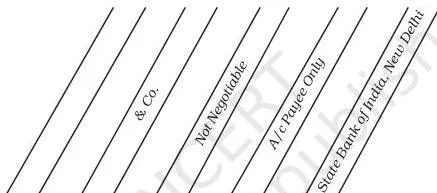
Money leaves the bank through cheques — blank cheque forms issued by the bank, on which the depositor writes the name of the party to be paid after the word “Pay” (NCERT, p. 104). Money enters through a pay-in-slip, whose counterfoil is returned signed by the cashier as the depositor’s receipt (NCERT, p. 104).
Crossing restricts who can collect the payment. In a general crossing two parallel lines are drawn, and the cheque can be paid through any bank. In a special crossing the name of a bank is written between the parallel lines, and payment can be made only to that bank.
An “A/c payee only” crossing means the amount can be deposited only into the account of the person whose name appears on the cheque (NCERT, p. 105).
Two more terms from the same page: a bearer cheque can be transferred by mere delivery, while an order cheque is transferred by endorsement and delivery — endorsement means writing instructions on the back of the cheque to pay a particular person and signing it (NCERT, p. 105).
A cheque is dishonoured when the bank returns it unpaid, generally for insufficient funds, and the firm reverses the earlier receipt in the bank column (NCERT, p. 106).
Petty Cash Book and the Imprest System
Small repetitive payments — postage, conveyance, cartage, telegrams — would make the main cash book bulky and overburden the head cashier. Large organisations therefore appoint a petty cashier and maintain a separate petty cash book (NCERT, p. 110).
The chapter gives three advantages of keeping a petty cash book (NCERT, p. 111):
- the chief cashier’s time is saved and he can concentrate on large cash transactions;
- control over small disbursements becomes easier, and division of work makes fraud and embezzlement difficult;
- recording is convenient — the main cash book stays manageable, and the materiality principle says insignificant details need not be shown in it.
The petty cashier works on the imprest system: a fixed sum, the imprest amount, is given at the start of the period; the petty cashier pays out of it; when a substantial part is spent, the exact amount spent is reimbursed, restoring the full imprest amount for the next period. Reimbursement may be weekly, fortnightly or monthly (NCERT, p. 110).
Example with original figures: on 1 February the petty cashier of M/s Mehta Furnishers receives ₹2,500. During the month he spends postage ₹320, conveyance ₹410, stationery ₹290, telephone ₹160 and miscellaneous ₹220 — total spent ₹1,400 — and is left with a balance of ₹1,100. The head cashier reimburses ₹1,400, so the imprest amount of ₹2,500 is restored.
The format carries an Amount Received column, Date, Particulars, Voucher No., Amount Paid, then analysis columns for the common expense heads — Postage, Telephone and Telegram, Conveyance, Stationery, Miscellaneous — and a Remarks column (NCERT, p. 112).
At posting, the petty cash account is debited with the advance, each expense account is debited with its column total, and the petty cash account is credited with the total spent (NCERT, p. 113).
Purchases Book and Purchases Return Book
The two buying-side special journals are the purchases book and the purchases return book. The first records what the business buys on credit, the second records what it sends back.
Purchases (Journal) Book
Only credit purchases of goods — goods meant for resale — belong in the purchases book. Cash purchases go to the cash book, and credit purchases of assets such as furniture, office equipment or building go to the journal proper (NCERT, p. 125).
The source document is the supplier’s invoice or bill, and the entry is made for the net amount: trade discount is deducted first and is not recorded in this book (NCERT, p. 126).
Columns: Date | Invoice No. | Name of Supplier (Account to be credited) | L.F. | Amount. Posting: each supplier’s account is credited daily, and the monthly total is debited to the Purchases Account (NCERT, p. 127).
Purchases Return Book, Debit Note and Credit Note
Goods are returned to suppliers when they are defective or not of the required quality. For every return the buyer prepares a debit note in duplicate and sends the original to the supplier; the supplier may in turn prepare a credit note. The debit note is the source document for the purchases return book (NCERT, pp. 128–129).
| Aspect | Debit note | Credit note |
|---|---|---|
| Who prepares it | The buyer | The seller |
| When | When goods are returned to a supplier, or an additional sum becomes recoverable from a party | When goods are received back from a customer |
| Account it affects | Debits the supplier (reduces what we owe) | Credits the customer (reduces what they owe) |
| Becomes the source for | Purchases return book | Sales return book |
Columns of the purchases return book: Date | Debit Note No. | Name of Supplier (Account to be debited) | L.F. | Amount. Posting: the supplier’s account is debited with the return, and the Purchases Return Account is credited with the periodical total (NCERT, p. 129).
The chapter’s analytical purchases book illustration adds separate CGST, SGST and IGST columns for the tax portions, so the tax amount sits in its own columns and never inflates the purchases figure (NCERT, pp. 138–139).
Sales Book and Sales Return Book
The two selling-side books are the mirror of the buying-side ones: the sales book records credit sales of goods, and the sales return book records goods customers send back.
Sales (Journal) Book
Only credit sales of merchandise are recorded here; cash sales go to the cash book. The source document is the sales invoice or bill issued by the firm to the customer, and two or more copies are prepared so the bookkeeper can enter from one (NCERT, p. 130). Columns: Date | Invoice No. | Name of Customer (Account to be debited) | L.F.
| Amount. Each customer’s account is debited daily, and the total is credited to the Sales Account periodically, generally monthly (NCERT, p. 131). A separate column may be added to record sales tax collected from the customer (NCERT, pp. 130–131).
Sales Return Book and the Credit Note
When customers return goods, the seller prepares a credit note — the buyer prepares the debit note, so the two are not interchangeable. The credit note is prepared in duplicate, serially numbered and dated, and is the source document for the sales return book (NCERT, pp. 132–133). Columns: Date | Credit Note No. | Name of Customer (Account to be credited) | L.F. | Amount.
The customer’s account is credited with the return, and the Sales Return Account is debited with the periodical total (NCERT, p. 134). The chapter’s analytical sales book illustration, like its purchases counterpart, keeps sales and CGST, SGST and IGST in separate columns (NCERT, pp. 139–140).
Journal Proper: Opening, Adjustment, Rectification and Closing Entries
The journal proper (also called journal residual) is the book of last resort — it records every transaction that finds no place in a special journal (NCERT, p. 140). Five categories:
- Opening entry — brings the opening balances of assets, liabilities and capital into a new set of books at the start of an accounting year.
- Adjustment entries — end-of-period updates on the accrual basis: rent outstanding, prepaid insurance, depreciation, commission received in advance.
- Rectification entries — correct errors in recording transactions or in posting them to the ledger.
- Transfer and closing entries — drawings transferred to capital at year end; expense and revenue balances transferred to the Trading and Profit and Loss Account.
- Other entries — cancellation of discount on a dishonoured cheque, credit purchase or sale of items other than goods, goods withdrawn for personal use, goods distributed as samples for sales promotion, endorsement and dishonour of bills of exchange, consignment and joint venture transactions, and loss of goods by fire, theft or spoilage (NCERT, pp. 140–141).
Balancing the Accounts: Debit Balance, Credit Balance, Overdraft
Balancing is how a book or account gets its closing figure: the two sides are totalled, the difference is written as Balance c/d on the smaller side, and brought down as Balance b/d on the other side for the next period. The cash book is balanced exactly like a ledger account (NCERT, p. 114).
One result never changes for the cash column: the cash book always has a debit balance, because cash payments can never exceed cash receipts plus the opening cash in hand (NCERT, p. 114). The bank column is different — it can end with a credit balance when the firm has an overdraft, meaning withdrawals have exceeded deposits (NCERT, p. 106).
Later, section 4.7 of the chapter, “Balancing the Accounts”, takes a full set of ledger accounts — capital, loan, sales, purchases, rent, drawings, creditors and debtors — posts a month’s transactions and balances each one.
Key Terms and Definitions from the Chapter
A quick lookup for revision, each term matched to the NCERT page where it is defined. Read the book’s own sentences alongside this table.
| Term | What it means | NCERT page |
|---|---|---|
| Cash book | Book of all cash receipts and payments; serves as both journal and cash account | 100 |
| Single column cash book | Cash book with one amount column on each side, when all receipts and payments are in cash | 100–101 |
| Double column cash book | Cash book with Cash and Bank amount columns on each side | 104 |
| Contra entry | Entry appearing on both sides of the cash book (cash vs bank), marked C; never posted | 106 |
| Overdraft | Bank position when withdrawals exceed deposits — a credit balance in the bank column | 106 |
| Pay-in-slip | Form filled to deposit cash or cheques into the bank; its counterfoil is returned as a receipt | 104 |
| Cheque | Bank form on which the depositor instructs payment to a named party | 104 |
| Bearer cheque | Cheque transferable by mere delivery | 105 |
| Order cheque | Cheque transferable by endorsement and delivery | 105 |
| Endorsement | Writing and signing instructions on the back of a cheque to pay a named person | 105 |
| General crossing | Two parallel lines on the cheque; payment can be collected through any bank | 105 |
| Special crossing | Bank’s name written between the parallel lines; payable only to that bank | 105 |
| A/c payee only | Crossing that allows deposit only into the account of the person named on the cheque | 105 |
| Dishonour of a cheque | Bank returns the cheque unpaid, generally for insufficient funds | 106 |
| Petty cash book | Separate cash book kept by a petty cashier for small repetitive payments | 110–111 |
| Imprest system | Fixed imprest amount given at period start; the exact amount spent is reimbursed | 110 |
| Trade discount | Discount deducted from the invoice; the special journals record only the net amount | 126 |
| Purchases book | Records credit purchases of goods on the basis of the supplier’s invoice | 125 |
| Debit note | Note prepared by the buyer to debit the supplier, usually for goods returned | 128–129 |
| Credit note | Note prepared by the seller to credit the customer whose goods were received back | 128–129 |
| Sales book | Records credit sales of goods on the basis of invoices issued by the firm | 130 |
| Journal proper | Book for transactions that find no place in any special journal | 140 |
| Opening entry | Entry bringing opening balances of assets, liabilities and capital into new books | 140 |
| Adjustment entries | End-of-period accrual entries: rent outstanding, prepaid insurance, depreciation, commission received in advance | 140 |
| Closing entries | Entries transferring expense and revenue balances to the Trading and Profit and Loss Account | 140–141 |
Common Mistakes Students Make in Recording of Transactions-II
These are the errors this chapter is famous for. Read each one before you attempt a question, then use the check column to test your own work.
| Mistake | Correct rule | How to check your answer |
|---|---|---|
| Cash purchases recorded in the purchases book | Only credit purchases of goods go in the purchases book; cash purchases go in the cash book (p. 125) | Ask: was cash paid at the same time? If yes, it belongs in the cash book. |
| Gross invoice amount entered instead of net | Record the amount after deducting trade discount (p. 126) | Recompute: list price minus trade discount must equal the supplier’s net invoice figure. |
| Contra entries posted to the ledger | Entries marked C are never posted (p. 106) | Scan the L.F. column — every row carrying C is ignored in posting. |
| Debit note confused with credit note | Buyer sends a debit note when returning goods; seller sends a credit note when goods are received back (pp. 128–130) | Ask: who is preparing the note, buyer or seller? That decides its name. |
| Bank column expected to always show a debit balance | Bank column can be credit (overdraft); cash column can never be credit (pp. 106, 114) | An opening overdraft appears on the credit side as Balance b/d — check which side you placed it on. |
| Credit purchase of furniture or machinery put in the purchases book | Only goods meant for resale belong there; assets go to the journal proper (credit) or cash book (cash) (p. 125) | Ask: is the item being resold? If no, it is not a purchases-book entry. |
| Dishonoured cheque treated as a fresh expense | Enter the reversal on the credit side in the bank column with the customer’s name — it restores the earlier position (p. 106) | Compare with the original receipt: the same amount reappears on the opposite side. |
How to Attempt Cash Book and Subsidiary Book Questions
The chapter’s learning objectives are the skill checklist for this unit: record transactions in the cash book and post to the ledger, prepare the petty cash book, record in the special purpose books, and balance the ledger accounts (NCERT, p. 99). A repeatable method for a cash book question:
- Enter opening balances on the correct side; a bank overdraft goes on the credit side as Balance b/d.
- Classify each transaction: cash or bank? receipt or payment?
- Mark contra entries with C on both sides.
- Total the two sides of each column; place the difference as Balance c/d on the smaller side.
- Bring it down as Balance b/d on the next period’s opening side.
- Verify: each pair of columns must total equally.
For subsidiary book questions, the decision rule picks the book first:
| Transaction | Book to use |
|---|---|
| Cash receipts and payments, including bank transactions | Cash Book |
| Credit purchase of goods for resale | Purchases Book (net of trade discount) |
| Goods returned to a supplier | Purchases Return Book (debit note) |
| Credit sale of goods | Sales Book (invoice issued by the firm) |
| Goods returned by a customer | Sales Return Book (credit note) |
| Anything else — credit purchase of an asset, opening, adjustments, rectifications, closing | Journal Proper |
Then take the source document, record the net amount, and post: individual accounts daily, periodic totals to the Purchases, Sales, Purchases Return and Sales Return accounts. One caution for exam season: textbook contents and the examinable syllabus are not always identical — check the current official CBSE syllabus for what this year actually requires.
What to Remember from This Chapter
- Special journals exist because repetitive transactions are grouped for economy and division of labour; transactions that fit nowhere go to the journal proper (pp. 99–100).
- The cash book is both journal and ledger: cash transactions are not journalised and no separate cash or bank account is opened (p. 100).
- Posting from the cash book: accounts on the receipts side are credited, accounts on the payments side are debited (p. 102).
- The cash book always has a debit balance; only the bank column can show a credit balance, through an overdraft (pp. 106, 114).
- Contra entries are marked C and are never posted (p. 106).
- The petty cash book works on the imprest system: fixed advance, reimbursement of the exact amount spent, and posting by analysis-column totals (pp. 110–113).
- Purchases book and sales book record only credit transactions in goods; returns go to the return books on the basis of the debit note and the credit note, and everything is entered net of trade discount (pp. 125–133).
- The journal proper records opening, adjustment, rectification, transfer and closing entries, plus miscellaneous items like goods withdrawn or destroyed (pp. 140–141).
Related Chapters and Resources
This listing is maintained for the 2026-27 academic session using the NCERT textbook information available to us. NCERT remains the authority for confirming the latest edition.
Chapter 5, the Bank Reconciliation Statement Class 11 notes, builds directly on the bank column of this chapter — the cash book balance and the pass book balance rarely agree, and that is the next chapter’s entire subject. For the full set, see the Class 11 Accountancy — all chapters, browse all Class 11 notes, or start from the CBSE notes directory.
Sources and Data Verification
This page describes Chapter 4 of the NCERT Class 11 Accountancy textbook Financial Accounting-I, official edition available on ncert.nic.in. The chapter opens on about printed page 98 of the book. This page covers this one chapter, not the whole syllabus, and it is maintained for the current academic session using the NCERT information available.
The single figure explained here is Fig 4.4, Types of crossing, from the chapter itself.
Reference: NCERT Class 11 Accountancy textbook, chapter 4, official edition on ncert.nic.in.
NCERT settles the textbook, its editions and the official PDFs; CBSE settles the curriculum, syllabus and examinations. To confirm the edition or browse the companion chapters, see the official NCERT index page for Class 11 Accountancy (Financial Accounting-I).
Recording of Transactions-II Class 11: Frequently Asked Questions
What is the difference between the cash book and a cash account in the ledger?
The cash book is both the journal and the cash account. When a cash book is maintained, cash transactions are not recorded in the journal, and no separate cash account is opened in the ledger — the cash book itself serves that purpose (NCERT, p. 100).
Why is the letter C written against some entries in the double column cash book?
C stands for contra. It is written against entries that appear on both sides of the cash book because cash and bank are involved with each other — cash deposited into the bank, or cash withdrawn from it. Since both aspects are already recorded in the cash book, entries marked C are never posted to the ledger (NCERT, p. 106).
What is the difference between a debit note and a credit note?
The buyer prepares a debit note when returning goods to a supplier; the seller prepares a credit note when goods are received back from a customer. The debit note debits the supplier, the credit note credits the customer, and each becomes the source document for its return book (NCERT, pp. 128–130).
Are cash purchases recorded in the purchases book?
No. The purchases book records only credit purchases of goods meant for resale. Cash purchases are recorded in the cash book, and credit purchases of assets such as furniture or machinery go to the journal proper (NCERT, p. 125).
How does the imprest system of petty cash work?
A fixed sum, the imprest amount, is given to the petty cashier at the start of the period. The petty cashier makes small payments from it; when most of it is spent, the exact amount spent is reimbursed, restoring the full imprest amount for the next period (NCERT, p. 110).
Which transactions are recorded in the journal proper?
The journal proper records transactions that fit in no special journal: opening entries, adjustment entries such as rent outstanding and prepaid insurance, rectification entries, transfer and closing entries, and miscellaneous items like credit purchases of items other than goods, goods withdrawn for personal use, goods distributed as samples, dishonour of bills, and loss of goods by fire or theft (NCERT, pp. 140–141).
Explore Class 11 Accountancy Books
Related chapters: